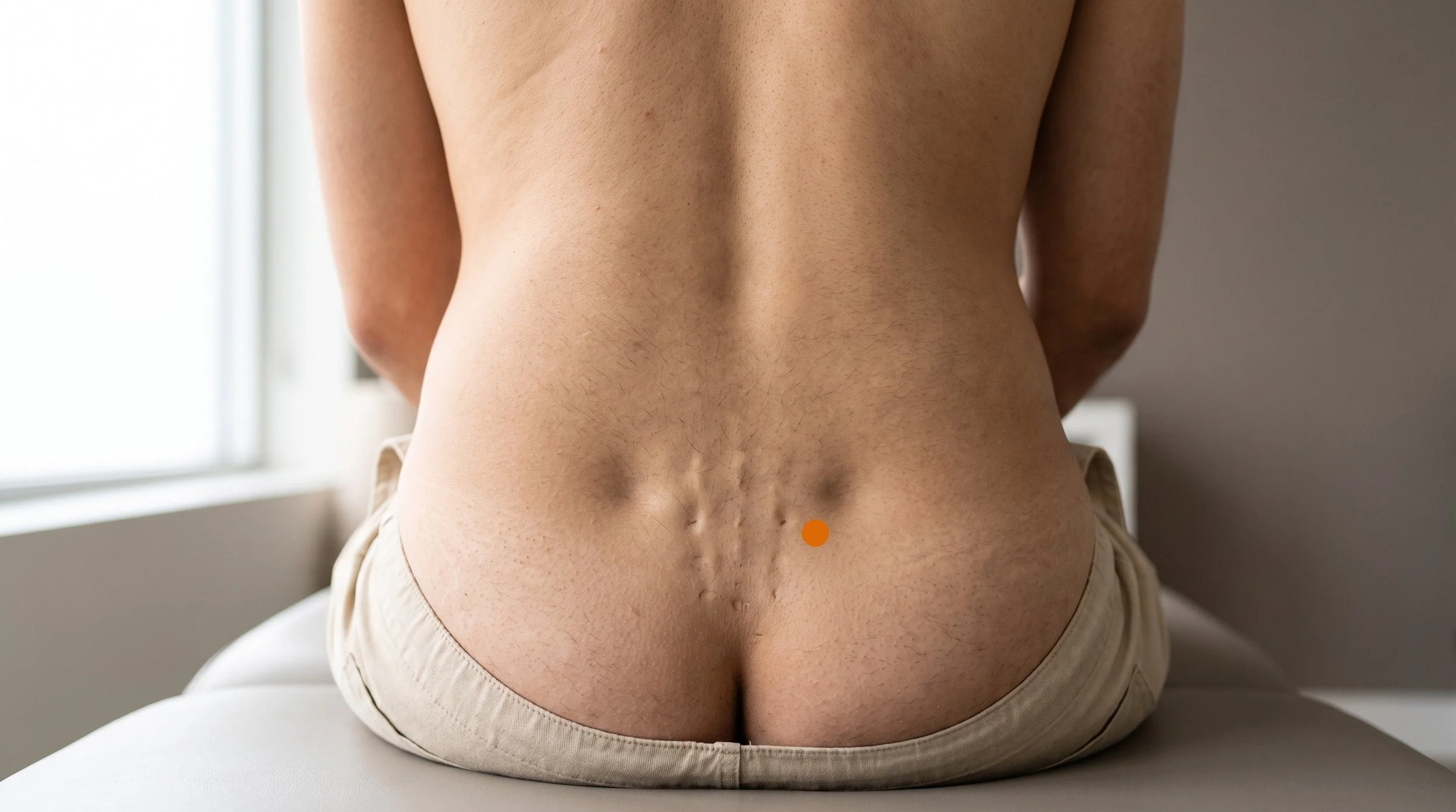
BL29 Acupuncture Point (Zhonglushu)
The Mid-Spine Shu Point on the Sacrum: Anatomy, Segmental Mechanism, and Why BL29 Belongs in Stubborn Low Back and Sacroiliac Cases
BL29 (Zhonglushu), often translated as Mid-Spine Shu, sits on the back of the sacrum, roughly a thumb's width and a half out from the midline at the level of the third posterior sacral foramen, level with BL33.
In plain terms, it's the spot just above and inboard of the dimple-like area at the top of the buttock, where the erector spinae tapers into the sacrum and the upper fibers of gluteus maximus take their origin.
Classical texts group it with the sacral run of the inner Bladder line and credit it with benefiting the lumbar region and warming cold in the intestines. Modern practitioners tend to reach for the bl29 acupuncture point for a narrower and very practical reason: stiff, guarded lumbosacral movement, especially the kind of back that hurts to rotate, and pain that patients localize to the sacroiliac region.
- BL29 lies 1.5 cun lateral to the midline at the level of the third posterior sacral foramen, over dense sacral aponeurosis, deep multifidus fibers, and the origin field of gluteus maximus, with bone directly beneath. Because the inner Bladder line converges toward the midline as it descends, the practical 1.5 cun measurement here is shorter than it is over the lumbar spine (Deadman).
- Classical sources list bladder 29 for stiffness and pain of the lumbar spine with inability to turn, along with cold-pattern diarrhea, dysenteric disorder, abdominal distention, hernia-type (shan) pain, and rib-side pain. These are best read as traditional attributions rather than as diagnostic claims (Deadman).
- Needle sensation at BL29 is usually described as a dull, heavy, spreading ache over the sacrum that can travel laterally into the upper buttock, a presentation consistent with A-delta and C-fiber activation of deep somatic tissue rather than sharp cutaneous pain (Zhao, 2008).
- The local innervation comes from lateral branches of the posterior rami of the third and fourth sacral nerves, with the posterior branches of the lateral sacral vessels and branches of the inferior gluteal vessels supplying the area, which places the point squarely in the S3 to S4 segment that also carries pelvic visceral afferents (Chinese Acupuncture and Moxibustion).
- Research doesn't test BL29 in isolation. It appears inside multi-point lumbosacral protocols, and the broader evidence base for acupuncture in chronic low back pain and sciatica is moderate at best but consistently favorable over no treatment (Mu et al., 2020; Rizzo et al., 2025; Tu et al., 2024).
- In clinic, BL29 is a supporting point rather than a headline point. It's most useful when palpation finds a tender, thickened band at the sacral base and the patient's main complaint is rotational stiffness, and it pairs naturally with dry needling of the gluteal muscles that refer into the same territory (Simons et al., 1999).
Is Your Low Back Stiff Every Time You Turn or Twist?
Rotational stiffness at the sacral base is one of the most common patterns we see, and it rarely responds to stretching alone. At Morningside Acupuncture, we palpate the sacral border carefully and use points like BL29 alongside the lumbar Bladder line to reduce guarding and restore comfortable rotation. Treatments combine traditional acupuncture with targeted needling of the muscles that actually load the area. Schedule a visit and let's find out what's driving the stiffness.
Schedule NowAnatomy of BL29: Why the Third Sacral Foramen Level Is Such an Important Location
Starting at the surface, BL29 passes through thin skin and a variable pad of subcutaneous fat before meeting one of the toughest connective tissue sheets in the body: the aponeurosis where the erector spinae and thoracolumbar fascia anchor onto the dorsal sacrum. Just deep and lateral to that sheet, the upper fibers of gluteus maximus take their origin from the sacrum and the long dorsal sacroiliac ligament, while the deepest slips of multifidus attach to the sacral surface itself.
This is a load transfer zone. Every time you rotate the trunk, push off a leg, or stand up from a low chair, force travels between the spine and the pelvis through exactly this tissue. When it becomes sensitized, patients describe a band of soreness across the sacral base and a distinct reluctance to twist.
The nerve geography explains a lot about how the bl 29 sacrum point behaves. The area is supplied by lateral branches of the posterior rami of the third and fourth sacral nerves (Chinese Acupuncture and Moxibustion), which enter the same segmental levels of the spinal cord that receive afferents from the pelvic viscera and the sacroiliac ligaments. Needling here recruits deep somatic afferents that converge on those dorsal horn neurons, and that convergence is one of the better-supported explanations for why a needle in the sacral wall can change how a diffuse, poorly localized regional pain feels.
Alongside local segmental effects, needle stimulation engages descending pain-modulating pathways from the brainstem and triggers release of endogenous opioid peptides, which helps account for relief that extends beyond the needled segment (Zhao, 2008).
Deep to the point sit the posterior branches of the lateral sacral artery and vein, with contributions from the inferior gluteal vessels, all lying against the periosteum of the dorsal sacrum (Chinese Acupuncture and Moxibustion). The sacral bone plate underneath is the main safety feature: it limits depth and makes this a low-risk location in trained hands. Conventional needling is perpendicular, generally 0.5 to 1 cun in the Deadman description, with other standard texts citing depths closer to 0.8 to 1.2 cun depending on body habitus.
Practitioners who intend to enter a sacral foramen directly, as is done in some pelvic-floor and urinary protocols, use different angulation and depth and additional training. For routine musculoskeletal work, staying over bone is both effective and prudent.
Related Best Acupuncture Points For Back Pain Related Gluteus Maximus Trigger PointsBL29 at a Glance: Classification, Location, and Clinical Use
| Category | Detail |
|---|---|
| Traditional Name | Zhonglushu (Mid-Spine Shu), Bladder 29 |
| Channel Classification | Bladder channel, inner (medial) line of the back, sacral portion (BL29, also written UB29; also called the Urinary Bladder channel) |
| Point Categories | No five-shu, luo, xi-cleft, or extraordinary vessel designation is assigned in the standard texts. Maciocia groups BL29 with the shu-type points of the back that relate to a body region rather than an organ, listing it as the point associated with the sacrum, and Kim's text names it the Mid-Spine Back Transporting Point. Its main classificatory identity is positional: the Bladder channel point level with the third posterior sacral foramen, paired in level with BL33. |
| Precise Location | On the sacrum, 1.5 cun lateral to the posterior midline, level with the third posterior sacral foramen and level with BL33. Note that the inner Bladder line narrows toward the midline as it descends, so the practical 1.5 cun here is shorter than over the lumbar spine. |
| Tissue Stimulated | Sacral aponeurosis of the erector spinae, deep multifidus attachments, the sacral origin field of gluteus maximus, and the fascial envelope described in our overview of fascia and stiffness, with periosteum of the dorsal sacrum beneath |
| Needle Depth / Direction | Perpendicular insertion 0.5 to 1 cun (Deadman); other standard texts cite 0.8 to 1.2 cun. Moxibustion is traditionally applicable. Needle toward bone, not into a foramen, unless specifically trained in sacral foraminal technique. |
| De Qi Sensation | A dull, heavy, spreading ache at the sacral base, sometimes with a sense of pressure or warmth that travels laterally into the upper buttock. Sharp or electric sensation means the needle should be adjusted. |
| Primary Clinical Uses | Lumbosacral stiffness and pain with difficulty turning the trunk, sacroiliac-region pain, gluteal and low back tension. Classical listings add cold-pattern diarrhea, dysenteric disorder, abdominal distention, shan (hernia-type) pain, and lateral costal pain as traditional attributions. |
| Common Point Combinations |
|
The Deadman text assigns Zhonglushu two traditional actions: benefiting the lumbar region and dispelling cold to stop diarrhea. Its headline indication is stiffness and pain of the lumbar spine with an inability to turn the trunk, and the surrounding indication list runs in an unexpected direction, taking in dysenteric disorder, cold lodged in the intestines, shan disorder, abdominal distention, pain along the sides of the ribs, wasting and thirsting disorder attributed to Kidney deficiency, and absence of sweating.
Two classical combinations are recorded there: the Supplementing Life pairing of BL29 with BL23 and BL24 for lumbar pain, and the Song of Points instruction to add BL29 to LI4 and ST36 when dysenteric disorder is severe. Older commentaries also read the point's name literally, taking lu as the paraspinal muscle mass and placing this point where those muscles rise off the sacrum, which is a fair description of what the needle actually meets. What makes the classical pattern striking is the pairing of a purely mechanical complaint, the back that can't rotate, with a set of cold, deep-seated bowel presentations.
Modern anatomy offers a tidy reason why one location might have accumulated both reputations: the sacral segments that innervate this tissue are also the segments that carry pelvic visceral information.
Why BL29 Is Used for Backs That Hurt to Turn Rather Than Backs That Hurt to Bend
Patients often separate their back pain by direction. Some can't bend forward, some can't extend, and a distinct group says the problem shows up when they rotate: reaching into the back seat, turning over in bed, twisting to look behind them. That rotational pattern tends to load the sacral base, where the erector aponeurosis, the deep multifidus, and the sacroiliac ligaments meet. BL29 sits directly over that junction. Needling there stimulates deep somatic afferents in the S3 and S4 segments, which converge in the dorsal horn with input from the sacroiliac ligaments and nearby structures.
When several inputs share the same neurons, a needle in accessible tissue can influence how the whole region is processed, which is part of why local sacral needling often reduces guarding faster than stretching does.
Beyond the segment, needle stimulation activates descending inhibitory systems running from the midbrain and brainstem to the spinal cord, along with release of endogenous opioid peptides, and these mechanisms have been mapped in considerable detail in laboratory work (Zhao, 2008). This is the more general analgesic effect that makes acupuncture useful for pain that isn't neatly localized, and it's the reason distal points are usually added to a local sacral prescription rather than replaced by it.
There's a second, more speculative reason clinicians take the sacral level seriously. The third sacral foramen sits next to the S3 nerve root, the same target used in sacral neuromodulation for bladder symptoms, and acupuncture research has deliberately used the BL33 location at that foramen to study pelvic effects (Wang et al., 2011). BL29 is the surface-level neighbor of that landmark, not a substitute for it, and there's no trial evidence that needling BL29 changes bladder or bowel function.
Still, the shared segmental address is a reasonable modern reading of why classical sources put bowel complaints and back stiffness in the same indication list.
What the Research Shows for BL29
It's worth being straightforward about the evidence: no clinical trial has tested Zhonglushu on its own. Studies of acupuncture for low back and sacral pain use multi-point protocols in which local Bladder channel points, sacral points, and distal points are needled together, so what the research can tell us is whether treatments containing points like this one help, not whether this specific point carries the effect. With that framing, the picture for the conditions BL29 is used for is cautiously positive, with quality of evidence ranging from low to moderate depending on the comparison.
| Study | Type | Focus | Key Finding |
|---|---|---|---|
| Mu et al., 2020 | Cochrane systematic review | Acupuncture for chronic nonspecific low back pain (33 trials, 8270 participants) | Compared with no treatment, moderate-certainty evidence suggested acupuncture improved pain and function, with the difference reaching clinical relevance for pain. |
| Rizzo et al., 2025 | Cochrane overview of reviews | Non-pharmacological and non-surgical treatments for low back pain in adults | Acupuncture was among the non-drug options with supportive evidence for chronic low back pain, though certainty varied across comparisons. |
| Vickers et al., 2018 | Individual patient data meta-analysis | Chronic musculoskeletal pain including back and neck pain (about 20,800 patients) | Acupuncture outperformed both sham and no-acupuncture controls, with effects that persisted over time rather than dissipating quickly. |
| Tu et al., 2024 | Multicenter randomized clinical trial | Chronic sciatica from herniated disk, 216 participants, 10 sessions over 4 weeks | Leg pain and disability improved more with acupuncture than sham, with differences reported through one year of follow-up. |
| Wang et al., 2011 | Randomized controlled trial protocol | Electroacupuncture at BL33, the point level with BL29 at the third sacral foramen | Designed to test point specificity at the sacral foramen level, illustrating research interest in this segment rather than proving an effect at BL29. |
| Zhao, 2008 | Narrative review of mechanism research | Neural mechanisms of acupuncture analgesia | Analgesic effects are attributed to segmental spinal processing, descending inhibitory control, and endogenous opioid release. |
Sacroiliac Pain That Keeps Coming Back?
Pain the patient points to with one finger just beside the sacrum often involves the sacral ligaments, the deep multifidus, and the gluteal origin all at once. Our clinicians use BL29 and the surrounding sacral points as part of a broader plan that includes dry needling, movement retraining, and load management. We track what changes between sessions instead of repeating the same treatment. Book an appointment and get a plan built around your presentation.
Schedule NowBL29 in the Context of Trigger Point Work
At Morningside, acupuncture and dry needling are the same tool applied through different reasoning frameworks, and the sacral base is a place where the two overlap almost exactly. The upper fibers of gluteus maximus originate from the sacrum within a centimeter or two of BL29, and trigger points in that muscle refer pain into the buttock and sacral region in a pattern patients frequently mistake for a joint problem (Simons et al., 1999).
When palpation finds a taut, tender band right at the point location, treating it serves both descriptions at once: it satisfies the classical instruction to needle the sacral Bladder line for stiffness that blocks rotation, and it addresses an identifiable myofascial target.
The gluteus medius and gluteus minimus deserve attention in the same session even though their attachments sit lateral to BL29. Both refer pain into the low back, sacroiliac region, and down the lateral hip and leg, and both are common contributors when a patient reports that their sacral pain also travels (Simons et al., 1999). A typical Morningside treatment for this presentation might use BL29 with neighboring lumbar and sacral points, then move laterally for trigger point needling of the gluteal group, and finish with distal points to broaden the analgesic response. We reassess rotation and single-leg loading before and after so we know whether the needling actually changed the mechanics or only the sensation.
BL29 Low Back and Sacroiliac Treatment at NYC's Highest-Rated Acupuncture Clinic
Morningside Acupuncture is the highest-rated acupuncture and dry needling clinic in New York City with over 500 five-star Google reviews. Our licensed acupuncturists integrate classical point selection, including sacral points like Zhonglushu, with evidence-informed trigger point work for back, hip, and pelvic pain. Every session starts with hands-on assessment so the needles go where the tissue is actually irritable. Schedule your appointment today.
Schedule NowFrequently Asked Questions
What does BL29 feel like when needled?
Most people feel a dull, heavy ache that spreads across the sacral base and sometimes drifts out toward the upper buttock. Because the tissue here is dense fascia and muscle attachment over bone, the sensation tends to be deep and slow to build rather than sharp. A brief pinch on insertion is normal. Electric, radiating, or genuinely sharp sensation isn't, and your acupuncturist should adjust the needle if that happens. Many patients notice a warm, released feeling in the sacrum afterward, and mild residual soreness for a day is common.
Why needle BL29 when my pain feels higher up in my lower back?
Pain location and pain source often differ. The sacral base is where the lumbar extensors and thoracolumbar fascia anchor, so irritability there can register as diffuse lumbar aching, particularly with rotation. Needling BL29 targets that attachment zone and its S3 to S4 segmental inputs, which converge with input from nearby ligaments and joints in the spinal cord (Zhao, 2008). In practice we rarely use it alone. It's typically combined with points higher along the lumbar Bladder line, which is exactly how the classical Supplementing Life grouping of BL29 with BL23 and BL24 was recorded.
Can I press BL29 myself between sessions?
Yes, and it's an easy point to reach. Find the top of your buttock crease region, then trace up along the bony sacrum until your thumb sits about a thumb's width and a half out from the midline, roughly two-thirds of the way down the sacrum. You're looking for a firm, slightly tender spot with bone beneath it. Press with the thumb or a knuckle at moderate pressure, enough to feel a deep ache but not enough to make you tense or hold your breath, and hold for 30 to 60 seconds. Repeat two or three times per side, then gently rotate your trunk a few times to reintroduce the movement. Twice a day is plenty. A tennis ball against a wall works well if reaching behind you is uncomfortable. Skip it over broken or irritated skin, and stop if pressure increases your pain rather than easing it.
Is BL29 safe to needle?
In trained hands it's one of the more forgiving points on the back, because the sacrum lies directly beneath and limits depth. Standard perpendicular insertion of 0.5 to 1 cun stays within the fascial and muscular layers over bone. The main precautions are ordinary ones: clean technique, awareness of the sacral vasculature in the area, extra caution in very thin patients, and additional care with anyone on anticoagulants. Deliberate needling into a sacral foramen is a different technique with different training requirements and isn't part of routine musculoskeletal treatment. Pregnant patients should tell their acupuncturist, since sacral and lumbosacral points are approached differently during pregnancy.
Where exactly is BL29 located?
BL29 is on the sacrum, 1.5 cun lateral to the posterior midline, at the level of the third posterior sacral foramen, which puts it level with BL33. A useful landmark sequence is to find the posterior superior iliac spines, the two bony bumps under the dimples at the top of the buttocks, which sit approximately at the level of the second sacral foramen, then move down one foramen level and inward toward the midline. Remember that the inner Bladder line converges toward the midline over the sacrum, so the working distance here is shorter than the 1.5 cun you'd measure over the lumbar spine (Deadman).
References
- Deadman, P., Al-Khafaji, M., & Baker, K. (2009). A manual of acupuncture. Journal of Chinese Medicine Publications.
- Cheng, X. (Ed.). (1999). Chinese acupuncture and moxibustion (Rev. ed.). Foreign Languages Press.
- Cunningham, P. M. (2000). Acupuncture points: A practical guide to classical and modern usage. Odyssey Press.
- Maciocia, G. (2005). The foundations of Chinese medicine: A comprehensive text for acupuncturists and herbalists (2nd ed.). Elsevier Churchill Livingstone.
- Kim, H. (2008). Handbook of Oriental medicine (3rd ed.). Harmony & Balance Press.
- Simons, D. G., Travell, J. G., & Simons, L. S. (1999). Travell & Simons' myofascial pain and dysfunction: The trigger point manual, Vol. 1: Upper half of body (2nd ed.). Williams & Wilkins.
- Mu, J., Furlan, A. D., Lam, W. Y., Hsu, M. Y., Ning, Z., & Lao, L. (2020). Acupuncture for chronic nonspecific low back pain. Cochrane Database of Systematic Reviews, 2020(12), CD013814. https://doi.org/10.1002/14651858.CD013814
- Rizzo, R. R. N., Cashin, A. G., Wand, B. M., Ferraro, M. C., Sharma, S., Lee, H., O'Hagan, E., Maher, C. G., Furlan, A. D., van Tulder, M. W., & McAuley, J. H. (2025). Non-pharmacological and non-surgical treatments for low back pain in adults: An overview of Cochrane reviews. Cochrane Database of Systematic Reviews, 3(3), CD014691. https://doi.org/10.1002/14651858.CD014691.pub2
- Vickers, A. J., Vertosick, E. A., Lewith, G., MacPherson, H., Foster, N. E., Sherman, K. J., Irnich, D., Witt, C. M., & Linde, K. (2018). Acupuncture for chronic pain: Update of an individual patient data meta-analysis. Journal of Pain, 19(5), 455-474. https://doi.org/10.1016/j.jpain.2017.11.005
- Tu, J. F., Shi, G. X., Yan, S. Y., Ni, G. X., Yu, F. T., Cai, G. W., Liu, Z. S., Ma, C. Y., Wang, L. Q., Yang, J. W., Zhou, X. Q., Meng, X. L., Fu, H. Y., Li, J., Wan, W. J., Sun, T. H., Wang, X. Z., & Liu, C. Z. (2024). Acupuncture vs sham acupuncture for chronic sciatica from herniated disk: A randomized clinical trial. JAMA Internal Medicine, 184(12), 1417-1424. https://doi.org/10.1001/jamainternmed.2024.5463
- Wang, Y., Liu, Z., Yu, J., Ding, Y., & Liu, X. (2011). Efficacy of electroacupuncture at Zhongliao point (BL33) for mild and moderate benign prostatic hyperplasia: Study protocol for a randomized controlled trial. Trials, 12, 211. https://doi.org/10.1186/1745-6215-12-211
- Zhao, Z. Q. (2008). Neural mechanism underlying acupuncture analgesia. Progress in Neurobiology, 85(4), 355-375. https://doi.org/10.1016/j.pneurobio.2008.05.004
Disclaimer: This web site is intended for educational and informational purposes only. Reading this website does not constitute providing medical advice or any professional services. This information should not be used for diagnosing or treating any health issue or disease. Those seeking medical advice should consult with a licensed physician. Seek the advice of a medical doctor or other qualified health professional for any medical condition. If you think you have a medical emergency, call 911 or go to the emergency room. No acupuncturist-patient relationship is created by reading this website or using the information. Morningside Acupuncture PLLC and its employees and contributors do not make any express or implied representations with respect to the information on this site or its use. For any legal interpretation of scope of practice in your state, consult a licensed attorney or regulatory authority.
Read more from our blog



