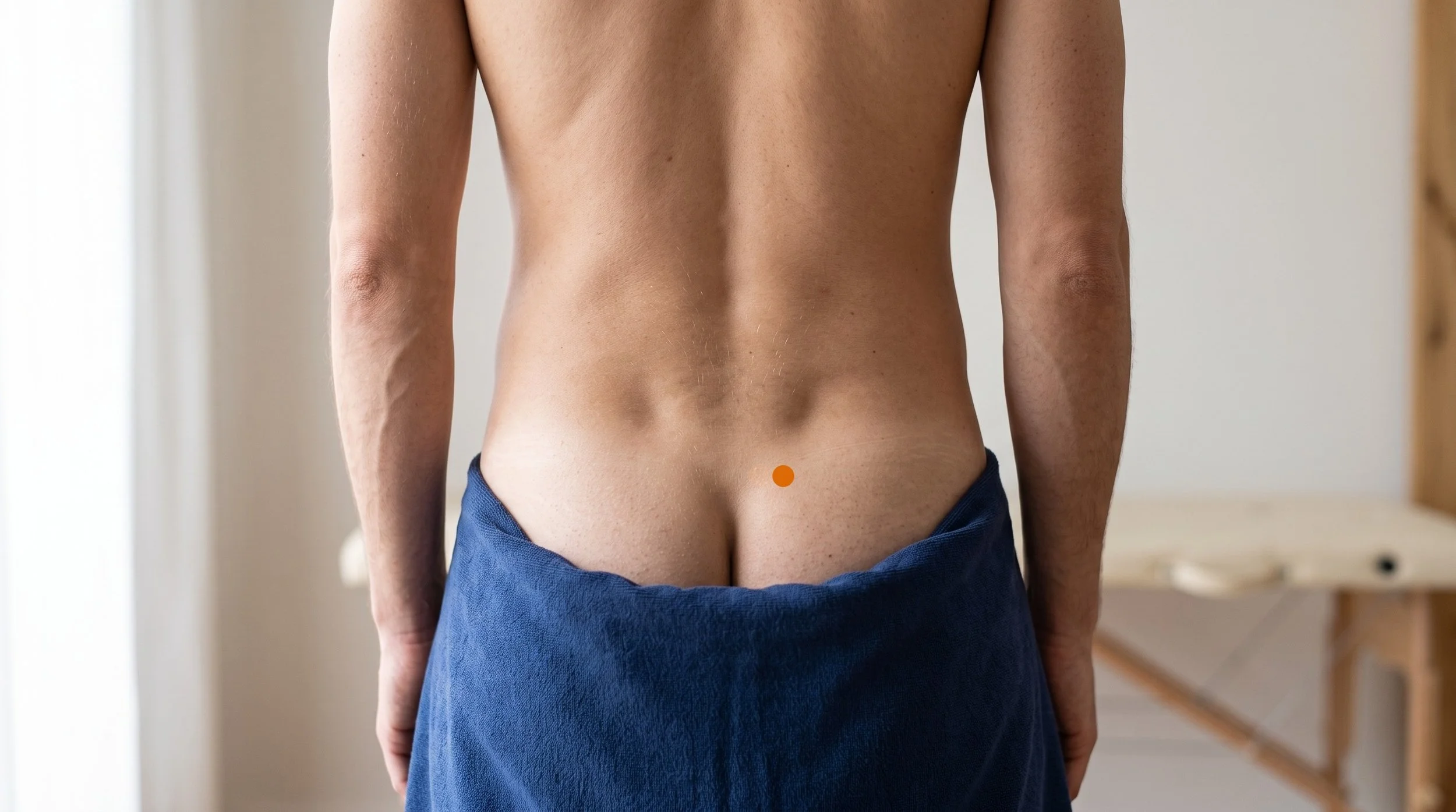
BL30 Acupuncture Point (Baihuanshu)
The White Ring Transport Point at the Base of the Sacrum: Anatomy, Sacral Nerve Mechanism, and Why BL30 Anchors Tailbone, Low Back, and Pelvic Floor Treatment
BL30, known in Chinese as Baihuanshu and usually translated as White Ring Shu, is the last point on the inner line of the Bladder channel before it crosses the buttock. You will find it low on the sacrum, roughly a thumb's width and a half out from the midline at the level of the fourth posterior sacral foramen, sitting level with BL34 in the eight sacral foramen points (Deadman et al., 2007).
That address matters clinically: the needle lands in the S4 territory, over the sacral origin of gluteus maximus and close to the connective tissue that anchors the pelvis, in a segment that also supplies the pelvic floor, bladder neck, and anorectal region.
For patients, that translates into a point we reach for when pain sits at the very bottom of the back, when sitting is the worst position of the day, or when low back complaints travel with pelvic floor and menstrual symptoms.
- BL30 (Baihuanshu, bladder 30) lies 1.5 cun lateral to the midline at the level of the fourth posterior sacral foramen, level with BL34, and is the lowest point of the inner Bladder line on the back (Deadman et al., 2007). Because the inner line converges toward the midline as it descends, the 1.5 cun measurement here is functionally shorter than it is over the lumbar spine.
- Under the skin the needle passes through subcutaneous tissue and gluteal fascia into the sacral origin of gluteus maximus, near where the sacrotuberous ligament anchors to the lower sacrum, a region long treated for sacral, buttock, and coccyx pain (Cunningham).
- Chinese texts place BL30 in the field of the lateral branches of the posterior rami of the third and fourth sacral nerves and the inferior gluteal nerve, with the inferior gluteal and, deeper, internal pudendal vessels in the neighborhood (Chinese Acupuncture and Moxibustion). This is the same S3 to S4 outflow that serves the pelvic floor and pudendal territory.
- Traditional actions attributed to the point (benefiting the lumbar region and legs, regulating menstruation, and stopping discharge and seminal emission) map reasonably well onto segmental physiology: stimulation of a somatic field that converges with pelvic visceral afferents in the sacral cord, plus recruitment of descending inhibitory pathways that damp nociceptive traffic more broadly (Zhao, 2008).
- The research picture is indirect but useful: acupuncture protocols for chronic low back pain show modest benefit over sham and usual care (Mu et al., 2020; Vickers et al., 2018), and sacral point protocols have been tested for pelvic conditions, including a small controlled trial in which needling at BL30 and BL35 improved chronic prostatitis and pelvic pain scores compared with a standard needling approach (Zhou et al., 2017).
- De qi at the bl 30 sacrum position is typically a deep, heavy ache that spreads across the lower sacrum and into the buttock, sometimes drifting toward the tailbone or the pelvic floor. Standard depth is perpendicular insertion of about 0.5 to 1 cun, and some classical sources forbid moxibustion at this point (Deadman et al., 2007).
Tailbone or Low Sacral Pain That Gets Worse the Longer You Sit?
Pain at the very base of the spine tends to be poorly served by generic back care, because the tissues involved are the sacral attachments, the deep gluteal layer, and the pelvic floor. At Morningside Acupuncture we use BL30 alongside the sacral foramen points and targeted dry needling of the gluteal muscles to calm that region and improve sitting tolerance. Treatment is paired with practical loading and positioning advice so gains carry over between visits. Schedule a visit and let us assess what is actually driving your tailbone pain.
Schedule NowAnatomy of BL30: Why the Lower Sacrum Beside the Fourth Sacral Foramen Is Such an Important Location
The surface landmark is straightforward once the sacral foramina are found: BL30 sits just lateral to the midline at the level of the fourth posterior sacral foramen, level with BL34 (Deadman et al., 2007). Under the fingertip there is skin, a variable layer of subcutaneous fat, then gluteal fascia, then the fibers of gluteus maximus where they take origin from the lower sacrum and the adjacent ligamentous sheet, with the sacrotuberous ligament anchoring nearby (Cunningham).
These tissues are loaded every time you shift weight in a chair, stand up from sitting, climb stairs, or brace during lifting, which is why the area becomes tender in people with prolonged sitting jobs, post-fall tailbone pain, postpartum pelvic pain, and stubborn sacroiliac complaints.
Neurologically, this is S3 and S4 country. Chinese anatomical descriptions place BL30 in the field of the lateral branches of the posterior rami of the third and fourth sacral nerves along with the inferior gluteal nerve (Chinese Acupuncture and Moxibustion), and the same sacral levels give rise to the pudendal nerve and the parasympathetic supply to the bladder, distal bowel, and reproductive organs. Somatic input from a needle at this level enters dorsal horn segments where pelvic visceral afferents also terminate, so stimulation here can influence how the cord processes signals arriving from deeper structures.
On top of that segmental effect, needling activates ascending pathways that engage brainstem descending inhibition, with endogenous opioid and monoamine systems contributing to reduced pain transmission (Zhao, 2008). Clinically, that is the plausible reason a point over the lower sacrum can ease both the local ache and complaints that feel deeper in the pelvis.
Deeper still, the region is supplied by the inferior gluteal artery and vein, with the internal pudendal vessels further in (Chinese Acupuncture and Moxibustion), which is exactly why needling conventions here are conservative. The usual technique is a perpendicular insertion of about 0.5 to 1 cun, with Chinese texts commonly citing 0.8 to 1.2 cun, and the bony sacral surface itself acts as a natural backstop that limits depth. Some classical sources forbid moxibustion at this point, an unusual restriction worth respecting even though modern practice varies (Deadman et al., 2007).
Sensible practice means angling the needle over bone rather than laterally toward the greater sciatic notch, using clean technique, and adjusting depth for body habitus.
Related Best Acupuncture Points For Back Pain Related Gluteus Maximus Trigger PointsBL30 at a Glance: Classification, Location, and Clinical Use
| Category | Detail |
|---|---|
| Traditional Name | Baihuanshu, White Ring Shu (BL30, bladder 30) |
| Channel Classification | Bladder channel of Foot Taiyang, inner (first) line on the back, the lowest inner-line point before the channel crosses the buttock (BL30, also written UB30; also called the Urinary Bladder channel) |
| Point Categories | No five-shu, luo, xi-cleft, or extraordinary vessel intersection is attributed to this point in the standard references. It is grouped with the sacral back points and sits level with BL34; some texts describe it in the back transporting series as the point associated with the anus (Maciocia's channel discussion), and later commentary treats it as a back point for the anal and gluteal region (Cunningham). |
| Precise Location | On the sacrum, 1.5 cun lateral to the posterior midline at the level of the fourth posterior sacral foramen, level with BL34. The inner Bladder line narrows toward the midline as it descends, so the 1.5 cun here is a relatively short measurement. |
| Tissue Stimulated | Skin and subcutaneous tissue over the lower sacrum, gluteal fascia, and the sacral origin of gluteus maximus near the sacrotuberous ligament attachment; functionally related to the gluteus maximus and pelvic floor myofascial regions |
| Needle Depth / Direction | Perpendicular insertion 0.5 to 1 cun (Chinese texts commonly list 0.8 to 1.2 cun), directed over the sacral surface rather than laterally; some classical sources forbid moxibustion here |
| De Qi Sensation | Deep, heavy, dull ache spreading across the lower sacrum and into the buttock, occasionally drifting toward the coccyx or pelvic floor; sharp or electric sensation means the needle should be adjusted |
| Primary Clinical Uses | Sacral and tailbone-region pain, low back and hip pain with difficulty sitting and standing, gluteal and sacroiliac complaints, and, in classical and modern use, menstrual irregularity and pelvic floor symptoms |
| Common Point Combinations |
|
In A Manual of Acupuncture, Deadman and colleagues present BL30 first and foremost as a local point for the lower back, sacrum, and hip, with a particular reputation for pain at the coccyx, along with the difficulty sitting and standing that goes with it (Deadman et al., 2007).
The classical actions attributed to the point are described as benefiting the lumbar region and legs, regulating menstruation, and stopping leucorrhoea and seminal emission, and the classical indication lists cluster into three groups: painful and stiff conditions of the low back, sacrum, hip, and legs; menstrual and fertility complaints; and what the tradition calls leakage, meaning discharges, turbid urine, and difficulty controlling bowel and bladder.
Later commentators added texture to the name itself, reading white ring as a reference to something precious, a jade or gold ring, while also noting the obvious link to the white discharges the point was said to treat (Cunningham).
What is striking is the coherence of that traditional pattern with modern anatomy: a point sited over S4 tissue was credited, centuries before segmental neurology existed, with governing precisely the low back, tailbone, anorectal, and pelvic functions that share that sacral level.
Why BL30 Is Used for Pelvic Floor Symptoms and Pain That Only Shows Up When You Sit
The first half of the explanation is segmental. Sensory nerves from the skin and muscle over the lower sacrum, from the pelvic floor muscles, and from pelvic organs all report into the same narrow band of spinal cord around S3 and S4. When several inputs converge on shared neurons, strong, sustained stimulation of the accessible somatic input can change how that pool of neurons responds, which is the same principle behind sacral neuromodulation in urology.
This is why a point on the back of the sacrum is used for complaints that patients feel in front, underneath, or deep inside, and why the classical indications for BL30 spanned back pain, bowel and bladder difficulty, and menstrual problems rather than staying tidily in one category.
The second half is systemic. Needle stimulation that produces genuine de qi recruits ascending signaling that activates brainstem structures such as the periaqueductal gray and rostral ventromedial medulla, which in turn release endogenous opioids, serotonin, and noradrenaline onto the dorsal horn and reduce pain transmission (Zhao, 2008). Local effects are also relevant at this site, since needling into the gluteal origin and sacral fascia may reduce muscle guarding and improve local blood flow in tissue that has been compressed and shortened by long hours of sitting.
There is also point-specific clinical work worth mentioning honestly. A randomized pilot study in men with chronic prostatitis and chronic pelvic pain syndrome compared deeper long-needle stimulation at BL30 and BL35 against a conventional needling approach at the same points and reported greater improvement in symptom index scores in the long-needle group at two weeks and at twenty-four weeks (Zhou et al., 2017).
It was a small single-center trial with an active comparator rather than a sham, so it is best read as supportive rather than conclusive, but it does suggest that depth and sensation at this location influence the outcome.
What the Research Shows for BL30
It is important to be clear about what the evidence can and cannot say. There are no large trials testing BL30 in isolation, and almost every study of acupuncture for low back or pelvic complaints uses multi-point protocols in which this point is one contributor among several, often alongside the sacral foramen points and lumbar back points. What the literature supports is the reasonableness of the overall approach: needling protocols that include sacral and lumbar points produce modest but measurable improvements for several conditions BL30 is traditionally used to treat.
Individual response still varies, and the honest framing for patients is that this point is a well-chosen component of a plan, not a treatment on its own.
| Study | Type | Focus | Key Finding |
|---|---|---|---|
| Mu et al., 2020 | Cochrane systematic review | Acupuncture for chronic nonspecific low back pain | Acupuncture appeared to produce small improvements in pain and function compared with sham and no treatment, though the certainty of the evidence was limited. |
| Vickers et al., 2018 | Individual patient data meta-analysis | Acupuncture across chronic pain conditions, including back and neck pain | Effects were superior to both sham and usual care and persisted over time, supporting a role beyond expectation alone. |
| Zhou et al., 2017 | Randomized controlled pilot trial | Needling at BL30 and BL35 for chronic prostatitis and chronic pelvic pain syndrome | Deeper long-needle stimulation at these two points was associated with better symptom index scores than conventional needling, in a small single-center sample. |
| Liu et al., 2017 | Multicenter randomized clinical trial | Electroacupuncture at sacral points for female stress urinary incontinence | Six weeks of electroacupuncture at sacral points reduced urine leakage more than sham, indicating that sacral segment stimulation may influence pelvic floor function. |
| Smith et al., 2016 | Cochrane systematic review | Acupuncture and acupressure for primary dysmenorrhoea | Some trials reported reduced menstrual pain, but the quality of evidence was low and the reviewers called for better designed studies. |
| Zhao, 2008 | Narrative review of mechanisms | Neural pathways underlying acupuncture analgesia | Analgesic effects are attributed to segmental spinal modulation together with descending inhibition mediated by opioid and monoamine systems. |
Low Back Pain That Travels With Pelvic or Menstrual Symptoms?
Many patients describe a lower back that flares in the same week their cycle or pelvic symptoms flare, which is unsurprising given how much sacral segmental territory those systems share. Our clinicians combine BL30 with points such as SP6, CV4, and the sacral foramen points, adjusting the plan to your cycle and your pain pattern. Sessions are unhurried, and progress is tracked visit by visit. Book an appointment to build a plan that addresses both sides of the picture.
Schedule NowBL30 in the Context of Trigger Point Work
Acupuncture, as we define it, is the use of an acupuncture needle, and that includes the hundreds of styles practiced worldwide as well as dry needling. At BL30 the two frameworks overlap almost perfectly, because the classical point sits in the sacral origin of gluteus maximus, a muscle whose taut bands can refer pain into the sacrum, the buttock, and occasionally toward the tailbone (Simons et al., 1999).
When a patient's chief complaint is pain at the base of the back that worsens with prolonged sitting or with standing up from a chair, we routinely needle the point location itself and then examine the surrounding gluteal tissue for tender bands that reproduce the familiar ache.
In practice, BL30 is rarely used alone. A typical Morningside session for this presentation might combine needling at the point with dry needling of gluteus maximus, gluteus medius, and gluteus minimus, the last two being frequent contributors to pain that spreads down the outer hip and leg, plus quadratus lumborum and the lumbar paraspinals when the low back is also involved.
For patients whose symptoms include pelvic floor tension, urinary urgency, or pain with sitting that feels deeper than the bone, we coordinate this work with pelvic floor assessment and, when appropriate, referral, since sacral needling is a useful adjunct rather than a substitute for pelvic floor rehabilitation.
BL30 Sacral and Pelvic Pain Treatment at NYC's Highest-Rated Acupuncture Clinic
Morningside Acupuncture is the highest-rated acupuncture and dry needling clinic in New York City with over 500 five-star Google reviews, and our practice is built around musculoskeletal and pelvic complaints that other approaches have not resolved. We treat the white ring shu point in context, meaning a full assessment of the sacroiliac region, gluteal muscles, and pelvic floor before a single needle goes in. Every plan blends acupuncture, dry needling, and clear home strategy. Schedule your session and get started this week.
Schedule NowFrequently Asked Questions
What does BL30 feel like when needled?
Most people describe a deep, heavy, slightly spreading ache rather than anything sharp. The sensation often stays in the lower sacrum and buttock, and some patients notice it drifting toward the tailbone or downward into the pelvic floor region. That spreading quality is what practitioners call de qi, and it usually settles into a warm, released feeling within a minute or two. Sharp, burning, or electric sensations are a signal to reposition the needle, so tell your clinician immediately if you feel them.
Why needle the back of the sacrum for symptoms I feel deep in the pelvis?
Because they share a spinal address. The tissues under BL30 are supplied from the third and fourth sacral levels, and those same segments carry sensory information from the pelvic floor, bladder, and anorectal region, so the inputs converge in a small stretch of spinal cord (Chinese Acupuncture and Moxibustion; Zhao, 2008). Stimulating the accessible somatic input can alter how that shared pool of neurons processes signals from deeper structures, which is the same reasoning behind sacral neuromodulation approaches in medicine. Classical texts arrived at a similar conclusion through observation, listing bowel, bladder, and gynecological indications for a point on the back of the sacrum (Deadman et al., 2007).
Can I press BL30 myself between sessions?
Yes, and it is one of the easier points to self-treat. Lie on your side or sit leaning forward, find the flat bony plate of the sacrum, and slide your thumb from the midline about one thumb's width and a half to the side, working low, near the bottom third of the sacrum. Press with your thumb or a soft massage ball against a wall, using firm but comfortable pressure, and hold for thirty to sixty seconds per side while breathing slowly. Repeat two or three rounds, once or twice a day, and stop if pressure produces numbness, tingling, or radiating leg symptoms. Acupressure here is a reasonable maintenance tool between visits, not a replacement for treatment or for a proper diagnosis of persistent tailbone or pelvic pain.
Is BL30 safe to needle?
In trained hands it is a low-risk point. The sacrum lies directly beneath it, so bone limits how deep a needle can travel, and standard technique is a perpendicular insertion of roughly 0.5 to 1 cun, with Chinese texts commonly citing 0.8 to 1.2 cun (Deadman et al., 2007). The main considerations are angling the needle over the sacral surface rather than laterally toward the greater sciatic notch, respecting the inferior gluteal and deeper pudendal vessels in the region, and using clean technique (Chinese Acupuncture and Moxibustion). Some classical sources forbid moxibustion at this point, which many practitioners still observe. Tell your clinician if you are pregnant, taking blood thinners, or have had sacral surgery or hardware, since these change how the area is approached.
Where exactly is BL30 located?
BL30 sits on the sacrum, 1.5 cun lateral to the posterior midline at the level of the fourth posterior sacral foramen, level with BL34 (Deadman et al., 2007). To find it, locate the flat triangular sacrum below the lumbar spine, identify the sacral foramina line, then move to the lowest of the four levels and measure just over a thumb's width out to the side. Keep in mind that the inner Bladder line converges toward the midline as it descends, so the 1.5 cun measurement here is proportionally shorter than the same measurement over the lumbar spine, and the point ends up closer to the midline than people expect.
References
- Deadman, P., Al-Khafaji, M., & Baker, K. (2009). A manual of acupuncture. Journal of Chinese Medicine Publications.
- Cheng, X. (Ed.). (1999). Chinese acupuncture and moxibustion (Rev. ed.). Foreign Languages Press.
- Cunningham, P. M. (2000). Acupuncture points: A practical guide to classical and modern usage. Odyssey Press.
- Maciocia, G. (2006). The channels of acupuncture: Clinical use of the secondary channels and eight extraordinary vessels. Churchill Livingstone Elsevier.
- Simons, D. G., Travell, J. G., & Simons, L. S. (1999). Travell & Simons' myofascial pain and dysfunction: The trigger point manual, Vol. 1: Upper half of body (2nd ed.). Williams & Wilkins.
- Mu, J., Furlan, A. D., Lam, W. Y., Hsu, M. Y., Ning, Z., & Lao, L. (2020). Acupuncture for chronic nonspecific low back pain. Cochrane Database of Systematic Reviews, 2020(12), CD013814. https://doi.org/10.1002/14651858.CD013814
- Vickers, A. J., Vertosick, E. A., Lewith, G., MacPherson, H., Foster, N. E., Sherman, K. J., Irnich, D., Witt, C. M., & Linde, K. (2018). Acupuncture for chronic pain: Update of an individual patient data meta-analysis. Journal of Pain, 19(5), 455-474. https://doi.org/10.1016/j.jpain.2017.11.005
- Zhou, M., Yang, M., Chen, L., Yu, C., Zhang, W., Ji, J., Chen, C., Shen, X., & Ying, J. (2017). The effectiveness of long-needle acupuncture at acupoints BL30 and BL35 for CP/CPPS: A randomized controlled pilot study. BMC Complementary and Alternative Medicine, 17, 263. https://doi.org/10.1186/s12906-017-1768-2
- Liu, Z., Liu, Y., Xu, H., He, L., Chen, Y., Fu, L., Li, N., Lu, Y., Su, T., Sun, J., Wang, J., Yue, Z., Zhang, W., Zhao, J., Zhou, Z., Wu, J., Zhou, K., Ai, Y., Zhou, J., ... Liu, B. (2017). Effect of electroacupuncture on urinary leakage among women with stress urinary incontinence: A randomized clinical trial. JAMA, 317(24), 2493-2501. https://doi.org/10.1001/jama.2017.7220
- Smith, C. A., Armour, M., Zhu, X., Li, X., Lu, Z. Y., & Song, J. (2016). Acupuncture for dysmenorrhoea. Cochrane Database of Systematic Reviews, 2016(4), CD007854. https://doi.org/10.1002/14651858.CD007854.pub3
- Zhao, Z. Q. (2008). Neural mechanism underlying acupuncture analgesia. Progress in Neurobiology, 85(4), 355-375. https://doi.org/10.1016/j.pneurobio.2008.05.004
Disclaimer: This web site is intended for educational and informational purposes only. Reading this website does not constitute providing medical advice or any professional services. This information should not be used for diagnosing or treating any health issue or disease. Those seeking medical advice should consult with a licensed physician. Seek the advice of a medical doctor or other qualified health professional for any medical condition. If you think you have a medical emergency, call 911 or go to the emergency room. No acupuncturist-patient relationship is created by reading this website or using the information. Morningside Acupuncture PLLC and its employees and contributors do not make any express or implied representations with respect to the information on this site or its use. For any legal interpretation of scope of practice in your state, consult a licensed attorney or regulatory authority.
Read more from our blog



