BL31 Acupuncture Point (Shangliao)
The Upper Crevice of the Sacrum: Anatomy, Mechanism, and Why the First Sacral Foramen Anchors Low Back and Pelvic Treatment
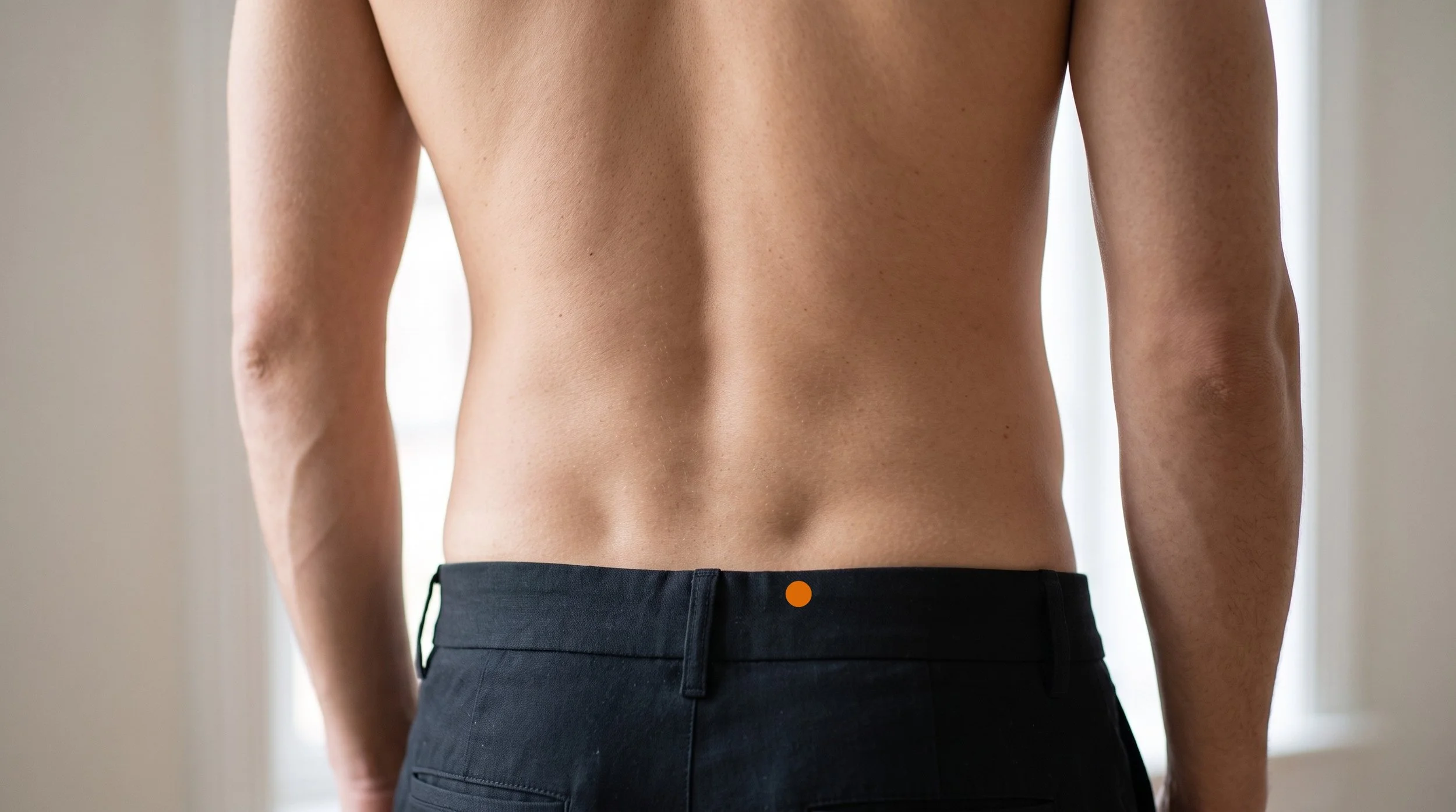
BL31, known in Chinese as Shangliao and usually translated as Upper Crevice, sits directly over the first posterior sacral foramen, roughly midway between the dimple of the posterior superior iliac spine and the midline of the sacrum. It is the uppermost of the eight liao (BL31 through BL34 on each side), the four paired openings in the back of the sacrum that acupuncturists have used for centuries to treat the lower abdomen, the pelvis, and the lumbosacral spine.
What makes the bl31 acupuncture point clinically interesting is that a classical map and a modern anatomy chart agree almost exactly here: needling at bladder 31 places the needle tip over a bony opening that transmits the dorsal ramus of the S1 nerve, in a region where lumbosacral musculoskeletal pain, urinary function, bowel function, and menstrual pain all share segmental territory.
- Location and layers: bl 31 sacrum needling passes through skin and subcutaneous fascia into the aponeurosis of the erector spinae and the sacral fibers of multifidus, with the origin of gluteus maximus lateral to it and the first posterior sacral foramen underneath. This is a dense, ligamentous, load-bearing region rather than a soft muscular one, so the needle sensation is usually deep and heavy.
- Traditional attribution, modern translation: classical texts describe BL31 as regulating the lower jiao, easing urination and defecation, regulating menstruation, and benefiting the lumbar region and legs. Read neurophysiologically, that list simply reflects the sacral segments this point overlies, since bladder, bowel, uterus, pelvic floor, and lumbosacral joints share afferent input at the same spinal levels (Zhao, 2008).
- Channel status: A Manual of Acupuncture lists BL31 as a meeting point of the Bladder and Gallbladder channels, and channel texts describe a Gallbladder branch crossing the sacrum through the eight liao, which is one reason the point is grouped with lateral hip and leg complaints as well as pelvic ones.
- Mechanism: needling near the S1 foramen stimulates dorsal ramus afferents and, with deeper foraminal insertion, sacral root territory, producing segmental inhibition at the dorsal horn along with descending pain modulation from brainstem circuits (Zhao, 2008). Sacral electroacupuncture is best understood as a form of peripheral neuromodulation rather than direct treatment of an organ.
- Research picture: reviews and trials test whole protocols rather than single points, and BL31 typically appears inside sacral or lumbosacral formulas. Acupuncture shows small to moderate benefits over sham and more meaningful benefits versus no treatment for chronic pain (Vickers et al., 2018; Mu et al., 2020), while sacral-region electroacupuncture has been studied for urinary leakage in women (Liu et al., 2017) and acupuncture for chronic pelvic pain syndrome in men (Sun et al., 2021).
- What patients feel: de qi at bl31 is typically a deep, dull, spreading ache or pressure in the sacrum that can travel into the buttock, occasionally down the back of the thigh, and sometimes toward the perineum when the needle reaches the foramen. It should feel heavy and diffuse, never sharp, electric, or lingering.
Sacral Pain, Period Pain, or Pelvic Tension That Will Not Settle?
BL31 is one of the first places we look when low back pain sits low and central, when menstrual cramps radiate into the sacrum, or when pelvic floor tension shows up alongside back symptoms. Our acupuncturists palpate the sacral foramina before needling, because the useful spot is usually the one that reproduces your familiar ache. We combine the eight liao region with lumbar segmental needling and, where appropriate, gentle electroacupuncture. Schedule a visit and we will map exactly where your pain is coming from.
Schedule NowAnatomy of BL31: Why the First Sacral Foramen Is Such an Important Location
At the surface, BL31 lies over the upper sacrum, roughly between the dimple marking the posterior superior iliac spine and the midline crest. Under the skin and subcutaneous tissue sits the tough aponeurosis of the erector spinae, then the sacral portion of multifidus, with the origin of gluteus maximus just lateral and the long posterior sacroiliac ligament nearby. These tissues take load every time you stand, hinge, carry, or sit for hours, and they stiffen in people who spend long days at a desk. That is a common reason the upper crevice point feels tender long before anyone has looked at it on an imaging report.
Directly beneath the point is the first posterior sacral foramen, which transmits the dorsal ramus of the S1 nerve, with the S1 root itself deeper in the sacral canal. Needling here stimulates cutaneous, muscular, and nerve trunk afferents that enter the cord at the same segments that receive input from the sacroiliac joint, the lower lumbar structures, the pelvic floor, and pelvic viscera.
Because those inputs converge on shared dorsal horn neurons, stimulation at one site can modulate excitability for the whole neighborhood, and repeated stimulation also recruits descending inhibitory pathways and endogenous opioid mechanisms (Zhao, 2008). This convergence, rather than anything mystical, is why one sacral point shows up in both back pain and pelvic protocols.
Deep to the sacrum sit the sacral venous plexus and pelvic contents, so depth discipline matters. Standard texts describe perpendicular insertion of about 0.5 to 1 cun, or 1.5 to 2 cun when the needle is threaded into the foramen with a slight medial and inferior angle, which is the technique used when a practitioner wants stronger sacral nerve stimulation. Notably, some classical sources forbid moxibustion at BL31 even though the eight liao are moxaed as a group elsewhere in the literature. In practice we adjust depth for body habitus, avoid forcing a needle against bone, and reserve deep foraminal technique for clear indications.
Related Multifidus Trigger Points Related Acupuncture For Low Back PainBL31 at a Glance: Classification, Location, and Clinical Use
| Category | Detail |
|---|---|
| Traditional Name | Shangliao (Upper Crevice), BL31, also written Bladder 31 or BL-31 |
| Channel Classification | Bladder channel of Foot Taiyang, sacral region; uppermost of the eight liao (Baliao, BL31 through BL34) (BL31, also written UB31; also called the Urinary Bladder channel) |
| Point Categories | Meeting point of the Bladder and Gallbladder channels; member of the eight liao group over the posterior sacral foramina; no five-shu or hui-meeting designation |
| Precise Location | On the sacrum, over the first posterior sacral foramen, approximately between the posterior superior iliac spine and the posterior midline, level with BL27 |
| Tissue Stimulated | Skin and subcutaneous fascia, erector spinae aponeurosis, sacral fibers of multifidus, the origin of gluteus maximus laterally, and the S1 dorsal ramus within the first foramen; functionally linked to pelvic floor musculature |
| Needle Depth / Direction | Perpendicular 0.5 to 1 cun, or 1.5 to 2 cun into the foramen with a slightly medial and inferior angle; some classical sources forbid moxibustion at this point |
| De Qi Sensation | Deep, heavy, spreading ache or pressure in the sacrum, sometimes radiating into the buttock or thigh, occasionally toward the perineum with foraminal needling |
| Primary Clinical Uses | Low back and sacral pain, menstrual cramps and irregular cycles, difficult urination and defecation in classical use, pelvic floor complaints in modern practice |
| Common Point Combinations |
|
A Manual of Acupuncture presents BL31 as a meeting point of the Bladder and Gallbladder channels and lists a set of traditional actions that all point downward: regulating the lower jiao, easing urination and defecation, regulating menstruation and reducing vaginal discharge, and benefiting the lumbar region and legs.
The classical indications gathered there cluster into three groups, urinary and bowel difficulty, a long gynecologic and reproductive list including painful or irregular periods and discharge, and lumbar pain with cold or aching in the back and knees, plus a few scattered systemic entries such as vomiting and febrile presentations. Older texts also record BL31 as part of the eight liao, treated together with moxibustion in the Thousand Ducat Formulas, while some sources separately caution against moxa at this specific point.
What is striking is the coherence of the pattern: without any knowledge of sacral nerve roots, classical authors assembled an indication list that maps neatly onto the organs and structures innervated from the sacral segments beneath the needle.
Why BL31 Is Used for Bladder, Bowel, and Menstrual Complaints and Not Just Back Pain
Patients often ask why a point on the back of the sacrum would be chosen for period pain or urinary symptoms. The answer is segmental. The sacral roots that pass beneath and around the eight liao supply the pelvic floor, the bladder and its sphincters, the rectum, and, through pelvic and hypogastric pathways, the uterus. Sensory information from these structures converges with input from skin, ligament, and muscle in the same spinal segments, so needling the sacrum lands in the same neural neighborhood as the symptoms (Zhao, 2008). That is also why sacral pain and pelvic symptoms so often travel together in the same patient.
On top of segmental effects, repeated needling engages descending inhibitory control from the midbrain and brainstem, along with endogenous opioid and other neurochemical mechanisms that reduce how strongly pain signals are amplified in the cord (Zhao, 2008). Pooled patient-level data across chronic pain conditions suggest that these effects are real but modest compared with sham needling, and larger compared with no acupuncture at all, with benefits that persist reasonably well over time (Vickers et al., 2018).
For pelvic conditions specifically, sacral-region electroacupuncture reduced urinary leakage compared with sham in a large trial of women with stress urinary incontinence (Liu et al., 2017), and an eight-week acupuncture course improved symptoms of chronic prostatitis and chronic pelvic pain syndrome in men, with effects that held at follow-up (Sun et al., 2021).
None of this makes BL31 a stand-alone answer for pelvic problems. It does make the point a reasonable component of a plan that also includes pelvic floor assessment, movement work, and medical care where indicated. In clinic, we choose the eight liao level that is most tender and most reproduces the patient's pattern, which is often BL32 for menstrual pain and BL31 or BL32 for sacral and sacroiliac complaints.
What the Research Shows for BL31
A fair reading of the evidence starts with an important caveat: almost no trial tests BL31 by itself. Studies evaluate protocols, usually several points needled over multiple sessions, and sacral points are frequently included in lumbosacral and pelvic formulas alongside distal points. So the honest framing is that BL31 sits inside protocols that have been studied, and that the reviews below describe the effect of those protocols rather than the effect of this single location.
Effect sizes versus sham are generally modest, quality of evidence is mixed, and results should be weighed alongside your own response over a short trial of care.
| Study | Type | Focus | Key Finding |
|---|---|---|---|
| Mu et al., 2020 | Cochrane systematic review | Acupuncture for chronic nonspecific low back pain, 33 trials with more than 8,000 participants | Acupuncture may not be clearly better than sham for immediate pain relief, though it appeared more helpful than no treatment, with the certainty of evidence rated low to moderate. |
| Vickers et al., 2018 | Individual patient data meta-analysis | Chronic musculoskeletal, headache, and osteoarthritis pain | Acupuncture was superior to both sham and no-acupuncture controls, with effects that decreased only modestly over about a year. |
| Smith et al., 2016 | Cochrane systematic review | Acupuncture and acupressure for primary dysmenorrhoea | Possible benefit for menstrual pain was reported, but risk of bias, inconsistency, and poor reporting left the evidence too uncertain for firm conclusions. |
| Liu et al., 2017 | Multicenter randomized clinical trial | Sacral and lumbosacral electroacupuncture for stress urinary incontinence in women | Electroacupuncture reduced urine leakage more than sham over six weeks, with the authors noting that long-term efficacy and mechanism still need study. |
| Sun et al., 2021 | Multicenter randomized sham-controlled trial | Acupuncture for chronic prostatitis and chronic pelvic pain syndrome in men | Twenty sessions over eight weeks produced greater symptom improvement than sham, with benefits that persisted through 24 weeks of follow-up. |
Why the Eight Liao Deserve a Careful Practitioner
Needling over a sacral foramen is straightforward in trained hands and imprecise in untrained ones, since the foramen is a small target under fascia and bone. At Morningside Acupuncture we locate BL31 by palpation and landmarks, adjust depth to your anatomy, and stop well short of the deep pelvis. That care is what lets us use the eight liao confidently for back, menstrual, and pelvic floor complaints. Book an appointment to be evaluated by a licensed acupuncturist.
Schedule NowBL31 in the Context of Trigger Point Work
Acupuncture, as we define it, is the use of an acupuncture needle, and that includes hundreds of styles from classical channel-based treatment to modern dry needling. At the sacrum those approaches overlap almost perfectly. The tissue immediately around BL31 includes the sacral fibers of multifidus and the erector spinae aponeurosis, and taut bands in the deep paraspinals can refer pain into the sacrum, buttock, and upper gluteal region in patterns patients often describe as sacroiliac pain (Simons et al., 1999). When we needle here, we are frequently addressing both a classically described point and a palpable myofascial target in the same insertion.
In a typical session for lumbosacral pain, we might needle BL31 and BL32 over the sacrum, add dry needling to multifidus, quadratus lumborum, gluteus medius, and gluteus maximus depending on exam findings, and finish with distal points chosen for the overall pattern. If pelvic floor tension is contributing, we address the sacral and gluteal muscles first and coordinate with pelvic floor physical therapy rather than needling internally. The goal is to reduce the total load on those shared sacral segments so the region can calm down between visits.
BL31 Low Back and Pelvic Pain Treatment at NYC's Highest-Rated Acupuncture Clinic
Morningside Acupuncture is the highest-rated acupuncture and dry needling clinic in New York City with over 500 five-star Google reviews. We treat lumbosacral pain, menstrual pain, and pelvic floor complaints with a blend of classical point selection and modern orthopedic needling, and BL31 is a regular part of that toolkit. Every plan is built around your exam findings rather than a template. Schedule your first session and we will get started.
Schedule NowFrequently Asked Questions
What does BL31 feel like when needled?
Most people feel a deep, heavy, spreading ache or a sense of pressure in the sacrum, sometimes with a wave that travels into the buttock or down the back of the thigh. With deeper insertion toward the foramen, some patients notice a dull sensation moving toward the pelvic floor or perineum. That heaviness is de qi, and it usually eases within moments. Sharp, burning, or electric sensations are not the goal, and you should tell your acupuncturist right away if you feel one so the needle can be adjusted.
Why needle the sacrum for period pain instead of the lower abdomen?
Both are reasonable, and many treatments use both. The sacrum works because the nerves supplying the uterus, bladder, and pelvic floor share spinal segments with the sacral skin and muscles, so stimulation at the eight liao reaches the same neural circuitry that carries pelvic pain (Zhao, 2008). Practically, the prone position also lets us treat the low back, sacroiliac region, and glutes in the same session, which matters since menstrual pain often radiates into the sacrum. Evidence for acupuncture in period pain is promising but still uncertain overall (Smith et al., 2016).
Can I press BL31 myself between sessions?
Yes, and it is easy to reach. Place your thumbs just inside the two dimples at the top of the sacrum, then slide slightly toward the midline and downward until you feel a soft depression over bone. Apply steady, moderate pressure for 30 to 60 seconds per side, breathing slowly, and repeat two or three times, or use small circular pressure for one to two minutes. A tennis ball or firm massage ball against a wall works well if your hands tire. Pressure should feel like a satisfying deep ache, never sharp, and it is reasonable to do this once or twice daily. Skip it over broken or irritated skin, and if you are pregnant, ask your acupuncturist and obstetric provider before using sacral points.
Is BL31 safe to needle?
In trained hands it is a routine and well-tolerated point, since the sacrum is a broad bony backstop and there is no lung or major organ risk in this region. The main considerations are needling depth, especially when threading toward the foramen, avoiding forceful insertion against bone, and clean technique over an area that can be moist or covered by clothing. Temporary soreness and occasional small bruises are the most common effects. Some classical sources also advise against moxibustion at BL31 specifically. If you are pregnant, have an implanted sacral neuromodulation device, take blood thinners, or have local skin infection or trauma, tell your practitioner so technique can be modified.
Where exactly is BL31 located?
BL31 lies on the sacrum over the first posterior sacral foramen, approximately midway between the dimple of the posterior superior iliac spine and the posterior midline, at the level of BL27. Clinicians usually find it by palpating for the small depressions in a vertical line down the sacrum, since the four foramina of the eight liao often feel like a row of soft hollows in the bone. BL31 is the highest of those four on each side, with BL32, BL33, and BL34 descending below it. Exact placement varies with sacral shape, so palpation matters more than measurement.
References
- Deadman, P., Al-Khafaji, M., & Baker, K. (2009). A manual of acupuncture. Journal of Chinese Medicine Publications.
- Cunningham, P. M. (2000). Acupuncture points: A practical guide to classical and modern usage. Odyssey Press.
- Kim, H. (2008). Handbook of Oriental medicine (3rd ed.). Harmony & Balance Press.
- Maciocia, G. (2005). The foundations of Chinese medicine: A comprehensive text for acupuncturists and herbalists (2nd ed.). Elsevier Churchill Livingstone.
- Cheng, X. (Ed.). (1999). Chinese acupuncture and moxibustion (Rev. ed.). Foreign Languages Press.
- Simons, D. G., Travell, J. G., & Simons, L. S. (1999). Travell & Simons' myofascial pain and dysfunction: The trigger point manual, Vol. 1: Upper half of body (2nd ed.). Williams & Wilkins.
- Zhao, Z. Q. (2008). Neural mechanism underlying acupuncture analgesia. Progress in Neurobiology, 85(4), 355-375. https://doi.org/10.1016/j.pneurobio.2008.05.004
- Vickers, A. J., Vertosick, E. A., Lewith, G., MacPherson, H., Foster, N. E., Sherman, K. J., Irnich, D., Witt, C. M., & Linde, K. (2018). Acupuncture for chronic pain: Update of an individual patient data meta-analysis. Journal of Pain, 19(5), 455-474. https://doi.org/10.1016/j.jpain.2017.11.005
- Mu, J., Furlan, A. D., Lam, W. Y., Hsu, M. Y., Ning, Z., & Lao, L. (2020). Acupuncture for chronic nonspecific low back pain. Cochrane Database of Systematic Reviews, 12(12), CD013814. https://doi.org/10.1002/14651858.CD013814
- Smith, C. A., Armour, M., Zhu, X., Li, X., Lu, Z. Y., & Song, J. (2016). Acupuncture for dysmenorrhoea. Cochrane Database of Systematic Reviews, 4(4), CD007854. https://doi.org/10.1002/14651858.CD007854.pub3
- Liu, Z., Liu, Y., Xu, H., He, L., Chen, Y., Fu, L., ... & Liu, B. (2017). Effect of electroacupuncture on urinary leakage among women with stress urinary incontinence: A randomized clinical trial. JAMA, 317(24), 2493-2501. https://doi.org/10.1001/jama.2017.7220
- Sun, Y., Liu, Y., Liu, B., Zhou, K., Yue, Z., Zhang, W., ... & Liu, Z. (2021). Efficacy of acupuncture for chronic prostatitis/chronic pelvic pain syndrome: A randomized trial. Annals of Internal Medicine, 174(10), 1357-1366. https://doi.org/10.7326/M21-1814
Disclaimer: This web site is intended for educational and informational purposes only. Reading this website does not constitute providing medical advice or any professional services. This information should not be used for diagnosing or treating any health issue or disease. Those seeking medical advice should consult with a licensed physician. Seek the advice of a medical doctor or other qualified health professional for any medical condition. If you think you have a medical emergency, call 911 or go to the emergency room. No acupuncturist-patient relationship is created by reading this website or using the information. Morningside Acupuncture PLLC and its employees and contributors do not make any express or implied representations with respect to the information on this site or its use. For any legal interpretation of scope of practice in your state, consult a licensed attorney or regulatory authority.
Read more from our blog