BL33 Acupuncture Point (Zhongliao)
The Middle Crevice Over the Third Sacral Foramen: Anatomy, Sacral Nerve Mechanisms, and Why This Point Anchors Pelvic and Low Back Treatment
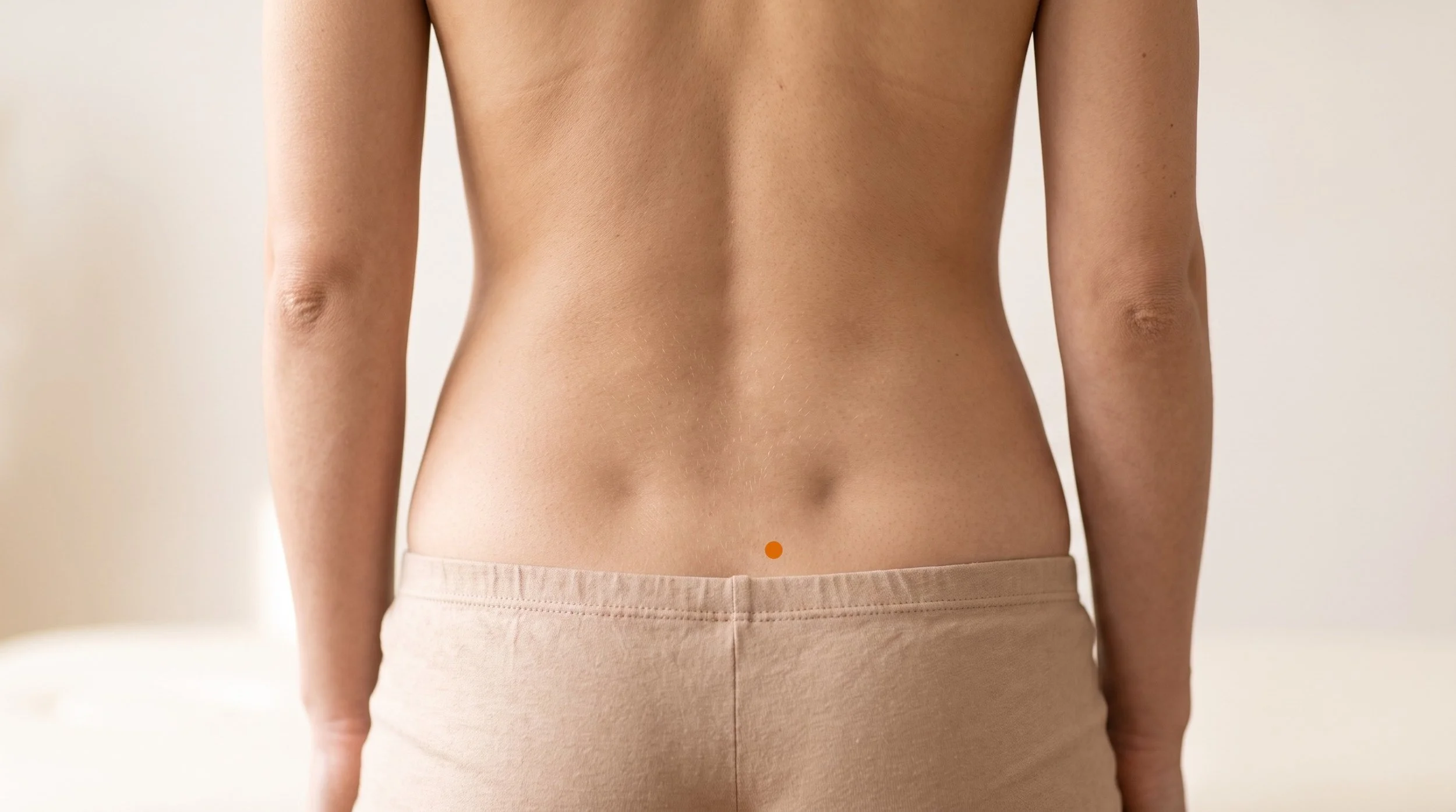
BL33 (Zhongliao, often translated as Middle Crevice) is the third of the eight liao points, the paired series that sits directly over the posterior sacral foramina. You'll find it low on the sacrum, in the small depression over the third posterior sacral foramen, just below BL32 and a short distance from the midline ridge you can feel running down the back of the sacrum.
Classical texts group it with its neighbors as a point for the lower abdomen and pelvis, and modern anatomy explains why that grouping has held up: the needle sits over the S3 nerve root, which carries much of the parasympathetic supply to the bladder, the distal bowel, and the pelvic organs. That combination of a palpable bony landmark, a named nerve root beneath it, and a long classical track record has made the bl33 acupuncture point one of the most studied points on the sacrum for urinary function, and a workhorse for sacral and low back pain in everyday practice.
- Location and layers: bladder 33 lies over the third posterior sacral foramen, below BL32, with the needle passing through skin, the thin aponeurotic layer of the erector spinae and multifidus over the sacrum, and the upper origin of gluteus maximus before reaching the foramen itself (Deadman et al., 2007; Cunningham, 2001).
- Traditional categories, translated: classical sources describe BL33 as a meeting point of the Bladder and Gallbladder channels and attribute to it actions on the lower burner, urination and defecation, menstruation, and the lower back and legs (Deadman et al., 2007). In neurophysiological terms, that's a list of functions served by the S2 to S4 segments.
- The mechanism story: deep needling at bl 33 sacrum places the needle tip near the S3 root, which is the same target used by implanted sacral neuromodulation devices, and animal work suggests stimulation here changes bladder filling and detrusor activity measurably (Yang et al., 2017; Liu et al., 2017b).
- Research picture: a 504-participant randomized trial of lumbosacral electroacupuncture reported less urine leakage than sham at six weeks in women with stress urinary incontinence (Liu et al., 2017a), while an earlier pilot used deep needling specifically at BL33 and BL35 (Xu et al., 2016). Cochrane authors reviewing acupuncture for stress urinary incontinence found the evidence base too thin to draw firm conclusions (Wang et al., 2013).
- Clinical framing: at Morningside we rarely use the middle crevice point alone. It's typically part of a sacral and lumbar treatment that may include BL32, BL54, gluteal and pelvic floor work, with analgesic effects supported by the broader chronic pain literature (Vickers et al., 2018; Mu et al., 2020).
- De qi here is distinctive: a deep, heavy, spreading ache in the sacrum, and when the needle enters the foramen many people describe a sensation traveling toward the perineum or down the back of the leg. That radiation is a sign the needle is engaging the sacral root, and it should be a controlled ache rather than a sharp electric jolt.
Sacral Pain, Bladder Urgency, or Pelvic Tension That Won't Settle?
Symptoms that sit low in the pelvis often involve the same sacral segments, which is why we assess the sacrum, the SI joints, the gluteal muscles, and the pelvic floor together rather than one at a time. BL33 is one of our most-used sacral points because it gives direct access to the S3 level with a needle instead of an implant. Treatment plans usually pair it with lumbar and distal points, plus movement and breathing work you can take home. Book a visit and we'll map out what's actually driving your symptoms.
Schedule NowAnatomy of BL33: Why the Third Sacral Foramen Is Such an Important Location
Run your fingers down the midline of the sacrum and you'll feel the median sacral crest, a low bony ridge. Slide slightly off that ridge and downward from BL32 and the tissue softens into a shallow dip: that's the third posterior sacral foramen, the landmark for BL33 (Deadman et al., 2007). The tissue over it is thin compared with the lumbar spine. There's skin and subcutaneous fat, then the flattened tendinous sheet where the erector spinae and multifidus attach onto the sacrum, then the upper fibers of the gluteus maximus origin (Cunningham, 2001).
This layer takes load every time you stand from a chair, climb stairs, or brace to lift, and it's also where the long posterior sacroiliac ligament and the sacrotuberous ligament transmit force between the pelvis and the spine. Sacral tenderness in this zone is common in people with SI joint irritation, postpartum pelvic pain, and long hours of sitting.
The nerve geography is what makes this point unusual. Each posterior sacral foramen transmits the posterior division of a sacral spinal nerve, and just deep to the third foramen sits the S3 root itself. S3 contributes heavily to the pelvic splanchnic nerves, the parasympathetic outflow that drives detrusor contraction and coordinates voiding, and it also supplies pelvic floor structures. Needling here therefore recruits afferent traffic entering the cord at the same segments that receive input from the bladder, the distal bowel, the sacroiliac region, and the pelvic floor.
Convergence of somatic and visceral input at shared segmental levels is one reason a needle in the back can influence sensations felt in the pelvis, and repetitive stimulation of these afferents also engages descending inhibitory pathways involving endogenous opioid and monoamine systems (Zhao, 2008). Clinically that means BL33 may reduce local sacral pain and may modulate pelvic organ sensation and reflexes at the same time.
Beneath the sacrum lie the pelvic contents, so depth discipline matters. Classical needling for BL33 is perpendicular to roughly 0.5 to 1 cun, or 1.5 to 2 cun when the practitioner intends to enter the foramen, and moxibustion is traditionally applied here (Deadman et al., 2007; Kim, 2001). Research protocols that deliberately target the S3 root angle the needle inward and downward at about 30 to 45 degrees and insert 50 to 80 mm, aiming for that characteristic perineal radiation (Xu et al., 2016).
Superficial needling into the sacral aponeurosis is safe and useful for local pain; foraminal needling is a distinctly different technique that requires accurate landmarking, appropriate needle length, and training. If a needle meets bone, the correction is to withdraw slightly and change angle rather than push.
Related Acupuncture For Low Back Pain Related Best Acupuncture Points For Back PainBL33 at a Glance: Classification, Location, and Clinical Use
| Category | Detail |
|---|---|
| Traditional Name | Zhongliao (Middle Crevice), BL33, also written Bladder 33 |
| Channel Classification | Bladder channel of Foot Taiyang; third of the eight liao (baliao) sacral points (BL33, also written UB33; also called the Urinary Bladder channel) |
| Point Categories | Meeting (intersecting) point of the Bladder and Gallbladder channels; one of the eight liao group spanning BL31 to BL34; not a five-shu, hui-meeting, or extraordinary vessel confluent point |
| Precise Location | On the sacrum, in the depression over the third posterior sacral foramen, directly below BL32 and lateral to the median sacral crest |
| Tissue Stimulated | Sacral aponeurosis of the erector spinae and multifidus, upper origin of gluteus maximus, posterior sacroiliac ligamentous tissue, and at depth the S3 nerve root within the foramen; frequently treated alongside pelvic floor trigger points |
| Needle Depth / Direction | Perpendicular 0.5 to 1 cun for local sacral work, or 1.5 to 2 cun angled slightly inward and downward into the foramen for sacral nerve targeting; moxibustion is traditionally applicable |
| De Qi Sensation | Deep, heavy, spreading ache over the sacrum; with foraminal insertion, a distending sensation that may travel toward the perineum or down the posterior leg |
| Primary Clinical Uses | Sacral, SI joint, and low back pain; urinary difficulty, urgency, frequency, and retention-pattern symptoms; menstrual irregularity and pelvic discomfort in traditional use; bowel difficulty in classical use |
| Common Point Combinations |
|
Deadman, Al-Khafaji, and Baker's A Manual of Acupuncture presents BL33 as a meeting point of the Bladder and Gallbladder channels and assigns it traditional actions in three domains: regulating the lower burner so that urination and defecation proceed normally, regulating menstruation and reducing vaginal discharge, and benefiting the lower back and legs (Deadman et al., 2007). The classical indication list clusters the same way.
There are elimination complaints (difficult or retained urine, painful urination, constipation, loose stools, abdominal fullness), gynecological complaints (irregular or scanty periods, discharge, infertility), and lumbosacral complaints (aching, cold, or heaviness across the sacrum, coccyx, and buttocks, with weakness or pain running into the leg). The text also links the point to the old depletion categories describing long-term exhaustion of the body's reserves.
Other sources echo the theme: the eight liao as a group are described as points for genital, urinary, and lumbosacral problems, with the upper three favored for sciatica and sacral pain and the middle pair leaned on for urinary and menstrual complaints (Cunningham, 2001), and Maciocia notes that these sacral points are often palpated as reflections of the reproductive system, particularly in women. What's striking is how tightly that traditional grouping maps onto a single anatomical fact the classical authors had no way to describe: the S3 root supplies almost exactly those structures.
Why BL33 Is Used for Bladder Symptoms That Seem Unrelated to the Back
Patients are often surprised that a point on the sacrum gets used for urinary urgency, frequency, or difficulty starting a stream. The link is segmental. The bladder, the urethral sphincter, the distal bowel, and the pelvic floor all send and receive nerve traffic through the S2 to S4 levels, and BL33 sits directly over the bony opening through which the S3 nerve passes. Needling into that space stimulates the same neural target that implanted sacral neuromodulation devices use for refractory bladder symptoms, just non-invasively and briefly rather than continuously.
Convergence at those shared spinal segments is why input from a needle in the sacrum can alter how the nervous system processes signals coming from pelvic organs (Zhao, 2008).
Point-specific physiology supports the plausibility of that story. In rats with experimentally induced overactive bladder, deep electroacupuncture at BL33 lengthened the interval between bladder contractions more than shallow needling at the same site, needling at an adjacent non-point, or needling at several distant points (Yang et al., 2017). In a separate model of urinary retention, low-frequency electroacupuncture at BL33 increased detrusor muscle electrical activity and shortened the interval between voids (Liu et al., 2017b).
Animal findings don't transfer directly to people, but they do suggest the effect depends on where and how deep the needle goes, which is not something you can say about most acupuncture points.
The same segmental logic explains why BL33 does double duty for pain. Sacral, SI joint, and deep gluteal pain refer through overlapping territory, and needling into the sacral aponeurosis and surrounding ligamentous tissue produces local nociceptive input that recruits descending inhibitory control (Zhao, 2008).
Individual patient data pooled across chronic pain trials indicate modest but persistent benefits for acupuncture over both sham and usual care (Vickers et al., 2018), and Cochrane authors reviewing chronic nonspecific low back pain found acupuncture better than no treatment for pain and function immediately after a course, with less certainty when compared against sham (Mu et al., 2020).
What the Research Shows for BL33
A word about how to read the evidence. Almost no trial isolates BL33 by itself, and the reviews below test whole protocols in which this point is one component among several. What makes BL33 unusual is that it has been singled out more often than most points, partly because its anatomical target is so specific and partly because it lends itself to sham comparisons at nearby non-points. Even so, the urinary trials are largely from a small number of research groups, the animal work is preclinical, and the pain literature is broad rather than point-specific. Read the table as evidence of plausibility and general benefit, not as proof that any single point produces a given result.
| Study | Type | Focus | Key Finding |
|---|---|---|---|
| Liu et al., 2017a | Multicenter randomized clinical trial (n = 504) | Lumbosacral electroacupuncture versus sham for stress urinary incontinence in women | Participants receiving lumbosacral electroacupuncture had less measured urine leakage at six weeks than those receiving sham, though longer-term effects and mechanisms remain unclear. |
| Xu et al., 2016 | Pilot randomized placebo-controlled trial (n = 80) | Deep electroacupuncture at BL33 and BL35 versus non-penetrating sham for pure stress urinary incontinence | The deep-needling group showed a greater reduction in leakage on pad testing than sham over six weeks, in a study explicitly framed as preliminary. |
| Wang et al., 2013 | Cochrane systematic review | Acupuncture for stress urinary incontinence in adults | The review authors concluded that available trials were too few and too limited in quality to establish whether acupuncture helps this condition. |
| Forde et al., 2016 | Narrative literature review | Acupuncture in the management of overactive bladder | The authors described generally encouraging but methodologically uneven studies and called for larger, better-controlled trials. |
| Yang et al., 2017 | Controlled animal study | Deep versus shallow electroacupuncture at BL33 compared with other points in rats with overactive bladder | Deep needling at BL33 prolonged the interval between bladder contractions more than shallow needling, a nearby non-point, or several distant points. |
| Liu et al., 2017b | Controlled animal study | Electroacupuncture at BL33 and detrusor smooth muscle activity in a rat urinary retention model | Low-frequency stimulation at BL33 increased detrusor electrical activity and altered voiding parameters, suggesting a depth-dependent and frequency-dependent effect. |
| Mu et al., 2020 | Cochrane systematic review | Acupuncture for chronic nonspecific low back pain | Acupuncture was better than no treatment for pain and back-specific function immediately after a course, with uncertain advantage over sham. |
| Vickers et al., 2018 | Individual patient data meta-analysis | Acupuncture across chronic musculoskeletal, headache, and osteoarthritis pain | Acupuncture outperformed both sham and no-acupuncture controls by modest margins, with effects that persisted over about a year. |
Low Back and SI Joint Pain That Keeps Coming Back?
Recurrent sacral and low back pain is often a mix of joint irritation, guarded gluteal and paraspinal muscle, and a nervous system that has become quick to protect the area. We combine needling at BL33 and its neighboring foramen points with dry needling of the muscles that refer into the same region. Most patients notice a change in stiffness and load tolerance within a handful of sessions. Schedule an evaluation and we'll build a plan around your specific pattern.
Schedule NowBL33 in the Context of Trigger Point Work
Sacral pain is rarely just sacral. The gluteus maximus attaches along the lateral border of the sacrum and can refer pain across the whole region, gluteus medius refers into the sacroiliac area and upper buttock, and quadratus lumborum sends pain down toward the crest of the ilium and the sacroiliac joint (Simons et al., 1999). The multifidus and the deeper paraspinal fibers that attach onto the sacrum produce a tight, localized ache close to the midline that patients frequently point to within a centimeter of BL33 itself. When we assess someone with sacral pain, we're mapping which of those muscles reproduces the complaint before deciding what to needle.
In practice that means BL33 is often used in the same session as dry needling of gluteus maximus and medius, quadratus lumborum, and, when the presentation includes urinary urgency, pelvic pressure, or pain with sitting, the pelvic floor. Because acupuncture is defined by the use of an acupuncture needle, there's no meaningful distinction between placing a needle at a classically named sacral point and placing one in a taut band of gluteus maximus: both are needling decisions made from an anatomical assessment.
The sacral point contributes segmental input at S3, the muscular targets address the mechanical contributors, and the combination tends to hold better than either approach alone.
BL33 Pelvic and Low Back Treatment at NYC's Highest-Rated Acupuncture Clinic
Morningside Acupuncture is the highest-rated acupuncture and dry needling clinic in New York City with over 500 five-star Google reviews, and sacral and pelvic complaints are among the cases we see most. Our licensed acupuncturists are trained in both classical point work and modern orthopedic needling, so BL33 gets used with anatomical precision rather than by rote. Every plan includes clear expectations about how many sessions we think it will take. Schedule your first appointment and let's get started.
Schedule NowFrequently Asked Questions
What does BL33 feel like when needled?
Most people feel a deep, heavy, spreading ache across the sacrum that builds over a few seconds rather than a sharp pinch. If the practitioner is needling into the third sacral foramen, the sensation often travels: patients commonly describe it moving toward the perineum, into the lower abdomen, or down the back of the thigh. That radiation is expected when the needle engages the S3 nerve, and research protocols targeting the sacral root specifically look for it (Xu et al., 2016). A brief electric flick can happen, but a persistent sharp or shooting sensation means the needle needs adjusting, so speak up if you feel one.
Why treat the sacrum for bladder symptoms instead of the abdomen?
Both are used, and often together. The abdomen gives access to the bladder region from the front (CV3 is the classic front pairing with the sacral points), while BL33 gives access to the nerve supply from behind. The S3 root that runs beneath the third sacral foramen carries much of the parasympathetic control of the bladder and pelvic floor, which is the same target that implanted sacral neuromodulation devices use. That anatomical directness is why BL33 has been chosen as the test point in several urinary trials, including animal work comparing it against other points (Yang et al., 2017; Liu et al., 2017b). In the clinic we usually combine front and back rather than choosing between them.
Can I press BL33 myself between sessions?
Yes, and the sacrum is one of the easier areas to self-treat. Sit or lie on your side, find the bony ridge running down the middle of the sacrum, then move about a finger's width to either side and slide down until you feel a shallow dip roughly two to three finger widths below the level of the pelvic dimples. Press with the pad of your thumb or a knuckle at firm but comfortable pressure, hold for 30 to 60 seconds per side, and repeat two or three rounds for a total of about three to five minutes. Slow diaphragmatic breathing while you hold makes a noticeable difference, since it helps the pelvic floor release rather than brace. A heat pack over the sacrum for 15 to 20 minutes is a reasonable stand-in for the moxibustion traditionally used at these points, and it's often more comfortable for stiff, cold-feeling sacral pain. Skip acupressure over broken skin, rashes, or unexplained new sacral pain, and check with your clinician first if you're pregnant.
Is BL33 safe to needle?
In trained hands, yes. Superficial needling into the sacral tissue is low risk because the sacrum itself sits directly beneath and limits depth. Deep foraminal needling is a different technique that requires accurate landmarking and appropriate needle length, since the pelvic contents lie on the far side of the bone, and it should only be done by a practitioner trained in it. Standard cautions apply: clean technique, care with anticoagulant use or bleeding disorders, and no needling over infected or broken skin. Pregnancy deserves specific mention, because sacral points in this group are classically associated with promoting labor and appear in traditional labor-induction combinations, so deep sacral needling during pregnancy should only be performed under the guidance of a practitioner experienced in obstetric care. Expected side effects are minor: brief soreness or a small bruise.
Where exactly is BL33 located?
BL33 sits on the sacrum, in the depression over the third posterior sacral foramen, directly below BL32 (Deadman et al., 2007). To find it, locate the two dimples at the back of the pelvis that mark the posterior superior iliac spines, then find the median sacral crest running down the midline. The four posterior sacral foramina lie in the corridor between those landmarks, spaced roughly evenly downward. BL33 is the third of those spaces, so it's below the level of the dimples and closer to the midline than most people expect. Fingertip palpation is the practical method: with light pressure you can usually feel the small give of the foramen against the surrounding bone. There's one on each side, and the bl 33 sacrum landmark is typically needled bilaterally.
References
- Deadman, P., Al-Khafaji, M., & Baker, K. (2009). A manual of acupuncture. Journal of Chinese Medicine Publications.
- Cunningham, P. M. (2000). Acupuncture points: A practical guide to classical and modern usage. Odyssey Press.
- Maciocia, G. (2005). The foundations of Chinese medicine: A comprehensive text for acupuncturists and herbalists (2nd ed.). Elsevier Churchill Livingstone.
- Kim, H. (2008). Handbook of Oriental medicine (3rd ed.). Harmony & Balance Press.
- O'Connor, J., & Bensky, D. (Eds. & Trans.). (1981). Acupuncture: A comprehensive text. Shanghai College of Traditional Medicine. Eastland Press.
- Simons, D. G., Travell, J. G., & Simons, L. S. (1999). Travell & Simons' myofascial pain and dysfunction: The trigger point manual, Vol. 1: Upper half of body (2nd ed.). Williams & Wilkins.
- Liu, Z., Liu, Y., Xu, H., He, L., Chen, Y., Fu, L., Li, N., Lu, Y., Su, T., Sun, J., Wang, J., Yue, Z., Zhang, W., Zhao, J., Zhou, Z., Wu, J., Zhou, K., Ai, Y., Zhou, J., ... Liu, B. (2017a). Effect of electroacupuncture on urinary leakage among women with stress urinary incontinence: A randomized clinical trial. JAMA, 317(24), 2493-2501. https://doi.org/10.1001/jama.2017.7220
- Xu, H., Liu, B., Wu, J., Du, R., Liu, X., Yu, J., & Liu, Z. (2016). A pilot randomized placebo controlled trial of electroacupuncture for women with pure stress urinary incontinence. PLoS ONE, 11(3), e0150821. https://doi.org/10.1371/journal.pone.0150821
- Wang, Y., Zhishun, L., Peng, W., Zhao, J., & Liu, B. (2013). Acupuncture for stress urinary incontinence in adults. Cochrane Database of Systematic Reviews, 2013(7), CD009408. https://doi.org/10.1002/14651858.CD009408.pub2
- Forde, J. C., Jaffe, E., Stone, B. V., Te, A. E., Espinosa, G., & Chughtai, B. (2016). The role of acupuncture in managing overactive bladder: A review of the literature. International Urogynecology Journal, 27(11), 1645-1651. https://doi.org/10.1007/s00192-015-2935-y
- Yang, L., Wang, Y., Mo, Q., & Liu, Z. (2017). A comparative study of electroacupuncture at Zhongliao (BL33) and other acupoints for overactive bladder symptoms. Frontiers of Medicine, 11(1), 129-136. https://doi.org/10.1007/s11684-016-0491-6
- Liu, X., Liu, K., Zhi, M., Mo, Q., Gao, X., & Liu, Z. (2017b). Effects of electroacupuncture at BL33 on detrusor smooth muscle activity in a rat model of urinary retention. Acupuncture in Medicine, 35(6), 437-444. https://doi.org/10.1136/acupmed-2016-011355
- Mu, J., Furlan, A. D., Lam, W. Y., Hsu, M. Y., Ning, Z., & Lao, L. (2020). Acupuncture for chronic nonspecific low back pain. Cochrane Database of Systematic Reviews, 2020(12), CD013814. https://doi.org/10.1002/14651858.CD013814
- Vickers, A. J., Vertosick, E. A., Lewith, G., MacPherson, H., Foster, N. E., Sherman, K. J., Irnich, D., Witt, C. M., & Linde, K. (2018). Acupuncture for chronic pain: Update of an individual patient data meta-analysis. Journal of Pain, 19(5), 455-474. https://doi.org/10.1016/j.jpain.2017.11.005
- Zhao, Z. Q. (2008). Neural mechanism underlying acupuncture analgesia. Progress in Neurobiology, 85(4), 355-375. https://doi.org/10.1016/j.pneurobio.2008.05.004
Disclaimer: This web site is intended for educational and informational purposes only. Reading this website does not constitute providing medical advice or any professional services. This information should not be used for diagnosing or treating any health issue or disease. Those seeking medical advice should consult with a licensed physician. Seek the advice of a medical doctor or other qualified health professional for any medical condition. If you think you have a medical emergency, call 911 or go to the emergency room. No acupuncturist-patient relationship is created by reading this website or using the information. Morningside Acupuncture PLLC and its employees and contributors do not make any express or implied representations with respect to the information on this site or its use. For any legal interpretation of scope of practice in your state, consult a licensed attorney or regulatory authority.
Read more from our blog