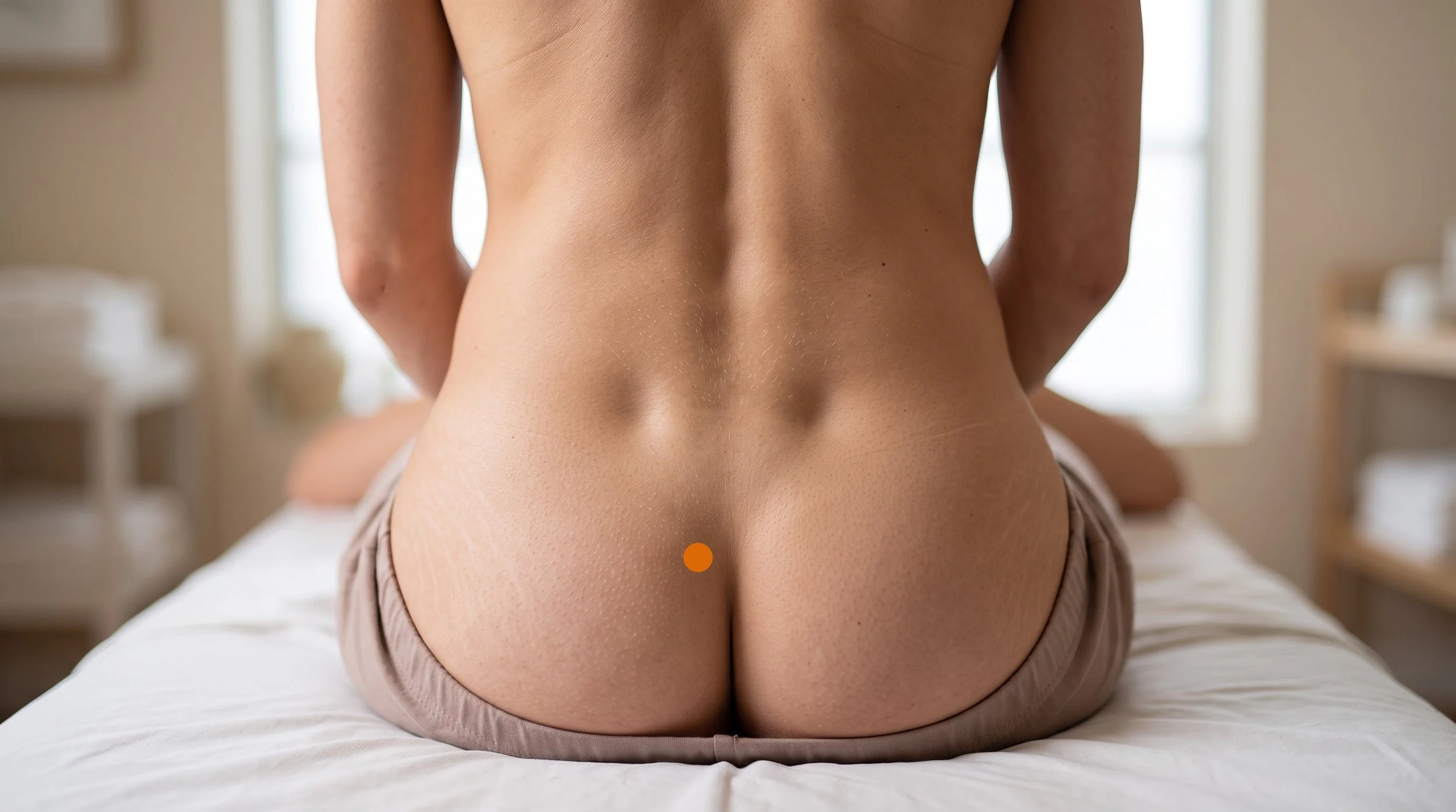
BL35 Acupuncture Point (Huiyang)
The Meeting of Yang Beside the Tailbone: Anatomy, Mechanism, and Why BL35 Anchors Coccyx, Anorectal, and Pelvic Floor Treatment
BL35, known in Chinese as Huiyang and usually translated as Meeting of Yang, sits at the very bottom of the Bladder channel's trunk: a half cun to either side of the midline, level with the tip of the tailbone. It's one of the least glamorous points on the body and one of the most anatomically interesting, because that small patch of tissue sits directly over the coccygeal nerve territory, the lowest fibers of gluteus maximus, and the back door of the pelvic floor.
Classical texts reached for the bl35 acupuncture point for haemorrhoids, chronic diarrhoea, vaginal discharge, and cold, weak conditions of the lower abdomen (Deadman et al., 2001). Modern clinicians reach for bladder 35 for a narrower and more practical set of problems: coccydynia, post-sitting tailbone pain, deep pelvic floor tension, and urinary and anorectal symptoms that don't respond to lumbar treatment alone. It's also one of the very few points with a large, high-profile trial built specifically around it (Liu et al., 2017).
- Location and layers: BL35 is 0.5 cun lateral to the midline at the level of the coccyx tip, passing through skin and subcutaneous fat into the medial fibers of gluteus maximus and the ligamentous attachments around the coccyx, with the pelvic floor muscles deeper still (Deadman et al., 2001; Cheng, 2010).
- Traditional attributions translated: the classical texts describe BL35 as clearing damp-heat, regulating the lower jiao, benefiting the coccyx, and treating haemorrhoids (Deadman et al., 2001). In neurophysiological terms, that's a point sitting squarely over the sacral and coccygeal segments that also serve the rectum, bladder neck, and pelvic floor.
- Nerve geography: standard references place BL35 in coccygeal nerve territory with branches of the inferior gluteal vessels nearby (Cheng, 2010), and deeper needling in this region has been used specifically to influence pudendal nerve distribution in clinical trials (Liu et al., 2017).
- Research picture: a 504-participant randomized trial published in JAMA used electroacupuncture at bilateral BL33 and BL35 for women with stress urinary incontinence and reported reduced urine leakage compared with sham (Liu et al., 2017), which makes bl 35 coccyx needling unusually well studied for such a small point.
- Clinical framing: BL35 is rarely used alone. It's typically added to sacral, lumbar, and gluteal work, and broad reviews of acupuncture for chronic pain report modest but persistent benefits from multi-point protocols rather than single points (Vickers et al., 2018).
- De qi at this point tends to be deep, heavy, and diffuse rather than sharp, often described as pressure spreading toward the tailbone, the sitting bones, or the floor of the pelvis; the needle sensation may reduce guarding in the surrounding muscles through segmental and descending pain-modulating pathways (Zhao, 2008).
Is Tailbone Pain Making Sitting Unbearable?
Coccydynia has a way of taking over the whole day, from the subway ride to the desk chair to dinner out. At Morningside Acupuncture, we use BL35 alongside sacral points and careful dry needling of the gluteal and pelvic floor attachments to calm the tissue that keeps the tailbone irritable. Treatment is precise, conservative, and paired with sitting strategy and loading advice you can actually follow. Schedule a visit and let's get you comfortable in a chair again.
Schedule NowAnatomy of BL35: Why the Tip of the Coccyx Is Such an Important Location
Bladder 35 sits at the lower end of the sacrum, half a cun off the midline, level with the tip of the tailbone (Deadman et al., 2001). Surface to deep, the needle passes through thin skin at the upper edge of the gluteal cleft, a variable layer of subcutaneous fat, then into the most medial and inferior fibers of gluteus maximus where they take origin from the coccyx and the surrounding fascia and ligaments. Deeper again lie the anococcygeal tissues and the posterior attachments of the pelvic floor, including coccygeus and the levator ani sheet that anchors onto the coccyx.
This is a mechanically busy corner of the body: it absorbs load every time you sit down hard, cycle for an hour, deliver a baby, or fall backward on ice, and it also tightens reflexively in people who chronically clench the pelvic floor.
The nerve geography is what makes this point clinically distinctive. Standard texts describe the innervation at BL35 as coccygeal nerve territory, with branches of the inferior gluteal artery and vein in the neighborhood (Cheng, 2010). The coccygeal plexus, formed from the lowest sacral roots and the coccygeal nerve, supplies the skin over the tailbone and contributes to the pelvic floor, while the nearby pudendal nerve carries motor and sensory fibers to the anal sphincter, perineum, and urethral sphincter.
Those same S2 to S4 segments receive visceral afferents from the rectum and bladder, which means somatic input from a needle here converges on spinal levels already busy processing pelvic visceral signals. Convergence of this kind is a well-described substrate for acupuncture's segmental effects, alongside descending inhibitory pathways recruited by needling more generally (Zhao, 2008). Clinically, deep needling in this territory has been used deliberately to influence pudendal distribution in pelvic floor trials (Liu et al., 2017).
Safety here is about depth and direction rather than danger from large vessels. The rectum and anal canal lie anterior and medial, and the ischioanal fossa sits lateral and deep, so needling is kept controlled and angled away from the midline canal. Classical sources describe perpendicular insertion of 1 to 1.5 cun, while other references keep the depth shallower at 0.5 to 1 cun, and moxibustion is traditionally considered appropriate at this point (Deadman et al., 2001; Cheng, 2010).
Research protocols that used deeper, obliquely angled insertion at BL35 were carried out by trained specialists in hospital settings (Liu et al., 2017), and that isn't a technique for casual use. We also use conservative depth and clear draping and consent practices given the sensitivity of the region, and we avoid or modify needling here during pregnancy and in anyone with local infection, active bleeding, or recent anorectal surgery unless a physician has cleared it.
Related Pelvic Floor Trigger Points Related Gluteus Maximus Trigger PointsBL35 at a Glance: Classification, Location, and Clinical Use
| Category | Detail |
|---|---|
| Traditional Name | Huiyang (Meeting of Yang), BL35, also written Bladder 35 |
| Channel Classification | Bladder channel of Foot Taiyang; the lowest point on the channel's trunk before it crosses onto the posterior thigh (BL35, also written UB35; also called the Urinary Bladder channel) |
| Point Categories | Not a five-shu, luo, or command point. Classical commentary notes that although BL35 isn't listed among the official intersecting points, the Systematic Classic describes Governing vessel qi as surfacing here, and the name itself refers to the meeting of the Bladder channel with the Governing vessel (Cunningham, 2019). Some lineage traditions include BL35 in a lower Governing vessel trajectory running from the perineum through the gluteal region to the spine (Sterman, 2019). |
| Precise Location | On the sacrum, 0.5 cun lateral to the posterior midline, level with the tip of the coccyx, bilaterally |
| Tissue Stimulated | Skin and subcutaneous tissue over the coccyx, the medial inferior fibers of gluteus maximus, the coccygeal attachments of the pelvic floor including coccygeus and levator ani, within coccygeal nerve territory |
| Needle Depth / Direction | Perpendicular insertion 1 to 1.5 cun per Deadman, with other texts using 0.5 to 1 cun; moxibustion is traditionally applicable. Angle is kept away from the midline anal canal, and depth is matched to body type |
| De Qi Sensation | Deep, heavy, pressure-like fullness at the tailbone that may spread toward the sitting bones, the perineum, or the floor of the pelvis; occasionally a brief dull ache rather than a sharp sensation |
| Primary Clinical Uses | Coccydynia and tailbone pain, sacral and lower gluteal pain, haemorrhoids and anorectal complaints in classical use, pelvic floor tension and urinary symptoms in modern practice, and cold-pattern lower abdominal complaints in classical use |
| Common Point Combinations |
|
Deadman, Al-Khafaji, and Baker present BL35 with two traditional actions: clearing damp-heat and regulating the lower jiao, and benefiting the coccyx while treating haemorrhoids. The indication list they record clusters into three groups: anorectal and genital complaints such as chronic haemorrhoids, rectal prolapse, blood in the stool, diarrhoea and dysenteric disorder, genital itching or sweating, and vaginal discharge; local pain problems including coccyx pain and pain of the lumbar region and leg; and deficiency states described as weak yang qi, impotence, and a cold abdomen (Deadman et al., 2001).
Other commentaries add that the point was favored for cold and depleted presentations more than hot ones, and for low back pain occurring with menstruation (Cunningham, 2019). What's striking about the classical pattern is how tightly it maps onto one anatomical region: nearly every traditional indication involves a structure innervated by the lowest sacral and coccygeal segments, which is a remarkable degree of coherence for a point described long before that segmental anatomy was formally worked out.
Why BL35 Is Used for Bladder and Pelvic Floor Symptoms, Not Just Tailbone Pain
Most patients assume a point at the tailbone can only treat the tailbone. The reason it does more comes down to segmental wiring. The skin, muscle, and ligament at BL35 are supplied by the lowest sacral and coccygeal nerves, and those same spinal segments carry the nerves that run the anal sphincter, the urethral sphincter, and the levator ani sheet, plus the visceral afferents arriving from the rectum and bladder.
When a needle creates a sustained, low-grade input at that level, it enters a spinal cord segment that's already processing pelvic signals, and that overlap gives acupuncture a plausible route to influence muscle tone, sphincter function, and pain perception in the pelvis (Zhao, 2008).
This is more than theory for BL35 specifically. A multicenter randomized trial of 504 women with stress urinary incontinence used electroacupuncture at bilateral BL33 and BL35, with deep needling aimed at sacral and pudendal nerve territory, and found greater reduction in urine leakage than sham electroacupuncture over six weeks of treatment (Liu et al., 2017). Very few individual acupuncture points have been tested in a trial of that size and design.
It doesn't prove BL35 does anything on its own, since it was always paired with BL33, but it does mean the sacral and coccygeal needling region has been examined seriously rather than assumed to work.
For pain, the mechanism story adds descending inhibition. Needling recruits brainstem and spinal pathways that dampen nociceptive transmission, which is part of why effects extend beyond the immediate needle site and beyond the treatment hour (Zhao, 2008), and large individual patient data analyses of chronic pain trials support modest, durable benefits from acupuncture protocols overall (Vickers et al., 2018). In practice, that means we use BL35 as one input within a plan for coccydynia or pelvic floor pain, not as a switch that turns the problem off.
What the Research Shows for BL35
Almost no acupuncture research isolates a single point, and BL35 is no exception. The studies below test protocols that include this region alongside other sacral, lumbar, or distal points, so the honest interpretation is that BL35 is part of protocols with some supportive evidence rather than a point with proven independent effects. Coccydynia research in particular remains thin across all treatment types, which is worth knowing before anyone promises quick results for tailbone pain.
| Study | Type | Focus | Key Finding |
|---|---|---|---|
| Liu et al., 2017 | Multicenter randomized sham-controlled trial (n=504) | Electroacupuncture at BL33 and BL35 for female stress urinary incontinence | Electroacupuncture at these two sacral points was associated with greater reduction in urine leakage than sham over six weeks, making this the most direct evidence involving BL35. |
| Sun et al., 2021 | Multicenter randomized sham-controlled trial | Acupuncture for chronic prostatitis and chronic pelvic pain syndrome | Twenty sessions over eight weeks produced greater symptom improvement than sham, with effects sustained through follow-up, supporting acupuncture's role in pelvic pain protocols generally. |
| Chen et al., 2022 | Systematic review of randomized controlled trials | Acupuncture for post-hemorrhoidectomy pain | A small number of trials suggested reduced postoperative pain with electroacupuncture, but the authors described the evidence base as limited and inconsistent. |
| Andersen et al., 2022 | Systematic review | Treatment options for persistent coccydynia | Non-surgical management helped many patients, though no single conservative modality emerged as clearly superior and the overall evidence quality was modest. |
| Mu et al., 2020 | Cochrane systematic review | Acupuncture for chronic nonspecific low back pain | Acupuncture showed benefits over no treatment and usual care for pain, though certainty of evidence varied and differences versus sham were often small. |
| Vickers et al., 2018 | Individual patient data meta-analysis | Acupuncture across chronic pain conditions | Acupuncture outperformed both sham and no-acupuncture controls with effects that persisted over time, supporting its use as a reasonable option for persistent musculoskeletal pain. |
Pelvic Floor Symptoms Nobody Has Really Addressed?
Deep pelvic tension, anorectal discomfort, and urinary symptoms often get bounced between specialists without anyone treating the muscles and nerves at the base of the pelvis. The meeting of yang point gives us direct segmental access to that region, and we combine it with sacral foramen points and trigger point work when it's appropriate. Everything is explained first, and nothing is done without your consent. Book a consultation to talk through what a course of care would look like.
Schedule NowBL35 in the Context of Trigger Point Work
The tissue at BL35 overlaps directly with myofascial targets we treat for tailbone and deep buttock pain. The lowest medial fibers of gluteus maximus attach around the coccyx and can refer pain into the sacral and tailbone region, and taut bands in the pelvic floor muscles, including levator ani and coccygeus, are classic contributors to deep, aching pain that patients localize to the tailbone or the sit bones (Simons et al., 1999). When palpation at or near BL35 reproduces a patient's familiar pain, the distinction between needling a classical point and needling a trigger point becomes academic. It's the same needle in the same tissue, and dry needling is simply one of the many styles of acupuncture practiced today.
At Morningside, we typically use BL35 alongside external dry needling of the gluteal group, the sacral multifidus, and, where indicated and within scope, the accessible posterior pelvic floor attachments, combined with sacral points such as BL33 and BL34. Coccydynia responds best when the plan also addresses sitting posture, cushion selection, hip and hamstring mobility, and any habitual pelvic floor clenching, so needling is one part of a broader approach. We stay conservative with depth in this region, explain each step before starting, and stop or adjust immediately if anything feels wrong to the patient.
BL35 Coccyx and Pelvic Pain Treatment at NYC's Highest-Rated Acupuncture Clinic
Morningside Acupuncture is the highest-rated acupuncture and dry needling clinic in New York City with over 500 five-star Google reviews, and we treat tailbone, sacral, and pelvic floor complaints every week. Our approach blends classical point selection like BL35 and its Bladder channel neighbors with orthopedic assessment and trigger point needling. You'll get a clear plan, realistic expectations, and measurable check-ins along the way. Schedule your appointment today.
Schedule NowFrequently Asked Questions
What does BL35 feel like when needled?
Most people describe a deep, heavy, spreading pressure at the tailbone rather than a sharp pain. The sensation may radiate toward the sit bones, the perineum, or the floor of the pelvis, and it sometimes arrives a second or two after insertion. Because this is a sensitive area, we use fine needles, insert slowly, and check in with you throughout. Mild soreness for a day afterward is common and typically fades quickly.
Why needle right at the tailbone instead of the low back?
Lumbar points reach the L1 to L5 segments, but the pelvic floor, anal sphincter, and bladder neck are wired through the lowest sacral and coccygeal nerves. BL35 sits in that specific territory, which is why it's traditionally reserved for coccyx, anorectal, and lower pelvic complaints while lumbar points handle the back itself (Deadman et al., 2001; Cheng, 2010). For tailbone pain that's worse with sitting and rising from a chair, treating the segment that actually supplies the painful structures usually makes more sense than treating the low back alone.
Can I press BL35 myself between sessions?
Yes, gentle acupressure is reasonable. Lie on your side with your knees bent, find the bony tip of your tailbone, then move roughly half an inch (about a finger's width) to either side, staying off the bone itself. Press with the pad of a thumb or a knuckle at a firm but comfortable intensity, hold for 30 to 60 seconds, release, and repeat two or three times per side, once or twice daily. Slow breathing and a deliberate release of the pelvic floor during each hold usually helps more than added pressure. Skip it if you have inflamed haemorrhoids, broken skin, a recent tailbone fracture, or any acute local infection, and stop if the pressure sharpens your pain.
Is BL35 safe to needle?
In trained hands, yes. There are no major vessels or organs immediately under the needle at typical depths, though the anal canal lies anterior and medial and the ischioanal fossa sits deep and lateral, so angle and depth are controlled carefully. Texts describe perpendicular insertion between roughly 0.5 and 1.5 cun depending on the source (Deadman et al., 2001; Cheng, 2010), and the deeper angled technique used in research protocols is a specialist procedure. We modify or avoid this point during pregnancy, with active local infection, over broken skin, in people on anticoagulants without clearance, and after recent anorectal surgery. Clear draping, consent, and communication are standard for any point in this region.
Where exactly is BL35 located?
Find the tip of the coccyx, the very bottom of the tailbone at the top of the gluteal cleft. BL35 is level with that tip and 0.5 cun lateral to the midline on each side, which is a narrow half-finger's width off center (Deadman et al., 2001). It's the lowest point on the trunk portion of the Bladder channel, sitting just above where the channel continues onto the back of the thigh at BL36.
References
- Deadman, P., Al-Khafaji, M., & Baker, K. (2009). A manual of acupuncture. Journal of Chinese Medicine Publications.
- Cheng, X. (Ed.). (1999). Chinese acupuncture and moxibustion (Rev. ed.). Foreign Languages Press.
- Cunningham, P. M. (2000). Acupuncture points: A practical guide to classical and modern usage. Odyssey Press.
- Cecil-Sterman, A. (2012). Advanced acupuncture: A clinic manual. Classical Wellness Press.
- Simons, D. G., Travell, J. G., & Simons, L. S. (1999). Travell & Simons' myofascial pain and dysfunction: The trigger point manual, Vol. 1: Upper half of body (2nd ed.). Williams & Wilkins.
- Liu, Z., Liu, Y., Xu, H., He, L., Chen, Y., Fu, L., Li, N., Lu, Y., Su, T., Sun, J., Wang, J., Yue, Z., Zhang, W., Zhao, J., Zhou, Z., Wu, J., Zhou, K., Ai, Y., Zhou, J., Pang, R., Wang, Y., Qin, Z., Yan, S., Li, H., Luo, L., & Liu, B. (2017). Effect of electroacupuncture on urinary leakage among women with stress urinary incontinence: A randomized clinical trial. JAMA, 317(24), 2493-2501. https://doi.org/10.1001/jama.2017.7220
- Sun, Y., Liu, Y., Liu, B., Zhou, K., Yue, Z., Zhang, W., Fu, W., Yang, J., Li, N., He, L., Zang, Z., Su, T., Fang, J., Ding, Y., Qin, Z., Song, H., Hu, H., Zhao, H., Mo, Q., Zhou, J., Wu, J., Liu, X., Wang, W., Pang, R., Chen, H., Wang, X., & Liu, Z. (2021). Efficacy of acupuncture for chronic prostatitis/chronic pelvic pain syndrome: A randomized trial. Annals of Internal Medicine, 174(10), 1357-1366. https://doi.org/10.7326/M21-1814
- Chen, H., Zhang, W., Sun, Y., Jiao, R., & Liu, Z. (2022). The role of acupuncture in relieving post-hemorrhoidectomy pain: A systematic review of randomized controlled trials. Frontiers in Surgery, 9, 815618. https://doi.org/10.3389/fsurg.2022.815618
- Andersen, G. Ø., Milosevic, S., Jensen, M. M., Andersen, M. Ø., Simony, A., Rasmussen, M. M., & Carreon, L. (2022). Coccydynia: The efficacy of available treatment options: A systematic review. Global Spine Journal, 12(7), 1611-1623. https://doi.org/10.1177/21925682211065389
- Mu, J., Furlan, A. D., Lam, W. Y., Hsu, M. Y., Ning, Z., & Lao, L. (2020). Acupuncture for chronic nonspecific low back pain. Cochrane Database of Systematic Reviews, 12(12), CD013814. https://doi.org/10.1002/14651858.CD013814
- Vickers, A. J., Vertosick, E. A., Lewith, G., MacPherson, H., Foster, N. E., Sherman, K. J., Irnich, D., Witt, C. M., & Linde, K. (2018). Acupuncture for chronic pain: Update of an individual patient data meta-analysis. Journal of Pain, 19(5), 455-474. https://doi.org/10.1016/j.jpain.2017.11.005
- Zhao, Z. Q. (2008). Neural mechanism underlying acupuncture analgesia. Progress in Neurobiology, 85(4), 355-375. https://doi.org/10.1016/j.pneurobio.2008.05.004
Disclaimer: This web site is intended for educational and informational purposes only. Reading this website does not constitute providing medical advice or any professional services. This information should not be used for diagnosing or treating any health issue or disease. Those seeking medical advice should consult with a licensed physician. Seek the advice of a medical doctor or other qualified health professional for any medical condition. If you think you have a medical emergency, call 911 or go to the emergency room. No acupuncturist-patient relationship is created by reading this website or using the information. Morningside Acupuncture PLLC and its employees and contributors do not make any express or implied representations with respect to the information on this site or its use. For any legal interpretation of scope of practice in your state, consult a licensed attorney or regulatory authority.
Read more from our blog



