BL37 Acupuncture Point (Yinmen)
The Gate of Abundance in the Middle of the Hamstrings: Anatomy, Mechanism, and Why This Mid Thigh Point Anchors Sciatica and Posterior Leg Treatment
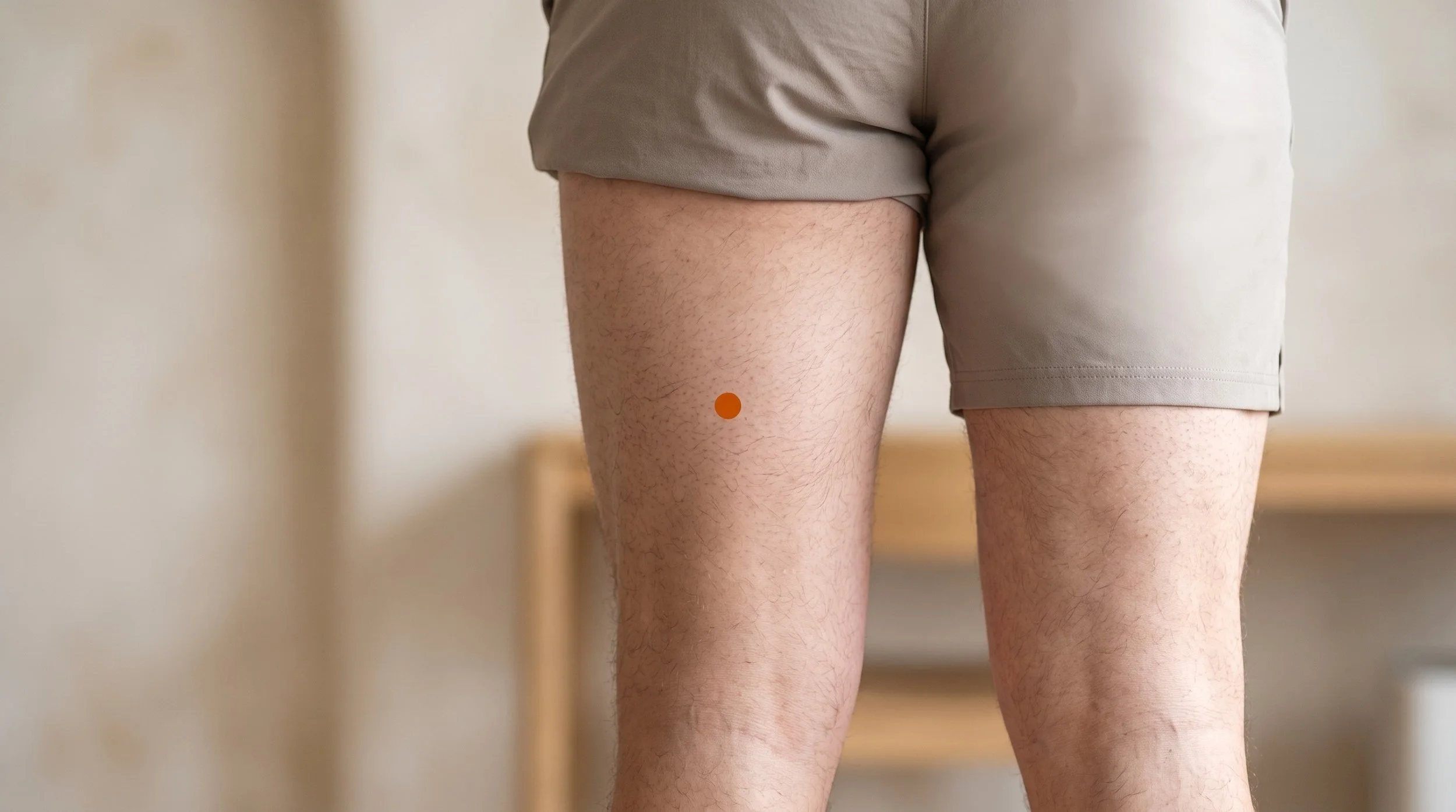
BL37 (Yinmen, often translated as Gate of Abundance) is the Bladder channel point that sits in the soft groove between the hamstring muscles, halfway down the back of the thigh. In plain terms, if you draw a line from the crease under the buttock to the crease behind the knee, the bl37 acupuncture point lies in the valley between the inner and outer hamstrings, a little above the midpoint of that line.
It matters clinically because that valley is exactly where the sciatic nerve travels beneath the muscle bellies, which makes bladder 37 one of the most practical places on the leg to influence posterior thigh pain, hamstring tightness, and pain that runs from the low back down the leg.
- Location and layers: Yinmen sits 6 cun below BL36 at the gluteal fold and 8 cun above BL40 at the knee crease, in the depression between semitendinosus medially and biceps femoris laterally. The needle passes through skin and subcutaneous fat into the intermuscular groove, with the sciatic nerve and its accompanying vessels lying deeper still.
- Traditional attributions: classical sources describe BL37 as activating the channel, easing pain, and benefiting the lumbar spine, with indications for lumbar stiffness, sciatica, thigh pain, and weakness or wasting of the leg. Read neurophysiologically, these are descriptions of a segmentally shared lumbosacral pain problem rather than a literal flow of energy.
- Nerve story: the point overlies the posterior femoral cutaneous nerve superficially and the sciatic nerve at depth, so needling here recruits inputs that enter the same L4 to S3 spinal segments as the low back, buttock, and calf structures patients complain about (Zhao, 2008).
- Research picture: acupuncture protocols for sciatica commonly include mid thigh Bladder channel points, and a multicenter randomized trial found meaningful leg pain and function improvements over sham that persisted at one year (Tu et al., 2024), while pooled analyses remain cautious about trial quality (Zhang et al., 2023).
- Clinical practice framing: BL37 is often tender on palpation in sciatica and is a go to choice when more proximal points such as GB30 do not produce sensation traveling down the leg. In sports settings it doubles as a needling target for hamstring strain and stiffness, where needling has been shown to improve short term flexibility compared with stretching alone (Alaei et al., 2020).
- De qi: patients usually report a deep, heavy, spreading ache in the thigh; when the needle approaches the nerve, a brief electric or tingling sensation may travel toward the calf or foot, which practitioners treat as a signal to stop advancing rather than a target to chase.
Is Your Sciatica Traveling Down the Back of Your Thigh?
Pain that starts in the low back or buttock and runs into the hamstring often responds better when treatment follows the whole nerve path instead of stopping at the spine. At Morningside Acupuncture, we palpate the mid hamstring groove where BL37 sits and needle it alongside lumbar and gluteal points, then reassess your straight leg raise and walking tolerance in the same visit. Most patients notice how their leg feels different within the first few sessions. Schedule a visit and let us map your pain from back to calf.
Schedule NowAnatomy of BL37: Why the Mid Hamstring Groove Is Such an Important Location
Run your fingers down the back of the thigh from the buttock crease and you'll feel two thick muscular columns separated by a soft valley. The medial column is semitendinosus with semimembranosus underneath, the lateral column is the long head of biceps femoris, and the valley between them is where BL37 lives. These muscles cross both the hip and the knee, which means they absorb load during sprinting, hill running, deadlifting, prolonged sitting, and even long subway commutes with a compressed seat edge. When they're overworked or protectively tight, the whole posterior chain from the sit bone to the calf tends to feel short and irritable.
Underneath that groove is the reason this point behaves the way it does. Superficially the area is supplied by the posterior femoral cutaneous nerve, and deeper still lies the sciatic nerve on its mid thigh course, accompanied by perforating branches of the deep femoral vessels. Needling into this territory stimulates mechanoreceptors and small diameter afferents that project into the same L4 to S3 spinal segments serving the lumbar spine, hip, hamstring, and calf.
That segmental convergence is the standard explanation for why a needle in the thigh can change how the low back and buttock feel, and repeated stimulation is also thought to engage descending inhibitory pathways from the brainstem that dampen pain signaling more broadly (Zhao, 2008).
Because the sciatic nerve is directly below, needling conventions here are deliberate. Standard depth is perpendicular insertion of roughly 1 to 2 cun with the patient lying prone and the hamstrings relaxed, aiming for the intermuscular plane rather than digging for a nerve response. If a strong electric sensation shoots toward the foot, the needle is withdrawn slightly rather than manipulated further, since repeated direct stimulation of a nerve trunk offers no added benefit and can leave the leg feeling sore or numb afterward. Practitioners also avoid deep vigorous technique in patients on anticoagulants or with significant sensory loss in the limb.
Related Muscles That Cause Sciatica Like Symptoms Related Best Acupuncture Points For SciaticaBL37 at a Glance: Classification, Location, and Clinical Use
| Category | Detail |
|---|---|
| Traditional Name | Yinmen (Gate of Abundance), also rendered as Abundance Door or Huge Gate |
| Channel Classification | Bladder channel of Foot Taiyang, 37th point, on the posterior thigh (BL37, also written UB37; also called the Urinary Bladder channel) |
| Point Categories | A regular channel point with no five shu, meeting, or extraordinary vessel designation in the classical literature. The Deadman manual lists its traditional actions as activating the channel and alleviating pain, and benefiting the lumbar spine, and other texts add strengthening the back, spine, and sinews and dispelling wind damp from the channel. |
| Precise Location | On the back of the thigh in the depression between the hamstring muscles, 6 cun distal to BL36 at the gluteal fold and 8 cun proximal to BL40 at the popliteal crease, on the line joining those two points, roughly 1 cun above the midpoint of that line |
| Tissue Stimulated | Skin and subcutaneous tissue, the intermuscular groove between semitendinosus medially and biceps femoris laterally, with the posterior femoral cutaneous nerve superficially and the sciatic nerve at depth |
| Needle Depth / Direction | Perpendicular insertion 1 to 2 cun with the patient prone and the hamstrings relaxed; angle stays in the muscular plane rather than seeking the nerve trunk |
| De Qi Sensation | A deep heavy ache or spreading fullness through the back of the thigh, sometimes with a brief electric or tingling wave traveling toward the calf or foot; that radiating sensation is a cue to ease off rather than press further |
| Primary Clinical Uses | Sciatica with pain down the back of the thigh, hamstring pain and tightness, hamstring strain in sports practice, low back pain and stiffness with difficulty bending and straightening, heaviness or weakness of the lower limb |
| Common Point Combinations |
|
The Deadman point manual presents Yinmen as a workhorse local point rather than a point with elaborate internal functions: its traditional actions are given as activating the channel and alleviating pain, and benefiting the lumbar spine, and its indication list covers lumbar rigidity, sciatica, thigh pain, swelling of the outer thigh, and painful obstruction or atrophy patterns of the lower limb.
The commentary notes something that reads almost like modern clinical shorthand, that the point is frequently tender when pressed in patients with sciatica and is favored when more proximal choices such as GB30 or BL54 don't send sensation traveling down the leg. Cunningham's text adds a nice image behind the name, describing a doorway between the thick, abundant hamstring muscles. What's striking is that a classical description built centuries before anatomical dissection was standard practice landed on a palpation finding and a treatment sequence that a sports clinician today would recognize immediately.
Why BL37 Is Used for Low Back Pain That Won't Bend or Straighten
It surprises people that a point halfway down the hamstring gets used for a stiff, guarded low back. The link is segmental. The hamstrings, the posterior thigh skin, the sciatic nerve, and the lower lumbar and sacral spinal structures all report into the same neighborhood of the spinal cord, roughly L4 through S3. When the low back is irritated, that whole segmental territory can become more sensitive, and the hamstrings often tighten protectively, which then limits forward bending and makes standing back up feel worse.
Needling into the mid thigh groove feeds a strong, well localized input into those same segments, and the classical Thousand Ducat Formulas grouping that pairs BL37 with BL39 for lumbar pain with difficulty bending and extending is a recognizable version of this same idea.
Two mechanisms are usually invoked. Locally, needling appears to reduce the sensitivity of taut muscle bands and to change local blood flow in the tissue, which is why hamstring stiffness and posterior thigh soreness frequently ease within a session (Simons et al., 1999). More centrally, sustained needle stimulation is associated with activation of endogenous opioid and monoamine pathways that produce descending inhibition of nociceptive transmission, a mechanism supported by decades of neurophysiological work (Zhao, 2008).
Large individual patient data analyses find that acupuncture produces modest but persistent benefits over sham and no acupuncture controls for chronic musculoskeletal pain, which is the realistic frame for what a point like Yinmen contributes (Vickers et al., 2018).
Practically, this means BL37 rarely works alone. It's most useful as the mid segment of a treatment that also addresses the lumbar spine, the gluteal region, and often the calf, so the nervous system gets a consistent message along the whole painful path instead of a single isolated input.
What the Research Shows for BL37
No trial has isolated BL37 by itself, and it's worth saying that plainly. What the literature tests is multi point protocols for sciatica and low back pain, and mid thigh Bladder channel points are common members of those protocols. So the evidence below tells us how the overall approach performs, not how much of the effect any one needle contributes. Reviews also repeatedly flag uneven trial quality, small samples, and the difficulty of building a convincing sham, which is why cautious language is appropriate here.
| Study | Type | Focus | Key Finding |
|---|---|---|---|
| Tu et al., 2024 | Multicenter randomized clinical trial (n = 216) | Acupuncture versus sham for chronic sciatica from herniated disk | Real acupuncture was associated with greater reductions in leg pain and disability than sham at four weeks, with differences reported through 52 weeks. |
| Zhang et al., 2023 | Systematic review and meta-analysis | Acupuncture therapy for sciatica across randomized trials | Pooled results favored acupuncture for pain intensity and pain threshold, though the authors cautioned that methodological quality limited confidence. |
| Mu et al., 2020 | Cochrane systematic review | Acupuncture for chronic nonspecific low back pain | Compared with no treatment, moderate certainty evidence suggested improvements in pain, while comparisons with sham and usual care were lower certainty and often below clinically important thresholds. |
| Rizzo et al., 2025 | Cochrane overview of reviews | Non pharmacological and non surgical treatments for low back pain | Acupuncture was among the treatments with supportive evidence for reducing pain and improving function in chronic low back pain. |
| Vickers et al., 2018 | Individual patient data meta-analysis (about 21,000 patients) | Acupuncture for chronic pain including back and neck pain | Effects were superior to both sham and no acupuncture controls, with benefit largely maintained at one year. |
| Alaei et al., 2020 | Single blind randomized controlled trial | Dry needling versus static stretching for hamstring tightness | A single needling session improved hamstring flexibility measures more than stretching in healthy participants with tight hamstrings. |
| Zhao, 2008 | Narrative review of neurophysiology | Mechanisms of acupuncture analgesia | Describes segmental spinal modulation and descending inhibitory pathways as the leading explanations for needling induced pain relief. |
Hamstring Tightness That Never Fully Lets Go?
Chronic hamstring tension in runners, cyclists, and desk based New Yorkers often reflects a mix of trigger points, protective guarding, and irritated nerve tissue. We combine acupuncture at bladder 37 with dry needling of biceps femoris and semitendinosus, then pair the session with loading and mobility work so the change sticks. Our clinicians are trained in both traditional channel theory and myofascial trigger point technique. Book an appointment and get a plan that treats the muscle and the nerve together.
Schedule NowBL37 in the Context of Trigger Point Work
The gate of abundance point sits in the middle of prime trigger point territory. Taut bands in biceps femoris tend to refer pain toward the back of the knee and upper calf, while semitendinosus and semimembranosus bands typically refer into the lower buttock and upper posterior thigh, both patterns patients frequently describe as sciatica even when the nerve isn't the primary driver (Simons et al., 1999). Because BL37 lies in the groove between these muscles, a single treatment position lets a clinician address the channel point and the neighboring myofascial bands without repositioning the patient.
At Morningside, we treat dry needling as one style within acupuncture rather than a separate therapy, so a session for posterior thigh pain may combine needling at bl 37 thigh level with palpation guided needling of biceps femoris and semitendinosus taut bands, plus lumbar and gluteal points when the exam points that direction. We check hip hinge quality, straight leg raise, and local tenderness before and after, and we're careful about depth and manipulation given the sciatic nerve's course.
For patients whose main problem turns out to be muscular rather than neural, that combination often changes symptoms faster than treating either layer alone.
BL37 Sciatica Treatment at NYC's Highest-Rated Acupuncture Clinic
Morningside Acupuncture is the highest-rated acupuncture and dry needling clinic in New York City with over 500 five-star Google reviews, and posterior leg pain is one of the conditions we see most. We use the bl 37 thigh point within a full treatment strategy that may include lumbar, gluteal, and calf points, plus trigger point needling and movement guidance. Every session is done by a licensed acupuncturist who explains what we are treating and why. Schedule your appointment today.
Schedule NowFrequently Asked Questions
What does BL37 feel like when needled?
Most people feel a dull, heavy, expanding ache in the back of the thigh that may spread up toward the buttock or down toward the knee. That's the classic de qi sensation and it usually settles into a warm, tired heaviness within a minute or two. Because the sciatic nerve runs beneath the point, some patients get a brief electric or tingling flash down the leg. That can be informative but isn't the goal, and a careful practitioner will adjust the needle rather than repeat it. Mild soreness for a day afterward, similar to post workout muscle soreness, is common and not concerning.
Why needle the middle of the thigh instead of the low back where my pain starts?
Because the painful low back and the painful thigh share spinal segments. Sensory input from the mid hamstring region and the sciatic nerve enters the cord around L4 to S3, the same territory that serves the lower lumbar spine and buttock, so needling there can modulate the whole segment rather than just the spot under the needle (Zhao, 2008). There's also a practical reason drawn from classical practice: the Deadman manual notes that BL37 is chosen when more proximal points don't produce sensation traveling down the leg, so it's a way to reach the nerve path more directly. In practice we usually treat both regions in the same session.
Can I press BL37 myself between sessions?
Yes, and it's easy to reach. Sit with your foot flat on the floor and your knee bent, then slide your thumb or knuckles down the back of your thigh from the buttock crease until you're roughly halfway to the knee crease, in the soft valley between the two hamstring cords. Press in slowly with firm, tolerable pressure and hold for 30 to 60 seconds while you breathe normally, then release. Repeat two or three times per leg, once or twice a day. A tennis ball or lacrosse ball under the thigh while seated on a firm chair works well too, using 60 to 90 seconds of sustained pressure. Stop if you feel electric shooting, numbness, or increased radiating symptoms, since acupressure over a nerve should never be aggressive.
Is BL37 safe to needle?
In trained hands it has a strong safety record. The main consideration is the sciatic nerve directly beneath the point, so needling is done at moderate depth in the intermuscular plane, without heavy repeated manipulation once the leg reports an electric sensation. Standard depth guidance is roughly 1 to 2 cun perpendicular. Extra caution applies to patients on blood thinners, those with significant numbness or motor loss in the leg, those with a known nerve injury, and anyone with local skin infection or recent surgery in the area. Temporary soreness or a small bruise are the most common side effects. As with any acupuncture, it should be performed by a licensed practitioner using sterile single use needles.
Where exactly is BL37 located?
On the back of the thigh, in the depression between the medial and lateral hamstring muscles, along the straight line connecting BL36 at the gluteal fold and BL40 at the crease behind the knee. It's 6 cun below BL36 and 8 cun above BL40, which places it about one cun above the midpoint of that line. The simplest way to find yinmen is to locate the midpoint between those two creases, then move a thumb's width toward the buttock and settle into the soft groove between the muscle bellies. On most people the spot is noticeably tender when the hamstrings are tight or when sciatica is active.
References
- Deadman, P., Al-Khafaji, M., & Baker, K. (2009). A manual of acupuncture. Journal of Chinese Medicine Publications.
- Cheng, X. (Ed.). (1999). Chinese acupuncture and moxibustion (Rev. ed.). Foreign Languages Press.
- O'Connor, J., & Bensky, D. (Eds. & Trans.). (1981). Acupuncture: A comprehensive text. Shanghai College of Traditional Medicine. Eastland Press.
- Cunningham, P. M. (2000). Acupuncture points: A practical guide to classical and modern usage. Odyssey Press.
- Simons, D. G., Travell, J. G., & Simons, L. S. (1999). Travell & Simons' myofascial pain and dysfunction: The trigger point manual, Vol. 1: Upper half of body (2nd ed.). Williams & Wilkins.
- Tu, J. F., Shi, G. X., Yan, S. Y., Ni, G. X., Yu, F. T., Cai, G. W., Liu, Z. S., Ma, C. Y., Wang, L. Q., Yang, J. W., Zhou, X. Q., Meng, X. L., Fu, H. Y., Li, J., Wan, W. J., Sun, T. H., Wang, X. Z., & Liu, C. Z. (2024). Acupuncture vs sham acupuncture for chronic sciatica from herniated disk: A randomized clinical trial. JAMA Internal Medicine, 184(12), 1417-1424. https://doi.org/10.1001/jamainternmed.2024.5463
- Zhang, Z., Hu, T., Huang, P., Yang, M., Huang, Z., Xia, Y., Zhang, X., Zhang, X., & Ni, G. (2023). The efficacy and safety of acupuncture therapy for sciatica: A systematic review and meta-analysis of randomized controlled trials. Frontiers in Neuroscience, 17, 1097830. https://doi.org/10.3389/fnins.2023.1097830
- Mu, J., Furlan, A. D., Lam, W. Y., Hsu, M. Y., Ning, Z., & Lao, L. (2020). Acupuncture for chronic nonspecific low back pain. Cochrane Database of Systematic Reviews, 2020(12), CD013814. https://doi.org/10.1002/14651858.CD013814
- Rizzo, R. R. N., Cashin, A. G., Wand, B. M., Ferraro, M. C., Sharma, S., Lee, H., O'Hagan, E., Maher, C. G., Furlan, A. D., van Tulder, M. W., & McAuley, J. H. (2025). Non-pharmacological and non-surgical treatments for low back pain in adults: An overview of Cochrane reviews. Cochrane Database of Systematic Reviews, 3(3), CD014691. https://doi.org/10.1002/14651858.CD014691.pub2
- Vickers, A. J., Vertosick, E. A., Lewith, G., MacPherson, H., Foster, N. E., Sherman, K. J., Irnich, D., Witt, C. M., & Linde, K. (2018). Acupuncture for chronic pain: Update of an individual patient data meta-analysis. Journal of Pain, 19(5), 455-474. https://doi.org/10.1016/j.jpain.2017.11.005
- Alaei, P., Nakhostin Ansari, N., Naghdi, S., Fakhari, Z., Komesh, S., & Dommerholt, J. (2020). Dry needling for hamstring flexibility: A single-blind randomized controlled trial. Journal of Sport Rehabilitation, 30(3), 452-457. https://doi.org/10.1123/jsr.2020-0111
- Zhao, Z. Q. (2008). Neural mechanism underlying acupuncture analgesia. Progress in Neurobiology, 85(4), 355-375. https://doi.org/10.1016/j.pneurobio.2008.05.004
Disclaimer: This web site is intended for educational and informational purposes only. Reading this website does not constitute providing medical advice or any professional services. This information should not be used for diagnosing or treating any health issue or disease. Those seeking medical advice should consult with a licensed physician. Seek the advice of a medical doctor or other qualified health professional for any medical condition. If you think you have a medical emergency, call 911 or go to the emergency room. No acupuncturist-patient relationship is created by reading this website or using the information. Morningside Acupuncture PLLC and its employees and contributors do not make any express or implied representations with respect to the information on this site or its use. For any legal interpretation of scope of practice in your state, consult a licensed attorney or regulatory authority.
Read more from our blog