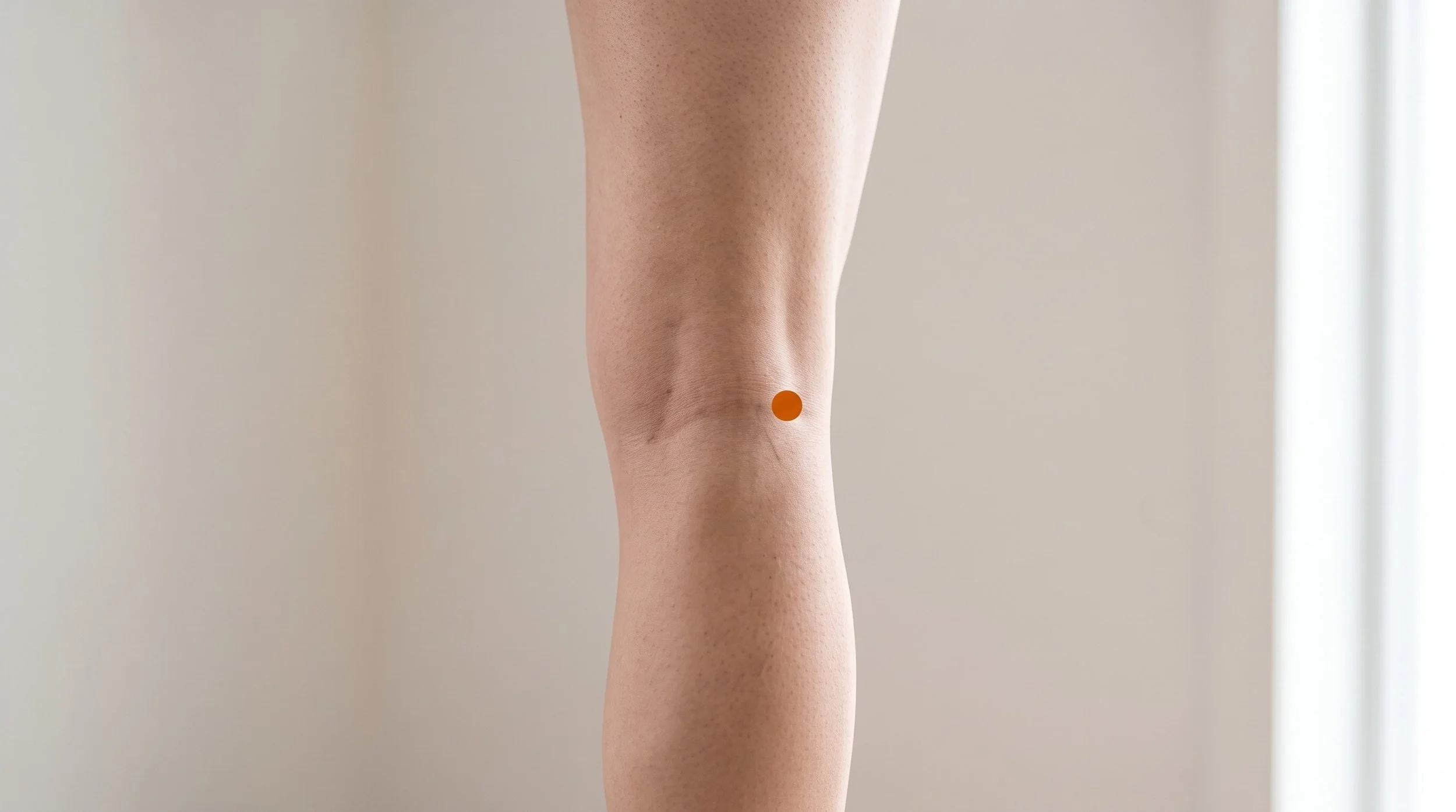
BL39 Acupuncture Point (Weiyang)
The Lower He-Sea Point at the Outer Knee Crease: Anatomy, Mechanism, and Why BL39 Connects Leg Needling to Bladder Function
BL39 (Weiyang, often translated as Outside of the Crook) sits at the back of the knee toward the outer end of the popliteal crease, tucked into the groove on the inner side of the biceps femoris tendon.
In plain terms, bend your knee slightly, find the prominent cord on the outer side of the crease, and slide your fingertip just inside it. Classically this bl39 acupuncture point is the lower he-sea point of the Triple Burner, which is why an old text assigns a leg point responsibility for urination, and clinically it is a practical local point for outer knee-crease pain, hamstring tendon irritation, and low back stiffness that radiates down the leg.
- Location and layers: bladder 39 lies at the lateral end of the popliteal crease on the medial border of the biceps femoris tendon, best located with the knee slightly flexed, and needled perpendicularly 1 to 1.5 cun (Deadman et al., 2007). The needle passes skin, subcutaneous fascia, and the tendon border region rather than open joint space.
- Traditional category translated: classical texts designate BL39 the lower he-sea point of the Triple Burner and describe a direct functional link with the bladder, giving the point its urinary reputation (Deadman et al., 2007; Maciocia, 2006). Read neurophysiologically, that is a claim about lumbosacral somatic afferents influencing pelvic autonomic reflexes rather than about fluid moving through channels.
- Nerve geography: the tissue around BL39 is supplied by the posterior femoral cutaneous nerve and lies immediately medial to the descending common fibular nerve, with segmental input in the L4 to S2 range, which overlaps the spinal levels that also serve bladder and pelvic floor reflexes (Ma, 2020).
- Mechanism: needling here recruits A-delta and C afferents that engage segmental gate control, descending inhibition from the periaqueductal grey and rostral ventromedial medulla, and endogenous opioid release, the same pathways described across acupuncture analgesia research (Zhao, 2008). Somato-autonomic reflex work provides a plausible route for leg-level stimulation to influence visceral function (Ma, 2020).
- Research picture: no trial isolates BL39, so the honest framing is protocol-level. Individual patient data pooling supports modest, persistent effects of acupuncture for chronic musculoskeletal pain (Vickers et al., 2018), Cochrane found acupuncture may improve function in chronic nonspecific low back pain compared with sham (Mu et al., 2020), and urinary trials and reviews of lower urinary tract symptoms are promising but mixed in quality (Liu et al., 2017; Zhong et al., 2018).
- De qi and practice: patients typically report a deep, heavy spreading ache behind and slightly outside the knee, sometimes travelling into the calf. A brief electric flash down the outer lower leg suggests contact with the common fibular nerve, and the needle should be withdrawn slightly and redirected (Deadman et al., 2007).
Outer Knee Pain or Tight Hamstrings Behind the Knee?
Pain at the outer end of the knee crease often involves the biceps femoris tendon, the lateral hamstring, and the way the whole posterior chain loads during running, cycling, and stair work. At Morningside Acupuncture we use BL39 alongside local knee points and dry needling of the hamstring group to reduce tenderness and improve tolerance for loading. Treatment is paired with simple strength and mobility homework so gains hold between visits. Schedule a session and let's assess what is actually driving the pain.
Schedule NowAnatomy of BL39: Why the Outer Popliteal Crease Is Such an Important Location
The tissue at BL39 is thin and mobile at the surface, then quickly organized. Under skin and subcutaneous fat sits the popliteal fascia, and the defining landmark is the biceps femoris tendon, a firm cord running toward the fibular head that becomes obvious when the knee is bent against light resistance. The point sits in the soft depression on the inner side of that cord, just above the lateral head of gastrocnemius.
This corner of the knee absorbs load during deceleration, cutting, hill running, prolonged sitting with the knees flexed, and repetitive cycling, which is why the lateral hamstring tendon and the fascia around it become tender and thickened in active adults and in people who sit for long stretches.
The nerve story is what makes this location clinically interesting. Cutaneous supply here comes largely from the posterior femoral cutaneous nerve, and the common fibular nerve runs along the medial border of the biceps femoris tendon on its way to the fibular neck, with the tibial nerve and popliteal vessels lying more centrally. These structures carry fibers from roughly L4 through S2, and inputs from that range converge in dorsal horn segments that also process signals from the lumbar spine, the posterior thigh, and, at adjacent sacral levels, from the bladder and pelvic floor.
Stimulating this territory can therefore modulate pain in the knee and low back through segmental convergence, and can engage descending inhibitory control from brainstem centers with endogenous opioid involvement (Zhao, 2008). Reviews of somato-autonomic reflexes describe how needling at defined body regions can influence organ-level physiology through spinal and supraspinal autonomic circuits, which offers a mechanistic frame for the classical urinary claims attached to this point (Ma, 2020).
The safety picture is straightforward if you respect the popliteal fossa. The popliteal artery and vein and the tibial nerve lie deeper and more medially, near the center of the crease, while BL39 is deliberately placed lateral to that neurovascular bundle. Standard technique is perpendicular insertion of 1 to 1.5 cun (Deadman et al., 2007), with the knee slightly flexed or supported on a bolster so the tissue is not stretched taut.
Practitioners angle away from the tendon border if a sharp electric sensation appears, avoid aggressive lifting and thrusting near the nerve, and use lighter depth in very lean patients or when there is a Baker's cyst, varicosity, or prior surgical hardware in the area.
Related Biceps Femoris Trigger Points Related Acupuncture For Biceps Femoris Muscle PainBL39 at a Glance: Classification, Location, and Clinical Use
| Category | Detail |
|---|---|
| Traditional Name | Weiyang (Outside of the Crook, also translated as Supporting Yang or Bending Yang) |
| Channel Classification | Bladder channel, point 39 of the foot taiyang line down the back of the body (BL39, also written UB39; also called the Urinary Bladder channel) |
| Point Categories | Lower he-sea point of the Triple Burner (Sanjiao), one of three lower he-sea points assigned to the yang channels of the arm; classical sources also describe a direct link between this point and the bladder fu |
| Precise Location | At the lateral end of the popliteal crease, in the depression on the medial side of the biceps femoris tendon, roughly one thumb width lateral to BL40 at the center of the crease; located with the knee slightly bent |
| Tissue Stimulated | Skin and popliteal fascia, the medial border of the biceps femoris tendon and its distal musculotendinous junction, and the superficial connective tissue overlying the lateral popliteal fossa; the common fibular nerve descends immediately alongside |
| Needle Depth / Direction | Perpendicular insertion 1 to 1.5 cun with the knee slightly flexed or bolstered; angle slightly away from the tendon border if a sharp radiating sensation occurs |
| De Qi Sensation | A deep, heavy, spreading ache at the outer knee crease that may travel into the calf or up the back of the thigh; a brief electric line down the lateral lower leg means the needle is too close to the common fibular nerve and should be adjusted |
| Primary Clinical Uses | Outer knee-crease and lateral hamstring tendon pain, low back stiffness radiating into the leg, calf and leg cramping in classical use, and traditionally difficult urination and retention-pattern symptoms |
| Common Point Combinations |
|
The Deadman text explains that classical theory ran into a problem: the he-sea points of the arm yang channels sit on the upper limb, yet the organs they are supposed to govern, including the intestines and the Triple Burner, do their work in the abdomen and pelvis. The solution recorded in the Spiritual Pivot was to assign each arm yang channel a second, lower he-sea point on the leg, and BL39 became the one belonging to the Triple Burner (Deadman et al., 2007; Maciocia, 2015).
Because the Triple Burner was traditionally described as the official responsible for drainage and the water passages, and because the same classic asserts a direct connection between this point and the bladder, BL39 acquired a specific reputation for problems of urination: retention treated by reducing, involuntary loss treated by reinforcing (Deadman et al., 2007). Later commentators added lumbar stiffness, leg and foot cramping, and swelling as further traditional indications (Cheng, 2010), while modern clinical texts frame the same point around difficult, dribbling, or obstructed urination (Cunningham, 2016).
What makes the pattern striking is not the theory itself but the anatomy underneath it: the classical authors chose a point in the lumbosacral nerve territory to influence pelvic function, centuries before anyone described a sacral micturition reflex.
Why BL39 Is Used for Urinary Symptoms and Not Only Knee Pain
The obvious use of this point is local. It sits where the lateral hamstring tendon crosses the knee, so it is a sensible choice for posterior and outer knee pain, tendon irritation, and calf tightness. The less obvious use is urinary, and the anatomical bridge is segmental. Sensory fibers from the tissue around BL39 enter the cord at roughly L4 through S2, close to and overlapping with the sacral segments that house the parasympathetic and pudendal circuitry for bladder filling and emptying.
Modern urology already exploits this arrangement with tibial nerve neuromodulation for overactive bladder, which stimulates lumbosacral afferents at the ankle to change bladder behavior, and the reflex logic described in the neuroscience literature is the same one that could explain leg-point effects on pelvic function (Ma, 2020).
Two other mechanisms matter for the pain side of the story. Needling recruits small-diameter afferents that inhibit nociceptive signaling within the same spinal segments and activate descending inhibitory pathways from the midbrain and medulla, with endogenous opioids and monoamines involved (Zhao, 2008). Local needling also produces measurable changes in blood flow and in the mechanical behavior of connective tissue around the needle, which is relevant when the target is a chronically loaded tendon border rather than a joint surface.
None of this means BL39 alone resolves urinary problems, and any change in urination, especially retention, hesitancy, blood in the urine, or fever, needs medical evaluation first. In our clinic the point is used inside a broader plan: local knee and lumbar treatment for musculoskeletal presentations, and lower abdominal and sacral points for pelvic and urinary presentations, always alongside appropriate urologic care.
What the Research Shows for BL39
It is worth being clear about what the evidence can and cannot say. There are no trials that needle BL39 in isolation, so the research below tests multi-point protocols in which a lateral popliteal point like this one may or may not have been included. Reviews of acupuncture for chronic pain and for lower urinary tract symptoms are the best available guide to whether the treatment package helps, not to the contribution of any single location. Effects reported are generally modest, quality varies, and sham comparisons in this field remain genuinely difficult to interpret.
| Study | Type | Focus | Key Finding |
|---|---|---|---|
| Mu et al., 2020 | Cochrane systematic review | Acupuncture for chronic nonspecific low back pain, 33 trials and 8,270 participants | Acupuncture may improve back-related function compared with sham, though pain benefits immediately after treatment were uncertain and the overall certainty of evidence was low to moderate. |
| Manheimer et al., 2010 | Cochrane systematic review | Acupuncture for peripheral joint osteoarthritis, including the knee | Small benefits in pain and function were reported against sham, with clinically more relevant differences against waiting list and usual care, so some effect may be non-specific. |
| Vickers et al., 2018 | Individual patient data meta-analysis | Nearly 21,000 patients across chronic pain conditions including back, neck, and osteoarthritis pain | Acupuncture was superior to both sham and no-acupuncture controls, with effects persisting over about a year, supporting more than expectation alone. |
| Liu et al., 2017 | Multicenter randomized clinical trial | Electroacupuncture at lumbosacral points for stress urinary incontinence in women | Six weeks of electroacupuncture reduced measured urine leakage more than sham, suggesting somatic stimulation in lumbosacral territory can influence bladder control. |
| Zhong et al., 2018 | Systematic review and meta-analysis | Electroacupuncture for postoperative urinary retention | Pooled results favored electroacupuncture on retention outcomes, but included trials were small and methodologically limited, so conclusions remain tentative. |
| Ma, 2020 | Mechanistic review | Somato-autonomic reflex pathways activated by needling | Needling defined somatic regions can drive sympathetic and parasympathetic reflexes, offering a plausible route by which limb points influence visceral function. |
Low Back Stiffness That Travels Into the Leg?
When back pain refers down the back of the thigh, treating the lumbar segment alone often leaves half the problem untouched. BL39 gives us access to the lower end of that pain pattern, and we combine it with lumbar and gluteal needling, plus manual and movement care. Most patients notice changes in stiffness and range within a few sessions. Book an appointment to start a structured plan.
Schedule NowBL39 in the Context of Trigger Point Work
Acupuncture is defined by the tool, an acupuncture needle, and that includes dry needling styles that target myofascial trigger points. BL39 happens to sit directly over territory that matters in trigger point terms: the distal biceps femoris and its tendon border. Trigger points in the lateral hamstring commonly refer pain toward the back of the knee and upper calf, which is exactly the region patients point to when they describe deep posterior knee discomfort (Simons et al., 1999).
When we needle here, we are often addressing both the classical point and a taut band in the same pass, then extending treatment along semitendinosus and semimembranosus on the medial side if the pattern is more diffuse.
In practice a session for posterior knee or radiating back pain might combine BL39 and BL40 at the crease, dry needling of the hamstring group and gluteal muscles, and lumbar segmental needling where the referral originates. Electrical stimulation is sometimes added at low frequency for lingering myofascial pain. Because the common fibular nerve runs close by, needling in this area is done with careful depth control and clear communication with the patient, and we adjust immediately if a radiating electric sensation appears rather than pursuing it.
BL39 Knee and Low Back Treatment at NYC's Highest-Rated Acupuncture Clinic
Morningside Acupuncture is the highest-rated acupuncture and dry needling clinic in New York City with over 500 five-star Google reviews, and our approach blends classical point selection with modern pain science. We use bl 39 knee needling as part of individualized protocols for popliteal and lateral knee pain, hamstring tendon irritation, and lumbar pain that radiates. Every plan includes clear expectations about how many sessions a fair trial usually takes. Schedule your visit and get started.
Schedule NowFrequently Asked Questions
What does BL39 feel like when needled?
Most people describe a deep, heavy, slightly spreading ache at the outer end of the knee crease, sometimes with a sense of fullness travelling into the calf or up the back of the thigh. That distending sensation is what practitioners call de qi. A sharp, brief electric flash down the outside of the lower leg is different: it suggests the needle is near the common fibular nerve, and your practitioner should withdraw slightly and redirect. Mild local soreness for a day afterward is common and harmless.
Why needle a point behind the knee for a urinary problem?
Traditionally, BL39 is the lower he-sea point of the Triple Burner, and classical texts describe a direct link between this point and the bladder, which is the source of its urinary reputation (Deadman et al., 2007). Anatomically, the nerves supplying this region carry fibers from around L4 to S2, close to the sacral segments involved in bladder reflexes, and stimulating lumbosacral afferents is an established way to influence bladder behavior in modern neuromodulation (Ma, 2020). That said, urinary symptoms always warrant medical evaluation, and acupuncture is used alongside that care, not instead of it.
Can I press BL39 myself between sessions?
Yes, acupressure here is safe and easy. Sit with your knee bent to about 90 degrees, run your thumb along the back of the knee crease until you feel the firm biceps femoris tendon toward the outer side, then slide just inside it into the soft depression. Apply steady, moderate pressure with your thumb for 30 to 60 seconds, breathing normally, then release and repeat two or three times per side. You can do this two or three times a day. Ease off immediately if you feel a sharp electric sensation down the leg, if the area feels pulsatile, or if there is any swelling behind the knee, and mention any bulge in that area to your clinician.
Is BL39 safe to needle?
In trained hands, yes. The point is deliberately placed lateral to the popliteal artery, vein, and tibial nerve, which sit deeper and more centrally in the fossa, and standard depth is 1 to 1.5 cun perpendicular (Deadman et al., 2007). Practitioners take extra care in lean patients, in anyone on anticoagulants, and when a Baker's cyst, varicose veins, or previous knee surgery changes local anatomy. Reasonable expectations include brief soreness or a small bruise; anything more should be reported.
Where exactly is BL39 located?
Bend your knee slightly so the crease behind it is visible. BL40 sits at the midpoint of that crease. Move laterally, toward the outer side of the leg, until your finger meets the strong biceps femoris tendon, then settle into the small depression on its inner border. That depression, on the crease itself, is the outside of the crook point, roughly one thumb width lateral to BL40. If you tense your hamstrings gently, the tendon becomes prominent and the landmark is unmistakable.
References
- Deadman, P., Al-Khafaji, M., & Baker, K. (2009). A manual of acupuncture. Journal of Chinese Medicine Publications.
- Maciocia, G. (2005). The foundations of Chinese medicine: A comprehensive text for acupuncturists and herbalists (2nd ed.). Elsevier Churchill Livingstone.
- Maciocia, G. (2006). The channels of acupuncture: Clinical use of the secondary channels and eight extraordinary vessels. Churchill Livingstone Elsevier.
- Cheng, X. (Ed.). (1999). Chinese acupuncture and moxibustion (Rev. ed.). Foreign Languages Press.
- Cunningham, P. M. (2000). Acupuncture points: A practical guide to classical and modern usage. Odyssey Press.
- Simons, D. G., Travell, J. G., & Simons, L. S. (1999). Travell & Simons' myofascial pain and dysfunction: The trigger point manual, Vol. 1: Upper half of body (2nd ed.). Williams & Wilkins.
- Mu, J., Furlan, A. D., Lam, W. Y., Hsu, M. Y., Ning, Z., & Lao, L. (2020). Acupuncture for chronic nonspecific low back pain. Cochrane Database of Systematic Reviews, 2020(12), CD013814. https://doi.org/10.1002/14651858.CD013814
- Manheimer, E., Cheng, K., Linde, K., Lao, L., Yoo, J., Wieland, S., van der Windt, D. A. W. M., Berman, B. M., & Bouter, L. M. (2010). Acupuncture for peripheral joint osteoarthritis. Cochrane Database of Systematic Reviews, 2010(1), CD001977. https://doi.org/10.1002/14651858.CD001977.pub2
- Vickers, A. J., Vertosick, E. A., Lewith, G., MacPherson, H., Foster, N. E., Sherman, K. J., Irnich, D., Witt, C. M., & Linde, K. (2018). Acupuncture for chronic pain: Update of an individual patient data meta-analysis. Journal of Pain, 19(5), 455-474. https://doi.org/10.1016/j.jpain.2017.11.005
- Zhao, Z. Q. (2008). Neural mechanism underlying acupuncture analgesia. Progress in Neurobiology, 85(4), 355-375. https://doi.org/10.1016/j.pneurobio.2008.05.004
- Liu, Z., Liu, Y., Xu, H., He, L., Chen, Y., Fu, L., Li, N., Lu, Y., Su, T., Sun, J., Wang, J., Yue, Z., Zhang, W., Zhao, J., Zhou, Z., Wu, J., Zhou, K., Ai, Y., Zhou, J., ... Liu, B. (2017). Effect of electroacupuncture on urinary leakage among women with stress urinary incontinence: A randomized clinical trial. JAMA, 317(24), 2493-2501. https://doi.org/10.1001/jama.2017.7220
- Zhong, Y., Zeng, F., Li, J., Yang, Y., Zhong, S., & Song, Y. (2018). Electroacupuncture for postoperative urinary retention: A systematic review and meta-analysis. Evidence-Based Complementary and Alternative Medicine, 2018, 7612618. https://doi.org/10.1155/2018/7612618
- Ma, Q. (2020). Somato-autonomic reflexes of acupuncture. Medical Acupuncture, 32(6), 362-366. https://doi.org/10.1089/acu.2020.1488
Disclaimer: This web site is intended for educational and informational purposes only. Reading this website does not constitute providing medical advice or any professional services. This information should not be used for diagnosing or treating any health issue or disease. Those seeking medical advice should consult with a licensed physician. Seek the advice of a medical doctor or other qualified health professional for any medical condition. If you think you have a medical emergency, call 911 or go to the emergency room. No acupuncturist-patient relationship is created by reading this website or using the information. Morningside Acupuncture PLLC and its employees and contributors do not make any express or implied representations with respect to the information on this site or its use. For any legal interpretation of scope of practice in your state, consult a licensed attorney or regulatory authority.
Read more from our blog



