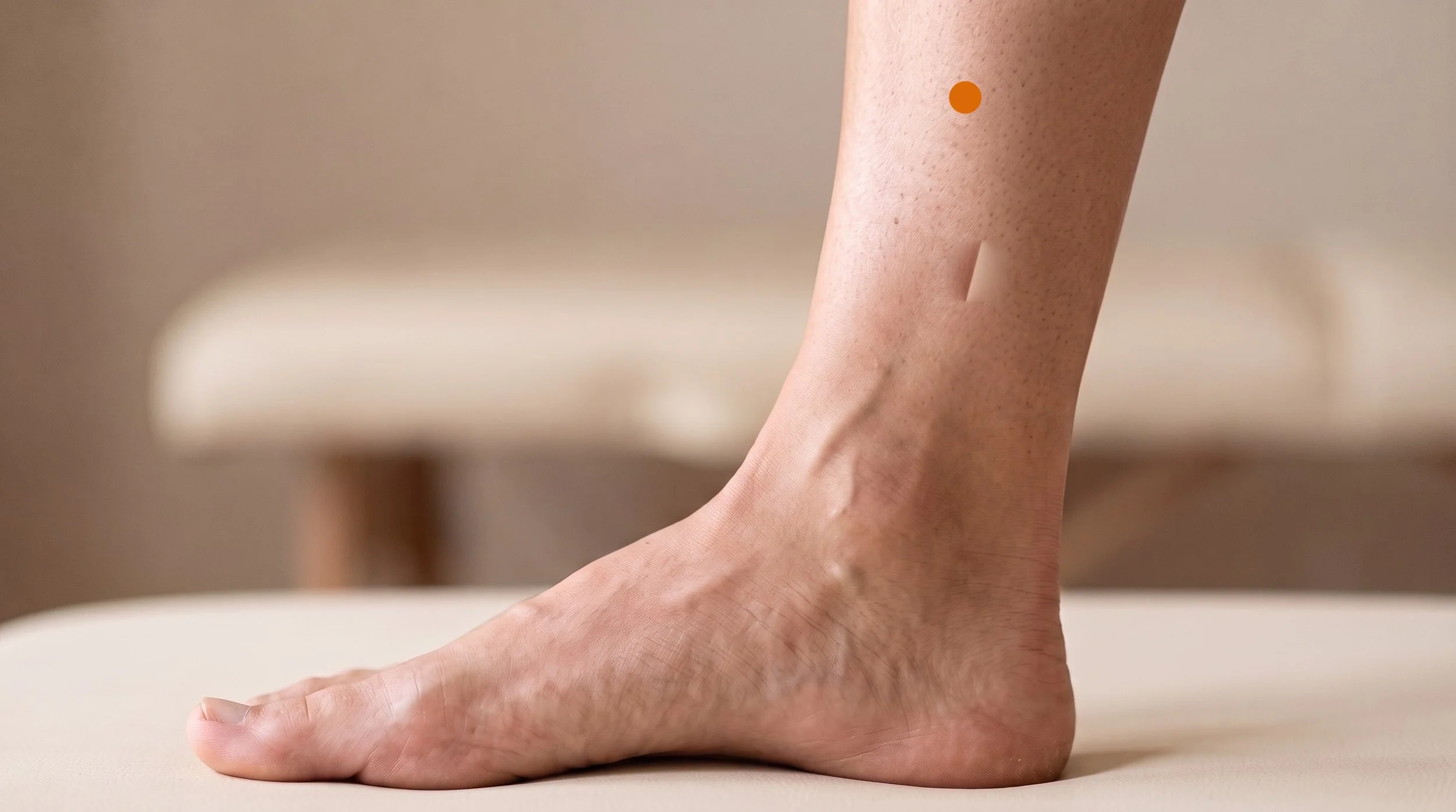
LV5 Acupuncture Point (Ligou)
The Luo Point Above the Inner Ankle: Anatomy, Mechanism, and Why LV5 Anchors Treatment for Period Pain, Pelvic Symptoms, and Throat Tightness
LV5 (Ligou, often translated as Woodworm Canal or Insect Groove), also written LR5, sits on the inner lower leg, five cun above the bony bump of the inner ankle, tucked just behind the sharp front edge of the shinbone in the soft gutter between bone and calf muscle. It is the luo-connecting point of the Liver channel, which in classical terms means it is the branching point where the Liver channel sends a vessel across to the Gall Bladder channel and upward toward the genitals (O'Connor & Bensky, 1981).
That classical anatomy is why the LV5 acupuncture point carries such a distinctive indication list: menstrual pain and irregular cycles, lower abdominal and genital complaints, urinary difficulty, and the odd but very recognizable feeling of a lump in the throat that classical texts call plumstone qi (Deadman et al., 2009). Clinically, it is a quiet, easy to reach point on the lower leg that gets used far more often than its modest reputation suggests.
- Location and layers: LV5 is 5 cun above the tip of the medial malleolus, immediately behind the medial crest of the tibia, in the depression between bone and the gastrocnemius, at the junction of the lower third and upper two thirds of a line from ankle to popliteal crease (Deadman et al., 2009). The needle passes through thin skin and subcutaneous tissue into the crural fascia and the fascial plane hugging the tibial periosteum.
- Traditional categories, translated: classical sources list Ligou as the Liver luo-connecting point, traditionally described as spreading Liver qi, clearing damp-heat from the lower burner, regulating menstruation, and treating plumstone qi (Deadman et al., 2009). In modern language, those are patterns of pelvic pain, urogenital irritation, cycle-related symptoms, and stress-linked throat tightness.
- Nerve story: the point lies in saphenous nerve territory (L3 to L4), with the great saphenous vein running nearby, so needling here recruits a well-mapped cutaneous and deep fascial afferent field rather than the pelvic segments themselves, which means its effects on pelvic symptoms are best explained by descending inhibition and central autonomic modulation (Zhao, 2008).
- Research picture: reviews of acupuncture for menstrual pain remain cautious, with a Cochrane review finding the evidence insufficient to confirm benefit for primary dysmenorrhoea (Smith et al., 2016), while a separate Cochrane review of premenstrual syndrome reported that acupuncture and acupressure may improve physical and psychological symptoms compared with sham, on limited and low-certainty data (Armour et al., 2018).
- Clinical framing: LV5 is rarely a solo point. It is typically used as a distal anchor alongside local abdominal or lumbosacral points, and larger sham-controlled trials of pelvic protocols, such as acupuncture for chronic prostatitis and chronic pelvic pain syndrome, show that multi-point treatment can produce durable symptom change (Sun et al., 2021).
- De qi: because the needle rests against a bony margin under fairly thin tissue, patients usually report a firm, dull, slightly spreading ache along the inner shin, sometimes traveling toward the knee or inner thigh, rather than a sharp sensation.
Struggling With Period Pain That Comes Back Every Month?
At Morningside Acupuncture, LV5 is one of the distal leg points we use inside individualized menstrual health protocols, paired with abdominal and lumbosacral points and, where appropriate, gentle electroacupuncture. We map your cycle, your pain pattern, and your stress load before choosing points, so treatment tracks your actual timeline rather than a generic template. Most patients start with a short series of weekly sessions timed around the cycle. Schedule a visit and let's build a plan around your calendar.
Schedule NowAnatomy of LV5: Why the Medial Tibial Border Is Such an Important Location
Run your thumb up the inner shin from the ankle bone and you will feel a sharp ridge, the medial crest of the tibia, with a soft groove immediately behind it. LV5 sits in that groove five cun above the tip of the medial malleolus, roughly a third of the way up from ankle to knee crease (Deadman et al., 2009). The tissue here is shallow and layered simply: skin, a thin subcutaneous layer carrying superficial veins, the crural fascia, and then the fascial plane that wraps the tibial border and the leading edge of the deep calf flexors.
Because so little muscle bulk covers the bone at this level, the point is easy to find reliably on nearly every body type, and it loads mechanically in runners, walkers, and anyone whose calf and deep flexors work hard on hard city pavement.
The skin and fascia at LV5 are supplied by the saphenous nerve, a sensory branch of the femoral nerve carrying L3 to L4 fibers, and the great saphenous vein runs in the same superficial neighborhood. That matters for mechanism. Needling stimulates A-delta and C fiber afferents in skin, fascia, and periosteum, and those inputs feed spinal dorsal horn circuits and ascend to brainstem and midbrain regions that drive descending inhibitory control through opioid, serotonergic, and noradrenergic pathways (Zhao, 2008).
Pooled individual patient data from chronic pain trials indicate acupuncture produces effects that are modestly but consistently greater than sham and clearly greater than no acupuncture, which is the honest ceiling for what a single distal point contributes (Vickers et al., 2018).
Deeper structures sit farther back and in the deep posterior compartment: flexor digitorum longus and tibialis posterior, and behind them the posterior tibial artery, veins, and tibial nerve. Standard needling technique at LV5 stays well clear of that bundle. Classical needling conventions are perpendicular insertion of 0.5 to 1 cun against the tibial border, or an oblique insertion angled up the leg of 1 to 2 cun when a broader channel effect is wanted (Deadman et al., 2009). Practitioners avoid visible superficial veins, and needle depth is adjusted for slim lower legs where the tibia sits close to the surface.
For patients who like to see how the whole pathway connects, our Liver Channel overview maps the course from the big toe up through the leg, abdomen, and chest.
Related Liver Channel Related LV3 Acupuncture PointLV5 (LR5) at a Glance: Classification, Location, and Clinical Use
| Category | Detail |
|---|---|
| Traditional Name | Ligou (Woodworm Canal, also translated Insect Groove or Gourd Ditch) |
| Channel Classification | Liver channel (Foot Jueyin), fifth point of the channel; LIV-5 in Deadman notation (LV5, also written LR5) |
| Point Categories | Luo-connecting point of the Liver channel; the departure point of the Liver luo vessel, which classically crosses to the Gall Bladder channel and sends a branch up the leg to the genitals |
| Precise Location | Inner lower leg, 5 cun above the prominence of the medial malleolus, just behind the medial crest of the tibia in the depression between bone and gastrocnemius; at the junction of the lower third and upper two thirds of the line from the malleolus to the popliteal crease |
| Tissue Stimulated | Skin and subcutaneous tissue in saphenous nerve territory, crural fascia, tibial periosteal margin, and the anterior edge of the deep calf flexors adjacent to the medial head of the gastrocnemius |
| Needle Depth / Direction | Perpendicular 0.5 to 1 cun against the medial tibial border, or oblique insertion directed proximally up the leg 1 to 2 cun |
| De Qi Sensation | Firm, dull ache with a spreading or heavy quality along the inner shin, sometimes traveling toward the knee or inner thigh; occasionally a brief bone-adjacent pressure sensation |
| Primary Clinical Uses | Menstrual cramping and irregular cycles, lower abdominal and pelvic discomfort, genital itching and irritation in classical use, urinary difficulty in classical use, and the globus or plumstone qi sensation of a lump in the throat |
| Common Point Combinations |
|
Deadman, Al-Khafaji, and Baker's A Manual of Acupuncture presents Ligou as the Liver channel's luo point and, in traditional terms, as a principal point for the genital region, since the Liver primary channel is described as encircling the genitals and the luo vessel from this point is said to ascend there as well.
The classical indication list they compile clusters into four recognizable groups: genital itching, swelling, and pain along with shan disorder and lower abdominal fullness; urinary difficulty and retention; menstrual pain, irregular cycles, vaginal discharge, and uterine prolapse; and a psycho-emotional cluster covering low mood, belching, fearfulness, palpitations, and the throat blockage sensation known as plumstone qi. They also note stiffness and pain in the lower back and cold, aching lower legs, which is consistent with several other Liver channel points.
What makes the pattern striking is its coherence: a single point on the inner shin gathered indications that modern clinicians would file under gynecology, urology, and stress physiology, three domains that classical authors clearly treated as one clinical territory (Deadman et al., 2009).
Why LV5 Is Used for the Sensation of a Lump in the Throat
Globus, the feeling of something stuck in the throat when swallowing is actually normal, is one of the oldest indications attached to this point. Classically it was explained by the Liver channel's ascent to the throat (Maciocia, 2006). Physiologically, the leg and the throat share no spinal segment, so a segmental convergence explanation does not apply here.
What can apply is central: needling generates strong, sustained afferent input that shifts activity in brainstem and limbic circuits involved in threat appraisal, muscle tone, and autonomic balance, the same circuits that keep pharyngeal and suprahyoid muscles subtly braced when a person is anxious or vigilant (Zhao, 2008).
Direct research on acupuncture for globus is still thin, and none of it isolates LV5. A randomized crossover trial of transcutaneous electroacupuncture at other points reported symptom improvement alongside changes in heart rate variability and neuropeptide levels, which the authors interpreted as parasympathetic involvement (Zhou et al., 2020). That is suggestive rather than conclusive, and it is a reasonable model for why a calm, autonomically oriented treatment can help a symptom that fluctuates with mood.
The same logic underlies LV5's pelvic reputation. Distal leg needling does not act on the uterus or bladder segmentally, but it can influence sympathetic outflow and regional blood flow, and a small early study found reduced uterine artery pulsatility index after electroacupuncture in women with high impedance (Stener-Victorin et al., 1996). Combined with descending pain inhibition, that gives a plausible, non-mystical account of why a point on the inner shin belongs in a menstrual or pelvic protocol.
What the Research Shows for LV5 (LR5)
One note on naming before the evidence: in the research literature this point is usually listed as LR5, the WHO standard code, and sometimes as LV5 or LIV5, so it is worth searching all three if you want to read the studies below in full.
Almost no clinical trial tests LV5 by itself. Research on acupuncture for menstrual pain, premenstrual symptoms, pelvic pain, and urinary symptoms tests multi-point protocols delivered over multiple sessions, and Ligou appears in some of them as one distal leg point among several. The fair way to read the evidence is therefore as support for the treatment approach that includes this point, not proof of the point's independent effect.
The findings below range from cautious and inconclusive to reasonably strong, and the honest summary is that acupuncture may reduce symptoms in several of these conditions while evidence quality varies considerably by condition.
| Study | Type | Focus | Key Finding |
|---|---|---|---|
| Smith et al., 2016 | Cochrane systematic review | Acupuncture and acupressure for primary dysmenorrhoea | The reviewers concluded that the available evidence was insufficient to determine whether acupuncture or acupressure reduce period pain, with adverse event data often missing. |
| Armour et al., 2018 | Cochrane systematic review | Acupuncture and acupressure for premenstrual syndrome | Limited, low-certainty evidence from five small trials suggested acupuncture and acupressure may improve physical and psychological premenstrual symptoms compared with sham. |
| Sun et al., 2021 | Multicenter randomized sham-controlled trial | Acupuncture for chronic prostatitis and chronic pelvic pain syndrome | Twenty sessions over eight weeks produced greater symptom improvement than sham, with the difference sustained through 24 weeks of follow-up. |
| Liu et al., 2017 | Randomized clinical trial (JAMA) | Electroacupuncture for stress urinary incontinence in women | Electroacupuncture reduced urinary leakage more than sham electroacupuncture over the treatment period, supporting an effect of needling on lower urinary tract symptoms. |
| Vickers et al., 2018 | Individual patient data meta-analysis | Acupuncture for chronic pain conditions | Acupuncture was superior to both sham and no-acupuncture controls, with effects that persisted over time rather than fading immediately after treatment. |
| Stener-Victorin et al., 1996 | Small prospective physiological study | Electroacupuncture and uterine artery blood flow impedance | Pulsatility index in the uterine arteries fell after a course of electroacupuncture in a small group of women, suggesting a vascular mechanism worth further study. |
| Zhou et al., 2020 | Randomized single-blind crossover trial | Transcutaneous electroacupuncture for globus pharyngeus | Stimulation at certain points improved globus symptoms acutely, with autonomic and neuropeptide changes proposed as the mechanism; LV5 itself was not tested. |
| Zhao, 2008 | Narrative review of neurophysiology | Neural mechanisms of acupuncture analgesia | Needling recruits peripheral afferents that engage spinal and supraspinal opioid, serotonergic, and noradrenergic pathways involved in descending pain inhibition. |
Feeling a Lump in Your Throat With No Medical Explanation?
Globus sensation is one of the oldest indications recorded for Ligou, and it remains one of the most common complaints we hear from stressed New Yorkers after reflux and structural causes have been ruled out. We combine LV5 with points that support autonomic downshifting, plus manual work for jaw, neck, and suprahyoid tension when the throat feels physically tight. Treatment is calm, brief, and easy to fit into a workday. Book a session and we'll assess what is driving the sensation.
Schedule NowLV5 in the Context of Trigger Point Work
Acupuncture, as we define it, is the use of an acupuncture needle, and that includes dry needling styles. At Morningside, the LV 5 leg location often sits within the same treatment field we are already working when someone has medial calf and shin complaints. The point lies at the front margin of the medial gastrocnemius and just superficial to the deep flexor group, and taut bands in the medial head of gastrocnemius and in soleus can refer pain into the calf, the back of the knee, and occasionally the arch of the foot (Simons et al., 1999).
When a patient presents with both cycle-related pelvic symptoms and chronically tight calves, we frequently needle LV5 as a channel point and then treat gastrocnemius and soleus bands as separate myofascial targets in the same session.
The two approaches are not interchangeable and we do not blur them. Trigger point needling aims at a specific taut band and a reproducible referral pattern, while LV5 is selected on channel and pattern logic for a distant symptom picture.
In practice they combine well, because both rely on the same afferent machinery: strong mechanical input to muscle, fascia, and periosteum, followed by local circulatory change and central pain modulation (Zhao, 2008). Patients usually feel the difference clearly, describing the trigger point response as a twitch and cramp and the LV5 response as a deeper, slower ache along the shin.
LV5 Pelvic and Menstrual Treatment at NYC's Highest-Rated Acupuncture Clinic
Morningside Acupuncture is the highest-rated acupuncture and dry needling clinic in New York City with over 500 five-star Google reviews, and our Upper West Side practice blends classical point selection with modern pain science. We use LV5 within broader treatment plans for menstrual cramping, pelvic discomfort, stress-related throat tightness, and lower leg tension. Every plan is explained in plain language, with realistic expectations about how many sessions a change usually takes. Schedule your first visit today.
Schedule NowFrequently Asked Questions
Is LV5 the same point as LR5 or LIV5?
Yes. LV5, LR5, and LIV5 are all codes for the same point, Ligou, point 5 of the Liver channel. LR is the WHO standard abbreviation and the one you will see in most research papers. LV is the form used by many American schools and clinics, and LIV appears in several widely used textbooks. You will also come across it written as Liver 5 or LIV-5. Whichever code is used, the location and the uses are the same.
What does LV5 feel like when needled?
Most people feel a firm, dull ache that spreads a short distance along the inner shin, sometimes with a heavy or pressure-like quality that can travel toward the knee or inner thigh. Because the point sits against the tibial border under fairly thin tissue, the sensation can arrive quickly and feel more solid than it does in fleshy areas. Sharp or electric sensations are not the goal and should be reported right away so the needle can be adjusted.
Why treat a point on the leg for menstrual cramps or a throat sensation?
Distal points are chosen for two reasons. Traditionally, Ligou is the Liver luo point on a channel described as running through the pelvis and up to the throat, which is why classical texts group genital, menstrual, urinary, and throat symptoms under one point (Deadman et al., 2009; Maciocia, 2006). Physiologically, distal needling works less through local anatomy and more through central mechanisms, engaging descending inhibition and autonomic regulation that influence pain and muscle tone at a distance (Zhao, 2008). There is also a practical advantage: the lower leg stays accessible when a patient is lying comfortably and does not need to undress.
Can I press LV5 myself between sessions?
Yes, and it is one of the easier points to self-treat. Sit with the ankle resting on the opposite knee, find the tip of the inner ankle bone, and measure about five cun up the inner shin, which for most adults is roughly a hand width plus a couple of finger widths, or about a third of the way from ankle to knee crease. Slide your thumb just behind the sharp front edge of the shinbone into the soft groove and press with firm, steady pressure angled slightly toward the bone. Hold for 30 to 60 seconds, release, and repeat two or three times per leg, once or twice daily. Slow circular pressure or gentle up and down gliding along the groove also works. Stop if the pressure feels sharp, if you notice a visible vein under the thumb, or if the area is bruised or inflamed.
Is LV5 safe to needle?
In trained hands it is a low-risk point. The main considerations are the superficial veins on the medial leg, which are avoided visually and by palpation, and needle depth, since the tibia sits close to the surface here and standard practice is perpendicular insertion of 0.5 to 1 cun or an oblique proximal insertion of 1 to 2 cun (Deadman et al., 2009). The deep neurovascular bundle of the calf lies well posterior to the needling plane. Extra caution applies for anyone on anticoagulants, with varicose veins, active skin infection, or significant lower leg swelling, and any calf symptom suggesting a possible blood clot should be medically evaluated before needling.
Where exactly is LV5 located?
For Ligou point location, start at the prominence of the medial malleolus, the bump on the inside of the ankle, and measure 5 cun straight up the inner leg. That level falls at the junction of the lower third and upper two thirds of the line between the malleolus and the popliteal crease. From there, move slightly backward off the sharp medial crest of the tibia into the depression between the bone and the calf muscle. Liver 5 sits in that groove, usually tender to firm pressure when relevant.
References
- Deadman, P., Al-Khafaji, M., & Baker, K. (2009). A manual of acupuncture. Journal of Chinese Medicine Publications.
- Maciocia, G. (2006). The channels of acupuncture: Clinical use of the secondary channels and eight extraordinary vessels. Churchill Livingstone Elsevier.
- O'Connor, J., & Bensky, D. (Eds. & Trans.). (1981). Acupuncture: A comprehensive text. Shanghai College of Traditional Medicine. Eastland Press.
- Simons, D. G., Travell, J. G., & Simons, L. S. (1999). Travell & Simons' myofascial pain and dysfunction: The trigger point manual, Vol. 1: Upper half of body (2nd ed.). Williams & Wilkins.
- Smith, C. A., Armour, M., Zhu, X., Li, X., Lu, Z. Y., & Song, J. (2016). Acupuncture for dysmenorrhoea. Cochrane Database of Systematic Reviews, 2016(4), CD007854. https://doi.org/10.1002/14651858.CD007854.pub3
- Armour, M., Ee, C. C., Hao, J., Wilson, T. M., Yao, S. S., & Smith, C. A. (2018). Acupuncture and acupressure for premenstrual syndrome. Cochrane Database of Systematic Reviews, 2018(8), CD005290. https://doi.org/10.1002/14651858.CD005290.pub2
- Sun, Y., Liu, Y., Liu, B., Zhou, K., Yue, Z., Zhang, W., Fu, W., Yang, J., Li, N., He, L., Zang, Z., Su, T., Fang, J., Ding, Y., Qin, Z., Song, H., Hu, H., Zhao, H., Mo, Q., ... Liu, Z. (2021). Efficacy of acupuncture for chronic prostatitis/chronic pelvic pain syndrome: A randomized trial. Annals of Internal Medicine, 174(10), 1357-1366. https://doi.org/10.7326/M21-1814
- Liu, Z., Liu, Y., Xu, H., He, L., Chen, Y., Fu, L., ... Liu, B. (2017). Effect of electroacupuncture on urinary leakage among women with stress urinary incontinence: A randomized clinical trial. JAMA, 317(24), 2493-2501. https://doi.org/10.1001/jama.2017.7220
- Zhou, W., Deng, Q., Jia, L., Zhao, H., Yang, M., Dou, G., He, Z., & Guo, W. (2020). Acute effect of transcutaneous electroacupuncture on globus pharyngeus: A randomized, single-blind, crossover trial. Frontiers in Medicine, 7, 179. https://doi.org/10.3389/fmed.2020.00179
- Stener-Victorin, E., Waldenström, U., Andersson, S. A., & Wikland, M. (1996). Reduction of blood flow impedance in the uterine arteries of infertile women with electro-acupuncture. Human Reproduction, 11(6), 1314-1317. https://doi.org/10.1093/oxfordjournals.humrep.a019378
- Vickers, A. J., Vertosick, E. A., Lewith, G., MacPherson, H., Foster, N. E., Sherman, K. J., Irnich, D., Witt, C. M., & Linde, K. (2018). Acupuncture for chronic pain: Update of an individual patient data meta-analysis. Journal of Pain, 19(5), 455-474. https://doi.org/10.1016/j.jpain.2017.11.005
- Zhao, Z. Q. (2008). Neural mechanism underlying acupuncture analgesia. Progress in Neurobiology, 85(4), 355-375. https://doi.org/10.1016/j.pneurobio.2008.05.004
Disclaimer: This web site is intended for educational and informational purposes only. Reading this website does not constitute providing medical advice or any professional services. This information should not be used for diagnosing or treating any health issue or disease. Those seeking medical advice should consult with a licensed physician. Seek the advice of a medical doctor or other qualified health professional for any medical condition. If you think you have a medical emergency, call 911 or go to the emergency room. No acupuncturist-patient relationship is created by reading this website or using the information. Morningside Acupuncture PLLC and its employees and contributors do not make any express or implied representations with respect to the information on this site or its use. For any legal interpretation of scope of practice in your state, consult a licensed attorney or regulatory authority.
Read more from our blog



