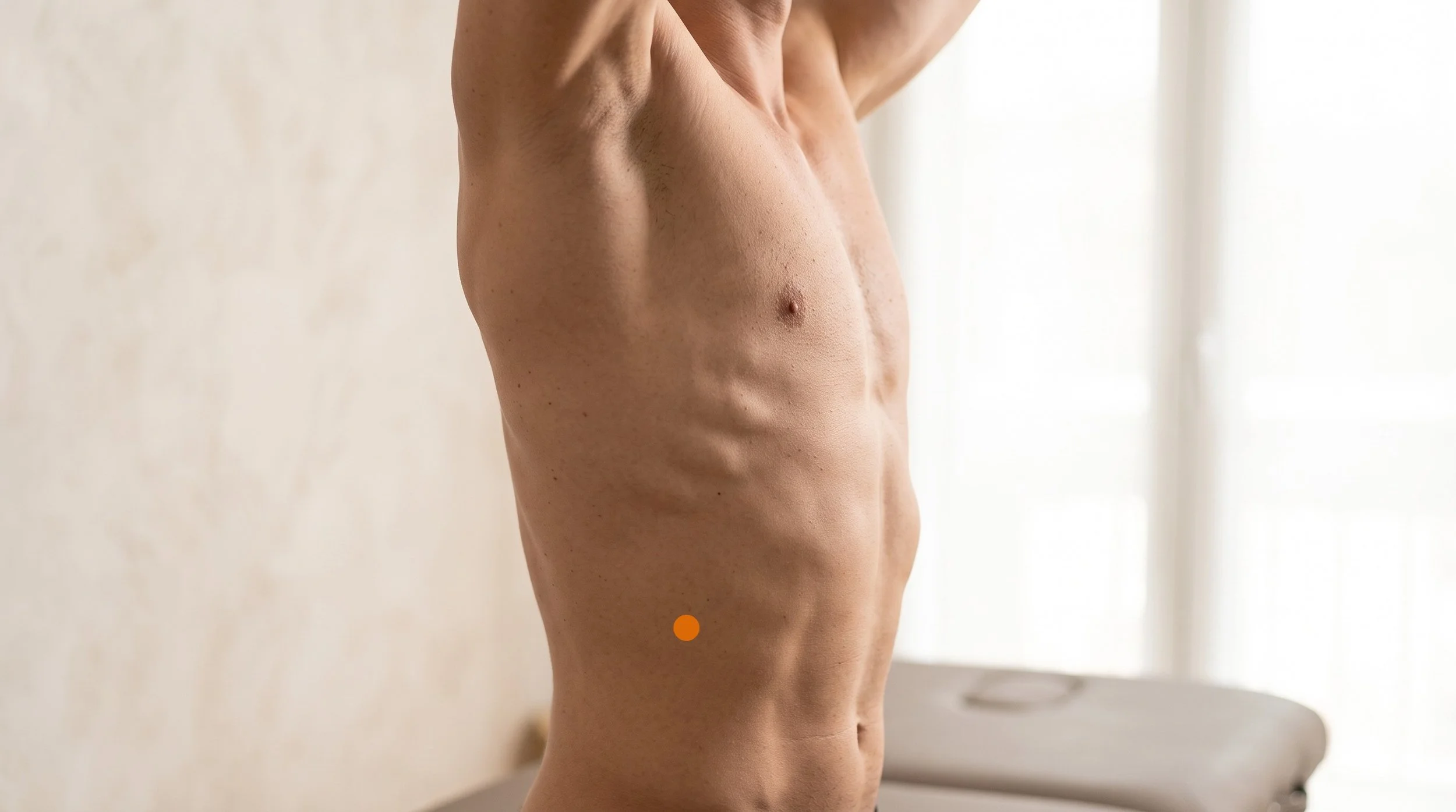
GB25 Acupuncture Point (Jingmen)
The Capital Gate at the Tip of the Twelfth Rib: Anatomy, Segmental Mechanism, and Why the Kidney Front-Mu Point Sits Where Flank and Low Back Pain Converge
GB25, known as Jingmen or Capital Gate, is the twenty-fifth point on the Gallbladder channel and the front-mu (alarm) point of the Kidneys. You will find it on the side of the trunk, just below and slightly in front of the free-floating end of the twelfth rib, in the soft lateral space between the lower ribcage and the top of the pelvis.
That small patch of flank is clinically busy: it sits over the layered abdominal wall muscles, close to the upper attachments of quadratus lumborum, within the T11 to T12 nerve territory, and directly superficial to the region where the kidney and ureter send their own sensory traffic into the spinal cord.
Classical texts assigned it to lumbar weakness, flank and rib pain, urinary difficulty, and cold digestive complaints; modern practice keeps using the GB25 acupuncture point mainly for flank pain and stubborn low back pain that flares with prolonged standing.
- Location and layers: gallbladder 25 lies below and in front of the free end of the twelfth rib, over skin, subcutaneous fat, and the three layers of the lateral abdominal wall (external oblique, internal oblique, transversus abdominis), with the thoracolumbar fascia and quadratus lumborum just posterior and the kidney deeper and more posterior still (Deadman et al., 2009).
- Category translated: the classical designation as front-mu point of the Kidneys is best understood in modern terms as a viscerosomatic reference zone, since the front-mu points sit within the surface areas that clinical anatomy long ago mapped as regions of referred sensitivity for their associated organs (O'Connor & Bensky, 1981).
- Mechanism: needling here recruits the eleventh intercostal and subcostal nerves, so afferent input enters the cord at roughly T11 and T12, the same segmental neighborhood that receives sympathetic afferents from the kidney and upper ureter, which is a plausible route for segmental modulation of both flank wall pain and deep visceral aching (Cheng, 1999; Zhao, 2008).
- Research picture: no trial isolates GB25, but reviews of acupuncture for chronic low back pain, the condition GB25 is most often used for, report modest benefit over sham and clearer benefit over no treatment or usual care (Mu et al., 2020), and the largest patient-level dataset supports durable effects for chronic musculoskeletal pain (Vickers et al., 2018).
- Clinical framing: at Morningside, GB25 is chosen when flank and lateral rib pain travels with lumbar pain, when standing for long periods is the aggravating factor, or when the twelfth rib region is tender on palpation, and it is typically combined with local paraspinal and quadratus lumborum needling rather than used alone (Simons et al., 1999).
- De qi and safety: patients usually report a dull, spreading, slightly heavy ache under the rib tip that can wrap toward the back; because the abdominal wall is thin here, needling stays perpendicular and shallow, 0.5 to 1 cun, and deep insertion is avoided in slim patients (Deadman et al., 2009).
Flank Pain That Wraps Into Your Low Back?
Pain at the bottom rib that spreads toward the spine is one of the most commonly mislabeled patterns we see, and it often involves the abdominal wall, quadratus lumborum, and the twelfth rib region together. We use GB25 alongside careful palpation of the rib tip and the lateral lumbar tissue to map where your pain is actually generated. Treatment blends traditional acupuncture with trigger point dry needling, manual therapy, and simple loading advice you can use between visits. Schedule an evaluation and let's find the driver instead of chasing the ache.
Schedule NowAnatomy of GB25: Why the Free End of the Twelfth Rib Is Such an Important Location
The twelfth rib is a floating rib: it attaches to the spine behind but ends free in the side of the trunk, with no cartilage anchoring it to the sternum. GB25 sits just below and in front of that free tip. Moving from the surface inward, a needle passes skin and subcutaneous fat, then the aponeurotic and muscular fibers of external oblique, internal oblique, and transversus abdominis, with the thoracolumbar fascia and the upper attachments of quadratus lumborum lying just behind and deep to the point (Deadman et al., 2009).
This tissue stack is loaded every time you rotate, side bend, breathe hard, or stabilize a heavy carry on one side, which is why the region becomes tender in people who lift, run, row, or simply sit rotated at a desk for years. The obliques and quadratus lumborum are both well-documented sources of referred pain into the flank, lower back, and iliac crest (Simons et al., 1999).
The segmental story is what makes this location interesting. The region is supplied by the eleventh intercostal and subcostal nerves, with matching intercostal vessels (Cheng, 1999). Those nerves carry sensation from a band of trunk at roughly T11 and T12, and the kidney and upper ureter send their own afferent traffic into the cord at overlapping thoracolumbar levels. When two input streams converge on the same dorsal horn neurons, deep visceral irritation can be felt in the body wall, and conversely, stimulating the body wall can modulate processing at that same segment.
This convergence is the modern explanation for why the front-mu points map so closely onto classically described zones of organ-referred surface tenderness (O'Connor & Bensky, 1981). Needling also engages broader systems: mechanical stimulation of muscle and fascia drives A-delta and C fiber input that recruits descending inhibitory pathways using endogenous opioids, serotonin, and norepinephrine, which is why effects are not limited to the needled dermatome (Zhao, 2008).
Depth discipline matters here. The kidney sits deep and posterior to this region, and the peritoneal cavity lies beneath a thin abdominal wall in slim patients, so classical needling conventions keep GB25 perpendicular and conservative at 0.5 to 1 cun, with the explicit caution that deep insertion in thin subjects may reach the peritoneal cavity (Deadman et al., 2009). Other texts are more conservative still, listing 0.3 to 0.5 cun with moxibustion permitted (Cheng, 1999; Kim, 2008).
In practice we palpate the rib tip first, angle away from the deep space rather than toward it, use shorter and finer needles on lean patients, and never needle blindly through tissue we have not assessed.
Related Acupuncture For Low Back Pain Related Muscles That Cause Low Back PainGB25 at a Glance: Classification, Location, and Clinical Use
| Category | Detail |
|---|---|
| Traditional Name | Jingmen (Capital Gate, also translated Capital Door) |
| Channel Classification | Gallbladder channel, point 25 (GB25, gallbladder 25) |
| Point Categories | Front-mu (alarm) point of the Kidneys; commonly paired with BL23 as the corresponding back-shu point; listed among trajectory points of the Gallbladder divergent channel |
| Precise Location | On the side of the trunk, just below and anterior to the free end of the twelfth rib. To confirm Jingmen point location, place a flat hand on the upper abdomen and walk the fingers down the costal margin until the eleventh rib tip is felt near umbilicus level (LV13), then continue along the rib border into the lateral lumbar region to the shorter twelfth rib tip |
| Tissue Stimulated | External and internal oblique and transversus abdominis at the rib tip, thoracolumbar fascia, with quadratus lumborum and abdominal obliques as adjacent myofascial targets |
| Needle Depth / Direction | Perpendicular insertion 0.5 to 1 cun, angled away from the deep abdominal and retroperitoneal space; shallower (0.3 to 0.5 cun) in thin patients; moxibustion is traditionally permitted |
| De Qi Sensation | A dull, heavy, spreading ache under the rib tip, sometimes traveling toward the back or around the flank; sharp or radiating sensation means the needle is repositioned |
| Primary Clinical Uses | Flank and lateral rib pain, lumbar pain aggravated by prolonged standing, spinal and lumbar weakness, hip and back pain; classically also urinary difficulty and cold-type digestive complaints |
| Common Point Combinations |
|
In the Deadman, Al-Khafaji and Baker text, Jingmen is presented as the front-mu point of the Kidneys, and the authors explain that mu means to gather, describing the front-mu points as places where the qi of an organ was traditionally said to concentrate on the front surface of the body.
The actions attributed to GB25 in that tradition cluster into three groups: supporting the Kidney and Spleen relationship, so that classical indications include cold or damp diarrhea, rumbling in the abdomen, and abdominal fullness; regulating the water passages, so that difficult or dark urine, facial puffiness, and thirst appear in the classical lists; and strengthening the lumbar region, giving indications such as spinal weakness and lumbar pain with an inability to stand for long.
Because the point also sits on the Gallbladder channel along the flank, the same commentary notes its use for combined back and lateral costal pain, including renal colic, and for hip pain. These are traditional attributions rather than physiological claims, but the pattern is striking: a point named for the flank ended up carrying indications that map neatly onto the shared thoracolumbar segments serving the kidney, the lateral abdominal wall, and the lumbar region.
Why GB25 Is Used for Low Back Pain That Only Hurts After You Have Been Standing a While
Patients are often surprised that a point on the side of the trunk gets used for back pain. The anatomy explains it. Quadratus lumborum runs from the top of the pelvis to the twelfth rib and the lumbar transverse processes, so the tissue immediately behind GB25 is under constant low-level demand whenever you stand, walk on uneven ground, or hold a bag on one side. That muscle is a classic source of deep lumbar and iliac crest pain, and it commonly co-loads with the obliques at the same rib tip (Simons et al., 1999).
Needling at this level delivers input through the eleventh intercostal and subcostal nerves into T11 and T12 segments, the same segments that receive input from the lower lumbar body wall and from deep retroperitoneal structures, which gives a straightforward segmental route for changing how that region is processed (Cheng, 1999).
Beyond the segment, needling recruits system-wide analgesic machinery. Experimental work indicates that acupuncture stimulation activates descending inhibitory control involving endogenous opioid peptides, serotonergic and noradrenergic pathways, and changes in central pain processing, which is why relief is often reported at sites beyond the needled area and why effects can outlast the session (Zhao, 2008). This helps make sense of the classical claim that a flank point could address lumbar weakness and hip pain at once, without needing any literal notion of energy traveling down a channel.
There is also a visceral angle worth naming carefully. GB25 sits in the surface region long associated with kidney referral, and acupuncture has been tested in acute renal colic, where an emergency department trial found that adding acupuncture to standard analgesia improved early pain response compared with sham (Tu et al., 2022). That does not mean GB25 treats kidney stones, and flank pain with fever, blood in the urine, or severe colicky pain always needs medical evaluation first. It does mean the segmental neighborhood is one where somatic input and autonomic regulation plausibly interact.
What the Research Shows for GB25
There is no clinical trial that isolates GB25 as a single-point intervention, so the honest framing is this: the evidence base tests multi-point protocols for conditions GB25 belongs to, most often chronic low back pain and flank or urinary complaints, and GB25 appears as one component of those prescriptions. Reviews consistently show that acupuncture outperforms no treatment and usually usual care, with smaller and less certain differences against sham needling, which is a pattern common across manual therapies where credible placebo controls are difficult to build. Read the studies below as support for treating this region and these conditions with needling, not as proof about one point.
| Study | Type | Focus | Key Finding |
|---|---|---|---|
| Mu et al., 2020 | Cochrane systematic review | Acupuncture for chronic nonspecific low back pain, 33 trials and over 8,000 participants | Acupuncture may improve pain and function compared with no treatment and usual care, with smaller and less certain differences versus sham. |
| Rizzo et al., 2025 | Cochrane overview of reviews | Non-drug and non-surgical treatments for low back pain in adults | Acupuncture is among the non-drug options with the more favorable evidence profile for chronic low back pain, though certainty varies across comparisons. |
| Vickers et al., 2018 | Individual patient data meta-analysis | Nearly 21,000 patients with chronic musculoskeletal pain, including back and neck pain | Acupuncture was superior to sham and to no-acupuncture control, with effects that persisted over about a year. |
| Tu et al., 2022 | Randomized clinical trial | Adjunctive acupuncture for acute renal colic in the emergency department | Adding acupuncture to standard analgesia improved early pain response rates compared with sham acupuncture in this single-center trial. |
| Liu et al., 2017 | Multicenter randomized clinical trial | Electroacupuncture for stress urinary incontinence in women | Electroacupuncture reduced urine leakage compared with sham, suggesting needling can influence lower urinary tract function, though sacral rather than flank points were used. |
| Zhao, 2008 | Narrative review of mechanism research | Neural mechanisms of acupuncture analgesia | Analgesic effects are attributed to segmental spinal modulation plus descending inhibitory pathways using opioid and monoamine signaling. |
Low Back Pain That Gets Worse the Longer You Stand?
Classical sources linked Jingmen to lumbar pain with an inability to stand for long, and that description still fits many desk-bound and on-your-feet New Yorkers. Our clinicians combine GB25 with local lumbar points, kidney back-shu region needling, and dry needling of the muscles that load the lower ribs and pelvis. Sessions are focused, evidence-informed, and paired with practical mobility and strength homework. Book a visit and get a plan built around how your back actually behaves.
Schedule NowGB25 in the Context of Trigger Point Work
Dry needling is one of the many styles that use an acupuncture needle, and at Morningside it is integrated into the same session rather than treated as a separate service. When a patient presents with flank and lumbar pain, GB25 frequently sits within a few centimeters of the myofascial targets we want anyway: the upper attachment region of quadratus lumborum, the lateral fibers of external and internal oblique at the twelfth rib, and the lower slips of the erector group.
Quadratus lumborum trigger points are documented to refer along the iliac crest, into the lower back, and sometimes toward the hip, while abdominal oblique trigger points can produce flank and lower abdominal discomfort that is easily mistaken for something visceral (Simons et al., 1999).
The practical workflow is palpation first. We locate the twelfth rib tip, assess tissue tone above and below it, and check whether pressure there reproduces the patient's familiar pain. If it does, treatment may combine a conservative perpendicular needle at GB25 with more specific needling of quadratus lumborum, iliocostalis lumborum, or the obliques, followed by breathing and hip hinge retraining so the region is not immediately reloaded the same way. Depth discipline is non-negotiable in this area, and needling is always guided by rib landmarks rather than by counting inches from a diagram.
GB25 Flank and Low Back Pain Treatment at NYC's Highest-Rated Acupuncture Clinic
Morningside Acupuncture is the highest-rated acupuncture and dry needling clinic in New York City with over 500 five-star Google reviews. We treat flank pain, rib-region pain, and chronic low back pain using GB25 within a full assessment that includes movement testing and myofascial palpation. Every plan is individualized, and we tell you honestly what acupuncture may and may not change. Schedule your appointment today at our Upper West Side office.
Schedule NowFrequently Asked Questions
What does GB25 feel like when needled?
Most patients describe a dull, heavy, slightly spreading ache directly under the free end of the twelfth rib, sometimes with a sense of the sensation wrapping toward the back or down into the flank. Some feel a brief twitch if the needle contacts a taut band in the oblique or quadratus lumborum region. It should not feel sharp, electric, or radiating; if it does, we withdraw slightly and redirect. Because the tissue here moves with breathing, the sensation often eases within a minute or two of the needle settling.
Why treat a point on my side when my pain is in my back?
Because the anatomy connects them. Quadratus lumborum attaches to the twelfth rib and the pelvis, so tension at the rib tip is often part of the same mechanical story as deep lumbar pain, and its referral patterns include the low back and iliac crest (Simons et al., 1999). Needling at this level also feeds into the T11 and T12 spinal segments, which share processing territory with the lower back and deeper structures, so input at the flank can modulate how back pain is perceived (Cheng, 1999; Zhao, 2008). Classical texts arrived at a similar clinical conclusion by pattern observation, listing Jingmen for combined back and lateral costal pain.
Can I press GB25 myself between sessions?
Yes, acupressure at this location is reasonable when done gently. Stand or lie on your side, slide your fingers down along the lower ribs on the side of your trunk until you find the last short rib that ends free, then move just below and slightly forward of that tip. Use flat finger pads, not a knuckle or a tool, and apply light to moderate pressure that registers as a satisfying ache and never as sharp pain. Hold for 30 to 60 seconds, breathe normally so you can feel the tissue move under your fingers, then release and repeat two or three times per side, once or twice daily. Stop immediately if pressure produces nausea, sharp pain, or any pain that radiates into the groin or down the leg, and check in with a clinician before continuing.
Is GB25 safe to needle?
It is safe when needled by a trained clinician who respects depth. The abdominal wall at the twelfth rib is thin, the peritoneal cavity lies beneath it, and the kidney sits deeper and more posterior, so classical guidance keeps insertion perpendicular and limited to roughly 0.5 to 1 cun, with explicit caution against deep needling in thin patients (Deadman et al., 2009). Some texts recommend an even more conservative 0.3 to 0.5 cun (Cheng, 1999). We adjust needle length and depth to body composition, avoid angling toward deep structures, and do not needle over areas of unexplained flank pain, recent trauma, suspected rib fracture, or acute abdominal symptoms until those are medically evaluated.
Where exactly is GB25 located?
GB25 is on the side of the trunk, just inferior and slightly anterior to the free end of the twelfth rib. The reliable way to find it is to place a flat hand on the upper abdomen and walk your fingers down along the costal margin until you feel the eleventh rib tip near the level of the navel, which marks LV13, then continue along the lower rib border backward into the lateral lumbar region until you reach the shorter, more posterior twelfth rib tip (Deadman et al., 2009). GB25 sits at that lower border. Rib anatomy varies, so the palpated landmark always wins over a measurement taken from an illustration.
References
- Deadman, P., Al-Khafaji, M., & Baker, K. (2009). A manual of acupuncture. Journal of Chinese Medicine Publications.
- Cheng, X. (Ed.). (1999). Chinese acupuncture and moxibustion (Rev. ed.). Foreign Languages Press.
- O'Connor, J., & Bensky, D. (Eds. & Trans.). (1981). Acupuncture: A comprehensive text. Shanghai College of Traditional Medicine. Eastland Press.
- Kim, H. (2008). Handbook of Oriental medicine (3rd ed.). Harmony & Balance Press.
- Simons, D. G., Travell, J. G., & Simons, L. S. (1999). Travell & Simons' myofascial pain and dysfunction: The trigger point manual, Vol. 1: Upper half of body (2nd ed.). Williams & Wilkins.
- Mu, J., Furlan, A. D., Lam, W. Y., Hsu, M. Y., Ning, Z., & Lao, L. (2020). Acupuncture for chronic nonspecific low back pain. Cochrane Database of Systematic Reviews, 2020(12), CD013814. https://doi.org/10.1002/14651858.CD013814
- Rizzo, R. R. N., Cashin, A. G., Wand, B. M., Ferraro, M. C., Sharma, S., Lee, H., O'Hagan, E., Maher, C. G., Furlan, A. D., van Tulder, M. W., & McAuley, J. H. (2025). Non-pharmacological and non-surgical treatments for low back pain in adults: An overview of Cochrane reviews. Cochrane Database of Systematic Reviews, 2025(3), CD014691. https://doi.org/10.1002/14651858.CD014691.pub2
- Vickers, A. J., Vertosick, E. A., Lewith, G., MacPherson, H., Foster, N. E., Sherman, K. J., Irnich, D., Witt, C. M., & Linde, K. (2018). Acupuncture for chronic pain: Update of an individual patient data meta-analysis. Journal of Pain, 19(5), 455-474. https://doi.org/10.1016/j.jpain.2017.11.005
- Tu, J. F., Cao, Y., Wang, L. Q., Shi, G. X., Jia, L. C., Liu, B. L., Yao, W. H., Pei, X. L., Cao, Y., Li, H. W., Yan, S. Y., Yang, J. W., Qu, Z. C., & Liu, C. Z. (2022). Effect of adjunctive acupuncture on pain relief among emergency department patients with acute renal colic due to urolithiasis: A randomized clinical trial. JAMA Network Open, 5(8), e2225735. https://doi.org/10.1001/jamanetworkopen.2022.25735
- Liu, Z., Liu, Y., Xu, H., He, L., Chen, Y., Fu, L., Li, N., Lu, Y., Su, T., Sun, J., Wang, J., Yue, Z., Zhang, W., Zhao, J., Zhou, Z., Wu, J., Zhou, K., Ai, Y., Zhou, J., ... Liu, B. (2017). Effect of electroacupuncture on urinary leakage among women with stress urinary incontinence: A randomized clinical trial. JAMA, 317(24), 2493-2501. https://doi.org/10.1001/jama.2017.7220
- Zhao, Z. Q. (2008). Neural mechanism underlying acupuncture analgesia. Progress in Neurobiology, 85(4), 355-375. https://doi.org/10.1016/j.pneurobio.2008.05.004
Disclaimer: This web site is intended for educational and informational purposes only. Reading this website does not constitute providing medical advice or any professional services. This information should not be used for diagnosing or treating any health issue or disease. Those seeking medical advice should consult with a licensed physician. Seek the advice of a medical doctor or other qualified health professional for any medical condition. If you think you have a medical emergency, call 911 or go to the emergency room. No acupuncturist-patient relationship is created by reading this website or using the information. Morningside Acupuncture PLLC and its employees and contributors do not make any express or implied representations with respect to the information on this site or its use. For any legal interpretation of scope of practice in your state, consult a licensed attorney or regulatory authority.
Read more from our blog



