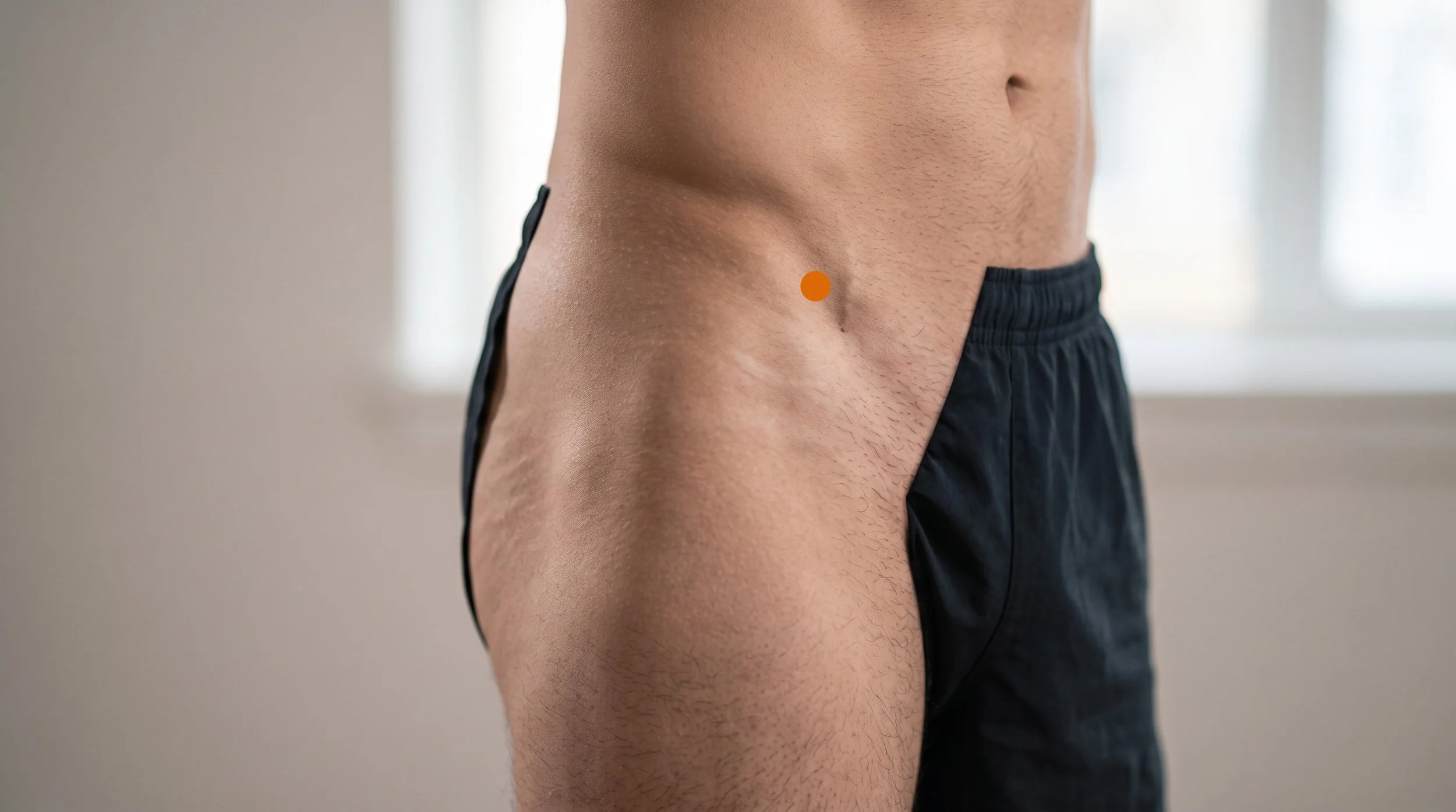
GB27 Acupuncture Point (Wushu)
The Five Pivots at the Front of the Hip Bone: Anatomy, Girdling Vessel Mechanisms, and Why GB27 Sits Where Pelvic Complaints Meet Hip Flexor Pain
GB27 (Wushu, translated as Five Pivots) is a Gallbladder channel point on the side of the lower abdomen, tucked into the small hollow just in front of the anterior superior iliac spine (the sharp bony point at the front of the pelvis), roughly level with CV4 about three cun below the navel.
Classically it's listed as a meeting point of the Gallbladder channel with the Girdling vessel, the horizontal belt-like pathway that encircles the waist, and traditional texts used it for lower abdominal and pelvic complaints as well as pain through the low back and iliac region.
Modern clinicians reach for the GB27 acupuncture point for a different but overlapping reason: it sits directly over the crowded attachment zone where the inguinal ligament, sartorius, tensor fasciae latae and the abdominal wall all converge on one bony prominence, which makes it a practical entry point for front-of-hip and iliac crest pain as well as pelvic-side discomfort.
- Location and layers: gallbladder 27 lies in the depression immediately anterior to the anterior superior iliac spine (ASIS), level with CV4, and the needle passes through skin, subcutaneous fat and the aponeurotic sheet of the lateral abdominal wall toward the dense attachment field of the inguinal ligament, sartorius and tensor fasciae latae (Deadman et al., 2009).
- Traditional categories, in plain terms: classical sources classify Wushu as a coalescent point of the Girdling (Dai) vessel along with GB26 and GB28, with attributed actions of regulating that vessel, regulating the lower jiao and transforming stagnation, a framework that maps onto a modern interest in lower abdominal wall, pelvic and hip flexor tissue (Deadman et al., 2009; Maciocia, 2005).
- Nerve geography: the region is supplied segmentally by the T12 to L1 iliohypogastric and ilioinguinal nerves and crossed by the lateral femoral cutaneous nerve at L2 to L3, so input from this site converges in spinal segments that also receive afferents from pelvic structures, one plausible basis for the classical pelvic indications (Zhao, 2008).
- Mechanism: needling here recruits A-delta and group III afferents that drive segmental inhibition and descending pain modulation involving endogenous opioid and monoaminergic systems, rather than moving any literal energy along a belt (Zhao, 2008).
- Research picture: no trial isolates GB27, so the honest framing is indirect. Individual patient data pooling suggests acupuncture produces modest, durable benefits in chronic musculoskeletal pain (Vickers et al., 2018), while gynecological and pelvic pain reviews are mixed to uncertain (Smith et al., 2016; Lin et al., 2023).
- De qi and practice framing: patients usually report a dull, spreading heaviness around the front of the hip bone that may drift toward the groin or lateral thigh. A brief electrical zing down the anterolateral thigh suggests contact near the lateral femoral cutaneous nerve and is a signal to withdraw and redirect.
Front-of-Hip or Iliac Crest Pain That Won't Settle?
Pain at the point of the hip bone often involves several tissues at once: the inguinal ligament attachment, the sartorius and tensor fasciae latae origins, and the abdominal wall pulling on the crest.
At Morningside Acupuncture we use GB27 as a local access point into that attachment zone, then add dry needling of the hip flexors and lateral hip when the exam points there. Treatment is paired with loading advice so the tissue tolerates walking, stairs and training again. Schedule a visit and we'll map exactly which structure is driving your symptoms.
Schedule NowAnatomy of GB27: Why the Front Corner of the Iliac Crest Is Such an Important Location
Slide your hand down the side of your lower belly and you'll bump into a firm bony prominence: that's the anterior superior iliac spine, and GB27 sits in the soft hollow just in front of and slightly medial to it. Superficially there's skin and a variable layer of subcutaneous fat. Underneath, this small area is unusually busy.
The external and internal oblique muscles and transversus abdominis anchor to the nearby iliac crest, the inguinal ligament takes its lateral attachment right at the ASIS, sartorius originates from the same prominence and runs diagonally down the thigh, and tensor fasciae latae begins just below and lateral to it. Prolonged sitting, deep hip flexion in cycling or rowing, heavy sprinting, and repeated trunk side bending all load this convergence, which is why the region so often becomes tender in athletes and desk-bound New Yorkers alike.
Neurologically, the Wushu point location sits at a segmental crossroads. Skin and superficial fascia here are supplied largely by the iliohypogastric and ilioinguinal nerves from T12 and L1, while the lateral femoral cutaneous nerve (L2 to L3) passes close to the ASIS beneath the inguinal ligament on its way to the anterolateral thigh. Those same lower thoracic and upper lumbar segments carry sympathetic outflow toward pelvic structures, so somatic input from this spot converges in the dorsal horn with visceral afferent traffic from the pelvis.
Needling stimulates small-diameter afferents that trigger segmental gating and engage descending inhibitory pathways in the brainstem, along with endogenous opioid and monoaminergic mechanisms measured in mechanistic research (Zhao, 2008). That convergence, not any belt of circulating energy, is the most reasonable modern account of why a point on the hip bone was used historically for symptoms felt deep in the pelvis.
Deep to the abdominal wall in this region lie the iliacus muscle against the inner surface of the ilium and, more medially, the peritoneal cavity and bowel. Classical texts describe perpendicular insertion of roughly 1 to 1.5 cun (Deadman et al., 2009), while other modern references use a more conservative 0.5 to 1.0 cun (Kim, 2008).
In practice, angle matters more than depth: needling toward the bony ilium rather than medially into the abdomen keeps the technique safe, and depth should be reduced in slender patients. The femoral neurovascular bundle sits well medial to this location, but pregnancy, abdominal surgical history and hernia in the groin all warrant a modified approach or a different point selection.
Related Acupuncture For Sartorius Muscle Pain Related Acupuncture For Tensor Fasciae Latae PainGB27 at a Glance: Classification, Location, and Clinical Use
| Category | Detail |
|---|---|
| Traditional Name | Wushu (Five Pivots), Gallbladder 27 |
| Channel Classification | Gallbladder channel of Foot Shaoyang, lateral lower abdomen |
| Point Categories | Meeting (coalescent) point of the Gallbladder channel with the Girdling vessel (Dai Mai), grouped classically with GB26 and GB28 as the vessel's principal points |
| Precise Location | In the depression just anterior to the anterior superior iliac spine on the lateral lower abdomen, approximately level with CV4, three cun below the umbilicus |
| Tissue Stimulated | Aponeurosis of the lateral abdominal wall near the iliac crest, inguinal ligament attachment, and the origins of sartorius and tensor fasciae latae; overlaps functionally with external abdominal oblique referral territory |
| Needle Depth / Direction | Perpendicular 1 to 1.5 cun per classical texts, with many modern practitioners staying at 0.5 to 1.0 cun and angling toward the ilium rather than medially |
| De Qi Sensation | Dull, heavy, spreading ache at the front of the hip bone, sometimes drifting toward the groin or lateral thigh; sharp electrical sensation into the anterolateral thigh means redirect |
| Primary Clinical Uses | Lower abdominal and pelvic-side pain, hip and iliac crest region pain, hip flexor and groin-adjacent complaints, and traditionally menstrual irregularity, vaginal discharge patterns and shan disorders |
| Common Point Combinations |
|
The Deadman text presents Wushu as a Girdling vessel point that, like GB26, was traditionally credited with regulating that vessel, easing lower abdominal pain and constipation, and addressing menstrual irregularity, vaginal discharge and uterine prolapse. What's distinctive in the commentary is the comparison between the two: the indications attributed to GB26 lean toward complaints described in women, while those attributed to GB27 lean toward what the classics called cold shan disorder in men and pain from testicular retraction, alongside back, lumbar and iliac pain.
The text also relays Zhu Danxi's observation that severe shan pain could be felt either in the testicles or in the neighborhood of this very point, in both cases implicating the Liver channel. These are traditional attributions rather than physiological claims, but the pattern is striking: physicians centuries ago were describing referred pain running between the groin and the front of the hip bone, a distribution that lines up neatly with the T12 to L2 segmental territory we can now map.
Why GB27 Is Used for Groin and Menstrual Complaints, Not Just Hip Pain
The link between a point on the hip bone and symptoms felt deep in the pelvis makes sense once you follow the nerves rather than the surface anatomy. The skin, fascia and muscle attachments at GB27 send their signals into the T12, L1 and L2 spinal segments. Sensory fibers from parts of the uterus, bladder and the lower abdominal viscera reach roughly the same segmental neighborhood by way of sympathetic pathways.
When two inputs converge on shared dorsal horn neurons, stimulating one can modulate how the other is processed, which is a well-described route by which somatic needling influences visceral sensation (Zhao, 2008). That is also why deep pelvic problems so often produce tenderness in the lower lateral abdominal wall, and why treating the wall can change how the pelvis feels.
On top of the segmental story sits a systemic one. Needle stimulation strong enough to produce de qi engages descending inhibitory pathways from the periaqueductal gray and rostral ventromedial medulla, with endogenous opioids, serotonin and norepinephrine contributing to reduced pain transmission, and repeated sessions appear to shift the system beyond the immediate treatment window (Zhao, 2008).
Clinically, this is consistent with the finding that acupuncture's effects on chronic pain are modest but persist substantially over a year of follow-up rather than vanishing at the end of a course (Vickers et al., 2018).
For the modern GB 27 hip presentation, the reasoning is simpler and more local. Athletes and heavy sitters commonly develop a tender band right at the ASIS where sartorius, tensor fasciae latae and the inguinal ligament all anchor, and the abdominal obliques can refer pain into the same territory (Simons et al., 1999). Needling into that attachment zone may reduce local nociceptive input and improve tolerance to hip flexion, which is why we frequently use this point on a hip pain plan rather than a gynecological one.
What the Research Shows for GB27
There's no clinical trial that studies GB27 by itself, and any honest summary has to start there. Acupuncture research tests multi-point protocols in which a point like Wushu might be one of eight or ten needles, so the evidence tells us about the treatment approach as a whole rather than about this location specifically. The reviews below are the closest relevant literature for the conditions GB27 is typically included for, and they range from reasonably supportive for chronic musculoskeletal pain to genuinely uncertain for menstrual pain.
| Study | Type | Focus | Key Finding |
|---|---|---|---|
| Vickers et al., 2018 | Individual patient data meta-analysis | Chronic musculoskeletal, headache and osteoarthritis pain across roughly 20,000 patients | Acupuncture was associated with greater pain relief than both sham and no-acupuncture controls, with effects that decayed only modestly over about a year. |
| Manheimer et al., 2018 | Cochrane systematic review | Acupuncture for hip osteoarthritis, six randomized trials with 413 participants | Acupuncture probably makes little or no difference compared with sham, though adding it to routine physician care may improve pain and function in unblinded trials. |
| Smith et al., 2016 | Cochrane systematic review | Acupuncture and acupressure for primary dysmenorrhoea | The reviewers concluded there's insufficient evidence to determine whether these approaches are effective for period pain, with limited adverse event reporting. |
| Lin et al., 2023 | Systematic review and meta-analysis | Analgesic effect of acupuncture in chronic pelvic pain, 17 trials with 1,455 patients | Pooled post-intervention pain scores favored acupuncture over control conditions, though trial quality and heterogeneity limit how firmly this can be interpreted. |
| Zhao, 2008 | Narrative review of mechanism research | Neural pathways underlying acupuncture analgesia | Analgesic effects are attributed to afferent stimulation engaging segmental inhibition and descending opioid and monoaminergic control systems. |
Pelvic-Side Discomfort and Cycle-Related Pain?
The lower lateral abdomen is a segmentally rich area, and traditionally the Girdling vessel points here were used for menstrual irregularity, discharge patterns and lower abdominal pain. We use GB27 alongside GB26, SP6 and lower abdominal points within a plan that respects your cycle timing and medical care. Acupuncture may reduce pain and tension for some patients, though research on menstrual pain remains uncertain and we say so plainly. Book an evaluation to see whether this approach fits your situation.
Schedule NowGB27 in the Context of Trigger Point Work
Acupuncture is defined by the tool, an acupuncture needle, and that includes dry needling. At Morningside, GB27 often serves as the channel-based anchor for a session that also targets specific muscles by palpation. The usual suspects around this location are the sartorius as it leaves the ASIS, the tensor fasciae latae just below and lateral to it, and the lateral abdominal wall, since taut bands in the external and internal obliques can refer pain across the lower abdomen and into the groin and hip region (Simons et al., 1999). Iliacus, iliopsoas and the anterior gluteus medius frequently join the list when the complaint involves deep hip flexion or single-leg loading.
The overlap between the point and the myofascial targets is close enough that the distinction is often academic. A needle placed just anterior to the ASIS reaches the same attachment zone that a clinician palpating for tender bands would choose, and the choice of framing simply reflects whether we're reasoning from channel relationships or from muscle referral maps. What matters clinically is the exam: if pressing near the ASIS reproduces your familiar pain, that tissue gets treated, and the treatment is then followed by graded loading so the improvement holds between sessions.
GB27 Hip and Pelvic Pain Treatment at NYC's Highest-Rated Acupuncture Clinic
Morningside Acupuncture is the highest-rated acupuncture and dry needling clinic in New York City with over 500 five-star Google reviews. Our clinicians combine channel-based point selection like GB27 with orthopedic assessment, dry needling and movement retraining for hip, groin and pelvic complaints. Every session is one-on-one, and we track objective changes rather than vague impressions. Schedule your appointment and start with a plan built around your exam findings.
Schedule NowFrequently Asked Questions
What does GB27 feel like when needled?
Most people describe a dull, full, slightly heavy ache right at the front corner of the hip bone, sometimes spreading toward the groin or the outer thigh. That sensation is de qi, and it typically builds over a few seconds and then fades. It should never feel sharp or burning. If you feel a quick electrical sensation shooting down the front or outside of the thigh, tell your clinician right away, since that suggests the needle is near the lateral femoral cutaneous nerve and it should be withdrawn and redirected.
Why needle a point on the hip bone for pelvic or menstrual symptoms?
Because the nerve supply to that patch of the lower abdominal wall enters the spinal cord in the same T12 to L2 segments that receive sensory traffic from pelvic structures. Input arriving in shared segments can modulate how other input from that region is processed, and needling also recruits descending pain control systems that act more broadly (Zhao, 2008). Classical texts arrived at similar clinical pairings through observation, describing GB27 as a Girdling vessel point for pelvic and lower abdominal complaints (Deadman et al., 2009). We frame it as neurology rather than energy flow, but the map turns out to be similar.
Can I press GB27 myself between sessions?
Yes, and it's straightforward. Find the bony point at the front of your pelvis by sliding your fingers down the side of your lower abdomen until you meet the prominence, then move just slightly forward and inward into the soft hollow. Press with your thumb or two fingertips at moderate pressure, enough to feel a dull ache but not enough to make you brace or hold your breath. Hold for 30 to 60 seconds, release, and repeat two or three times per side, once or twice a day. Small circular pressure or gentle pressure while slowly bringing the knee up and down can help if hip flexion is the aggravating motion. Skip it during pregnancy, over any hernia, over recent surgical scars, or on skin that is broken or inflamed, and stop if pressing produces numbness or tingling down the thigh.
Is GB27 safe to needle?
In trained hands, yes. The main considerations are depth and angle: the point sits over the abdominal wall near the iliac fossa, so needling is directed toward the bony ilium rather than medially, and depth is reduced in slender patients. Classical texts list perpendicular insertion of about 1 to 1.5 cun (Deadman et al., 2009), while other modern references keep to 0.5 to 1.0 cun (Kim, 2008). Practitioners take extra care with pregnancy, groin hernia, prior abdominal or pelvic surgery, and any known abdominal wall defect. Transient sensation into the anterolateral thigh can occur because of the lateral femoral cutaneous nerve and resolves with repositioning. Minor bruising is the most common side effect.
Where exactly is GB27 located?
On the side of the lower abdomen, in the depression immediately in front of the anterior superior iliac spine, approximately level with CV4 three cun below the umbilicus (Deadman et al., 2009). To find it, place your hand on the lateral part of your lower abdomen below navel level and palpate the pronounced bony bump, or trace the ridge of the iliac crest forward until you reach its front prominence. The point is in the soft hollow just anterior to that bump. GB26 sits above and behind it on the flank, and GB28 lies just below and slightly medial, the three together forming the Girdling vessel group on the Gallbladder channel.
References
- Deadman, P., Al-Khafaji, M., & Baker, K. (2009). A manual of acupuncture. Journal of Chinese Medicine Publications.
- Maciocia, G. (2005). The foundations of Chinese medicine: A comprehensive text for acupuncturists and herbalists (2nd ed.). Elsevier Churchill Livingstone.
- Kim, H. (2008). Handbook of Oriental medicine (3rd ed.). Harmony & Balance Press.
- Cunningham, P. M. (2000). Acupuncture points: A practical guide to classical and modern usage. Odyssey Press.
- Simons, D. G., Travell, J. G., & Simons, L. S. (1999). Travell & Simons' myofascial pain and dysfunction: The trigger point manual, Vol. 1: Upper half of body (2nd ed.). Williams & Wilkins.
- Vickers, A. J., Vertosick, E. A., Lewith, G., MacPherson, H., Foster, N. E., Sherman, K. J., Irnich, D., Witt, C. M., & Linde, K. (2018). Acupuncture for chronic pain: Update of an individual patient data meta-analysis. Journal of Pain, 19(5), 455-474. https://doi.org/10.1016/j.jpain.2017.11.005
- Zhao, Z. Q. (2008). Neural mechanism underlying acupuncture analgesia. Progress in Neurobiology, 85(4), 355-375. https://doi.org/10.1016/j.pneurobio.2008.05.004
- Manheimer, E., Cheng, K., Wieland, L. S., Shen, X., Lao, L., Guo, M., & Berman, B. M. (2018). Acupuncture for hip osteoarthritis. Cochrane Database of Systematic Reviews, 2018(5), CD013010. https://doi.org/10.1002/14651858.CD013010
- Smith, C. A., Armour, M., Zhu, X., Li, X., Lu, Z. Y., & Song, J. (2016). Acupuncture for dysmenorrhoea. Cochrane Database of Systematic Reviews, 2016(4), CD007854. https://doi.org/10.1002/14651858.CD007854.pub3
- Lin, K. Y.-H., Chang, Y.-C., Lu, W.-C., Kotha, P., Chen, Y.-H., & Tu, C.-H. (2023). Analgesic efficacy of acupuncture on chronic pelvic pain: A systemic review and meta-analysis study. Healthcare, 11(6), 830. https://doi.org/10.3390/healthcare11060830
Disclaimer: This web site is intended for educational and informational purposes only. Reading this website does not constitute providing medical advice or any professional services. This information should not be used for diagnosing or treating any health issue or disease. Those seeking medical advice should consult with a licensed physician. Seek the advice of a medical doctor or other qualified health professional for any medical condition. If you think you have a medical emergency, call 911 or go to the emergency room. No acupuncturist-patient relationship is created by reading this website or using the information. Morningside Acupuncture PLLC and its employees and contributors do not make any express or implied representations with respect to the information on this site or its use. For any legal interpretation of scope of practice in your state, consult a licensed attorney or regulatory authority.
Read more from our blog



