GB29 Acupuncture Point (Juliao)
GB29 Acupuncture Point
The Squatting Bone Hole at the Side of the Hip: Anatomy, Mechanism, and Why This Point Anchors Lateral Hip, Gluteal, and IT Band Treatment
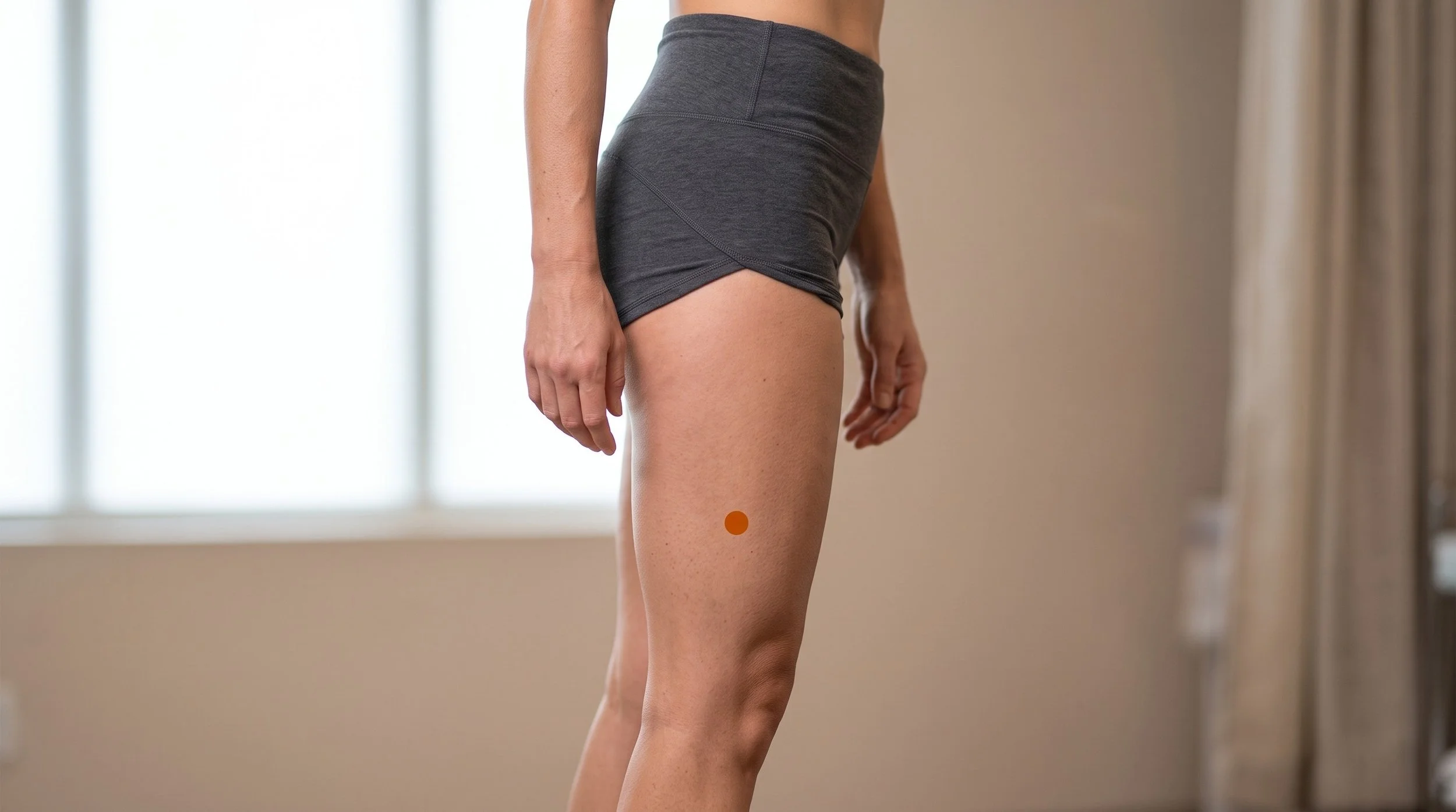
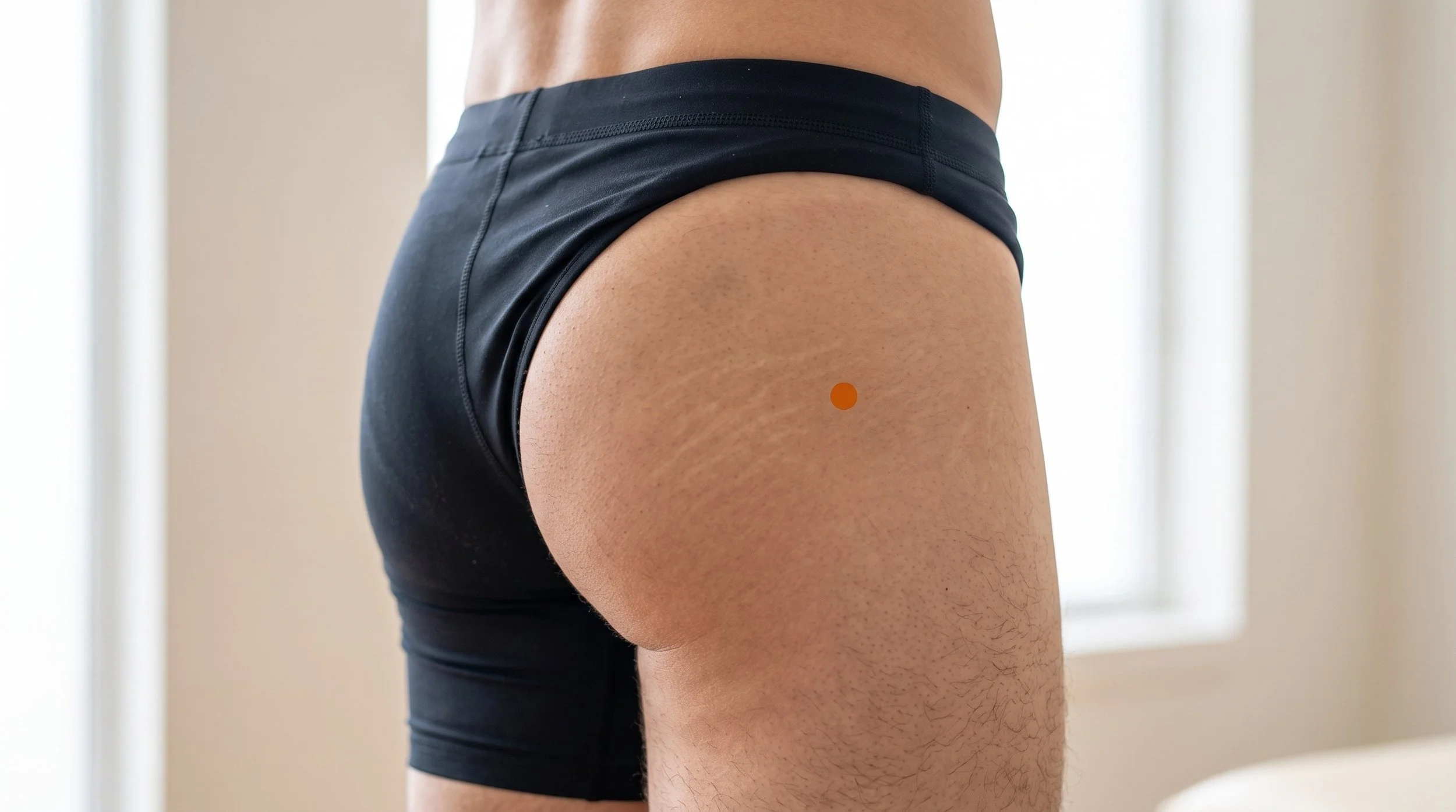
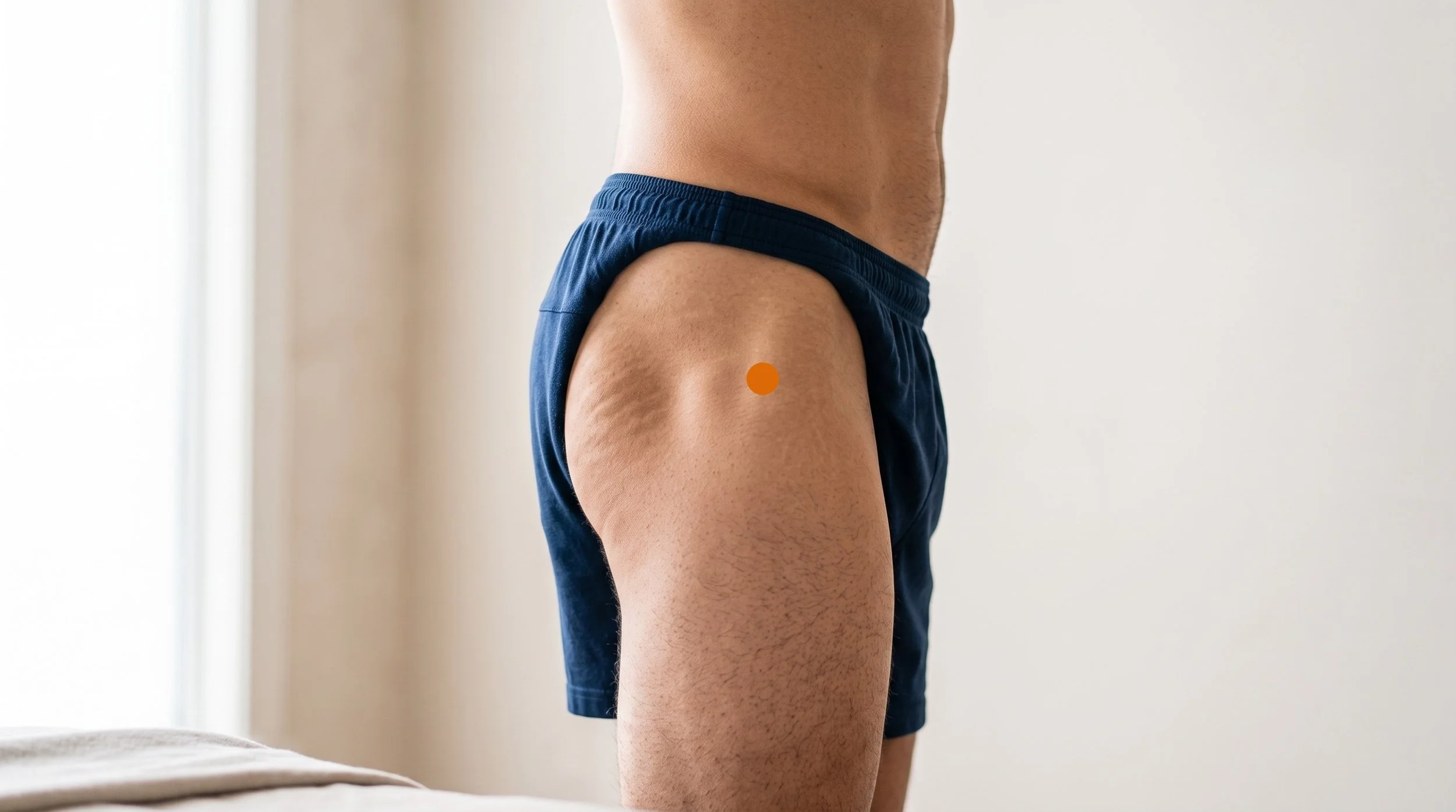
GB29 (Juliao, often translated as Squatting Bone Hole or Stationary Crevice) sits on the outside of the hip, in the soft depression halfway between the bony point at the front of your pelvis (the anterior superior iliac spine) and the bump of the greater trochanter you can feel when you roll your leg in and out. It is the classic Gallbladder channel access point to the front-lateral hip, landing over tensor fasciae latae and the anterior fibers of gluteus medius, which are exactly the tissues that get loaded by single-leg stance, stairs, hills, side-sleeping, and long days of walking on New York City pavement.
In practice the gb29 acupuncture point matters because it gives a needle direct access to the hip abductor complex at the level where lateral hip pain, gluteal tendon irritation, and IT band region symptoms overlap, while classical sources also credit it with influence over pain that travels forward into the groin.
- Location and layers: gallbladder 29 lies midway between the anterior superior iliac spine and the prominence of the greater trochanter, with the needle passing through skin and subcutaneous fat into tensor fasciae latae and the anterior part of gluteus medius (Deadman et al., 2007; Kim, 2011).
- Traditional attributions: classical texts categorize GB29 as a point that moves the channel and relieves pain, benefits the hip joint, and serves as a meeting point of the Gallbladder channel with the Yang Motility (Yang Qiao) vessel, with some channel texts also grouping it with Yang Linking vessel points (Deadman et al., 2007; Cheng, 1987; Maciocia, 2006).
- Mechanism: needling here stimulates free nerve endings and muscle spindles in tissue supplied largely by the superior gluteal nerve (L4 to S1), the same segmental territory that carries hip joint and lateral thigh sensation, so input can converge with painful signals in the dorsal horn and recruit descending inhibitory pathways (Zhao, 2008).
- Research picture: reviews of acupuncture and needling for hip complaints are cautiously positive but limited, with a Cochrane review finding acupuncture probably has little or no effect versus sham in hip osteoarthritis, while an unblinded trial suggested benefit when added to routine care and a later review of hip pain trials describing the evidence as weak because of small samples (Manheimer et al., 2018; Park et al., 2023).
- Clinical framing: the strongest point-specific signal for this region comes from lateral hip work, where a randomized trial found dry needling was not inferior to cortisone injection over six weeks in greater trochanteric pain syndrome (Brennan et al., 2017), while load management and graded exercise remain the backbone of care (Mellor et al., 2018).
- De qi: patients usually report a deep, dull, spreading fullness in the outer hip, sometimes with a brief twitch of tensor fasciae latae or gluteus medius, and occasionally a sensation that drifts toward the groin or down the outside of the thigh (Deadman et al., 2007; Simons et al., 1999).
Is Your Outer Hip Sore Every Time You Climb Stairs or Sleep on That Side?
Lateral hip pain rarely comes from one structure, which is why we assess the whole abductor system before we needle. At Morningside Acupuncture we use GB29 alongside gluteus medius, gluteus minimus, and tensor fasciae latae needling to reduce tissue sensitivity and make loading tolerable again. We pair that with practical load advice for stairs, sleep positions, and sitting habits that keep compressing the tendon. Schedule a visit and we'll build a plan around how your hip actually behaves.
Schedule NowAnatomy of GB29: Why the Gap Between the ASIS and Greater Trochanter Is Such an Important Location
The gb 29 location is a genuine soft-tissue window. Slide your fingers from the bony front corner of your pelvis toward the outer bump of your thigh bone and you will find a slight hollow at the midpoint, which is the target described in the classical location texts (Deadman et al., 2007; Kim, 2011). Under the skin and a thin fat layer sits tensor fasciae latae, a short, dense muscle that tensions the iliotibial band, and just behind it the anterior fibers of gluteus medius.
These are the tissues that control pelvic level during single-leg stance, so they take repeated load from walking, stairs, hills, running, carrying groceries on one side, and standing with weight shifted onto one hip. When they become irritable, people describe outer hip soreness, discomfort lying on that side, and a pinching sensation at end range hip flexion that often gets labeled impingement.
The nerve geography explains why needling here can change how the hip feels rather than only how it moves. Both tensor fasciae latae and gluteus medius are supplied by the superior gluteal nerve, carrying fibers from roughly L4 through S1, and the overlying skin is served by lateral cutaneous branches from the same general region.
Sensory information from the hip joint capsule, the gluteal tendons, and the lateral thigh feeds into overlapping segments of the spinal cord, so a needle placed into muscle at GB29 generates a strong, well-localized afferent barrage that arrives at the same dorsal horn neurons already receiving nociceptive traffic from the sore hip. Experimental work on acupuncture analgesia describes this combination of segmental modulation plus activation of descending inhibitory pathways from the brainstem, along with local release of neuropeptides and changes in blood flow at the needle site (Zhao, 2008).
That is a plausible, testable account of why patients often report reduced sensitivity and easier movement in the minutes to hours after treatment, and it does not require any appeal to energy moving through the body.
Deeper structures set the safety boundaries. Below gluteus medius lies gluteus minimus and the deep branch of the superior gluteal artery, which runs with the nerve between those two muscles, while the ascending branch of the lateral circumflex femoral artery supplies tensor fasciae latae anteriorly. The hip joint capsule and the femoral neurovascular bundle are farther medial and anterior, well away from a needle angled straight into the lateral hip.
Standard practice is perpendicular insertion of about 1 to 2 cun, adjusted for body size, with oblique inferior angling used when a practitioner wants a longer path along the muscle belly (Deadman et al., 2007). Practitioners avoid forceful deep needling in very thin patients, needle with extra care around hip replacement hardware, and stop advancing at any sharp or electric sensation, which suggests neural contact rather than muscle.
Related Best Acupuncture Points For Hip Pain Related Acupuncture For Gluteus Medius Trigger PointsGB29 at a Glance: Classification, Location, and Clinical Use
| Category | Detail |
|---|---|
| Traditional Name | Juliao (Squatting Bone Hole, also rendered Stationary Crevice or Squatting Crevice) |
| Channel Classification | Point of the Gallbladder channel, on the lateral hip |
| Point Categories | Meeting point of the Gallbladder channel with the Yang Motility (Yang Qiao) vessel, and listed among the coalescent points of that vessel in modern Chinese texts; some channel texts also group it with Yang Linking (Yang Wei) vessel points. It is not a five-shu, source, or hui-meeting point. |
| Precise Location | In the depression midway between the anterior superior iliac spine and the prominence of the greater trochanter. To confirm the trochanter, rest one hand over the outer hip while rotating the foot in and out with the other so the bony prominence moves under your fingers. |
| Tissue Stimulated | Tensor fasciae latae and the anterior fibers of gluteus medius, overlying gluteus minimus; see Tensor Fasciae Latae Trigger Points and Gluteus Medius Trigger Points |
| Needle Depth / Direction | Perpendicular insertion 1 to 2 cun, adjusted for body size; oblique inferior insertion is described in classical texts for a longer intramuscular path |
| De Qi Sensation | Deep, heavy, spreading ache in the outer hip, sometimes with a visible twitch of tensor fasciae latae or gluteus medius, occasionally drifting toward the groin or down the lateral thigh |
| Primary Clinical Uses | Lateral hip pain, greater trochanteric and gluteal tendon irritation, hip impingement discomfort, IT band region pain, restricted hip mobility, sciatica-pattern leg pain |
| Common Point Combinations |
|
Deadman's point manual presents GB29 as one of the most frequently used points for hip disorders in traditional practice, with actions described as activating the channel, relieving pain, and benefiting the hip joint.
The classical indication list attributed to this point is broader than the local anatomy alone would suggest: back and leg pain, lumbar pain that spreads toward the lower abdomen, hip pain that travels into the groin, leg weakness and paralysis, sciatica, and shan disorder, alongside a curious set of upper body entries covering pain at the front of the shoulder that reaches into the chest and difficulty raising the arm.
The commentary explains that last group through a cross-needling logic in which the shoulder above is treated as the structural counterpart of the hip below, so a point that governs forward-radiating hip pain is also credited with forward-radiating shoulder pain. A handful of internal symptoms such as swelling, vomiting, and diarrhea round out the traditional list.
What is striking is how consistent the mechanical core of that list is, since the great majority of these entries describe pain and weakness in exactly the hip abductor and lateral chain territory a modern clinician would palpate before needling.
Why GB29 Is Used for Groin Pain and Even Shoulder Pain, Not Just the Outer Hip
Patients are often surprised that a needle on the side of the hip changes symptoms they feel in the front of the groin or deep in the joint. The reason is convergence. Sensory fibers from the hip capsule, gluteal tendons, tensor fasciae latae, and the skin of the lateral thigh all report into overlapping spinal segments around L4 to S1, and second-order neurons there receive input from more than one structure. When several tissues share a relay station, the brain cannot always tell which one is complaining, which is why deep hip pathology is so often felt as groin or lateral thigh pain.
Needling into muscle at GB29 delivers a large, clean burst of input into that shared relay, which can transiently reduce how strongly the painful signals are passed upward (Zhao, 2008).
The second layer is systemic rather than local. Sustained needle stimulation activates descending pathways from the midbrain and brainstem that release serotonin, noradrenaline, and endogenous opioids at the spinal cord, dampening transmission across a wider area than the segment being needled (Zhao, 2008). This is part of why patients frequently report a general easing of hip stiffness and better tolerance for stairs and walking rather than a pinpoint change at the needle site alone.
Individual patient data pooled across chronic pain trials suggests acupuncture produces modest but persistent benefit over sham and no-acupuncture controls, with effects that decay slowly rather than disappearing after treatment ends (Vickers et al., 2018).
The classical shoulder indication is best understood as a mirroring convention rather than a physiological claim. Traditional practice treated the shoulder and hip as structural counterparts, so a hip point credited with resolving forward-radiating pain was also applied to forward-radiating shoulder pain (Deadman et al., 2007). We present that as a historical selection logic, not as evidence that needling the hip treats the shoulder. In current practice GB29 earns its place through what sits under the needle: the abductor complex that controls the pelvis on one leg.
What the Research Shows for GB29
There is no clinical trial of GB29 as an isolated intervention, which is true for nearly every individual acupuncture point. Trials test multi-point protocols or region-based needling, so the fair question is whether needling the lateral hip region, of which this point is a standard component, changes outcomes for hip and gluteal pain.
The picture is cautiously encouraging and clearly limited: reviews report short-term reductions in pain and improvements in function with acupuncture and dry needling around the hip, but the studies are small, the blinding is difficult, and the certainty of evidence is generally rated low. Below is a summary of the most relevant work, followed by the caveat that structured loading remains the best-supported long-term strategy for lateral hip pain.
| Study | Type | Focus | Key Finding |
|---|---|---|---|
| Manheimer et al., 2018 | Cochrane systematic review | Acupuncture for hip osteoarthritis | Compared with sham acupuncture, the review found acupuncture probably has little or no effect on hip pain or function (moderate-quality evidence in small trials); one unblinded trial found benefit when acupuncture was added to routine physician care, an effect the authors note likely includes expectation. |
| Park et al., 2023 | Systematic review and meta-analysis | Acupuncture for hip pain across twelve randomized trials | Reviewers described potential benefit for hip pain with no serious adverse events reported, while rating the supporting evidence as weak because of small samples and low study quality. |
| Brennan et al., 2017 | Noninferiority randomized clinical trial | Dry needling versus cortisone injection for greater trochanteric pain syndrome | Over six weeks, dry needling was not inferior to cortisone injection for pain and function in lateral hip pain, though follow-up was short. |
| Ceballos-Laita et al., 2021 | Randomized controlled trial | Dry needling of hip musculature in hip osteoarthritis | Adding dry needling was associated with improvements in pain, hip muscle strength, and physical function in this single-center trial. |
| Jiménez-del-Barrio et al., 2022 | Systematic review and meta-analysis | Dry needling for hip or knee osteoarthritis | Pooled results suggested short-term reductions in pain and improved function, with the authors grading the evidence as very low quality. |
| Mellor et al., 2018 | Randomized clinical trial (LEAP) | Education plus exercise versus corticosteroid injection versus wait and see for gluteal tendinopathy | Load management education with exercise outperformed injection and no treatment at longer follow-up, supporting loading as the foundation of lateral hip care. |
| Vickers et al., 2018 | Individual patient data meta-analysis | Acupuncture for chronic musculoskeletal pain | Acupuncture was associated with modest benefit over sham and no-acupuncture controls, with effects persisting over about a year. |
IT Band Pain That Keeps Coming Back After Every Long Run?
When the outer thigh and knee flare up mile after mile, the hip is usually part of the story. We combine the gb29 acupuncture point with distal Gallbladder channel points and targeted dry needling along the lateral line to calm the tissues that drive the pattern. Runners often notice that stride tolerance improves as hip abductor sensitivity settles. Book an appointment and let's look at the whole chain, not just the sore spot.
Schedule NowGB29 in the Context of Trigger Point Work
Acupuncture means the use of an acupuncture needle, and that includes the hundreds of styles practiced worldwide as well as dry needling. GB29 happens to sit almost exactly where a clinician trained in myofascial work would palpate for taut bands in tensor fasciae latae and the anterior gluteus medius, so the traditional point and the modern muscular target are close neighbors.
The trigger point literature describes tensor fasciae latae referring pain down the outside of the thigh, gluteus minimus producing a long lateral referral that can mimic sciatica, and gluteus medius sending pain into the posterior and lateral hip and upper buttock (Simons et al., 1999). Those referral maps overlap substantially with what patients call IT band pain, outer hip pain, and hip impingement.
At Morningside we typically treat GB29 as one node in a lateral hip protocol rather than a standalone technique. A session might combine needling at GB29 with dry needling of gluteus medius, gluteus minimus, and tensor fasciae latae, distal Gallbladder channel points such as GB34 for the lateral chain, and manual work along the iliotibial band and lateral quadriceps.
Patients whose pain is worst on single-leg stance, stairs, or side-lying often respond best when needling is followed by progressive abductor loading, since the trial evidence for lateral hip pain favors exercise and load management for durable change (Mellor et al., 2018). Needling can lower sensitivity enough for that loading to be tolerable, which is generally how we frame its role.
GB29 Hip Pain Treatment at NYC's Highest-Rated Acupuncture Clinic
Morningside Acupuncture is the highest-rated acupuncture and dry needling clinic in New York City with over 500 five-star Google reviews, and hip and gluteal pain is one of the things we see most. Every session blends point-based acupuncture, trigger point dry needling, and clear rehab guidance so results hold between visits. We treat athletes, desk workers, and post-op patients working their way back to full weight-bearing comfort. Schedule your appointment and get a plan for the hip you actually use every day.
Schedule NowFrequently Asked Questions
What does GB29 feel like when needled?
Most people feel a brief pinch at the skin, then a deep, heavy, spreading ache in the outer hip that is usually described as pressure or fullness rather than sharpness. Because tensor fasciae latae and gluteus medius are dense muscles, the sensation can be strong and may include a short involuntary twitch if a taut band is engaged. Some patients notice the feeling travel toward the groin or down the lateral thigh, which classical texts treated as a sign the point had been engaged properly. Sharp, electric, or shooting sensations are not the goal and should be reported immediately so the needle can be adjusted.
Why needle the side of the hip when my pain is in the groin or down my thigh?
Deep hip structures and the muscles at GB29 report into overlapping spinal segments around L4 to S1, so pain from the joint, the gluteal tendons, and the abductor muscles is frequently felt somewhere other than its source. Needling accessible muscle in that shared segmental territory delivers strong input to the same spinal relay, which can reduce how forcefully the painful signals are transmitted upward and recruit descending inhibitory pathways (Zhao, 2008). The classical texts arrived at a similar clinical rule from a different direction, describing GB29 specifically for hip pain that radiates forward into the groin and lower abdomen (Deadman et al., 2007). Practically, it means the most useful needle is often not at the spot that hurts most.
Can I press GB29 myself between sessions?
Yes, acupressure here is straightforward and safe for most people. Find the anterior superior iliac spine (the bony corner at the front of your pelvis) and the greater trochanter (the bump on the outside of your upper thigh, easiest to feel if you roll your foot in and out), then locate the soft hollow midway between them. Using your thumb or the heel of your hand, press straight in with steady, moderate pressure that reproduces a dull ache rather than sharp pain, and hold for 30 to 60 seconds. Repeat two or three times per side, once or twice daily, and follow with gentle hip abduction or a slow side-lying leg lift so the tissue is loaded rather than only pressed. Stop if you get numbness, tingling, or increasing pain over the following day, and skip acupressure entirely over a hip replacement, recent fracture, or any area of unexplained swelling.
Is GB29 safe to needle?
In trained hands it is a low-risk point. There is no lung or major organ beneath it, and the femoral neurovascular bundle sits well medial to the insertion path. Standard depth is about 1 to 2 cun perpendicular, adjusted for body size (Deadman et al., 2007). The main considerations are avoiding overly forceful deep insertion in very thin patients, respecting the superior gluteal neurovascular bundle that runs deep between gluteus medius and minimus, and taking extra care in anyone with a hip replacement, hip hardware, an active infection, or a bleeding disorder or anticoagulant use. Post-needling soreness for a day or two is the most common side effect, and reviews of dry needling for hip and knee conditions have not reported serious adverse events (Jiménez-del-Barrio et al., 2022).
Where exactly is GB29 located?
GB29 is on the outside of the hip, in the depression midway along a line drawn from the anterior superior iliac spine to the prominence of the greater trochanter (Deadman et al., 2007; Kim, 2011). To find it, place a fingertip on the bony corner at the front of your pelvis and another on the outer bump of your upper thigh bone, then move to the midpoint between them and feel for a slight hollow. An alternative method described in classical texts is to flex the hip and locate the point at the lateral end of the crease that forms. If you press there and feel a familiar deep ache in your outer hip, you are in the right neighborhood.
References
- Deadman, P., Al-Khafaji, M., & Baker, K. (2009). A manual of acupuncture. Journal of Chinese Medicine Publications.
- Kim, H. (2008). Handbook of Oriental medicine (3rd ed.). Harmony & Balance Press.
- Cheng, X. (Ed.). (1999). Chinese acupuncture and moxibustion (Rev. ed.). Foreign Languages Press.
- Maciocia, G. (2006). The channels of acupuncture: Clinical use of the secondary channels and eight extraordinary vessels. Churchill Livingstone Elsevier.
- Simons, D. G., Travell, J. G., & Simons, L. S. (1999). Travell & Simons' myofascial pain and dysfunction: The trigger point manual, Vol. 1: Upper half of body (2nd ed.). Williams & Wilkins.
- Manheimer, E., Cheng, K., Wieland, L. S., Shen, X., Lao, L., Guo, M., & Berman, B. M. (2018). Acupuncture for hip osteoarthritis. Cochrane Database of Systematic Reviews, 2018(5), CD013010. https://doi.org/10.1002/14651858.CD013010
- Park, H. S., Jeong, H. I., Sung, S. H., & Kim, K. H. (2023). Acupuncture treatment for hip pain: A systematic review and meta-analysis. Healthcare, 11(11), 1624. https://doi.org/10.3390/healthcare11111624
- Brennan, K. L., Allen, B. C., & Maldonado, Y. M. (2017). Dry needling versus cortisone injection in the treatment of greater trochanteric pain syndrome: A noninferiority randomized clinical trial. Journal of Orthopaedic & Sports Physical Therapy, 47(4), 232-239. https://doi.org/10.2519/jospt.2017.6994
- Ceballos-Laita, L., Jiménez-del-Barrio, S., Marín-Zurdo, J., Moreno-Calvo, A., Marín-Boné, J., Albarova-Corral, M. I., & Estébanez-de-Miguel, E. (2021). Effectiveness of dry needling therapy on pain, hip muscle strength, and physical function in patients with hip osteoarthritis: A randomized controlled trial. Archives of Physical Medicine and Rehabilitation, 102(5), 959-966. https://doi.org/10.1016/j.apmr.2021.01.077
- Jiménez-del-Barrio, S., Medrano-de-la-Fuente, R., Hernando-Garijo, I., Mingo-Gómez, M. T., Estébanez-de-Miguel, E., & Ceballos-Laita, L. (2022). The effectiveness of dry needling in patients with hip or knee osteoarthritis: A systematic review and meta-analysis. Life, 12(10), 1575. https://doi.org/10.3390/life12101575
- Mellor, R., Bennell, K., Grimaldi, A., Nicolson, P., Kasza, J., Hodges, P., Wajswelner, H., & Vicenzino, B. (2018). Education plus exercise versus corticosteroid injection use versus a wait and see approach on global outcome and pain from gluteal tendinopathy: Prospective, single blinded, randomised clinical trial. BMJ, 361, k1662. https://doi.org/10.1136/bmj.k1662
- Vickers, A. J., Vertosick, E. A., Lewith, G., MacPherson, H., Foster, N. E., Sherman, K. J., Irnich, D., Witt, C. M., & Linde, K. (2018). Acupuncture for chronic pain: Update of an individual patient data meta-analysis. Journal of Pain, 19(5), 455-474. https://doi.org/10.1016/j.jpain.2017.11.005
- Zhao, Z. Q. (2008). Neural mechanism underlying acupuncture analgesia. Progress in Neurobiology, 85(4), 355-375. https://doi.org/10.1016/j.pneurobio.2008.05.004
Disclaimer: This web site is intended for educational and informational purposes only. Reading this website does not constitute providing medical advice or any professional services. This information should not be used for diagnosing or treating any health issue or disease. Those seeking medical advice should consult with a licensed physician. Seek the advice of a medical doctor or other qualified health professional for any medical condition. If you think you have a medical emergency, call 911 or go to the emergency room. No acupuncturist-patient relationship is created by reading this website or using the information. Morningside Acupuncture PLLC and its employees and contributors do not make any express or implied representations with respect to the information on this site or its use. For any legal interpretation of scope of practice in your state, consult a licensed attorney or regulatory authority.
Read more from our blog