GB21 Acupuncture Point (Jianjing)
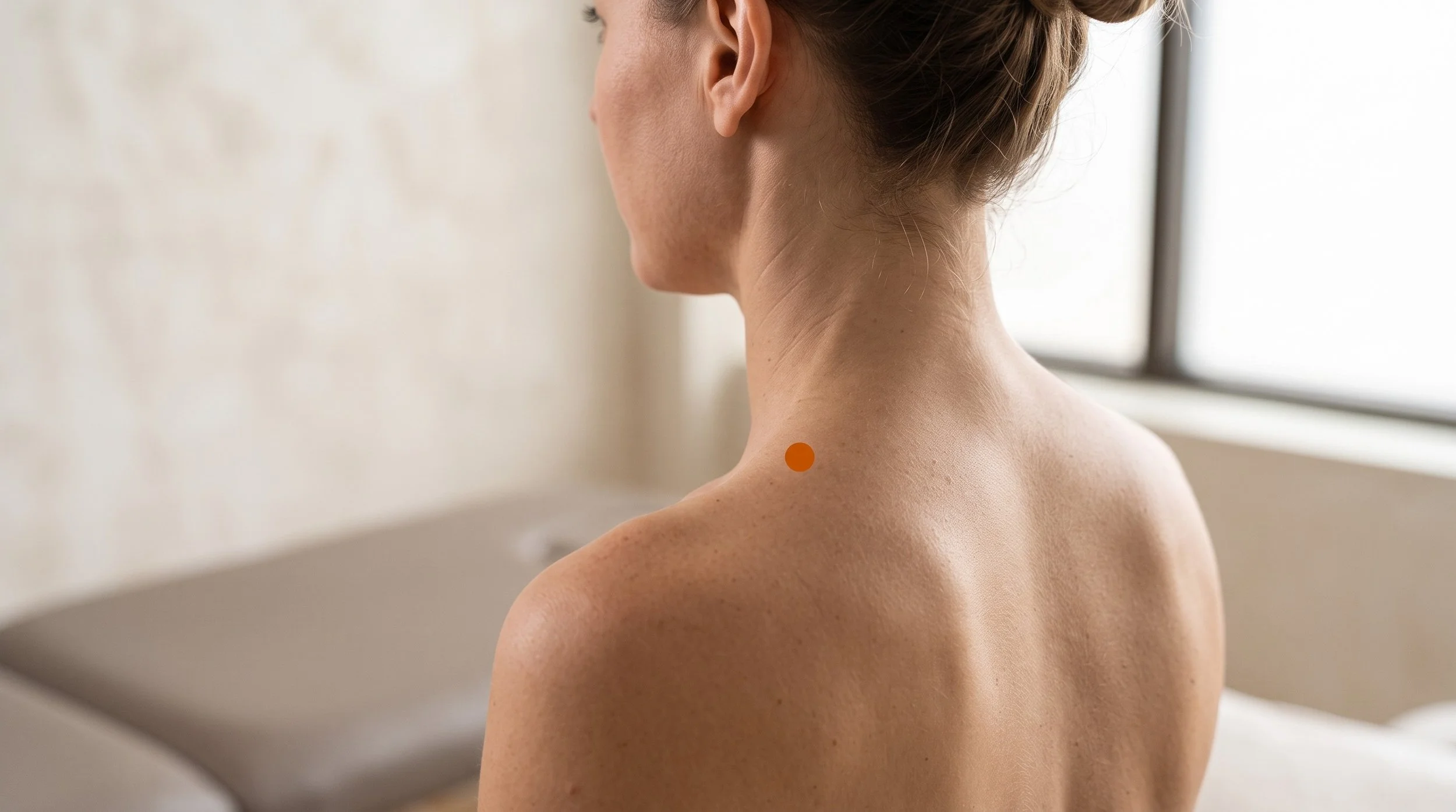
GB21 Acupuncture Point
The Shoulder Well at the Crest of the Trapezius: Anatomy, Mechanism, and Why This Point Anchors Neck, Shoulder, and Tension Headache Treatment
GB21, called Jianjing or Shoulder Well, is the twenty-first point of the Gallbladder channel and sits exactly where most people reach when they say their shoulders are tight: on the crest of the upper trapezius, roughly midway between the bony bump at the base of the neck (the C7 spinous process) and the outer tip of the shoulder blade's acromion. Gallbladder 21 matters clinically because it is one of the few points that is simultaneously a local muscular target, a channel crossing where the Gallbladder, Triple Burner, and Stomach channels meet the Yang Linking Vessel, and a site that overlaps almost perfectly with the most commonly documented myofascial trigger point in the human body. That combination is why the gb21 acupuncture point shows up in treatment plans for neck stiffness, shoulder and upper back pain, desk-work tension, and headaches that seem to climb from the shoulders into the head, and why it also carries two of the most important safety cautions in the point repertoire.
- Location and layers: the shoulder well point lies on the free crest of the upper trapezius, with levator scapulae and supraspinatus deeper and the apex of the lung deep and anterior, which is why oblique rather than deep perpendicular needling is the convention (Deadman et al., 2009).
- Traditional attributions include regulating and descending qi, freeing the channel to relieve pain, softening nodules, benefiting the breasts, and expediting delivery. Read neurophysiologically, most of these map onto local muscle tone change, segmental modulation, and autonomic and vascular effects rather than any literal flow of energy (Deadman et al., 2009).
- Mechanism: needling here recruits cutaneous and muscle afferents that enter the cord at roughly C3 and C4, a segment that shares dorsal horn territory with upper cervical input, which helps explain why treating the shoulder crest can change perceived neck stiffness and head pain (Zhao, 2008).
- Research picture: reviews of acupuncture for neck pain and of trigger point dry needling report short and medium term reductions in pain and pressure sensitivity, though evidence quality is generally low to moderate and protocols use several points at once (Trinh et al., 2016; Tough et al., 2009; Gattie et al., 2017).
- Point-specific physiology: a laser Doppler spectroscopy pilot study found higher cutaneous and subcutaneous microcirculation over GB21 than over an adjacent non-tender reference site on the same trapezius, one of the few measurements made at this specific location (Bürklein & Banzer, 2007).
- De qi at GB21 is usually a deep, heavy, spreading ache that may travel toward the neck, scapula, or occasionally the arm. With trigger point needling in the same muscle, a brief involuntary twitch is common and generally settles within seconds (Simons et al., 1999).
Are Your Shoulders Always Up Around Your Ears?
Chronic upper trapezius tension rarely resolves with stretching alone because the tissue keeps getting reloaded by desk posture, bag carrying, and stress-driven breathing. At Morningside Acupuncture we needle GB21 with a safe oblique or pinch-and-lift technique, then work the surrounding levator scapulae, rhomboids, and suboccipital muscles so the whole pattern changes rather than one sore spot. Most patients notice easier neck rotation and lighter shoulders within the first few sessions. Schedule a visit and let us assess what is actually loading your shoulders.
Schedule NowAnatomy of GB21: Why the Crest of the Upper Trapezius Is Such an Important Location
From the surface inward, GB21 passes through thin skin and a modest subcutaneous layer before meeting the free upper border of the trapezius, the muscle that most people can pinch between thumb and fingers at the top of the shoulder. Deeper and slightly forward sit levator scapulae and the scalene group, while supraspinatus lies deep and lateral within the supraspinous fossa. This tissue takes a constant, low-grade load: sustained shoulder elevation at a keyboard, one-sided bag and laptop carrying, overhead reaching, cold drafts, and the shallow upper-chest breathing pattern many people default to when stressed. Classical sources describe this exact region as unusually prone to contraction, tightness, and pain from strain, posture, and exposure to cold, which is a fair description of what a modern clinician palpates there most days (Deadman et al., 2009).
The trapezius receives its motor supply from the spinal accessory nerve, with pain and proprioceptive fibers traveling with the C3 and C4 ventral rami, and the skin over the shoulder crest is supplied by the supraclavicular branches of the cervical plexus. Needling therefore delivers input into the C3 and C4 spinal segments, and those segments share dorsal horn territory with upper cervical afferents, a convergence that gives a local shoulder technique influence over how stiff the neck feels and how readily head pain is triggered. Mechanistically, acupuncture at a tender muscular site is thought to work through this segmental gating together with descending inhibitory pathways from the brainstem and the release of endogenous opioids and other neurotransmitters (Zhao, 2008). Locally, a needle also produces measurable vascular and tissue responses, and one pilot study using laser Doppler spectroscopy found greater cutaneous and subcutaneous blood flow over GB21 than over a nearby asymptomatic reference site in the same muscle (Bürklein & Banzer, 2007).
The important safety structure is deeper still: the apex of the lung rises above the level of the first rib and lies deep and anterior to this point, and the transverse cervical and subclavian vessels run in the same neighborhood. Classical and modern texts agree that deep perpendicular insertion here carries a real risk of pneumothorax, especially in slim patients, which is why the standard technique is a posterior oblique insertion of about 0.5 to 1 cun directed away from the chest, or a pinch-and-lift approach where the muscle belly is raised between the fingers and needled tangentially (Deadman et al., 2009). Classical sources also list GB21 as contraindicated in pregnancy because of its traditionally described strong descending action. Both cautions are routine, easily managed by a trained practitioner, and among the first things acupuncture students learn about this point.
Related Trapezius Trigger Points Related Dry Needling Trapezius PainGB21 at a Glance: Classification, Location, and Clinical Use
| Category | Detail |
|---|---|
| Traditional Name | Jianjing (Shoulder Well), Gallbladder 21 |
| Channel Classification | Twenty-first point of the Gallbladder channel (Foot Shao Yang) |
| Point Categories | Meeting point of the Gallbladder channel with the Triple Burner (Sanjiao) and Stomach channels and with the Yang Linking Vessel (Yang Wei Mai); listed among the coalescent points of the Yang Linking Vessel in modern Chinese texts |
| Precise Location | On the crest of the shoulder, midway between the spinous process of C7 (the level of GV14) and the tip of the acromion, at the highest point of the upper trapezius on the sagittal plane. Classically located at the point of maximum tenderness |
| Tissue Stimulated | Upper trapezius muscle belly, with levator scapulae and supraspinatus deeper; supraclavicular cutaneous nerves in the overlying skin |
| Needle Depth / Direction | Posterior oblique insertion 0.5 to 1 cun, directed away from the chest, or a pinch-and-lift tangential technique. Deep perpendicular needling is avoided because of the underlying lung apex |
| De Qi Sensation | Deep, heavy, spreading ache that often travels toward the neck or shoulder blade; a brief local twitch may occur when a taut band is engaged |
| Primary Clinical Uses | Upper trapezius tension and trigger points, neck stiffness and reduced rotation, shoulder and upper back pain, tension-type and cervicogenic headache, stress held in the shoulders |
| Common Point Combinations |
|
Deadman, Al-Khafaji, and Baker's A Manual of Acupuncture presents Jianjing as a point that regulates qi, frees the channel and relieves pain, transforms and lowers phlegm while dissipating nodules, and benefits the breasts and expedites delivery. Traditionally, the shoulder crest was seen as a bottleneck where Liver and Gallbladder yang rising with anger, frustration, and resentment tends to pile up just below the relatively narrow neck, and the same region was said to be injured by sprain, cold drafts during sleep, sustained poor posture, and occupational strain. On that reasoning, classical indication lists group under GB21 roughly five families of complaints: neck, shoulder, back, and arm stiffness or pain including post-stroke weakness; phlegm and nodular presentations such as goiter and scrofula; rebellious upward patterns including cough, wheezing, flushed face, and agitation; obstetric uses covering difficult or prolonged labor and retained placenta; and breast complaints from pain and abscess to milk that will not flow. What is striking is the internal consistency of the pattern: nearly every traditional use turns on the same idea of bringing something downward and releasing a chokepoint, which is precisely why the same text that praises the point for stalled labor also forbids it in pregnancy.
Why GB21 Is Used for Headaches That Seem to Start in the Shoulders
Patients often describe a headache that builds through the afternoon, starting as a band of tightness across the top of the shoulders and ending as pressure behind the eyes or at the temples. That progression is not imagination. Sensory fibers from the upper trapezius enter the spinal cord around C3 and C4, and those segments feed into the same upper cervical dorsal horn region that receives input from the neck and, in turn, converges with trigeminal input serving the head and face. When that pool of neurons is repeatedly bombarded by input from taut, tender muscle, it becomes easier to excite, and ordinary sensations begin to register as pain in areas well away from the original tissue (Zhao, 2008). Needling the shoulder crest is a way of changing that input at its source.
Beyond the segmental story, needling appears to recruit descending inhibitory systems from the brainstem that damp nociceptive traffic more broadly, along with local vascular and inflammatory changes at the needle site (Zhao, 2008). Measurements taken specifically at GB21 found higher local microcirculation than at an adjacent quiet point on the same muscle, which is consistent with the idea that these tender shoulder sites are physiologically distinct rather than arbitrary landmarks, though a single pilot study cannot carry that argument on its own (Bürklein & Banzer, 2007). Clinically, the practical payoff is that shoulder needling often reduces headache frequency and neck stiffness together, because both are being driven by overlapping input.
There is also an autonomic and behavioral layer worth naming. Many people hold shoulder elevation as a stress posture, and the upper trapezius is one of the first muscles to recruit during anxious or effortful breathing. Treatment that reduces resting tone in that muscle tends to be reported as broadly calming, and studies suggest acupuncture can shift markers of autonomic balance, though the effect sizes are modest and the mechanisms are still being worked out (Zhao, 2008). For patients whose main complaint is stress carried in the shoulders, GB21 is usually one of the first points on the plan.
What the Research Shows for GB21
A fair reading of the literature is that GB21 has rarely been studied in isolation. Almost every trial of acupuncture for neck or shoulder pain uses a multi-point protocol in which GB21 is one component among several, so the honest claim is that the point is embedded in protocols that show benefit, not that the point itself has been isolated and proven. Reviews consistently describe short to medium term reductions in pain and pressure sensitivity with low to moderate certainty, small sample sizes, and difficulty designing credible sham controls. The exceptions are a handful of studies that did target this location specifically, including a microcirculation measurement over GB21 and randomized trials of GB21 acupressure during labor.
| Study | Type | Focus | Key Finding |
|---|---|---|---|
| Trinh et al., 2016 | Cochrane systematic review | Acupuncture for neck disorders, 27 trials | Acupuncture performed better than sham or no treatment for pain and disability with low to moderate quality evidence, and this review has since been withdrawn pending updating, so it should be read as suggestive rather than settled. |
| Vickers et al., 2018 | Individual patient data meta-analysis | Chronic pain including neck and shoulder pain | Acupuncture was associated with modest but statistically significant reductions in chronic pain compared with sham and no-acupuncture controls, with effects persisting over about a year. |
| Tough et al., 2009 | Systematic review and meta-analysis | Acupuncture and dry needling for myofascial trigger point pain | Needling of trigger points may reduce pain, but the authors judged the evidence insufficient to conclude that it outperforms placebo needling. |
| Gattie et al., 2017 | Systematic review and meta-analysis | Trigger point dry needling for musculoskeletal conditions | Dry needling showed favorable short and medium term effects on pain compared with sham or no treatment, with mostly low to moderate quality evidence. |
| Bürklein & Banzer, 2007 | Physiological pilot study | Cutaneous and subcutaneous blood flow measured over GB21 | Microcirculation was significantly higher over GB21 than over an adjacent asymptomatic reference site on the trapezius, a small preliminary finding requiring replication. |
| Torkiyan et al., 2021 | Randomized controlled trial | GB21 acupressure for first stage labor pain in 174 primiparous women | Pain reduction was significantly greater with GB21 acupressure than with sham point pressure or routine care, while delivery outcomes did not differ between groups. |
| Smith et al., 2017 | Cochrane systematic review | Acupuncture or acupressure for induction of labour, 22 trials | There was no clear reduction in caesarean rates, some signal for improved cervical ripening, and evidence quality ranged from low to high with many trials at moderate risk of bias. |
GB21 and Acupressure Points to Induce Labor: Safety First, Then What the Research Shows
Start with the safety framing, because this is the single most repeated caution attached to Jianjing. Classical sources list GB21 as contraindicated in pregnancy on the basis of its traditionally described strong downward action, and that restriction is taught as standard practice in acupuncture training today (Deadman et al., 2009). Searches for pressure points for labor turn up GB21 constantly, usually without that context. If you are pregnant, GB21 is not a point to press or needle on your own at any stage, and firm work on the shoulder crest should be avoided during routine massage as well. Any use of acupuncture or acupressure near term for cervical ripening, labor preparation, or labor support belongs with a licensed acupuncturist or trained midwife working alongside your obstetric team, at full term, with your provider's knowledge.
With that established, the research on this cluster is genuinely interesting but limited. The Cochrane review of acupuncture and acupressure for induction of labour pooled 22 trials in more than 3,400 women and found no clear reduction in caesarean section rates, some signal that acupuncture may improve cervical maturity, evidence quality ranging from low to high, and few trials reporting the safety outcomes that matter most (Smith et al., 2017). Notably, most of these protocols use points such as LI4, SP6, and BL32 rather than GB21 alone, so acupressure points to induce labor should be understood as a family of techniques with mixed and modest evidence, not a reliable method of starting labor.
GB21 does have one trial to its own name. In a randomized controlled trial of 174 first-time mothers, acupressure applied at GB21 during the first stage of labor produced significantly greater pain reduction than sham point pressure or routine care alone, while measured delivery outcomes did not differ between groups (Torkiyan et al., 2021). That distinction is worth holding onto: the better-supported role for the shoulder well point in labor is comfort and pain intensity during established labor with a trained person applying it, not induction on demand. It also explains the classical logic neatly, since the same descending action that traditional texts credited for expediting delivery is the exact reason the point is off limits earlier in pregnancy.
Do Your Headaches Start in Your Neck and Shoulders?
When head pain builds late in the workday and tracks up from the shoulder crest, the upper trapezius and cervical segments are usually part of the story. We combine GB21 with GB20 at the base of the skull and distal points such as LI4 to address both the local muscle and the segmental input that feeds head pain. Treatment is precise, comfortable, and paired with practical loading and posture advice. Book an appointment to have your headache pattern mapped properly.
Schedule NowGB21 in the Context of Trigger Point Work
GB21 is one of the clearest examples of overlap between the classical point map and the myofascial trigger point map. The most frequently documented trigger point in the upper trapezius sits at essentially the same spot on the muscle crest, and its referral pattern climbs the side of the neck to the mastoid area and temple, which mirrors the classical association of this region with neck stiffness and head pain (Simons et al., 1999). Classical texts even instructed practitioners to locate Jianjing at the point of maximum tenderness, which is functionally the same instruction a clinician follows when palpating for a taut band (Deadman et al., 2009). Whether the needle is described as acupuncture at GB21 or as dry needling of the upper trapezius, the target tissue and the technique are largely the same, and both fall under acupuncture in the broad sense of using an acupuncture needle.
At Morningside Acupuncture, GB21 is rarely treated in isolation. Because upper trapezius tension almost always travels with neighbors, we typically assess and needle levator scapulae, the rhomboids, supraspinatus, and the suboccipital group in the same session, then decide whether the pattern is being driven from the neck, the shoulder blade, or the thoracic spine. Reviews of trigger point needling report short and medium term reductions in pain with generally low to moderate quality evidence, which matches what we see clinically: needling changes tissue quality and comfort quickly, and holding that change depends on addressing the load, whether that means workstation adjustments, breathing retraining, or graded strengthening (Tough et al., 2009; Gattie et al., 2017).
GB21 Neck and Shoulder Tension Treatment at NYC's Highest-Rated Acupuncture Clinic
Morningside Acupuncture is the highest-rated acupuncture and dry needling clinic in New York City with over 500 five-star Google reviews, and shoulder and neck tension is one of the most common reasons patients walk through our door. Our licensed acupuncturists use GB21 alongside orthopedic assessment, trigger point dry needling, cupping, and manual therapy so the results hold between visits. Every plan is built around your work setup, training load, and stress patterns, not a template. Schedule your first session and start with a clear evaluation.
Schedule NowFrequently Asked Questions
What does GB21 feel like when needled?
Most people feel a distinct, deep, heavy ache that spreads along the shoulder crest and sometimes travels toward the neck, the shoulder blade, or occasionally down the arm. That spreading, dull quality is de qi, and it usually eases within 20 to 30 seconds of insertion. If the needle engages a taut band, you may feel a brief involuntary twitch in the muscle, which can be startling but is short lived and typically followed by a noticeable release. Mild soreness for a day afterward, similar to post-workout soreness, is common and not a problem.
Why treat the shoulder crest for a headache instead of just the head?
Because the input driving many headaches arrives from the neck and shoulder segments rather than the head itself. Sensory fibers from the upper trapezius enter the cord around C3 and C4, and that input converges in the upper cervical dorsal horn with pathways serving the head and face, so persistent bombardment from tight, tender muscle can lower the threshold for head pain (Zhao, 2008). Needling GB21 addresses that input at its source, and it is usually combined with GB20 at the base of the skull and a distal point such as LI4 so both the local tissue and the segmental picture are covered.
Can I press GB21 myself between sessions?
Yes, with two caveats: skip it entirely if you are pregnant, and press rather than dig. Find the crest of your shoulder about midway between the bony bump at the base of your neck and the outer tip of your shoulder, then pinch the muscle between your thumb and fingers so you are holding tissue rather than pressing down toward your chest. Squeeze or press to a firm but tolerable level, around 5 or 6 out of 10, and hold for 30 to 60 seconds while breathing slowly, then release. Repeat two or three times per side, once or twice a day, and follow it with gentle neck rotations and a shoulder blade squeeze so the tissue moves through its new range. If pressing reproduces radiating arm pain, numbness, or tingling, stop and have it assessed.
Is GB21 safe to needle?
It is safe in trained hands, and it carries two specific cautions that every practitioner learns early. First, the apex of the lung lies deep and anterior to this point, so deep perpendicular insertion risks pneumothorax, particularly in slim patients. The standard approach is a posterior oblique insertion of roughly 0.5 to 1 cun angled away from the chest, or a pinch-and-lift technique that keeps the needle within the raised muscle belly (Deadman et al., 2009). Second, classical sources contraindicate GB21 in pregnancy, and that restriction is still followed. Sensitive patients occasionally feel lightheaded from strong sensation here, which is why treatment is often given lying down. Tell your practitioner about pregnancy, blood thinners, a pacemaker, or previous lung surgery before treatment.
Where exactly is GB21 located?
For gb 21 point location, use two landmarks. Find the prominent spinous process at the base of the neck (C7, the level of GV14) and the outer tip of the acromion at the very top of the shoulder, then take the midpoint between them. GB21 sits there, on the highest part of the upper trapezius when viewed from the side, and in practice it is found at the most tender spot in that area (Deadman et al., 2009). If you shrug your shoulder, the muscle that bulges under your fingers is the trapezius you are looking for, and the point is on its crest rather than on bone.
Are acupressure points to induce labor safe to try at home?
Not without professional guidance, and GB21 in particular should be left alone during pregnancy. GB21 is classically contraindicated in pregnancy, and while some trials suggest acupressure may help with labor pain and possibly cervical ripening, the overall evidence for induction is mixed and safety outcomes are underreported (Smith et al., 2017; Torkiyan et al., 2021). If you are at or past your due date and interested in acupuncture or acupressure for labor preparation, talk with your obstetric provider first and work with a licensed acupuncturist experienced in obstetric care rather than following instructions found online.
References
- Deadman, P., Al-Khafaji, M., & Baker, K. (2009). A manual of acupuncture. Journal of Chinese Medicine Publications.
- Cheng, X. (Ed.). (1999). Chinese acupuncture and moxibustion (Rev. ed.). Foreign Languages Press.
- Maciocia, G. (2005). The foundations of Chinese medicine: A comprehensive text for acupuncturists and herbalists (2nd ed.). Elsevier Churchill Livingstone.
- Kim, H. (2008). Handbook of Oriental medicine (3rd ed.). Harmony & Balance Press.
- Maciocia, G. (2006). The channels of acupuncture: Clinical use of the secondary channels and eight extraordinary vessels. Churchill Livingstone Elsevier.
- Simons, D. G., Travell, J. G., & Simons, L. S. (1999). Travell & Simons' myofascial pain and dysfunction: The trigger point manual, Vol. 1: Upper half of body (2nd ed.). Williams & Wilkins.
- Zhao, Z. Q. (2008). Neural mechanism underlying acupuncture analgesia. Progress in Neurobiology, 85(4), 355-375. https://doi.org/10.1016/j.pneurobio.2008.05.004
- Vickers, A. J., Vertosick, E. A., Lewith, G., MacPherson, H., Foster, N. E., Sherman, K. J., Irnich, D., Witt, C. M., & Linde, K. (2018). Acupuncture for chronic pain: Update of an individual patient data meta-analysis. Journal of Pain, 19(5), 455-474. https://doi.org/10.1016/j.jpain.2017.11.005
- Trinh, K., Graham, N., Irnich, D., Cameron, I. D., & Forget, M. (2016). Acupuncture for neck disorders. Cochrane Database of Systematic Reviews, 2016(5), CD004870. https://doi.org/10.1002/14651858.CD004870.pub4
- Tough, E. A., White, A. R., Cummings, T. M., Richards, S. H., & Campbell, J. L. (2009). Acupuncture and dry needling in the management of myofascial trigger point pain: A systematic review and meta-analysis of randomised controlled trials. European Journal of Pain, 13(1), 3-10. https://doi.org/10.1016/j.ejpain.2008.02.006
- Gattie, E., Cleland, J. A., & Snodgrass, S. (2017). The effectiveness of trigger point dry needling for musculoskeletal conditions by physical therapists: A systematic review and meta-analysis. Journal of Orthopaedic & Sports Physical Therapy, 47(3), 133-149. https://doi.org/10.2519/jospt.2017.7096
- Bürklein, M., & Banzer, W. (2007). Noninvasive blood flow measurement over acupuncture points (Gb21): A pilot study. Journal of Alternative and Complementary Medicine, 13(1), 33-37. https://doi.org/10.1089/acm.2006.9149
- Torkiyan, H., Sedigh Mobarakabadi, S., Heshmat, R., Khajavi, A., & Ozgoli, G. (2021). The effect of GB21 acupressure on pain intensity in the first stage of labor in primiparous women: A randomized controlled trial. Complementary Therapies in Medicine, 58, 102683. https://doi.org/10.1016/j.ctim.2021.102683
- Smith, C. A., Armour, M., & Dahlen, H. G. (2017). Acupuncture or acupressure for induction of labour. Cochrane Database of Systematic Reviews, 2017(10), CD002962. https://doi.org/10.1002/14651858.CD002962.pub4
Disclaimer: This web site is intended for educational and informational purposes only. Reading this website does not constitute providing medical advice or any professional services. This information should not be used for diagnosing or treating any health issue or disease. Those seeking medical advice should consult with a licensed physician. Seek the advice of a medical doctor or other qualified health professional for any medical condition. If you think you have a medical emergency, call 911 or go to the emergency room. No acupuncturist-patient relationship is created by reading this website or using the information. Morningside Acupuncture PLLC and its employees and contributors do not make any express or implied representations with respect to the information on this site or its use. For any legal interpretation of scope of practice in your state, consult a licensed attorney or regulatory authority.
Read more from our blog