GB26 Acupuncture Point (Daimai)
GB26 Acupuncture Point
The Girdling Vessel Point at the Waistline: Anatomy, Segmental Mechanism, and Why This Flank Point Bridges Menstrual, Abdominal, and Low Back Complaints
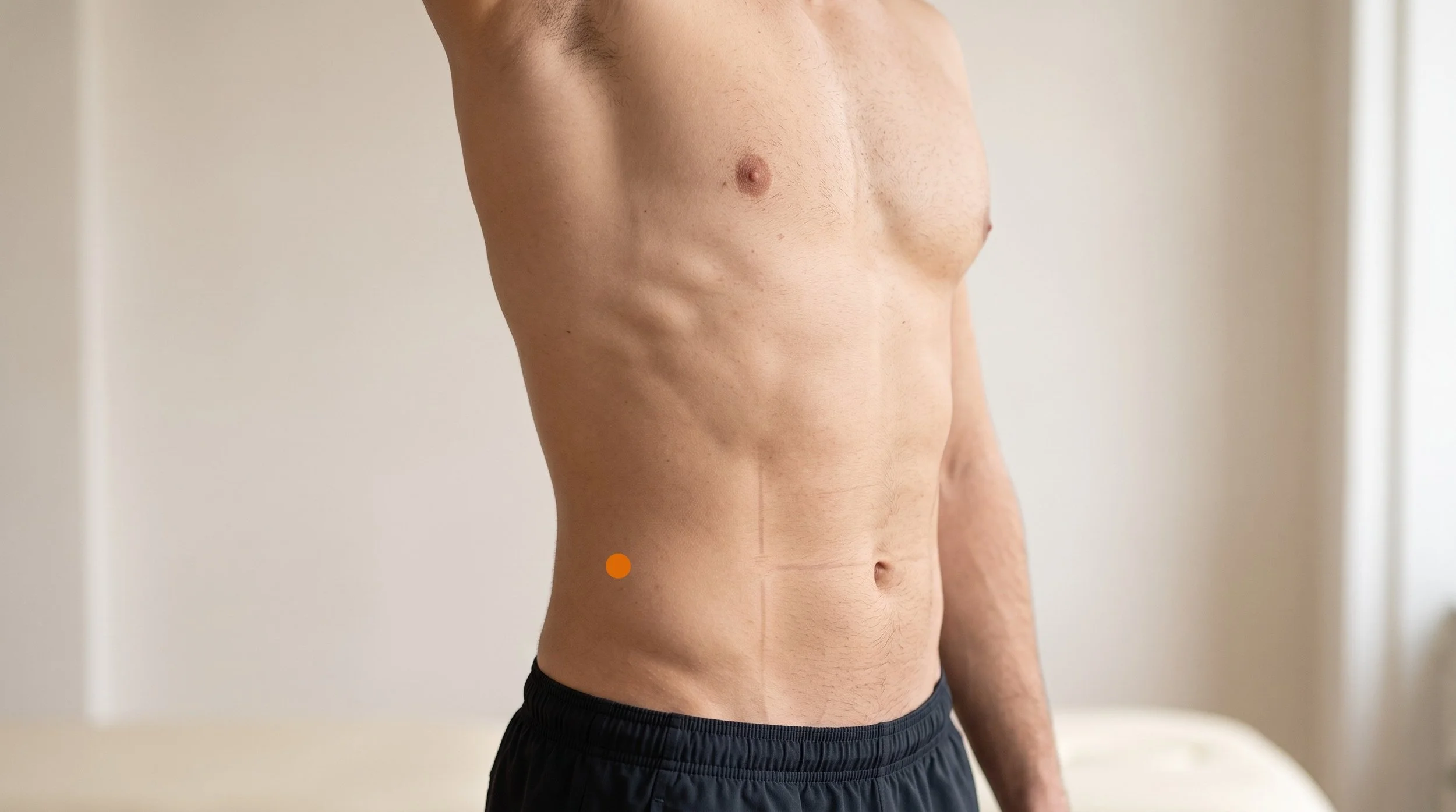
GB26 (Daimai, often translated as Girdling Vessel or Belt Vessel) sits on the side of the abdomen, directly below the free end of the eleventh rib and level with the navel. In plain terms, if you slide your fingers down the lower edge of your ribcage until the last floating rib ends, then drop straight down to belly button height, you are on it.
Classically it is described as a meeting point of the Gallbladder channel with the Girdling vessel, the one traditional channel pictured as running horizontally around the waist rather than up and down the body (Deadman et al., 2001). Clinically the gb26 acupuncture point matters for two overlapping reasons: it lies in the T10 to T11 segmental band that also supplies pelvic and lower abdominal structures, and it sits directly over the oblique abdominal wall, a common source of flank, waist, and referred lower abdominal pain. That combination is why gallbladder 26 shows up in both gynecological point formulas and hands on treatment of the lateral trunk.
- Location and layers: the gb 26 location is on the lateral abdomen below the free tip of the eleventh rib (just under LV13), level with the umbilicus, usually close to the mid axillary line; the needle passes through skin, subcutaneous fat, and the layered external oblique, internal oblique, and transversus abdominis (Deadman et al., 2001).
- Traditional categories translated: classical texts list Daimai as the main point for regulating the Girdling vessel, for menstrual irregularity and vaginal discharge, and for pain of the flank, waist, and lower abdomen (Deadman et al., 2001; Cunningham, 2000 style clinical texts). Read neurophysiologically, that list clusters around one spinal neighborhood rather than around one organ.
- Mechanism: segmental innervation here comes from the lower thoracoabdominal nerves around T10 to T11, the same spinal levels that receive visceral afferents from uterine and lower abdominal structures travelling with sympathetic pathways, so needling may modulate shared dorsal horn circuits (Zhao, 2008).
- Research picture: reviews of acupuncture for period pain remain cautious, with a Cochrane review finding the evidence insufficient to confirm benefit (Smith et al., 2016), while other meta analyses report pain reductions in trials of limited methodological quality (Woo et al., 2018).
- Point specific data: GB26 is one of the electro-acupuncture points used in a sham controlled trial for central obesity that reported reductions in waist circumference and body weight (Lam et al., 2024), the closest thing to direct trial evidence involving this specific location.
- De qi and practice framing: patients usually report a heavy, spreading fullness across the flank that can travel toward the low back, not a sharp sting; depth stays conservative because the peritoneal cavity lies beneath the muscle layers in thin patients (Deadman et al., 2001).
Struggling With Painful Periods or Cycle Irregularity in NYC?
At Morningside Acupuncture we treat menstrual complaints as a whole body pattern rather than a single symptom, and GB26 is one of the abdominal points we use to work the T10 to T11 segmental field alongside points on the legs and lower abdomen. Treatment plans typically combine gentle abdominal needling, distal points such as SP6 and LV3, and practical guidance on heat, sleep, and cycle tracking. Most patients are seen weekly during the first phase, then spaced out as symptoms settle. Schedule a visit to build a plan around your cycle.
Schedule NowAnatomy of GB26: Why the Waistline Below the Eleventh Rib Is Such an Important Location
GB26 sits on the soft lateral abdominal wall between the ribcage and the iliac crest, a zone with no bony protection. Under the skin and subcutaneous fat lie three sheets of muscle running in different directions: the external oblique, the internal oblique, and the transversus abdominis, all blending into the abdominal aponeurosis toward the front. This region is loaded every time you rotate, side bend, cough, or brace, and it also absorbs strain from prolonged sitting and from postural asymmetry at the pelvis.
Because the eleventh rib is a floating rib, its free tip is mobile, and the tissue just below it can become tender in people with rib flare, chronic bracing, or heavy rotational sport (Simons et al., 1999).
The nerve geography is the interesting part. The flank at this level is supplied by the lower thoracoabdominal (intercostal) nerves around T10 and T11, which travel between the oblique layers to reach skin and muscle. Those same spinal segments receive visceral afferent traffic from lower abdominal and pelvic structures via sympathetic pathways, which means somatic input from the abdominal wall and visceral input from the pelvis converge on overlapping dorsal horn neurons.
Needling a somatic point in that band can therefore influence how the segment processes both kinds of input, and it recruits the broader descending inhibitory and endogenous opioid systems that underlie acupuncture analgesia (Zhao, 2008). Segmental convergence also explains why deep pelvic pain is so often felt as a band across the waist and low back, and why treating the wall can change the felt pain (Simons et al., 1999).
Deep to the transversus abdominis lies the transversalis fascia and then the peritoneal cavity, with the colon nearby and the kidney sitting further posteriorly. This is why the classical needling instruction is conservative: perpendicular insertion of roughly 0.5 to 1 cun, with the reminder that deep needling in thin patients can reach the peritoneal cavity (Deadman et al., 2001).
In practice we palpate the rib tip first, keep the angle perpendicular or slightly oblique into the muscle plane, avoid aggressive deep thrusting, and adjust depth to body habitus. Needled this way GB26 is a muscular wall point, not a visceral one.
Related External Abdominal Oblique Trigger Points Related Muscles That Cause Low Back PainGB26 at a Glance: Classification, Location, and Clinical Use
| Category | Detail |
|---|---|
| Traditional Name | Daimai (Girdling Vessel, also translated Belt Vessel) |
| Channel Classification | Gallbladder channel of Foot Shaoyang, 26th point |
| Point Categories | Meeting (crossing) point of the Gallbladder channel with the Girdling vessel (Dai Mai); one of the three Gallbladder channel points classically described as lying on the Girdling vessel, together with GB27 and GB28 |
| Precise Location | Lateral abdomen, directly below the free end of the eleventh rib (below LV13), level with the umbilicus, generally on or near the mid axillary line |
| Tissue Stimulated | Skin and subcutaneous tissue over the layered lateral abdominal wall: external abdominal oblique, internal oblique, and transversus abdominis, with the lower intercostal muscles just above at the rib tip |
| Needle Depth / Direction | Perpendicular insertion 0.5 to 1 cun into the muscle plane; depth kept conservative because deep needling in thin patients can reach the peritoneal cavity |
| De Qi Sensation | Heavy, spreading fullness or a band like ache across the flank that may travel toward the low back or lower abdomen; sharp or radiating pain means the needle should be adjusted |
| Primary Clinical Uses | Menstrual irregularity, vaginal discharge in classical listings, flank and waist pain, lower abdominal distention and fullness |
| Common Point Combinations |
|
Traditional sources give Daimai an unusual job. Deadman, Al-Khafaji and Baker describe the Girdling vessel as the single classical channel that circles the body horizontally, binding the vertically running channels of the trunk and legs, and they present GB26 as the principal point for regulating it (Deadman et al., 2001). In that framework the vessel is held responsible for containing downward leakage, which is why classical lists tie it to vaginal discharge, and the traditional term for discharge itself is built from the characters for belt and for downward.
Because the vessel is also said to bind the channels that classical anatomy traces to the uterus, the point was attributed influence over menstrual irregularity, absent periods, infertility, and prolapse, and separately used as a local point for flank pain, waist pain, and distention or hardness of the lower abdomen. Maciocia's channel text places it in the same role within the extraordinary vessel system (Maciocia, 2006).
What is striking is that a purely metaphorical image, a belt around the waist, maps almost exactly onto a real segmental band of innervation at T10 to T11, which is probably why the point's classical indication list looks so coherent to a modern clinician.
Why GB26 Is Used for Waist Pain That Wraps Around the Flank
Most people expect an abdominal point to be about digestion or periods, so it surprises patients when we needle GB26 for low back and waist pain. The logic is segmental. The flank at the level of the eleventh rib tip is served by the lower thoracoabdominal nerves, and those nerves come from the same spinal levels that supply the deep lower back muscles and receive input from pelvic structures.
When pain wraps horizontally around the waist and worsens with rotation, the abdominal wall is frequently part of the problem rather than a bystander, and the oblique muscles can refer pain across the flank and into the low back and groin (Simons et al., 1999).
Needling into that segmental field does two things at once. Locally it changes muscle tone and blood flow in a taut, guarded abdominal wall. Centrally it recruits descending inhibitory pathways and endogenous opioid mechanisms that dampen how the spinal cord passes pain signals upward, an effect studied extensively in acupuncture analgesia research (Zhao, 2008).
Large individual patient data analyses of chronic pain trials suggest acupuncture produces effects greater than sham needling and greater than no acupuncture control, with benefits that persist over months rather than fading immediately (Vickers et al., 2018).
There is also a vascular and autonomic angle relevant to the point's gynecological reputation. Electro-acupuncture has been shown in a small prospective study to reduce blood flow impedance in the uterine arteries of infertile women, consistent with a sympathetically mediated change in pelvic vascular tone rather than anything mystical (Stener-Victorin et al., 1996). That kind of finding does not prove GB26 specifically treats any condition, but it offers a plausible physiological route by which needling in the lower thoracic segmental field could influence pelvic comfort.
What the Research Shows for GB26
A caution before the table: almost no trial isolates a single point, and GB26 is no exception. The studies below test multi point protocols in which this location is one contributor among several, and most reviews of acupuncture for menstrual pain rate the underlying trials as methodologically limited. Read the evidence as support for the treatment approach that includes GB26, not as proof of the point on its own.
| Study | Type | Focus | Key Finding |
|---|---|---|---|
| Smith et al., 2016 | Cochrane systematic review | Acupuncture and acupressure for primary dysmenorrhoea | The review concluded there was insufficient evidence to determine whether acupuncture or acupressure reduce period pain, with adverse event data often missing. |
| Woo et al., 2018 | Systematic review and meta-analysis | Acupuncture in women with primary dysmenorrhea | Pooled results suggested reductions in menstrual pain compared with control conditions, though the authors flagged methodological weaknesses in the included trials. |
| Lam et al., 2024 | Randomized sham-controlled trial | Electro-acupuncture for central obesity using a protocol that included GB26 (Daimai) | The active group showed reductions in waist circumference and related measures compared with sham needling in a single trial, which needs replication. |
| Mu et al., 2020 | Cochrane systematic review | Acupuncture for chronic nonspecific low back pain | Acupuncture may produce modest short term improvements in pain and function compared with no treatment or usual care, with low to moderate certainty evidence. |
| Vickers et al., 2018 | Individual patient data meta-analysis | Acupuncture for chronic musculoskeletal, headache, and osteoarthritis pain | Acupuncture was associated with greater pain reduction than both sham and no acupuncture controls, with effects largely sustained over twelve months. |
| Stener-Victorin et al., 1996 | Small prospective clinical study | Electro-acupuncture and uterine artery blood flow impedance | Pulsatility index in the uterine arteries decreased after a course of electro-acupuncture, suggesting an autonomic and vascular mechanism worth further study. |
| Zhao, 2008 | Narrative review of mechanism research | Neural mechanisms of acupuncture analgesia | Needle stimulation engages segmental spinal modulation and descending inhibitory pathways involving endogenous opioids and monoamines. |
Flank, Waist, and Wrap Around Low Back Pain?
Pain that circles the waist rather than sitting in one spot often involves the oblique abdominal wall and the lower intercostal nerves, exactly the tissue GB26 sits on. We combine acupuncture at the point with dry needling of the obliques and thoracolumbar structures, then add rotation and breathing drills so the relief holds between sessions. Our licensed acupuncturists are trained in both classical channel theory and orthopedic needling. Book an evaluation and we will map where your pain actually comes from.
Schedule NowGB26 in the Context of Trigger Point Work
Acupuncture, as we define it, is the use of an acupuncture needle, and that includes trigger point dry needling. GB26 sits directly over the lateral abdominal wall, so the same insertion can serve two frameworks at once: a classical Girdling vessel point and a myofascial target in the external oblique. Trigger points in the oblique muscles are well described as producing referred pain that spreads across the flank, into the groin, and around toward the low back, and they can mimic or accompany visceral complaints (Simons et al., 1999).
When a patient's waist pain reproduces on palpation right under the eleventh rib tip, we treat what we find rather than debating which map it belongs to.
In a typical session we might needle GB26 alongside dry needling of the external and internal obliques, quadratus lumborum, and the lower intercostals near the rib margin, then add distal channel points such as GB34 or SP6 depending on the presentation. Needling on the abdomen is always done with shallower depth and slower technique than on the limbs, with careful attention to body habitus and breathing. Patients often notice that trunk rotation and side bending feel easier immediately, and we pair that window with simple rotation, breathing, and hip mobility work so the change carries into the week.
GB26 Menstrual and Flank Pain Treatment at NYC's Highest-Rated Acupuncture Clinic
Morningside Acupuncture is the highest-rated acupuncture and dry needling clinic in New York City with over 500 five-star Google reviews, and our Midtown practice sees patients for period pain, pelvic tension, and stubborn flank and low back complaints every week. Every plan starts with a thorough intake and physical assessment, so points like GB26 are chosen for your presentation rather than pulled from a template. We keep sessions calm, unhurried, and clearly explained. Schedule your first appointment and see what a targeted plan feels like.
Schedule NowFrequently Asked Questions
What does GB26 feel like when needled?
Most people describe a dull, heavy fullness that spreads across the flank, sometimes with a band like sensation traveling toward the low back or lower abdomen. Because the abdominal wall is soft tissue with no bone underneath, the sensation tends to be diffuse rather than pinpoint. A brief muscle twitch can occur if a taut band in the oblique is engaged, which is normal and usually followed by a release of tension. Sharp, electric, or radiating pain is not the goal and means the needle should be repositioned.
Why needle the side of the abdomen for period pain instead of the lower belly?
Both make sense, and we often use both. The lateral waist at GB26 sits in the T10 to T11 segmental band, and visceral afferents from pelvic structures reach the spinal cord at overlapping levels, so stimulation here can influence the same dorsal horn circuits that process deep pelvic sensation (Zhao, 2008). Adding a lateral point also treats the oblique abdominal wall, which is frequently tender and guarded in people with recurring pelvic pain and can contribute referred discomfort of its own (Simons et al., 1999). Classically, GB26 was chosen because it is the main point of the Girdling vessel, the traditional channel described as encircling the waist (Deadman et al., 2001).
Can I press GB26 myself between sessions?
Yes, and it is an easy one to find. Slide your fingers down the lower edge of your ribcage on one side until you feel the end of the last floating rib, then move straight down to the level of your navel and settle into the soft tissue there. Use flat fingertips or a thumb with steady, moderate pressure, enough to feel a dull ache and no more, and hold for 30 to 60 seconds while breathing slowly into your lower ribs. Repeat two or three times per side, once or twice a day, and you can add gentle side bending or trunk rotation while holding pressure. Skip it over broken skin, recent abdominal surgery, hernia sites, or any undiagnosed abdominal pain, and if you are pregnant or could be, check with your clinician before working the abdomen.
Is GB26 safe to needle?
In trained hands, yes. The main consideration is depth: the abdominal wall is thin in lean patients, and classical texts specifically caution that deep needling here can reach the peritoneal cavity, which is why insertion stays around 0.5 to 1 cun (Deadman et al., 2001). Licensed acupuncturists palpate the rib tip, account for body composition, and use single use sterile needles with a controlled angle. The point is generally avoided or heavily modified in pregnancy, over hernias, on inflamed or infected skin, and in patients with organomegaly or significant bleeding risk. Mild bruising or brief soreness is the most common side effect.
Where exactly is GB26 located?
On the lateral abdomen, directly below the free end of the eleventh rib and level with the umbilicus, which places it just below LV13 and usually on or near the mid axillary line dropped from the apex of the armpit. To find it, rest your whole hand on your upper abdomen and walk your fingers down along the costal margin with gentle pressure until you feel the last floating rib end, typically a little above navel height, then drop straight down to umbilicus level (Deadman et al., 2001). The point is bilateral, so there is one on each side. Rib anatomy varies, so palpating for the rib tip beats measuring.
References
- Deadman, P., Al-Khafaji, M., & Baker, K. (2009). A manual of acupuncture. Journal of Chinese Medicine Publications.
- Maciocia, G. (2006). The channels of acupuncture: Clinical use of the secondary channels and eight extraordinary vessels. Churchill Livingstone Elsevier.
- Cunningham, P. M. (2000). Acupuncture points: A practical guide to classical and modern usage. Odyssey Press.
- Simons, D. G., Travell, J. G., & Simons, L. S. (1999). Travell & Simons' myofascial pain and dysfunction: The trigger point manual, Vol. 1: Upper half of body (2nd ed.). Williams & Wilkins.
- Smith, C. A., Armour, M., Zhu, X., Li, X., Lu, Z. Y., & Song, J. (2016). Acupuncture for dysmenorrhoea. Cochrane Database of Systematic Reviews, 2016(4), CD007854. https://doi.org/10.1002/14651858.CD007854.pub3 [VERIFY BEFORE PUBLISHING]
- Woo, H. L., Ji, H. R., Pak, Y. K., Lee, H., Heo, S. J., Lee, J. M., & Park, K. S. (2018). The efficacy and safety of acupuncture in women with primary dysmenorrhea: A systematic review and meta-analysis. Medicine, 97(23), e11007. https://doi.org/10.1097/MD.0000000000011007
- Lam, T. F., Lyu, Z., Wu, X., Wong, Y. P., Cao, P., Wong, E. Y., Hung, H. B., Zhang, S., Bian, Z., & Zhong, L. L. D. (2024). Electro-acupuncture for central obesity: A patient-assessor blinded, randomized sham-controlled clinical trial. BMC Complementary Medicine and Therapies, 24, 62. https://doi.org/10.1186/s12906-024-04340-5
- Mu, J., Furlan, A. D., Lam, W. Y., Hsu, M. Y., Ning, Z., & Lao, L. (2020). Acupuncture for chronic nonspecific low back pain. Cochrane Database of Systematic Reviews, 2020(12), CD013814. https://doi.org/10.1002/14651858.CD013814
- Vickers, A. J., Vertosick, E. A., Lewith, G., MacPherson, H., Foster, N. E., Sherman, K. J., Irnich, D., Witt, C. M., & Linde, K. (2018). Acupuncture for chronic pain: Update of an individual patient data meta-analysis. Journal of Pain, 19(5), 455-474. https://doi.org/10.1016/j.jpain.2017.11.005
- Stener-Victorin, E., Waldenström, U., Andersson, S. A., & Wikland, M. (1996). Reduction of blood flow impedance in the uterine arteries of infertile women with electro-acupuncture. Human Reproduction, 11(6), 1314-1317. https://doi.org/10.1093/oxfordjournals.humrep.a019378
- Zhao, Z. Q. (2008). Neural mechanism underlying acupuncture analgesia. Progress in Neurobiology, 85(4), 355-375. https://doi.org/10.1016/j.pneurobio.2008.05.004
Disclaimer: This web site is intended for educational and informational purposes only. Reading this website does not constitute providing medical advice or any professional services. This information should not be used for diagnosing or treating any health issue or disease. Those seeking medical advice should consult with a licensed physician. Seek the advice of a medical doctor or other qualified health professional for any medical condition. If you think you have a medical emergency, call 911 or go to the emergency room. No acupuncturist-patient relationship is created by reading this website or using the information. Morningside Acupuncture PLLC and its employees and contributors do not make any express or implied representations with respect to the information on this site or its use. For any legal interpretation of scope of practice in your state, consult a licensed attorney or regulatory authority.
Read more from our blog