BL57 Acupuncture Point (Chengshan)
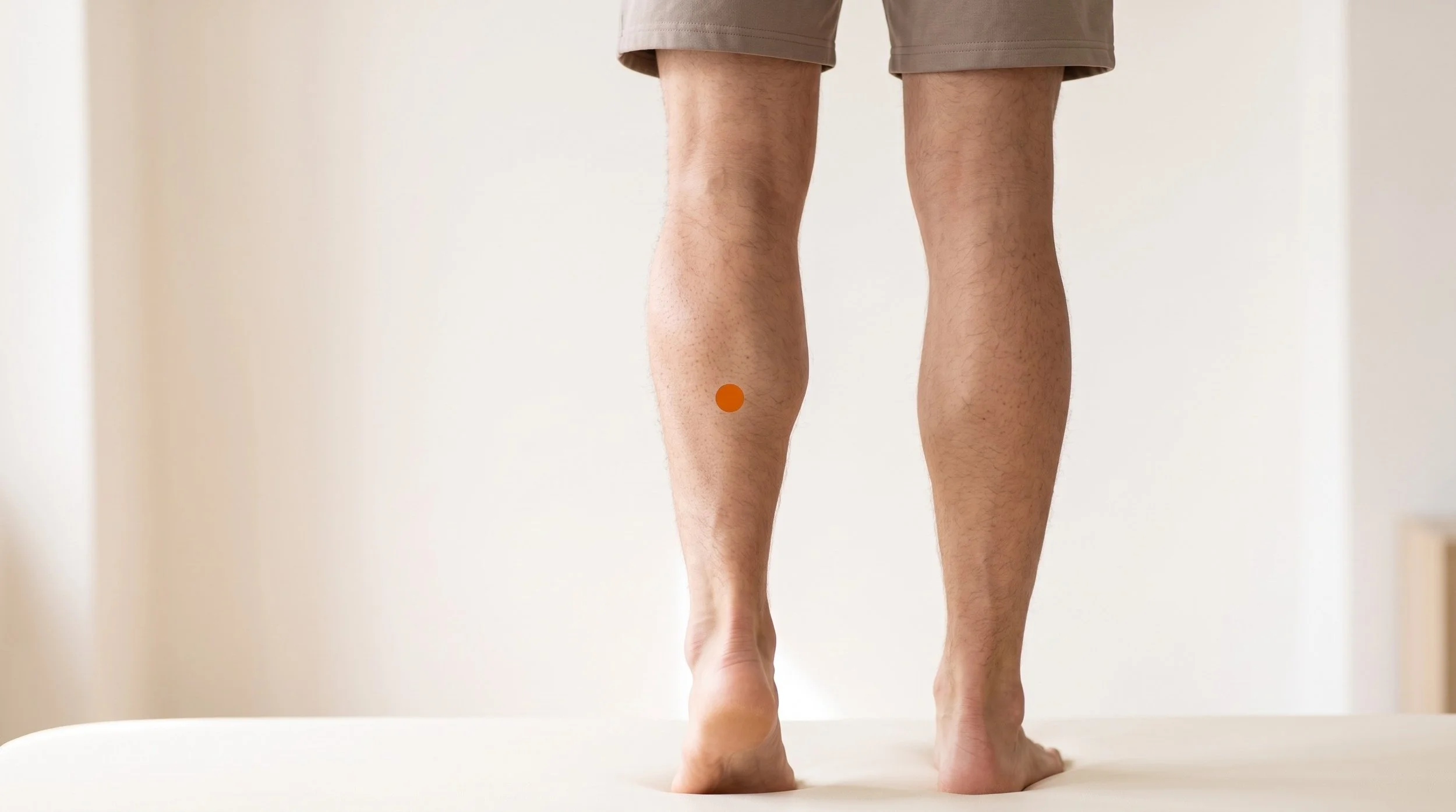
BL57 Acupuncture Point
Support the Mountain at the Base of the Calf: Anatomy, Mechanism, and Why This Point Anchors Treatment for Cramps, Achilles Pain, and Heel Pain
BL57 (Chengshan, often translated as Support the Mountain) sits on the posterior midline of the calf, in the soft notch you can feel where the two bellies of the gastrocnemius taper together and hand off to the Achilles tendon, roughly 8 cun below the crease behind the knee. The name is descriptive rather than poetic: the twin gastrocnemius bellies stand up like a mountain and the point sits underneath, at the place where the load of every step is transferred from muscle into tendon.
That location is why the bl57 acupuncture point has stayed in continuous clinical use for more than two thousand years, traditionally for calf cramping, heel pain, and hemorrhoids, and in modern practice for calf strain, Achilles tendon irritation, plantar heel pain, and the posterior leg component of sciatic pain.
- Bladder 57 lies in the depression below the gastrocnemius bellies, at the musculotendinous junction over the soleus, about midway between BL40 and BL60; the needle passes through skin and crural fascia into the gastrocnemius aponeurosis and soleus, with the tibial nerve and posterior tibial vessels lying deeper (Deadman et al., 2007; Kim, 2016).
- Traditional sources attribute to BL57 the actions of relaxing the sinews, freeing the channel, easing pain, benefiting the calf and heel, and treating hemorrhoids; in modern terms these are descriptions of reduced muscle tone, improved local perfusion, and reduced nociceptive input from a heavily loaded tissue (Deadman et al., 2007; Kim, 2016).
- The point sits in tibial nerve territory within the S1 to S2 segmental field, which explains why sensation from needling often spreads toward the heel or up toward the popliteal fossa and why the point is used for symptoms further along that same segment (Zhao, 2008).
- Needling here appears to engage both local and systemic mechanisms: near infrared spectroscopy work shows measurable changes in calf muscle oxygenation and blood volume after segmental needling (Kaneko et al., 2016), while pooled patient level data support modest, durable effects of acupuncture in chronic musculoskeletal pain (Vickers et al., 2018).
- Point specific research is limited but not absent: BL57 was part of the protocol in a sham controlled trial for calf cramps in dialysis patients (Mohamadi Jahromi et al., 2024), and it was among the most frequently selected points in trials reviewed for post hemorrhoidectomy pain (Chen et al., 2022).
- De qi at BL57 tends to be strong: a deep, spreading ache with heaviness that can travel toward the Achilles or upward behind the knee, and in a tight or cramping calf the muscle may give a brief twitch as the tension releases.
- BL57 was included by Ma Dan-yang among his short list of Heavenly Star points, where it is paired with BL40, a sign of how highly it was rated in classical practice (Deadman et al., 2007; Maciocia, 2015).
Are Night Cramps and Calf Tightness Interrupting Your Sleep and Training?
Calf cramps rarely come from the calf alone: ankle mechanics, hydration, medication effects, training load, and lumbar nerve irritation all feed into them. At Morningside Acupuncture, BL57 is a workhorse point in these cases, combined with BL40 and with dry needling of the gastrocnemius and soleus when palpation finds taut, tender bands. We pair the needling with loading advice so the calf tolerates more before it complains. Schedule a visit and let's get your calves quiet at night.
Schedule NowAnatomy of BL57: Why the Gastrocnemius Musculotendinous Junction Is Such an Important Location
Run a finger up the midline of the Achilles tendon and it will eventually drop into a soft V shaped notch where the medial and lateral heads of the gastrocnemius converge into their common aponeurosis. That notch is BL57, and it is easier to find if the patient presses the ball of the foot against your hand so the calf contracts (Deadman et al., 2007). Under the skin and crural fascia the needle meets the gastrocnemius aponeurosis and then the soleus, the slower, endurance oriented muscle that keeps you upright and absorbs load every time the heel leaves the ground.
This is a high strain zone: musculotendinous junctions concentrate mechanical stress, which is exactly why runners, dancers, cyclists, people who walk New York City in unsupportive shoes, and anyone returning to activity too quickly develop tenderness right here.
The overlying skin is supplied by the sural nerve and its medial sural cutaneous contribution, while the muscles themselves are innervated by the tibial nerve, all within the S1 to S2 segmental field of the sacral plexus. Needling stimulates A delta and C fiber afferents in muscle and fascia, and those afferents enter the dorsal horn in the same spinal segments that receive input from the heel, the plantar fascia, the posterior thigh, and the sacral and anorectal region.
Convergence of these inputs onto shared dorsal horn neurons is one of the accepted reasons a needle placed in the calf can modulate pain reported some distance away, and stimulation of these afferents also recruits descending inhibitory pathways from the midbrain and brainstem that reduce transmission more broadly (Zhao, 2008). Local effects matter too: needling in a segment has been shown to alter muscle oxygenation and blood volume in the calf, consistent with the traditional description of a point that softens and nourishes a hardened muscle (Kaneko et al., 2016).
Deep to the soleus lie the tibial nerve and the posterior tibial artery and veins, which is the main reason BL57 is needled with attention rather than force. Standard practice is perpendicular insertion of 1 to 1.5 cun, with oblique angling proximally or distally as an option, and shallower depths are entirely reasonable in thin or sensitive patients (Deadman et al., 2007; Kim, 2016). Clinicians avoid vigorous deep manipulation, take care with prominent varicosities, and do not needle the calf when there is any suspicion of deep vein thrombosis. Sensation at this point can be unusually strong, so dosing conservatively on a first visit is good practice.
Related Calf Pain Treatment NYC Related Gastrocnemius Trigger PointsBL57 at a Glance: Classification, Location, and Clinical Use
| Category | Detail |
|---|---|
| Traditional Name | Chengshan (Support the Mountain), Bladder 57 |
| Channel Classification | Bladder (Foot Taiyang) channel, lower leg |
| Point Categories | A regular point of the Bladder channel with no five shu, hui meeting, or standard crossing designation. It is listed among Ma Dan-yang's Heavenly Star points, his short group of especially valued points, where it is coupled with BL40 (Deadman et al., 2007; Maciocia, 2015). Some commentary traditions also record an early attribution of a Yang Wei vessel opening role to BL57, later reassigned in the classical literature, so it is best treated as a historical footnote rather than current practice (Sterman, 2017). |
| Precise Location | On the posterior midline of the calf, in the depression formed below the two gastrocnemius bellies when the muscle contracts, roughly 8 cun distal to the popliteal crease and about midway between BL40 and BL60. For bl 57 location, ask the patient to press the ball of the foot against your hand and let your finger settle into the notch that appears. |
| Tissue Stimulated | Skin and crural fascia, the aponeurosis where the medial and lateral gastrocnemius heads converge, and the underlying soleus; the tibial nerve and posterior tibial vessels lie deeper and are avoided. |
| Needle Depth / Direction | Perpendicular insertion 1 to 1.5 cun, or oblique angling proximally or distally along the calf; many texts use a more conservative 0.8 to 1.2 cun. Moxibustion is traditionally permitted. |
| De Qi Sensation | A strong, deep, spreading ache with heaviness or fullness in the calf, often radiating toward the Achilles and heel or upward toward the back of the knee; a brief muscle twitch is common when a taut band is engaged. |
| Primary Clinical Uses | Calf cramps and calf pain, Achilles tendon pain, plantar heel pain, posterior leg pain with sciatic radiation, low back pain as a distal point, and traditional use for hemorrhoid and anorectal symptoms. |
| Common Point Combinations |
|
Deadman, Al-Khafaji and Baker's A Manual of Acupuncture presents BL57 as a point with three durable clinical territories in the classical record: hemorrhoids and anorectal complaints, cramping and contracture of the calf, and heel pain. Traditional theory linked it to the anorectal region through the Bladder divergent channel, which was described as winding around the anus, and classical songs and compendia named it the leading distal point for hemorrhoids of several described types, often paired with DU1.
For the calf, older texts framed nocturnal cramping as a sign of insufficient Blood failing to nourish the sinews at rest, a pattern thought to affect women and older adults more often; BL57 was not considered to build Blood, only to act locally on the tightened muscle. Classical indication lists also include lumbar pain and stiffness, sciatic pain, heavy or weak legs, heel pain, and burning soles with an inability to stand for long, along with a scattering of febrile and systemic entries typical of the period.
What stands out is the persistence of the pattern: a single point on the calf tied simultaneously to the heel below it, the low back above it, and the anorectal region, which maps surprisingly well onto the shared sacral segmental territory modern neuroanatomy describes.
Why BL57 Is Used for Heel Pain and Anorectal Symptoms, Not Just Calf Cramps
The most useful way to understand BL57's range is segmental. The muscles under this point are supplied by the tibial nerve within the S1 to S2 field, and the same lower sacral segments receive input from the heel and plantar fascia, the posterior thigh, the low back, and, through sacral pathways, the pelvic floor and anorectal region. Sensory neurons from these different tissues converge onto shared populations of dorsal horn neurons, so a strong, well localized afferent barrage from the calf can change how that segment processes signals arriving from its neighbors (Zhao, 2008).
That convergence is a plausible modern reading of why classical texts filed hemorrhoids, heel pain, and calf contracture under one point rather than three.
Needling also recruits effects that reach beyond the segment. Afferent stimulation activates descending inhibitory systems involving the periaqueductal gray and rostral ventromedial medulla, along with endogenous opioid and monoaminergic signaling, which raises pain thresholds more diffusely (Zhao, 2008). Locally, needling within a segment measurably shifts muscle oxygenation and blood volume in the calf, a change consistent with reduced resting tone and improved perfusion in a muscle that has been working in a shortened, guarded position (Kaneko et al., 2016). Clinically this is what patients describe as the calf feeling looser and warmer for a day or two after treatment.
None of this makes BL57 a stand-alone answer. The largest individual patient data analysis of acupuncture for chronic pain found effects that were statistically robust and persisted over months, but modest in size, and those effects came from full multi-point treatments rather than single points (Vickers et al., 2018). BL57 earns its place as one reliable component of a plan that also includes loading, footwear, and training adjustments.
What the Research Shows for BL57
It's worth being clear about what the evidence can and cannot say. Nearly all trials test multi-point protocols, so no study isolates BL57 as a variable, and the conditions it is used for (calf cramps, plantar heel pain, Achilles pain, post-surgical anorectal pain) have small, heterogeneous literatures with frequent methodological limitations.
What can reasonably be said is that BL57 appears repeatedly inside protocols that have outperformed sham or usual care, that the general evidence base for acupuncture in chronic musculoskeletal pain is reasonably strong, and that the point's physiology is well characterized even where clinical trials are thin.
| Study | Type | Focus | Key Finding |
|---|---|---|---|
| Vickers et al., 2018 | Individual patient data meta-analysis | Acupuncture for chronic musculoskeletal, headache, and osteoarthritis pain | Acupuncture outperformed both sham and no-acupuncture controls with effects that persisted over time, though the differences from sham were modest. |
| Mohamadi Jahromi et al., 2024 | Randomized clinical trial | Calf cramps in patients on hemodialysis, using a protocol that included BL57 | Pain severity and cramp frequency improved significantly in the acupuncture group compared with sham, in a small single-center sample. |
| Clark & Tighe, 2012 | Systematic review | Acupuncture for plantar heel pain | Reviewed trials suggested benefit comparable to commonly used conservative care, but study quality and reporting limited the strength of that conclusion. |
| Llurda-Almuzara et al., 2021 | Systematic review and meta-analysis | Dry needling for plantar heel pain and plantar fasciitis | Needling of myofascial trigger points was associated with reduced pain, with the authors noting variability in protocols and follow-up. |
| Chen et al., 2022 | Systematic review of randomized trials | Acupuncture for post-hemorrhoidectomy pain, where BL57 was among the most frequently selected points | Included trials reported lower pain scores with electroacupuncture at several time points, but only four small studies were available and conclusions remain tentative. |
| Kaneko et al., 2016 | Physiological study using near infrared spectroscopy | Muscle tissue oxygenation at the low back and calf after segmental needling | Oxygenated hemoglobin and blood volume increased in calf muscle following needling, suggesting local circulatory effects that may accompany reduced muscle tension. |
| Zhao, 2008 | Narrative review of mechanisms | Neural pathways underlying acupuncture analgesia | Describes segmental dorsal horn modulation plus descending inhibitory and neurochemical pathways as the primary mechanisms of needle-induced analgesia. |
Heel Pain That Bites on the First Steps of the Morning?
Plantar heel pain and Achilles irritation are usually load problems in a stiff, overworked posterior chain, and the calf is often the quietest offender. We use BL57 with KI3 and local points at the heel, along with trigger point needling of the calf muscles that refer pain into the arch. Treatment is paired with a progressive calf loading plan, because needling reduces symptoms best when the tissue is also being trained. Book an evaluation and start working on the first ten steps of your day.
Schedule NowBL57 in the Context of Trigger Point Work
BL57 sits in territory that trigger point mapping treats as clinically important. Taut bands in the medial and lateral heads of the gastrocnemius commonly produce posterior leg pain and cramping, and are classically associated with nocturnal calf cramps, while soleus trigger points refer strongly into the heel and can mimic plantar fasciitis (Simons et al., 1999).
Because BL57 lies at the junction where the gastrocnemius aponeurosis meets the soleus, needling here often engages tissue that is already implicated on palpation, which is one reason the point so often reproduces a patient's familiar symptoms rather than producing a novel sensation.
At Morningside Acupuncture, BL57 is usually one element of a broader posterior chain treatment. A typical session might combine BL57 and BL40 with dry needling of the gastrocnemius heads, the soleus, and, when heel symptoms dominate, tibialis posterior and the deep intrinsic foot muscles, followed by cupping along the calf and a specific calf loading progression.
Acupuncture and dry needling are the same tool used with different reasoning frameworks: an acupuncture needle placed at a classical point and an acupuncture needle placed in a taut band both work through the nervous system, and combining the two lets us treat the symptomatic tissue and the segment that governs it in a single visit.
BL57 Calf and Heel Pain Treatment at NYC's Highest-Rated Acupuncture Clinic
Morningside Acupuncture is the highest-rated acupuncture and dry needling clinic in New York City with over 500 five-star Google reviews, and calf, Achilles, and heel complaints are among the conditions we see most. Every session begins with an orthopedic assessment so BL57 is used because your exam points there, not because it appears in a textbook list. Treatment blends classical point selection with trigger point dry needling, cupping, and rehab guidance. Schedule your appointment and let's build a plan for your legs.
Schedule NowFrequently Asked Questions
What does BL57 feel like when needled?
Most people feel a deep, spreading ache with a sense of heaviness or fullness in the middle of the calf, often traveling down toward the Achilles or up behind the knee. If the calf is tight or has active taut bands, there may be a quick involuntary twitch as the muscle lets go, which is brief and usually followed by a noticeable easing of tension. BL57 is one of the stronger points on the leg, so a competent practitioner adjusts depth and stimulation to your tolerance rather than pushing through it. Mild soreness in the calf for a day afterward, similar to post-exercise soreness, is common and self-limiting.
Why treat the calf for heel pain or low back pain instead of just needling where it hurts?
Because the calf, heel, posterior thigh, and lower back share overlapping spinal segments. Sensory input from BL57 enters the cord in the same S1 to S2 region that receives signals from the heel and plantar fascia, and convergence at that level lets needling in one tissue influence how the segment processes input from another (Zhao, 2008). There is also a purely mechanical argument: a stiff, overworked calf increases tensile load through the Achilles and the plantar fascia, so reducing calf tone changes the load on the painful structure. In practice we treat both, using BL57 alongside local points at the site of pain.
Can I press BL57 myself between sessions?
Yes, and it's one of the easier points to self-treat. Sit with the knee bent and the foot flat, run a thumb up the midline of the Achilles tendon until it drops into the soft notch below the two calf bellies (about a third of the way up the lower leg), then press straight in with your thumb or a knuckle at a firm but tolerable pressure. Hold steady pressure for 30 to 60 seconds, breathing normally, release, and repeat two or three times per leg, once or twice a day. For an active cramp, firm pressure here plus a gentle dorsiflexion stretch (pulling the toes toward the shin) often shortens the episode. Stop if pressure produces sharp, electric, or radiating pain, and skip self-pressure entirely if you have new unilateral calf swelling, redness, or warmth, which needs medical assessment first.
Is BL57 safe to needle?
In trained hands, yes. The main structures to respect are the tibial nerve and the posterior tibial vessels, which lie deep to the soleus, so needling stays within conventional depths of roughly 1 to 1.5 cun and avoids vigorous deep manipulation (Deadman et al., 2007; Kim, 2016). Practitioners take extra care with prominent varicose veins, with patients on anticoagulants, and with anyone who bruises easily, and the calf is not needled when deep vein thrombosis is suspected, since new calf swelling, warmth, or unilateral pain requires medical evaluation. Because sensation here can be intense, a lower dose is sensible at a first visit.
Where exactly is BL57 located?
On the posterior midline of the calf, in the depression that forms just below the point where the two gastrocnemius bellies come together, roughly 8 cun below the popliteal crease and approximately midway between BL40 behind the knee and BL60 beside the outer ankle. The most reliable way to find bladder 57 is to contract the muscle: have the person press the ball of the foot against resistance, or stand on tiptoe, and the inverted V shaped notch below the muscle bellies becomes visible and palpable. If the calf contour is hard to read, splitting the distance between the knee crease and the level of the outer ankle bone gets you very close.
References
- Deadman, P., Al-Khafaji, M., & Baker, K. (2009). A manual of acupuncture. Journal of Chinese Medicine Publications.
- Maciocia, G. (2005). The foundations of Chinese medicine: A comprehensive text for acupuncturists and herbalists (2nd ed.). Elsevier Churchill Livingstone.
- Kim, H. (2008). Handbook of Oriental medicine (3rd ed.). Harmony & Balance Press.
- Cecil-Sterman, A. (2012). Advanced acupuncture: A clinic manual. Classical Wellness Press.
- Simons, D. G., Travell, J. G., & Simons, L. S. (1999). Travell & Simons' myofascial pain and dysfunction: The trigger point manual, Vol. 1: Upper half of body (2nd ed.). Williams & Wilkins.
- Zhao, Z. Q. (2008). Neural mechanism underlying acupuncture analgesia. Progress in Neurobiology, 85(4), 355-375. https://doi.org/10.1016/j.pneurobio.2008.05.004
- Vickers, A. J., Vertosick, E. A., Lewith, G., MacPherson, H., Foster, N. E., Sherman, K. J., Irnich, D., Witt, C. M., & Linde, K. (2018). Acupuncture for chronic pain: Update of an individual patient data meta-analysis. Journal of Pain, 19(5), 455-474. https://doi.org/10.1016/j.jpain.2017.11.005
- Mohamadi Jahromi, L. S., Vejdanpak, M., Ghaderpanah, R., Sadrian, S. H., Dabbaghmanesh, A., Roshanzamir, S., & Dabbaghmanesh, M. (2024). Efficacy of acupuncture on pain severity and frequency of calf cramps in dialysis patients: A randomized clinical trial. Journal of Acupuncture and Meridian Studies, 17(2), 47-54. https://doi.org/10.51507/j.jams.2024.17.2.47
- Clark, R. J., & Tighe, M. (2012). The effectiveness of acupuncture for plantar heel pain: A systematic review. Acupuncture in Medicine, 30(4), 298-306. https://doi.org/10.1136/acupmed-2012-010183
- Llurda-Almuzara, L., Labata-Lezaun, N., Meca-Rivera, T., Navarro-Santana, M. J., Cleland, J. A., Fernández-de-las-Peñas, C., & Pérez-Bellmunt, A. (2021). Is dry needling effective for the management of plantar heel pain or plantar fasciitis? An updated systematic review and meta-analysis. Pain Medicine, 22(7), 1630-1641. https://doi.org/10.1093/pm/pnab114
- Chen, H., Zhang, W., Sun, Y., Jiao, R., & Liu, Z. (2022). The role of acupuncture in relieving post-hemorrhoidectomy pain: A systematic review of randomized controlled trials. Frontiers in Surgery, 9, 815618. https://doi.org/10.3389/fsurg.2022.815618
- Kaneko, Y., Kime, R., Furuya, E., Sakamoto, A., & Katsumura, T. (2016). Effects of acupuncture stimulation on muscle tissue oxygenation at different points. Advances in Experimental Medicine and Biology, 923, 327-333. https://doi.org/10.1007/978-3-319-38810-6_43
Disclaimer: This web site is intended for educational and informational purposes only. Reading this website does not constitute providing medical advice or any professional services. This information should not be used for diagnosing or treating any health issue or disease. Those seeking medical advice should consult with a licensed physician. Seek the advice of a medical doctor or other qualified health professional for any medical condition. If you think you have a medical emergency, call 911 or go to the emergency room. No acupuncturist-patient relationship is created by reading this website or using the information. Morningside Acupuncture PLLC and its employees and contributors do not make any express or implied representations with respect to the information on this site or its use. For any legal interpretation of scope of practice in your state, consult a licensed attorney or regulatory authority.
Read more from our blog