Dry Needling for Piriformis Syndrome
How Targeting Deep Gluteal Trigger Points May Relieve Sciatic-Like Buttock Pain
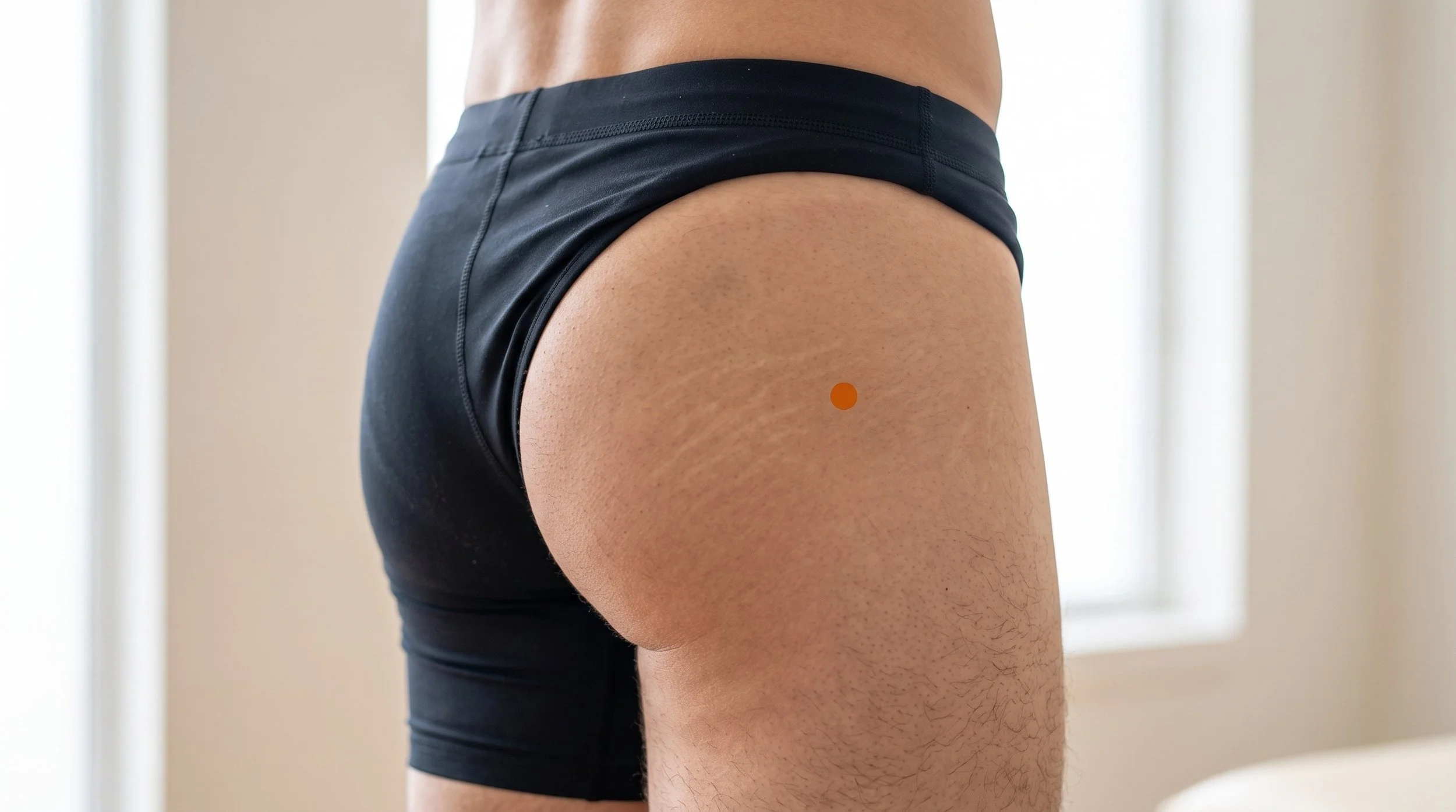
Piriformis syndrome produces deep buttock pain, hip stiffness, and leg symptoms that closely mimic lumbar disc sciatica, yet the source is a small muscle buried beneath the gluteus maximus. Dry needling offers direct access to the piriformis and surrounding deep rotators in a way that stretching and surface massage cannot reach.
- The piriformis muscle sits directly adjacent to the sciatic nerve; in approximately 16% of people the nerve passes through or above the muscle rather than beneath it, making these individuals more vulnerable to compression (Smoll, 2010).
- Trigger points within the piriformis itself refer pain into the buttock, posterior hip, and upper posterior thigh in a pattern that overlaps substantially with L5-S1 radiculopathy, leading to frequent misdiagnosis.
- Gluteus minimus trigger points alone can mimic the full leg-length distribution of sciatica, radiating pain from the lateral hip to the ankle (Travell & Simons, 1992), which is why multiple deep gluteal muscles must be assessed together.
- Elevated concentrations of inflammatory nociceptors and sensitizing biochemicals are present within active trigger points, and dry needling may normalize this local chemical environment to reduce pain signaling (Shah et al., 2008).
- A 10-year clinical study found that targeted injection into the piriformis produced meaningful symptom reduction in patients who had not responded to conservative care (Fishman et al., 2002).
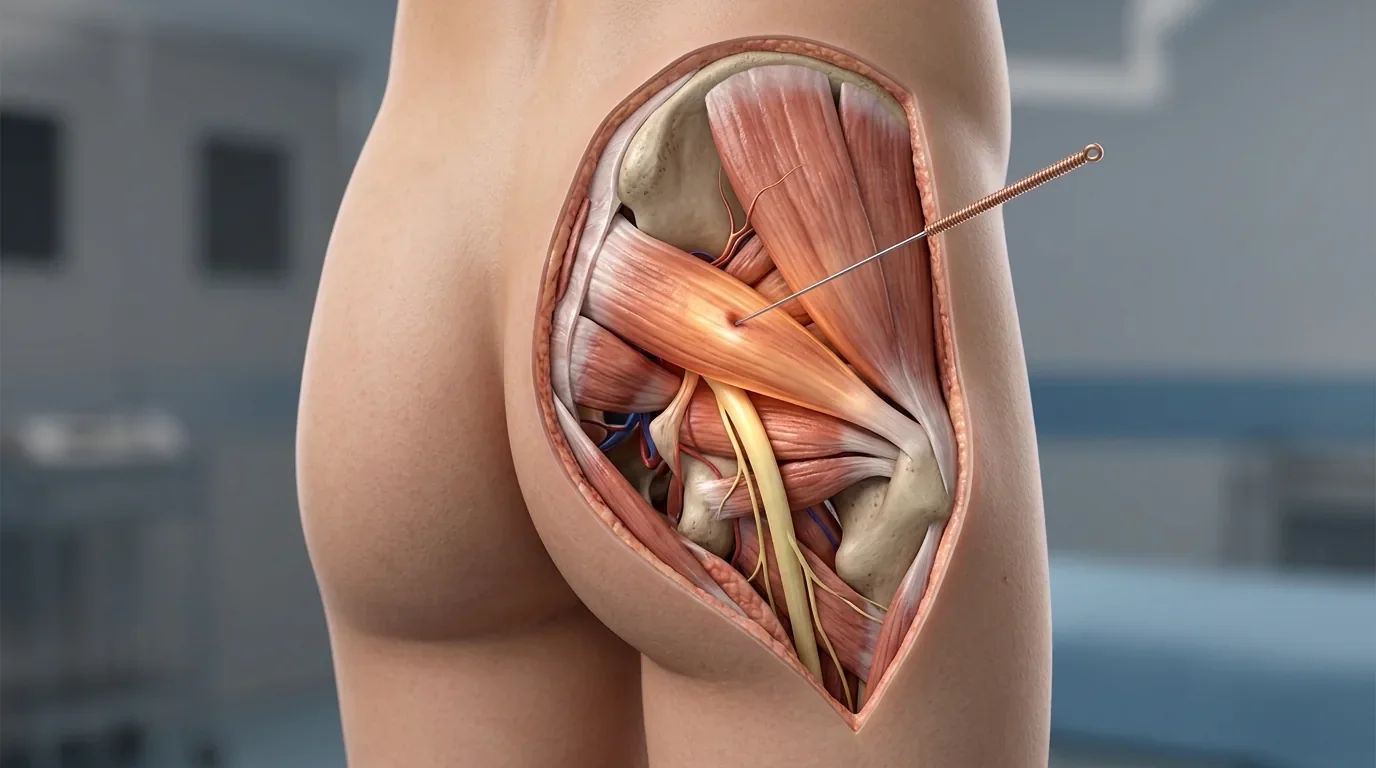
- The deep location of the piriformis beneath the gluteus maximus makes it inaccessible to standard massage pressure; a thin monofilament dry needling needle can reach the muscle directly with precision.
Could your deep buttock pain be coming from the piriformis rather than your spine?
Many patients arrive at Morningside Acupuncture after months of treating a lumbar disc problem that was never the actual source of their leg pain. Our clinicians assess the full deep gluteal compartment to identify which muscles are driving symptoms before needling begins.
Schedule NowWhat Piriformis Syndrome Actually Is
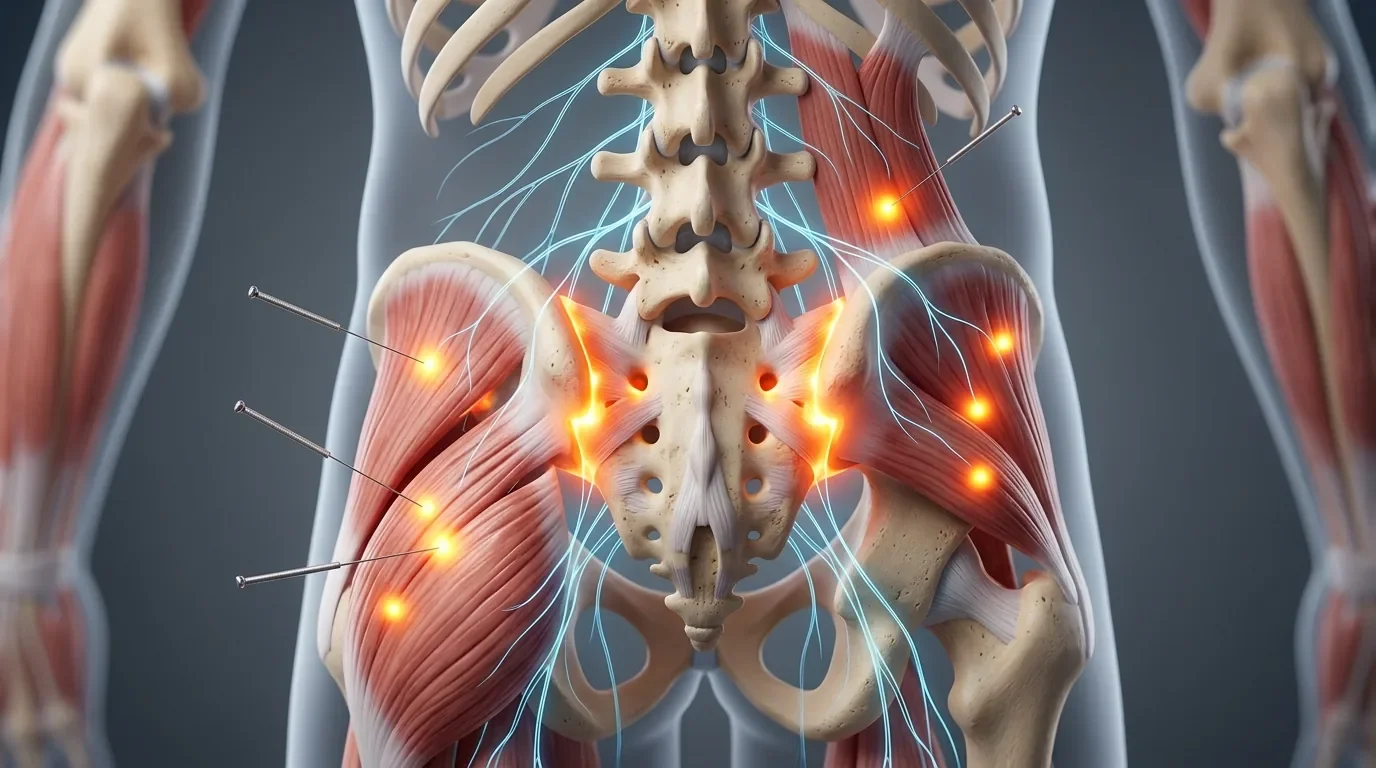
The piriformis is a small, pear-shaped muscle that runs from the anterior surface of the sacrum to the greater trochanter of the femur. Its job is to externally rotate the hip and assist with abduction when the hip is flexed. Because it crosses the posterior pelvic wall directly adjacent to where the sciatic nerve exits the pelvis through the greater sciatic foramen, the relationship between these two structures is anatomically intimate.
In the majority of people, the sciatic nerve runs directly beneath the piriformis muscle. In a significant minority, however, this arrangement varies. A meta-analysis pooling cadaveric data found that in approximately 16% of cases the sciatic nerve passes through the piriformis belly, above it, or in a split pattern where different divisions of the nerve take separate routes relative to the muscle (Smoll, 2010). These individuals have a structurally higher risk of piriformis-related sciatic nerve irritation at rest, with exercise, or following prolonged sitting.
When the piriformis develops trigger points or sustained muscular tension, it can compress the sciatic nerve mechanically. The resulting symptoms, including deep buttock pain, posterior thigh aching, and sometimes numbness or tingling into the leg, are clinically indistinguishable from lumbar radiculopathy on history alone. Distinguishing features tend to emerge only on physical examination: tenderness on deep palpation of the piriformis belly, pain reproduction with resisted external rotation, and the absence of lumbar movement limitations that would accompany a disc-origin problem.
Related Piriformis Trigger Points: Referred Pain Patterns and TreatmentThe Diagnostic Overlap with Lumbar Sciatica
Piriformis syndrome is estimated to account for between 6% and 8% of low back and leg pain presentations that initially present as sciatica (Kirschner et al., 2009). The diagnostic confusion is understandable: both conditions produce buttock pain radiating into the leg, both may worsen with prolonged sitting, and both can respond partially to general movement. The key difference lies in where the nerve is being irritated. In lumbar disc sciatica the compression occurs at the nerve root as it exits the spinal canal. In piriformis syndrome the sciatic nerve is being irritated several centimeters distally, at the piriformis muscle belly itself.
MRI of the lumbar spine, the standard first imaging step when sciatica is suspected, will be normal or show incidental findings in true piriformis syndrome. This is not always recognized, and patients may receive diagnoses of non-specific back pain or be told their imaging findings are "not significant enough" to explain their pain, when in fact the piriformis was never imaged or examined. Electrodiagnostic studies can occasionally show delayed H-reflex latency with the hip in flexion, adduction, and internal rotation, a position that stretches the piriformis and further compresses the nerve, but this test is not universally sensitive (Fishman et al., 2002).
Trigger Points: The Myofascial Layer of Piriformis Syndrome
Trigger points within the piriformis muscle are a central part of the clinical picture in most cases. These hyperirritable nodules within the muscle belly develop in response to overload, trauma, sustained contraction, or compensation for dysfunction elsewhere in the kinetic chain. Hip flexor tightness, weak gluteus medius, prolonged sitting, or direct trauma from a fall can all initiate piriformis trigger points.
What makes piriformis trigger points particularly consequential is that the referred pain they generate closely maps the distribution of the sciatic nerve itself. Travell and Simons documented that piriformis trigger points refer pain into the sacroiliac region, the buttock, and the posterior hip, and that the muscle contributes to the entrapment of the sciatic nerve within its fascial compartment (Travell & Simons, 1992). When the trigger point is active, the sustained low-grade contraction of the affected fibers maintains a constant state of muscular shortening that keeps pressure on the adjacent nerve.
The piriformis rarely acts alone. Neighboring deep external rotators, the gluteal muscles, and lumbar stabilizers develop satellite trigger points in response to the primary dysfunction, and these satellites may be generating as much referred pain as the piriformis itself. Effective assessment and treatment must account for the full compartment.
| Muscle | Role in Piriformis Syndrome | Trigger Point Referred Pain Pattern | Plain English |
|---|---|---|---|
| Piriformis | Primary driver; directly adjacent to sciatic nerve | Deep buttock, SI joint, posterior hip, upper posterior thigh | The main culprit: compressed sciatic nerve and referred pain into the back of the hip |
| Gluteus Medius | Weak gluteus medius overloads piriformis during gait; satellite trigger points common | Lower back, outer hip, upper buttock | Hip weakness that forces the piriformis to work harder, perpetuating the cycle |
| Gluteus Minimus | Anterior fibers refer pain into lateral thigh to ankle; posterior fibers into buttock and posterior leg | Lateral hip, lateral thigh, outer leg, ankle | Can produce the full length of a sciatica pattern with no spinal involvement at all |
| Obturator Internus | Fellow deep external rotator; develops trigger points when piriformis is dysfunctional | Deep buttock, coccyx region, posterior thigh | A deep neighbor that amplifies pain in the same region, often overlooked |
| Quadratus Femoris | External rotator at ischial tuberosity; contributes to ischial pain and sitting discomfort | Ischial region, deep buttock, proximal posterior thigh | Causes pain directly where you sit, often mistaken for hamstring origin |
| Quadratus Lumborum | Primary lumbar stabilizer; loads the pelvis asymmetrically when tight, increasing piriformis demand | Lower back, sacroiliac region, outer hip, greater trochanter | Often the upstream driver: when this muscle is tight, the piriformis compensates and overworks |
Has stretching failed to resolve your piriformis pain?
Piriformis stretches work the surface. Trigger points embedded in the muscle belly do not release with passive lengthening alone. At Morningside Acupuncture, we use dry needling to reach directly into the piriformis and surrounding deep rotators, addressing the source that stretching cannot access.
Schedule NowHow Dry Needling Targets the Piriformis
The piriformis lies deep to the gluteus maximus and is not reachable by conventional soft tissue massage techniques. Surface pressure applied to the gluteal region may temporarily reduce tone in the overlying muscles but rarely penetrates deeply enough to deactivate trigger points within the piriformis belly itself. Dry needling uses a thin monofilament acupuncture needle, which can be guided through the layers of gluteal tissue to reach the piriformis with precision.
On contact with an active trigger point, the needle often elicits a local twitch response, a brief involuntary contraction of the taut band. This twitch response is associated with a rapid change in the electrical activity of the affected motor end plates and a corresponding reduction in the sustained contraction that was maintaining pressure on the sciatic nerve. Research measuring the biochemical environment at trigger point sites has found elevated levels of sensitizing substances including substance P, calcitonin gene-related peptide, bradykinin, and inflammatory prostaglandins; dry needling is thought to assist in normalizing this chemical milieu (Shah et al., 2008).
In clinical practice, treatment for piriformis syndrome typically combines direct piriformis needling with assessment and treatment of the full deep gluteal compartment. The obturator internus, gluteus medius, gluteus minimus, and quadratus femoris are evaluated at the same session because satellite trigger points in these muscles will perpetuate symptoms even after the piriformis is successfully treated. Addressing only the piriformis in isolation often produces short-term relief that does not hold.
Related Dry Needling Guide: Mechanisms, Evidence, and What to ExpectThe Role of Hip Mechanics and Perpetuating Factors
Piriformis syndrome rarely resolves permanently without addressing the biomechanical factors that caused the muscle to overload in the first place. The two most common perpetuating patterns are anterior pelvic tilt with tight hip flexors, and weakness of the gluteus medius. When the hip flexors are shortened and the pelvis tips forward, the piriformis is placed under increased resting tension. When the gluteus medius is weak, the piriformis is recruited to assist with pelvic stability during walking, a role it was not designed to sustain over thousands of repetitions.
Prolonged sitting is a third major perpetuating factor. Seated posture holds the piriformis in a lengthened state under sustained load, a mechanical situation that is particularly effective at generating trigger points in muscles that are not otherwise injured. Runners who transition quickly to high mileage, cyclists with poor saddle height, and office workers who sit for eight or more hours per day all share elevated piriformis risk through different mechanical routes.
Dry needling sessions are most effective when the practitioner evaluates these perpetuating factors during the initial assessment and communicates them clearly to the patient. Deactivating trigger points creates a window of reduced pain and improved extensibility; using that window to correct movement patterns and strengthen the hip stabilizers extends the benefit considerably.
Related Sciatica Treatment NYC: When the Nerve Is the ProblemReady to address deep buttock and hip pain at its actual source?
At Morningside Acupuncture, we are the highest-rated acupuncture and dry needling clinic in New York City with over 500 five-star Google reviews. We specialize in piriformis syndrome, sciatic nerve entrapment, and deep gluteal trigger points, offering precise dry needling that reaches where stretching and massage cannot. If you have been chasing a lumbar disc diagnosis that has not improved with treatment, a full deep gluteal assessment may reveal the real driver.
Schedule NowFrequently Asked Questions
How is piriformis syndrome different from regular sciatica?
True sciatica originates at the nerve root in the lumbar spine, usually from a disc or bony narrowing compressing the nerve as it exits the spinal canal. Piriformis syndrome irritates the same sciatic nerve, but further along its path, at the point where it travels adjacent to or through the piriformis muscle. The pain can feel identical, which is why proper physical examination is essential. Lumbar MRI will typically be normal in piriformis syndrome, while movement tests that load the piriformis specifically will reproduce symptoms.
Does dry needling into the piriformis hurt?
The piriformis is a deep muscle, so the needle must travel through the gluteal layers to reach it. Most patients describe a dull, pressure-like ache during the procedure rather than sharp pain. If a local twitch response occurs when the trigger point is contacted, there may be a brief cramping sensation lasting one to two seconds. Post-treatment soreness in the gluteal region is common for 24 to 48 hours and is generally considered a sign that the muscle responded to treatment.
How many dry needling sessions are typically needed for piriformis syndrome?
Most patients begin to notice a change in symptoms within the first two or three sessions. A full treatment course for piriformis syndrome typically ranges from four to eight sessions depending on how long the condition has been present, the number of satellite trigger points involved, and whether perpetuating factors like hip weakness or prolonged sitting are being addressed concurrently. Chronic or recurring cases may benefit from periodic maintenance sessions.
Can I do the piriformis stretch while I am getting dry needling treatment?
Yes, and stretching is encouraged between sessions. Dry needling creates a period of reduced muscle tension and improved tissue quality; gentle piriformis stretches during this window can help maintain the length gained from treatment. However, aggressive stretching immediately after a needling session is best avoided for the first day, as the tissue may be locally sensitized. Your clinician will advise on timing and technique.
Does Morningside Acupuncture treat piriformis syndrome specifically?
Yes. Deep gluteal trigger points, including piriformis syndrome, are among the more common presentations we treat at Morningside. Our clinicians perform a full assessment of the hip, pelvis, and lumbar region before needling to ensure all contributing muscles are identified and that the treatment plan reflects the complete clinical picture rather than just the most obvious pain site.
References
- Smoll, N. R. (2010). Variations of the piriformis and sciatic nerve with clinical consequence: a meta-analysis. Clinical Anatomy, 23(1), 8–17. https://doi.org/10.1002/ca.20893
- Fishman, L. M., Dombi, G. W., Michaelsen, C., Ringel, S., Rozbruch, J., Rosner, B., & Weber, C. (2002). Piriformis syndrome: diagnosis, treatment, and outcome — a 10-year study. Archives of Physical Medicine and Rehabilitation, 83(3), 295–301. https://doi.org/10.1053/apmr.2002.30622
- Kirschner, J. S., Foye, P. M., & Cole, J. L. (2009). Piriformis syndrome, diagnosis and treatment. Muscle & Nerve, 40(1), 10–18. https://doi.org/10.1002/mus.21318
- Shah, J. P., Danoff, J. V., Desai, M. J., Parikh, S., Nakamura, L. Y., Phillips, T. M., & Gerber, L. H. (2008). Biochemicals associated with pain and inflammation are elevated in sites near to and remote from active myofascial trigger points. Archives of Physical Medicine and Rehabilitation, 89(1), 16–23. https://doi.org/10.1016/j.apmr.2007.10.018
- Travell, J. G., & Simons, D. G. (1992). Myofascial Pain and Dysfunction: The Trigger Point Manual, Volume 2: The Lower Extremities. Williams & Wilkins.
- Dommerholt, J., & Fernandez-de-las-Penas, C. (Eds.). (2013). Trigger Point Dry Needling: An Evidence and Clinical-Based Approach. Churchill Livingstone.
Disclaimer: This web site is intended for educational and informational purposes only. Reading this website does not constitute providing medical advice or any professional services. This information should not be used for diagnosing or treating any health issue or disease. Those seeking medical advice should consult with a licensed physician. Seek the advice of a medical doctor or other qualified health professional for any medical condition. If you think you have a medical emergency, call 911 or go to the emergency room. No acupuncturist-patient relationship is created by reading this website or using the information. Morningside Acupuncture PLLC and its employees and contributors do not make any express or implied representations with respect to the information on this site or its use. For any legal interpretation of scope of practice in your state, consult a licensed attorney or regulatory authority.
Read more from our blog