GB12 Acupuncture Point (Wangu)
GB12 Acupuncture Point
The Mastoid Point Behind the Ear: Anatomy, Upper Cervical Mechanism, and Why GB12 Belongs in Headache and Neck Pain Treatment
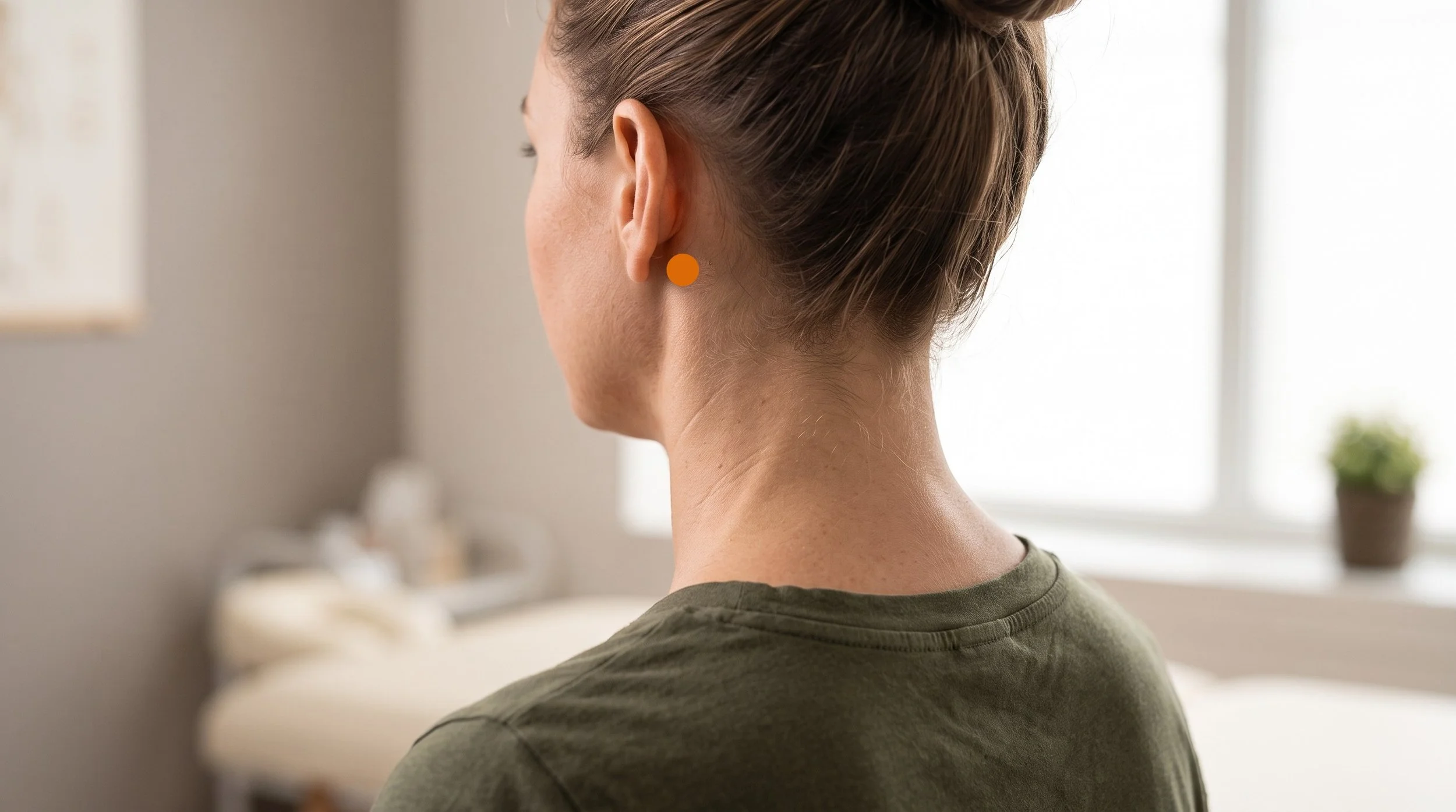
GB12, called Wangu in pinyin and usually rendered in English as Completion Bone (older texts also translate it as Mastoid Process or Whole Bone), is the point that sits in the soft hollow just behind and slightly below the bony bump you can feel behind your ear. That bump is the mastoid process, and the depression behind it is where several neck muscles anchor into the skull.
Because so much tissue converges in a small space, the gb12 acupuncture point is one of the more useful upper cervical locations for headaches that wrap around or behind the ear, for necks that will not rotate comfortably, and for the low grade tension that people notice most at the end of a long screen day. Classical sources also file gallbladder 12 under points that settle the mind, which is less intuitive until you look at where it sits and what it is touching.
- Location and layers: wangu gb12 lies in the depression just posterior and inferior to the mastoid process, over the attachment territory of sternocleidomastoid and splenius capitis, with longissimus capitis nearby and the posterior belly of digastric running deep (Deadman et al., 2007).
- Traditional categorization: Chinese sources list GB12 as a meeting point of the Gallbladder and Bladder channels and traditionally credit it with dispelling wind, easing head pain, and calming the spirit, language we treat as historical description rather than a physiological claim (Deadman et al., 2007; Kim, 2010).
- Mechanism: the region is supplied by the great auricular and lesser occipital nerves from the C2 to C3 roots, and upper cervical afferents converge with trigeminal afferents on shared second order neurons, which helps explain why neck tissue can refer pain into the head and around the ear (Bartsch & Goadsby, 2002).
- Needling this zone recruits both segmental and descending pain modulation, including opioid and monoaminergic pathways described in experimental work on acupuncture analgesia (Zhao, 2008).
- Research picture: large pooled analyses support acupuncture for chronic pain including neck pain and chronic headache, and a Cochrane review found acupuncture may reduce tension-type headache frequency, though trials test whole protocols rather than any single point (Vickers et al., 2018; Linde et al., 2016).
- De qi at gb 12 mastoid is typically a deep, heavy ache that spreads toward the occiput, the ear, or the angle of the jaw; it should feel dull and diffuse, never sharp, electric, or radiating down the arm.
Headaches That Start Behind Your Ear?
Pain that begins at the base of the skull and settles behind the ear is often driven by upper cervical muscles rather than the head itself. At Morningside Acupuncture we use GB12 together with nearby suboccipital and splenius points, hands-on assessment of neck rotation, and dry needling of the muscles that reproduce your pattern. Most patients notice how much of the ache is coming from the neck once those tissues release. Schedule a visit and we will map your headache pattern in the first session.
Schedule NowAnatomy of GB12: Why the Mastoid Process Is Such an Important Location
Run a finger up behind your ear and you will meet a firm bony prominence, the mastoid process. Slide just behind and below it and the finger drops into a small hollow, which is where GB12 sits (Deadman et al., 2007). Under the skin and a thin layer of fascia, this hollow is crowded with tendon and muscle: sternocleidomastoid attaches onto the mastoid from the front, splenius capitis and longissimus capitis anchor just behind it, and the posterior belly of digastric runs deep along its medial groove.
These muscles are loaded every time you hold your head forward at a laptop, sleep on an awkward pillow, clench through a stressful call, or drive with your chin poked out. Chronic low-level loading in this attachment zone is a common reason the area feels tender long before anyone calls it a headache.
The nerve geography is what makes gallbladder 12 clinically interesting. Skin and deep tissue here are supplied by the great auricular and lesser occipital nerves, both branches of the cervical plexus carrying C2 and C3 fibers, and the greater occipital nerve territory begins just medially. Experimental work has shown that afferents from the upper cervical region and afferents from cranial structures converge on the same second order neurons in the trigeminocervical region, so input from neck muscle and skin can amplify or refer into head pain patterns (Bartsch & Goadsby, 2002).
That convergence is the modern explanation for a very old observation, which is that a point behind the ear can influence pain felt at the temple, the ear, the jaw, and the back of the head. Needling in this segment also engages descending inhibitory systems that dampen nociceptive signaling more broadly, a mechanism described in detail in the neurobiology literature (Zhao, 2008).
Depth matters here. The mastoid process itself gives a bony backstop, but the deeper anatomy nearby includes the stylomastoid foramen with the emerging facial nerve, the internal jugular vein medially, and mastoid emissary veins passing through the bone. For that reason the standard needling convention for GB12 is oblique insertion directed inferiorly, roughly 0.5 to 1 cun, angling along the tissue plane rather than perpendicular and medial (Deadman et al., 2007).
In practice this means a shallow, angled needle that meets muscle and tendon and stops well short of anything deep. Practitioners typically palpate the bone first, then let the needle follow the muscle rather than seek depth.
Related Sternocleidomastoid Trigger Points Related Suboccipital Trigger PointsGB12 at a Glance: Classification, Location, and Clinical Use
| Category | Detail |
|---|---|
| Traditional Name | Wangu (GB12), commonly translated as Completion Bone, and rendered in other texts as Mastoid Process or Whole Bone |
| Channel Classification | Gallbladder channel of Foot Shaoyang, in the head and neck region behind the ear |
| Point Categories | Meeting point of the Gallbladder and Bladder channels; also described in classical channel theory as a connection point of the Leg Greater Yang (Bladder) sinew channel |
| Precise Location | In the depression just posterior and inferior to the mastoid process. Place a finger on the bony prominence behind the ear and slide backward until it drops into the hollow. |
| Tissue Stimulated | Mastoid attachments of sternocleidomastoid and splenius capitis, longissimus capitis, the adjacent suboccipital region, with the posterior belly of digastric lying deep |
| Needle Depth / Direction | Oblique insertion directed inferiorly, 0.5 to 1 cun, angled along the tissue plane behind the mastoid rather than perpendicular or medial |
| De Qi Sensation | A deep, heavy, spreading ache behind the ear that may travel toward the occiput, the ear itself, or the jaw angle; sharp or electric sensations mean the needle should be adjusted |
| Primary Clinical Uses | Headache felt behind or around the ear, neck stiffness with limited rotation, upper cervical muscle tension, and in classical listings jaw and cheek discomfort and disturbed sleep |
| Common Point Combinations |
|
Deadman, Al-Khafaji and Baker's A Manual of Acupuncture presents GB12 as a point that traditionally benefits the head, expels what classical medicine called wind from both exterior and interior origins, and calms the spirit. The indication lists group into three broad clusters: head and neck complaints (headache, pain behind the ear, stiffness with an inability to turn the head), local heat and swelling patterns affecting teeth, cheek, ear, and throat, and disorders of movement and mental state such as facial deviation, clenched jaw, and limb weakness.
A fourth cluster covers agitation and insomnia, which the text links to the point's proximity to the extra point Anmian. These are traditional attributions rather than modern diagnostic categories, but the pattern is striking: a single small hollow behind the ear was credited with reaching upward into the head, forward into the face and jaw, and inward toward sleep and agitation, exactly the territory that modern anatomy shows is served by overlapping upper cervical and cranial nerve input.
Why GB12 Is Used for Jaw Tension and Restless Sleep, Not Just Neck Pain
The straightforward use of GB12 is local. If your neck muscles are loaded and tender where they attach to the mastoid, needling that attachment zone can reduce muscle tone and local sensitivity. The less obvious uses make sense once you follow the wiring. The tissue at GB12 is supplied by C2 and C3 branches, and those upper cervical afferents share second order neurons with trigeminal afferents that carry sensation from the face, jaw, and cranial structures (Bartsch & Goadsby, 2002).
Convergence in both directions means neck input can drive face and head symptoms, and it also means treating the neck can influence how the head and jaw feel. That is the modern reading of classical listings for cheek, ear, and tooth discomfort at this point.
The sleep connection is looser but not arbitrary. Needling produces effects beyond the local segment, including engagement of descending inhibitory pathways and shifts in autonomic balance that patients often experience as a drop in arousal during and after treatment (Zhao, 2008). Reducing a persistent nociceptive input from the skull base can also remove one of the reasons a person keeps waking.
Reviews of acupuncture for insomnia report improvements in sleep quality measures compared with some controls, while noting that trial quality varies and that protocols use multiple points rather than any single location (Kim et al., 2021). We frame GB12 as one contributor within a sleep-oriented treatment, not as a sleep switch.
Clinically, this is why GB12 is rarely used alone. It anchors a regional approach that usually includes GB20 for the suboccipital line, GB21 for the shoulder crest, and a distal point such as SI3, with the specific selection driven by where your tenderness and movement restriction actually live.
What the Research Shows for GB12
There is no dedicated trial isolating GB12, and it would be unusual if there were. Acupuncture research tests protocols, and points in the upper cervical region tend to appear inside those protocols alongside GB20, BL10, and local tender points. So the honest framing is this: the evidence below supports acupuncture as an approach for headache and neck pain, and GB12 is a commonly used component of the treatments those trials studied. It does not establish that this point alone produces the effect.
| Study | Type | Focus | Key Finding |
|---|---|---|---|
| Linde et al., 2016 | Cochrane systematic review | Acupuncture for prevention of tension-type headache | Acupuncture may reduce headache frequency compared with usual care and showed small effects over sham, though evidence quality was limited. |
| Vickers et al., 2018 | Individual patient data meta-analysis | Chronic pain including neck pain and chronic headache | Acupuncture was associated with modest but statistically significant benefits over both sham and no-acupuncture controls, with effects largely persisting over a year. |
| Trinh et al., 2016 | Cochrane systematic review | Acupuncture for neck disorders | Reported moderate quality evidence of short-term pain relief for chronic neck pain compared with sham, with longer-term effects less certain. |
| Liu et al., 2024 | Meta-analysis of randomized trials | Acupuncture for cervicogenic headache | Pooled results favored acupuncture on effectiveness and pain scores, but the authors noted publication bias and largely regional trial samples. |
| Kim et al., 2021 | Systematic review and meta-analysis | Acupuncture for insomnia | Reported improved sleep quality scores in several comparisons, with variable methodological quality across included trials. |
| Bartsch & Goadsby, 2002 | Experimental neurophysiology | Convergence of upper cervical and cranial afferents | Demonstrated that many nociceptive neurons receive input from both cranial and cervical territories, supporting neck-to-head pain referral. |
| Zhao, 2008 | Narrative review of mechanisms | Neural basis of acupuncture analgesia | Summarizes segmental inhibition and descending opioid and monoaminergic pathways as the principal mechanisms studied. |
Stiff Neck That Will Not Turn?
Limited rotation is one of the oldest listed uses for the wangu point, and it remains one of the most practical. We pair GB12 with GB20, GB21, and distal points, then add mobility work so the range you gain in the room carries into your week. Acupuncture and dry needling are used here as tools for muscle tone and pain modulation, not quick fixes. Book an appointment and bring the movements that bother you most.
Schedule NowGB12 in the Context of Trigger Point Work
The hollow behind the mastoid is dense trigger point territory. The clavicular and sternal divisions of sternocleidomastoid attach right at the mastoid and are classically associated with referral into the ear, the temple, and behind the eye, while splenius capitis attaches just posteriorly and refers toward the vertex (Simons et al., 1999). Longissimus capitis and the suboccipital group sit close by, and the posterior belly of digastric lies deep near the mastoid groove.
In other words, the gb 12 mastoid location and several well-described myofascial targets share the same small patch of anatomy, which is why patients often describe a familiar, recognizable ache when the area is palpated.
At Morningside we treat that overlap directly. A session for neck-driven headache might combine GB12 with dry needling of sternocleidomastoid, splenius capitis and cervicis, and the suboccipitals, plus GB20 and GB21 along the same functional chain. Acupuncture and dry needling both use an acupuncture needle, so this is one continuous toolkit rather than two competing methods, and we choose the framing that best fits the finding in front of us. Dosage is conservative in this region, with angled shallow needling behind the mastoid and careful attention to the deeper structures nearby.
GB12 Headache and Neck Pain Treatment at NYC's Highest-Rated Acupuncture Clinic
Morningside Acupuncture is the highest-rated acupuncture and dry needling clinic in New York City with over 500 five-star Google reviews, and upper cervical pain is one of the things we see most. Treatment plans combine point-based acupuncture, trigger point dry needling, cupping when appropriate, and clear home guidance. You will always know why each point was chosen and what we expect it to change. Schedule your visit to get started.
Schedule NowFrequently Asked Questions
What does GB12 feel like when needled?
Most people feel a dull, heavy, spreading ache behind the ear that may drift toward the back of the head, into the ear, or down toward the jaw angle. If the muscle attachment is irritable, there can be a brief twitch or a short cramp-like grab that settles within seconds. Sensations that are sharp, burning, electric, or that shoot into the arm are not what we are looking for, and the needle is adjusted or removed if they occur.
Why treat behind the ear when my pain is at my temple or forehead?
Because the upper cervical region and the cranial pain pathways share second order neurons, input from neck muscles and skin can be felt in the front of the head (Bartsch & Goadsby, 2002). Treating the tissue that is actually generating the input often changes where the pain is felt. This is also the reason classical texts listed a point behind the ear for cheek, tooth, and temple complaints long before the neuroanatomy was described.
Can I press GB12 myself between sessions?
Yes, this is one of the easier points for self-care. Find the bony bump behind your ear, slide your fingertip just behind and slightly below it into the hollow, and apply steady moderate pressure with the pad of your index or middle finger. Hold for 30 to 60 seconds, then add small slow circles for another 30 seconds, and repeat on the other side. Two or three rounds per side, once or twice a day, is plenty. Keep the pressure firm but comfortable, breathe slowly while you hold, and stop if you feel dizzy, lightheaded, or any tingling into the scalp or face.
Is GB12 safe to needle?
In trained hands, yes. The standard technique is oblique insertion directed inferiorly at 0.5 to 1 cun, which keeps the needle in muscle and tendon behind the mastoid rather than heading deep or medially (Deadman et al., 2007). Practitioners avoid deep perpendicular angling here because of the vessels and nerves that pass near the base of the skull. Common effects are minor and short-lived, such as local soreness or a small bruise. Tell your practitioner if you take anticoagulants, have had ear or mastoid surgery, or have any implanted hardware in the area.
Where exactly is GB12 located?
GB12 sits in the depression just posterior and inferior to the mastoid process, the bony prominence you can feel behind your earlobe. The simplest way to find the wangu point is to place a fingertip on the prominence itself, then slide backward until the finger drops into a soft hollow, usually within a centimeter or so. In most people the spot is noticeably tender when neck muscles are loaded, which is a useful confirmation.
References
- Deadman, P., Al-Khafaji, M., & Baker, K. (2009). A manual of acupuncture. Journal of Chinese Medicine Publications.
- Kim, H. (2008). Handbook of Oriental medicine (3rd ed.). Harmony & Balance Press.
- Simons, D. G., Travell, J. G., & Simons, L. S. (1999). Travell & Simons' myofascial pain and dysfunction: The trigger point manual, Vol. 1: Upper half of body (2nd ed.). Williams & Wilkins.
- Linde, K., Allais, G., Brinkhaus, B., Fei, Y., Mehring, M., Shin, B.-C., Vickers, A., & White, A. R. (2016). Acupuncture for the prevention of tension-type headache. Cochrane Database of Systematic Reviews, 2016(4), CD007587. https://doi.org/10.1002/14651858.CD007587.pub2
- Trinh, K., Graham, N., Irnich, D., Cameron, I. D., & Forget, M. (2016). Acupuncture for neck disorders. Cochrane Database of Systematic Reviews, 2016(5), CD004870. https://doi.org/10.1002/14651858.CD004870.pub4 [VERIFY BEFORE PUBLISHING]
- Vickers, A. J., Vertosick, E. A., Lewith, G., MacPherson, H., Foster, N. E., Sherman, K. J., Irnich, D., Witt, C. M., & Linde, K. (2018). Acupuncture for chronic pain: Update of an individual patient data meta-analysis. Journal of Pain, 19(5), 455-474. https://doi.org/10.1016/j.jpain.2017.11.005
- Liu, Z., Gao, X., Zhang, X., & Qu, Y. (2024). Meta-analysis of acupuncture treatment for cervicogenic headache. World Neurosurgery, 189, 166-173. https://doi.org/10.1016/j.wneu.2024.05.084
- Kim, S.-A., Lee, S.-H., Kim, J.-H., van den Noort, M., Bosch, P., Won, T., Yeo, S., & Lim, S. (2021). Efficacy of acupuncture for insomnia: A systematic review and meta-analysis. American Journal of Chinese Medicine, 49(5), 1135-1150. https://doi.org/10.1142/S0192415X21500543
- Bartsch, T., & Goadsby, P. J. (2002). Stimulation of the greater occipital nerve induces increased central excitability of dural afferent input. Brain, 125(7), 1496-1509. https://doi.org/10.1093/brain/awf166
- Zhao, Z. Q. (2008). Neural mechanism underlying acupuncture analgesia. Progress in Neurobiology, 85(4), 355-375. https://doi.org/10.1016/j.pneurobio.2008.05.004
Disclaimer: This web site is intended for educational and informational purposes only. Reading this website does not constitute providing medical advice or any professional services. This information should not be used for diagnosing or treating any health issue or disease. Those seeking medical advice should consult with a licensed physician. Seek the advice of a medical doctor or other qualified health professional for any medical condition. If you think you have a medical emergency, call 911 or go to the emergency room. No acupuncturist-patient relationship is created by reading this website or using the information. Morningside Acupuncture PLLC and its employees and contributors do not make any express or implied representations with respect to the information on this site or its use. For any legal interpretation of scope of practice in your state, consult a licensed attorney or regulatory authority.
Read more from our blog