Acupuncture for Meniscus Tear
Conservative Care, Myofascial Treatment, and Why Surgery Is Often Not the Answer for Degenerative Tears
Most meniscus tears, particularly the degenerative type common in adults over 40, respond to conservative management at least as well as surgery, and acupuncture combined with dry needling addresses both the pain and the muscle dysfunction that prevents full recovery.
- Two landmark randomized controlled trials, the METEOR trial (Katz et al., 2013) and the KANON trial (Sihvonen et al., 2013), found that arthroscopic partial meniscectomy produces no better outcomes than physical therapy or sham surgery for degenerative meniscus tears in middle-aged adults.
- Degenerative meniscus tears are present in approximately 36% of asymptomatic adults over age 50, meaning an MRI finding alone does not confirm that the tear is responsible for a patient's knee pain.
- The popliteus muscle, located behind the knee, frequently harbors trigger points that produce a sensation of something trapped or locked in the joint, closely mimicking the mechanical symptoms patients attribute to their meniscus tear.
- Trigger points in the quadriceps, hamstrings, and gastrocnemius add significantly to knee pain in meniscus tear patients and perpetuate the altered loading patterns that stress the remaining meniscal tissue.
- Acupuncture activates descending inhibitory pathways and reduces central sensitization, which is significant because longstanding knee pain produces spinal cord wind-up that amplifies all knee nociception regardless of its source (Zhao, 2008).
- For patients who have had meniscus surgery, acupuncture and dry needling can accelerate recovery by addressing post-surgical muscle inhibition, reducing swelling-related joint stiffness, and normalizing quadriceps and hamstring activation.
- Acupuncture produces clinically meaningful reductions in chronic knee and hip pain in large-scale meta-analyses (Vickers et al., 2018).
Told You Need Surgery for Your Meniscus Tear?
Clinical guidelines now recommend conservative management as first-line care for most degenerative meniscus tears in adults over 40. At Morningside, we offer an evidence-based conservative approach that includes dry needling for the trigger points amplifying your knee pain alongside acupuncture for central pain regulation, giving you the best chance of avoiding or delaying surgery.
Schedule NowThe Evidence Gap: Surgery vs. Conservative Care
The case for conservative management of degenerative meniscus tears changed substantially after two high-quality clinical trials produced results that surprised the orthopaedic community. The METEOR trial by Katz and colleagues randomized 351 patients aged 45 and older with symptomatic degenerative meniscus tears to either arthroscopic partial meniscectomy plus physical therapy or physical therapy alone. Both groups improved significantly over six months, with no clinically meaningful difference between the surgical and non-surgical arms (Katz et al., 2013).
The Finnish KANON trial by Sihvonen and colleagues went further, randomizing 146 patients with non-obstructive medial meniscus tears to arthroscopic partial meniscectomy or sham surgery (an arthroscopic procedure without actual tissue removal). Both groups showed comparable improvement in knee pain and function at one, two, and five years of follow-up, suggesting that the surgical procedure itself rather than any specific tissue alteration drove the improvement in the active surgery group (Sihvonen et al., 2013).
These trials specifically studied degenerative tears in middle-aged and older adults, not traumatic bucket-handle tears in young athletes causing true mechanical locking. The distinction matters: acute traumatic tears with true joint locking or extension block may genuinely require surgical management, but the degenerative tears that constitute the majority of meniscus diagnoses in adults over 40 do not.
Related What Is a Meniscus Tear? Types, Natural History, and the Surgery EvidenceThe Myofascial Layer: What Most Knee Treatments Miss
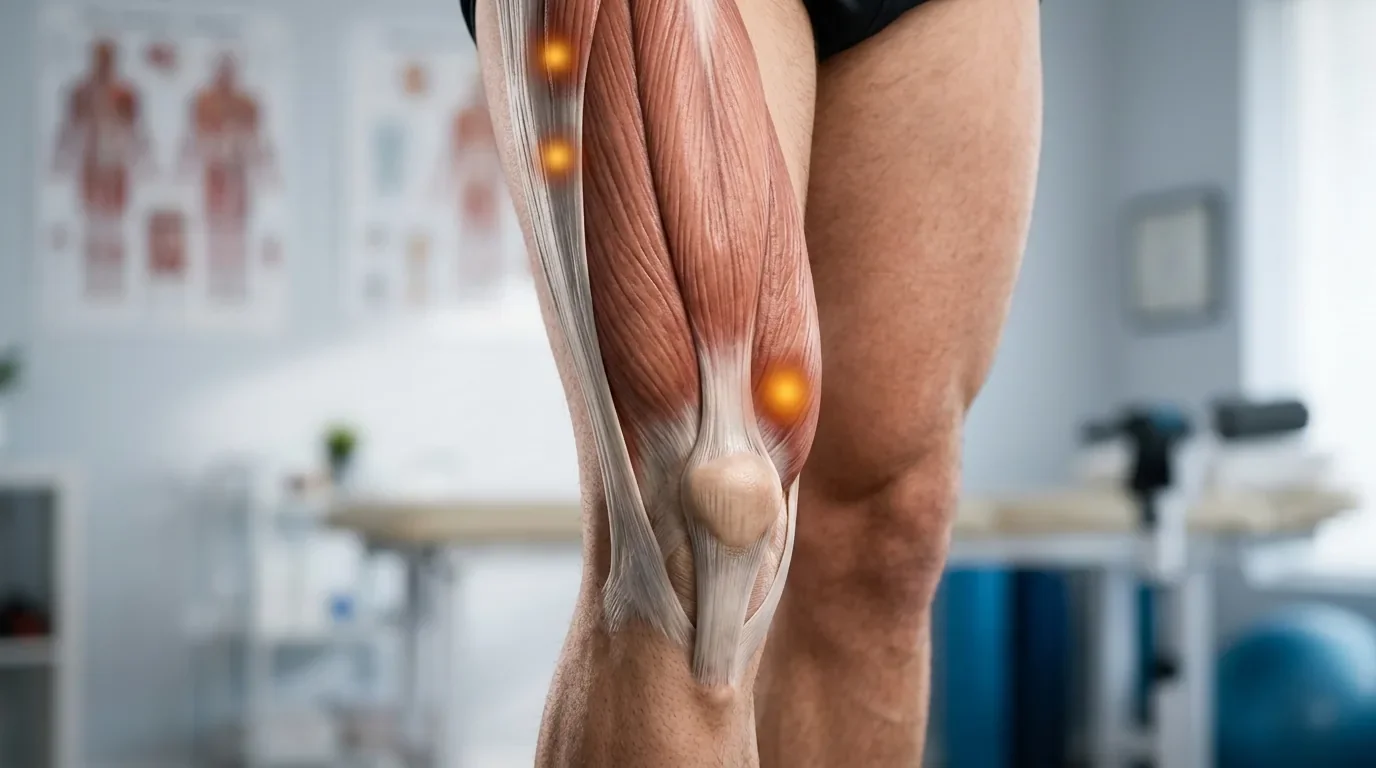
A meniscus tear diagnosis, particularly when accompanied by knee pain, almost invariably coexists with active trigger points in the muscles that cross the knee joint. These trigger points alter the loading dynamics of the knee, reducing the shock absorption and load distribution that healthy quadriceps and hamstring function provides, and directly adding to the pain picture through their referred pain patterns.
| Muscle | Referred Pain to Knee | Specific Clinical Contribution |
|---|---|---|
| Popliteus | Posterior knee; pain with squatting | Produces "something trapped" sensation mimicking mechanical meniscus symptoms; often the primary driver of posterior knee symptoms in degenerative tears |
| Vastus Medialis | Medial knee; inferior patella | Inhibition of vastus medialis alters patellar tracking and medial compartment loading, increasing stress on medial meniscus |
| Rectus Femoris | Anterior knee; patella | Anterior knee pain; reduces quadriceps eccentric control during loading activities |
| Biceps Femoris | Posterior knee; fibular head | Lateral posterior knee pain; increases lateral tibial rotation stress on lateral meniscus |
| Semimembranosus | Posterior and medial knee | Medial posterior knee pain; Baker's cyst can develop from semimembranosus bursa irritation adjacent to the joint |
| Gastrocnemius | Posterior knee; calf | Posterior knee pain; calf stiffness reducing ankle dorsiflexion increases tibial stress during loading |
| Gracilis | Medial knee; inner thigh | Linear stripe of medial knee pain along the pes anserine insertion; frequently mistaken for medial meniscus or MCL pathology |
How Acupuncture Works for Knee Pain from Meniscus Tears
Chronic knee pain from meniscus pathology involves multiple levels of neural sensitization. At the peripheral level, inflammatory mediators in and around the tear sensitize nociceptors in the remaining meniscal tissue, the joint capsule, and the subchondral bone. At the spinal cord level, repeated nociceptive input from the knee produces dorsal horn sensitization (wind-up), lowering the threshold for pain generation from all knee-related inputs. At the cortical level, longstanding pain produces maladaptive changes in pain processing circuitry.
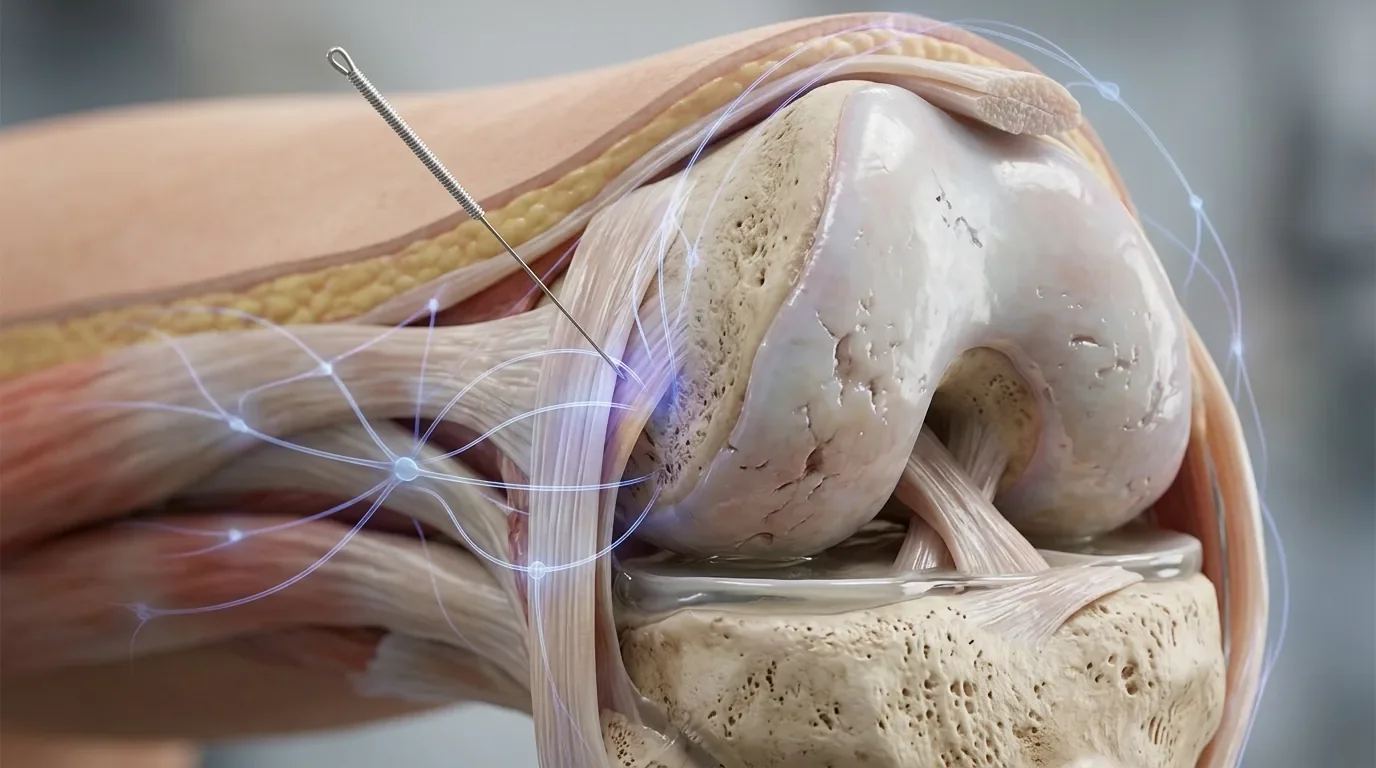
Acupuncture addresses each of these levels. Local needling in the knee region promotes microcirculatory improvements and reduces local inflammatory mediator concentrations. Segmental needling activates inhibitory interneurons in the L3-L4 spinal cord segments that process knee nociception, reducing dorsal horn excitability. Supraspinal effects via the periaqueductal gray provide descending opioidergic and noradrenergic inhibition of spinal pain transmission (Zhao, 2008). This multilevel action explains why acupuncture produces improvements in knee pain that outlast the immediate treatment session.
Knee Pain That Limits Your Daily Activity?
Whether you are managing a meniscus tear conservatively or recovering from knee surgery, our clinicians at Morningside develop individualized plans that combine dry needling for muscle trigger points with acupuncture for pain regulation. Most patients with longstanding knee pain carry a significant myofascial burden that was never addressed by their previous treatment.
Schedule NowTreatment Approach: Conservative and Post-Surgical
| Phase | Primary Goals | Treatment Focus |
|---|---|---|
| Conservative management (non-surgical) | Reduce knee pain; deactivate trigger points; restore quadriceps function; reduce joint sensitization | Popliteus, vastus medialis, hamstring dry needling; acupuncture for central sensitization; progressive loading exercise |
| Post-surgical recovery (weeks 2-8) | Reduce post-operative inflammation; address quadriceps inhibition; restore range of motion; manage scar tissue | Acupuncture for inflammatory regulation; dry needling to address post-surgical trigger points in quadriceps and hamstrings |
| Return to activity phase (8+ weeks post-surgical or ongoing conservative) | Restore full function; address compensatory patterns in hip and ankle; prevent recurrence | Hip and ankle muscle dry needling; functional exercise integration; neuromuscular re-education |
A key aspect of the conservative approach is that it does not mean simply waiting to see if the pain resolves. Active treatment of the myofascial component, progressive strengthening of the quadriceps and hip musculature to offload the meniscus, and reduction of central sensitization through acupuncture all contribute to an outcome that conservative management trials have shown to be equivalent to surgery for degenerative tears. Patients who understand this and engage actively in a well-structured conservative program tend to achieve the best outcomes.
Related Dry Needling for Knee Pain: How It Works and Who It Helps Related Muscles That Cause Knee Pain: A Trigger Point GuideGet Expert Knee Pain Care in New York City
At Morningside Acupuncture, we are the highest-rated acupuncture and dry needling clinic in New York City with over 500 five-star Google reviews. We specialize in complex knee pain presentations including meniscus tears, treating the myofascial and central sensitization components that determine how much pain a structural finding actually generates. Our clinicians work alongside your orthopaedic team to provide an integrative approach that maximizes your chance of a good outcome whether you are managing conservatively or recovering from surgery.
Schedule NowFrequently Asked Questions
Can a meniscus tear heal without surgery?
It depends on the tear type and location. Tears in the outer, vascular third of the meniscus have blood supply and some capacity for healing. Degenerative tears in the inner avascular zone do not heal structurally, but they can become asymptomatic with conservative management as the surrounding inflammation resolves and the muscles stabilizing the knee are strengthened. Two major randomized trials showed that degenerative meniscus tears in middle-aged adults do not produce better outcomes with surgery than with conservative care.
Will acupuncture fix my meniscus tear?
Acupuncture does not repair torn meniscal tissue, but many patients with meniscus tears find that a large portion of their pain was being generated by trigger points in the surrounding muscles rather than the tear itself. Deactivating those trigger points with dry needling, reducing central sensitization with acupuncture, and strengthening the knee stabilizers often produces substantial pain relief and functional improvement even when the structural tear remains present on imaging.
How is the treatment different for acute traumatic vs. degenerative meniscus tears?
Acute traumatic tears in younger patients, particularly bucket-handle tears causing true joint locking, may require surgical evaluation before conservative management is appropriate. Degenerative tears in middle-aged or older adults are appropriate for conservative management as first-line care. For post-surgical patients, our approach focuses on reducing post-operative inflammation, addressing the quadriceps inhibition that is nearly universal after knee surgery, and restoring normal movement patterns.
How many sessions will I need for meniscus-related knee pain at Morningside?
Patients with meniscus tear symptoms typically see meaningful improvement within four to eight sessions over three to six weeks. Cases with significant central sensitization or longstanding chronic pain may require ten to twelve sessions. Post-surgical patients often benefit from starting within the first two weeks after surgery and continuing for six to eight weeks through the early rehabilitation period.
Is there any risk of making a meniscus tear worse with acupuncture or dry needling?
Dry needling targets the muscles around the knee, not the joint itself, so there is no direct risk of affecting the meniscal tissue. The treatment is performed with sterile single-use needles, and the muscles treated (quadriceps, hamstrings, popliteus, gastrocnemius) are well distant from the joint space. Active joint infection or severe acute hemarthrosis are contraindications that require medical clearance first.
References
- Katz, J. N., Brophy, R. H., Chaisson, C. E., de Chaves, L., Cole, B. J., Dahm, D. L., Donnell-Fink, L. A., Guermazi, A., Haas, A. K., Jones, M. H., Levy, B. A., Mandl, L. A., Martin, S. D., Marx, R. G., Miniaci, A., Matava, M. J., Palmisano, J., Reinke, E. K., Richardson, B. E., & Rome, B. N. (2013). Surgery versus physical therapy for a meniscal tear and osteoarthritis. New England Journal of Medicine, 368(18), 1675-1684. https://doi.org/10.1056/NEJMoa1301408
- Sihvonen, R., Paavola, M., Malmivaara, A., Itälä, A., Joukainen, A., Nurmi, H., Kalske, J., & Järvinen, T. L. (2013). Arthroscopic partial meniscectomy versus sham surgery for a degenerative meniscal tear. New England Journal of Medicine, 369(26), 2515-2524. https://doi.org/10.1056/NEJMoa1305189
- Vickers, A. J., Vertosick, E. A., Lewith, G., MacPherson, H., Foster, N. E., Sherman, K. J., Irnich, D., Witt, C. M., & Linde, K. (2018). Acupuncture for chronic pain: Update of an individual patient data meta-analysis. JAMA Internal Medicine, 178(11), 1444-1453. https://doi.org/10.1001/jamainternmed.2018.4242
- Zhao, Z. Q. (2008). Neural mechanism underlying acupuncture analgesia. Progress in Neurobiology, 85(4), 355-375. https://doi.org/10.1016/j.pneurobio.2008.05.004
- Simons, D. G., Travell, J. G., & Simons, L. S. (1999). Travell & Simons' myofascial pain and dysfunction: The trigger point manual (2nd ed.). Williams & Wilkins.
- Kietrys, D. M., Palombaro, K. M., Azzaretto, E., Huber, R., Schaller, B., Schlussel, J. M., & Tucker, M. (2013). Effectiveness of dry needling for upper-quarter myofascial pain: A systematic review and meta-analysis. Journal of Orthopaedic & Sports Physical Therapy, 43(9), 620-634. https://doi.org/10.2519/jospt.2013.4668
Disclaimer: This web site is intended for educational and informational purposes only. Reading this website does not constitute providing medical advice or any professional services. This information should not be used for diagnosing or treating any health issue or disease. Those seeking medical advice should consult with a licensed physician. Seek the advice of a medical doctor or other qualified health professional for any medical condition. If you think you have a medical emergency, call 911 or go to the emergency room. No acupuncturist-patient relationship is created by reading this website or using the information. Morningside Acupuncture PLLC and its employees and contributors do not make any express or implied representations with respect to the information on this site or its use. For any legal interpretation of scope of practice in your state, consult a licensed attorney or regulatory authority.
Read more from our blog