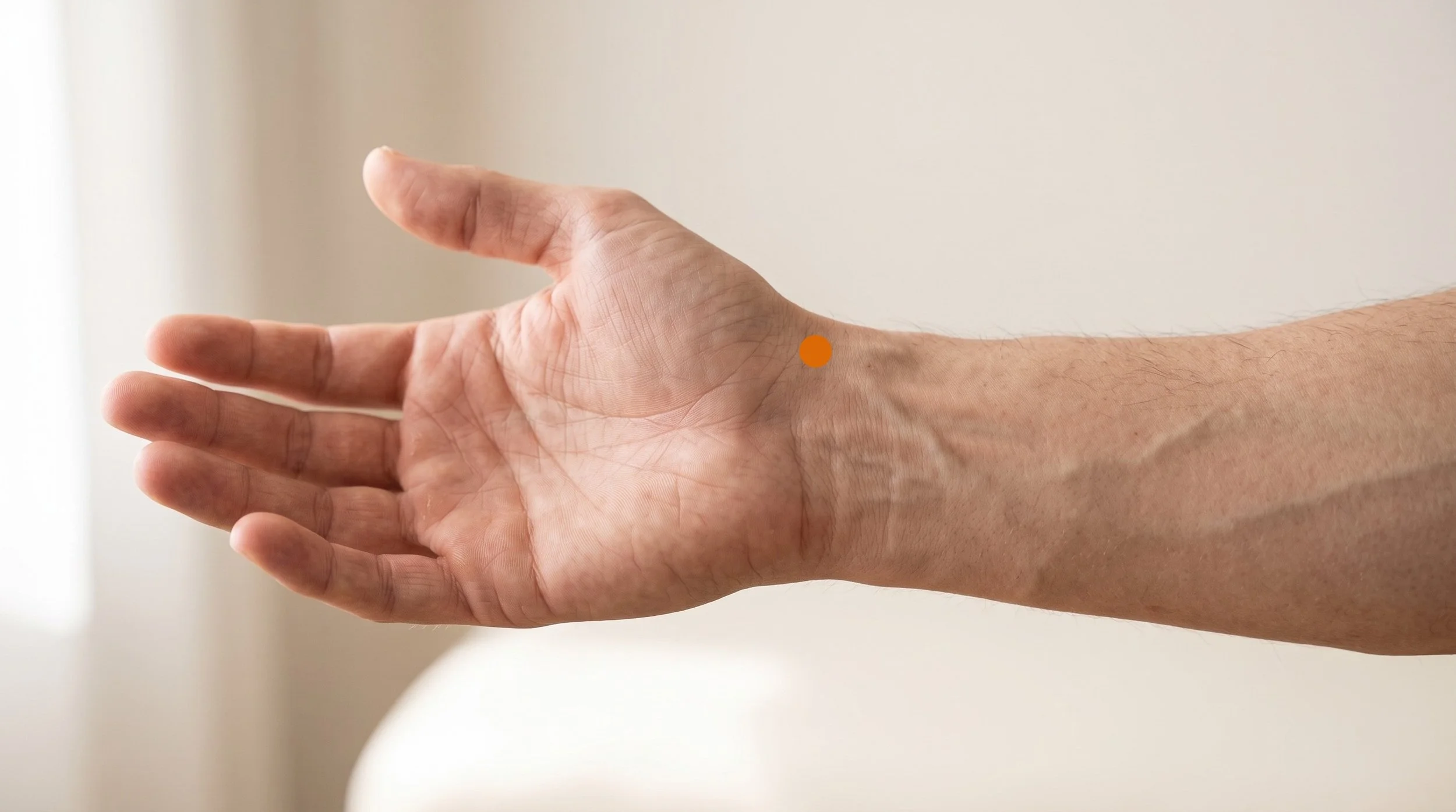
LU11 Acupuncture Point (Shaoshang)
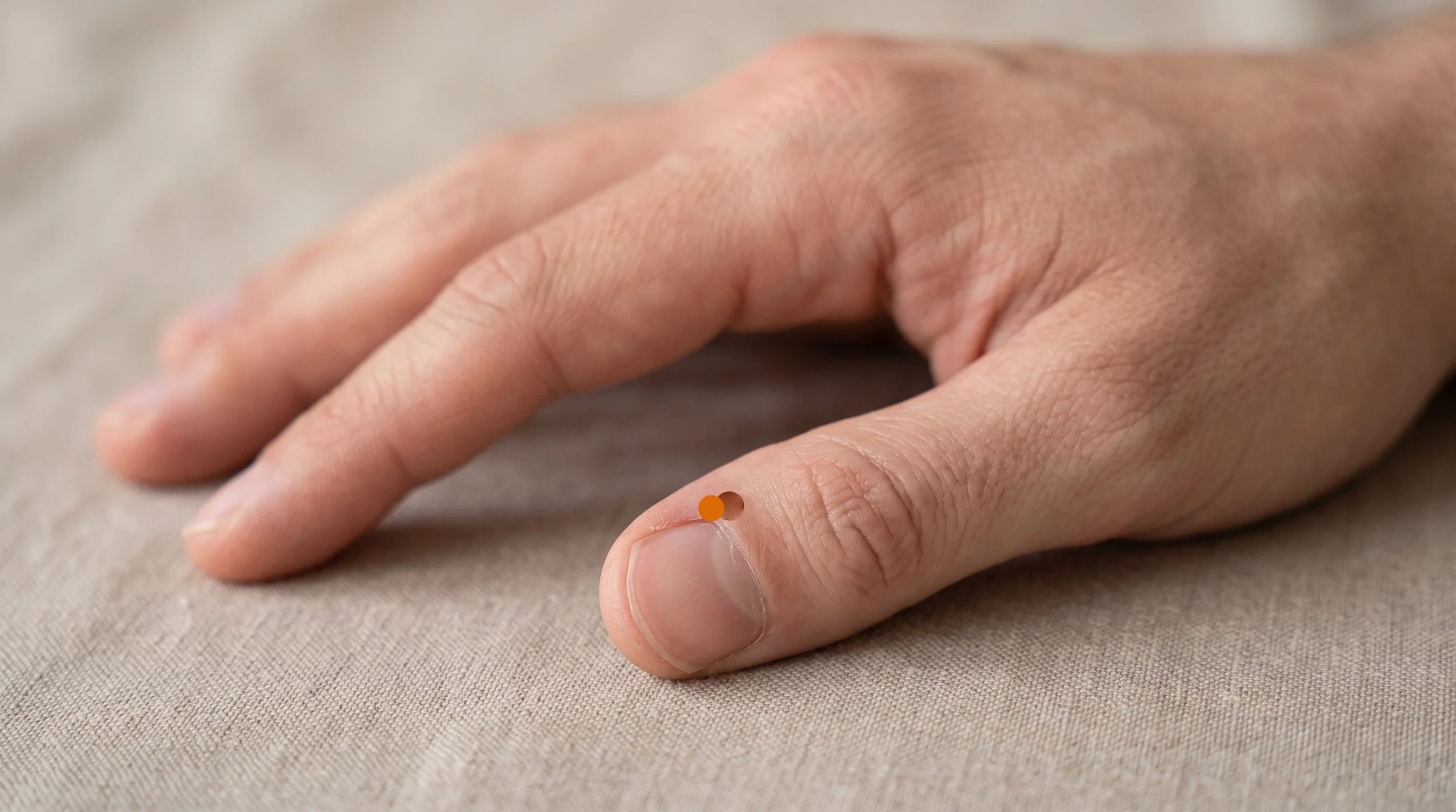
LU11 Acupuncture Point
The Lesser Shang at the Corner of the Thumbnail: Anatomy, Nerve Supply, and Why This Jing-Well Point Anchors Classical Throat Treatment
LU11 (Shaoshang, translated as Lesser Shang) is the final point of the Lung channel, sitting at the outer corner of the thumbnail on the radial side, roughly a tenth of a cun from where the nail edge meets the nail base. It is the smallest kind of target an acupuncturist works with, a sliver of richly innervated skin over the tip of the distal phalanx, and yet it carries an outsized reputation.
Classical texts assign LU11 to acute, loud, sudden presentations: a throat that has closed down overnight, a person who has lost consciousness, a fever that spikes fast. Modern clinicians use the lu11 acupuncture point far more conservatively, usually as a brief, shallow adjunct within a larger treatment, but the reason it earned its status is worth understanding: the fingertips carry some of the densest cutaneous innervation in the body, so a single needle here produces an unusually strong and precisely located burst of afferent signalling.
- Location and layers: LU11 sits where a line along the radial border of the thumbnail meets a line along the nail base, about 0.1 cun from the corner (Deadman et al., 2001). There is almost no soft tissue here, just epidermis, dermis, and a thin bed of connective tissue over the distal phalanx, which is why needling is shallow and brief rather than deep and retained.
- Traditional categories, translated: LU11 is classified as the jing-well point and the Wood point of the Lung channel, and it appears under the alternative name Gui-xin among Sun Si-miao's thirteen ghost points (Deadman et al., 2001; Maciocia, 2008). In neurophysiological terms, jing-well points are simply the most densely innervated, lowest-threshold sites on each channel, which explains their classical role in acute and arousal-related situations.
- Nerve story: sensation here travels through digital branches of the superficial radial nerve into the C6 dorsal root, and fingertip skin has an exceptionally high receptor and free nerve ending density. Strong small-fibre input of this kind is one of the best studied triggers for descending pain modulation from the brainstem (Zhao, 2008).
- Classical use: the traditional attribution is to clear heat and benefit the throat, plus first aid style revival applications, with pricking to bleed described as the standard method for severe throat presentations (Deadman et al., 2001; Kim, 2015). We frame these as historical indications, not as claims that a thumb point treats infection.
- Research picture: evidence specific to LU11 is thin and mostly comes from small trials and animal work, including a randomised study using bloodletting at LU11 and LI1 alongside standard care in severe pneumonia (Fu et al., 2021) and mechanistic rat models of jing-well bloodletting (Yu et al., 2017). A sham-controlled trial of single-point needling for acute tonsillitis and pharyngitis found no advantage over sham (Fleckenstein et al., 2009), so expectations should stay modest.
- De qi at LU11: patients describe a bright, sharp pinch that peaks immediately and fades within seconds, quite unlike the heavy, spreading ache of a point in muscle. Because the sensation is intense but very short, we tell people what is coming, work quickly, and rarely retain the needle.
Dealing With a Sore, Scratchy Throat and a Cough That Will Not Settle?
Throat irritation, hoarseness, and a lingering post-viral cough are among the most common reasons New Yorkers come in during winter and allergy season. Our acupuncturists may use LU11 briefly at the thumb alongside LU7, LI4, and gentle work around the neck and upper chest, with the goal of easing discomfort and helping you rest while your body does the healing. We also screen for the situations that belong with your physician first, including high fever, difficulty swallowing, or suspected strep. Schedule a visit and let's build a plan that fits what you're actually dealing with.
Schedule NowAnatomy of LU11: Why the Corner of the Thumbnail Is Such an Important Location
LU11 is defined by two imaginary lines: one running along the radial border of the thumbnail and one running along the base of the nail. Where they intersect, roughly 0.1 cun off the nail corner, is the point (Deadman et al., 2001). The tissue stack is thin and simple. Under the surface keratin layer there is glabrous-transition skin, a highly vascular dermis, a paper-thin layer of connective tissue, and then the distal phalanx itself. Nothing here generates force, so LU11 is not loaded by movement the way a muscular point is.
What loads this region instead is contact: pressing, pinching, gripping, and the repetitive pinch-and-swipe pattern that dominates modern hand use. That is also why the area is so easy to locate and so unforgiving of sloppy needle depth.
The sensory supply comes from digital branches of the superficial radial nerve, feeding into roughly the C6 segment (Deadman et al., 2001). Fingertip and nail-fold skin carries an extremely high density of mechanoreceptors and free nerve endings, which means a very small needle stimulus here generates a disproportionately large afferent volley.
That volley enters the dorsal horn and recruits the same machinery that underlies acupuncture analgesia more broadly: local segmental inhibition, and activation of descending pathways from the periaqueductal grey and rostral ventromedial medulla that dampen nociceptive transmission across wide areas of the body (Zhao, 2008). The classical idea that a point at the end of a channel can act on the opposite end of that channel is, in this reading, a description of central rather than local effects.
Distal fingertip stimulation also tends to produce brisk autonomic responses, including changes in skin blood flow and a startle-like arousal, which may be part of why jing-well points were historically favoured in acute and collapse-type situations.
There are no large arteries, nerves, or viscera at risk at LU11, which makes it anatomically one of the safest points on the body. The relevant vessels are the small terminal digital arteries and the dense capillary network of the nail bed, which is exactly what classical bleeding technique exploited. Conventional needling is perpendicular or oblique, angled proximally, at 0.1 to 0.2 cun, with brief stimulation and usually no retention (Deadman et al., 2001; Kim, 2015).
Where a pricking or bleeding method is used, it is a single quick puncture releasing a few drops, followed by pressure with sterile gauze. Clean-needle technique matters more here than at most points because the fingertip is a high-contact, high-contamination area, and bleeding methods are avoided in people on anticoagulants, with bleeding disorders, with peripheral vascular compromise, or with any local skin infection.
Related Lung Channel Related Acupuncture Channel PathwaysLU11 at a Glance: Classification, Location, and Clinical Use
| Category | Detail |
|---|---|
| Traditional Name | Shaoshang (Lesser Shang), LU11, also recorded under the alternative name Gui-xin (Ghost Faith) |
| Channel Classification | Terminal point of the Lung channel of Hand Taiyin |
| Point Categories | Jing-well point of the Lung channel; Wood point of the Lung channel; one of Sun Si-miao's thirteen ghost points |
| Precise Location | On the extensor aspect of the thumb, at the intersection of a line along the radial border of the nail and a line along the base of the nail, approximately 0.1 cun from the nail corner |
| Tissue Stimulated | Thin, densely innervated skin and dermis over the distal phalanx of the thumb, supplied by digital branches of the superficial radial nerve (about C6); no muscle at the point itself, though thumb pain treatment often includes dry needling of the extensor pollicis longus and brevis |
| Needle Depth / Direction | Perpendicular or oblique insertion angled proximally, 0.1 to 0.2 cun, with brief stimulation; classical practice also used a quick prick to release a few drops of blood |
| De Qi Sensation | A sharp, bright, immediate pinch that fades within seconds rather than the heavy, spreading ache typical of points in muscle; the needle is usually not retained |
| Primary Clinical Uses | Traditionally used for acute sore throat and throat swelling, cough and breathlessness, thumb and wrist pain, and first aid style revival in the classical record; modern use is as a brief distal adjunct within a larger treatment |
| Common Point Combinations |
|
Deadman's Manual of Acupuncture presents LU11 as the jing-well point of the Lung channel, with two traditional actions: reviving consciousness and clearing heat to benefit the throat. The logic offered is elegant in its own terms.
The Lung channel's internal branch reaches its highest point at the throat, so the point at the far end of the channel was understood to act powerfully on the opposite end, which is why LU11 was needled or pricked to bleed for acute throat presentations attributed to excess heat, including the older disease categories of childhood throat moth (roughly corresponding to tonsillitis) and mumps. The text contrasts LU11 with LU10, noting that LU10 was applied to both excess and deficiency patterns while LU11 was reserved for the more extreme, purely excess situations.
The commentary also cites the Classic of Difficulties on jing-well points treating fullness below the Heart, which is how LU11 acquired its listings for chest fullness, sweating, agitation, and mania, and in turn how it came to be included among Sun Si-miao's thirteen ghost points under the name Gui-xin (Maciocia, 2008).
What is striking about the classical pattern is its internal consistency: one small point at the end of one channel is credited with throat, chest, mind, and revival functions, all derived from a single structural claim about where that channel begins and ends.
Why LU11 Is Used for Throat Symptoms When the Point Is on Your Thumb
The honest answer starts with segmental anatomy. LU11 feeds into roughly the C6 spinal segment through digital branches of the superficial radial nerve, while the throat and pharynx are supplied largely by cranial nerves and upper cervical segments. There is no direct segmental overlap, so a purely local explanation does not work.
What does have support is the broader picture of acupuncture analgesia: strong afferent input from a densely innervated site recruits descending inhibitory pathways from the brainstem that reduce nociceptive transmission over a wide territory, not just the segment stimulated (Zhao, 2008). Fingertip stimulation is a particularly efficient way to generate that input, which is a plausible neurophysiological reading of why classical practice reached for jing-well points when symptoms were acute and severe.
There is also an autonomic and vascular thread. Experimental work on bleeding at the twelve hand jing-well points in rat models of cerebral ischaemia reported changes in blood-brain barrier integrity and reduced brain oedema, which the authors interpreted as evidence for a vascular and immune-modulating component rather than a simple pain effect (Yu et al., 2017). Animal findings do not transfer directly to human sore throats, but they do suggest that intense fingertip stimulation is not biologically inert.
On the clinical side, the picture is mixed and deserves caution. A randomised trial of a single-point acupuncture treatment on the Large Intestine channel for acute tonsillitis and pharyngitis found no advantage over sham laser stimulation of the same area (Fleckenstein et al., 2009), and a pragmatic emergency department trial found acupuncture safe and broadly comparable to standard medication for several acute pain conditions while noting that none of the approaches produced ideal relief (Cohen et al., 2017).
For most patients, this means LU11 is best understood as a supporting player. It may reduce the sharpness of throat discomfort within a session and it can be a useful accent for thumb and wrist symptoms along the Lung channel line, but it is not a stand-alone treatment for infection, and it should never delay medical assessment when symptoms are severe. The chronic pain evidence base for acupuncture as a whole is stronger than any single point's evidence base, which is why we treat with combinations rather than isolated points (Vickers et al., 2018).
What the Research Shows for LU11
Almost no clinical research isolates LU11. Trials of acupuncture for throat conditions test whole protocols, usually with local neck points, LI4, and channel points on the forearm, so any effect attributed to the protocol cannot be assigned to the thumb point alone. The research that does name LU11 tends to involve bleeding techniques combined with conventional care in Chinese hospital settings, with small samples and design limitations, and at least one rigorous sham-controlled trial of single-point needling for sore throat was negative.
The table below sets out what has actually been tested, with the honest caveat that the mechanistic literature on acupuncture analgesia is considerably stronger than the point-specific clinical literature.
| Study | Type | Focus | Key Finding |
|---|---|---|---|
| Fu et al., 2021 | Randomised controlled trial | Bleeding at LU11 and LI1 added to standard care for severe community-acquired pneumonia in older adults | The added intervention was associated with better reported clinical outcomes in this small single-centre trial, though the design and sample size limit how far the result can be generalised. |
| Fleckenstein et al., 2009 | Randomised sham-controlled trial | Single-point acupuncture on the Large Intestine channel for acute tonsillitis and pharyngitis | A single treatment was no more effective than sham stimulation of the same area for sore throat pain, which argues against expecting much from any one point used alone. |
| Yu et al., 2017 | Animal mechanistic study | Bleeding puncture at the twelve hand jing-well points in a rat model of cerebral ischaemia | The authors reported reduced brain oedema and better preserved blood-brain barrier markers, suggesting a vascular and immune component to jing-well stimulation that has not been confirmed in humans. |
| Cohen et al., 2017 | Multicentre randomised trial | Acupuncture compared with pharmacotherapy for acute pain in emergency departments | Acupuncture was safe and broadly comparable to medication at one hour, though the authors emphasised that none of the options provided optimal acute analgesia. |
| Vickers et al., 2018 | Individual patient data meta-analysis | Acupuncture for chronic musculoskeletal, headache, and osteoarthritis pain | Acupuncture produced modest but statistically robust benefits over both sham and no-acupuncture controls, with effects that persisted over time. |
| Zhao, 2008 | Narrative review of mechanisms | Neural pathways underlying acupuncture analgesia | Needle stimulation activates peripheral afferents that engage spinal and supraspinal inhibitory circuits and endogenous opioid signalling, which is the most defensible mechanism for distal point effects. |
Thumb Pain, Grip Problems, or Texting Thumb Slowing You Down?
Pain at the base and tip of the thumb is a daily complaint in a city full of phones, keyboards, and cameras. We combine channel points along the Lung and Large Intestine lines with dry needling of the thenar muscles and the thumb extensors, plus practical loading advice so the tissue actually adapts. LU11 is used sparingly here, as a distal accent rather than the main event. Book an evaluation and we'll map out where your thumb pain is really coming from.
Schedule NowLU11 in the Context of Trigger Point Work
LU11 has no muscle belly underneath it, so it is never a trigger point target in the myofascial sense. What it can do is sit at the end of a treatment chain for thumb, thenar, and forearm complaints. When a patient comes in with pain at the thumb tip, base, or web space, we usually find restriction and taut bands further upstream, commonly in the thenar group, adductor pollicis, brachioradialis, and the thumb extensors, and referral patterns from these muscles can reach the thumb and radial wrist (Simons et al., 1999).
Dry needling those muscles addresses the source of the load, while a brief needle at LU11 adds a strong distal sensory input at the far end of the same channel line.
In practice, a thumb-focused session at Morningside might combine dry needling of the extensor pollicis longus and brevis and the thenar muscles with channel points such as LU10, LI4, and LU7, finishing with a quick, shallow LU11 stimulation if the presentation is acute and sharply localised.
For throat and voice complaints, the trigger point element usually moves to the neck instead, where the sternocleidomastoid, scalenes, and suprahyoid muscles can contribute to a sensation of tightness or a lump in the throat, and where careful needling may reduce the muscular component of what the patient experiences as a throat problem. Acupuncture and dry needling are the same tool used with different reasoning, and LU11 is one of the clearest examples of a point where the classical reasoning and the myofascial reasoning simply do not overlap.
LU11 Throat and Thumb Treatment at NYC's Highest-Rated Acupuncture Clinic
Morningside Acupuncture is the highest-rated acupuncture and dry needling clinic in New York City with over 500 five-star Google reviews, and that reputation comes from careful, individualized treatment rather than one-size-fits-all protocols. We use LU11 the way the classical record suggests, briefly and precisely, inside a broader plan that may include neck and jaw work, breathing retraining, and myofascial dry needling. Every session begins with an assessment so you understand why each point is chosen. Schedule your appointment and see what a thoughtful treatment plan feels like.
Schedule NowFrequently Asked Questions
What does LU11 feel like when needled?
Sharp and brief. Because fingertip skin is so densely innervated and there is almost no soft tissue to cushion the needle, LU11 produces an immediate bright pinch rather than the heavy, dull, spreading ache people associate with de qi at points in muscle. The sensation typically peaks instantly and settles within a few seconds, and the needle is usually removed right away rather than retained. Most patients find it very tolerable once they know what to expect, and we always say so beforehand. If a bleeding technique is used, the sensation is similar to a lancet fingerstick, over almost as soon as it starts.
Why would an acupuncturist needle my thumb for a throat problem?
Traditionally, the Lung channel is described as ending at the thumb while its internal branch reaches its highest point at the throat, so classical texts treated LU11 as acting on the opposite end of the same line (Deadman et al., 2001). Neurophysiologically, the more defensible explanation is that intense input from a densely innervated fingertip recruits descending inhibitory pathways that reduce pain signalling well beyond the segment stimulated (Zhao, 2008). It is worth being clear about limits: this may take the edge off discomfort, but it does not treat an infection, and a sham-controlled trial of single-point needling for acute sore throat found no advantage over sham (Fleckenstein et al., 2009).
Can I press LU11 myself between sessions?
Yes, and acupressure here is easy because the landmark is obvious. Find the outer corner of your thumbnail on the side facing away from your other fingers, then move a millimetre or two toward the base of the nail. Pinch that corner firmly between the thumb and index finger of your other hand, using enough pressure to feel a definite sensation without producing bruising or numbness. Hold for 10 to 30 seconds, release, and repeat three to five times on each thumb. You can do this a few times a day, particularly when a throat feels scratchy or a thumb feels achy. Stop if the skin becomes sore, discoloured, or irritated, and never break the skin yourself.
Is LU11 safe to needle?
Anatomically it is one of the lowest-risk points on the body, since there are no major vessels, nerves, or organs anywhere near it. The needle goes in 0.1 to 0.2 cun, angled proximally, and comes straight back out. The main considerations are hygiene and patient selection. Fingertips are high-contact areas, so clean technique and single-use sterile needles are essential. Bleeding methods are avoided in anyone taking anticoagulants, with a bleeding disorder, with poor peripheral circulation or neuropathy, or with any local skin infection or nail problem. LU11 is also not appropriate as a substitute for medical care, and symptoms such as high fever, difficulty swallowing or breathing, drooling, or a rapidly swelling throat need urgent medical assessment.
Where exactly is LU11 located?
Look at the back of your thumb with the nail facing you. Picture one line running down the outer (radial) edge of the nail, the side closest to your wrist crease when your palm faces up, and a second line running across the base of the nail where it meets the skin. LU11 sits where those two lines cross, roughly 0.1 cun from the corner of the nail, which is about the width of a matchstick. Some traditions describe jing-well points less as fixed dots and more as a small responsive zone around the nail corner, and practitioners often locate the exact spot by finding the most tender or reactive area there (Sterman, 2018).
References
- Deadman, P., Al-Khafaji, M., & Baker, K. (2009). A manual of acupuncture. Journal of Chinese Medicine Publications.
- Kim, H. (2008). Handbook of Oriental medicine (3rd ed.). Harmony & Balance Press.
- Maciocia, G. (2005). The foundations of Chinese medicine: A comprehensive text for acupuncturists and herbalists (2nd ed.). Elsevier Churchill Livingstone.
- Maciocia, G. (2006). The channels of acupuncture: Clinical use of the secondary channels and eight extraordinary vessels. Churchill Livingstone Elsevier.
- Cecil-Sterman, A. (2012). Advanced acupuncture: A clinic manual. Classical Wellness Press.
- Simons, D. G., Travell, J. G., & Simons, L. S. (1999). Travell & Simons' myofascial pain and dysfunction: The trigger point manual, Vol. 1: Upper half of body (2nd ed.). Williams & Wilkins.
- Fu, Y., Yang, Z., Cai, Y., Liu, H., Li, S., Kou, N., Wu, J., & Zhang, Q. (2021). Effect of bloodletting at Shaoshang and Shangyang acupuncture points on outcome and prognosis of severe community-acquired pneumonia in the elderly. Disease Markers, 2021, 3295021. https://doi.org/10.1155/2021/3295021
- Fleckenstein, J., Lill, C., Lüdtke, R., Gleditsch, J., Rasp, G., & Irnich, D. (2009). A single point acupuncture treatment at large intestine meridian: A randomized controlled trial in acute tonsillitis and pharyngitis. The Clinical Journal of Pain, 25(7), 624-631. https://doi.org/10.1097/AJP.0b013e3181a49e35
- Yu, N., Wang, Z., Chen, Y., Yang, J., Lu, X., Guo, Y., Chen, Z., & Xu, Z. (2017). The ameliorative effect of bloodletting puncture at hand twelve Jing-well points on cerebral edema induced by permanent middle cerebral ischemia via protecting the tight junctions of the blood-brain barrier. BMC Complementary and Alternative Medicine, 17(1), 470. https://doi.org/10.1186/s12906-017-1979-6
- Cohen, M. M., Smit, D. V., Andrianopoulos, N., Ben-Meir, M., Taylor, D. M., Parker, S. J., Xue, C. C., & Cameron, P. A. (2017). Acupuncture for analgesia in the emergency department: A multicentre, randomised, equivalence and non-inferiority trial. Medical Journal of Australia, 206(11), 494-499. https://doi.org/10.5694/mja16.00771
- Zhao, Z. Q. (2008). Neural mechanism underlying acupuncture analgesia. Progress in Neurobiology, 85(4), 355-375. https://doi.org/10.1016/j.pneurobio.2008.05.004
- Vickers, A. J., Vertosick, E. A., Lewith, G., MacPherson, H., Foster, N. E., Sherman, K. J., Irnich, D., Witt, C. M., & Linde, K. (2018). Acupuncture for chronic pain: Update of an individual patient data meta-analysis. Journal of Pain, 19(5), 455-474. https://doi.org/10.1016/j.jpain.2017.11.005
Disclaimer: This web site is intended for educational and informational purposes only. Reading this website does not constitute providing medical advice or any professional services. This information should not be used for diagnosing or treating any health issue or disease. Those seeking medical advice should consult with a licensed physician. Seek the advice of a medical doctor or other qualified health professional for any medical condition. If you think you have a medical emergency, call 911 or go to the emergency room. No acupuncturist-patient relationship is created by reading this website or using the information. Morningside Acupuncture PLLC and its employees and contributors do not make any express or implied representations with respect to the information on this site or its use. For any legal interpretation of scope of practice in your state, consult a licensed attorney or regulatory authority.
Read more from our blog