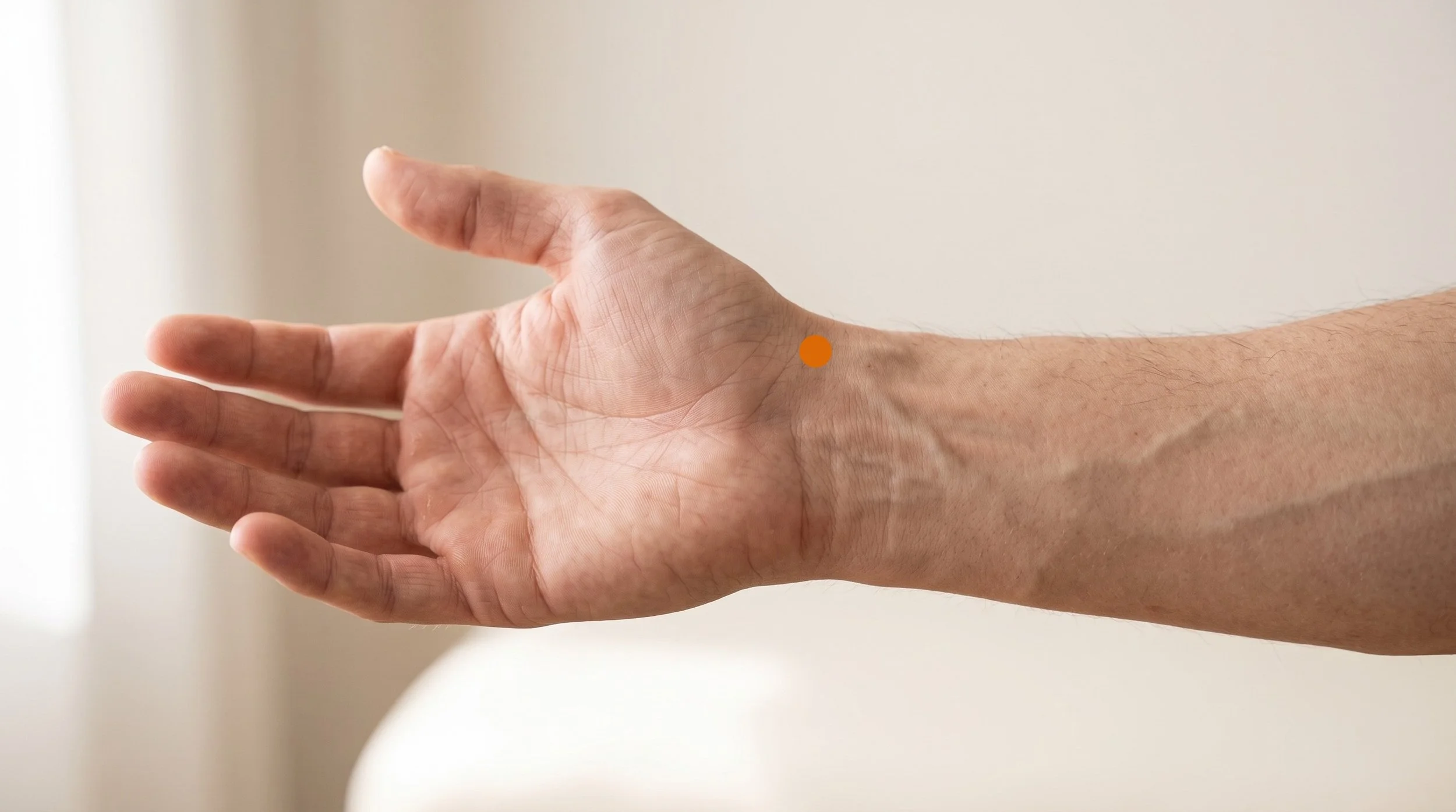
Yuyao Acupuncture Point (M-HN-6)
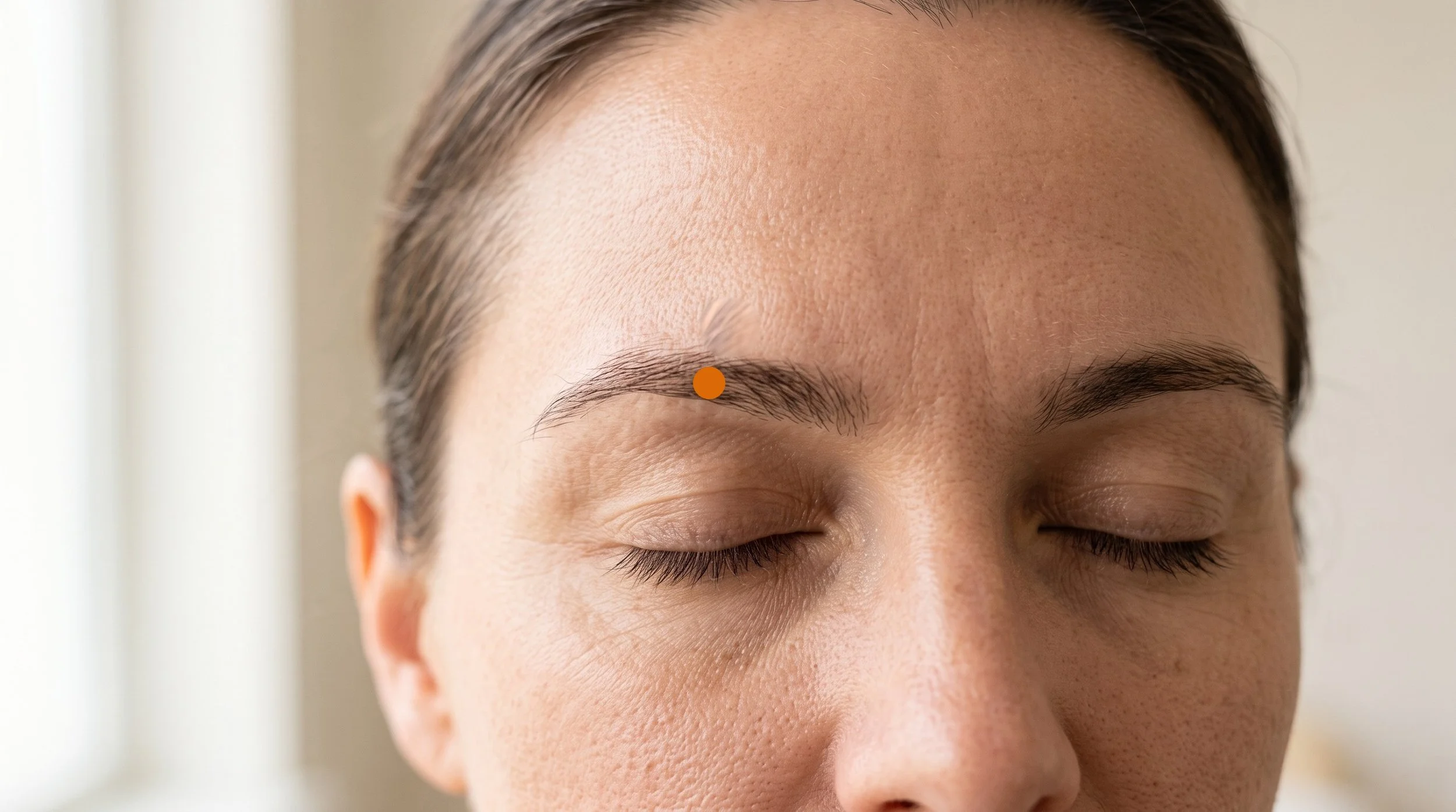
Yuyao Acupuncture Point
Fish Waist at the Center of the Eyebrow: Anatomy, Mechanism, and Why This Extra Point Belongs in Frontal Headache and Eye Strain Treatment
Yuyao, written in modern texts as M-HN-6 and translated as Fish Waist, is an extra point (a named location that sits outside the fourteen main channels) found in the middle of the eyebrow, in the small dip directly above the pupil when the eyes look straight ahead. The name refers to the way the brow curves like the midsection of a fish, and the location is easy to confirm on almost every face: run a fingertip along the upper edge of the eye socket and settle into the soft spot at the center of the brow hairs.
Clinically, the yuyao acupuncture point matters because it sits over the exit territory of the supraorbital nerve, the first-division trigeminal branch that carries sensation from the forehead and upper lid. That anatomy is why this eyebrow acupuncture point shows up so often in treatment for frontal headache, brow-ridge pressure, tired and irritated eyes, and twitching lids, and why it is usually threaded flat along the brow rather than needled straight down.
- Location and layers: the yuyao point sits mid-eyebrow above the pupil, with the needle passing through skin and a thin fat layer into the interwoven fibers of orbicularis oculi and frontalis over the bony supraorbital ridge, so the target tissue is a mobile muscular sheet lying directly on bone.
- Traditional attributions: classical sources describe Yuyao as benefiting the eyes and as relaxing the sinews to alleviate pain, with indications that cluster red, swollen or painful eyes, visual obscuration, eyelid twitching, drooping of the lid, and frontal headache. These are traditional categories, presented here as historical attributions rather than physiology.
- Mechanism: needling here recruits first-division trigeminal afferents from the supraorbital nerve, and these converge in the trigeminocervical complex with input from the forehead, eye and upper neck, a convergence pattern that also supports segmental and descending pain modulation (Zhao, 2008).
- Nerve context: cadaveric work on the brow region has mapped several sites where frontal branches of the trigeminal nerve pass through and around the corrugator, which is part of why the brow line is treated as a frontal headache zone in both needling and surgical literature (Janis et al., 2013).
- Research picture: no trial isolates M-HN-6 on its own, but it appears inside multi-point headache protocols, and reviews of acupuncture for tension-type headache and episodic migraine report modest benefit over sham and usual care (Linde et al., 2016a; Linde et al., 2016b), while pooled individual patient data support durable effects for chronic pain generally (Vickers et al., 2018).
- De qi and practice: patients usually report a dull, spreading fullness across the brow and forehead when the needle is threaded, sometimes with a light ache toward the eye socket or the top of the head, and the point is almost always combined with GB14, BL2, Taiyang or a distal point rather than used alone.
Do Your Headaches Sit Right Behind the Eyebrow?
Brow-line headaches that build across a workday, tighten when you squint, and refuse to shift with over-the-counter medication often respond to careful work at the brow and upper neck together. At Morningside Acupuncture we treat Yuyao alongside GB14, BL2 and the suboccipital muscles, and pair local needling with distal points chosen for your pattern. Most patients notice the frontal pressure soften within the first few sessions. Schedule a visit and we will map where your headache actually starts.
Schedule NowAnatomy of YUYAO: Why the Mid-Eyebrow Ridge Is Such an Important Location
From the surface inward, Yuyao is remarkably shallow. Under thin brow skin there is a small amount of subcutaneous fat, then the orbital part of orbicularis oculi, the ring-shaped muscle that closes the eye, interlacing with fibers of frontalis (the brow-raising sheet of the epicranius) and, more medially, with corrugator supercilii. Below that thin muscular blanket lies the periosteum of the frontal bone at the supraorbital ridge, so the entire working depth of the point is measured in millimeters.
What loads this tissue is ordinary modern life: squinting into glare, holding a low-grade frown at a screen, straining through an outdated eyeglass prescription, clenching the brow during concentration, and the sustained lid activity that comes with reduced blinking. Over time those habits leave the brow tender to firm pressure, and that tenderness is often exactly what a patient calls a headache.
The nerve geography is what makes this an important location rather than just a convenient one. The supraorbital nerve, a terminal branch of the frontal nerve from the ophthalmic division of the trigeminal nerve, emerges through the supraorbital notch or foramen and fans upward across the forehead and scalp, with sensory territory that includes the upper eyelid and the conjunctiva.
Classical texts place Yuyao just lateral to that notch, which puts a needle threaded along the brow squarely within the nerve's exit territory. Because first-division trigeminal afferents and upper cervical afferents converge onto shared second-order neurons in the trigeminocervical complex, input from the brow, the eye and the upper neck is processed in an overlapping way, which helps explain why frontal headache, eye discomfort and neck tightness so often travel as a package.
Needling in this territory generates small-fiber afferent traffic that engages segmental gating and descending inhibitory pathways involving endogenous opioid and monoaminergic systems (Zhao, 2008). Anatomical studies of the brow region also document specific points where these frontal nerve branches can be compressed by muscle and fascia, a mechanism that has been used to explain why the frontal zone behaves as a headache generator in some patients (Janis et al., 2013).
Safety in this area is mostly about blood vessels and direction. The supraorbital artery and vein run with the nerve at the notch, the supratrochlear vessels sit just medially, and the region is generously supplied by branches of the frontal and superficial temporal systems. Puncturing one of these vessels does not cause serious harm, but it can produce a visible bruise or a black eye, which is a cosmetic outcome worth discussing before treatment.
For that reason, needling convention here is transverse only: the skin is often pinched or the tissue tented, and a fine needle is threaded medially or laterally along the brow, commonly 0.3 to 1 cun depending on the source and the aim, sometimes threaded toward GB14 Yangbai above the brow or toward BL2 Zanzhu at its medial end. A needle should never be angled downward into the orbit, and pressure with a clean cotton ball for a solid ten to fifteen seconds after withdrawal is standard practice.
Related Frontalis Trigger Points Related Orbicularis Oculi Trigger PointsYUYAO at a Glance: Classification, Location, and Clinical Use
| Category | Detail |
|---|---|
| Traditional Name | Yuyao (Fish Waist), also rendered as Fish Spine in some English texts |
| Channel Classification | Extra point of the head and neck, coded M-HN-6, not on a main channel |
| Point Categories | Extraordinary (extra) point of the head at the mid-eyebrow. No five-shu, back-shu, front-mu, meeting or extraordinary vessel designations are attributed to it in the reference texts. Traditional actions listed are benefiting the eyes and relaxing the sinews to alleviate pain, and the point is classically through-needled from GB14 Yangbai or BL2 Zanzhu. |
| Precise Location | In the center of the eyebrow, in the depression directly above the pupil when the eyes look straight forward, just lateral to the supraorbital notch |
| Tissue Stimulated | Brow skin and thin subcutaneous tissue over the supraorbital ridge, then the interlacing fibers of orbicularis oculi and frontalis, with corrugator supercilii nearby medially |
| Needle Depth / Direction | Transverse (subcutaneous) insertion directed medially or laterally along the brow, roughly 0.3 to 1 cun, often threaded toward GB14 or BL2; never angled into the orbit |
| De Qi Sensation | A dull, heavy distension spreading across the brow and forehead, sometimes traveling toward the vertex or as a mild ache around the eye socket; a brief sting on skin entry is common in this thin-skinned area |
| Primary Clinical Uses | Eye strain and eye discomfort, brow-ridge and frontal headache, supraorbital pain, eyelid twitching, and eyelid drooping in classical listings |
| Common Point Combinations |
|
In the Deadman text, Yuyao is traced to the Classic of the Jade Dragon, and its traditional actions are given as benefiting the eyes and relaxing the sinews to alleviate pain. The indications attributed to it in that literature fall into three tidy groups: inflammatory and painful eye conditions, problems with visual clarity, and disorders of eyelid movement including twitching and drooping, all alongside frontal headache.
Deadman's commentary notes that in practice the point is chosen mainly for supraorbital pain and for eye and eyelid complaints, and that it is typically stimulated by threading from GB14 Yangbai or BL2 Zanzhu rather than needled in isolation. Other standard references repeat a similar cluster, adding supraorbital neuralgia and facial paralysis to the list.
What is striking is how neatly that classical grouping tracks a single anatomical story: motor problems of the lid, sensory pain above the orbit, and irritation of the eye itself all belong to one small territory served by one muscular sheet and one first-division trigeminal branch, a coherence the classical authors described symptomatically long before the nerve was named.
Why YUYAO Is Used for Frontal Headaches That Feel Like Pressure Behind the Brow
Patients describe this headache in consistent language: a band or a weight sitting on the eyebrows, worse late in the day, worse with screens and glare, often with a sense that the eyes themselves are tired. The anatomical reason the brow is a productive place to treat is convergence. Sensory fibers from the forehead, upper lid and eye travel in the ophthalmic division of the trigeminal nerve and terminate in the trigeminocervical complex, where they share second-order neurons with afferents from the upper cervical segments.
When that pool of neurons becomes sensitized, ordinary input from muscle and skin can be read as pain, and the pain is felt across the whole convergent field rather than at one tidy spot. Needling into the supraorbital nerve's territory delivers a controlled, well-localized afferent volley into precisely that pool.
What that volley may do is described in the mechanistic literature as a two-part effect. Locally and segmentally, small-fiber input can gate transmission at the level of the dorsal horn equivalent for the face, while ascending signals recruit descending inhibitory systems from the midbrain and brainstem that release endogenous opioids, serotonin and noradrenaline (Zhao, 2008). Needling also produces local vascular and mechanical changes in the tissue itself, which may matter in a muscle sheet held in low-grade contraction all day.
There is a useful parallel from device research: transcutaneous stimulation of the supraorbital nerve, applied over roughly the same brow territory, reduced monthly migraine days compared with sham in a randomized trial (Schoenen et al., 2013). That does not prove an acupuncture needle at Yuyao works the same way, but it does show that this nerve territory is a modifiable input into trigeminal pain processing rather than an arbitrary surface landmark.
For eye strain specifically, the appeal of the point is partly local and partly regional. The tissue being needled is the same tissue doing the squinting, and the periorbital points as a group are the ones most consistently selected in eye-focused protocols. Reviews of acupuncture for dry eye, which pool multi-point protocols that frequently include brow and periorbital points, report improvements in tear film and symptom measures compared with artificial tears alone, though the trials vary widely in method and quality (Na et al., 2021). The honest summary is that Yuyao is a reasonable local point within a well-designed protocol, not a standalone answer to an eye condition.
What the Research Shows for YUYAO
There is no randomized trial that tests the yuyao acupuncture point by itself, and there very likely never will be, because acupuncture is delivered as a protocol rather than as a single insertion. What the literature can tell us is whether protocols that include brow-line points help the conditions Yuyao is chosen for, and whether the underlying physiology is plausible.
On that basis the evidence for headache is moderate and reasonably consistent, the evidence for eye conditions is more preliminary, and the mechanistic case for stimulating this specific nerve territory is supported by both neurophysiological review work and device studies. Read the table below as context for a clinical decision, not as proof about one point.
| Study | Type | Focus | Key Finding |
|---|---|---|---|
| Linde et al., 2016a | Cochrane systematic review | Acupuncture for the prevention of tension-type headache, where brow, temple and neck points are standard protocol components | Acupuncture added to usual care was associated with meaningfully fewer headache days than usual care alone, with a smaller but statistically significant advantage over sham. |
| Linde et al., 2016b | Cochrane systematic review | Acupuncture for the prevention of episodic migraine, including protocols that commonly use frontal and periorbital points | A course of at least six sessions appeared to be a reasonable option for migraine prevention, with effects at least comparable to prophylactic drug treatment and moderate certainty evidence. |
| Vickers et al., 2018 | Individual patient data meta-analysis | Acupuncture for chronic pain conditions including chronic headache, using data from nearly 21,000 patients | Acupuncture was superior to both sham and no-acupuncture controls, and treatment effects persisted over about twelve months rather than dissipating quickly. |
| Na et al., 2021 | Systematic review and meta-analysis | Acupuncture for typical dry eye, using protocols that frequently include periorbital and brow points | Pooled results favored acupuncture over artificial tears alone on tear break-up time and Schirmer testing, though heterogeneity across trials was high. |
| Schoenen et al., 2013 | Randomized sham-controlled trial | Transcutaneous stimulation of the supraorbital nerve, the same territory targeted at Yuyao, for migraine prevention | Verum stimulation reduced monthly migraine days and produced a higher responder rate than sham, supporting this brow territory as a modifiable pain input. |
| Zhao, 2008 | Narrative review of mechanism research | Neural pathways underlying acupuncture analgesia, including segmental gating and descending inhibitory control | Needle-evoked afferent input engages spinal and supraspinal modulatory circuits involving endogenous opioid and monoaminergic transmitters, offering a plausible mechanism for local point effects. |
| Janis et al., 2013 | Cadaveric anatomical study | Relationship between the corrugator muscle and frontal branches of the trigeminal nerve in the brow region | Multiple discrete sites of potential nerve compression were identified in the brow, supporting the frontal region as an anatomically credible headache generator. |
Screen Fatigue, Dry Irritated Eyes, and a Twitching Lid?
Long hours on a monitor load the brow and lid muscles in ways most people never notice until the eye starts flickering or the forehead feels heavy. Treatment at Morningside combines the yuyao point with neighboring brow points, gentle periorbital work, and dry needling of frontalis and orbicularis oculi where tender bands are found. We also review screen ergonomics, blink habits and neck posture so the results hold between visits. Book an appointment to get a plan built around your workday.
Schedule NowYUYAO in the Context of Trigger Point Work
Acupuncture, in our definition, is the use of an acupuncture needle, and that includes dry needling, so the practical question at the brow is not which tradition a needle belongs to but which tissue needs it. The point location for M-HN-6 overlaps the frontalis and orbicularis oculi sheet, and both muscles have documented referral patterns in the trigger point literature, with frontalis referring upward over the forehead and orbicularis oculi referring into the region above the eye and toward the nose.
When we palpate a patient with brow-line headache we are often finding the same tender band whether we call it a taut band in frontalis or a reactive extra point at Yuyao. The needling is essentially identical: a fine needle laid flat under the skin along the brow, with light stimulation only, because this tissue is thin, well supplied with blood vessels and very sensitive.
In a typical Morningside session for frontal headache, brow needling is one layer of a larger plan. We commonly pair Yuyao and GB14 with dry needling of frontalis and, where relevant, temporalis, and we check upper trapezius and sternocleidomastoid, since trigger points in those neck and shoulder muscles refer pain into the forehead and temple and are frequently the upstream driver. For eye strain and lid twitching we work more gently around the orbit and add distal points chosen for the patient's overall pattern.
We also discuss the bruising risk honestly, since the brow is vascular and a small hematoma here is visible for several days, and we adjust technique or skip the point entirely for patients on anticoagulants or with an important event on the calendar.
YUYAO Headache and Eye Strain Treatment at NYC's Highest-Rated Acupuncture Clinic
Morningside Acupuncture is the highest-rated acupuncture and dry needling clinic in New York City with over 500 five-star Google reviews, and headache and facial pain are among the conditions we see most. Every session starts with palpation of the brow, temple, jaw and upper neck so needling is placed where the tissue is actually irritable, not simply where a chart says a point should be. Yuyao is one tool inside that assessment, used with clean technique, fine needles and clear expectations. Schedule your first visit and we will build a treatment plan around your specific headache pattern.
Schedule NowFrequently Asked Questions
What does YUYAO feel like when needled?
Most people feel a brief sting as the needle passes through the thin brow skin, then a spreading dull fullness across the eyebrow and forehead. Some patients describe the sensation traveling upward toward the top of the head or settling as a light ache around the eye socket. Because the needle is threaded flat rather than pushed deep, there is no sensation of pressure against bone. The brow is a sensitive area, so we use very fine needles and minimal manipulation, and it is normal for the eye on that side to water slightly for a moment.
Why treat the eyebrow when my headache feels like it is behind my eye or across my whole forehead?
Because the brow is where the relevant nerve surfaces. The supraorbital nerve emerges from a notch at the inner third of the orbital rim and fans across the forehead, and its sensory territory includes the upper lid and part of the eye. Pain from that territory is processed in the trigeminocervical complex alongside input from the upper neck, which is why forehead pain, eye discomfort and neck tightness so often show up together and why the pain feels more diffuse than its source. Treating at the brow places a needle in the nerve's exit territory, and we usually combine that with points at the temple, the base of the skull and a distal point to address the whole convergent field rather than one spot.
Can I press YUYAO myself between sessions?
Yes, and it is one of the easier points to self-treat. Find the center of your eyebrow directly above the pupil with your eyes looking straight ahead, then use the pad of your index finger or thumb to apply steady, moderate pressure straight back against the bony ridge for about 30 to 60 seconds. You can also slide the finger slowly along the brow from the inner end to the outer end, spending a few seconds on any tender spots, and repeat that sweep three or four times. Two or three rounds a day is plenty, ideally during screen breaks. Use enough pressure to feel a dull ache, never sharp pain, keep the eyes closed and relaxed, and stop if you notice dizziness, visual changes or increasing pain. Pressing the brow is not a substitute for an eye exam if your symptoms include changes in vision.
Is YUYAO safe to needle?
In trained hands, yes, with two specific cautions. The first is bruising: the supraorbital artery and vein run with the nerve, and the brow region is well vascularized, so nicking a vessel can produce a bruise or a black eye that lasts several days. Careful transverse technique and firm post-needle pressure reduce that risk considerably, but it cannot be eliminated, which is why we ask about blood thinners and upcoming events. The second is direction: the needle is threaded flat along the brow and must never be angled downward toward the orbit. Beyond that, standard precautions apply, including single-use sterile needles, clean skin, and avoiding needling over broken skin, active infection or recent cosmetic injections in the area.
Where exactly is YUYAO located?
Look straight ahead and draw an imaginary vertical line up from the center of your pupil. Where that line crosses the eyebrow, at roughly the midpoint of the brow, you will feel a small depression against the bony ridge of the eye socket. That depression is Yuyao, or M-HN-6. It sits just to the outer side of the supraorbital notch, the small groove near the inner third of the orbital rim that often feels tender when pressed. If you are unsure, run a fingertip slowly along the top of the eye socket; the fish waist point is usually the spot where the brow feels thickest and the underlying tissue most tender.
References
- Deadman, P., Al-Khafaji, M., & Baker, K. (2009). A manual of acupuncture. Journal of Chinese Medicine Publications.
- O'Connor, J., & Bensky, D. (Eds. & Trans.). (1981). Acupuncture: A comprehensive text. Shanghai College of Traditional Medicine. Eastland Press.
- Cheng, X. (Ed.). (1999). Chinese acupuncture and moxibustion (Rev. ed.). Foreign Languages Press.
- Maciocia, G. (2005). The foundations of Chinese medicine: A comprehensive text for acupuncturists and herbalists (2nd ed.). Elsevier Churchill Livingstone.
- Maciocia, G. (2006). The channels of acupuncture: Clinical use of the secondary channels and eight extraordinary vessels. Churchill Livingstone Elsevier.
- Cunningham, P. M. (2000). Acupuncture points: A practical guide to classical and modern usage. Odyssey Press.
- Filshie, J., White, A., & Cummings, M. (Eds.). (2016). Medical acupuncture: A Western scientific approach (2nd ed.). Elsevier.
- Simons, D. G., Travell, J. G., & Simons, L. S. (1999). Travell & Simons' myofascial pain and dysfunction: The trigger point manual, Vol. 1: Upper half of body (2nd ed.). Williams & Wilkins.
- Linde, K., Allais, G., Brinkhaus, B., Fei, Y., Mehring, M., Shin, B. C., Vickers, A., & White, A. R. (2016a). Acupuncture for the prevention of tension-type headache. Cochrane Database of Systematic Reviews, 2016(4), CD007587. https://doi.org/10.1002/14651858.CD007587.pub2
- Linde, K., Allais, G., Brinkhaus, B., Fei, Y., Mehring, M., Vertosick, E. A., Vickers, A., & White, A. R. (2016b). Acupuncture for the prevention of episodic migraine. Cochrane Database of Systematic Reviews, 2016(6), CD001218. https://doi.org/10.1002/14651858.CD001218.pub3
- Vickers, A. J., Vertosick, E. A., Lewith, G., MacPherson, H., Foster, N. E., Sherman, K. J., Irnich, D., Witt, C. M., & Linde, K. (2018). Acupuncture for chronic pain: Update of an individual patient data meta-analysis. Journal of Pain, 19(5), 455-474. https://doi.org/10.1016/j.jpain.2017.11.005
- Na, J. H., Jung, J. H., Park, J. G., Song, P. H., & Song, C. H. (2021). Therapeutic effects of acupuncture in typical dry eye: A systematic review and meta-analysis. Acta Ophthalmologica, 99(5), 489-498. https://doi.org/10.1111/aos.14651 [VERIFY BEFORE PUBLISHING]
- Schoenen, J., Vandersmissen, B., Jeangette, S., Herroelen, L., Vandenheede, M., Gerard, P., & Magis, D. (2013). Migraine prevention with a supraorbital transcutaneous stimulator: A randomized controlled trial. Neurology, 80(8), 697-704. https://doi.org/10.1212/WNL.0b013e3182825055
- Janis, J. E., Hatef, D. A., Hagan, R., Schaub, T., Liu, J. H., Thakar, H., Bolden, K. M., Heller, J. B., & Kurkjian, T. J. (2013). Anatomy of the supratrochlear nerve: Implications for the surgical treatment of migraine headaches. Plastic and Reconstructive Surgery, 131(4), 743-750. https://doi.org/10.1097/PRS.0b013e3182818b0c
- Zhao, Z. Q. (2008). Neural mechanism underlying acupuncture analgesia. Progress in Neurobiology, 85(4), 355-375. https://doi.org/10.1016/j.pneurobio.2008.05.004
Disclaimer: This web site is intended for educational and informational purposes only. Reading this website does not constitute providing medical advice or any professional services. This information should not be used for diagnosing or treating any health issue or disease. Those seeking medical advice should consult with a licensed physician. Seek the advice of a medical doctor or other qualified health professional for any medical condition. If you think you have a medical emergency, call 911 or go to the emergency room. No acupuncturist-patient relationship is created by reading this website or using the information. Morningside Acupuncture PLLC and its employees and contributors do not make any express or implied representations with respect to the information on this site or its use. For any legal interpretation of scope of practice in your state, consult a licensed attorney or regulatory authority.
Read more from our blog