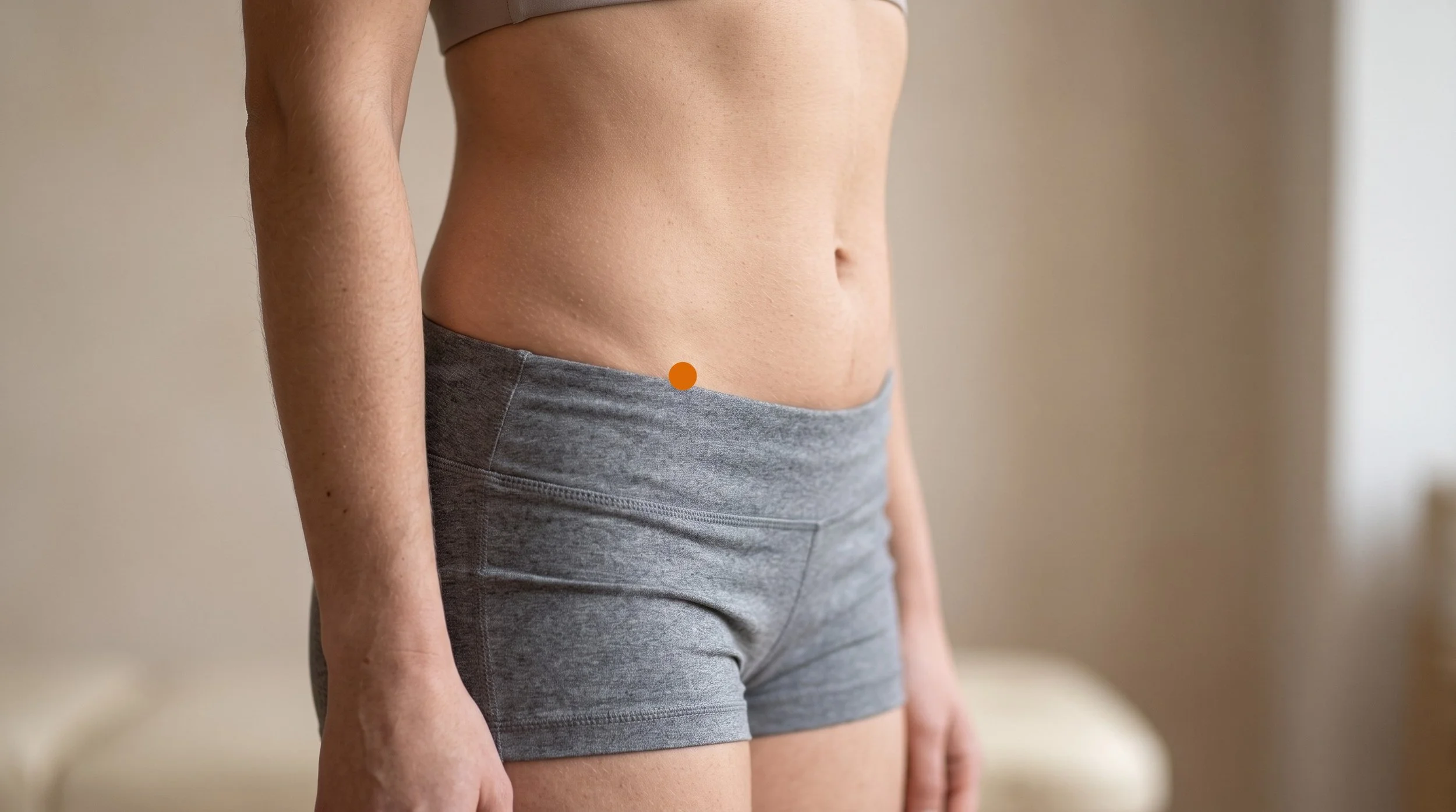
GB28 Acupuncture Point (Weidao)
The Linking Path Below the Iliac Spine: Anatomy, Mechanism, and Why This Girdling Vessel Point Bridges Pelvic and Hip Complaints
GB28, known in Chinese as Weidao and usually translated as Linking Path, sits on the side of the lower abdomen just in front of and below the bony point of the hip you can feel when you press into the front of your pelvic rim (the anterior superior iliac spine). It is the lower of the two Gallbladder points that sit at the pelvic brim, half a cun anterior and inferior to GB27, and it is classically described as a meeting point of the Gallbladder channel with the Girdling vessel, the horizontal belt-like pathway that encircles the waist.
Clinically the GB28 acupuncture point earns its place for two reasons: it lies over a busy junction of abdominal wall, inguinal ligament and hip flexor tissue where mechanical strain accumulates, and it shares segmental nerve supply with the lower abdomen and pelvis, which is why gallbladder 28 shows up in treatment plans for lower abdominal and pelvic-brim pain as well as anterior hip complaints.
- Location and layers: Weidao point location is 0.5 cun anterior and inferior to GB27, just below and in front of the ASIS, where the needle passes through skin and fat into the oblique and transversus aponeurosis near the lateral end of the inguinal ligament and the upper attachment field of sartorius.
- Traditional attribution: classical sources list GB28 as one of three Girdling vessel crossing points with GB26 and GB27, traditionally used for lower abdominal pain, uterine prolapse, irregular menstruation, vaginal discharge, shan (groin and genital) disorders, back and iliac pain, poor appetite and vomiting; these are historical categories, not modern diagnoses.
- Mechanism: needling here recruits iliohypogastric, ilioinguinal and lateral femoral cutaneous fibers from the T12 to L2 segments, the same neurological neighborhood that receives pelvic visceral afferents, which offers a segmental convergence explanation for why a lower abdominal point may influence pelvic-region symptoms (Zhao, 2008).
- Research picture: acupuncture as a whole has moderate evidence for chronic pain conditions in individual patient data meta-analysis (Vickers et al., 2018), while pelvic and menstrual pain reviews are more mixed, with Cochrane finding the evidence insufficient to draw firm conclusions (Smith et al., 2016) and later pelvic pain meta-analyses reporting benefit from generally low-quality trials (Lin et al., 2023).
- Physiological plausibility for pelvic use: a small early study reported reduced uterine artery blood flow impedance after a course of electroacupuncture, which is often cited as support for autonomic and vascular effects of needling in the lower abdomen and low back, though the sample was tiny and uncontrolled (Stener-Victorin et al., 1996).
- De qi and practice: patients usually report a heavy, spreading ache that can travel along the pelvic brim or toward the groin, and GB 28 hip work is almost always combined with distal points and, where indicated, dry needling of sartorius or the abdominal obliques rather than used alone.
Lower Abdominal or Pelvic-Brim Pain That Nothing Seems To Touch?
Pain that wraps the front of the pelvis is often a mix of abdominal wall tension, hip flexor loading and sensitized pelvic nerves, and it rarely responds to stretching alone. At Morningside Acupuncture we use GB28 alongside neighboring Girdling vessel points and distal leg points to calm that region while addressing the muscles that keep reloading it. Treatment is paced, explained and adjusted based on how your symptoms change week to week. Schedule a visit and we'll map out where your pain is actually coming from.
Schedule NowAnatomy of GB28: Why the Front of the Iliac Spine Is Such an Important Location
Working from the surface inward, a needle at GB28 passes through skin and subcutaneous fat into the aponeurotic sheet formed by external oblique, internal oblique and transversus abdominis as they converge toward the iliac crest and the lateral end of the inguinal ligament. Just below and lateral to that, the upper attachment field of sartorius leaves the ASIS, with tensor fasciae latae immediately behind it.
This is a genuine mechanical crossroads: rotation and side bending of the trunk load the obliques into the crest, prolonged sitting shortens the hip flexors, and repetitive kicking, cycling or running loads the sartorius and rectus femoris attachments. The result is that the tissue at this location is frequently tender to palpation even in people whose main complaint is felt elsewhere in the pelvis.
The nerve geography explains much of the clinical behavior of this point. Cutaneous and muscular supply in this region comes from the iliohypogastric and ilioinguinal nerves (T12 and L1) and the lateral femoral cutaneous nerve (L2 and L3), the latter typically passing under or through the inguinal ligament close to the ASIS before fanning across the anterolateral thigh.
Those same T12 to L2 spinal segments receive sympathetic afferent traffic from pelvic structures traveling through the hypogastric and superior hypogastric plexuses, so somatic input from the abdominal wall and visceral input from the pelvis converge on overlapping dorsal horn neurons. Needle stimulation at this depth activates A-delta and C-fiber afferents that engage spinal gating and descending inhibitory pathways involving endogenous opioid, serotonergic and noradrenergic signaling, which is the current best-supported account of how acupuncture modulates pain (Zhao, 2008).
Deeper and medial to the point lie the iliacus muscle against the inner surface of the ilium, the deep circumflex iliac vessels running along the crest, and, further medially, the peritoneal cavity and its contents.
Classical texts give perpendicular insertion of roughly 1 to 1.5 cun, with other references listing a more conservative 0.5 to 1 cun, and moxibustion is described as applicable. In practice the safest technique is to angle slightly toward the iliac bone rather than medially into the abdomen, to reduce depth in thin patients, and to avoid the area entirely during pregnancy, over hernias, over surgical hardware or where abdominal pathology has not been evaluated. As with all lower abdominal points, clean technique and clear communication about depth matter more than chasing a strong sensation.
Related Pain Finder Lower Torso Related Acupuncture For Sartorius Muscle PainGB28 at a Glance: Classification, Location, and Clinical Use
| Category | Detail |
|---|---|
| Traditional Name | Weidao (Linking Path), also translated as Connecting Passage or Maintaining the Way |
| Channel Classification | Gallbladder channel, lower abdomen, at the pelvic brim below GB27 |
| Point Categories | Meeting (crossing) point of the Gallbladder channel with the Girdling (Dai) vessel; one of the three Girdling vessel coalescent points along with GB26 and GB27; no five-shu or hui-meeting designation |
| Precise Location | On the side of the lower abdomen, 0.5 cun anterior and inferior to GB27, which sits at the anterior superior iliac spine; GB28 therefore lies just in front of and below the ASIS |
| Tissue Stimulated | Abdominal oblique aponeurosis at the iliac crest (external abdominal oblique, abdominal obliques), lateral end of the inguinal ligament, upper attachment field of sartorius, with iliacus deep to the point and referred pelvic symptoms sometimes overlapping pelvic floor patterns |
| Needle Depth / Direction | Perpendicular insertion 1 to 1.5 cun in classical sources, with 0.5 to 1 cun listed elsewhere; angling slightly toward the ilium is preferred over medial angulation, and moxibustion is traditionally described as applicable |
| De Qi Sensation | A dull, heavy, spreading ache at the pelvic rim that may radiate toward the groin, the front of the hip or along the crest; sharp or electric sensation traveling down the outer thigh suggests contact with the lateral femoral cutaneous nerve and calls for repositioning |
| Primary Clinical Uses | Lower abdominal and pelvic-brim pain, iliac and hip-front pain, low back pain with lateral pelvic involvement, and traditionally menstrual irregularity, vaginal discharge patterns, uterine prolapse, shan disorders, poor appetite and nausea |
| Common Point Combinations |
|
In A Manual of Acupuncture, GB28 is presented as a meeting point of the Gallbladder channel with the Girdling vessel, with traditional actions given as regulating that vessel and regulating the lower jiao while transforming stagnation. The indication list attributed to the classical literature is unusually wide for a single abdominal point: prolapse of the uterus, irregular menstruation and vaginal discharge; pain of the back, iliac region and lower abdomen along with shan disorders of the groin and genitals; and, sitting oddly beside those, loss of appetite and vomiting.
Other classical commentaries add congestion in the lower abdomen, hernia-type pain, constipation and edema, and Maciocia's account of the Girdling vessel describes a belt that binds the vertical channels of the trunk, with laxity of that belt traditionally blamed for dampness settling into the lower body.
Read as a traditional attribution rather than a physiological claim, the striking feature is that a point sitting on the pelvic rim was expected to influence structures above it (digestion), below it (the groin and thigh) and behind it (the ilium and low back), which is exactly the distribution you would predict from the T12 to L2 innervation of that patch of body wall.
Why GB28 Is Used for Anterior Hip Pain and Lateral Thigh Numbness
Most people first meet GB28 in a gynecological context, so it surprises them to be needled here for hip and thigh symptoms. The anatomy makes the case. The point sits within a couple of finger widths of where the lateral femoral cutaneous nerve leaves the pelvis near the inguinal ligament, and it overlies tissue that anchors both the abdominal wall and the sartorius. When that region is compressed by prolonged sitting, tight waistbands, heavy load carrying or a stiff anterior hip, patients may report front-of-hip pinching, a deep ache along the crest, or burning and numbness spreading down the outer thigh.
Because the somatic afferents from this area and the visceral afferents from the pelvis converge on the same lower thoracic and upper lumbar spinal segments, tenderness here can also reflect sensitization driven from the pelvis rather than from the muscle itself (Zhao, 2008).
The second half of the mechanism story is central rather than local. Needle stimulation strong enough to produce de qi activates small-diameter afferents that trigger descending inhibitory control from the periaqueductal gray and rostral ventromedial medulla, releasing endogenous opioids and monoamines that reduce dorsal horn excitability over the following minutes to hours (Zhao, 2008).
This is why treatment usually pairs a local point like GB28 with distal points on the leg: the local needle addresses the sensitized tissue and its segment, while the distal needle contributes to the broader, less region-specific analgesic response. Individual patient data pooled across chronic pain trials indicate that acupuncture produces effects greater than sham and greater than usual care, with benefits that persist over months rather than disappearing immediately after treatment (Vickers et al., 2018).
There is also a vascular and autonomic component worth mentioning cautiously. Needling in the lower abdomen and lumbosacral region has been reported to change regional blood flow, including one small early study that found reduced uterine artery pulsatility index after a course of electroacupuncture (Stener-Victorin et al., 1996). That work involved a handful of participants and no control group, so it should be treated as a hypothesis about autonomic and vasomotor effects rather than proof of clinical benefit.
Still, it fits a coherent model in which segmental needling influences sympathetic outflow to the pelvic vasculature, and it helps explain why some patients describe a warm, softening sensation across the lower abdomen during treatment.
What the Research Shows for GB28
No trial has isolated GB28 on its own, and it would be misleading to imply otherwise. The relevant research tests multi-point protocols for conditions where this point is commonly included, such as menstrual pain, chronic pelvic pain and musculoskeletal pain, so the honest framing is that GB28 is one component of protocols that have been studied with mixed results. Review quality in the pelvic and menstrual literature is generally low, sham comparisons are difficult to design for abdominal points, and effect sizes vary widely between trials. What follows is a summary of the strongest available evidence and its limits.
| Study | Type | Focus | Key Finding |
|---|---|---|---|
| Smith et al., 2016 | Cochrane systematic review | Acupuncture and acupressure for primary dysmenorrhoea (42 studies) | Reviewers concluded there was insufficient evidence to determine whether acupuncture or acupressure reduce menstrual pain, with low or very low certainty across all comparisons. |
| Lin et al., 2023 | Systematic review and meta-analysis | Acupuncture for chronic pelvic pain (17 trials, 1,455 patients) | Pooled analysis suggested acupuncture may reduce pain scores compared with control interventions, though trial quality and heterogeneity limit confidence. |
| Sung et al., 2018 | Systematic review and meta-analysis | Acupuncture for chronic pelvic pain in women (4 RCTs, 474 participants) | Acupuncture added to conventional care was associated with better outcomes than conventional care alone, but methodological quality was generally low. |
| Vickers et al., 2018 | Individual patient data meta-analysis | Acupuncture for chronic musculoskeletal, headache and osteoarthritis pain | Acupuncture was more effective than both sham and no-acupuncture control, with effects that decreased only modestly over about 12 months. |
| Stener-Victorin et al., 1996 | Small prospective physiological study | Electroacupuncture and uterine artery blood flow impedance in infertile women | Pulsatility index fell after a course of electroacupuncture in 10 women, an early signal of vascular and autonomic effects that needs controlled replication. |
| Zhao, 2008 | Narrative review of neurophysiology | Mechanisms of acupuncture analgesia | Analgesic effects are attributed to afferent-driven spinal gating plus descending inhibition involving opioid, serotonergic and noradrenergic systems. |
Front-of-Hip Tightness, Pinching or Numbness Along the Outer Thigh?
The area around GB28 sits right where the lateral femoral cutaneous nerve exits near the inguinal ligament, which is why some people feel burning or numbness across the front and outside of the thigh. We combine careful needling at this point with dry needling of sartorius, tensor fasciae latae and the abdominal wall, plus movement guidance for sitting and hip position. Many patients notice changes in symptom intensity within a few sessions. Book an appointment to get assessed.
Schedule NowGB28 in the Context of Trigger Point Work
GB28 sits directly over tissue that is a routine target in myofascial practice. The external and internal obliques attach along the iliac crest and can refer pain across the lower abdomen, into the groin and occasionally toward the testicle or labia, a pattern that overlaps closely with the classical indications listed for this point (Simons, Travell, & Simons, 1999). Sartorius, whose attachment field begins immediately below the ASIS, refers a sharp or tingling sensation along the front of the thigh and is frequently involved when patients describe pinching at the front of the hip.
Because acupuncture simply means the use of an acupuncture needle, needling at GB28 and dry needling these muscles are the same act described in two vocabularies, and at Morningside we choose the framing that best fits what the tissue examination shows.
In practice, a session for pelvic-brim or anterior hip pain often begins with palpation along the crest, the inguinal ligament and the hip flexor attachments to find the tender bands that reproduce the patient's symptoms. GB28 may be needled as a local point with a shallow to moderate perpendicular insertion angled toward the bone, then combined with dry needling of the obliques, sartorius or tensor fasciae latae, plus distal points such as GB34 or SP6 to recruit the broader descending inhibitory response.
When symptoms include burning or numbness across the outer thigh, we work deliberately away from the nerve's exit point and focus on offloading the surrounding tissue rather than needling directly onto an irritated nerve. Home guidance usually addresses sitting position, belt and waistband pressure, and graded hip extension mobility.
GB28 Pelvic and Hip Pain Treatment at NYC's Highest-Rated Acupuncture Clinic
Morningside Acupuncture is the highest-rated acupuncture and dry needling clinic in New York City with over 500 five-star Google reviews, and our approach blends classical point selection with modern pain science. GB28 is one of the points we reach for when lower abdominal, pelvic-brim and anterior hip complaints overlap, always as part of a broader plan rather than a single needle. You'll get a clear explanation of what we're treating and why at every step. Schedule your session on the Upper West Side today.
Schedule NowFrequently Asked Questions
What does GB28 feel like when needled?
Most people report a dull, heavy, slightly spreading ache at the pelvic rim rather than a sharp pain. That sensation, called de qi, may travel a short distance toward the groin, along the crest or into the front of the hip, and it often eases within a minute of the needle settling. Some patients notice a warm or softening feeling across the lower abdomen. A sudden electric or zinging sensation shooting down the outer thigh is not the goal and simply means the needle is close to the lateral femoral cutaneous nerve, so your practitioner should withdraw and reposition.
Why needle a lower abdominal point for hip and thigh symptoms?
Because the anatomy at this location belongs to both regions. GB28 lies where the abdominal wall aponeurosis, the lateral inguinal ligament and the upper sartorius attachment all converge, just where the lateral femoral cutaneous nerve leaves the pelvis. Nerve supply here comes from the T12 to L2 segments, which also carry afferent input from pelvic structures and the front of the thigh, so stimulation at one site can influence perception across the whole convergent segment (Zhao, 2008). Classical sources arrived at a similar clinical grouping from observation, listing iliac and low back pain alongside lower abdominal complaints for this same point.
Can I press GB28 myself between sessions?
Yes, gentle self-acupressure is reasonable for most people. Find the bony front point of your hip (the ASIS), then move about half a thumb width forward and down onto the soft tissue just below it. Press with the pad of your thumb or two fingertips at a pressure you would rate about 4 or 5 out of 10, hold for 30 to 60 seconds, release, and repeat two or three times per side. You can add slow diaphragmatic breathing or a very small hip flexion and extension movement while holding. Once or twice daily is plenty. Stop if you feel numbness or electric sensations down the thigh, and skip this entirely if you are pregnant, have a hernia in the area, have had recent abdominal or pelvic surgery, or have undiagnosed abdominal pain.
Is GB28 safe to needle?
In trained hands it is a routine point, but it deserves respect because the abdominal cavity lies deep and medial to it. Practitioners generally insert perpendicularly, angle slightly toward the ilium rather than medially, and adjust depth for body habitus, with classical texts giving 1 to 1.5 cun and more conservative sources listing 0.5 to 1 cun. It should be avoided in pregnancy, over hernias, over surgical scars or implants, and in anyone with acute or unexplained abdominal pain until that has been evaluated medically. Expected minor effects are brief soreness or a small bruise, since the region has a superficial vascular supply along the crest.
Where exactly is GB28 located?
Locate the anterior superior iliac spine, the prominent bony bump at the front of your pelvic rim. GB27 sits at that landmark, and GB28 is 0.5 cun anterior and inferior to it, meaning slightly forward and slightly below, on the soft tissue of the lower lateral abdomen. Both are Girdling vessel crossing points, with GB26 sitting higher and more medially at the level of the umbilicus below the free end of the eleventh rib. If you are searching for Weidao point location and want to confirm you are in the right place, the spot is usually tender to firm pressure when the abdominal wall or hip flexors are involved.
References
- Deadman, P., Al-Khafaji, M., & Baker, K. (2009). A manual of acupuncture. Journal of Chinese Medicine Publications.
- Maciocia, G. (2005). The foundations of Chinese medicine: A comprehensive text for acupuncturists and herbalists (2nd ed.). Elsevier Churchill Livingstone.
- Cunningham, P. M. (2000). Acupuncture points: A practical guide to classical and modern usage. Odyssey Press.
- Kim, H. (2008). Handbook of Oriental medicine (3rd ed.). Harmony & Balance Press.
- O'Connor, J., & Bensky, D. (Eds. & Trans.). (1981). Acupuncture: A comprehensive text. Shanghai College of Traditional Medicine. Eastland Press.
- Simons, D. G., Travell, J. G., & Simons, L. S. (1999). Travell & Simons' myofascial pain and dysfunction: The trigger point manual, Vol. 1: Upper half of body (2nd ed.). Williams & Wilkins.
- Zhao, Z. Q. (2008). Neural mechanism underlying acupuncture analgesia. Progress in Neurobiology, 85(4), 355-375. https://doi.org/10.1016/j.pneurobio.2008.05.004
- Vickers, A. J., Vertosick, E. A., Lewith, G., MacPherson, H., Foster, N. E., Sherman, K. J., Irnich, D., Witt, C. M., & Linde, K. (2018). Acupuncture for chronic pain: Update of an individual patient data meta-analysis. Journal of Pain, 19(5), 455-474. https://doi.org/10.1016/j.jpain.2017.11.005
- Smith, C. A., Armour, M., Zhu, X., Li, X., Lu, Z. Y., & Song, J. (2016). Acupuncture for dysmenorrhoea. Cochrane Database of Systematic Reviews, 2016(4), CD007854. https://doi.org/10.1002/14651858.CD007854.pub3
- Lin, K. Y.-H., Chang, Y.-C., Lu, W.-C., Kotha, P., Chen, Y.-H., & Tu, C.-H. (2023). Analgesic efficacy of acupuncture on chronic pelvic pain: A systemic review and meta-analysis study. Healthcare, 11(6), 830. https://doi.org/10.3390/healthcare11060830
- Sung, S.-H., Sung, A.-D.-M., Sung, H.-K., An, T.-E.-B., Kim, K. H., & Park, J.-K. (2018). Acupuncture treatment for chronic pelvic pain in women: A systematic review and meta-analysis of randomized controlled trials. Evidence-Based Complementary and Alternative Medicine, 2018, 9415897. https://doi.org/10.1155/2018/9415897
- Stener-Victorin, E., Waldenström, U., Andersson, S. A., & Wikland, M. (1996). Reduction of blood flow impedance in the uterine arteries of infertile women with electro-acupuncture. Human Reproduction, 11(6), 1314-1317. https://doi.org/10.1093/oxfordjournals.humrep.a019378
Disclaimer: This web site is intended for educational and informational purposes only. Reading this website does not constitute providing medical advice or any professional services. This information should not be used for diagnosing or treating any health issue or disease. Those seeking medical advice should consult with a licensed physician. Seek the advice of a medical doctor or other qualified health professional for any medical condition. If you think you have a medical emergency, call 911 or go to the emergency room. No acupuncturist-patient relationship is created by reading this website or using the information. Morningside Acupuncture PLLC and its employees and contributors do not make any express or implied representations with respect to the information on this site or its use. For any legal interpretation of scope of practice in your state, consult a licensed attorney or regulatory authority.
Read more from our blog



