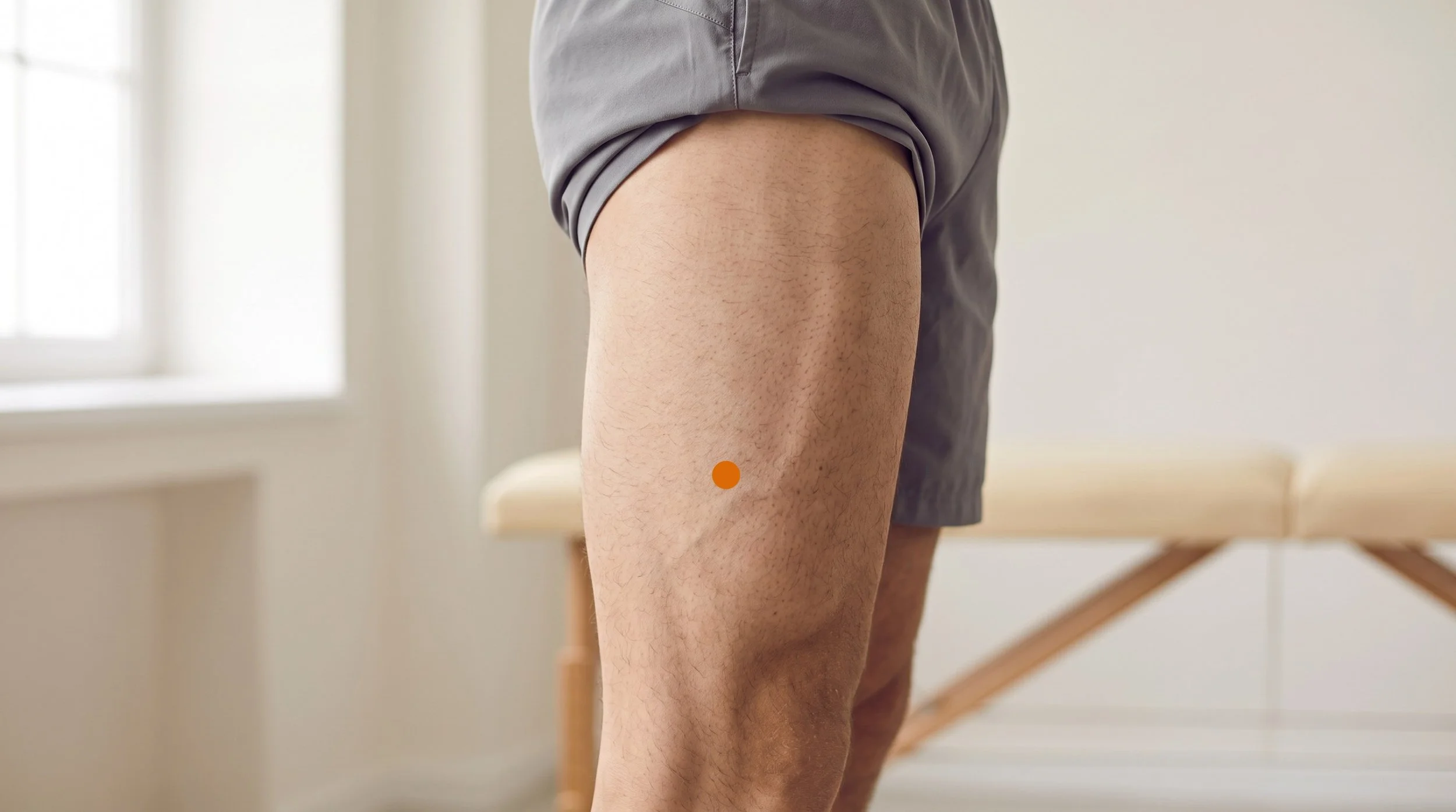
GB32 Acupuncture Point (Zhongdu)
The Middle Ditch on the Iliotibial Line: Anatomy, Mechanism, and Why This Lower Thigh Gallbladder Point Belongs in Sciatica and IT Band Care
GB32 (Zhongdu, often translated as Middle Ditch) is a Gallbladder channel point on the outer thigh, sitting 2 cun below GB31 in the shallow furrow between the quadriceps in front and the hamstrings behind.
In plain terms: stand with your arms at your sides, find the spot where your middle fingertip touches the thigh (that is GB31), then drop about two thumb widths lower and settle into the soft groove you can feel under the iliotibial tract.
Classical texts group it with the points that traditionally expel wind, damp and cold and free the channel, and modern practice uses it for the same territory that gives runners, cyclists, and desk-bound New Yorkers trouble: aching and tightness along the outer thigh, burning or numb patches over the lateral quadriceps, and sciatic-type pain that tracks down the side of the leg rather than straight down the back.
The GB32 acupuncture point matters clinically because it gives access to the iliotibial line at a level below GB31, where the fascia, the intermuscular septum, and cutaneous nerve territory all converge in one needling window.
- Location and layers: GB32 lies 2 cun below GB31 on the lateral thigh, just proximal to the junction of the upper three quarters and lowest quarter of the 19 cun line from the greater trochanter to the popliteal crease, in the groove between vastus lateralis and biceps femoris (Deadman et al., 2009). A needle here passes skin, subcutaneous tissue, the iliotibial tract, and then the muscular interval over the lateral intermuscular septum.
- Traditional categories, translated: the classical actions attributed to Zhongdu GB32 are expelling wind, damp and cold and activating the channel to relieve pain (Deadman et al., 2009; Kim, 2008). In neurophysiological language, that describes a local point used to modulate deep somatic input from fascia and muscle in a well-defined dermatomal and myotomal band.
- Nerve story: the skin here sits in lateral femoral cutaneous nerve territory (roughly L2 and L3), while the muscles bordering the groove are supplied by the femoral nerve (vastus lateralis) and the sciatic nerve (biceps femoris), so one point can influence several converging inputs at the dorsal horn (Zhao, 2008).
- Research picture: acupuncture protocols that include lateral thigh and Gallbladder channel points have been studied for sciatica, with reviews reporting benefit over medication alone but flagging weak methods and heterogeneity (Qin et al., 2015; Han et al., 2022; Zhang et al., 2023). Individual patient data pooling across chronic musculoskeletal pain conditions supports modest, durable effects of needling generally (Vickers et al., 2018).
- Clinical framing: gallbladder 32 is rarely used alone. It is typically needled with GB31 above, GB34 below, and gluteal points when the pain originates at the hip, and it is often combined with trigger point needling of the surrounding muscles (Simons et al., 1999).
- De qi at GB 32 thigh level tends to be heavy and spreading rather than sharp, sometimes traveling toward the knee or up toward the hip. Needle stimulation strong enough to produce that sensation has been associated with larger increases in local skin and muscle blood flow than very superficial insertion (Sandberg et al., 2004).
Outer Thigh Pain That Flares Every Time You Run or Sit Too Long?
Lateral thigh pain rarely comes from one tissue, which is why we assess the hip, the iliotibial line, and the low back before choosing points. GB32 gives us a working window into the groove between vastus lateralis and the hamstrings, and we often pair it with GB31 above and GB34 below in the same session. Treatment is combined with movement screening and simple loading advice so the change holds between visits. Book an evaluation at Morningside Acupuncture and we can map where your pain is actually generated.
Schedule NowAnatomy of GB32: Why the Groove Between Vastus Lateralis and the Hamstrings Is Such an Important Location
From the surface down, GB32 sits under thin skin and subcutaneous fat, then the iliotibial tract, a dense sheet of fascia that runs from the hip to the lateral tibia and functions as a tension member for the lateral thigh. Immediately beneath is the palpable furrow between vastus lateralis in front and the long head of biceps femoris behind, and deeper still is the lateral intermuscular septum anchoring onto the femur.
This is a high-load neighborhood: repetitive hip abduction and adduction in running and cycling, side-lying sleep on a firm mattress, prolonged sitting with the hip flexed, and hip abductor weakness all concentrate stress here. Both bordering muscles are well described sources of referred pain, with vastus lateralis capable of producing a long band of ache down the outer thigh and biceps femoris referring toward the back of the knee (Simons et al., 1999).
The nerve geography is what makes this point interesting. Skin over the anterolateral thigh belongs largely to the lateral femoral cutaneous nerve, a purely sensory branch from roughly L2 and L3, which is why irritation in this region can present as burning, tingling, or a numb patch rather than muscular soreness. The muscles bordering the groove answer to different roots: vastus lateralis through the femoral nerve, biceps femoris through the sciatic nerve.
Needling into this interval recruits A-delta and C fiber afferents from skin, fascia, and muscle that converge on shared dorsal horn segments, where they can engage segmental inhibition and trigger descending pain control through brainstem pathways using serotonin, noradrenaline, and endogenous opioids (Zhao, 2008). Local effects matter too: needle stimulation of muscle strong enough to elicit de qi has been shown to increase both skin and muscle blood flow at the stimulated site, a plausible contributor to the loosening patients report afterward (Sandberg et al., 2004).
Deep to the septum lie the femur and the perforating branches of the deep femoral artery, which is why depth and angle conventions here are conservative rather than casual. Classical texts describe perpendicular or slightly posteriorly angled insertion of 1 to 2 cun, or oblique insertion up or down the thigh of 1.5 to 2.5 cun, with the oblique approach useful for engaging the iliotibial line along its length (Deadman et al., 2009). Other modern manuals list a shallower perpendicular depth of under about 1 cun, and moxibustion is considered appropriate at this point (Kim, 2008).
In practice, thigh girth varies enormously, so a clinician should be palpating the groove and adjusting depth to the individual rather than following a fixed number, and should take extra care in patients on anticoagulants.
Related Dry Needling For IT Band Pain Related Vastus Lateralis Trigger PointsGB32 at a Glance: Classification, Location, and Clinical Use
| Category | Detail |
|---|---|
| Traditional Name | Zhongdu (Middle Ditch), GB32, Gallbladder 32 |
| Channel Classification | Gallbladder channel of Foot Shaoyang, lateral thigh region, the point directly below GB31 on the iliotibial line |
| Point Categories | No five-shu, luo-connecting, xi-cleft, or extraordinary vessel designation is assigned to this point. It is classified in the traditional literature by function rather than category: expelling wind, damp and cold, activating the channel, and alleviating pain (Deadman et al., 2009; Kim, 2008) |
| Precise Location | On the outer thigh 2 cun below GB31, in the groove between vastus lateralis and biceps femoris. On the 19 cun line from the prominence of the greater trochanter to the popliteal crease, it falls just above the junction of the upper three quarters and the lowest quarter, often at a tender spot |
| Tissue Stimulated | Skin in lateral femoral cutaneous nerve territory, iliotibial tract, the muscular interval between vastus lateralis and biceps femoris, and the lateral intermuscular septum over the femur |
| Needle Depth / Direction | Perpendicular or slightly posteriorly angled 1 to 2 cun, or oblique insertion directed proximally or distally 1.5 to 2.5 cun; more conservative depths near 1 cun are also taught, and moxibustion is applicable |
| De Qi Sensation | A deep, heavy, spreading ache in the groove, sometimes traveling toward the knee or the hip; a brief twitch may occur if a taut band in vastus lateralis or biceps femoris is engaged |
| Primary Clinical Uses | Lateral thigh pain and numbness, sciatic-type pain along the outer leg, iliotibial band region tightness in athletes, and cold-pattern aching of the leg muscles in classical use |
| Common Point Combinations |
|
Deadman's Manual of Acupuncture notes that both the Systematic Classic of Acupuncture and Moxibustion and the Great Compendium of Acupuncture and Moxibustion recommended Zhongdu GB32 for cold pathogenic influence settling into the muscles and sinews, and the commentary uses that indication to illustrate how the Yellow Emperor's Inner Classic sorted painful obstruction two different ways: by which pathogen dominates (wind, cold, or damp) and by how deeply the problem has penetrated, from skin inward through muscles, vessels, sinews, and bone, with each level traditionally linked to a corresponding organ (Deadman et al., 2009).
Presented as traditional attribution rather than physiology, the classical indication list for this point runs to atrophy and weakness of the leg, painful obstruction with numbness, hemiplegia, sciatica, back and hip pain, and even urticaria.
What is striking is how well the depth-based scheme maps onto how clinicians still think today: a superficial, skin-level complaint (a burning numb patch) is treated differently from a deep, dense, cold-feeling ache in the muscle belly, even when both sit at the same spot on the thigh.
Why GB32 Is Used for Numbness and Nerve-Type Symptoms, Not Just Muscle Soreness
Patients are often surprised that a point on the side of the thigh helps with tingling, burning, or a dead patch of skin, since those feel like nerve problems rather than muscle problems. The explanation is convergence. Sensory information from skin, fascia, muscle, and joint in this region funnels into overlapping segments of the spinal cord, so needle input from one tissue can change how the nervous system processes input from the others in that same neighborhood.
Because the anterolateral thigh is lateral femoral cutaneous nerve territory and the bordering muscles are supplied by femoral and sciatic branches, GB32 sits at an unusually rich crossroads of L2 through S2 input. Needling there recruits small-diameter afferents that engage segmental inhibitory circuits and also activate descending pain modulation from the midbrain and brainstem, which uses opioid, serotonergic, and noradrenergic signaling to turn down transmission at the dorsal horn (Zhao, 2008).
There is a local layer too. Fascial and muscular tissue that has been chronically loaded or compressed tends to be poorly perfused and locally sensitized, and needle stimulation delivered deep enough to produce de qi has been shown to raise blood flow in both skin and underlying muscle more than superficial insertion does (Sandberg et al., 2004). That combination, better local perfusion plus reduced central amplification, is the most defensible way to explain why patients often report that the outer thigh feels lighter and less tight for days after treatment, even when nothing structural has changed.
It also explains why we do not treat the numb patch by itself: quieting the whole segment, including the gluteal and lumbar contributors, usually outlasts treating only the spot that feels odd.
None of this is a promise of resolution. Entrapment-type thigh symptoms may reduce with needling in some patients and not in others, the evidence base for that specific presentation is thin, and persistent or progressive numbness, weakness, or bowel and bladder changes always warrant medical evaluation first.
What the Research Shows for GB32
There is no clinical trial testing GB32 in isolation, and it would be misleading to imply otherwise. What exists is research on multi-point acupuncture protocols for sciatica and lateral leg pain (which often include Gallbladder channel thigh points), broader evidence for acupuncture in chronic musculoskeletal pain, dry needling trials for iliotibial band and myofascial complaints, and mechanistic studies on what a needle does to local tissue and to central pain processing. Read the table below as context for how this point is used inside a plan, not as evidence for the point on its own.
| Study | Type | Focus | Key Finding |
|---|---|---|---|
| Qin et al., 2015 | Systematic review and meta-analysis | Acupuncture for sciatica across 11 randomized trials | Acupuncture may outperform drug therapy and may add to it, though the authors describe the evidence as limited by the small number of rigorous studies. |
| Han et al., 2022 | Systematic review and meta-analysis | Acupuncture compared with analgesics for sciatica, including safety and relapse | Pooled results favored acupuncture over analgesics on effectiveness and safety measures, with the caveat that better designed trials are needed. |
| Zhang et al., 2023 | Systematic review and meta-analysis | Updated pooling of randomized trials of acupuncture therapy for sciatica | Reported efficacy and safety signals in favor of acupuncture while noting that earlier heterogeneity and sample size problems still limit confidence. |
| Vickers et al., 2018 | Individual patient data meta-analysis | Chronic musculoskeletal, headache, and osteoarthritis pain | Acupuncture was superior to sham and to no-acupuncture control, with effects that persisted over about a year, supporting more than a short-lived placebo response. |
| Maghroori et al., 2021 | Randomized clinical trial | Dry needling compared with shockwave therapy in iliotibial band syndrome | Both interventions improved pain and lower extremity function, with dry needling showing better pain scores at the four-week point in this small sample. |
| Gattie et al., 2017 | Systematic review and meta-analysis | Trigger point dry needling for musculoskeletal conditions | Dry needling was associated with reduced pain compared with sham or no treatment in the short term, with quality of evidence varying by body region. |
| Sandberg et al., 2004 | Controlled physiological study | Local skin and muscle blood flow response to needle stimulation in the lower leg | Deep muscle stimulation produced substantially larger increases in skin and muscle blood flow than subcutaneous insertion, suggesting stimulation depth and intensity matter. |
Sciatic-Type Pain Running Down the Side of the Leg?
When pain tracks down the outer leg rather than the back of the thigh, the Gallbladder line points, including GB32, become a natural part of the plan. We use them alongside gluteal and lumbar points, and we adjust needle depth and stimulation to what your tissue tolerates. Many patients notice looser hip rotation and easier stair climbing within a few sessions. Schedule a visit and we can build a plan around your specific pattern.
Schedule NowGB32 in the Context of Trigger Point Work
Acupuncture, in our usage, means treatment with an acupuncture needle, and that includes dry needling styles that select targets by muscle and referral pattern rather than by channel. GB32 happens to sit in a location where those two maps overlap almost perfectly. The groove it occupies is bordered by vastus lateralis, which can refer a long stripe of ache down the lateral thigh toward the knee, and by the long head of biceps femoris, which refers toward the back of the knee and upper calf (Simons et al., 1999).
In a typical Morningside session for outer thigh pain, we might needle GB31 and GB32 along the iliotibial line, then treat taut bands in vastus lateralis, tensor fasciae latae, and gluteus medius or minimus depending on what palpation and movement testing reveal.
The practical value of combining the two frameworks is coverage. Channel-based selection keeps us treating the whole line from hip to ankle, which matters when pain radiates, while trigger point selection makes sure the specific bands generating referral get addressed. Reviews of dry needling for musculoskeletal pain report short-term pain reduction compared with sham or no treatment, and a small trial in iliotibial band syndrome found needling comparable to shockwave therapy with better pain scores at four weeks (Gattie et al., 2017; Maghroori et al., 2021).
We treat those findings as encouraging rather than conclusive, and we pair needling with hip abductor loading and running or cycling adjustments, since the mechanical driver usually has to change for relief to last.
GB32 Sciatica and IT Band Treatment at NYC's Highest-Rated Acupuncture Clinic
Morningside Acupuncture is the highest-rated acupuncture and dry needling clinic in New York City with over 500 five-star Google reviews, and lateral hip and thigh pain is one of the complaints we see most. Our approach blends channel-based point selection (GB30, GB31, GB32, GB34) with anatomically guided dry needling of vastus lateralis, tensor fasciae latae, and biceps femoris. Every plan includes practical loading and mobility homework so gains carry over into running, cycling, and long workdays. Schedule your appointment and let's get the outer leg quiet again.
Schedule NowFrequently Asked Questions
What does GB32 feel like when needled?
Most people describe a deep, heavy, slightly spreading ache in the groove on the side of the thigh, sometimes with a sensation that travels toward the knee or up toward the hip. That is de qi, and it is the target sensation rather than sharpness. If the needle engages a taut band in vastus lateralis or the hamstring, you may feel a brief involuntary twitch, which is normal and settles immediately. Some patients notice mild soreness for a day, similar to post-workout muscle soreness, and gentle movement usually eases it.
Why treat the middle of the thigh when my pain seems to come from my hip or back?
Because lateral thigh pain is usually a chain problem rather than a single-spot problem. The iliotibial tract transmits tension from the hip abductors down to the knee, and the nerves supplying the skin and muscles around GB32 originate in the lumbar spine, so the tissue at mid-thigh often carries the consequences of what is happening above it. Needling at GB32 gives access to that middle segment of the chain, and we generally combine it with gluteal and lumbar points rather than relying on it alone. Treating several levels of the same neural segment tends to hold better than treating only where the pain is loudest.
Can I press GB32 myself between sessions?
Yes, and it is a reasonable self-care option for the outer thigh. Sit with the knee bent, let the thigh relax, and slide your fingers down the side of the leg from GB31 (roughly where the middle fingertip lands when the arm hangs at your side) about two thumb widths to the soft groove between the quadriceps and hamstrings. Press with your thumb, knuckle, or the heel of your hand into any tender spot using steady, moderate pressure and hold for 30 to 60 seconds, breathing normally, then repeat two or three times per side. A foam roller or massage ball along the same line works well too, but keep pressure tolerable rather than punishing, aim for a session or two a day, and stop if you get numbness, tingling, or pain that lingers afterward.
Is GB32 safe to needle?
In trained hands it is one of the more forgiving points on the body, since the target is a thick muscular and fascial region with no lung, major joint, or superficial great vessel directly beneath the usual insertion path. The relevant cautions are depth and technique: the femur and the perforating vessels near the lateral intermuscular septum lie deeper, so needle depth is matched to the patient's build, and extra care is warranted in people taking blood thinners or with clotting disorders. Bruising is the most common minor side effect, and temporary soreness is possible. Anyone with unexplained progressive numbness, leg weakness, or bowel or bladder symptoms should be evaluated medically before starting needling.
Where exactly is GB32 located?
GB32 is on the lateral thigh 2 cun (about two thumb widths) below GB31, in the palpable groove between vastus lateralis in front and biceps femoris behind, deep to the iliotibial tract. Using the classical measurement, the distance from the prominence of the greater trochanter to the popliteal crease is counted as 19 cun, and GB32 sits just above the junction of the upper three quarters and the lowest quarter of that line, often at a tender point (Deadman et al., 2009). Practically, find GB31 first with the arm hanging at the side, move two thumb widths distally, and sink into the furrow you can feel with the leg relaxed.
References
- Deadman, P., Al-Khafaji, M., & Baker, K. (2009). A manual of acupuncture. Journal of Chinese Medicine Publications.
- Kim, H. (2008). Handbook of Oriental medicine (3rd ed.). Harmony & Balance Press.
- Simons, D. G., Travell, J. G., & Simons, L. S. (1999). Travell & Simons' myofascial pain and dysfunction: The trigger point manual, Vol. 1: Upper half of body (2nd ed.). Williams & Wilkins.
- Qin, Z., Liu, X., Wu, J., Zhai, Y., & Liu, Z. (2015). Effectiveness of acupuncture for treating sciatica: A systematic review and meta-analysis. Evidence-Based Complementary and Alternative Medicine, 2015, 425108. https://doi.org/10.1155/2015/425108
- Han, K. H., Cho, K. H., Han, C., Cui, S., Lin, L., Baek, H. H., Kim, J., Jang, B. H., & Ko, S. G. (2022). The effectiveness and safety of acupuncture treatment on sciatica: A systematic review and meta-analysis. Complementary Therapies in Medicine, 71, 102872. https://doi.org/10.1016/j.ctim.2022.102872
- Zhang, Z., Hu, T., Huang, P., Yang, M., Huang, Z., Xia, Y., Zhang, X., Zhang, X., & Ni, G. (2023). The efficacy and safety of acupuncture therapy for sciatica: A systematic review and meta-analysis of randomized controlled trials. Frontiers in Neuroscience, 17, 1097830. https://doi.org/10.3389/fnins.2023.1097830
- Vickers, A. J., Vertosick, E. A., Lewith, G., MacPherson, H., Foster, N. E., Sherman, K. J., Irnich, D., Witt, C. M., & Linde, K. (2018). Acupuncture for chronic pain: Update of an individual patient data meta-analysis. Journal of Pain, 19(5), 455-474. https://doi.org/10.1016/j.jpain.2017.11.005
- Maghroori, R., Karshenas, L., & Khosrawi, S. (2021). Shockwave therapy versus dry needling for the management of iliotibial band syndrome: A randomized clinical trial. Galen Medical Journal, 10, 1-8. https://doi.org/10.31661/gmj.v10i0.2174
- Gattie, E., Cleland, J. A., & Snodgrass, S. (2017). The effectiveness of trigger point dry needling for musculoskeletal conditions by physical therapists: A systematic review and meta-analysis. Journal of Orthopaedic & Sports Physical Therapy, 47(3), 133-149. https://doi.org/10.2519/jospt.2017.7096
- Sandberg, M., Lindberg, L. G., & Gerdle, B. (2004). Peripheral effects of needle stimulation (acupuncture) on skin and muscle blood flow in fibromyalgia. European Journal of Pain, 8(2), 163-171. https://doi.org/10.1016/S1090-3801(03)00090-9
- Zhao, Z. Q. (2008). Neural mechanism underlying acupuncture analgesia. Progress in Neurobiology, 85(4), 355-375. https://doi.org/10.1016/j.pneurobio.2008.05.004
Disclaimer: This web site is intended for educational and informational purposes only. Reading this website does not constitute providing medical advice or any professional services. This information should not be used for diagnosing or treating any health issue or disease. Those seeking medical advice should consult with a licensed physician. Seek the advice of a medical doctor or other qualified health professional for any medical condition. If you think you have a medical emergency, call 911 or go to the emergency room. No acupuncturist-patient relationship is created by reading this website or using the information. Morningside Acupuncture PLLC and its employees and contributors do not make any express or implied representations with respect to the information on this site or its use. For any legal interpretation of scope of practice in your state, consult a licensed attorney or regulatory authority.
Read more from our blog



