Best Acupuncture Points for TMJ
Masseter, Temporalis, and Pterygoid Trigger Points — How Acupuncture and Dry Needling Address the Muscular and Neurological Drivers of Temporomandibular Dysfunction
Temporomandibular dysfunction (TMD) is one of the most prevalent chronic pain conditions affecting the jaw, face, and head, and its muscular component is frequently overlooked in favor of joint-focused treatments. Research consistently finds that trigger points in the masseter, temporalis, medial pterygoid, and lateral pterygoid account for a significant proportion of TMD pain, referred tooth pain, ear pain, and jaw clicking, making them primary targets for acupuncture and dry needling intervention.
- TMD is best understood as a condition with multiple contributing factors: articular (disc displacement, joint inflammation), muscular (trigger points in the masticatory muscles), and neurological (central sensitization of the trigeminal system), with most clinical presentations involving some combination of all three (Simons et al., 1999).
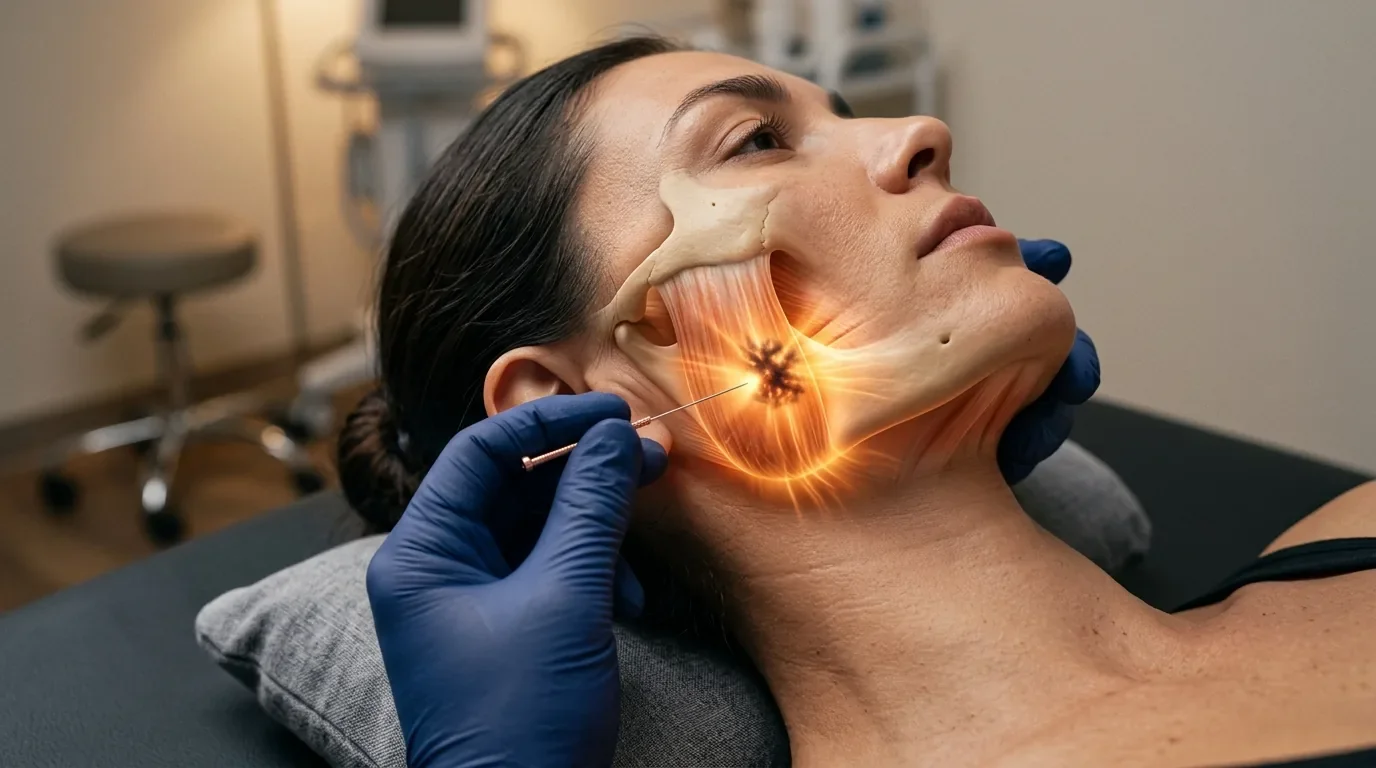
- The masseter is the most powerful muscle in the jaw and the most common source of trigger points in TMD; its referred pain patterns include the cheek, teeth, gums, and the temporomandibular joint itself, meaning that many patients with diagnosed "joint" pain are actually experiencing referred pain from the masseter muscle.
- The temporalis muscle, spreading across the temporal bone above the ear, harbors trigger points that refer pain to the teeth (particularly the upper molars and front teeth), the temporal region, and above the eye, and is the most common source of temporal headache that accompanies TMD.
- The medial and lateral pterygoid muscles, located deep to the mandible and inaccessible to manual palpation, can be reached by intraoral or external needling approaches and are a frequent source of deep jaw pain, restricted opening, and ear stuffiness in TMD.
- LI4 (Hegu), ST6 (Jiache), ST7 (Xiaguan), and GB34 are the most frequently included acupuncture points for TMD in clinical trials, with LI4 providing supraspinal trigeminal modulation and the local jaw points addressing the masticatory muscle trigger points and joint capsule directly (Zhao, 2008).
- A systematic review of acupuncture for TMD found significant improvements in pain intensity, mouth opening, and quality of life compared to sham and control interventions, with effects comparable to splint therapy for many patients (Fernandez-Carnero et al., 2010).
Is jaw pain, clicking, or restricted mouth opening affecting your daily comfort?
At Morningside Acupuncture, TMD treatment addresses the masticatory muscle trigger points that are the primary driver of most jaw pain, combined with the distal points that reduce trigeminal sensitization and central pain amplification. Many patients who have found limited benefit from splints alone experience significant improvement when the muscular component is addressed directly.
Schedule NowThe Muscular Anatomy of TMD: Why the Jaw Muscles Matter More Than the Joint
The temporomandibular joint itself is a complex structure involving the condylar head of the mandible, the glenoid fossa of the temporal bone, and an articular disc that moves with jaw opening and closing. Structural problems in the disc, including anterior displacement that produces the clicking many TMD patients hear, are real and clinically relevant. However, studies using MRI to identify disc displacement in pain-free populations find disc displacement in 30–35% of asymptomatic individuals, suggesting that disc position alone does not predict pain.
The muscles that control jaw movement are the primary pain generators in most TMD presentations. The masseter, which elevates the mandible for biting, is the most commonly affected. The temporalis, which assists in jaw closure and positions the mandible, is the second most common. The medial pterygoid, which assists in jaw closing and protrusion, and the lateral pterygoid, which opens the jaw and assists in disc movement, complete the masticatory muscle group and contribute to deep, anterior, and medial jaw pain patterns.
All of these muscles are innervated by the mandibular branch of the trigeminal nerve (V3), and trigger points within them generate referred pain through the same trigeminal nucleus caudalis pathways that process dental pain, facial pain, and headache. This is why masseter trigger points can cause apparent tooth pain that leads to unnecessary dental procedures, and why temporalis trigger points produce temporal headaches that are diagnostically attributed to migraine or tension headache rather than jaw muscle dysfunction (Simons et al., 1999).
The Key Acupuncture Points for TMD
| Point | Location | Target Tissue | Primary Use in TMD |
|---|---|---|---|
| ST6 (Jiache) | Over the masseter muscle, at the angle of the mandible, 1 cun anterior and superior to the mandibular angle | Masseter (superficial belly); branches of the masseteric nerve | Masseter trigger points; cheek and tooth pain; restricted jaw opening from masseter tightness |
| ST7 (Xiaguan) | Anterior to the ear, in the depression between the zygomatic arch and the mandibular notch when the mouth is closed; disappears when the mouth opens | Lateral pterygoid (superficial access); masseter (deep portion); TMJ capsule anterior surface; masseteric nerve | Jaw clicking; joint capsule irritation; restricted opening; deep jaw pain |
| GB2 (Tinghui) | Anterior to the intertragic notch of the ear, in the depression formed when the mouth is open | Parotid gland region; auriculotemporal nerve; TMJ lateral surface; retrodiscal tissue | Ear pain and ear stuffiness from TMD; TMJ lateral pain; auriculotemporal neuralgia |
| TE21 (Ermen) | Anterior to the ear, superior to the tragus, in the depression when the mouth opens | Superficial temporal artery and auriculotemporal nerve; TMJ superior surface | Superior TMJ pain; temporal headache from jaw tension; ear pressure |
| GB8 / Temporal trigger points | Superior to the auricle, over the temporal muscle belly; specific locations vary by trigger point position | Temporalis; temporal nerve branches of V3 | Temporal headache from TMD; upper molar tooth pain; eye pain above the brow from temporalis referral |
| LI4 (Hegu) | Dorsal hand, between 1st and 2nd metacarpals | Deep radial nerve; C6-C7 territory with trigeminal convergence in brainstem | Supraspinal trigeminal modulation; acute jaw pain reduction; systemic anti-nociception |
| ST36 / GB34 | Lower leg (see descriptions above) | Deep peroneal nerve; peroneal nerve — broad supraspinal activation | Systemic pain modulation; reducing trigeminal central sensitization between sessions |
Masseter Trigger Points: The Most Treatable TMD Driver
The masseter has two bellies, superficial and deep, and trigger points in each produce distinct referred pain patterns. Superficial masseter trigger points refer pain to the cheek, the upper and lower molars, the gums, and the front of the ear. Deep masseter trigger points refer into the TMJ itself, the ear canal, and the suboccipital region. Tinnitus is a frequently reported symptom from deep masseter trigger point activity, making the masseter a suspect whenever a TMD patient also complains of ear ringing.
ST6 at the angle of the jaw and tender points along the masseter belly are the primary needling targets for masseter trigger points. The needle enters the superficial masseter at depths of 0.5 to 1 cun, with the deep masseter requiring slightly greater penetration toward the mandibular ramus. De qi in the masseter typically produces a local ache or facial flushing, and the referred tooth pain that masseter trigger points generate may momentarily reproduce or transiently intensify during needling before resolving as the trigger point deactivates.
Temporalis Trigger Points: The Temple and Tooth Pain Muscle
The temporalis muscle fans across the temporal bone from the temporal line of the skull down to the coronoid process of the mandible. Trigger points in the anterior belly refer pain to the upper front teeth and the forehead; trigger points in the middle belly refer to the upper premolars and molars; trigger points in the posterior belly refer to the back of the head and behind the ear. The range of referred tooth pain from the temporalis alone accounts for a substantial number of unnecessary dental procedures each year.
Needling the temporalis requires careful attention to depth because the temporal bone is relatively thin at the temporal fossa and the needle must remain within the muscle belly rather than contacting bone. Practitioners palpate for tender points in the temporal region before needling, which are often sharply painful in TMD patients and correspond to the active trigger points generating the patient's headache and tooth pain patterns.
Pterygoid Muscles: The Deep Jaw Pain Source
The medial and lateral pterygoid muscles are inaccessible to surface palpation due to their position medial to the mandibular ramus. They are nonetheless critical contributors to TMD pain in many patients, particularly those with deep aching jaw pain, restricted jaw opening with a deviated jaw trajectory, and a feeling of ear fullness that is not explained by otological pathology.
Lateral pterygoid trigger points refer pain to the TMJ itself and the maxillary sinus region, and a hyperactive lateral pterygoid pulls the condyle and disc anteriorly during jaw closing, contributing to the anterior disc displacement that produces clicking. Medial pterygoid trigger points refer pain to the throat, the tongue base, and deep to the ear, and contribute to the jaw clenching and teeth-bracing postures that perpetuate TMD. These muscles can be accessed through an intraoral approach by a skilled practitioner.
Related Best Acupuncture Points for Migraines: Temporal Headaches and the Trigeminocervical SystemHave dental treatments not resolved your jaw or tooth pain?
Masseter and temporalis trigger points are a common source of tooth pain and jaw discomfort that dental interventions cannot address because the pain is referred from muscle tissue rather than generated by the tooth itself. Morningside's practitioners are trained to assess whether your jaw symptoms have a significant muscular trigger point component and to target those muscles directly with acupuncture and dry needling.
Schedule NowLI4 for Jaw Pain: The Trigeminal Connection
LI4 (Hegu) at the first web space of the hand is included in virtually every acupuncture protocol for facial and jaw pain because of its neurophysiological connection to the trigeminal system. The radial nerve at LI4 carries afferent signals in the C6-C7 territory, and in the brainstem these signals converge on the trigeminal nucleus caudalis through the spinotrigeminal tract. This convergence allows LI4 afferent input to competitively inhibit pain processing in the trigeminal territory, reducing the sensitivity of neurons processing facial and jaw pain.
LI4 is also one of the most potent supraspinal descending inhibition activators in the acupuncture system, recruiting the periaqueductal gray and descending serotonergic and noradrenergic pathways that reduce pain sensitivity throughout the nervous system, including the trigeminal nucleus. In patients with chronic TMD where central sensitization has developed, this systemic pain modulation from LI4 addresses the amplified pain processing that makes every jaw movement hurt, while the local masseter and temporalis needling addresses the peripheral tissue generating the ongoing afferent input that sustains that sensitization.
What the Research Shows: Acupuncture for TMD
Acupuncture for TMD has been examined in numerous randomized controlled trials and systematic reviews. A 2010 review by Fernandez-Carnero and colleagues found that acupuncture produced significantly greater improvements in pain intensity and jaw opening compared to sham acupuncture and to standard conservative care including splints in most included trials. The combination of local masticatory muscle needling and distal trigeminal modulation points was more effective than either approach alone.
Dry needling specifically targeting masseter and temporalis trigger points has been compared to occlusal splint therapy in several trials, with both treatments producing significant pain reduction and improved jaw range of motion, and no statistically significant difference between them for most outcomes. The combination of dry needling with splint therapy produced superior results to either treatment alone, suggesting that the muscular component and articular component benefit from simultaneous treatment.
Ready to address the muscular component of your TMJ pain?
At Morningside Acupuncture, the highest-rated acupuncture and dry needling clinic in New York City with over 500 five-star Google reviews, our practitioners assess which combination of local jaw muscle needling, joint area points, and distal trigeminal modulation points is most appropriate for your specific TMD presentation. Book a new patient visit to get started on a protocol tailored to your jaw pain pattern.
Schedule NowFrequently Asked Questions About Acupuncture for TMJ
What causes TMJ clicking and can acupuncture help it?
Jaw clicking is typically produced by the articular disc moving over the condylar head in a pattern called anterior disc displacement with reduction. The disc returns to its normal position on the condyle as the jaw opens, producing the click. A hyperactive lateral pterygoid muscle, which attaches to the anterior disc, is frequently a contributing factor by pulling the disc forward during jaw closing. Needling the lateral pterygoid may reduce its hypertonicity and allow the disc mechanics to normalize, but disc displacement with significant structural derangement cannot be fully corrected by needling alone. For many patients, however, reducing muscle tension in the pterygoids and masseter reduces the frequency and volume of clicking and the associated pain.
Is it safe to needle the jaw muscles, and will it hurt?
Acupuncture in the jaw region is safe when performed by a trained practitioner who understands the facial anatomy and stays within the masticatory muscles rather than approaching the deeper vascular structures of the infratemporal fossa. The masseter is one of the more sensitive muscles for needling because its referral patterns include the teeth, which can produce an intense but brief sensation during needle insertion. Most patients describe the experience as intense but manageable and notice significant reduction in jaw tension and referred pain within the session.
How is acupuncture for TMD different from what a dentist or oral surgeon might offer?
Dental and oral surgical management of TMD focuses primarily on the articular component through occlusal splints, bite adjustment, and in severe cases, arthrocentesis or surgery. These interventions address disc position and joint mechanics but do not treat the masticatory muscle trigger points that are the primary pain source in most TMD cases. Acupuncture and dry needling address the muscular component that is left untreated by dental interventions, which is why many patients experience significant improvement in pain and function when both the articular and muscular components are treated concurrently.
Can acupuncture help with teeth grinding (bruxism) related TMD?
Bruxism, the involuntary clenching or grinding of teeth during sleep or while awake, creates sustained overload of the masticatory muscles that leads to trigger point development and TMD pain. Acupuncture cannot stop the bruxism behavior itself, but it can reduce the muscular consequences of bruxism by deactivating masseter and temporalis trigger points, reducing the resting tone of these muscles, and addressing the autonomic stress activation that drives nocturnal bruxism through points like LV3, HT7, and PC6. Most TMD patients with bruxism benefit most from a combined approach that includes a night guard to protect the teeth and acupuncture to address the muscle pathology that develops despite the guard.
How quickly does acupuncture help TMD pain?
Many patients with muscle-dominant TMD notice meaningful improvement in jaw pain and range of motion within two to four sessions, as the masseter and temporalis trigger points begin to resolve with repeated needling. Central sensitization, which develops in patients who have had TMD for months or years, takes longer to resolve because it requires the sustained reduction of peripheral pain input before the amplified central processing normalizes. A typical course of treatment for established TMD is eight to twelve sessions, with most patients maintaining improvement with monthly follow-up sessions.
References
- Simons, D. G., Travell, J. G., & Simons, L. S. (1999). Travell and Simons' Myofascial Pain and Dysfunction: The Trigger Point Manual (2nd ed.). Lippincott Williams & Wilkins.
- Zhao, Z. Q. (2008). Neural mechanism underlying acupuncture analgesia. Progress in Neurobiology, 85(4), 355–375. https://doi.org/10.1016/j.pneurobio.2008.05.004
- Fernandez-Carnero, J., La Touche, R., Ortega-Santiago, R., Galan-del-Rio, F., Pesquera, J., Ge, H. Y., & Fernandez-de-las-Penas, C. (2010). Short-term effects of dry needling of active myofascial trigger points in the masseter muscle in patients with temporomandibular disorders. Journal of Orofacial Pain, 24(1), 106–112.
- Vickers, A. J., Vertosick, E. A., Lewith, G., MacPherson, H., Foster, N. E., Sherman, K. J., Irnich, D., Witt, C. M., & Linde, K. (2018). Acupuncture for chronic pain: Update of an individual patient data meta-analysis. The Journal of Pain, 19(5), 455–474. https://doi.org/10.1016/j.jpain.2017.11.005
- Dıraçoğlu, D., Yıldırım, N. K., Saral, I., Özkan, M., Karan, A., Özkan, S., & Aksoy, C. (2012). Temporomandibular dysfunction and risk factors for anxiety and depression. Journal of Back and Musculoskeletal Rehabilitation, 25(2), 119–123. https://doi.org/10.3233/BMR-2012-0319
Disclaimer: This web site is intended for educational and informational purposes only. Reading this website does not constitute providing medical advice or any professional services. This information should not be used for diagnosing or treating any health issue or disease. Those seeking medical advice should consult with a licensed physician. Seek the advice of a medical doctor or other qualified health professional for any medical condition. If you think you have a medical emergency, call 911 or go to the emergency room. No acupuncturist-patient relationship is created by reading this website or using the information. Morningside Acupuncture PLLC and its employees and contributors do not make any express or implied representations with respect to the information on this site or its use. For any legal interpretation of scope of practice in your state, consult a licensed attorney or regulatory authority.
Read more from our blog