Fall Marathon Recovery with Acupuncture
What Happens to Your Muscles After 26.2 Miles, Why Rest Alone Does Not Resolve Marathon-Generated Trigger Points, and How Dry Needling Accelerates Recovery and Return to Training
The New York City Marathon is run every first Sunday of November, and in the days that follow thousands of finishers experience a particular kind of soreness that differs from ordinary training fatigue. What most runners do not know is that the muscle damage from 26.2 miles generates trigger points that passive rest does not resolve, and that without treatment those trigger points frequently become the basis of chronic pain that persists through the winter and into the following spring training cycle.
- Marathon running generates trigger points through two distinct mechanisms: the sustained high-force eccentric quadriceps loading of the early miles, and the progressively deteriorating running mechanics of the final six to eight miles when fatigue-altered movement patterns expose undertrained muscle groups to loading they were not prepared for during the training cycle (Simons et al., 1999).
- The three-week taper before a marathon reduces the total trigger point clearance stimulus that regular training provides, meaning many runners arrive at the start line carrying a higher latent trigger point load than they would have mid-training, which compounds the muscle damage generated by the race itself.
- Passive rest does not resolve myofascial trigger points. The central sensitization and energy crisis at the motor endplate that sustains an active trigger point requires direct mechanical intervention to produce the local twitch response that resets the dysfunctional sarcomere contraction (Shah et al., 2008).
- Acupuncture's effects on pain are clinically meaningful and durable across large patient populations (Vickers et al., 2018), and post-marathon dry needling in the 48-to-72-hour window after the race targets the acute trigger point formation before those points become established and require longer treatment courses to resolve.
- Runners who receive dry needling treatment in the first week after a fall marathon consistently report earlier return-to-run milestones and fewer residual complaints going into winter maintenance training compared with runners who rely on rest alone.
Just Finished the NYC Marathon or Another Fall Race and Dealing With More Soreness Than Expected?
Morningside Acupuncture specializes in post-marathon recovery for New York City runners. We see a significant volume of NYC Marathon finishers in the days following the race and offer focused post-race dry needling sessions targeting the muscles most burdened by 26.2 miles. The optimal treatment window is 48 to 72 hours post-race. Book now to start your recovery on the right timeline.
Schedule NowWhat 26.2 Miles Actually Does to Muscle Tissue
The post-marathon body is not simply tired in the way that a long training run produces tiredness. The physiological disruption of marathon racing is categorically different from training-level loading, and understanding why matters for understanding why recovery takes longer than most runners expect and why conventional approaches to rest and nutrition are not always sufficient to restore full function.
During the first half of a marathon, the primary loading pattern on the quadriceps is eccentric: the muscle produces force while lengthening, absorbing the impact of each footstrike and controlling knee flexion on the downhill sections and the Verrazzano-Narrows Bridge in the early miles of the NYC course. Eccentric loading at high repetition is the primary generator of the delayed-onset muscle damage and trigger point formation that follow a long race. The quadriceps, hip flexors, and calf complex are all eccentrically loaded thousands of times per mile, and at marathon race pace those loads are substantially higher than in training.
By miles 18 to 22, running mechanics begin to deteriorate as the primary movers fatigue. The body compensates by recruiting accessory and stabilizing muscles in patterns that those muscles are not conditioned for. Runners who have trained the hip flexors and quadriceps adequately may find that their gluteus medius, tensor fasciae latae, or tibialis anterior are the structures that fail later in the race, generating the lateral knee pain or foot drop fatigue that slows the final miles. These compensation-pattern trigger points are the ones most likely to become chronic, because they were generated in a novel loading context that the runner's training program did not specifically prepare.
The Taper Problem: Why You May Start the Race With More Tension Than You Think
The standard marathon taper reduces weekly mileage by 40 to 60 percent over the final two to three weeks before the race. From a cardiovascular and glycogen perspective, this approach is well-supported. From a trigger point perspective, it creates a problem that most training programs do not address.
Regular high-mileage training generates trigger points continuously, but the training stimulus itself also partially clears those points through the mechanical action of sustained muscle contraction, the increased local circulation that exercise drives, and the release of endogenous analgesic compounds that high-intensity exercise produces. When training volume drops sharply in the taper, the clearance stimulus drops with it, while any trigger points that were accumulating during peak training remain.
Runners who arrive at the starting line in Staten Island having tapered aggressively are often carrying a higher latent trigger point load in the hamstrings, IT band, and calf complex than they were during their 20-mile training runs three weeks earlier. That pre-existing load means the muscles begin the race with less reserve capacity to absorb the trigger point generation that 26.2 miles will produce. A pre-race dry needling session one to two weeks before the marathon, not in the final days, addresses this taper-period accumulation and allows runners to begin the race with a lower starting load.
RelatedAcupuncture for Runners: A Complete Guide RelatedIT Band Syndrome: Trigger Points, Treatment, and Running ReturnWhy Passive Rest Does Not Resolve Marathon-Generated Trigger Points
The most common post-marathon recovery advice is rest, hydration, nutrition, and gentle movement. All of these are appropriate and valuable. None of them resolve myofascial trigger points.
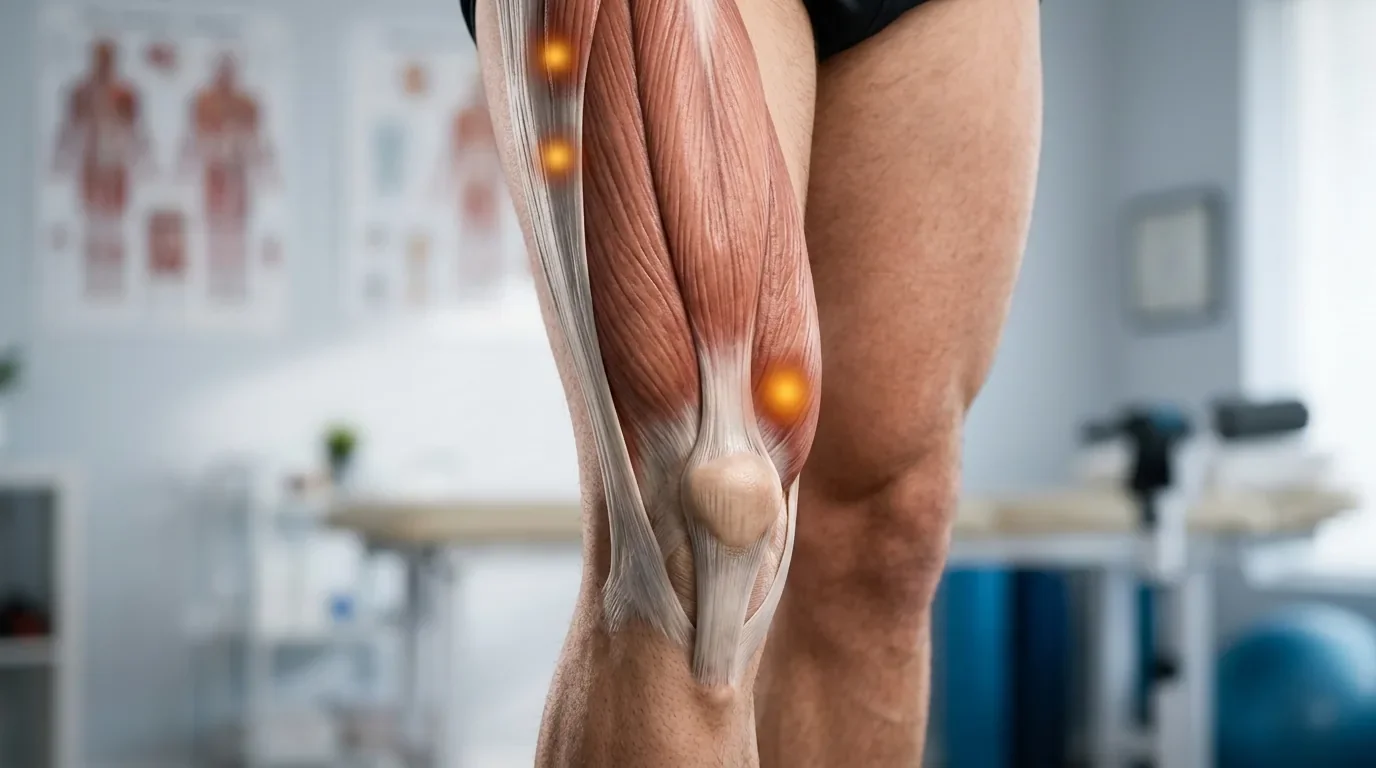
A trigger point persists through a self-sustaining cycle at the motor endplate. Excess acetylcholine release produces sustained sarcomere contraction in a localized band of muscle fibers. That contraction compresses the local microcirculation, creating an energy deficit that prevents the muscle from completing the normal relaxation cycle. The nociceptive peptides that accumulate in this environment, including substance P, bradykinin, and calcitonin gene-related peptide, sensitize nearby nociceptors and can diffuse to adjacent structures, explaining why trigger points in the quadriceps generate referred pain that reaches the knee, and why calf trigger points generate plantar symptoms (Shah et al., 2008).
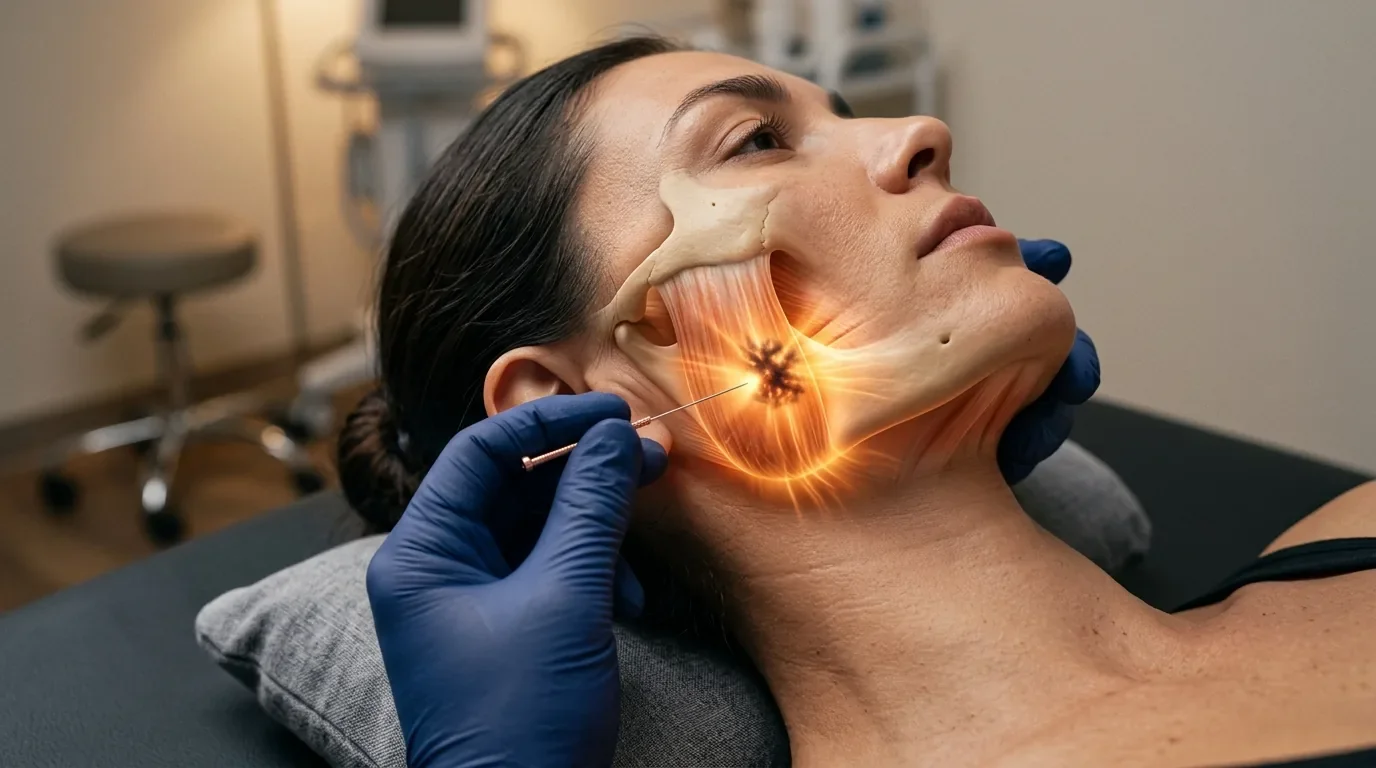
This cycle does not resolve through rest because rest removes the loading that contributed to trigger point formation but does not provide the mechanical stimulus needed to interrupt the cycle. The local twitch response that dry needling produces, a brief involuntary contraction of the affected muscle fibers, is the observable marker of motor endplate reset. After a local twitch response, the abnormal endplate potential normalizes, the sustained sarcomere contraction releases, local circulation is restored, and the biochemical environment that was maintaining the pain signal disperses. That sequence requires a needle. It cannot be produced by rest, massage, or foam rolling alone, though those modalities provide complementary benefit.
| Region | Primary Trigger Point Sources | Symptom Pattern | Recovery Priority |
|---|---|---|---|
| Quadriceps / knee | Vastus lateralis, rectus femoris | Deep anterior knee ache, stair pain, patellofemoral pressure | High — generated by sustained eccentric loading throughout race |
| IT band / lateral knee | Tensor fasciae latae, gluteus maximus | Lateral knee pain, hip tightness, band-like lateral thigh tension | High — worsens days 2-4 as inflammation peaks |
| Calf / Achilles | Gastrocnemius, soleus | Posterior calf tightness, heel pain, plantar symptoms on first morning steps | High — sustained push-off loading over 26.2 miles |
| Hip flexors | Iliopsoas, rectus femoris | Groin tightness, anterior hip pain with hip extension, low back referral | Medium-high — fatigue-driven shortening in final miles |
| Low back / SI region | Quadratus lumborum, gluteus medius | Lumbar ache, SI joint pressure, one-sided hip pain from late-race asymmetry | Medium — often driven by late-race compensatory movement patterns |
| Shin / anterior compartment | Tibialis anterior | Anterior shin ache, foot drop fatigue in final miles, dorsal foot tension | Medium — clearance prevents shin splints in early return-to-run |
Planning to Run a Fall Race and Want to Set Up a Recovery Plan in Advance?
The most effective approach to post-marathon recovery with dry needling starts before the race, not after. A pre-race session one to two weeks out addresses the taper-period trigger point accumulation, and a post-race session 48 to 72 hours after the finish line targets the acute muscle damage before it becomes chronic. We can set up both appointments in advance so your recovery is structured from day one.
Schedule NowThe Post-Race Treatment Window: Why Timing Matters
The 48 to 72 hours immediately following a marathon represent the optimal window for dry needling treatment. This timing is based on the biology of acute muscle damage and trigger point formation: the initial inflammatory response to eccentric muscle loading peaks in this window, the nociceptive peptide environment at the motor endplate is most actively driving the sensitization cycle, and intervening at this point prevents the consolidation of trigger points into the more established pattern that develops after two to three weeks of untreated recovery.
Many runners assume they should wait until soreness has resolved before seeking treatment, reasoning that their muscles need to "recover" before any intervention would be appropriate. The biology suggests the opposite: the acute trigger points forming in the 48-to-72-hour window are more responsive to treatment than the same trigger points would be after two weeks of passive rest have allowed them to become established. Earlier treatment produces faster resolution.
In practical terms for NYC Marathon runners: the race is on the first Sunday of November. The optimal treatment window is Tuesday or Wednesday of the following week, before the acute phase has fully resolved and before returning to work schedules have disrupted the recovery window. Runners who wait until they are "feeling better" to book treatment are often booking into the second or third week post-race, by which point the trigger points that could have been resolved in a single session may require multiple sessions to address.
Return to Running: Using Dry Needling to Guide the Reintroduction of Training
The standard guidance for post-marathon return to running is to take one day of rest for every mile of the race, meaning 26 days of no running before gradual resumption of training. This guideline reflects the cardiovascular and structural recovery needs of an uncomplicated post-marathon body. It does not account for the trigger point load that will be present throughout that rest period and which will directly influence how the first return-to-run sessions feel.
Runners who attempt their first post-marathon run at three to four weeks with unresolved trigger points in the quadriceps, IT band, and calf frequently experience a premature return of symptoms that they interpret as insufficient recovery time. They extend their rest, which does nothing to address the underlying trigger points, and attempt another return at five or six weeks with the same result. The tissue itself has recovered; the trigger point-driven dysfunction has not.
A more effective approach uses dry needling sessions at one week and two weeks post-race to clear the acute and then the residual trigger point load, followed by a structured return to running that begins with confirmation of full pain-free range of motion and normal muscle extensibility rather than an arbitrary time-based milestone. This approach consistently produces earlier return-to-run timelines and fewer recurrences of the post-marathon complaints that would otherwise persist into winter base training or, in runners who race fall and spring, into the following spring training cycle.
RelatedAcupuncture for the 2026 NYC Marathon: Training and Race Preparation RelatedDry Needling at Morningside Acupuncture: What to ExpectThe Fall Racing Calendar Beyond the NYC Marathon
The NYC Marathon draws the most attention each November, but it runs alongside a broader fall racing calendar that includes the Brooklyn Marathon (the same weekend), the Jersey City Marathon, the Staten Island Half Marathon, the NYRR 60K, and numerous half marathons throughout September and October. Runners finishing any of these events face the same post-race trigger point pattern as NYC Marathon finishers, scaled approximately to race distance and intensity.
Half marathon finishers typically generate a less severe trigger point load than marathon finishers, but the pattern is similar: eccentric quadriceps and calf loading driving the primary complaints, with late-race compensation patterns generating secondary IT band and hip flexor involvement. Half marathon runners who race at a higher relative intensity (near race effort rather than comfortable long-run pace) may present with trigger point loads that approach what marathon runners experience, because the higher intensity per mile compensates for the shorter distance in terms of total motor endplate stress.
For runners completing multiple fall races, the cumulative trigger point load compounds across events if recovery between races is purely passive. A runner doing the Brooklyn Half in mid-October followed by the NYC Marathon three weeks later with no dry needling between events arrives at the marathon start line carrying unresolved trigger points from the half marathon in addition to any accumulation from the taper. This compounding pattern is one reason experienced multi-race runners who add quarterly dry needling to their recovery protocols consistently report fewer breakdowns across the racing season.
Finished Your Fall Race and Ready to Start Recovering the Right Way?
Morningside Acupuncture is the highest-rated acupuncture and dry needling clinic in New York City with over 500 five-star Google reviews. We work with marathon and half marathon finishers throughout the fall race season, providing targeted post-race dry needling that accelerates recovery and sets runners up for a successful return to training. Schedule your post-race session now.
Schedule NowFrequently Asked Questions
How soon after the NYC Marathon should I get a dry needling session?
The optimal window is 48 to 72 hours post-race, which for the NYC Marathon means Tuesday or Wednesday of the week following the race. This timing targets the acute trigger point formation before those points consolidate into the more established pattern that develops over two to three weeks of passive rest. Earlier treatment generally produces faster and more complete resolution than waiting until soreness has already resolved.
I'm very sore the day after the marathon. Is it safe to get dry needling that soon?
Mild to moderate post-race soreness does not contraindicate dry needling. The acute inflammatory phase that produces that soreness is precisely when trigger point treatment is most effective. The one situation where you would delay is if you have a specific injury concern, such as suspected stress fracture, acute tendon tear, or significant soft tissue injury from a fall during the race, which would require evaluation before dry needling is appropriate.
Will dry needling help me return to running faster after the marathon?
Research on dry needling for myofascial trigger points suggests it produces meaningful reductions in pain and improvements in muscle function (Kietrys et al., 2013), and clinical experience with post-marathon runners at Morningside Acupuncture consistently shows earlier return-to-run milestones when trigger points are addressed in the first one to two weeks post-race compared with passive rest alone. The improvement comes from removing the trigger point load that would otherwise produce pain and restricted range of motion during early return runs.
My knee pain didn't start until a week after the marathon. Is it still worth treating?
Yes, and this presentation is actually common. The initial post-race soreness involves widespread diffuse muscle fatigue, and as that resolves over the first week, localized trigger point-driven pain in the quadriceps, IT band, or calf becomes more distinct. Trigger points that were masked by the general inflammatory response become the dominant pain source once the acute phase resolves. A session in the first two weeks post-race is still well within the early treatment window.
Can I get treatment at Morningside Acupuncture after the Brooklyn or Jersey City Marathon too?
Absolutely. The post-race trigger point pattern is consistent across fall marathons regardless of which specific event you ran. We work with runners finishing the full NYC fall race calendar, from half marathons in September through the November marathons. The treatment approach is the same: targeting the muscles most loaded by your specific race distance and intensity, with timing optimized for the early post-race window.
References
- Simons, D. G., Travell, J. G., & Simons, L. S. (1999). Travell and Simons' Myofascial Pain and Dysfunction: The Trigger Point Manual (2nd ed.). Lippincott Williams & Wilkins.
- Vickers, A. J., Vertosick, E. A., Lewith, G., MacPherson, H., Foster, N. E., Sherman, K. J., Irnich, D., Witt, C. M., & Linde, K. (2018). Acupuncture for chronic pain: Update of an individual patient data meta-analysis. Journal of Pain, 19(5), 455-474. https://doi.org/10.1016/j.jpain.2017.11.005
- Shah, J. P., Danoff, J. V., Desai, M. J., Parikh, S., Nakamura, L. Y., Phillips, T. M., & Gerber, L. H. (2008). Biochemicals associated with pain and inflammation are elevated in sites near to and remote from active myofascial trigger points. Archives of Physical Medicine and Rehabilitation, 89(1), 16-23. https://doi.org/10.1016/j.apmr.2007.10.018
- Kietrys, D. M., Palombaro, K. M., Azzaretto, E., Hubler, R., Schaller, B., Schlussel, J. M., & Tucker, M. (2013). Effectiveness of dry needling for upper-quarter myofascial pain: A systematic review and meta-analysis. Journal of Orthopaedic & Sports Physical Therapy, 43(9), 620-634. https://doi.org/10.2519/jospt.2013.4668
- Zhao, Z. Q. (2008). Neural mechanism underlying acupuncture analgesia. Progress in Neurobiology, 85(4), 355-375. https://doi.org/10.1016/j.pneurobio.2008.05.004
Disclaimer: This web site is intended for educational and informational purposes only. Reading this website does not constitute providing medical advice or any professional services. This information should not be used for diagnosing or treating any health issue or disease. Those seeking medical advice should consult with a licensed physician. Seek the advice of a medical doctor or other qualified health professional for any medical condition. If you think you have a medical emergency, call 911 or go to the emergency room. No acupuncturist-patient relationship is created by reading this website or using the information. Morningside Acupuncture PLLC and its employees and contributors do not make any express or implied representations with respect to the information on this site or its use. For any legal interpretation of scope of practice in your state, consult a licensed attorney or regulatory authority.
Read more from our blog