GB23 Acupuncture Point (Zhejin)
Flank Sinews Below the Armpit: Anatomy, Mechanism, and Why This Fifth Intercostal Space Point Anchors Rib Cage and Breathing Work
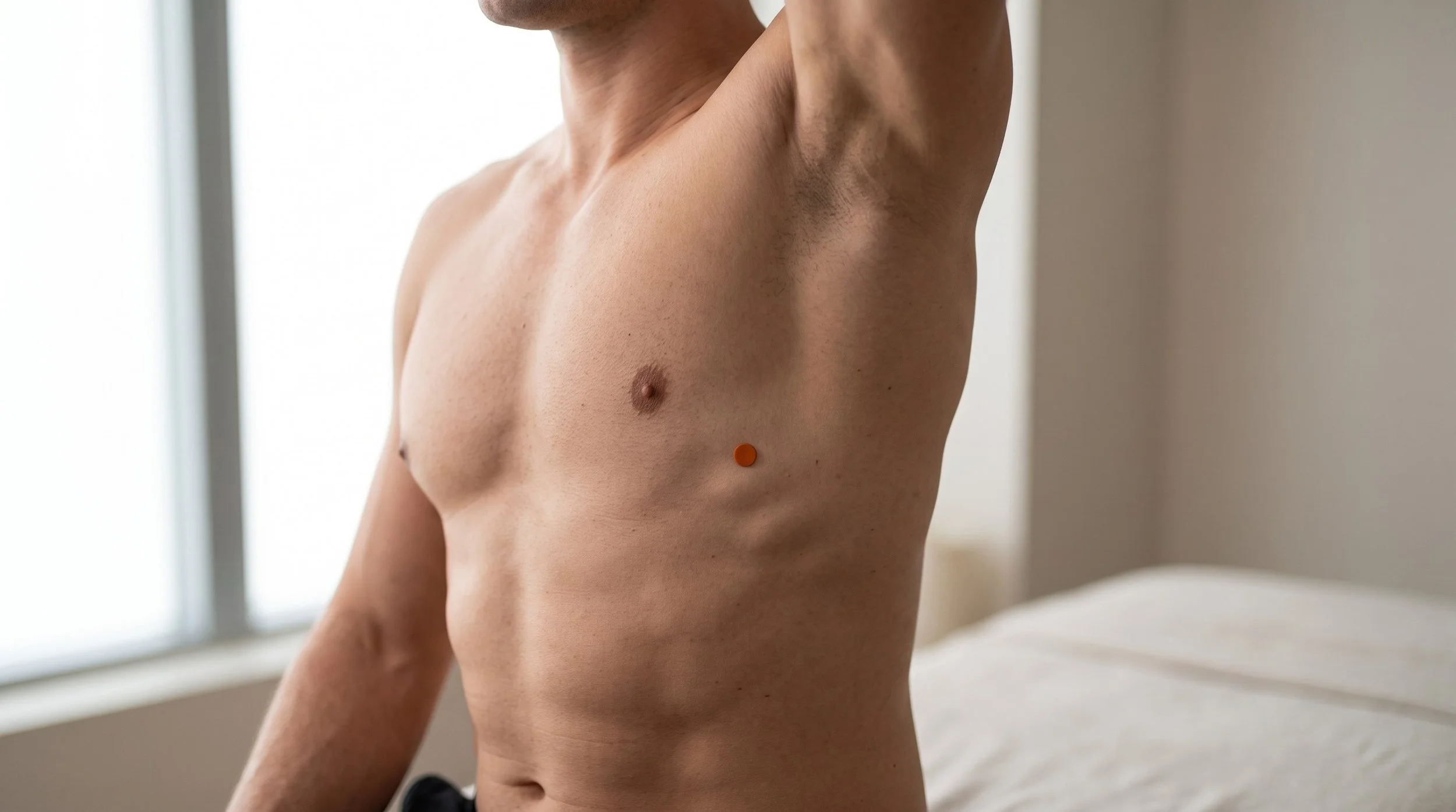
GB23, known in Chinese as Zhejin and translated as Flank Sinews, sits on the side of the chest in the fifth intercostal space, roughly level with the nipple and one cun forward of GB22 (Deadman et al., 2009).
In plain terms, if you lift your arm and slide your fingers down from the armpit along the side of the ribs, you land in the neighborhood of the GB23 acupuncture point. It matters clinically because this is where the rib cage meets the muscles that swing the shoulder blade, where the intercostal nerves run their segmental course, and where patients who describe a tight band around the ribs, a catch on the deep breath, or a habit of constant sighing tend to be exquisitely tender. Gallbladder 23 is a small, precise, anatomically demanding point, and it is one of the most useful local targets we have for the lateral chest wall.
- Location and layers: GB23 lies in the fifth intercostal space on the lateral chest wall, one cun anterior to GB22, with skin, fascia, serratus anterior digitations, and the external and internal intercostal muscles above the pleura and lung (Deadman et al., 2009; Cheng, 1999).
- Traditional category: classical texts list Zhejin as a meeting point of the Gallbladder and Bladder channels, and the Great Compendium of Acupuncture and Moxibustion treated it, under the alternate name Danmu, as the front-mu point of the Gallbladder rather than GB24 (Deadman et al., 2009). These are traditional attributions, not anatomical claims.
- Mechanism: needling here engages the lateral cutaneous branch of the fifth intercostal nerve and, deeper, the intercostal muscles of the same segment, which is why sensory input at this level may modulate thoracic wall pain through segmental convergence and descending inhibitory pathways (Cheng, 1999; Zhao, 2008).
- Autonomic angle: the classical picture of sighing, chest oppression, and disturbed sleep maps loosely onto stress-driven breathing patterns, and reviews of acupuncture and heart rate variability suggest needling may shift autonomic balance toward parasympathetic tone, though findings are heterogeneous (Lee et al., 2010; Hamvas et al., 2023).
- Research picture: no trial has isolated GB23 on its own. Evidence relevant to how we use it comes from multi-point protocols for chronic pain, anxiety, insomnia, and reflux symptoms, all of which report modest to moderate effects with methodological caveats (Vickers et al., 2018; Yang et al., 2021; Kim et al., 2021; Zhu et al., 2017).
- Practice framing and de qi: needling is transverse-oblique along the rib space at 0.5 to 1 cun, never perpendicular, because deep or upright insertion here may induce a pneumothorax (Deadman et al., 2009; He et al., 2012). De qi at GB23 is usually a spreading ache or a band-like heaviness that travels along the rib rather than a sharp or electric feeling.
Tight Ribs, Shallow Breathing, or a Catch on the Deep Inhale?
Rib cage restriction rarely shows up on imaging, which is why so many people are told nothing is wrong while the tightness persists. At Morningside Acupuncture, we assess the lateral chest wall carefully and use GB23 alongside adjacent rib-space points and gentle needling of serratus anterior and the intercostals to reduce guarding and restore easier breathing mechanics. Treatment is paired with breathing retraining so the change holds between sessions. Schedule a visit and let us map where your rib cage is actually stuck.
Schedule NowAnatomy of GB23: Why the Fifth Intercostal Space Is Such an Important Location
GB23 sits on the side of the chest, one cun anterior to GB22 in the fifth intercostal space, around the level of the nipple (Deadman et al., 2009). Under the needle there is thin skin and superficial fascia, then the slips of serratus anterior that fan across the outer ribs toward the scapula, then the external and internal intercostal muscles bridging the ribs themselves (Cheng, 1999).
This region gets loaded in ways people rarely notice: repetitive overhead reaching, heavy pressing and pulling in the gym, prolonged desk posture with a rounded upper back, chronic coughing, and shallow upper chest breathing under stress. Serratus anterior and the intercostals are also classic sites of referred myofascial pain, capable of producing a side-of-chest ache and an air hunger sensation that patients often describe as not being able to get a full breath (Simons et al., 1999).
The nerve geography here is straightforward and clinically useful. The lateral cutaneous branch of the fifth intercostal nerve supplies the skin over the point, with the intercostal nerve proper running deeper along the rib groove and the long thoracic nerve serving serratus anterior nearby (Cheng, 1999). Because that nerve enters the spinal cord at a defined thoracic level, sensory input from needling at GB23 converges centrally with input from the deeper structures of the same segment, which is the mechanistic basis for treating rib wall pain locally rather than chasing it around the body.
Needling also recruits descending inhibitory control from the brainstem and mobilizes endogenous opioid and monoaminergic mechanisms that raise pain thresholds more broadly (Zhao, 2008). In practice this means a well-placed rib space needle can reduce local tenderness and, in some patients, ease the guarded breathing pattern that accompanies it.
The deep structure that governs technique here is the lung. Beneath the intercostals lies the pleura, so the standard convention at GB23 is a transverse-oblique insertion along the rib space to a depth of 0.5 to 1 cun, angled away from the pleural surface, with perpendicular or deep needling explicitly cautioned against (Deadman et al., 2009). The lateral thoracic and fifth intercostal vessels run in this region as well, so needle placement is kept along the intercostal space rather than driven toward the inferior rib border (Cheng, 1999).
Pneumothorax is consistently reported as the most common serious adverse event in reviews of acupuncture safety, and nearly all reported cases involve deep needling over the thorax by inadequately trained operators (He et al., 2012). With correct angle, depth, and anatomical knowledge, this point is safe in trained hands.
Related Intercostal Muscles Trigger Points Related Serratus Anterior Trigger PointsGB23 at a Glance: Classification, Location, and Clinical Use
| Category | Detail |
|---|---|
| Traditional Name | Zhejin (Flank Sinews), also recorded historically as Danmu |
| Channel Classification | Gallbladder channel, point 23, on the lateral chest wall |
| Point Categories | Meeting point of the Gallbladder and Bladder channels; the Great Compendium of Acupuncture and Moxibustion assigned it front-mu status for the Gallbladder under the name Danmu, in place of GB24 (traditional attributions) |
| Precise Location | Below the axilla in the fifth intercostal space, 1 cun anterior to GB22, approximately level with the nipple |
| Tissue Stimulated | Skin and superficial fascia, serratus anterior, and the external and internal intercostal muscles, innervated by the lateral cutaneous branch of the fifth intercostal nerve |
| Needle Depth / Direction | Transverse-oblique along the intercostal space, 0.5 to 1 cun; never perpendicular or deep, as pneumothorax is a real risk |
| De Qi Sensation | A spreading, band-like ache or heaviness along the rib space, sometimes with a sense of the side of the chest softening; sharp, electric, or breath-catching sensations mean the needle should be adjusted |
| Primary Clinical Uses | Lateral rib and chest wall pain, intercostal tenderness, chest fullness and constrained breathing, sighing with low mood, and traditionally listed digestive rebellion such as vomiting and acid regurgitation |
| Common Point Combinations |
|
Deadman, Al-Khafaji and Baker record a striking historical wrinkle at this point: the Great Compendium of Acupuncture and Moxibustion named Zhejin as the Gallbladder front-mu point and gave it the alternative title Danmu, a role usually assigned to GB24 (Deadman et al., 2009). The two points share most of their classical indication lists, with GB23 weighted toward the chest because it sits higher on the rib cage.
In traditional terms the pattern behind those indications is one of unexpressed anger and frustration impeding the free movement of qi, which then binds in the lateral costal region and restricts the chest, producing fullness, rib pain, frequent sighing, and a tendency toward sadness. If that constraint was thought to generate heat, the classical texts described it spilling upward to disturb sleep, settling in the middle to produce vomiting and acid regurgitation, or descending to create heat in the lower abdomen.
What makes the pattern striking is how well its symptom cluster matches what modern clinicians see in stressed patients with braced rib cages, shallow breathing, poor sleep, and reflux, even though the explanatory language is entirely different.
Why GB23 Is Used for Breathing That Feels Restricted Rather Than Obstructed
Patients often arrive saying they cannot get a satisfying breath, even after normal lung testing. Frequently the problem is mechanical and neurological rather than pulmonary: the lateral chest wall is held in a state of low-grade guarding, serratus anterior and the intercostals are tender, and the rib cage does not expand symmetrically.
Because GB23 sits directly over that tissue and shares a spinal segment with the deeper structures of the fifth rib space, needling here delivers input that converges centrally with the signals driving the guarding, which is the segmental logic behind treating locally on the ribs (Cheng, 1999). Trigger points in serratus anterior and the intercostals can themselves generate side-of-chest pain and a sensation of breathlessness, so releasing them often changes how a breath feels before it changes anything measurable (Simons et al., 1999).
There is a second layer beyond the segment. Needling activates descending inhibitory pathways from the brainstem and engages endogenous opioid and monoaminergic systems that raise pain thresholds well beyond the treated area (Zhao, 2008). Systematic reviews of heart rate variability also suggest that acupuncture may shift autonomic balance toward greater parasympathetic activity, although trial quality is variable and effects are not uniform across studies (Lee et al., 2010; Hamvas et al., 2023).
For a patient whose chest tightness rises and falls with stress, that combination of local desensitization and broader autonomic settling is a plausible account of why a session can leave the ribs feeling looser and the breath deeper.
None of this is unique to GB23 as a magic location. What the point offers is precise access to a clinically important patch of the rib cage, with a traditional indication list that happens to describe the same patient we see today: tight-chested, sigh-prone, sleeping poorly, and often dealing with reflux on top of it.
What the Research Shows for GB23
It is worth being clear about what the evidence can and cannot say. There are no randomized trials isolating GB23, and there almost certainly never will be, because clinical acupuncture is delivered as a multi-point prescription. What we can look at is research on the conditions this point is used within: chronic musculoskeletal pain, anxiety, insomnia, reflux symptoms, and thoracic neuropathic pain. Those reviews test whole protocols against sham or usual care, so any conclusion about GB23 specifically is inferential, and study quality across this literature is uneven.
| Study | Type | Focus | Key Finding |
|---|---|---|---|
| Vickers et al., 2018 | Individual patient data meta-analysis | Chronic musculoskeletal, headache, and osteoarthritis pain | Acupuncture outperformed both sham and no-acupuncture controls for chronic pain, with effects that persisted over time, though differences from sham were modest. |
| Zhao, 2008 | Narrative review of neurophysiology | Mechanisms of acupuncture analgesia | Analgesic effects are attributed to peripheral and spinal signaling plus descending inhibitory control involving endogenous opioid and monoaminergic systems. |
| Hamvas et al., 2023 | Systematic review and meta-analysis | Manual acupuncture and heart rate variability | Pooled data suggested increases in parasympathetic indices after real needling that were not seen with sham, though the included trial count was small. |
| Lee et al., 2010 | Systematic review | Acupuncture effects on heart rate variability | Results across trials were inconsistent and methodological quality was limited, so autonomic effects should be described cautiously. |
| Yang et al., 2021 | Systematic review and meta-analysis | Acupuncture for anxiety disorders | Twenty randomized trials pointed toward reduced anxiety symptoms with acupuncture, with generally favorable tolerability but variable trial quality. |
| Kim et al., 2021 | Systematic review and meta-analysis | Acupuncture for insomnia | Pooled trials reported improved sleep quality scores compared with pharmacotherapy comparators, tempered by risk of bias concerns. |
| Zhu et al., 2017 | Systematic review and meta-analysis | Acupuncture for gastro-oesophageal reflux disease | Adding acupuncture to standard medication was associated with better global symptom improvement, though sample sizes were small and methodological quality was poor. |
| Wang et al., 2022 | Network meta-analysis | Acupuncture-related therapies for postherpetic neuralgia | Several needling approaches appeared beneficial for this thoracic and truncal nerve pain, but confidence is limited by the quality of the underlying trials. |
| He et al., 2012 | Systematic review of adverse events | Safety of acupuncture, including thoracic points | Pneumothorax was among the most frequently reported serious adverse events, underscoring the need for shallow oblique technique over the ribs. |
Stress That Lives in Your Chest Rather Than Your Head?
Many of our New York City patients describe a squeezed, heavy chest, frequent sighing, and sleep that never quite deepens. Zhejin acupuncture is traditionally used for exactly this cluster, and we combine it with distal points such as PC6 and LV3 to address the whole pattern rather than the rib alone. Sessions are quiet, unhurried, and designed to shift your nervous system out of a braced state. Book an appointment and see how your breathing changes after one treatment.
Schedule NowGB23 in the Context of Trigger Point Work
Acupuncture at Morningside means the use of an acupuncture needle across many styles, and trigger point dry needling is one of them. GB23 sits directly over territory that trigger point clinicians know well: the lower digitations of serratus anterior along the outer ribs and the intercostal muscles within the rib space itself.
Trigger points in serratus anterior classically refer pain to the side of the chest and down the inner arm and can produce a distinctly breathless quality, while intercostal trigger points create sharp local rib pain that worsens with deep inhalation, twisting, or coughing (Simons et al., 1999). When a patient's tender spot at GB23 reproduces their exact complaint, we are almost always working the same tissue that a myofascial map would identify.
Technique matters more here than almost anywhere else on the torso. We needle flat along the rib space or angle over a rib rather than between ribs when the tissue is thin, we keep depth shallow, and we palpate carefully before insertion. Sessions often pair GB 23 ribs treatment with distal points such as PC6 or GB34, cupping or manual work across the lateral chest, and a short breathing drill that trains lower rib expansion. The goal is not simply to release a tight muscle but to change the pattern of guarding that keeps recreating it.
GB23 Rib and Chest Wall Treatment at NYC's Highest-Rated Acupuncture Clinic
Morningside Acupuncture is the highest-rated acupuncture and dry needling clinic in New York City with over 500 five-star Google reviews, and our team treats thoracic and rib cage complaints week in and week out. We use GB 23 ribs work as part of a broader plan that may include intercostal dry needling, cupping over the lateral chest, and manual therapy for the shoulder girdle. Every treatment starts with a clear explanation of what we are needling and why. Schedule your first visit today.
Schedule NowFrequently Asked Questions
What does GB23 feel like when needled?
Most people feel a dull, spreading ache or a band-like heaviness that runs along the rib space, sometimes with a sense of the side of the chest releasing. Because the needle is angled shallowly along the intercostal space, the sensation stays superficial and localized rather than radiating far. Sharp pain, an electric jolt, or any catch in the breath is not the goal, and we adjust or withdraw the needle immediately if that happens.
Why needle on the ribs instead of using only distal points for chest tightness?
Distal points are valuable, but when the pain generator is the chest wall itself, local needling delivers input into the same spinal segment as the irritated tissue, which is the most direct route to changing that segment's sensitivity (Cheng, 1999; Zhao, 2008). Serratus anterior and intercostal trigger points also refer pain and breathlessness in patterns that respond best to treatment at the source (Simons et al., 1999). In practice we usually do both, using GB23 locally and adding distal points such as PC6 or LV3 for the broader pattern.
Can I press GB23 myself between sessions?
Yes, and acupressure is a reasonable way to extend the benefit of a session. Lift your arm, find the fifth rib space on the side of the chest roughly level with the nipple and slightly forward of the mid-axillary line, and use flat fingertip pressure rather than a poking motion. Hold moderate, comfortable pressure for 30 to 60 seconds while breathing slowly into the lower ribs, then release and repeat two or three times per side, once or twice a day. Combining this with slow nasal breathing and a gentle side-bend stretch of the rib cage tends to help more than pressure alone. Stop if you feel sharp pain, numbness, or any change in your breathing.
Is GB23 safe to needle?
It is safe when needled correctly, and it is not a point for casual or untrained needling. The lung lies beneath the intercostal muscles here, so the standard technique is transverse-oblique insertion along the rib space at 0.5 to 1 cun with perpendicular and deep needling explicitly avoided (Deadman et al., 2009). Pneumothorax remains one of the most commonly reported serious adverse events in acupuncture safety reviews, and reported cases overwhelmingly involve deep needling over the chest by inadequately trained practitioners (He et al., 2012). Tell your practitioner if you have lung disease, emphysema, a very thin build, or a history of chest surgery, and seek urgent care if you ever develop sudden shortness of breath or chest pain after any thoracic needling.
Where exactly is GB23 located?
GB23 is on the side of the chest below the armpit, in the fifth intercostal space, one cun anterior to GB22 and approximately level with the nipple (Deadman et al., 2009). To find it, locate GB22 below the center of the axilla on the mid-axillary line, then move about one thumb-width forward while staying in the same rib space. Note that a few textbooks place the point at the fourth intercostal space, which reflects normal variation in how the classical description is interpreted, so the practical rule is to palpate for the tender rib space in that region rather than measure rigidly.
References
- Deadman, P., Al-Khafaji, M., & Baker, K. (2009). A manual of acupuncture. Journal of Chinese Medicine Publications.
- Cheng, X. (Ed.). (1999). Chinese acupuncture and moxibustion (Rev. ed.). Foreign Languages Press.
- O'Connor, J., & Bensky, D. (Eds. & Trans.). (1981). Acupuncture: A comprehensive text. Shanghai College of Traditional Medicine. Eastland Press.
- Simons, D. G., Travell, J. G., & Simons, L. S. (1999). Travell & Simons' myofascial pain and dysfunction: The trigger point manual, Vol. 1: Upper half of body (2nd ed.). Williams & Wilkins.
- Zhao, Z. Q. (2008). Neural mechanism underlying acupuncture analgesia. Progress in Neurobiology, 85(4), 355-375. https://doi.org/10.1016/j.pneurobio.2008.05.004
- Vickers, A. J., Vertosick, E. A., Lewith, G., MacPherson, H., Foster, N. E., Sherman, K. J., Irnich, D., Witt, C. M., & Linde, K. (2018). Acupuncture for chronic pain: Update of an individual patient data meta-analysis. Journal of Pain, 19(5), 455-474. https://doi.org/10.1016/j.jpain.2017.11.005
- Lee, S., Lee, M. S., Choi, J. Y., Lee, S. W., Jeong, S. Y., & Ernst, E. (2010). Acupuncture and heart rate variability: A systematic review. Autonomic Neuroscience, 155(1-2), 5-13. https://doi.org/10.1016/j.autneu.2010.02.003
- Hamvas, S., Hegyi, P., Kiss, S., Lohner, S., McQueen, D., & Havasi, M. (2023). Acupuncture increases parasympathetic tone, modulating HRV: Systematic review and meta-analysis. Complementary Therapies in Medicine, 72, 102905. https://doi.org/10.1016/j.ctim.2022.102905
- Yang, X. Y., Yang, N. B., Huang, F. F., Ren, S., & Li, Z. J. (2021). Effectiveness of acupuncture on anxiety disorder: A systematic review and meta-analysis of randomised controlled trials. Annals of General Psychiatry, 20, 9. https://doi.org/10.1186/s12991-021-00327-5
- Kim, S. A., Lee, S. H., Kim, J. H., van den Noort, M., Bosch, P., Won, T., Yeo, S., & Lim, S. (2021). Efficacy of acupuncture for insomnia: A systematic review and meta-analysis. American Journal of Chinese Medicine, 49(5), 1135-1150. https://doi.org/10.1142/S0192415X21500543
- Zhu, J., Guo, Y., Liu, S., Su, X., Li, Y., Yang, Y., Hou, L., Wang, G., Zhang, J., Chen, J. D. Z., Wang, Q., Wei, R., & Wei, W. (2017). Acupuncture for the treatment of gastro-oesophageal reflux disease: A systematic review and meta-analysis. Acupuncture in Medicine, 35(5), 316-323. https://doi.org/10.1136/acupmed-2016-011205
- Wang, H., Wan, R., Chen, S., Qin, H., Cao, W., Sun, L., Shi, Y., Zheng, Q., & Li, Y. (2022). Comparison of efficacy of acupuncture-related therapy in the treatment of postherpetic neuralgia: A network meta-analysis of randomized controlled trials. Evidence-Based Complementary and Alternative Medicine, 2022, 3975389. https://doi.org/10.1155/2022/3975389
- He, W., Zhao, X., Li, Y., Xi, Q., & Guo, Y. (2012). Adverse events following acupuncture: A systematic review of the Chinese literature for the years 1956-2010. Journal of Alternative and Complementary Medicine, 18(10), 892-901. https://doi.org/10.1089/acm.2011.0825
Disclaimer: This web site is intended for educational and informational purposes only. Reading this website does not constitute providing medical advice or any professional services. This information should not be used for diagnosing or treating any health issue or disease. Those seeking medical advice should consult with a licensed physician. Seek the advice of a medical doctor or other qualified health professional for any medical condition. If you think you have a medical emergency, call 911 or go to the emergency room. No acupuncturist-patient relationship is created by reading this website or using the information. Morningside Acupuncture PLLC and its employees and contributors do not make any express or implied representations with respect to the information on this site or its use. For any legal interpretation of scope of practice in your state, consult a licensed attorney or regulatory authority.
Read more from our blog