Masseter Trigger Points
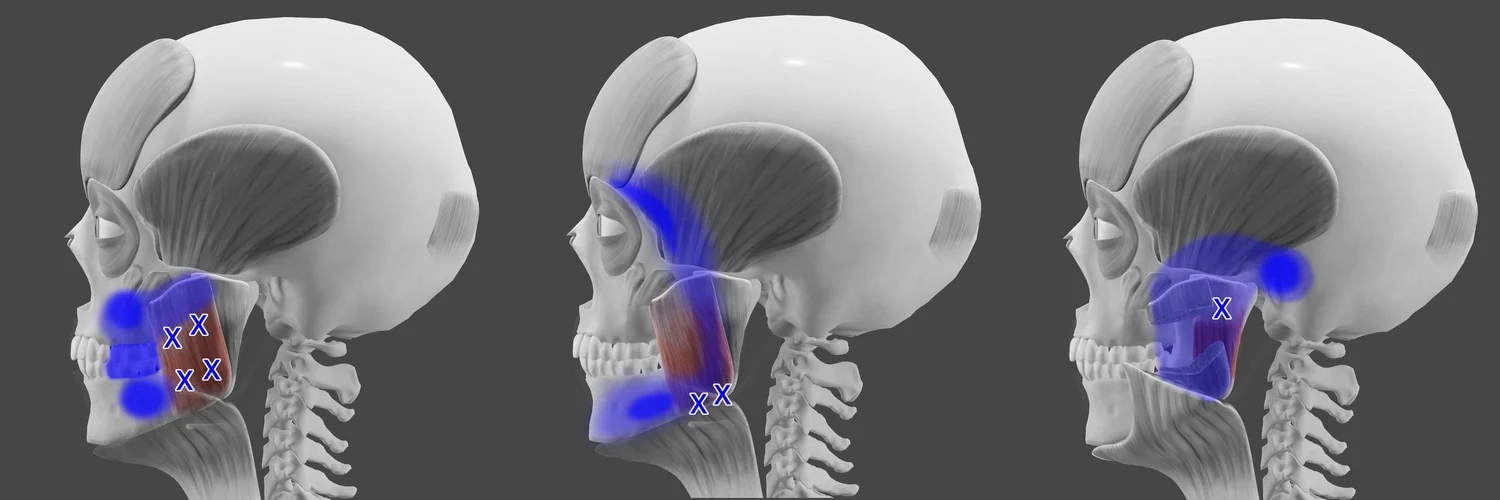
Trigger points in the masseter can refer pain to the jaw and cheek area, the ear and side of the head, and the teeth and lower face.
Reviewed by Teddy Levarda, L.Ac. Updated November 2026.
On this page
Key points
- Where it hurts: the jaw and cheek area, the ear and side of the head, and the teeth and lower face.
- Common contributors: teeth clenching or grinding, chewing gum or eating tough foods frequently, and jaw imbalances or TMJ misalignment.
- Often mistaken for: TMJ dysfunction, trigeminal neuralgia, or sinusitis.
- What may help: dry needling, manual therapy, stretching and strengthening.
Introduction
The masseter is a powerful jaw muscle responsible for chewing, jaw closure, and TMJ stabilization. When trigger points develop in this muscle, they can cause jaw pain, facial tightness, and headaches, often mimicking TMJ dysfunction, sinus pressure, or ear pain.
Name and Area
- Name: Masseter
- Area: Located on the side of the face, running from the cheekbone (zygomatic arch) to the lower jaw (mandible).
Indications
Masseter trigger points may contribute to:
- Pain in the Jaw, Cheeks, and Side of the Head (Mistaken for TMJ Dysfunction or Sinus Pain)
- Pain That Extends to the Ear (Can Mimic Ear Infections or Eustachian Tube Dysfunction)
- Headaches in the Temples and Around the Eyes (Resembles Tension Headaches or Migraines)
- Jaw Clicking or Locking (Common in TMJ Disorders and Teeth Clenching)
- Pain or Stiffness When Chewing (Particularly with Tough Foods, Gum, or Frequent Talking)
- Increased Jaw Tension During Stress or Sleep (Common in People Who Clench or Grind Their Teeth, Known as Bruxism)
Pain from this muscle is often mistaken for TMJ dysfunction, sinus issues, or trigeminal nerve pain.
Muscle Action
- Elevates the Jaw: Closes the mouth for chewing and biting.
- Assists in Jaw Clenching: Works with other jaw muscles to generate bite force.
- Stabilizes the TMJ: Helps keep the jaw aligned during movement.
The masseter is essential for chewing, speaking, and maintaining proper jaw function.
Signs and Symptoms
Individuals with masseter trigger points often report:
- Pain in the Jaw and Cheeks That Feels Like a Deep Ache or Tension
- Pain That Extends to the Ear or Temples (Common in TMJ Disorders and Headaches)
- Tightness in the Jaw That Worsens with Stress or Anxiety
- Clicking, Popping, or Locking in the TMJ (Can Cause Difficulty Opening or Closing the Mouth)
- Pain When Eating, Chewing, or Talking for Long Periods
- Morning Jaw Pain or Headaches Due to Nighttime Clenching or Grinding (Bruxism)
Pain worsens with excessive chewing, teeth clenching, stress, or poor jaw posture.
Perpetuating Factors
Common causes of masseter trigger points include:
- Teeth Clenching or Grinding (Bruxism, Commonly Due to Stress or Anxiety)
- Chewing Gum or Eating Tough Foods Frequently
- Jaw Imbalances or TMJ Misalignment (Can Cause Overuse of the Masseter Muscle)
- Frequent Talking or Singing (Can Lead to Jaw Muscle Fatigue and Tension)
- Forward Head Posture (Puts Excess Strain on the Jaw and TMJ Muscles)
Trigger Point Referral Pattern
Trigger points in the masseter refer pain to:
- The jaw and cheek area (Can Mimic TMJ Dysfunction or Sinus Pain)
- The ear and side of the head (Mistaken for Ear Infections or Tension Headaches)
- The teeth and lower face (Can Resemble Dental Pain or Nerve Issues)
Pain from this muscle is often confused with TMJ dysfunction, headaches, or trigeminal neuralgia.
Differential Diagnosis
Masseter trigger points may be mistaken for:
- TMJ Dysfunction (Jaw Pain and Clicking, Limited Jaw Movement)
- Trigeminal Neuralgia (Sharp, Shooting Facial Pain That Can Resemble Nerve Compression)
- Sinusitis (Pain and Pressure in the Cheeks, Often Accompanied by Congestion)
- Tension Headaches (Pain in the Temples and Forehead, Worsens With Stress and Jaw Clenching)
- Ear Infections (Pain and Fullness in the Ear, Often Without an Infection Present)
A thorough jaw, neck, and dental examination is necessary to rule out these conditions.
Associated Trigger Points
Masseter trigger points often co-exist with:
- Temporalis (Temple Headaches and Jaw Pain, Can Contribute to Bruxism)
- Lateral Pterygoid (Inner Jaw and Ear Pain, Affects Jaw Opening and TMJ Alignment)
- Sternocleidomastoid (SCM) (Neck and Head Pain, Can Mimic Migraines or Sinus Issues)
- Upper Trapezius (Shoulder and Neck Pain, Common in Postural Strain and Stress-Related Tension)
Anatomy and Innervation
| Muscle | Origin | Insertion | Innervation |
|---|---|---|---|
| Masseter (Superficial Head) | Zygomatic arch (cheekbone) | Angle of the mandible | Mandibular branch of the trigeminal nerve (CN V3) |
| Masseter (Deep Head) | Inner zygomatic arch | Ramus of the mandible | Mandibular branch of the trigeminal nerve (CN V3) |
The masseter is innervated by the mandibular nerve (CN V3), which also controls chewing and jaw movement.
Patient Examination
A comprehensive examination should include:
- Palpation: Identify tender nodules along the cheek, jawline, and TMJ region.
- Jaw Mobility Testing: Assess pain or tightness when opening and closing the mouth.
- TMJ Function Testing: Look for clicking, popping, or locking symptoms.
- Postural Assessment: Rule out forward head posture, which increases jaw strain.
Corrective Actions
Dry Needling
- Dry needling, a needling technique that uses acupuncture needles, may release trigger points in the masseter, which may reduce jaw tightness and improve TMJ function.
We treat masseter trigger points with dry needling at our Upper West Side clinic.
Manual Therapy
- Trigger Point Release: Apply gentle sustained pressure inside the cheek and near the TMJ.
- Myofascial Release: Massage techniques to loosen tight jaw muscles and reduce facial tension.
Stretching
- Jaw Relaxation Stretch: Open the mouth slightly and move the jaw side to side to release tightness.
- Neck and Posture Stretch: Helps reduce compensatory strain on the jaw from poor head posture.
Strengthening Exercises
- Controlled Jaw Opening Drills: Improves jaw mobility and reduces excessive tension in the masseter.
- Tongue-to-Roof-of-Mouth Exercises: Encourages proper jaw alignment and reduces clenching.
Postural and Behavioral Adjustments
- Avoid Excessive Jaw Clenching or Grinding (Use a Night Guard if Necessary)
- Maintain Good Head and Neck Posture (Reduces Jaw Strain and TMJ Overuse)
- Limit Excessive Talking, Chewing Gum, or Nail Biting (Prevents Masseter Overuse)
What the Research Shows
- A randomized crossover trial of 12 women with myofascial temporomandibular disorder found greater increases in pressure pain threshold and pain-free mouth opening after deep dry needling of active masseter trigger points than after sham needling (Fernández-Carnero et al., 2010).
- A randomized trial of 40 people with masseter-related temporomandibular disorder compared superficial and deep dry needling once a week for three weeks. Pain decreased in both groups, and the superficial needling group reported the larger reduction (Özden et al., 2020).
- A randomized sham-controlled study in people with temporomandibular disorder measured an increase in masseter tissue oxygen saturation right after trigger point dry needling. Pain also rose briefly right after needling, which the authors attributed to the procedure itself (Macedo et al., 2023).
Conclusion
The masseter plays a crucial role in jaw movement, TMJ function, and chewing, but trigger points in this muscle can cause significant jaw pain, headaches, and ear discomfort. By incorporating dry needling, manual therapy, stretching, and relaxation techniques, individuals may reduce pain, improve mobility, and help prevent TMJ dysfunction.
Struggling with head or neck pain? Let's take a look together.
Acupuncture and dry needling on the Upper West Side. Sessions run 45 to 60 minutes.
Book your first visitReferences
- Simons DG, Travell JG, Simons LS. (1999). Travell & Simons' Myofascial Pain and Dysfunction: The Trigger Point Manual. Volume 1: Upper Half of Body (2nd ed.). Williams & Wilkins.
- Fernández-Carnero J, La Touche R, Ortega-Santiago R, Galan-del-Rio F, Pesquera J, Ge HY, Fernández-de-las-Peñas C. (2010). Short-term effects of dry needling of active myofascial trigger points in the masseter muscle in patients with temporomandibular disorders. Journal of Orofacial Pain, 24(1), 106–112. https://pubmed.ncbi.nlm.nih.gov/20213036/
- Özden MC, Atalay B, Özden AV, Çankaya A, Kolay E, Yıldırım S. (2020). Efficacy of dry needling in patients with myofascial temporomandibular disorders related to the masseter muscle. Cranio, 38(5), 305–311. https://doi.org/10.1080/08869634.2018.1526848
- Macedo CF, Sonza A, Puel AN, Santos ARD. (2023). Trigger point dry needling increases masseter muscle oxygenation in patients with temporomandibular disorder. Journal of Applied Oral Science, 31, e20230099. https://doi.org/10.1590/1678-7757-2023-0099