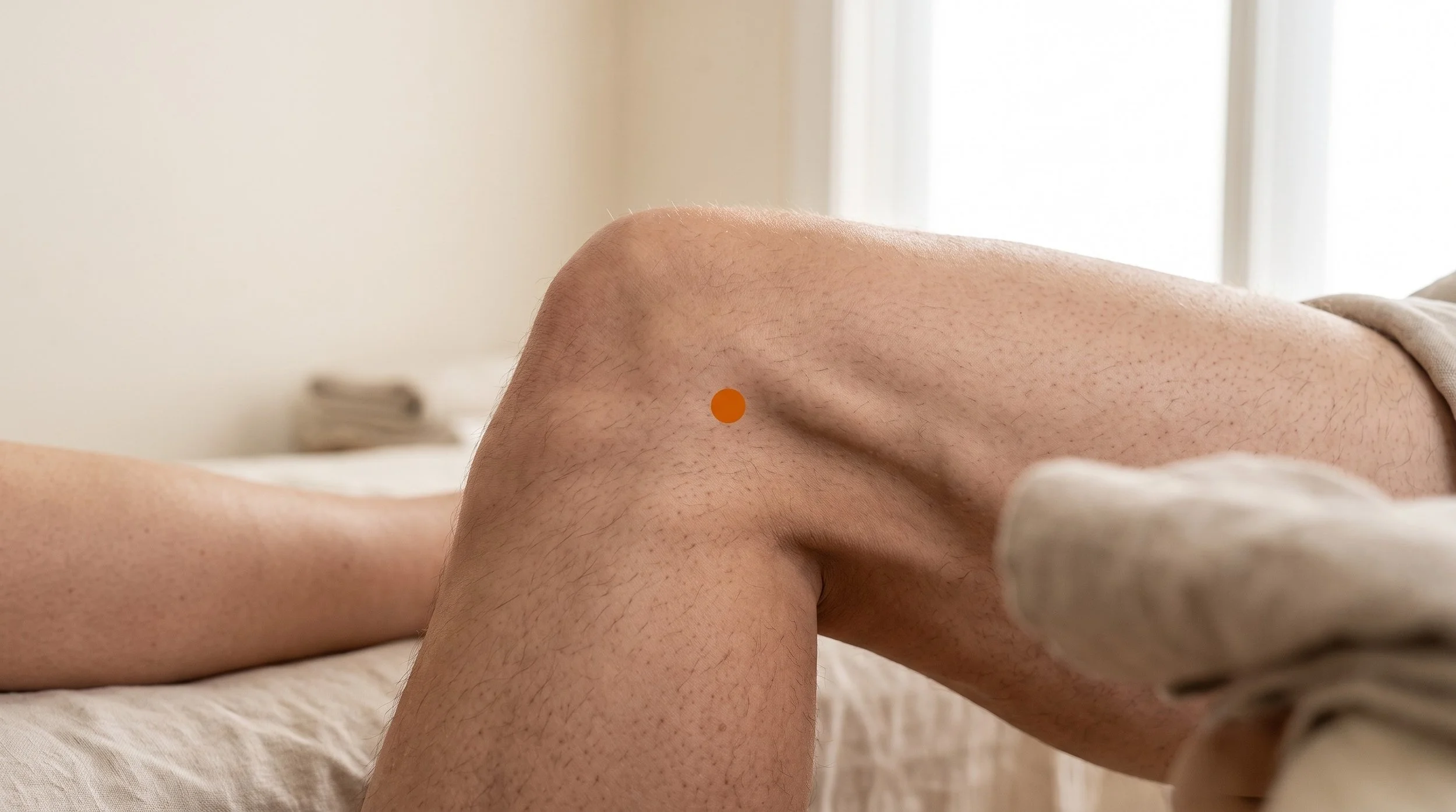
GB33 Acupuncture Point (Xiyangguan)
The Knee Yang Gate Above the Lateral Epicondyle: Anatomy, Mechanism, and Why This Point Anchors Lateral Knee and IT Band Treatment
GB33, known in Chinese as Xiyangguan and usually translated as Knee Yang Gate, sits on the outer side of the knee in the small hollow just above the bony bump of the lateral femoral epicondyle, tucked in the groove between the femur and the tendon of the biceps femoris.
In plain terms, if you run a fingertip down the outside of your thigh along that groove, the finger drops into a soft depression right before it meets bone. That hollow is the GB33 acupuncture point, and it matters clinically because it lands exactly where the iliotibial tract, the lateral collateral ligament region and the distal hamstring tendon all converge on the lateral knee, the same real estate that becomes tender in runners, cyclists and anyone with stubborn outside-of-the-knee pain.
- Location and layers: gallbladder 33 lies in the depression above the lateral epicondyle of the femur, between the bone and the biceps femoris tendon, with the posterior edge of the iliotibial tract in front and the tendon behind (Deadman et al., 2009; O'Connor & Bensky, 1981). Classical texts place it roughly 3 cun proximal to GB34 (Cheng, 1999).
- Traditional attribution: the Gallbladder channel texts credit GB33 with relaxing the sinews, benefiting the joints and dispelling wind-damp, and list redness, swelling and pain of the outer knee, restricted bending and straightening, and numbness of the lower leg among its indications (Deadman et al., 2009; Kim, 2008). Read through a modern lens, that describes a stiff, painful, sometimes numb lateral knee rather than any literal pathogen.
- Mechanism: needling here stimulates branches of the lateral femoral cutaneous nerve and the richly innervated tendon and retinacular tissue of the lateral knee, feeding segmental input into lumbar spinal levels that also receive nociception from the joint capsule and IT band, which is one plausible route to local pain modulation (Zhao, 2008).
- Local chemistry: animal work found that needling raises adenosine in the tissue around the needle and that the local antinociceptive effect depends on adenosine A1 receptors, a mechanism that is relevant for a point used mainly for its effect on the tissue directly beneath it (Goldman et al., 2010).
- Research picture: large pooled patient-level data support acupuncture for chronic musculoskeletal pain including knee pain, while Cochrane analysis of joint osteoarthritis found small effects against sham and larger effects against waiting list, and one high-profile trial found no advantage over sham laser (Vickers et al., 2018; Manheimer et al., 2010; Hinman et al., 2014).
- Practice framing and de qi: expect a heavy, spreading ache or distension that may travel up the outer thigh or toward the knee joint line rather than a sharp jolt (O'Connor & Bensky, 1981). At Morningside, GB 33 knee needling is usually one part of a lateral-chain treatment that includes GB34 and dry needling of the vastus lateralis and biceps femoris (Simons et al., 1999).
Outer Knee Pain That Flares Every Time You Run?
Lateral knee pain rarely stays put: it creeps up the outer thigh, sharpens on downhills and stairs, and comes back the moment mileage climbs again. We use GB33 as a local access point into the iliotibial tract and distal biceps femoris tendon, then work the whole lateral chain from hip to shin so the tissue that keeps overloading the knee gets addressed too. Treatment is combined with load guidance so the outer knee can tolerate running again. Schedule an evaluation and let's map where your pain actually starts.
Schedule NowAnatomy of GB33: Why the Hollow Above the Lateral Epicondyle Is Such an Important Location
Under the skin at GB33, the first structure of consequence is the iliotibial tract, the thick fascial band that carries tension from the tensor fasciae latae and gluteus maximus down to the lateral tibia. Just behind it runs the biceps femoris tendon on its way to the fibular head, and the depression between the two, sitting immediately above the lateral epicondyle of the femur, is the point itself (Deadman et al., 2009; O'Connor & Bensky, 1981).
Deeper still lie the lateral collateral ligament region, the lateral femoral condyle and the fat and bursal tissue that separates the IT band from bone. This is a compression and shear zone: every time the knee moves through roughly 30 degrees of flexion, the tract and the underlying tissue are squeezed against the epicondyle, which is precisely why repetitive running and cycling load concentrates here.
The skin and superficial fascia at this level are supplied by terminal branches of the lateral femoral cutaneous nerve, and the region is served by the superior lateral genicular vessels (Cheng, 1999; O'Connor & Bensky, 1981). Deeper tendon, ligament and capsular tissue is innervated by articular branches carrying lumbar segmental input, which means the needle sensation and the joint pain share spinal cord territory.
Convergence of cutaneous, muscular and articular afferents onto the same dorsal horn neurons is one of the better-explained routes by which local needling can change how a painful joint is perceived, alongside the release of local mediators such as adenosine at the needle site (Zhao, 2008; Goldman et al., 2010). None of this requires energy flow as an explanation: it's ordinary neurophysiology applied to a very specific piece of anatomy.
Safety at GB33 is mostly about what sits behind and below it. The common fibular nerve travels along the medial border of the biceps femoris tendon and then wraps around the fibular neck, so needling is kept in the groove above the epicondyle and angled away from the posterior tendon border. Textbook depths vary: several sources describe perpendicular insertion of 0.5 to 1 cun, while others allow 1 to 2 cun or more with the expectation of strong local distension (Kim, 2008; Deadman et al., 2009; O'Connor & Bensky, 1981).
Deadman notes that several classical texts contraindicate moxibustion at this point, while some modern manuals consider moxa acceptable, so practitioners differ (Deadman et al., 2009; Kim, 2008). In our clinic, GB33 is needled with the knee slightly flexed and supported, and patients with prior lateral knee surgery or hardware are assessed before any deep insertion.
Related Acupuncture For IT Band Pain Related Best Acupuncture Points For Knee PainGB33 at a Glance: Classification, Location, and Clinical Use
| Category | Detail |
|---|---|
| Traditional Name | Xiyangguan, Knee Yang Gate, also known classically as Hanfu or Mansion of Cold |
| Channel Classification | Gallbladder channel of Foot Shaoyang, lateral knee, approximately 3 cun above GB34 |
| Point Categories | No five-shu, hui-meeting or extraordinary vessel designation is attributed to this point in the standard references. It's classed as a local knee point on the Gallbladder channel (Deadman et al., 2009; Maciocia, 2006), and in some luo channel systems it's used as a harmonizing point, being one point proximal to the he-sea point GB34 (Cecil-Sterman, 2012). |
| Precise Location | Lateral knee, in the depression superior and slightly posterior to the lateral epicondyle of the femur, between the femur and the tendon of biceps femoris; slide a finger down the groove on the outer thigh until it falls into the hollow just above the epicondyle |
| Tissue Stimulated | Posterior border of the iliotibial tract, distal biceps femoris tendon, lateral collateral ligament region and lateral femoral epicondyle periosteal tissue; adjacent vastus lateralis and rectus femoris fibers are often treated in the same session |
| Needle Depth / Direction | Perpendicular insertion, commonly 0.5 to 1 cun in conservative texts and up to 1 to 2 cun in others, directed into the hollow above the epicondyle and away from the posterior tendon border; several classical texts contraindicate moxibustion here, though modern manuals differ |
| De Qi Sensation | Deep local distension, heaviness and soreness that may spread up the outer thigh, down toward the fibular head, or across toward the inner thigh; sharp electric sensation means the needle is too close to a nerve and should be adjusted |
| Primary Clinical Uses | Lateral knee pain that extends up the outer thigh, iliotibial band syndrome and lateral knee overuse in runners and cyclists, difficulty bending and straightening the knee, knee osteoarthritis with lateral compartment pain, distal hamstring tendon pain, and numbness of the lower leg in classical use |
| Common Point Combinations |
|
In Deadman's Manual of Acupuncture, GB33 carries the alternative name Hanfu, translated as Mansion of Cold, and the commentary explains this as a traditional observation that cold-natured pain tends to gather at the outer knee and can be addressed at this point. The traditional actions attributed to it are relaxing the sinews, benefiting the joints and dispelling wind-damp, with classical indications covering a hot, swollen, painful lateral knee, an inability to bend or straighten the joint, wind painful obstruction with numbness, numb and obstructed sensation in the lower leg, and leg qi (Deadman et al., 2009).
Other texts add contracture of the tendons in the popliteal fossa and progressive knee swelling to that list (Cheng, 1999; O'Connor & Bensky, 1981), and Maciocia includes it in his short roster of local knee points alongside GB34 (Maciocia, 2006). What's striking is how precisely the classical description maps onto a modern lateral knee presentation: a specific side of the joint, pain that climbs the thigh, restricted flexion and extension, and altered sensation down the leg, all named centuries before anyone described the iliotibial tract.
Why GB33 Is Used for IT Band Pain That Nobody Expected to Come From the Knee
Most people with iliotibial band syndrome point to a spot on the outside of the knee, an inch or two above the joint line, and that spot is essentially GB33. The tissue there is dense with mechanoreceptors and nociceptors: the fascial tract, the underlying fat and bursa, the periosteum of the epicondyle and the neighboring tendon all report into the same lumbar spinal segments. When those afferents are repeatedly bombarded by compression during running, the dorsal horn neurons that receive them can become easier to excite, which is part of why a modest amount of mechanical load starts producing outsized pain. Needling into that same segmental territory delivers a controlled, competing input that appears to help normalize this processing (Zhao, 2008).
There's also a purely local layer to the effect. Laboratory work showed that inserting and manipulating a needle raises adenosine concentrations in the surrounding tissue, and that blocking adenosine A1 receptors abolishes the local pain-reducing effect, which gives a concrete biochemical account of why needling directly into a symptomatic area can help (Goldman et al., 2010).
Alongside that, needling recruits descending inhibitory pathways from the brainstem that dampen incoming signals more broadly, which is one reason patients sometimes report their whole leg feeling looser rather than just the treated spot (Zhao, 2008).
Finally, the point sits at a mechanical crossroads. The biceps femoris and the tensor fasciae latae both influence tension in this region, and reducing resting tone in overactive lateral thigh muscles can change how much the tract is compressed against the epicondyle with each stride (Simons et al., 1999). We treat GB33 as a local target, not a standalone fix: it's paired with hip and quadriceps work and with loading changes, since the outer knee usually hurts because of what's happening above and below it.
What the Research Shows for GB33
It's worth being clear about what the research can and can't tell you. Almost no trial isolates GB33 on its own; the studies test multi-point protocols for knee pain in which a lateral knee point like this one is typically included as a local selection alongside GB34, ST34, ST35 and the Xiyan points. So the evidence below speaks to acupuncture for knee and lateral knee conditions generally, and to the physiological mechanisms that make a local point like Xiyangguan plausible, rather than to this point specifically.
Results are also mixed, with meaningful benefits in some analyses and no advantage over sham in others, and that tension is honestly reflected in the table.
| Study | Type | Focus | Key Finding |
|---|---|---|---|
| Manheimer et al., 2010 | Cochrane systematic review | Acupuncture for peripheral joint osteoarthritis, including the knee | Sham-controlled trials showed statistically significant but small benefits that didn't reach the review's threshold for clinical relevance, while waiting list comparisons showed larger improvements that may partly reflect expectation effects. |
| Vickers et al., 2018 | Individual patient data meta-analysis | Acupuncture for chronic pain, including osteoarthritis and musculoskeletal pain | Pooled patient-level data suggested acupuncture is superior to both sham and no-acupuncture controls for chronic pain, with effects that persisted over time rather than dissipating immediately. |
| Hinman et al., 2014 | Randomized clinical trial (Zelen design) | Needle and laser acupuncture for chronic knee pain in adults aged 50 and over | Neither needle nor laser acupuncture produced clinically meaningful improvements over sham laser at 12 weeks, a result that argues for cautious expectations in older adults with chronic knee pain. |
| Maghroori et al., 2021 | Randomized clinical trial | Dry needling compared with shockwave therapy for iliotibial band syndrome | Both interventions improved pain and lower extremity function, with dry needling showing better pain scores at four weeks, though iliotibial band length didn't change measurably. |
| Goldman et al., 2010 | Experimental animal study | Local tissue mechanism of needling | Needling raised adenosine levels in the tissue around the needle, and the local pain-reducing effect was absent in animals lacking adenosine A1 receptors, suggesting a concrete local mechanism for point-site needling. |
| Zhao, 2008 | Narrative review of neurophysiology | Neural mechanisms of acupuncture analgesia | Reviewed evidence indicates needling engages segmental spinal inhibition and descending pain-modulating pathways involving endogenous opioid and monoamine systems. |
Knee That Won't Fully Bend or Straighten?
Classical texts paired Xiyangguan with points above and below for contracted sinews and difficulty flexing and extending the knee, and that pattern still shows up in the clinic as a stiff, guarded joint that never quite lets go. We combine needling at GB33 with adjacent knee points and targeted dry needling of the quadriceps and hamstrings to reduce protective muscle tone around the joint. Most patients notice easier range of motion within a few sessions. Book a visit and we'll assess your knee in detail.
Schedule NowGB33 in the Context of Trigger Point Work
Acupuncture, as we define it, is the use of an acupuncture needle, and that includes dry needling of myofascial trigger points. GB33 happens to sit at the distal end of two muscles that commonly harbor taut bands in patients with lateral knee complaints: the vastus lateralis, whose lower fibers can refer pain along the outer thigh and into the lateral knee, and the biceps femoris, which refers toward the back and outside of the knee (Simons et al., 1999).
In practice, we palpate the lateral thigh from greater trochanter to epicondyle before needling anything, because the tender spot at the point location is frequently the endpoint of a longer band of sensitized tissue rather than an isolated lesion.
A typical Morningside session for lateral knee pain might needle GB33 in the hollow above the epicondyle, add GB34 below the joint line, and then treat trigger points in the vastus lateralis, tensor fasciae latae, gluteus medius and biceps femoris with dry needling, sometimes with electrical stimulation across the lateral chain.
Cupping or instrument-assisted work along the iliotibial tract is often added, and randomized data comparing dry needling with shockwave therapy in iliotibial band syndrome found both approaches improved pain and function, with dry needling edging ahead on pain at four weeks (Maghroori et al., 2021). The needling is paired with hip abductor loading and cadence or gear adjustments, because manual work alone rarely holds if the mechanical demand doesn't change.
GB33 Lateral Knee Pain Treatment at NYC's Highest-Rated Acupuncture Clinic
Morningside Acupuncture is the highest-rated acupuncture and dry needling clinic in New York City with over 500 five-star Google reviews, and lateral knee and IT band complaints are among the most common problems we see. Every session starts with palpation of the lateral thigh, the epicondyle and the joint line so needling at GB33 and its neighbors targets the tissue that actually reproduces your symptoms. We integrate acupuncture, dry needling and cupping with practical loading advice for runners and cyclists. Schedule your appointment today.
Schedule NowFrequently Asked Questions
What does GB33 feel like when needled?
Most people feel a deep, dull ache or a sense of pressure and heaviness right at the outer knee, sometimes spreading up the outer thigh or down toward the fibular head, and occasionally across toward the inner thigh. That heavy, spreading sensation is de qi, and it's the response practitioners aim for at this point. Because the tissue here is dense and often already sensitive in IT band cases, the initial insertion can feel more noticeable than at fleshier points. A brief twitch response is possible if a taut band in the nearby biceps femoris or vastus lateralis is engaged. Sharp, electric or radiating sensations aren't the goal and mean the needle should be repositioned.
Why needle right at the sore spot instead of a distal point?
Both approaches have a place, and most of our treatments use both. Local needling at GB33 works through the tissue directly beneath the needle and through the spinal segments that serve the lateral knee, delivering competing sensory input into the same dorsal horn neurons that are processing the joint pain, plus local effects such as adenosine release at the needle site (Zhao, 2008; Goldman et al., 2010). Distal points on the same channel and on the opposite limb can help when the local area is too irritable to needle directly, or when pain is widespread. Classical practice combined the two: the Thousand Ducat Formulas paired GB33 with GB30 at the hip and BL56 in the calf for numbness of the lower leg, effectively treating the whole limb rather than one sore point (Deadman et al., 2009).
Can I press GB33 myself between sessions?
Yes, and it's an easy one to find. Sit with the knee bent to about 90 degrees, find the bony bump on the outside of the knee (the lateral epicondyle of the femur), then slide your thumb just above it into the soft groove between the bone and the hamstring tendon behind. Press straight in with your thumb or a knuckle at a firm but tolerable pressure, around a 5 or 6 out of 10, and hold for 30 to 60 seconds while breathing normally. Repeat two or three times per side, and you can do this two or three times a day. Slow, small circles or a gentle sustained hold both work. Add a slow bend and straighten of the knee while maintaining pressure if that feels productive. Stop if the pressure produces sharp pain, numbness or tingling down the leg, and don't press over recently injured, swollen, bruised or surgically repaired tissue.
Is GB33 safe to needle?
In trained hands, yes. The main anatomical consideration is the common fibular nerve, which travels along the medial border of the biceps femoris tendon behind the point and then wraps around the fibular neck, so needling is kept in the groove above the epicondyle and directed away from that posterior border. Depth conventions vary between texts, from about 0.5 to 1 cun in more conservative sources to 1 to 2 cun or more in others, and practitioners choose based on the patient's build and tissue sensitivity (Kim, 2008; Deadman et al., 2009). Deadman notes that several classical texts contraindicate moxibustion at this point, though some modern manuals consider moxa acceptable, so approaches differ. Mild soreness or a small bruise afterward is the most common side effect. Anyone with a knee replacement, hardware, an acute ligament injury, local infection, or who is taking anticoagulants should tell their practitioner beforehand.
Where exactly is GB33 located?
GB33 is on the lateral side of the knee, in the depression above and slightly behind the lateral epicondyle of the femur, between the femur and the tendon of biceps femoris (Deadman et al., 2009). Chinese texts often describe it as roughly 3 cun above GB34, which sits in the hollow anterior and inferior to the head of the fibula (Cheng, 1999). The simplest way to find the knee yang gate point is to start above the knee and run a fingertip down the groove on the outer thigh between the femur and the hamstring tendon until it drops into the hollow just before the epicondyle. Bending the knee slightly and gently contracting the hamstring makes the biceps femoris tendon stand out, which makes the groove much easier to identify.
References
- Deadman, P., Al-Khafaji, M., & Baker, K. (2009). A manual of acupuncture. Journal of Chinese Medicine Publications.
- Cheng, X. (Ed.). (1999). Chinese acupuncture and moxibustion (Rev. ed.). Foreign Languages Press.
- O'Connor, J., & Bensky, D. (Eds. & Trans.). (1981). Acupuncture: A comprehensive text. Shanghai College of Traditional Medicine. Eastland Press.
- Kim, H. (2008). Handbook of Oriental medicine (3rd ed.). Harmony & Balance Press.
- Maciocia, G. (2005). The foundations of Chinese medicine: A comprehensive text for acupuncturists and herbalists (2nd ed.). Elsevier Churchill Livingstone.
- Maciocia, G. (2006). The channels of acupuncture: Clinical use of the secondary channels and eight extraordinary vessels. Churchill Livingstone Elsevier.
- Cunningham, P. M. (2000). Acupuncture points: A practical guide to classical and modern usage. Odyssey Press.
- Cecil-Sterman, A. (2012). Advanced acupuncture: A clinic manual. Classical Wellness Press.
- Simons, D. G., Travell, J. G., & Simons, L. S. (1999). Travell & Simons' myofascial pain and dysfunction: The trigger point manual, Vol. 1: Upper half of body (2nd ed.). Williams & Wilkins.
- Manheimer, E., Cheng, K., Linde, K., Lao, L., Yoo, J., Wieland, S., van der Windt, D. A. W. M., Berman, B. M., & Bouter, L. M. (2010). Acupuncture for peripheral joint osteoarthritis. Cochrane Database of Systematic Reviews, 2010(1), CD001977. https://doi.org/10.1002/14651858.CD001977.pub2
- Vickers, A. J., Vertosick, E. A., Lewith, G., MacPherson, H., Foster, N. E., Sherman, K. J., Irnich, D., Witt, C. M., & Linde, K. (2018). Acupuncture for chronic pain: Update of an individual patient data meta-analysis. Journal of Pain, 19(5), 455-474. https://doi.org/10.1016/j.jpain.2017.11.005
- Hinman, R. S., McCrory, P., Pirotta, M., Relf, I., Forbes, A., Crossley, K. M., Williamson, E., Kyriakides, M., Novy, K., Metcalf, B. R., Harris, A., Reddy, P., Conaghan, P. G., & Bennell, K. L. (2014). Acupuncture for chronic knee pain: A randomized clinical trial. JAMA, 312(13), 1313-1322. https://doi.org/10.1001/jama.2014.12660
- Maghroori, R., Karshenas, L., & Khosrawi, S. (2021). Shockwave therapy versus dry needling for the management of iliotibial band syndrome: A randomized clinical trial. Galen Medical Journal, 10, e2174. https://doi.org/10.31661/gmj.v10i0.2174
- Goldman, N., Chen, M., Fujita, T., Xu, Q., Peng, W., Liu, W., Jensen, T. K., Pei, Y., Wang, F., Han, X., Chen, J. F., Schnermann, J., Takano, T., Bekar, L., Tieu, K., & Nedergaard, M. (2010). Adenosine A1 receptors mediate local anti-nociceptive effects of acupuncture. Nature Neuroscience, 13(7), 883-888. https://doi.org/10.1038/nn.2562
- Zhao, Z. Q. (2008). Neural mechanism underlying acupuncture analgesia. Progress in Neurobiology, 85(4), 355-375. https://doi.org/10.1016/j.pneurobio.2008.05.004
Disclaimer: This web site is intended for educational and informational purposes only. Reading this website does not constitute providing medical advice or any professional services. This information should not be used for diagnosing or treating any health issue or disease. Those seeking medical advice should consult with a licensed physician. Seek the advice of a medical doctor or other qualified health professional for any medical condition. If you think you have a medical emergency, call 911 or go to the emergency room. No acupuncturist-patient relationship is created by reading this website or using the information. Morningside Acupuncture PLLC and its employees and contributors do not make any express or implied representations with respect to the information on this site or its use. For any legal interpretation of scope of practice in your state, consult a licensed attorney or regulatory authority.
Read more from our blog



