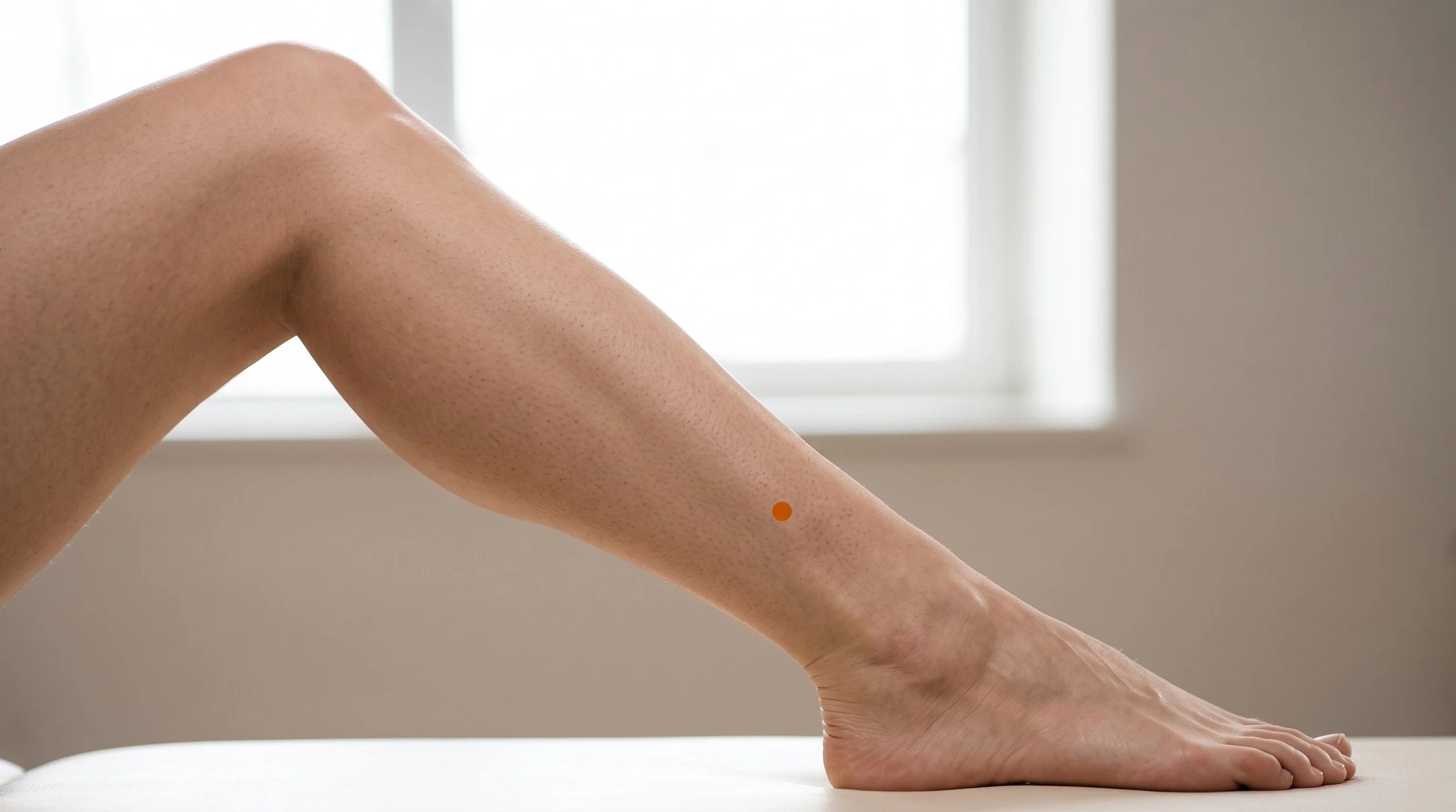
GB37 Acupuncture Point (Guangming)
Bright Light on the Outer Shin: Anatomy, Mechanism, and Why the Gallbladder Luo Point Became the Classical Distal Eye Point
GB37 (Guangming, translated as Bright Light) sits on the outer lower leg, five cun above the bony bump of the outer ankle, right at the front edge of the fibula where the shin muscles meet the peroneal group. It is the luo-connecting point of the Gallbladder channel, the place where that channel's connecting vessel is traditionally described as branching toward the Liver channel, and because classical theory links the Liver with the eyes, GB37 became the most famous distal eye point on the leg.
In modern practice the gb37 acupuncture point earns its place for two very practical reasons: it gives clinicians a low-risk, easily accessed site far from the head for patients with eye strain and one-sided headache, and it lands in a stretch of lateral leg tissue that is frequently overloaded in runners, walkers, and anyone with chronic ankle or lateral shin complaints.
- Location and layers: GB37 is found 5 cun above the tip of the lateral malleolus at the anterior border of the fibula, just distal to the junction of the upper two thirds and lower third of a 16 cun malleolus to popliteal crease measurement (Deadman et al., 2000). The needle passes skin and subcutaneous fascia into the interval between the peroneal muscles and extensor digitorum longus.
- Traditional categories, read neurophysiologically: classical texts assign GB37 the role of luo-connecting point, the site where the Gallbladder connecting channel departs toward the Liver channel (Maciocia, 2006; Deadman et al., 2000). Translated into modern terms, this is a lower leg site whose sensory input converges centrally with segments that also serve the lateral thigh, hip, and trunk, which is why it is used at a distance rather than only locally.
- Nerve story: the point sits in superficial fibular nerve territory (L4 to S1), with the deep fibular nerve and anterior tibial vessels lying deeper and more medially. Needling here recruits A-delta and group III afferents that engage spinal segmental gating and brainstem descending inhibition, including opioid-mediated pathways (Zhao, 2008).
- Research picture: GB37 has been imaged more than most points because of its eye reputation, and results are mixed. Early fMRI work found no reliable visual cortex activation from needling it (Gareus et al., 2002), a multisession study found occipital signal changes that were not specific to the point (Kong et al., 2009), while a small recent EEG study reported short-term improvements in uncorrected visual acuity and contrast sensitivity in myopic volunteers (Wang et al., 2024).
- Clinical framing: GB37 is almost never used alone. It appears inside multi-point protocols for eye strain, dry eye, and one-sided headache, and reviews of those broader protocols (not of this single point) report modest but real benefits for headache and chronic pain (Linde et al., 2016; Vickers et al., 2018; Hu et al., 2021).
- De qi: patients usually describe a deep dull ache or heavy, spreading pressure that travels toward the outer ankle or up the shin. A brief bright flick can occur if a superficial fibular nerve branch is brushed, and the needle should be adjusted if that sensation lingers.
Struggling With Screen Related Eye Strain and Temple Headaches?
Long days on monitors leave many New Yorkers with aching, dry, heavy eyes and a one-sided headache that settles behind the temple by mid-afternoon. At Morningside Acupuncture we use GB37 as a distal anchor alongside orbital and temporal points, then add manual therapy for the neck and jaw muscles that keep feeding the pattern. Treatment is comfortable, evidence-informed, and built around your actual work setup. Schedule a visit and let's map what is driving your eye fatigue.
Schedule NowAnatomy of GB37: Why the Anterior Fibular Border Is Such an Important Location
GB37 lies on the lateral lower leg, five cun above the prominence of the lateral malleolus, at the front edge of the fibula. Under the skin and a thin layer of subcutaneous fat and fascia, the needle enters the septal interval between the peroneus muscles behind and extensor digitorum longus in front. This is working tissue: the peroneals stabilize the ankle against rolling and control the foot during single-leg stance, while extensor digitorum longus lifts the toes during swing phase.
Hill running, worn shoes, chronic ankle instability, and long walking days on hard city pavement all load this compartment, which is why the area is so often tender to palpation even in patients who came in for something else. One useful location note from the classical texts is that the fibula is easier to feel just above the ankle, so clinicians often trace its anterior edge upward from there rather than guessing at the midshaft (Deadman et al., 2000).
The relevant nerve geography is straightforward. The tissue at GB37 falls within superficial fibular nerve territory, drawing on the L4 to S1 spinal segments, with the deep fibular nerve and the anterior tibial vessels situated deeper and slightly medial in the anterior compartment. Needling recruits small-diameter afferents in muscle and fascia, and that input reaches dorsal horn neurons where it converges with signals from other structures sharing those segments.
Central processing then matters more than local anatomy: repetitive stimulation engages descending inhibitory control from the periaqueductal gray and rostral ventromedial medulla, along with endogenous opioid signalling, which is the best-supported general mechanism for acupuncture analgesia (Zhao, 2008). Local effects are real too, including axon reflex vasodilation and changes in tissue blood flow around the needle.
Deeper and medial to the point sit the anterior tibial artery and deep fibular nerve, running along the interosseous membrane, so needle angle matters more than needle depth alone. Standard technique is perpendicular insertion of about 1 to 1.5 cun, with some texts favoring a shallower 0.7 to 1 cun (Deadman et al., 2000; Kim, 2015). Angling straight in along the fibular border keeps the needle in the muscular interval rather than driving it medially across the compartment. Patients on anticoagulants, or those with known peripheral neuropathy or prior compartment issues, warrant more conservative depth and stimulation.
Related Peroneus Longus Trigger Points Related Extensor Digitorum Longus Trigger PointsGB37 at a Glance: Classification, Location, and Clinical Use
| Category | Detail |
|---|---|
| Traditional Name | Guangming (Bright Light or Brightness) |
| Channel Classification | Gallbladder channel, foot shaoyang; point 37 of 44 |
| Point Categories | Luo-connecting point of the Gallbladder channel, the site where the Gallbladder connecting channel is described as departing toward the Liver channel and dispersing over the dorsum of the foot; traditionally the principal distal eye point of the Gallbladder channel. No five-shu, hui-meeting, or extraordinary vessel designations are attributed to GB37 in the source texts. |
| Precise Location | Lateral lower leg, 5 cun above the prominence of the lateral malleolus, at the anterior border of the fibula, just distal to the junction of the upper two thirds and lower third of the 16 cun malleolus-to-popliteal-crease measurement. |
| Tissue Stimulated | Skin and subcutaneous fascia, the septal interval between the peroneal group and extensor digitorum longus, superficial fibular nerve territory. Overlaps clinically with Peroneus Longus Trigger Points and Extensor Digitorum Longus Trigger Points. |
| Needle Depth / Direction | Perpendicular insertion 1 to 1.5 cun (some texts 0.7 to 1 cun), directed along the fibular border rather than angled medially toward the anterior tibial vessels. |
| De Qi Sensation | Deep dull ache, heaviness, or spreading pressure toward the lateral ankle or up the shin; a brief electric flick may signal contact with a superficial fibular nerve branch and calls for repositioning. |
| Primary Clinical Uses | Eye strain, aching, itching, and dryness as a distal eye point; one-sided and temporal headache; lateral lower leg pain, calf and shin complaints, difficulty standing after prolonged sitting; knee pain along the lateral line; breast distention in classical use. |
| Common Point Combinations |
|
Deadman, Al-Khafaji, and Baker summarize GB37 with two traditional actions: benefiting the eyes, and dispelling wind-damp while activating the channel to relieve pain. The eye role is explained through channel logic rather than local anatomy, since the Liver is traditionally said to open into the eyes, the Liver and Gallbladder channels and the Gallbladder divergent channel are described as reaching the eye, and the luo-connecting point is the classical bridge between paired channels.
On that reasoning the classical indication list runs from eye pain, redness, and itching to night blindness and refractive complaints, and it extends outward to one-sided headache, teeth grinding, febrile disease without sweating, and breast distention attributed to stagnant Liver qi. The Great Compendium of Acupuncture and Moxibustion adds a split that clinicians still find useful: excess presentations were framed as heat and pain in the lower leg, knee pain, body numbness, and grinding of the teeth, while the deficiency picture was weakness of the legs with difficulty standing up after sitting.
What makes the pattern striking is its internal consistency. A single site on the shin was asked to serve the eyes, the temples, the breast, and the leg, and every one of those claims was derived from the same channel map rather than added at random.
Why GB37 Is Used for Eye Strain and One-Sided Headache From a Point on the Shin
The first question patients ask is fair: how can a needle in the lower leg matter to the eyes or the temple? The honest answer is that classical theory and modern neuroscience give different accounts.
Classically, GB37 was chosen because the Gallbladder connecting channel was said to link with the Liver channel, and the Liver was said to open into the eyes (Deadman et al., 2000). Neurophysiologically, we would describe something less direct: needling recruits sensory afferents whose input reaches the dorsal horn and then ascends to brainstem and cortical networks that regulate pain, muscle tone, and autonomic balance.
Distal points are used partly because they produce robust, tolerable sensory input from a safe location while the head and neck stay untouched, which is genuinely useful for a patient whose temples and orbits are already sensitized.
The second layer is descending inhibition. Sustained needle stimulation engages the periaqueductal gray and rostral ventromedial medulla and recruits endogenous opioid mechanisms that dampen pain transmission throughout the body, not just in the segment being needled (Zhao, 2008). That system does not care much where the input came from, which is why a shin point can influence a headache pattern.
Add the autonomic shift most patients notice during a session, slower breathing, warmer hands, less jaw clenching, and you have a plausible route for reduced eye and temple tension without invoking energy travelling up a line.
Point-specific findings on GB37 and vision are more cautious than the classical reputation. An early fMRI study concluded that needling GB37 did not produce a clear visual cortex response or reliably modulate the response to visual stimulation (Gareus et al., 2002), and a later multisession study found occipital signal changes that were comparable at GB37, BL60, and a nearby non-point, which argues against point-specific visual cortex effects (Kong et al., 2009).
More recently, a small EEG study in myopic volunteers reported short-term gains in uncorrected visual acuity and contrast sensitivity after needling GB37, along with shifts in resting EEG microstates (Wang et al., 2024).
Taken together, this suggests real physiological effects that may relate to attention, arousal, and ocular comfort rather than a hardwired shin-to-retina circuit.
What the Research Shows for GB37
Almost no clinical trial isolates a single acupuncture point, and GB37 is no exception. Where it appears in research, it does so inside multi-point protocols for dry eye, eye strain, or headache, or as an imaging target in mechanistic studies with small samples. That means the practical evidence question is not whether GB37 works on its own, but whether the treatment approaches that include it produce meaningful change, and how much of that change can reasonably be credited to this particular site. The table below separates the point-specific physiological studies from the broader clinical reviews so the distinction stays clear.
| Study | Type | Focus | Key Finding |
|---|---|---|---|
| Gareus et al., 2002 | fMRI mechanistic study | Whether needling GB37 activates the visual cortex | Stimulation of GB37 did not produce a clear visual cortex BOLD response, which tempers claims of a direct eye-brain link for this point. |
| Kong et al., 2009 | Multisession fMRI study | Point specificity of vision-related points GB37 and BL60 versus a non-point | Occipital signal changes were modest and similar across all three sites, so the results did not support point-specific visual cortex effects. |
| Wang et al., 2024 | Small before-and-after EEG study | Acupuncture at GB37 in myopic volunteers | Uncorrected visual acuity and contrast sensitivity improved short-term alongside EEG microstate shifts, though the sample was small and uncontrolled. |
| Hu et al., 2021 | Two-center randomized controlled trial | Laser acupuncture including GB37 for dry eye disease | The multi-point laser protocol, which included GB37, was associated with improved tear film stability compared with sham, suggesting the point set is worth further study. |
| Linde et al., 2016 | Cochrane systematic review | Acupuncture for prevention of episodic migraine | Adding acupuncture to usual care reduced headache frequency, with effects at least comparable to prophylactic drug treatment in the included comparisons. |
| Vickers et al., 2018 | Individual patient data meta-analysis | Acupuncture for chronic pain including headache and musculoskeletal pain | Acupuncture outperformed both sham and no-acupuncture controls, with benefits that persisted over time, though effects versus sham were modest. |
| Chen et al., 2025 | Systematic review and meta-analysis | Acupuncture for degenerative eye diseases | Response rates favored acupuncture, but effects on visual acuity and intraocular pressure remained inconclusive and the authors called for stronger trials. |
Lateral Shin, Ankle, and Knee Pain That Flares When You Stand Up?
Pain along the outer lower leg that bites after sitting, or a knee that complains on stairs, often involves the peroneal group, extensor digitorum longus, and their attachments along the fibula. GB37 sits directly in that corridor, so we can combine channel-based needling with precise dry needling of the muscles that reproduce your symptoms. We pair the needling with loading strategy so the improvement holds between sessions. Book an evaluation and get a clear plan for your leg.
Schedule NowGB37 in the Context of Trigger Point Work
The location of GB37 puts it right where several lateral leg muscles do their work, so channel-based needling and trigger point needling often converge here. Peroneus longus and brevis sit just posterior to the fibular border, extensor digitorum longus sits anterior, and extensor hallucis longus lies deeper in the anterior compartment. Trigger points in the peroneal muscles typically refer pain toward the lateral ankle and along the outer foot, while extensor digitorum longus refers toward the dorsum of the foot and toes (Simons et al., 1999).
Patients who describe outer shin burning after long walks, a persistent sense of ankle instability, or lateral leg pain that flares on standing after a long sit often have tender bands in exactly this corridor.
At Morningside Acupuncture we treat GB37 and the surrounding muscles as one clinical region rather than two competing systems. A session for lateral leg pain might use GB37 with GB34 and GB39 along the channel, then add dry needling of peroneus longus and extensor digitorum longus at the specific taut bands that reproduce the patient's pain, finishing with ankle and hip loading work so the tissue tolerates more the following week.
For headache and eye strain patients we usually reverse the emphasis: GB37 as a distal point, with the primary myofascial work done in the suboccipitals, temporalis, and upper trapezius where the referral patterns actually match the symptoms. Acupuncture here simply means the use of an acupuncture needle, and both approaches use the same tool with different targeting logic.
GB37 Eye Strain and Headache Treatment at NYC's Highest-Rated Acupuncture Clinic
Morningside Acupuncture is the highest-rated acupuncture and dry needling clinic in New York City with over 500 five-star Google reviews, and our Upper West Side practice treats eye strain, migraine patterns, and lower leg pain every week. We use GB37 as part of individualized protocols that combine classical point selection with orthopedic assessment and myofascial needling. Every treatment plan is explained in plain language, with realistic timelines and no upselling. Schedule your first session and see what focused, expert care feels like.
Schedule NowFrequently Asked Questions
What does GB37 feel like when needled?
Most people feel a dull, heavy ache or a spreading pressure around the outer shin that may travel toward the ankle or up toward the knee. That sensation, called de qi, usually builds over several seconds and settles into a warm heaviness once the needle is in place. Because the superficial fibular nerve runs through this territory, a brief bright or electric flick can occur; that is not harmful, but tell your practitioner so the needle can be adjusted. Some patients also notice a subtle heaviness or watering sensation in the eyes during treatment, which is interesting but not required for the treatment to be useful.
Why treat the eyes with a point on the lower leg instead of around the eyes?
Both are used, and they do different jobs. Points around the orbit address local tissue directly, while distal points like GB37 provide strong sensory input from a location that is safe, easy to access, and far from an area that may already feel sore or sensitive. Classically, GB37 was chosen because the Gallbladder connecting channel was said to link with the Liver channel, which was described as opening into the eyes (Deadman et al., 2000). Physiologically we would explain it through central pain and autonomic modulation, including descending inhibitory pathways engaged by needling anywhere on the body (Zhao, 2008). Imaging studies of GB37 and vision have been mixed, so we present it as a well-established traditional option with supportive but not decisive modern evidence (Gareus et al., 2002; Kong et al., 2009).
Can I press GB37 myself between sessions?
Yes, and it is one of the easier points to self-treat. Sit down, find the bony bump on the outside of your ankle, then measure roughly a hand's width plus a couple of finger widths up the leg (about five cun, or a third of the way from ankle to knee) and slide your thumb to the front edge of the fibula. You should feel a slight groove between muscle bellies, often tender. Press with your thumb at a firm but comfortable pressure, hold for 30 to 60 seconds, then release, and repeat two or three times per leg. Small circular pressure works just as well. Doing this once or twice a day, ideally during a screen break with your eyes closed for a minute, is reasonable. Stop if you get numbness, tingling that persists, or sharp pain.
Is GB37 safe to needle?
GB37 is considered a low-risk point when needled by a trained clinician. The main structures to respect are the superficial fibular nerve branches in the subcutaneous layer and, deeper and more medially, the anterior tibial vessels and deep fibular nerve along the interosseous membrane. Standard perpendicular insertion of about 1 to 1.5 cun directed along the fibular border keeps the needle in the muscular interval and away from those structures (Deadman et al., 2000). Mild bruising or short-lived post-needle soreness is the most common side effect. Tell your practitioner if you take blood thinners, have peripheral neuropathy, have had lower leg surgery or a compartment syndrome, or have any local skin infection, since technique should be adjusted accordingly.
Where exactly is GB37 located?
GB37 is on the outer lower leg, five cun above the tip of the lateral malleolus, at the front border of the fibula. A practical way to find it: the distance from the ankle bone tip to the crease behind the knee is measured as 16 cun, so GB37 sits just below the junction of the upper two thirds and lower third of that line. Trace the front edge of the fibula upward from just above the ankle, where the bone is easy to feel, and look for a slight depression between the peroneal muscles and the toe extensors. Mild tenderness on pressure is common and helps confirm you are in the right neighborhood.
References
- Deadman, P., Al-Khafaji, M., & Baker, K. (2009). A manual of acupuncture. Journal of Chinese Medicine Publications.
- Cunningham, P. M. (2000). Acupuncture points: A practical guide to classical and modern usage. Odyssey Press.
- Kim, H. (2008). Handbook of Oriental medicine (3rd ed.). Harmony & Balance Press.
- Maciocia, G. (2005). The foundations of Chinese medicine: A comprehensive text for acupuncturists and herbalists (2nd ed.). Elsevier Churchill Livingstone.
- Simons, D. G., Travell, J. G., & Simons, L. S. (1999). Travell & Simons' myofascial pain and dysfunction: The trigger point manual, Vol. 1: Upper half of body (2nd ed.). Williams & Wilkins.
- Gareus, I. K., Lacour, M., Schulte, A. C., & Hennig, J. (2002). Is there a BOLD response of the visual cortex on stimulation of the vision-related acupoint GB 37?. Journal of Magnetic Resonance Imaging, 15(3), 227-232. https://doi.org/10.1002/jmri.10059
- Kong, J., Kaptchuk, T. J., Webb, J. M., Kong, J.-T., Sasaki, Y., Polich, G. R., Vangel, M. G., Kwong, K., Rosen, B., & Gollub, R. L. (2009). Functional neuroanatomical investigation of vision-related acupuncture point specificity: A multisession fMRI study. Human Brain Mapping, 30(1), 38-46. https://doi.org/10.1002/hbm.20481
- Wang, Z., Yan, H., Su, K., Wu, R., Wang, L., Bi, H., & Wu, J. (2024). Effects of acupuncture at limb acupoint Guangming (GB37) on UDVA, CS, and EEG microstate in myopia. Frontiers in Neuroscience, 18, 1492529. https://doi.org/10.3389/fnins.2024.1492529
- Hu, W.-L., Yu, H.-J., Pan, L.-Y., Wu, P.-C., Pan, C.-C., Kuo, C.-E., Tseng, Y.-J., & Hung, Y.-C. (2021). Laser acupuncture improves tear film stability in patients with dry eye disease: A two-center randomized-controlled trial. Journal of Alternative and Complementary Medicine, 27(7), 579-587. https://doi.org/10.1089/acm.2020.0524
- Linde, K., Allais, G., Brinkhaus, B., Fei, Y., Mehring, M., Vertosick, E. A., Vickers, A., & White, A. R. (2016). Acupuncture for the prevention of episodic migraine. Cochrane Database of Systematic Reviews, 2016(6), CD001218. https://doi.org/10.1002/14651858.CD001218.pub3
- Vickers, A. J., Vertosick, E. A., Lewith, G., MacPherson, H., Foster, N. E., Sherman, K. J., Irnich, D., Witt, C. M., & Linde, K. (2018). Acupuncture for chronic pain: Update of an individual patient data meta-analysis. Journal of Pain, 19(5), 455-474. https://doi.org/10.1016/j.jpain.2017.11.005
- Zhao, Z. Q. (2008). Neural mechanism underlying acupuncture analgesia. Progress in Neurobiology, 85(4), 355-375. https://doi.org/10.1016/j.pneurobio.2008.05.004
- Chen, K.-Y., Chan, H.-C., & Chan, C.-M. (2025). Is acupuncture a viable therapeutic strategy for degenerative eye diseases? A systematic review and meta-analysis. Complementary Therapies in Medicine, 93, 103235. https://doi.org/10.1016/j.ctim.2025.103235
Disclaimer: This web site is intended for educational and informational purposes only. Reading this website does not constitute providing medical advice or any professional services. This information should not be used for diagnosing or treating any health issue or disease. Those seeking medical advice should consult with a licensed physician. Seek the advice of a medical doctor or other qualified health professional for any medical condition. If you think you have a medical emergency, call 911 or go to the emergency room. No acupuncturist-patient relationship is created by reading this website or using the information. Morningside Acupuncture PLLC and its employees and contributors do not make any express or implied representations with respect to the information on this site or its use. For any legal interpretation of scope of practice in your state, consult a licensed attorney or regulatory authority.
Read more from our blog



