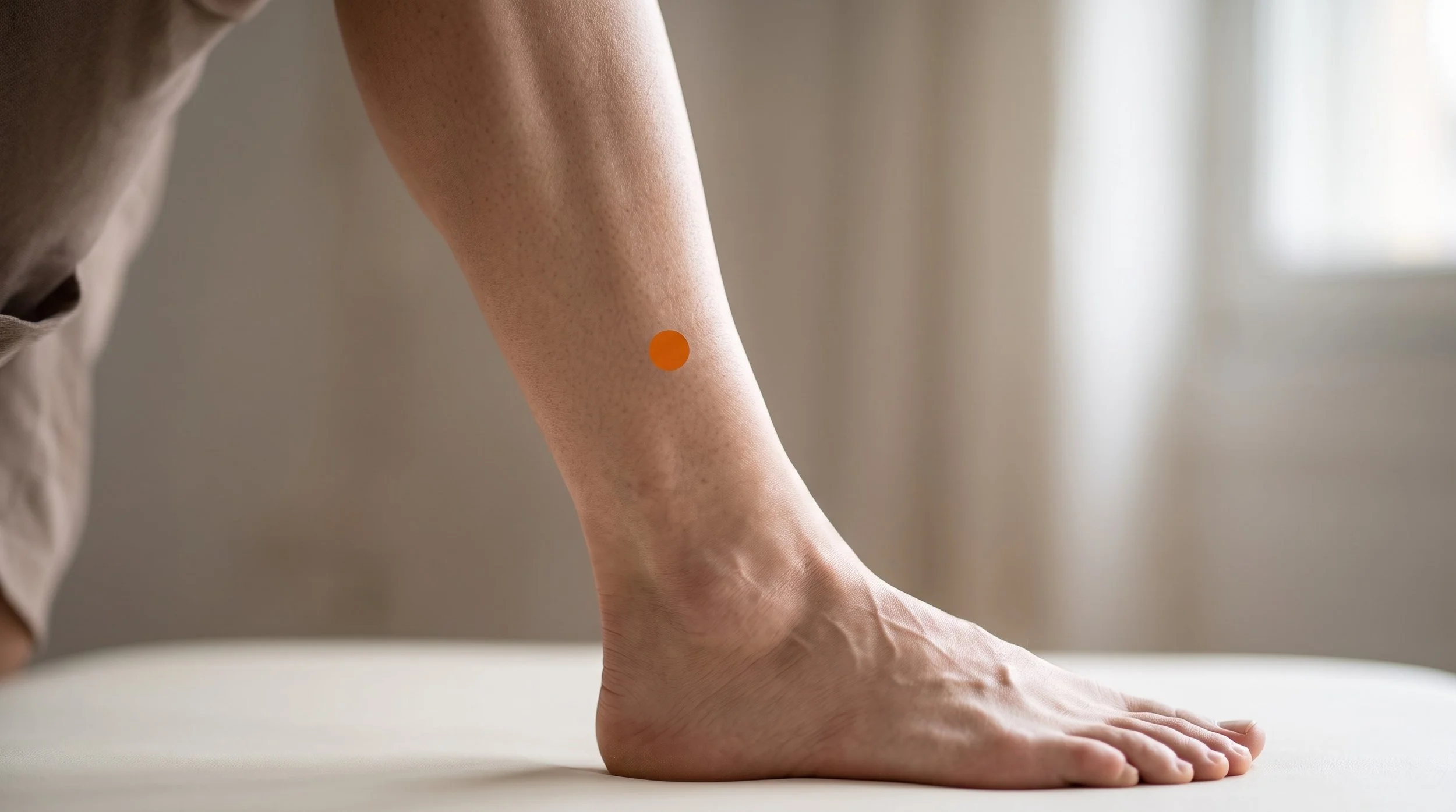
GB38 Acupuncture Point (Yangfu)
The Fire Point on the Fibula: Anatomy, Mechanism, and Why This Lower Leg Point Anchors Treatment for One-Sided Headache and Lateral Leg Pain
GB38 (Yangfu, often translated as Yang Assistance or Yang Aid) sits on the outer lower leg, four cun above the bony bump of the outer ankle, right along the front edge of the fibula. In classical terms it's the jing-river point and the fire point of the Gallbladder channel, which is a compact way of saying it was the point reached for when the channel was considered hot, tight, or overactive rather than depleted.
In modern clinical practice, the gb38 acupuncture point earns its place for two very different reasons: it's a distal option for one-sided, temple-dominant headaches, and it sits directly over the fibularis (peroneal) muscle group that so often drives lateral leg and outer ankle pain. That combination, a head complaint and a leg complaint treated from the same spot, is exactly what makes gallbladder 38 worth understanding in detail.
- Location and layers: Yangfu sits 4 cun above the tip of the lateral malleolus at the anterior border of the fibula, between extensor digitorum longus and peroneus brevis. Because the fibula is hidden by muscle at this height, most clinicians palpate the bone lower down near the ankle and trace its front edge upward.
- Traditional categories, translated: classical texts assign GB38 the fire and jing-river designations of the Gallbladder channel and describe actions of clearing channel heat, harmonizing shaoyang, and benefiting sinews and bones. Read neurophysiologically, that maps onto a strongly innervated distal site used to modulate pain referred along the lateral body line.
- The nerve story: needling here engages skin, fascia, and muscle in superficial fibular nerve territory with segmental input around L4 to S1, which recruits spinal and supraspinal pain modulation rather than any local effect at the head (Zhao, 2008).
- Research picture: no trial isolates GB38 by itself, but Cochrane reviews support acupuncture protocols that commonly include distal Gallbladder channel points for migraine and tension-type headache prevention (Linde et al., 2016a; Linde et al., 2016b), and individual patient data pooling supports modest, persisting benefit for chronic pain overall (Vickers et al., 2018).
- Clinical framing: GB38 is a distal point, so it's usually needled alongside local points at the temple, neck, or ankle depending on the complaint, and it pairs naturally with dry needling of the fibularis muscles when lateral leg or ankle symptoms dominate (Salom-Moreno et al., 2015).
- De qi here is typically a heavy, spreading ache that can travel toward the outer ankle or the top of the foot. A brief electrical flick means a superficial fibular nerve branch has been contacted, and the needle should be repositioned rather than pushed further.
Struggling With One-Sided Headaches That Settle Behind the Temple?
Temple-dominant and migraine-pattern headaches often respond better when treatment includes distal points on the lateral leg rather than local needling alone. At Morningside Acupuncture we use GB38 with points at the head and upper neck, and we track your headache frequency session to session so we can tell whether the plan is working. Treatment is adjusted based on what your response actually shows, not on a fixed template. Schedule a visit and let's map your pattern.
Schedule NowAnatomy of GB38: Why the Anterior Border of the Fibula Is Such an Important Location
The yangfu point location sits on the lateral lower leg where the tissue stack is thin and predictable. Under the skin and superficial fascia lies the lateral compartment, with peroneus brevis forming the bulk of the muscle here, and the anterior compartment neighbor extensor digitorum longus just in front of it. The fibula itself is the deep landmark, though at four cun above the ankle it's covered by muscle and no longer easy to feel, which is why clinicians usually find the bone's front edge closer to the ankle where it's obvious and then follow that line upward toward the fibular head.
This region works hard during walking and running: the fibularis muscles evert the foot and stabilize against inversion, and extensor digitorum longus decelerates the forefoot at heel strike. Runners, court athletes, and anyone with a history of rolled ankles tend to be tender here long before they notice anything at the joint itself.
Sensory supply to the skin and fascia in this zone comes from the superficial fibular (peroneal) nerve, with segmental contributions arriving at spinal levels roughly L4 through S1. That matters for mechanism. Needling a well-innervated musculofascial target activates small-diameter afferents, and that input reaches dorsal horn neurons that also receive convergent signals from joints, ligaments, and deeper tissue in the same segments.
The result is local and regional modulation of how the nervous system weights incoming nociceptive information, plus ascending recruitment of brainstem systems that release descending inhibition along serotonergic, noradrenergic, and endogenous opioid pathways (Zhao, 2008). Local effects also include a small vascular and inflammatory response around the needle that appears to contribute to tissue-level changes. None of this requires the head and the leg to be physically connected: the shared processing happens centrally, which is the honest modern reading of why a distal leg point can influence a headache pattern.
Deep to the point, the anterior tibial artery and vein and the deep fibular nerve run within the anterior compartment, well beneath the usual working depth. The standard convention of perpendicular insertion at 0.7 to 1 cun keeps the needle in muscle and fascia and away from those structures, and several texts describe a slightly shallower range of 0.5 to 0.7 cun. Because the superficial fibular nerve pierces the fascia in the lower third of the leg, a sharp electrical sensation shooting toward the foot is a cue to withdraw slightly and redirect.
Standard clean needle technique applies, and needling should be avoided over broken skin, active cellulitis, or a region of acute unexplained swelling in the calf.
Related Pain Finder Leg Ankle Foot Related Gall Bladder ChannelGB38 at a Glance: Classification, Location, and Clinical Use
| Category | Detail |
|---|---|
| Traditional Name | Yangfu (Yang Assistance, also translated as Yang Aid) |
| Channel Classification | Gallbladder channel of the foot shaoyang, point 38 of 44 |
| Point Categories | Jing-river point of the Gallbladder channel; fire point of the Gallbladder channel; classically described as the point to reduce when the Gallbladder is in excess |
| Precise Location | On the lateral lower leg, 4 cun above the prominence of the lateral malleolus at the anterior border of the fibula, between extensor digitorum longus and peroneus brevis. Using the 16 cun measure from the tip of the lateral malleolus to the popliteal crease, it falls at the junction of the upper three quarters and the lowest quarter. |
| Tissue Stimulated | Skin and superficial fascia in superficial fibular nerve territory, peroneus brevis, the adjacent fibers of extensor digitorum longus, and the fascial border shared with peroneus longus |
| Needle Depth / Direction | Perpendicular insertion 0.7 to 1 cun (some texts describe 0.5 to 0.7 cun); angle slightly toward the fibula and stay out of the deeper anterior compartment |
| De Qi Sensation | Heavy, dull, spreading ache along the outer lower leg, often traveling toward the lateral malleolus or the dorsum of the foot; a brief electrical zing means a cutaneous nerve branch was contacted and the needle should be repositioned |
| Primary Clinical Uses | One-sided and temple-dominant headache, lateral leg and outer ankle pain, migratory or wandering joint pain in classical use, rib-side and chest-side discomfort in shaoyang patterns, lateral lower limb tightness and weakness |
| Common Point Combinations |
|
Deadman's A Manual of Acupuncture presents Yangfu as the fire and jing-river point of the Gallbladder channel and reports the Great Compendium of Acupuncture and Moxibustion instruction that it be reduced when the Gallbladder is in excess, a traditional attribution rather than a physiological claim.
The indications recorded in that literature fall into recognizable groups: head and face complaints along the temple and outer eye, shaoyang pivot symptoms such as alternating chills and fever with a bitter taste and side-of-chest discomfort, swellings and nodules near the armpit and neck, and a large musculoskeletal cluster covering pain along the outer leg, contracted sinews, low back pain described in vivid weight and dampness imagery, and pain that migrates from joint to joint.
The Spiritual Pivot's directive to needle jing-river points when disease sits in the sinews and bones is usually cited for the yin channels, yet the indication list attached to this yang channel point clearly runs the same way. What's striking is the pairing: a single point on the outer shin credited with both a very specific local pain territory and a whole-body wandering pain pattern, a combination few points in the classical record carry at once.
Why GB38 Is Used for Headaches and Wandering Joint Pain That Start Nowhere Near the Ankle
The first part of the answer is segmental. Needling GB38 recruits small-diameter afferents in skin, fascia, and the fibularis muscle group, and those signals arrive at dorsal horn segments that already receive input from the ankle, the lateral knee, and the lateral hip region. Because many spinal neurons receive convergent input from multiple tissues, stimulating one input can change how the whole neighborhood is processed, which is one reason a point above the ankle can shift symptoms felt at the outer knee or lateral thigh (Zhao, 2008). For lateral leg and ankle complaints, that segmental logic is straightforward and the point is essentially local to the problem tissue.
The headache application works through a different route. Distal needling drives ascending input to the brainstem and midbrain, which engages descending inhibitory systems that dampen nociceptive transmission at levels far from the needle, including the trigeminal territory that carries most head pain (Zhao, 2008). This is why acupuncture protocols for headache routinely combine local points at the temple and neck with distal points on the hands and legs rather than needling only where it hurts.
Cochrane reviewers have found that adding acupuncture to usual care reduces headache frequency in both episodic migraine and frequent tension-type headache, with a full course of treatment mattering more than any single point (Linde et al., 2016a; Linde et al., 2016b).
The classical wandering pain indication doesn't have a tidy modern equivalent, and we shouldn't pretend otherwise. What we can say is that widespread, shifting musculoskeletal pain often involves central sensitization, and that acupuncture's measurable effects in chronic pain populations are modest but durable, persisting beyond the treatment course in pooled individual patient data (Vickers et al., 2018). GB38 is used within that framework as one distal input among several, not as a stand-alone answer.
What the Research Shows for GB38
It's worth being clear about what the evidence can and can't tell us. No published trial tests GB38 in isolation, and none is likely to, because acupuncture is delivered as a multi-point protocol chosen for the individual. What the literature offers instead is evidence for protocols and regions that include this point, plus mechanistic work explaining how distal needling could plausibly affect head and limb pain. The studies below should be read as context for how GB38 is used, not as proof of what one needle in one spot accomplishes.
| Study | Type | Focus | Key Finding |
|---|---|---|---|
| Linde et al., 2016a | Cochrane systematic review | Acupuncture for prevention of episodic migraine | Adding acupuncture to usual care reduced migraine frequency, with effects at least comparable to prophylactic drug treatment on moderate-quality evidence. |
| Linde et al., 2016b | Cochrane systematic review | Acupuncture for prevention of tension-type headache | Reviewers concluded that a course of at least six sessions may be a worthwhile option for people with frequent tension-type headache. |
| Vickers et al., 2018 | Individual patient data meta-analysis | Acupuncture across chronic pain conditions including headache and musculoskeletal pain | Acupuncture outperformed both sham and no-acupuncture controls by modest margins, with benefit largely retained at twelve months. |
| Park et al., 2013 | Systematic review and meta-analysis | Acupuncture for ankle sprain | Pooled results favored acupuncture for symptom improvement, though trial quality was generally poor and the authors urged caution. |
| Salom-Moreno et al., 2015 | Randomized clinical trial | Trigger point dry needling of the lateral peroneus muscle plus proprioceptive exercise in chronic ankle instability | Adding needling to exercise was associated with greater improvement in function and pain at one month than exercise alone in a small sample. |
| Zhao, 2008 | Narrative review of mechanisms | Neural mechanisms of acupuncture analgesia | Describes segmental spinal modulation and descending inhibitory pathways as the principal explanation for both local and distant analgesic effects. |
Outer Ankle and Lateral Leg Pain That Keeps Coming Back?
Recurrent outer ankle sprains, shin-adjacent aching, and a leg that feels unreliable on uneven ground often involve irritable fibularis muscles rather than the ligament alone. GB38 sits directly over that tissue, so we can combine channel-based needling with targeted dry needling of peroneus brevis and peroneus longus in the same session. We pair the needling with balance and loading work so the gains carry into your training. Book an appointment to get a plan for the whole chain.
Schedule NowGB38 in the Context of Trigger Point Work
The gb 38 leg position overlaps almost exactly with the muscle bellies clinicians target when treating lateral leg complaints. Peroneus brevis lies directly under the point at this height, peroneus longus runs just posterior and superficial to it in the upper leg, and extensor digitorum longus borders it in front. Trigger points in the fibularis group are classically described as referring pain over the lateral malleolus and along the outer border of the foot, a distribution that reads almost like the classical indication list for Yangfu (Simons et al., 1999). When a patient points to the outer ankle but the joint itself examines well, the muscle is usually the better first target.
In practice at Morningside, we treat GB38 as a hinge between the two systems. If the presentation is headache-led, we needle it as a distal channel point with local head and neck points and leave the leg work light. If the presentation is leg-led, we needle the point and then extend into peroneus brevis and peroneus longus with dry needling, sometimes adding tibialis anterior when the front of the shin is also loaded, and we finish with balance and eccentric loading work.
Small trials of dry needling to the fibularis muscles in chronic ankle instability have reported improvements in pain, function, and single-limb balance when needling is paired with proprioceptive exercise, which matches what we see clinically (Salom-Moreno et al., 2015). Acupuncture, in the sense that matters here, is the use of an acupuncture needle, and whether we call a given insertion a channel point or a trigger point is a question of reasoning rather than of tools.
GB38 Headache and Leg Pain Treatment at NYC's Highest-Rated Acupuncture Clinic
Morningside Acupuncture is the highest-rated acupuncture and dry needling clinic in New York City with over 500 five-star Google reviews. Our licensed acupuncturists treat headaches, lateral leg pain, and ankle instability using both classical point selection and modern myofascial needling, in one integrated visit. You get clear explanations, measurable goals, and home strategies between sessions. Schedule your appointment today.
Schedule NowFrequently Asked Questions
What does GB38 feel like when needled?
Most people feel a dull, heavy, slightly spreading ache that builds over a few seconds and can travel toward the outer ankle or the top of the foot. That's the de qi sensation clinicians look for. Because this is muscle-rich tissue, a mild post-needle soreness for a day is common and unremarkable. A sharp electrical sensation shooting into the foot is different: it suggests a cutaneous nerve branch has been contacted, and your acupuncturist should adjust the needle right away.
Why needle a point on the shin for a headache that's in my temple?
Because pain modulation happens in the nervous system, not along a hose. Needling a well-innervated distal site sends afferent input to the spinal cord and brainstem, which activates descending inhibitory pathways that can reduce pain signaling in the head (Zhao, 2008). Traditional theory arrived at the same clinical habit through channel logic, connecting the outer leg with the temple along the Gallbladder line. In practice, distal points like GB38 are combined with local points at the neck and temple rather than used instead of them, and Cochrane reviews of these combined protocols support their use for headache prevention (Linde et al., 2016a).
Can I press GB38 myself between sessions?
Yes, and it's an easy point to find on yourself. Sit with the ankle relaxed, find the bony bump on the outside of your ankle, and measure roughly four finger-widths above it (about a hand's breadth minus the thumb), then slide slightly forward until you feel the firm front edge of the fibula. The tender spot just in front of that edge is your target. Use a thumb or knuckle with steady, moderate pressure for 30 to 60 seconds, breathe normally, then release and repeat two or three times per side. Doing this once or twice a day is plenty. Pressure should register as a satisfying ache, never as sharp pain or numbness, and you should stop if you get any pins and needles into the foot.
Is GB38 safe to needle?
In trained hands, yes. The main structures to respect are the superficial fibular nerve in the subcutaneous layer and the anterior tibial vessels and deep fibular nerve deeper in the anterior compartment, which sit well below the standard working depth of 0.7 to 1 cun. Clean needle technique, correct depth, and repositioning if an electrical sensation appears keep the point straightforward. Needling is avoided over broken or infected skin, and any calf that's acutely swollen, warm, or painful without a clear mechanical explanation should be evaluated medically before needling, since deep vein thrombosis needs to be excluded. Bruising is the most common side effect and resolves on its own.
Where exactly is GB38 located?
GB38 is on the outer lower leg, 4 cun above the tip of the lateral malleolus, at the anterior border of the fibula, in the groove between extensor digitorum longus and peroneus brevis. A second way to find it uses the proportional measurement from the tip of the lateral malleolus to the popliteal crease, which is 16 cun: the point sits at the junction of the upper three quarters and the lowest quarter of that line. One practical tip from the classical location notes is that the fibula is hard to palpate at this height because muscle covers it, so trace the bone's front edge from just above the ankle, where it's easy to feel, and extend that line upward. GB39 (Xuanzhong) is the nearby point three cun above the malleolus, so confirm your measurement before needling.
References
- Deadman, P., Al-Khafaji, M., & Baker, K. (2009). A manual of acupuncture. Journal of Chinese Medicine Publications.
- Cheng, X. (Ed.). (1999). Chinese acupuncture and moxibustion (Rev. ed.). Foreign Languages Press.
- Cunningham, P. M. (2000). Acupuncture points: A practical guide to classical and modern usage. Odyssey Press.
- Kim, H. (2008). Handbook of Oriental medicine (3rd ed.). Harmony & Balance Press.
- Simons, D. G., Travell, J. G., & Simons, L. S. (1999). Travell & Simons' myofascial pain and dysfunction: The trigger point manual, Vol. 1: Upper half of body (2nd ed.). Williams & Wilkins.
- Linde, K., Allais, G., Brinkhaus, B., Fei, Y., Mehring, M., Vertosick, E. A., Vickers, A., & White, A. R. (2016a). Acupuncture for the prevention of episodic migraine. Cochrane Database of Systematic Reviews, 2016(6), CD001218. https://doi.org/10.1002/14651858.CD001218.pub3
- Linde, K., Allais, G., Brinkhaus, B., Fei, Y., Mehring, M., Shin, B.-C., Vickers, A., & White, A. R. (2016b). Acupuncture for the prevention of tension-type headache. Cochrane Database of Systematic Reviews, 2016(4), CD007587. https://doi.org/10.1002/14651858.CD007587.pub2
- Vickers, A. J., Vertosick, E. A., Lewith, G., MacPherson, H., Foster, N. E., Sherman, K. J., Irnich, D., Witt, C. M., & Linde, K. (2018). Acupuncture for chronic pain: Update of an individual patient data meta-analysis. Journal of Pain, 19(5), 455-474. https://doi.org/10.1016/j.jpain.2017.11.005
- Park, J., Hahn, S., Park, J.-Y., Park, H.-J., & Lee, H. (2013). Acupuncture for ankle sprain: Systematic review and meta-analysis. BMC Complementary and Alternative Medicine, 13, 55. https://doi.org/10.1186/1472-6882-13-55
- Salom-Moreno, J., Ayuso-Casado, B., Tamaral-Costa, B., Sanchez-Mila, Z., Fernandez-de-las-Penas, C., & Alburquerque-Sendin, F. (2015). Trigger point dry needling and proprioceptive exercises for the management of chronic ankle instability: A randomized clinical trial. Evidence-Based Complementary and Alternative Medicine, 2015, 790209. https://doi.org/10.1155/2015/790209
- Zhao, Z. Q. (2008). Neural mechanism underlying acupuncture analgesia. Progress in Neurobiology, 85(4), 355-375. https://doi.org/10.1016/j.pneurobio.2008.05.004
Disclaimer: This web site is intended for educational and informational purposes only. Reading this website does not constitute providing medical advice or any professional services. This information should not be used for diagnosing or treating any health issue or disease. Those seeking medical advice should consult with a licensed physician. Seek the advice of a medical doctor or other qualified health professional for any medical condition. If you think you have a medical emergency, call 911 or go to the emergency room. No acupuncturist-patient relationship is created by reading this website or using the information. Morningside Acupuncture PLLC and its employees and contributors do not make any express or implied representations with respect to the information on this site or its use. For any legal interpretation of scope of practice in your state, consult a licensed attorney or regulatory authority.
Read more from our blog



