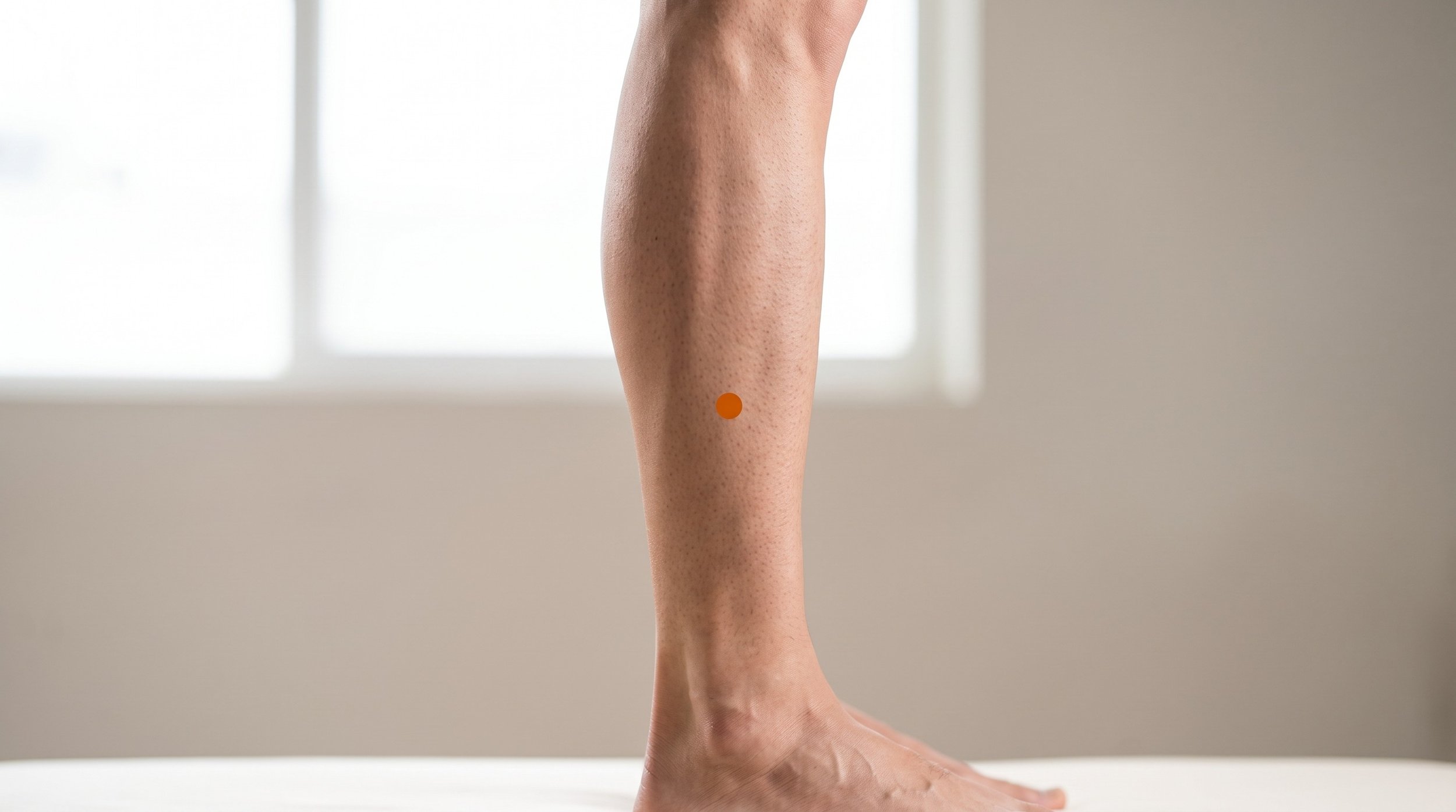
GB36 Acupuncture Point (Waiqiu)
The Xi-Cleft on the Front Edge of the Fibula: Anatomy, Mechanism, and Why GB36 Is Reserved for Acute Channel Pain and Painful Skin
GB36, known in Chinese as Waiqiu and usually translated as Outer Hill or Outer Mound, sits on the outside of the lower leg roughly halfway between the ankle bone and the knee, seven cun above the tip of the lateral malleolus on the front edge of the fibula. It is the xi-cleft point (also called the accumulation or cleft point) of the Gallbladder channel, the category that classical texts reserved for sudden, sharp, acute problems along a channel rather than slow chronic ones.
That makes the gb36 acupuncture point a distal option clinicians reach for when pain flares along the outer leg, hip, ribs, or side of the neck, and it is one of the few points in the classical literature singled out for pain of the skin itself rather than pain of muscle or joint.
- Location and layers: GB36 lies 7 cun above the prominence of the lateral malleolus at the anterior border of the fibula, level with GB35 which sits at the posterior border of the same bone. The needle passes through skin and subcutaneous fascia into the fibularis (peroneus) longus muscle belly, with the extensor digitorum longus of the anterior compartment immediately in front.
- Traditional category translated into modern terms: as the xi-cleft point of the Gallbladder channel, GB36 was traditionally described as a place where channel qi and blood gather and sink deeper, and it was used for acute pain and for boosting the effect of other Gallbladder channel points (Maciocia, 2005; Deadman et al., 2007). In neurophysiological language, this reads as a somatic input site along a shared segmental and myofascial chain.
- Nerve story: the needling zone sits in territory served by branches of the superficial fibular nerve, with segmental input in the L4 to S1 range. Needle stimulation of muscle and fascia recruits A-delta and C afferents that engage spinal and brainstem pain modulation, including descending inhibitory pathways (Zhao, 2008).
- Research picture: no trial has tested GB36 in isolation, so evidence comes from multi-point protocols. Individual patient data pooling suggests acupuncture produces modest but persistent benefit over sham and no-acupuncture controls in chronic musculoskeletal pain (Vickers et al., 2018), and reviews of neck pain and sciatica report favorable but methodologically limited findings (Trinh et al., 2016; Zhang et al., 2023).
- Clinical framing: we tend to use GB36 for acute rather than smoldering presentations, often alongside local needling at the painful site. Studies of needling in the lower leg show measurable local microcirculatory changes after insertion, which fits the clinical impression of a warm, loosening response in the lateral compartment (Kim et al., 2016).
- De qi at GB36 is usually a dull, heavy, spreading ache that travels down the outer shin toward the ankle or occasionally up toward the knee. A brief electric flick can occur if a superficial fibular nerve branch is brushed, and that is a signal to withdraw slightly and redirect rather than push deeper.
Flare-Up of Outer Leg or Hip Pain That Will Not Settle?
Acute pain that runs down the side of the leg often involves the lateral compartment, the iliotibial band, and the gluteal muscles working as one chain. At Morningside Acupuncture we use GB36 as a distal xi-cleft point alongside local needling of the tender lateral leg tissue, then add movement retraining so the relief holds between visits. Most patients feel a change in tightness within the first two or three sessions. Schedule a visit and we will map where your pain actually lives.
Schedule NowAnatomy of GB36: Why the Front Border of the Fibula Is Such an Important Location
GB36 sits at a mechanically busy seam. Under the skin and superficial fascia lies the fibularis (peroneus) longus, the long eversion muscle of the lateral compartment, and just anterior to the needle sits the border between that muscle and the anterior compartment extensors. This tissue works constantly during walking, running, and any balance correction on uneven ground, and it takes a heavy load after ankle sprains, in runners who overpronate, and in people who spend long days on hard city sidewalks.
The fibula itself is easiest to palpate just above the ankle, so the reliable way to find the waiqiu point location is to trace the bone's front edge upward from the ankle toward the fibular head and then measure seven cun from the tip of the lateral malleolus, which is one cun below the midpoint of a sixteen cun line from the malleolus to the popliteal crease (Deadman et al., 2007).
The relevant nerve geography is superficial fibular. That nerve runs down the lateral compartment between the peroneal muscles before piercing the deep fascia in the lower third of the leg to supply skin over the dorsum of the foot, and its segmental origins fall in the L4 to S1 range. Needling here creates a strong afferent volley from muscle, fascia, and periosteal tissue that converges in the dorsal horn with input from other structures sharing those segments, which is one plausible reason a leg point can influence pain that is felt elsewhere along the same chain.
Repeated stimulation also recruits descending inhibitory control from the midbrain and brainstem and shifts endogenous opioid and monoamine signaling, mechanisms mapped in detail in the experimental literature on acupuncture analgesia (Zhao, 2008). Local effects matter too: reviews of microcirculatory studies report measurable blood flow changes in skin and muscle after needle insertion in the lower leg, with deeper intramuscular needling producing larger shifts than superficial insertion (Kim et al., 2016).
Deep to the point is the fibula, which acts as a natural backstop, and beyond it the interosseous membrane and the vessels of the anterior compartment sit deeper and more medially. The common fibular nerve wraps the neck of the fibula well above GB36, so the main structure to respect at this level is the superficial fibular nerve and its branches.
Deadman and colleagues give perpendicular insertion of 1 to 1.5 cun, while several other point manuals recommend a more conservative 0.5 to 0.8 cun, and moxibustion is traditionally described as applicable.
In practice we angle to stay in muscle rather than driving toward bone, stop advancing if a sharp electric sensation occurs, and use lighter technique in patients on anticoagulants or with reduced sensation in the leg.
Related Peroneus Longus Trigger Points Related Pain Finder Leg Ankle FootGB36 at a Glance: Classification, Location, and Clinical Use
| Category | Detail |
|---|---|
| Traditional Name | Waiqiu (Outer Hill, also translated as Outer Mound) |
| Channel Classification | Gallbladder channel, point 36, on the lateral lower leg |
| Point Categories | Xi-cleft point (accumulation point) of the Gallbladder channel. The reference literature attributes no five-shu, luo-connecting, hui-meeting, or extraordinary vessel designations to this point. |
| Precise Location | On the outer lower leg, 7 cun above the prominence of the lateral malleolus at the anterior border of the fibula, level with GB35 which sits at the posterior border. Equivalent landmark: one cun distal to the midpoint of the sixteen cun line from the malleolar tip to the popliteal crease. |
| Tissue Stimulated | Skin and subcutaneous fascia over the fibularis (peroneus) longus belly at the front edge of the fibula, with extensor digitorum longus just anterior; the zone frequently overlaps myofascial targets described on our Peroneus Longus Trigger Points page |
| Needle Depth / Direction | Perpendicular insertion 1 to 1.5 cun per Deadman; several manuals use a more conservative 0.5 to 0.8 cun. Moxibustion is traditionally applicable. |
| De Qi Sensation | Dull, heavy, spreading ache in the outer shin, often traveling toward the ankle or knee; a brief electric flick suggests contact with a superficial fibular nerve branch and calls for slight withdrawal and redirection |
| Primary Clinical Uses | Acute pain along the Gallbladder channel of the leg, hip, and side of the body; stiff and cold-feeling neck in classical use; rib-side distention in classical use; skin pain and heightened skin sensitivity in classical use |
| Common Point Combinations |
|
In the classical framework summarized by Deadman and colleagues, xi-cleft points mark places where channel qi and blood, having flowed relatively superficially from the fingers and toes, gather and plunge into deeper tissue, and points of this category were reserved for acute presentations and severe pain. GB36 carries the standard traditional actions of activating the channel and relieving pain, with a secondary attribution of clearing heat and resolving toxin.
Its recorded indications spread widely: fullness and distention of the chest and rib-side, headache, abdominal pain, agitation and mania, weakness or painful obstruction of the lower limb, cold and damp heaviness in the legs, and a cold, stiff, aching neck with sensitivity to wind and cold. The Systematic Classic of Acupuncture and Moxibustion recommended it specifically where painful skin accompanied wasting and painful obstruction, and the Illustrated Classic of Acupuncture Points on the Bronze Man listed it among treatments for rabies with alternating chills and fever, to be moxaed before treating the bite.
What stands out is the skin indication: most channel points in this region were framed around muscle, joint, and sinew, so a point selected for pain of the skin itself is an unusual entry in the record and hints that classical clinicians were tracking something like cutaneous hypersensitivity.
Why GB36 Is Used for Neck Stiffness and Painful, Oversensitive Skin
Patients are often puzzled that a point below the knee gets used for the side of the neck. The traditional logic is channel-based: the Gallbladder pathway runs from the head down the side of the body to the outer leg and foot, so a point at the lower end can be selected for problems at the upper end. The modern reading is convergence and central processing.
Strong needle input from muscle and fascia in the leg travels into the spinal cord and brainstem, where it modulates the same networks that handle input from the neck and shoulder girdle, and it also triggers descending inhibitory activity that dampens transmission at levels far from the needle (Zhao, 2008). This is why distal points are commonly needled first, with the patient gently moving the painful neck while the leg needles are retained.
The skin pain indication is even more interesting through a pain science lens. When peripheral nerves are irritated or a region becomes centrally sensitized, light touch and clothing pressure can be reported as painful, and the tissue that hurts is the skin rather than the muscle underneath. GB36 sits in superficial fibular nerve territory, and needling in that territory produces a controlled afferent barrage plus local vascular and inflammatory changes, including measurable increases in skin and muscle blood flow after insertion (Kim et al., 2016).
It is a reasonable, though not proven, explanation for how an old indication for painful skin might map onto what clinicians now call cutaneous allodynia.
Practically, we tend to reserve GB36 for the acute end of the spectrum, in keeping with its traditional category, and to use it as a partner rather than a soloist. It pairs naturally with GB40 at the ankle, GB34 at the knee, and local points at the site of pain, and it fits well in treatments for lateral leg symptoms that accompany low back or gluteal problems. Broader analyses of acupuncture in chronic musculoskeletal pain support modest, durable effects for the intervention as a whole, which is the honest context for any single point (Vickers et al., 2018).
What the Research Shows for GB36
There is no clinical trial that isolates GB36, and it would be misleading to imply otherwise. What exists is evidence for acupuncture protocols that include lower leg Gallbladder channel points among a larger prescription, plus mechanistic work explaining how needling in the leg produces local and central effects. The reasonable interpretation is that GB36 contributes as one element of a multi-point treatment, chosen for its channel relationship, its xi-cleft role in acute pain, and its accessibility on the lateral leg.
Study quality in this literature is variable, blinding is difficult, and effect sizes over sham are usually modest, so expectations should be set accordingly.
| Study | Type | Focus | Key Finding |
|---|---|---|---|
| Vickers et al., 2018 | Individual patient data meta-analysis | Acupuncture for chronic musculoskeletal, headache, and osteoarthritis pain across nearly 21,000 patients | Acupuncture outperformed both sham and no-acupuncture controls by modest margins, with benefit largely maintained at twelve months. |
| Trinh et al., 2016 | Cochrane systematic review | Acupuncture for acute, subacute, and chronic neck disorders | Moderate-quality evidence favored acupuncture over sham for pain at treatment completion and short-term follow-up, though the review was later withdrawn pending update and trials were mostly small. |
| Fang et al., 2024 | Systematic review and meta-analysis | Durability of acupuncture effects in chronic neck pain across eighteen randomized trials | Acupuncture used as an adjunct therapy was associated with sustained pain relief at three and six months after treatment ended. |
| Zhang et al., 2023 | Systematic review and meta-analysis | Acupuncture for sciatica, a common source of lateral and posterior leg pain | Pooled results favored acupuncture for pain intensity and pain threshold with few adverse events, but methodological limitations temper confidence. |
| Kim et al., 2016 | Systematic review of physiological studies | Local microcirculatory response to manual acupuncture, including needling of lower leg muscle | Needling generally produced increases in skin and muscle blood flow, with deeper intramuscular insertion producing larger changes than superficial needling. |
| Zhao, 2008 | Mechanistic review | Neural pathways underlying acupuncture analgesia | Analgesic effects are attributed to afferent recruitment, spinal segmental inhibition, and descending opioid and monoaminergic control rather than to any single local action. |
Stiff Neck That Feels Worse in Wind and Cold?
Classical texts paired GB36 with points at the back of the head for neck pain that worsens with drafts and cold exposure, and that pattern still shows up in modern clinic rooms in air conditioned offices. We combine distal needling at GB36 with careful local work in the upper cervical and shoulder muscles, plus dry needling of the trigger points that reproduce your specific pain. Sessions are calm, precise, and built around what your exam shows. Book an appointment to get started.
Schedule NowGB36 in the Context of Trigger Point Work
The gb 36 leg location sits directly over the fibularis (peroneus) longus, a muscle with well-documented trigger points that refer pain along the outer ankle and into the foot, and it borders the anterior compartment extensors that refer toward the shin and toes (Simons et al., 1999). That overlap means the same insertion site can serve two purposes in one session: a classical distal xi-cleft point when we are treating acute channel pain, and a myofascial target when palpation finds a taut band that reproduces the patient's familiar symptoms.
Which framing we use changes the technique, since trigger point needling looks for a local twitch response and channel needling aims for a spreading de qi sensation.
In a typical Morningside session for lateral leg or ankle pain, GB36 might be combined with dry needling of the peroneus longus and brevis, the tibialis anterior, and gluteus medius, because chronic ankle instability and lateral leg overload usually involve the whole chain rather than one muscle. For neck presentations we invert the pattern, using GB36 and other distal points while the patient moves the neck, then treating upper trapezius, levator scapulae, and suboccipital tissue locally.
Acupuncture and dry needling are the same tool used with different reasoning, and we are explicit with patients about which logic is guiding each needle.
GB36 Lateral Leg and Neck Pain Treatment at NYC's Highest-Rated Acupuncture Clinic
Morningside Acupuncture is the highest-rated acupuncture and dry needling clinic in New York City with over 500 five-star Google reviews, and our approach blends classical point selection with orthopedic and myofascial assessment. GB36 rarely works alone, so we build a treatment that includes distal channel points, local needling, and practical loading advice for the ankle, leg, and neck. You will always know why each needle is placed where it is. Schedule your session today.
Schedule NowFrequently Asked Questions
What does GB36 feel like when needled?
Most people describe a dull, heavy, slightly achy fullness that spreads along the outer shin, sometimes drifting down toward the ankle or up toward the outside of the knee. That spreading quality is de qi, and it is the response we are looking for. A quick electric zing can happen if the needle brushes a branch of the superficial fibular nerve; it is brief and harmless, and your practitioner should withdraw slightly and redirect. The area can feel mildly tender for a day afterward, especially if the muscle was already loaded from running or walking.
Why needle a point on the lower leg for neck or rib-side pain?
Two reasons, one traditional and one physiological. Traditionally, GB36 belongs to the Gallbladder channel, which is described as running from the head down the side of the body to the outer leg, so a distal point can be selected for symptoms at the far end of that pathway. Physiologically, strong needle input from leg muscle and fascia feeds into spinal and brainstem circuits that modulate pain more broadly, including descending inhibitory pathways (Zhao, 2008). Distal needling also leaves the painful neck free to move during treatment, which is often useful for acute stiffness.
Can I press GB36 myself between sessions?
Yes, and it is a straightforward point to self-treat. Sit with your foot flat on the floor, find the bony tip of your outer ankle bone, and measure roughly a hand's width plus a few finger widths up the leg, about a third of the way from ankle to knee, then slide your thumb onto the front edge of the fibula where the muscle feels firm. Press with your thumb at a firmness of about six out of ten, hold for thirty to sixty seconds, release, and repeat two or three times per leg. Small circular pressure or slow ankle circles while you hold can help. Two or three short rounds a day is plenty, and you should stop if pressing produces numbness, tingling into the foot, or sharp pain.
Is GB36 safe to needle?
It is considered a low-risk point in trained hands. The fibula sits directly behind the needle path, no major artery or organ is in the immediate vicinity, and the common fibular nerve wraps the bone well above this level. The structure to respect is the superficial fibular nerve, so practitioners avoid heavy stimulation if an electric sensation occurs. Extra caution applies with anticoagulant medication, reduced sensation or circulation in the leg, active infection or skin breakdown, and any history of compartment syndrome. Mild soreness or a small bruise are the most common side effects.
Where exactly is GB36 located?
GB36 is on the lateral lower leg, 7 cun above the prominence of the lateral malleolus, at the anterior border of the fibula. A practical way to find the waiqiu point location is to note that the distance from the malleolar tip to the popliteal crease is measured as sixteen cun, so the point sits one cun below the midpoint of that line. Because the fibula is covered by muscle higher up, palpate the bone's front edge just above the ankle where it is easy to feel, then trace that line upward. Gallbladder 36 is level with GB35, which sits on the posterior border of the same bone, so the two points sandwich the fibula at the same height.
References
- Deadman, P., Al-Khafaji, M., & Baker, K. (2009). A manual of acupuncture. Journal of Chinese Medicine Publications.
- Maciocia, G. (2005). The foundations of Chinese medicine: A comprehensive text for acupuncturists and herbalists (2nd ed.). Elsevier Churchill Livingstone.
- Simons, D. G., Travell, J. G., & Simons, L. S. (1999). Travell & Simons' myofascial pain and dysfunction: The trigger point manual, Vol. 1: Upper half of body (2nd ed.). Williams & Wilkins.
- Vickers, A. J., Vertosick, E. A., Lewith, G., MacPherson, H., Foster, N. E., Sherman, K. J., Irnich, D., Witt, C. M., & Linde, K. (2018). Acupuncture for chronic pain: Update of an individual patient data meta-analysis. Journal of Pain, 19(5), 455-474. https://doi.org/10.1016/j.jpain.2017.11.005
- Zhao, Z. Q. (2008). Neural mechanism underlying acupuncture analgesia. Progress in Neurobiology, 85(4), 355-375. https://doi.org/10.1016/j.pneurobio.2008.05.004
- Trinh, K., Graham, N., Irnich, D., Cameron, I. D., & Forget, M. (2016). Acupuncture for neck disorders. Cochrane Database of Systematic Reviews, 2016(5), CD004870. https://doi.org/10.1002/14651858.CD004870.pub4
- Fang, J., Shi, H., Wang, W., Chen, H., Yang, M., Gao, S., Yao, H., Zhu, L., Yan, Y., & Liu, Z. (2024). Durable effect of acupuncture for chronic neck pain: A systematic review and meta-analysis. Current Pain and Headache Reports, Advance online publication. https://doi.org/10.1007/s11916-024-01267-x
- Zhang, Z., Hu, T., Huang, P., Yang, M., Huang, Z., Xia, Y., Zhang, X., Zhang, X., & Ni, G. (2023). The efficacy and safety of acupuncture therapy for sciatica: A systematic review and meta-analysis of randomized controlled trials. Frontiers in Neuroscience, 17, 1097830. https://doi.org/10.3389/fnins.2023.1097830
- Kim, S. Y., Min, S., Lee, H., Cheon, S., Zhang, X., Park, J. Y., Song, T. J., & Park, H. J. (2016). Changes of local blood flow in response to acupuncture stimulation: A systematic review. Evidence-Based Complementary and Alternative Medicine, 2016, 9874207. https://doi.org/10.1155/2016/9874207
Disclaimer: This web site is intended for educational and informational purposes only. Reading this website does not constitute providing medical advice or any professional services. This information should not be used for diagnosing or treating any health issue or disease. Those seeking medical advice should consult with a licensed physician. Seek the advice of a medical doctor or other qualified health professional for any medical condition. If you think you have a medical emergency, call 911 or go to the emergency room. No acupuncturist-patient relationship is created by reading this website or using the information. Morningside Acupuncture PLLC and its employees and contributors do not make any express or implied representations with respect to the information on this site or its use. For any legal interpretation of scope of practice in your state, consult a licensed attorney or regulatory authority.
Read more from our blog



