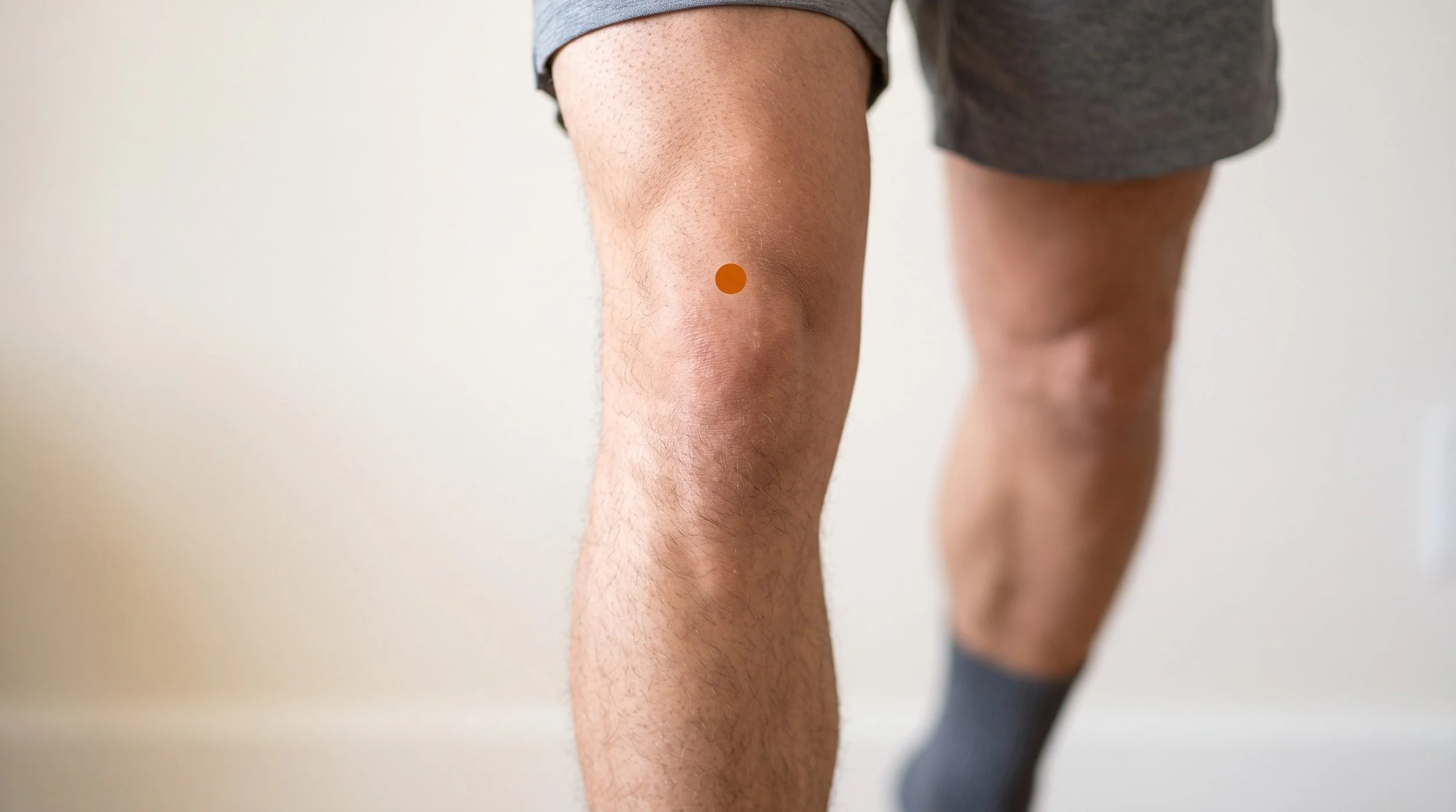
Heding Acupuncture Point (M-LE-27)
The Crane's Summit Above the Kneecap: Anatomy, Mechanism, and Why This Extra Point Anchors Local Treatment of Knee Pain and Swelling
Heding (M-LE-27, also numbered EX-LE-2) is an extraordinary point whose name is usually translated as Crane's Summit or Crane's Top. You'll find it in the small hollow at the midpoint of the upper border of the kneecap, sitting in the quadriceps tendon right where the thigh muscles converge onto the patella.
Unlike most points discussed in this series, the heding acupuncture point belongs to no primary channel, and it earned its place in the point repertoire purely through clinical use: it's the standard needling site above the patella, the mirror image of the eyes-of-the-knee points below it, and it appears in knee protocols from classical Chinese texts through to modern pain clinic practice.
- Location and layers: Heding lies in the depression at the middle of the superior patellar margin, where the needle passes through skin and subcutaneous tissue into the quadriceps tendon, with the suprapatellar recess of the knee joint lying deeper still. Standard depth is 0.5 to 1 cun perpendicular, and skilled practitioners keep the needle in tendon and soft tissue rather than pushing toward the joint cavity.
- Traditional attribution: classical sources credit this extra point with moving qi and blood locally and benefiting the knee joint, and list it for crane's knee wind, swelling and pain of the knee, leg qi, and weakness of the knee and leg. Read neurophysiologically, that's a description of a local point for a swollen, stiff, poorly loaded extensor mechanism.
- Mechanism: needling here stimulates free nerve endings and mechanoreceptors in tendon and periarticular tissue supplied by femoral nerve branches carrying L2 to L4 input, which converge in the same spinal segments that receive nociception from the knee joint itself, and repeated stimulation also recruits descending inhibitory pathways involving endogenous opioid and monoamine systems (Zhao, 2008).
- Research picture: Heding is not usually studied alone, but it shows up repeatedly in the point formulas of trials included in knee osteoarthritis reviews, and pooled analyses suggest acupuncture protocols containing local knee points may reduce pain and improve function versus sham and usual care, with effects that appear to persist for some months (Manheimer et al., 2010; Vickers et al., 2018; Chen et al., 2024).
- Clinical framing: at Morningside we treat Heding as an anchor rather than a stand-alone answer, pairing it with the eyes-of-the-knee points, quadriceps points, and dry needling of the vasti when the story involves stairs, kneeling, prolonged sitting, or a knee that swells after activity.
- De qi: patients typically report a dull, spreading heaviness or a deep tendon ache across the top of the kneecap, sometimes radiating a few centimeters into the thigh, rather than the sharper electric sensation associated with points sitting directly on a nerve trunk.
Is Knee Pain Making Stairs and Kneeling Difficult?
Knees that ache on stairs, complain after a long walk in the city, or swell the day after a workout usually involve the extensor mechanism, and Heding sits directly on it. Our licensed acupuncturists use Heding with the eyes-of-the-knee points, quadriceps points, and dry needling of the thigh muscles to reduce local sensitivity and improve tolerance for loading. Treatment is paired with simple strength and mobility guidance so gains carry over between visits. Schedule an appointment and let's map out what's actually driving your knee pain.
Schedule NowAnatomy of HEDING: Why the Hollow Above the Kneecap Is Such an Important Location
Slide a finger up the front of the kneecap and you'll drop into a soft depression at its upper edge. That hollow is Heding. Under the skin and a thin layer of subcutaneous tissue sits the quadriceps tendon, the shared insertion where rectus femoris, vastus medialis, vastus lateralis, and vastus intermedius all funnel onto the patella. This is the tissue that absorbs load every time you descend a staircase, rise from a low chair, or hold a squat, and it's also the tissue that stiffens and becomes tender in patellofemoral pain, quadriceps tendinopathy, and long-standing arthritic knees.
Deep to the tendon lies a fat pad and then the suprapatellar recess, the upward extension of the joint capsule that fills first when a knee swells, which is one reason this location has traditionally been chosen for knees that feel puffy and tight above the cap.
The nerve supply here comes from branches of the femoral nerve, carrying fibers rooted in the L2 to L4 spinal segments, the same segments that receive articular afferents from the knee joint. That overlap matters. When a needle activates small-diameter afferents in the tendon and periarticular tissue, the input arrives in dorsal horn neurons that also process joint nociception, and this segmental convergence is one of the mechanisms proposed for local point analgesia.
Sustained or repeated stimulation additionally engages descending inhibitory control from the brainstem, with endogenous opioid and monoaminergic signaling contributing to reduced pain transmission (Zhao, 2008). Local effects add another layer: needling produces small changes in blood flow and tissue signaling around the insertion site, which may help explain the loosening patients often describe in a stiff extensor mechanism. Trigger points in the vasti refer pain to the front and deep interior of the knee, so the same territory is often mechanically involved too (Simons et al., 1999).
Safety considerations here are mostly about depth and direction. The knee joint capsule sits below the tendon, and needling into a joint space is avoided because of rare but serious reports of septic arthritis after acupuncture, a caution emphasized in Western medical acupuncture texts. Standard practice is perpendicular insertion of 0.5 to 1 cun into the tendon and immediately surrounding soft tissue, sometimes angled slightly, with clean technique and no attempt to enter the suprapatellar pouch.
Patients with a knee replacement or other hardware need extra care, since needles should stay away from a prosthesis, and anyone with an acutely hot, red, or systemically unwell knee needs medical evaluation before any needling at all.
Related Acupuncture For Knee Pain Related Best Acupuncture Points For Knee PainHEDING at a Glance: Classification, Location, and Clinical Use
| Category | Detail |
|---|---|
| Traditional Name | Heding (Crane's Summit, also rendered Crane's Top) |
| Channel Classification | Extraordinary (extra) point, M-LE-27, also numbered EX-LE-2; not located on a primary channel |
| Point Categories | Extra point of the lower limb. Because it sits outside the primary channel system, it carries no five-shu, xi-cleft, luo, front-mu, back-shu, hui-meeting, or extraordinary vessel designation. Traditional sources classify it simply as a local knee point that activates qi and blood and benefits the knee joint. |
| Precise Location | In the depression at the midpoint of the upper (superior) border of the patella, best found with the knee relaxed and slightly flexed over a support |
| Tissue Stimulated | Quadriceps tendon at its patellar insertion, prepatellar subcutaneous tissue, and periarticular soft tissue over the suprapatellar recess; functionally linked to the vastus medialis, vastus lateralis, vastus intermedius, and rectus femoris |
| Needle Depth / Direction | Perpendicular insertion 0.5 to 1 cun into the tendon and soft tissue; some styles use a slightly oblique angle. Needling into the joint cavity is avoided. |
| De Qi Sensation | Dull, heavy, spreading tendon ache across the top of the kneecap, occasionally traveling a short distance up the thigh or into the front of the joint |
| Primary Clinical Uses | Knee pain and swelling, stiffness of the knee, weakness of the knee and leg, difficulty with stairs and kneeling, patellofemoral and extensor mechanism complaints, knee osteoarthritis as part of a multi-point protocol; traditionally indicated for crane's knee wind and leg qi |
| Common Point Combinations |
|
Deadman, Al-Khafaji, and Baker's point manual presents Heding as a valuable secondary point for disorders of the knee joint, traditionally described as activating qi and blood and benefiting the knee, with classical indications that cluster tightly around one region: crane's knee wind, swelling and pain of the joint, leg qi, and weakness of the knee and leg. The same text notes that it's usually chosen alongside the eyes-of-the-knee points, SP10, ST34, GB34, and SP9, which tells you how it was actually used, as one element of a local frame rather than a solo prescription.
Older Chinese point compendia are even more compressed, listing it simply for diseases of the knee joint and the soft tissues around it. What's striking is the consistency: across centuries of commentary and across very different clinical traditions, this point never drifts into systemic indications the way many channel points do, and the classical image of crane's knee wind, a swollen joint above a thinned leg, maps neatly onto the arthritic knee with quadriceps wasting that walks into a modern clinic.
Why HEDING Is Used for Knees That Hurt Most on Stairs, Not at Rest
A common pattern in our Manhattan practice is a knee that behaves fine on flat ground and then complains loudly on subway stairs, on a hike downhill, or when kneeling to reach something on a low shelf. Those are all high-demand tasks for the extensor mechanism, and they compress the patella against the femur. Heding sits directly over the tissue doing that work. Needling there delivers input to femoral nerve branches from the L2 to L4 segments, the same segmental level that carries pain information from the joint itself, so the stimulus and the problem meet in the same part of the spinal cord. That convergence is the core of the segmental model of local point analgesia (Zhao, 2008).
Beyond the segment, needling recruits broader pain control machinery. Descending pathways from the brainstem can dampen dorsal horn transmission through opioid and monoamine signaling, which is part of why patients often notice relief that outlasts the session and sometimes extends beyond the needled area (Zhao, 2008).
Interestingly, one randomized trial that separated local from distant points in knee osteoarthritis used Heding along with GB34 and SP9 as its proximal group and found that both local and distant needling reduced pain after a single session, with the distant points performing better on some measures (Yu et al., 2021). That's a useful reminder that local points like this one work best inside a full prescription rather than alone.
There's a mechanical layer too. Anterior knee pain frequently involves tender, taut bands in the quadriceps that refer pain into and around the kneecap (Simons et al., 1999). Needling into that tissue may reduce local sensitivity and improve the patient's tolerance for loading, which is what actually changes stair climbing. We treat Heding as the doorway into that whole system, not as a switch for pain.
What the Research Shows for HEDING
It's worth being clear about what the evidence can and can't tell us. Almost no trial isolates Heding, because knee protocols are built from groups of points, so the honest framing is that this point appears frequently inside protocols that have been tested, and the results belong to the protocol as a whole. Reviews of acupuncture for knee osteoarthritis generally report modest benefits for pain and function against sham and larger differences against usual care, with meaningful variation between trials in point selection, dosing, and control design.
Individual results vary, and acupuncture is best considered one component of care alongside exercise, load management, and medical treatment where appropriate.
| Study | Type | Focus | Key Finding |
|---|---|---|---|
| Manheimer et al., 2010 | Cochrane systematic review | Acupuncture for peripheral joint osteoarthritis, including the knee, using protocols that commonly included local points such as Heding and Xiyan | Acupuncture showed statistically significant benefits over sham for pain and function in knee osteoarthritis, though the review judged the differences over sham to be small and of uncertain clinical importance. |
| Vickers et al., 2018 | Individual patient data meta-analysis | Chronic pain conditions including osteoarthritis, pooling raw data from high-quality randomized trials | Acupuncture was associated with greater pain reduction than both sham and no-acupuncture controls, with effects that persisted over twelve months rather than dissipating quickly. |
| Chen et al., 2024 | Systematic review and meta-analysis | Durability of acupuncture effects for knee osteoarthritis after treatment ends | The authors reported improvements in pain and function that may last roughly three to six months after a course of treatment, with a favorable safety profile. |
| Liu et al., 2024 | Systematic review with pairwise and network meta-analysis | Effect of acupuncture for knee osteoarthritis and how acupuncture type, dose, and follow-up influence outcomes | Acupuncture appeared beneficial for knee osteoarthritis, with results suggesting treatment characteristics such as type and dose may influence the size of the effect. |
| Yu et al., 2021 | Randomized controlled trial | Proximal points including Heding (EX-LE-2), GB34, and SP9 compared with distal points and sham in knee osteoarthritis | All groups showed pain reduction after a single session, with the distal point group achieving greater improvement in pain and range of motion than the proximal group. |
| Zhao, 2008 | Narrative review of neurophysiology | Mechanisms of acupuncture analgesia, including segmental processing and descending inhibitory control | Needle stimulation of somatic afferents is described as modulating dorsal horn transmission and engaging endogenous opioid and monoaminergic pathways. |
Managing Knee Osteoarthritis Without Adding More Medication?
Many of our patients with degenerative knee changes want something that helps pain and function without piling on anti-inflammatories. Acupuncture protocols built around local knee points such as Heding, combined with GB34, SP10, and ST34, are among the best-studied non-drug options for this presentation. We'll walk you through what the reviews actually support and set realistic expectations for a course of care. Book a visit and we'll build a plan around your knee, your activity level, and your goals.
Schedule NowHEDING in the Context of Trigger Point Work
Heding sits at the convergence of four muscles, so it's unusually easy to integrate with trigger point dry needling. The vastus medialis commonly refers pain to the front and inner aspect of the knee and is associated with buckling and quadriceps inhibition, the vastus lateralis can produce lateral knee pain and a patella that feels stuck, the vastus intermedius contributes to difficulty straightening the knee after sitting, and rectus femoris often refers deep pain into the front of the joint (Simons et al., 1999).
When palpation of these muscles reproduces a patient's familiar pain, treating them alongside the point makes far more sense than needling the point in isolation.
In practice, a typical Morningside session for anterior knee pain might combine Heding with the eyes-of-the-knee points, dry needling of tender bands in vastus medialis and rectus femoris, and one or two channel points such as GB34 or ST36 depending on presentation. Everything here uses the same tool, an acupuncture needle, whether the rationale is drawn from classical point theory or from myofascial anatomy, and we choose the framing that best fits what we find on examination.
Post-needling we usually add quadriceps loading work, because reducing sensitivity is only useful if the knee then gets rebuilt for the stairs, hills, and long walking days that New York demands.
HEDING Knee Pain Treatment at NYC's Highest-Rated Acupuncture Clinic
Morningside Acupuncture is the highest-rated acupuncture and dry needling clinic in New York City with over 500 five-star Google reviews, and knee pain is one of the most common reasons patients find us. We combine classical point selection, including the Heding knee point, with orthopedic assessment and trigger point dry needling of the quadriceps and surrounding muscles. Sessions are calm, precise, and built around measurable changes in how your knee moves. Schedule your visit today and get started.
Schedule NowFrequently Asked Questions
What does HEDING feel like when needled?
Most patients describe a dull, heavy ache or a sense of deep pressure right at the top of the kneecap, sometimes spreading a short distance up into the thigh or down toward the joint line. Because the needle enters tendon rather than muscle belly, the sensation can feel firmer and more localized than a typical muscular point. It shouldn't feel sharp, electric, or burning. Sensitivity is often higher when the knee is already swollen, so we adjust needle depth and stimulation accordingly.
Why needle above the kneecap when my pain feels like it's inside the joint?
Pain that feels deep inside the knee is often generated or amplified by the tissues around it, including the quadriceps tendon, the retinaculum, and the fat pads, all of which share spinal segments with the joint itself. Needling at Heding delivers input to femoral nerve branches from the same L2 to L4 levels that carry joint nociception, so the stimulus reaches the same dorsal horn neurons processing your pain (Zhao, 2008). Needling directly into a joint space is deliberately avoided for safety reasons, which is another reason clinicians work the periarticular tissue instead.
Can I press HEDING myself between sessions?
Yes, and it's a reasonable self-care option for a stiff or achy knee. Sit with the leg supported and the knee relaxed or slightly bent, then slide a thumb up the front of the kneecap until it drops into the hollow at the upper edge. Apply steady, moderate pressure for 30 to 60 seconds, breathing normally, then release and repeat two or three times. You can do this two or three times a day, and it pairs well with gentle quadriceps sets and short-range knee bends. Stop if pressure increases sharp pain, and skip it entirely if the knee is hot, red, acutely swollen, or recently operated on.
Is HEDING safe to needle?
In trained hands it's a low-risk point, but it has specific cautions. The knee joint capsule and its suprapatellar recess lie deep to the tendon, so practitioners keep insertion within the standard 0.5 to 1 cun range and avoid entering the joint cavity, since rare cases of septic arthritis have been reported after acupuncture around joints. Clean needle technique is essential. Patients with a knee replacement or other implanted hardware need needles kept well away from the prosthesis, and an acutely hot, swollen, or systemically unwell knee should be medically evaluated before any needling. Mild soreness or a small bruise at the site is the most common side effect.
Where exactly is HEDING located?
Heding is in the depression at the midpoint of the upper border of the patella. To find it, sit with the leg extended and the quadriceps relaxed, locate the top edge of the kneecap, and move straight up until your finger falls into a soft hollow just above the bone. It's a midline point relative to the kneecap, sitting directly above the patella rather than to either side, which distinguishes it from the eyes-of-the-knee points located in the hollows below the kneecap on each side of the patellar ligament. Many people find it tender on the affected side, and that tenderness helps confirm the location.
References
- Deadman, P., Al-Khafaji, M., & Baker, K. (2009). A manual of acupuncture. Journal of Chinese Medicine Publications.
- O'Connor, J., & Bensky, D. (Eds. & Trans.). (1981). Acupuncture: A comprehensive text. Shanghai College of Traditional Medicine. Eastland Press.
- Cheng, X. (Ed.). (1999). Chinese acupuncture and moxibustion (Rev. ed.). Foreign Languages Press.
- Filshie, J., White, A., & Cummings, M. (Eds.). (2016). Medical acupuncture: A Western scientific approach (2nd ed.). Elsevier.
- Cunningham, P. M. (2000). Acupuncture points: A practical guide to classical and modern usage. Odyssey Press.
- Simons, D. G., Travell, J. G., & Simons, L. S. (1999). Travell & Simons' myofascial pain and dysfunction: The trigger point manual, Vol. 1: Upper half of body (2nd ed.). Williams & Wilkins.
- Manheimer, E., Cheng, K., Linde, K., Lao, L., Yoo, J., Wieland, S., van der Windt, D. A. W. M., Berman, B. M., & Bouter, L. M. (2010). Acupuncture for peripheral joint osteoarthritis. Cochrane Database of Systematic Reviews, 2010(1), CD001977. https://doi.org/10.1002/14651858.CD001977.pub2
- Vickers, A. J., Vertosick, E. A., Lewith, G., MacPherson, H., Foster, N. E., Sherman, K. J., Irnich, D., Witt, C. M., & Linde, K. (2018). Acupuncture for chronic pain: Update of an individual patient data meta-analysis. Journal of Pain, 19(5), 455-474. https://doi.org/10.1016/j.jpain.2017.11.005
- Chen, H., Shi, H., Gao, S., Fang, J., Yi, J., Wu, W., Liu, X., & Liu, Z. (2024). Durable effects of acupuncture for knee osteoarthritis: A systematic review and meta-analysis. Current Pain and Headache Reports, 28(7), 709-722. https://doi.org/10.1007/s11916-024-01242-6
- Liu, C. Y., Duan, Y. S., Zhou, H., Wang, Y., Tu, J. F., Bao, X. Y., Yang, J. W., Lee, M. S., & Wang, L. Q. (2024). Clinical effect and contributing factors of acupuncture for knee osteoarthritis: A systematic review and pairwise and exploratory network meta-analysis. BMJ Evidence-Based Medicine, Advance online publication. https://doi.org/10.1136/bmjebm-2023-112626
- Yu, W. Z., Huang, C. M., Ng, H. P., & Lee, Y. C. (2021). Distal acupoints outperform proximal acupoints in treating knee osteoarthritis: A randomized controlled trial. Evidence-Based Complementary and Alternative Medicine, 2021, 4827123. https://doi.org/10.1155/2021/4827123
- Zhao, Z. Q. (2008). Neural mechanism underlying acupuncture analgesia. Progress in Neurobiology, 85(4), 355-375. https://doi.org/10.1016/j.pneurobio.2008.05.004
Disclaimer: This web site is intended for educational and informational purposes only. Reading this website does not constitute providing medical advice or any professional services. This information should not be used for diagnosing or treating any health issue or disease. Those seeking medical advice should consult with a licensed physician. Seek the advice of a medical doctor or other qualified health professional for any medical condition. If you think you have a medical emergency, call 911 or go to the emergency room. No acupuncturist-patient relationship is created by reading this website or using the information. Morningside Acupuncture PLLC and its employees and contributors do not make any express or implied representations with respect to the information on this site or its use. For any legal interpretation of scope of practice in your state, consult a licensed attorney or regulatory authority.
Read more from our blog



