Dingchuan Acupuncture Point (M-BW-1)
The Calm Dyspnoea Point Beside C7: Anatomy, Segmental Mechanism, and Why This Modern Extra Point Anchors Wheeze, Cough, and Upper Back Protocols
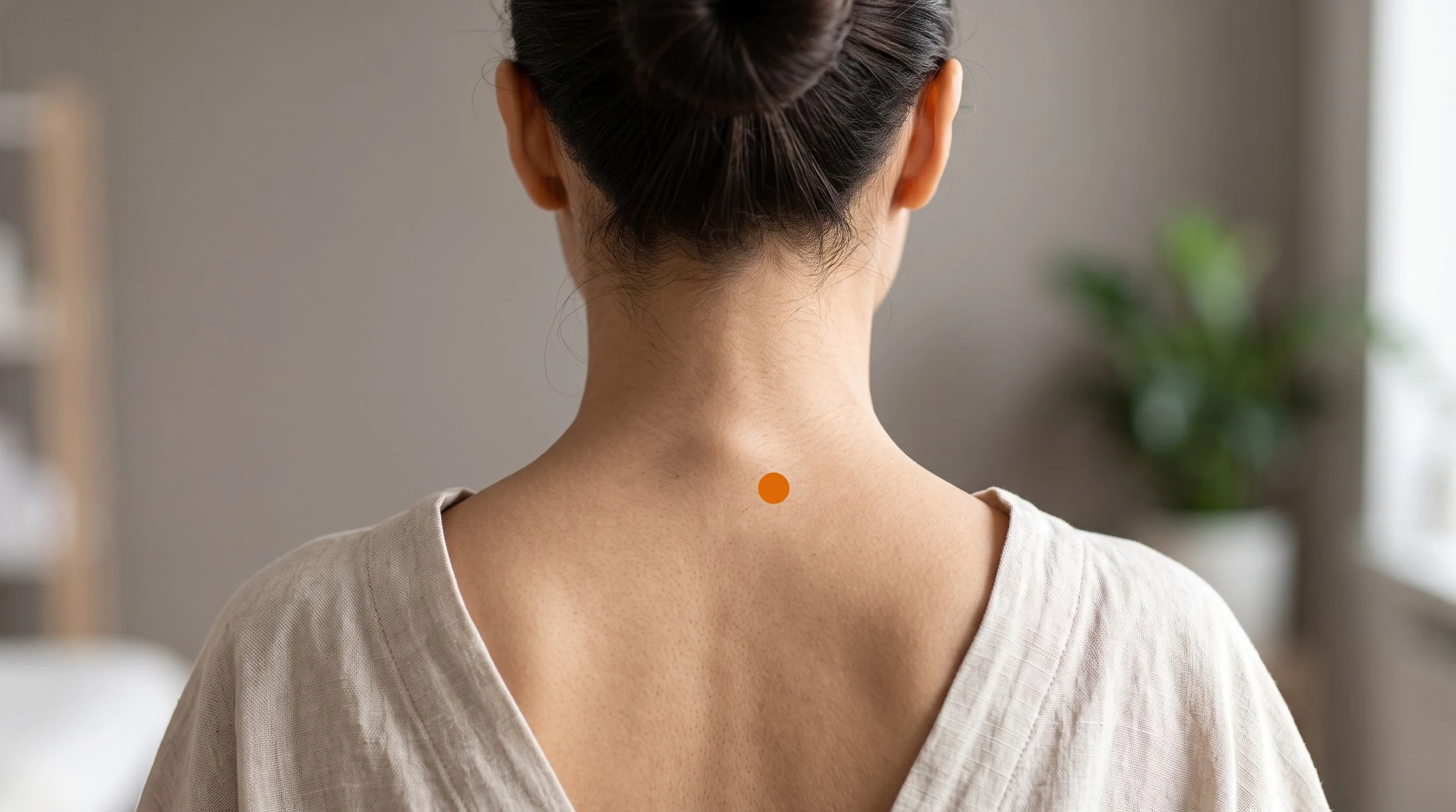
DINGCHUAN (M-BW-1, also coded EX-B1) is an extra point whose name is usually translated as Calm Dyspnoea, or in the more common American spelling, the calm dyspnea point. You'll find it at the base of the neck, half a cun to one cun out to either side of the small hollow just below the bump of the seventh cervical vertebra, which puts it directly beside GV14.
It belongs to no channel and carries none of the classical five-shu or shu-mu designations, yet the dingchuan acupuncture point has become one of the most consistently selected points in modern Chinese respiratory protocols, and it earns its place for two very different reasons: it sits at the spinal segments that feed sympathetic and sensory traffic to the airways, and it sits squarely in the thick of the muscles that ache at the base of a desk worker's neck.
- Location and layers: DINGCHUAN sits 0.5 to 1 cun lateral to the depression below the C7 spinous process, beside GV14, over upper trapezius and the deeper cervicothoracic paraspinals (rhomboid minor, serratus posterior superior, splenius and semispinalis cervicis, multifidus) as described in the Manual of Acupuncture.
- Traditional attribution: the classical texts credit this point with calming wheezing and dyspnoea and stopping cough, with listed indications covering asthma, wheeze, cough, urticaria, and pain of the upper back; those are traditional attributions rather than proven physiological actions.
- Mechanism: needling here recruits dorsal rami of the lower cervical and upper thoracic segments, the same neurological neighborhood as the T1 to T5 preganglionic sympathetic outflow that helps regulate airway smooth muscle and secretions, and segmental somatoautonomic reflexes of exactly this kind have been documented experimentally (Uchida et al., 2017).
- Research picture: reviews of acupuncture for asthma have long been cautious, with an older Cochrane review finding the evidence insufficient to make recommendations (McCarney et al., 2004), while a more recent sham-controlled meta-analysis reported modest improvements in FEV1 percentage and quality of life alongside high heterogeneity (Pang et al., 2023).
- Clinical framing: DINGCHUAN is used as an adjunct beside inhalers, controllers, and physician-directed care, never in place of them; the strongest respiratory trial signal in this area comes from work on exertional breathlessness in COPD, where acupuncture added to standard medication outperformed placebo needling (Suzuki et al., 2012).
- De qi and dosing: patients usually report a dull, heavy, spreading ache at the base of the neck that may travel toward the shoulder or between the shoulder blades, sometimes with a sense that the chest has loosened; needling is angled toward the spine, 0.5 to 1 cun, which keeps the trajectory away from the lung apex.
Wheezing, Lingering Cough, or a Chest That Never Feels Fully Open?
At Morningside Acupuncture we use DINGCHUAN as part of a breathing-focused treatment alongside your prescribed medical care, typically pairing it with CV22, BL13, and LU7 to address both the airway story and the accessory breathing muscles that get overworked. Many patients with chronic cough or asthma also carry a rigid upper chest and a locked cervicothoracic junction, and that mechanical layer responds well to needling. We keep the plan conservative, measurable, and coordinated with your physician. Schedule a visit and let's build a plan around how you're actually breathing.
Schedule NowAnatomy of DINGCHUAN: Why the C7 Junction Is Such an Important Location
Run a finger down the back of the neck and the last prominent bump before the shoulders is usually the C7 spinous process. DINGCHUAN sits in the soft tissue just lateral to the hollow below it. The needle passes through skin and subcutaneous fascia into the upper fibers of trapezius, then into a dense stack of deeper muscles at the cervicothoracic junction: rhomboid minor, serratus posterior superior, splenius cervicis, semispinalis cervicis, and multifidus filling the gutter beside the lamina.
This is the hinge where the mobile cervical spine meets the far stiffer thoracic spine, so it absorbs the load of forward head posture, heavy bags, and hours of screen work. It's also where accessory breathing effort shows up, since labored breathing recruits scalenes, upper trapezius, and the whole shoulder girdle.
The sensory supply here comes from the dorsal rami of the lower cervical and first thoracic nerves, with cutaneous branches of the cervical plexus covering the skin and the spinal accessory nerve driving trapezius. Two things follow from that geography.
First, nociceptive input from these segments converges in the same dorsal horn regions that receive input from deeper thoracic structures, which is the standard convergence model used to explain why local needling can influence sensations felt more diffusely across the upper chest and back.
Second, needling generates A-delta and C fiber traffic that engages descending inhibitory pathways involving the periaqueductal gray and rostral ventromedial medulla, along with local opioid and adenosine mediated effects, which is the best-supported account of how acupuncture reduces pain (Zhao, 2008). Segmental input at thoracic levels can also alter autonomic outflow through somatoautonomic reflexes that have been mapped in experimental preparations (Uchida et al., 2017), and the T1 to T5 sympathetic outflow that supplies the airways sits immediately deep and inferior to this point.
Safety governs technique here. The apex of the lung rises above the first rib at the root of the neck, so the convention is a perpendicular-oblique insertion angled toward the spine, 0.5 to 1 cun, as the Manual of Acupuncture specifies. Angling laterally or away from the midline, or driving deep at this level, is what creates pneumothorax risk, and competent practitioners simply don't needle that way. Toward the midline the needle meets the lamina and the dense multifidus, which is a safe backstop.
Practitioners also account for body build, since depth to bone varies considerably, and for the vertebral vessels and stellate ganglion that lie well anterior and are not on the trajectory of a correctly angled needle.
Related Acupuncture For Neck Pain Related Pain Finder Upper Back Shoulder ArmDINGCHUAN at a Glance: Classification, Location, and Clinical Use
| Category | Detail |
|---|---|
| Traditional Name | Dingchuan, usually rendered Calm Dyspnoea or Stopping Asthma (the calm dyspnea point) |
| Channel Classification | Extra point, M-BW-1 in the back and waist group, also coded EX-B1; not a member of any of the twelve primary channels |
| Point Categories | No channel membership, no five-shu status, no shu-mu, hui-meeting, or extraordinary vessel intersection. Classed among the extra points as a modern addition, and described in the Manual of Acupuncture as one of the primary points for acute wheezing, dyspnoea, and asthma. |
| Precise Location | At the base of the neck, 0.5 to 1 cun lateral to the depression below the spinous process of C7, immediately beside GV14 |
| Tissue Stimulated | Upper fibers of trapezius, rhomboid minor, serratus posterior superior, splenius cervicis, semispinalis cervicis, and multifidus at the cervicothoracic junction; innervation from lower cervical and T1 dorsal rami |
| Needle Depth / Direction | Perpendicular-oblique insertion angled toward the spine, 0.5 to 1 cun. Never angle laterally or away from the midline at this level. |
| De Qi Sensation | Dull, heavy, spreading ache at the base of the neck, often radiating toward the shoulder or interscapular area, sometimes with warmth or a subjective sense of the chest opening |
| Primary Clinical Uses | Wheezing and asthma patterns as an adjunct to standard medical care, cough, lower neck and upper back pain, and urticaria in classical listings |
| Common Point Combinations |
|
The Manual of Acupuncture presents DINGCHUAN as a modern addition to the extra point group rather than an inheritance from the Han or Ming classics, and it's blunt about the point's role: this is one of the first choices for acute wheezing, dyspnoea, and asthma. The traditional action is given as calming dyspnoea and wheezing and stopping cough, with indications gathered around asthma, wheeze, cough, urticaria, and upper back pain, and the text records a modern acute-asthma grouping of DINGCHUAN with CV22 and LU6.
Maciocia's account matches, describing the point as promoting the descending of Lung qi and calming asthma, again a traditional attribution and not a physiological claim. What's striking is how quickly a point with no classical pedigree, no channel, and no five-shu status climbed to the top of the modern respiratory point list, which says something about how much practitioners trust what they feel under the needle at this particular segment.
Why DINGCHUAN Is Used for Both Breathlessness and Stubborn Lower Neck Pain
The two uses aren't as unrelated as they look. Sensory nerves from the skin and muscles beside C7 and T1 enter the spinal cord at segments that also carry autonomic traffic toward the chest, and stimulating somatic tissue at a given segment can change autonomic output at that segment, a set of reflexes that has been characterized in detail in animal work and reviewed for acupuncture specifically (Uchida et al., 2017). That's the neurophysiological way of talking about what the classical texts described as calming wheezing.
It doesn't mean a needle beside C7 dilates bronchi on demand. It means there's a plausible route by which local input at this segment may influence airway related autonomic tone and the sensation of breathlessness, and it explains why the point is placed here rather than somewhere arbitrary.
The pain side is more straightforward. Needling at DINGCHUAN reaches trapezius and the deep cervicothoracic paraspinals, produces the local twitch and de qi response practitioners look for, and drives afferent input that engages descending inhibitory circuits in the brainstem along with segmental gating in the dorsal horn (Zhao, 2008). For neck and back pain, the individual patient data meta-analysis of acupuncture trials found effects that were superior to sham and to no-acupuncture control, and that persisted over follow-up (Vickers et al., 2018).
Patients with chronic cough or asthma often carry substantial tension in exactly these accessory breathing muscles, so treating this area can improve comfort and mechanics even when the underlying respiratory condition is being managed pharmacologically.
There's one more practical reason clinicians reach for it: accessibility. The point is easy to locate, easy to needle safely with the correct angle, and it can be treated in prone or seated positions with the patient's back exposed, which matters when someone is short of breath and doesn't want to lie flat.
What the Research Shows for DINGCHUAN
A caveat before the table: almost no trial tests DINGCHUAN by itself. It appears inside multi-point protocols alongside BL13, GV14, CV22, and Lung channel points, so the evidence tells us about acupuncture packages that contain this point, not about the point in isolation. The respiratory literature is also mixed, with older reviews concluding the data were too weak to support recommendations and newer syntheses reporting modest effects with substantial heterogeneity.
Reading it honestly means treating acupuncture as a possible adjunct to standard asthma and COPD care, with the pain-related evidence considerably stronger than the airway-related evidence.
| Study | Type | Focus | Key Finding |
|---|---|---|---|
| McCarney et al., 2004 | Cochrane systematic review | Acupuncture for chronic asthma, 11 trials with 324 participants | The review concluded there wasn't enough good-quality evidence to make recommendations about acupuncture in asthma, and flagged wide variation in technique and outcomes. |
| Pang et al., 2023 | Systematic review and meta-analysis | Sham or placebo-controlled trials of acupuncture in adult asthma | Acupuncture was well tolerated and appeared to improve FEV1 percentage and quality of life compared with sham, though heterogeneity was high and the authors called for larger, better-controlled trials. |
| Suzuki et al., 2012 | Randomized placebo-controlled trial | Acupuncture added to standard medication for dyspnea on exertion in COPD | Patients receiving real acupuncture showed greater improvement in exertional breathlessness than those receiving placebo needling, suggesting a possible adjunctive role. |
| Wu et al., 2022 | Meta-analysis of randomized double-blind placebo-controlled trials | Acupoint application of herbal medicine for asthma, with point selection data | BL13, DINGCHUAN (EX-B1), CV22, BL23, and GV14 were the points most commonly used across included trials, confirming this point's central place in modern asthma protocols. |
| Vickers et al., 2018 | Individual patient data meta-analysis | Acupuncture for chronic pain including neck and musculoskeletal pain | Acupuncture was more effective than sham and than no-acupuncture control, with effects largely sustained over twelve months. |
| Uchida et al., 2017 | Narrative review of experimental physiology | Somatoautonomic reflexes elicited by acupuncture-type stimulation | Segmental somatic stimulation can modify autonomic outflow through spinal and supraspinal reflex circuits, though most data come from anesthetized animals. |
Base-of-Neck Tension That Keeps Coming Back After Every Deadline?
The tissue under DINGCHUAN is the same tissue that stiffens after long laptop hours: upper trapezius, rhomboids, and the deep cervicothoracic paraspinals. We combine needling at this point with dry needling of the surrounding muscles and with distal points to reduce guarding and restore rotation and extension at the base of the neck. Most people notice the difference in how easily they turn their head and how deeply they can inhale. Book an evaluation and we'll map exactly which layer is driving your pain.
Schedule NowDINGCHUAN in the Context of Trigger Point Work
Acupuncture, by our definition, is the use of an acupuncture needle, and that includes dry needling. DINGCHUAN happens to sit in tissue that trigger point clinicians target constantly. The upper fibers of trapezius refer pain up the side of the neck toward the temple, and the deeper cervicothoracic muscles including rhomboid minor, serratus posterior superior, and multifidus refer into the interscapular region, patterns documented in the Travell and Simons manual (Simons et al., 1999).
When a patient points at the base of their neck and says the ache never really leaves, we're often needling the classical point and the myofascial target with the same insertion.
In practice we combine DINGCHUAN with dry needling of upper trapezius, levator scapulae, rhomboids, and the cervical multifidus, adjusting angle and depth for each target while keeping every needle at this level oriented toward the spine.
For patients whose complaint is breathing rather than pain, the same muscles matter, because chronic cough and asthma recruit accessory breathing muscles that become tender and restricted over time. Releasing them won't change lung function on its own, but it can make breathing feel less effortful and often improves cervical rotation as a bonus.
We pair this with movement work so the gains hold: thoracic extension, scapular mechanics, and breathing retraining that shifts effort back toward the diaphragm.
DINGCHUAN Breathing and Neck Tension Treatment at NYC's Highest-Rated Acupuncture Clinic
Morningside Acupuncture is the highest-rated acupuncture and dry needling clinic in New York City with over 500 five-star Google reviews, and we treat the cervicothoracic junction all day long, for breathing complaints and for stubborn upper back pain alike. Our licensed acupuncturists use precise, evidence-informed needling at DINGCHUAN and its neighbors, with clear safety protocols at every step. You'll get a plan that names the tissue, the segment, and the expected timeline. Schedule your appointment today.
Schedule NowFrequently Asked Questions
What does DINGCHUAN feel like when needled?
Most people describe a dull, heavy fullness at the base of the neck that spreads toward the shoulder or between the shoulder blades. That's de qi, and it usually builds over a few seconds rather than arriving as a sharp pain. If the needle catches a taut band in trapezius or the deeper paraspinals, you may feel a brief twitch or cramp that fades quickly. Some patients report a subjective easing across the upper chest afterward, and mild soreness at the site for a day is common and harmless.
Why needle the back of the neck for a breathing problem instead of the chest?
Two reasons. Anatomically, the point sits at the spinal segments that carry sensory and sympathetic traffic relevant to the airways, and segmental stimulation of this kind can influence autonomic output through documented reflex pathways (Uchida et al., 2017). Practically, the muscles that do the extra work when breathing is labored, including upper trapezius and the cervicothoracic paraspinals, live right here. Chest points like CV22 and CV17 are typically used in the same treatment, so it isn't an either-or choice. Traditional texts framed this as the point that calms wheezing and stops cough, and modern protocols kept it for the same clinical role.
Can I press DINGCHUAN myself between sessions?
Yes, acupressure here is simple and safe. Find the bump of C7 at the base of your neck, drop into the small hollow just below it, then move about a thumb's width out to either side into the muscle. Use your fingertips or ask a partner, and press with steady, firm pressure at an intensity that reads as satisfying rather than painful, roughly a 4 or 5 out of 10. Hold for 30 to 60 seconds per side, release, and repeat two or three times, ideally with slow nasal breathing and a long exhale. Two or three short sessions a day is plenty. Acupressure is a comfort measure and a way to reduce muscle tension, not a treatment for an asthma attack.
Is DINGCHUAN safe to needle?
In trained hands, yes. The one structure that demands respect is the apex of the lung, which sits higher in the chest than most people expect, so the standard technique is a perpendicular-oblique insertion angled toward the spine at 0.5 to 1 cun, as the Manual of Acupuncture specifies. Angling away from the midline or needling deeply and laterally at this level is what creates pneumothorax risk, and licensed practitioners don't do it. Expected effects are minor: brief soreness, occasionally a small bruise. If you have severe or unstable asthma, use inhalers and controller medications exactly as prescribed and seek emergency care for a serious attack. Acupuncture is used here as an adjunct, and this point isn't a substitute for medical treatment.
Where exactly is DINGCHUAN located?
Bend your neck forward and feel for the most prominent bony bump at the base of the neck, which is usually the C7 spinous process. Just below it is a small depression, and that depression is GV14. DINGCHUAN sits 0.5 to 1 cun lateral to that hollow, on both sides, in the muscular tissue beside the spine. On most adults, half a cun is roughly a finger's width. The classical measurement uses the cun system, where one cun equals the distance between the creases of the middle finger's middle joint, so the point scales with individual body proportions rather than sitting at a fixed number of centimeters.
References
- Deadman, P., Al-Khafaji, M., & Baker, K. (2009). A manual of acupuncture. Journal of Chinese Medicine Publications.
- Maciocia, G. (2005). The foundations of Chinese medicine: A comprehensive text for acupuncturists and herbalists (2nd ed.). Elsevier Churchill Livingstone.
- O'Connor, J., & Bensky, D. (Eds. & Trans.). (1981). Acupuncture: A comprehensive text. Shanghai College of Traditional Medicine. Eastland Press.
- Cheng, X. (Ed.). (1999). Chinese acupuncture and moxibustion (Rev. ed.). Foreign Languages Press.
- Kim, H. (2008). Handbook of Oriental medicine (3rd ed.). Harmony & Balance Press.
- Simons, D. G., Travell, J. G., & Simons, L. S. (1999). Travell & Simons' myofascial pain and dysfunction: The trigger point manual, Vol. 1: Upper half of body (2nd ed.). Williams & Wilkins.
- McCarney, R. W., Brinkhaus, B., Lasserson, T. J., & Linde, K. (2004). Acupuncture for chronic asthma. Cochrane Database of Systematic Reviews, 2003(1), CD000008. https://doi.org/10.1002/14651858.CD000008.pub2
- Pang, J., Shergis, J. L., Zheng, L., Liu, S., Guo, X., Zhang, A. L., Lin, L., Xue, C. C., & Wu, L. (2023). Clinical evidence for acupuncture for adult asthma: Systematic review and meta-analysis of randomised sham/placebo-controlled trials. Complementary Therapies in Medicine, 75, 102956. https://doi.org/10.1016/j.ctim.2023.102956
- Suzuki, M., Muro, S., Ando, Y., Omori, T., Shiota, T., Endo, K., Sato, S., Aihara, K., Matsumoto, M., Suzuki, S., Itotani, R., Ishitoko, M., Hara, Y., Takemura, M., Ueda, T., Kagioka, H., Hirabayashi, M., Fukui, M., & Mishima, M. (2012). A randomized, placebo-controlled trial of acupuncture in patients with chronic obstructive pulmonary disease (COPD): The COPD-acupuncture trial (CAT). Archives of Internal Medicine, 172(11), 878-886. https://doi.org/10.1001/archinternmed.2012.1233
- Wu, C., Chen, S., Zhou, T., Wu, K., Qiao, Z., Zhang, Y., & Xin, N. (2022). The role of acupoint application of herbal medicine for asthma: Meta-analysis of randomized double-blind placebo-controlled trials. Evidence-Based Complementary and Alternative Medicine, 2022, 5589433. https://doi.org/10.1155/2022/5589433
- Uchida, S., Kagitani, F., & Sato-Suzuki, I. (2017). Somatoautonomic reflexes in acupuncture therapy: A review. Autonomic Neuroscience, 203, 1-8. https://doi.org/10.1016/j.autneu.2016.11.001
- Zhao, Z. Q. (2008). Neural mechanism underlying acupuncture analgesia. Progress in Neurobiology, 85(4), 355-375. https://doi.org/10.1016/j.pneurobio.2008.05.004
- Vickers, A. J., Vertosick, E. A., Lewith, G., MacPherson, H., Foster, N. E., Sherman, K. J., Irnich, D., Witt, C. M., & Linde, K. (2018). Acupuncture for chronic pain: Update of an individual patient data meta-analysis. Journal of Pain, 19(5), 455-474. https://doi.org/10.1016/j.jpain.2017.11.005
Disclaimer: This web site is intended for educational and informational purposes only. Reading this website does not constitute providing medical advice or any professional services. This information should not be used for diagnosing or treating any health issue or disease. Those seeking medical advice should consult with a licensed physician. Seek the advice of a medical doctor or other qualified health professional for any medical condition. If you think you have a medical emergency, call 911 or go to the emergency room. No acupuncturist-patient relationship is created by reading this website or using the information. Morningside Acupuncture PLLC and its employees and contributors do not make any express or implied representations with respect to the information on this site or its use. For any legal interpretation of scope of practice in your state, consult a licensed attorney or regulatory authority.
Read more from our blog



