Does Acupuncture Hurt?
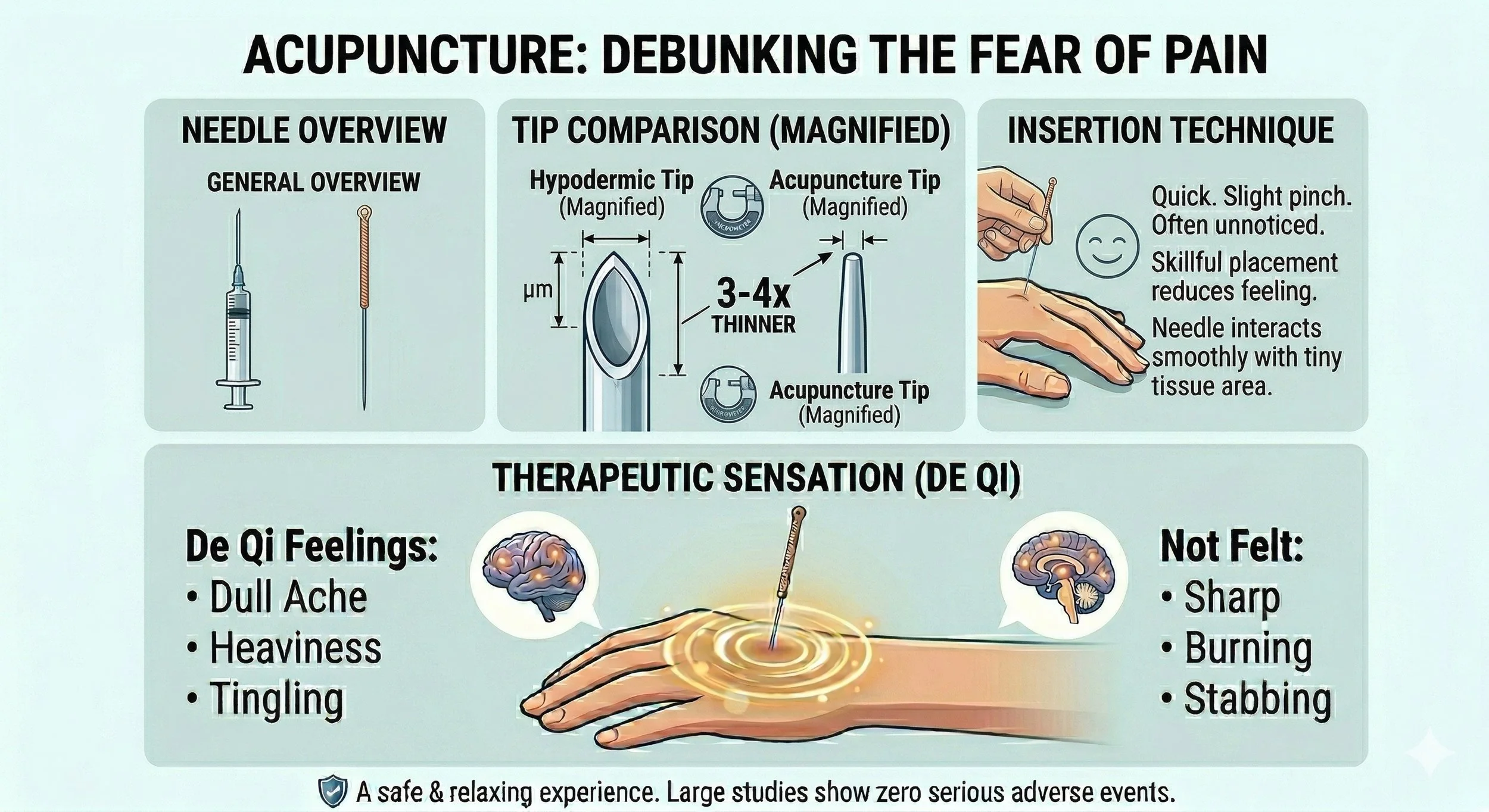
Infographic: Does Acupuncture Hurt?
What Acupuncture Needles Actually Feel Like
If you've been thinking about trying acupuncture but keep putting it off because of the needles, you're not alone. Fear of needle pain is one of the most common reasons people delay or avoid treatment altogether. The good news is that acupuncture needles aren't what most people picture, and the sensations they produce are usually very different from what you'd expect.
This post covers what acupuncture needles actually feel like during insertion and treatment, how they compare to the needles you encounter at a doctor's office, what the therapeutic sensation called De Qi is and why it matters, and what the safety research says about adverse events for both traditional acupuncture and dry needling.
| Key Points |
|---|
| Acupuncture needles are solid, not hollow, and typically 3 to 4 times thinner than a standard hypodermic needle. |
| Most patients report little to no pain during needle insertion when performed by a skilled practitioner. |
| The therapeutic sensation known as De Qi (a dull ache, heaviness, or tingling) is distinct from sharp pain and may be associated with clinical effectiveness. |
| Neuroimaging research suggests De Qi sensations and sharp pain activate different brain regions. |
| Traditional acupuncture sessions are generally very relaxing, with many patients falling asleep during the needle retention period. |
| Dry needling may produce more intense sensations during treatment, but patients often relax deeply once the active needling is complete. |
| Prospective safety surveys of over 34,000 acupuncture treatments have reported zero serious adverse events. |
Nervous About Your First Acupuncture Session?
At Morningside Acupuncture, we specialize in making first-time patients comfortable with both acupuncture and dry needling.
New patients get $100 off their first session.
| Book Now — $100 Off First Visit | Call or Text (917) 830-4440 |
900 West End Ave, Suite 1C — Upper West Side, NYC
Acupuncture Needles vs. Hypodermic Needles
When most people hear "needle," they think of the hypodermic needles used for blood draws, vaccines, and injections. Hypodermic needles are hollow, with a beveled (angled) tip designed to cut through tissue so that fluid can pass through. That cutting action is what produces the familiar sting.
Acupuncture needles are fundamentally different. They're solid filiform needles with a rounded, tapered tip that pushes tissue aside rather than cutting it. This design results in significantly less tissue disruption and, consequently, far less pain on insertion.
The size difference is substantial. Most acupuncture needles range from 0.16mm to 0.25mm in diameter. A standard hypodermic needle used for injections is approximately 0.7mm to 0.8mm. That makes acupuncture needles roughly three to four times thinner. The finest Japanese-style needles (0.12mm) are about the width of a single human hair.
| Feature | Acupuncture Needle | Hypodermic Needle |
|---|---|---|
| Construction | Solid (filiform) | Hollow |
| Tip Design | Rounded, tapered | Beveled (cutting edge) |
| Typical Diameter | 0.16mm to 0.25mm | 0.7mm to 0.8mm |
| Tissue Interaction | Separates tissue | Cuts tissue |
| Purpose | Stimulate tissue and nervous system | Deliver or withdraw fluid |
What Does Needle Insertion Feel Like?
In most cases, patients feel very little during needle insertion itself. A skilled practitioner using a guide tube (a small plastic tube that stabilizes the needle) can insert the needle through the skin in a fraction of a second. Many patients don't realize a needle has been placed until the practitioner tells them.
When a sensation is felt, it's typically a brief, mild pinch at the skin surface that disappears within a second. This is comparable to the sensation of plucking a single hair from your arm.
Certain body areas are naturally more sensitive than others. The hands and feet tend to produce slightly stronger sensations during insertion. Points near tendons, between bones, or on the face (which has a high density of nerve endings) may also be more noticeable. A good practitioner accounts for these differences by adjusting needle gauge, insertion speed, and technique based on the treatment area and the patient's individual sensitivity.
Understanding De Qi: The Therapeutic Sensation
Once the needle is through the skin and positioned in the muscle, the practitioner may gently manipulate it by rotating, lifting, or pressing slightly deeper. This is when patients often report a distinctive sensation that's quite different from the insertion itself.
Patients commonly describe this as a dull ache, heaviness, mild pressure, warmth, tingling, or a sensation of the muscle being "grabbed." In acupuncture terminology, this composite sensation is called De Qi (pronounced "duh chee"). It occupies a space between pleasant and mildly uncomfortable, similar to the deep pressure of a firm massage on a tight muscle.
A classification study by MacPherson and Asghar (2006) surveyed 20 international acupuncture experts and identified seven sensations associated with De Qi: aching, dull, heavy, numb, radiating, spreading, and tingling. A separate cluster of sensations, including burning, sharp, stinging, and pricking, was associated with acute pain at the needle site rather than the therapeutic response.
Why De Qi May Matter for Treatment Outcomes
Research suggests that De Qi sensations and sharp pain produce measurably different neurological responses. A functional MRI study by Asghar et al. (2010) found that when subjects reported predominantly De Qi sensations during needling, their brain scans showed significant deactivations in limbic and subcortical structures. When subjects reported predominantly sharp pain instead, the pattern reversed, with activations appearing in pain-processing regions.
A 2024 study published in Frontiers in Neuroscience found that needle sensation intensity was positively correlated with increased vagal (parasympathetic) activity. The analgesic effects of acupuncture appeared concurrently with these autonomic nervous system changes within five minutes of needling. This suggests that the dull, heavy sensation many patients feel isn't a side effect. It may be part of how the treatment produces its therapeutic effects.
How Acupuncture and Dry Needling Differ in Sensation
The sensation you experience during treatment depends significantly on the style of acupuncture being used. There are dozens of approaches, and each uses different needle gauges, depths, and manipulation techniques.
Traditional Acupuncture
During a traditional acupuncture session, needles are inserted and then retained (left in place) while the patient rests, typically for 20 to 30 minutes. This retention period is usually deeply relaxing. The majority of patients at our clinic fall asleep during this phase. The combination of the needles producing subtle neurological input and the stillness of resting tends to shift the nervous system into a calm, parasympathetic-dominant state.
Dry Needling
Dry needling is a more active treatment approach. Instead of retaining needles for extended periods, the practitioner targets specific trigger points in muscles, often producing local twitch responses (brief, involuntary muscle contractions). These sensations are more intense than what most patients experience during traditional acupuncture.
However, once the active needling is complete, patients often rest on the table, sometimes with heat lamps, and many still fall asleep. The transition from the intensity of trigger point work to deep relaxation can happen remarkably quickly.
Not Sure What's Causing Your Pain?
Use our interactive Trigger Point Pain Finder to identify which muscles and trigger points may be contributing to your symptoms.
Safety and Adverse Events
Acupuncture has a strong safety profile supported by large prospective studies. A survey of over 34,000 acupuncture treatments published in the BMJ by MacPherson et al. (2001) reported zero serious adverse events. Minor adverse events (such as temporary nausea or prolonged soreness) occurred at a rate of approximately 1.3 per 1,000 treatments. The most common local reaction was mild bruising, reported after about 1.7% of treatments. The most frequently reported reactions overall were feeling relaxed (11.9%) and feeling energized (6.6%). A separate survey of 32,000 consultations by White et al. (2001) produced similarly reassuring findings.
Dry Needling Adverse Events
Dry needling tends to produce a higher rate of minor reactions compared to traditional acupuncture. A prospective survey of over 20,000 dry needling treatments by Gattie et al. (2020) found bleeding in approximately 16% of sessions, bruising in 7.7%, and pain during treatment in 5.9%. No significant adverse events were reported.
It's worth noting that this study surveyed physical therapists who generally complete shorter dry needling training programs and often use thicker gauge needles than licensed acupuncturists. This isn't necessarily an apples-to-apples comparison. To date, no studies have compared adverse event rates for dry needling when performed by acupuncturists versus other provider types, which would be a valuable area for future research.
When compared with the adverse event profiles of commonly prescribed pain medications or over-the-counter NSAIDs, acupuncture and dry needling both present a relatively low-risk treatment option.
| Frequently Asked Questions | |
|---|---|
| Q: Does acupuncture hurt more than a shot or blood draw? | No. Acupuncture needles are solid and roughly 3 to 4 times thinner than hypodermic needles. Most patients report minimal to no sensation during insertion. |
| Q: What is that dull, achy feeling during acupuncture? | That's De Qi, a composite therapeutic sensation that may include heaviness, dull aching, tingling, or warmth. Research suggests it's associated with the treatment's neurological effects and is distinct from sharp pain. |
| Q: Is dry needling more painful than traditional acupuncture? | Dry needling typically produces more intense sensations during treatment because it targets trigger points and often elicits local twitch responses. However, the intensity is temporary, and most patients relax deeply once the active needling portion is complete. |
| Q: Will I bruise after acupuncture? | Mild bruising may occur in approximately 1.7% of acupuncture treatments according to prospective safety data. Bruising rates tend to be somewhat higher with dry needling. Any bruising is typically minor and resolves within a few days. |
| Q: Are there areas of the body where acupuncture hurts more? | The hands, feet, and face tend to be more sensitive due to higher nerve density. Points near tendons or between bones may also produce stronger sensations. A skilled practitioner adjusts their technique based on the treatment area and the patient's individual sensitivity. |
| Q: Is acupuncture safe? | Large prospective studies totaling over 66,000 treatments have reported zero serious adverse events from acupuncture. When compared with commonly used pain medications, acupuncture has a very favorable safety profile. |
| Q: Do people actually fall asleep during acupuncture? | Yes. During traditional acupuncture sessions, it's very common for patients to fall asleep during the retention period when needles are left in place for 20 to 30 minutes. Many patients describe it as the most relaxed they've felt all week. |
Schedule an Appointment at Morningside Acupuncture
If you've been curious about acupuncture or dry needling but worried about needle pain, we're happy to answer any questions before your first visit. At Morningside Acupuncture, we treat athletes, runners, and anyone dealing with pain at our Upper West Side clinic. New patients receive $100 off their first session.
Ready to Try Acupuncture?
Experience acupuncture and dry needling at Morningside Acupuncture on the Upper West Side.
New patients get $100 off their first session.
| Book Now — $100 Off | Call or Text (917) 830-4440 |
References
Asghar, A. U., Green, G., Lythgoe, M. F., Lewith, G., & MacPherson, H. (2010). Acupuncture needling sensation: The neural correlates of deqi using fMRI. BMC Complementary and Alternative Medicine, 10, 8. https://pubmed.ncbi.nlm.nih.gov/20025853/
Gattie, E., Cleland, J. A., & Snodgrass, S. (2020). Adverse events associated with therapeutic dry needling. International Journal of Sports Physical Therapy, 15(1), 103–113. https://pubmed.ncbi.nlm.nih.gov/32089962/
MacPherson, H., & Asghar, A. (2006). Acupuncture needle sensations associated with De Qi: A classification based on experts' ratings. Journal of Alternative and Complementary Medicine, 12(7), 633–637. https://pubmed.ncbi.nlm.nih.gov/16970533/
MacPherson, H., Thomas, K., Walters, S., & Fitter, M. (2001). The York acupuncture safety study: Prospective survey of 34,000 treatments by traditional acupuncturists. BMJ, 323(7311), 486–487. https://pubmed.ncbi.nlm.nih.gov/11532841/
Wang, Z., Wang, X., & Liu, J. (2024). Effect of "needle sensation" and the real-time changes in autonomic nervous system activity during acupuncture analgesia. Frontiers in Neuroscience, 18, 1349059. https://www.frontiersin.org/journals/neuroscience/articles/10.3389/fnins.2024.1349059/full
White, A., Hayhoe, S., Hart, A., & Ernst, E. (2001). Adverse events following acupuncture: Prospective survey of 32,000 consultations with doctors and physiotherapists. BMJ, 323(7311), 485–486. https://pubmed.ncbi.nlm.nih.gov/11532840/
Disclaimer: This content is for informational purposes only and does not constitute medical advice. Consult a licensed healthcare provider before beginning any new treatment. Results may vary.
Disclaimer: This web site is intended for educational and informational purposes only. Reading this website does not constitute providing medical advice or any professional services. This information should not be used for diagnosing or treating any health issue or disease. Those seeking medical advice should consult with a licensed physician. Seek the advice of a medical doctor or other qualified health professional for any medical condition. If you think you have a medical emergency, call 911 or go to the emergency room. No acupuncturist-patient relationship is created by reading this website or using the information. Morningside Acupuncture PLLC and its employees and contributors do not make any express or implied representations with respect to the information on this site or its use. For any legal interpretation of scope of practice in your state, consult a licensed attorney or regulatory authority.
Read more from our blog