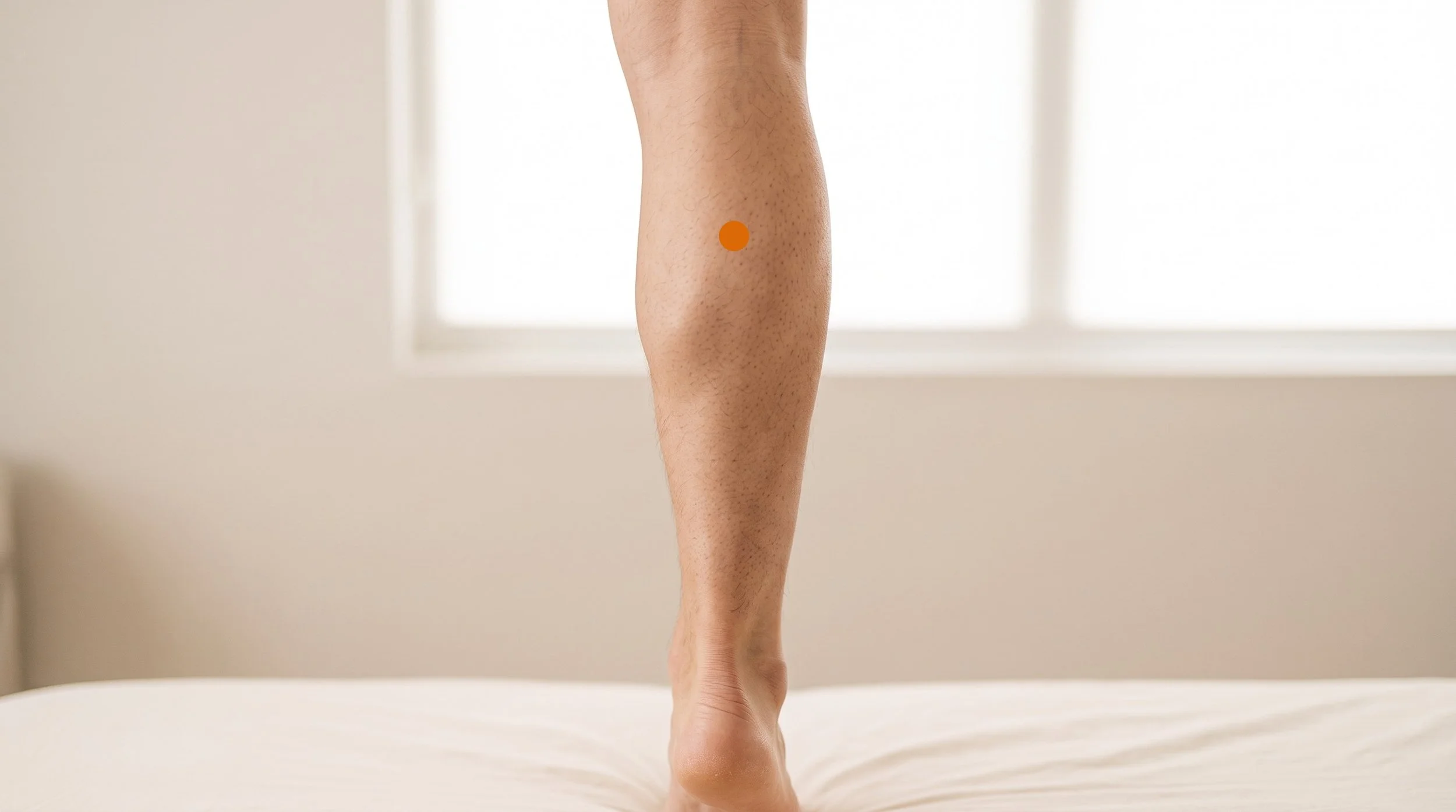
BL56 Acupuncture Point (Chengjin)
Support the Sinews in the Belly of the Calf: Anatomy, Mechanism, and Why BL56 Is a Working Point for Cramps, Heel Pain, and Low Back Tightness
BL56, known in Chinese as Chengjin and usually translated as Support the Sinews, sits in the thickest part of the calf, halfway between BL55 and BL57 and about 5 cun below the crease of the knee at BL40.
In plain terms, if you run your thumb down the back of the calf from the knee crease and stop where the muscle is fullest, you are on or very near the bl56 acupuncture point. It is not one of the famous command points, yet clinicians keep coming back to it, because that patch of gastrocnemius is exactly where night cramps grip, where runners and dancers build dense taut bands, and where pain that shows up under the heel is often generated.
Classical sources group Chengjin with BL57 as the two proximal points that reach the heel, and the same location gives access to a muscle mass tied by nerve segment and by fascia to the low back, the Achilles, and the plantar surface of the foot.
- Location and layers: bladder 56 lies in the center of the gastrocnemius belly, midway between BL55 and BL57, with the needle passing through skin and subcutaneous tissue into the two heads of gastrocnemius and, with deeper insertion, toward the soleus beneath (Deadman et al., 2007).
- Traditional attributions translated: classical texts credit Chengjin with relaxing the sinews, freeing the channel, easing pain, and benefiting the foot and heel, language that maps neatly onto reduced muscle tone, improved local circulation, and modulated nociception rather than any literal flow of energy (Deadman et al., 2007).
- Nerve story: the point sits in medial sural cutaneous territory with tibial nerve branches deeper, sharing S1 and S2 segmental input with the Achilles, heel, and lower lumbar tissues, which gives a plausible convergence route for referred and shared pain (Zhao, 2008).
- Research picture: no trial has isolated BL56 on its own, so the honest evidence base is multi-point acupuncture for chronic low back pain (Mu et al., 2020) and chronic musculoskeletal pain (Vickers et al., 2018), plus heel-pain reviews of acupuncture and calf-focused needling (Clark & Tighe, 2012; Llurda-Almuzara et al., 2021).
- Clinical framing: several classical texts list this point as contraindicated to needling, so many practitioners either treat it gently or work the immediately surrounding tissue, and modern manuals allow perpendicular insertion of roughly 1 to 1.5 cun with moxibustion (Deadman et al., 2007).
- De qi at bl 56 calf level is usually a deep, heavy, slightly achy fullness that spreads up toward the knee crease or down along the Achilles, and when a taut band is engaged patients may feel a brief involuntary twitch (Simons et al., 1999).
Waking Up to Calf Cramps or Tight, Heavy Legs?
Night cramps and stubborn calf tightness rarely respond to stretching alone, especially when the muscle has developed dense, tender bands through the belly. At Morningside Acupuncture we needle BL56 and the surrounding gastrocnemius and soleus tissue, then add loading and mobility work so the calf tolerates walking, running, and stairs again. Treatment is paired with a full lower limb assessment, because ankle stiffness and hip mechanics often keep feeding the problem. Schedule a visit and let's get your calves quiet at night.
Schedule NowAnatomy of BL56: Why the Gastrocnemius Belly Is Such an Important Location
BL56 sits at the fullest part of the calf, where the medial and lateral heads of gastrocnemius are still broad and thick before they taper toward the Achilles tendon. Under the skin and a thin subcutaneous layer, a needle enters gastrocnemius directly, and with deeper insertion it approaches the soleus that lies underneath. This is a high-load region: gastrocnemius crosses both the knee and the ankle, so it is working during every push-off, every stair, every hill, and every sprint.
Add prolonged standing, heeled shoes, sudden increases in running volume, or long flights, and the tissue at this exact spot commonly becomes dense, tender, and prone to cramping.
The nerve geography explains much of the point's reach. Superficially the region belongs to medial sural cutaneous territory, while deeper branches come from the tibial nerve, and the same S1 and S2 segments supply the Achilles, the posterior heel, and part of the lumbosacral tissues (Deadman et al., 2007). When inputs from different structures converge on shared dorsal horn neurons, the nervous system can localize pain poorly, so calf dysfunction may be felt at the heel and heel irritation may keep the calf guarded.
Needling into this segmental territory produces strong afferent input that engages spinal gating and descending inhibitory pathways involving endogenous opioid and monoamine systems, which is the most supported explanation for why a needle in the calf can change how the heel and lower back feel (Zhao, 2008). Local effects matter as well, since needle stimulation can alter blood volume and tissue oxygenation in the muscle being treated (Kimura et al., 2015).
Deep to the muscle lie the posterior tibial vessels and the tibial nerve, with the small saphenous vein running superficially in the midline region, so depth and angle are not casual choices here. Standard modern guidance is perpendicular insertion of roughly 1 to 1.5 cun, with moxibustion considered appropriate, though several classical texts list Chengjin as contraindicated to needling, which is why many practitioners favor moderate depth and gentle stimulation (Deadman et al., 2007).
Just as important is patient screening: a painful, swollen, warm, or unilaterally enlarged calf needs medical evaluation to exclude deep vein thrombosis before any needling or firm pressure is applied.
Related Calf Pain Treatment NYC Related Gastrocnemius Trigger PointsBL56 at a Glance: Classification, Location, and Clinical Use
| Category | Detail |
|---|---|
| Traditional Name | Chengjin (Support the Sinews), Bladder 56 |
| Channel Classification | Bladder channel of Foot Taiyang, lower leg region (BL56, also written UB56; also called the Urinary Bladder channel) |
| Point Categories | A regular channel point with no five-shu, luo-connecting, xi-cleft, or extraordinary vessel designation in the classical literature; grouped with BL57 as one of the two principal proximal points affecting the foot and heel, and noted in several classical texts as contraindicated to needling (Deadman et al., 2007) |
| Precise Location | Posterior lower leg, 5 cun below BL40 on the line toward BL57, midway between BL55 and BL57, in the center of the gastrocnemius belly |
| Tissue Stimulated | Skin and subcutaneous tissue over the medial and lateral heads of the gastrocnemius, with deeper insertion approaching the soleus; medial sural cutaneous territory superficially, tibial nerve branches deeper |
| Needle Depth / Direction | Perpendicular, approximately 0.8 to 1.5 cun depending on build; moxibustion is commonly applied, and gentler technique is often preferred given the classical caution |
| De Qi Sensation | Deep, heavy, spreading ache through the calf that may travel toward the knee crease or down along the Achilles; a brief muscle twitch is possible when a taut band is engaged |
| Primary Clinical Uses | Calf cramp and calf tightness, posterior leg pain, plantar and posterior heel pain treated together with local points, low back pain with tight posterior chain, and hemorrhoids in classical listings |
| Common Point Combinations |
|
In A Manual of Acupuncture, Deadman and colleagues present Chengjin through its name: a point that supports the sinews, traditionally indicated for contraction and pain of the muscles, especially in the calf and lumbar region. They also make a broader observation about channel behavior, namely that Bladder channel points become progressively more capable of influencing the entire channel as they move distally, and BL56 is described in exactly those terms, with traditional indications spanning the head (headache, dizziness, heat in the head, nosebleed, nasal congestion), the low back, the calf, and the heel.
Heel pain in particular is framed as a problem that needs proximal treatment rather than local needling alone, and BL56 with BL57 are named as the two chief proximal points for that region. The classical listings also include hemorrhoids and swelling of the axilla, which the text explains by way of Bladder sinew and divergent channel pathways that reach the armpit and encircle the anus.
What is striking is how coherent this looks through a modern lens: a single calf location credited with influencing the heel below it, the low back above it, and structures that share its segmental innervation, all attributed centuries before anyone described a dorsal horn.
Why BL56 Is Used for Heel Pain That Starts Far From the Heel
Patients with plantar heel pain often describe the classic pattern of sharp pain on the first steps out of bed, and they usually assume the problem is entirely in the sole of the foot. The calf tells a different story. Gastrocnemius and soleus feed the Achilles, which anchors into the same calcaneus that the plantar fascia pulls on, so a stiff or overloaded calf changes how the heel is loaded with every step.
Layered on top of that mechanical link is a neurological one: the calf, the Achilles, and the heel share S1 and S2 innervation, so sensory input from these tissues converges within the same spinal segments, which helps explain why pain is often felt at the heel while the more irritable tissue sits higher up the leg (Zhao, 2008). Classical practice arrived at a similar conclusion from clinical observation alone, listing BL56 and BL57 as the proximal points required alongside local heel treatment (Deadman et al., 2007).
Mechanistically, needling BL56 delivers strong input from muscle and connective tissue afferents into that segmental territory. Experimental work indicates that this input recruits spinal and supraspinal pain modulation involving endogenous opioids and descending monoaminergic pathways, effects that outlast the needling session itself (Zhao, 2008). Locally, needle stimulation appears able to change muscle blood volume and oxygenation in the treated tissue, which is a plausible contributor when the target is a dense, chronically loaded calf (Kimura et al., 2015).
Neither mechanism requires any appeal to energy flow, and neither guarantees a result in a given patient, but together they offer a reasonable account of why proximal calf needling often reduces heel symptoms.
The same logic applies upward. Patients with chronic low back pain frequently present with a rigid posterior chain, limited ankle dorsiflexion, and tender calf tissue, and treating only the lumbar region can leave that pattern untouched. Adding BL56 gives an option along the Bladder channel that is comfortable to needle in prone position, complements local lumbar points, and fits the classical description of a point for contraction and pain of the lumbar spine and lower leg (Deadman et al., 2007).
What the Research Shows for BL56
It is worth being direct about what the evidence can and cannot say. No randomized trial has tested BL56 in isolation, and single-point studies are rare in acupuncture research generally, because real treatment uses combinations. What exists is trial and review evidence for multi-point acupuncture and for needling of the calf musculature in the conditions this point is traditionally used for, meaning low back pain, plantar heel pain, and calf cramping.
Read the table below as context for a reasonable clinical role rather than proof of a point-specific effect, and note that effect sizes in this literature are usually modest and the certainty of evidence often low to moderate.
| Study | Type | Focus | Key Finding |
|---|---|---|---|
| Mu et al., 2020 | Cochrane systematic review | Acupuncture for chronic nonspecific low back pain | Acupuncture may reduce pain and improve function compared with no treatment or usual care, with smaller and less certain differences against sham, and the review authors judged the certainty of evidence to be low to moderate. |
| Vickers et al., 2018 | Individual patient data meta-analysis | Acupuncture for chronic musculoskeletal, headache, and osteoarthritis pain | Pooled patient-level data suggest acupuncture is superior to both sham and no-acupuncture control for chronic pain, with effects that persist over about 12 months, though the sham comparison difference is modest. |
| Clark & Tighe, 2012 | Systematic review | Acupuncture for plantar heel pain | The authors reported evidence supporting acupuncture for plantar heel pain that is broadly comparable to commonly used conventional options, while noting substantial heterogeneity across trials. |
| Llurda-Almuzara et al., 2021 | Systematic review and meta-analysis | Dry needling for plantar heel pain, including calf muscle targets | Low to moderate quality evidence suggests trigger point dry needling may reduce pain intensity in the short term and pain-related disability over longer follow-up, based on a small number of trials. |
| Cotchett et al., 2014 | Randomized controlled trial | Trigger point dry needling for plantar heel pain | Real needling produced statistically significant reductions in first-step pain compared with sham at six weeks, although the between-group difference fell below the minimal important difference and minor transient adverse events were more frequent. |
| Temel et al., 2023 | Randomized controlled trial | Dry needling of gastrocnemius trigger points added to stretching for nocturnal calf cramps | Outcomes favored adding needling to a stretching program, but the trial was small and single center, so the result should be treated as preliminary. |
| Kimura et al., 2015 | Physiological crossover study | Electroacupuncture frequency and muscle oxygenation measured by near-infrared spectroscopy | Needle stimulation was associated with frequency-dependent changes in tissue oxygenation index during and after treatment, supporting a local vascular component to needling effects in muscle. |
Heel Pain That Has Not Improved With Insoles and Rolling?
Plantar heel pain is often treated only at the heel, which misses the calf that pulls on it. We use the chengjin heel pain point alongside BL57, BL60, and tender points in the arch, so the whole posterior chain gets addressed in one session. Most patients also leave with a simple loading plan for the calf and foot, since needling works best when the tissue is being trained. Book an evaluation and we'll map where your heel pain is actually coming from.
Schedule NowBL56 in the Context of Trigger Point Work
Acupuncture is defined by the tool, an acupuncture needle, and it includes hundreds of styles, dry needling among them. That matters at BL56, because this point sits directly over territory that trigger point clinicians target every day. Referral patterns described in the trigger point literature place gastrocnemius referral along the posteromedial calf, into the instep and arch, while soleus involvement refers strongly toward the heel and posterior ankle (Simons et al., 1999).
In other words, the classical claim that this calf point benefits the foot and heel and the myofascial claim that calf taut bands refer to the heel are describing overlapping clinical territory from two different vocabularies.
In practice at Morningside, we palpate the calf before choosing depth or technique. If a firm band with a tender nodule sits at or near the BL56 location, we may needle it directly and look for a local twitch response, then extend the treatment to BL57, BL55, and the soleus below, adding BL60 and ashi points at the heel when plantar symptoms are present. Manual therapy, ankle mobility work, and progressive calf loading such as heel raises follow, since needling reduces irritability but loading is what builds tolerance.
Patients with night cramps usually also get guidance on pre-sleep calf stretching and hydration, and anyone with new unilateral calf swelling, warmth, or redness is referred for medical evaluation before treatment continues.
BL56 Calf and Heel Pain Treatment at NYC's Highest-Rated Acupuncture Clinic
Morningside Acupuncture is the highest-rated acupuncture and dry needling clinic in New York City with over 500 five-star Google reviews, and calf, heel, and low back complaints are among the conditions we see most. Our treatments combine classical point selection such as BL56 with BL57 and BL60, precise dry needling of the gastrocnemius and soleus, and rehab guidance you can carry out between sessions. Every plan is built around your history, your training load, and your goals rather than a fixed protocol. Schedule your appointment today and start working on the tissue that is actually driving your symptoms.
Schedule NowFrequently Asked Questions
What does BL56 feel like when needled?
Most people describe a deep, heavy, dull ache spreading through the calf rather than a sharp pinch. The sensation can travel up toward the back of the knee or down along the Achilles, and it often eases within a minute or two into a warm, tired feeling like the muscle has just done a hard set of heel raises. If a taut band is engaged, you may notice a quick involuntary twitch, which is normal and brief. Some patients feel mild calf soreness for a day afterward, similar to post-exercise soreness.
Why treat the calf when my pain is under my heel?
Because the calf and the heel are linked both mechanically and neurologically. Gastrocnemius and soleus pull on the Achilles, which attaches to the same heel bone the plantar fascia loads, so calf stiffness changes heel mechanics with every step. They also share S1 and S2 segmental innervation, so sensory information from calf, Achilles, and heel converges in the same part of the spinal cord, which blurs where symptoms are felt (Zhao, 2008). Classical practice reached a similar conclusion clinically, naming BL56 and BL57 as the main proximal points to pair with local heel treatment (Deadman et al., 2007).
Can I press BL56 myself between sessions?
Yes, and it is easy to reach. Sit with the knee bent and the foot flat, find the fullest part of the calf about a third of the way down from the knee crease, and use your thumb or a knuckle to press slowly into the muscle until you feel a firm, tolerable ache of roughly four to six out of ten. Hold steady pressure for 30 to 60 seconds, release, and repeat three to five times per calf, once or twice daily. Following it with a 30 second calf stretch on a step, knee straight and then slightly bent, tends to work better than pressure alone. Skip self-pressure if the calf is swollen, warm, red, or painful in a new and unexplained way, and get that checked medically first.
Is BL56 safe to needle?
In trained hands, yes. It is worth knowing that several classical texts list Chengjin as contraindicated to needling, while modern manuals allow perpendicular insertion of roughly 0.8 to 1.5 cun with moxibustion, so many practitioners choose moderate depth and gentler stimulation here (Deadman et al., 2007). The main anatomical considerations are the small saphenous vein superficially and the tibial nerve and posterior tibial vessels deep to the muscle, which is why depth and angle are controlled rather than casual. The most important safety step is screening: acute unilateral calf pain with swelling, warmth, or redness requires medical assessment to rule out deep vein thrombosis before needling or firm massage.
Where exactly is BL56 located?
On the back of the lower leg in the center of the gastrocnemius belly, 5 cun below BL40 at the popliteal crease and midway between BL55 and BL57. The simplest way to find it is to locate BL57 first, in the depression where the two heads of the calf muscle converge above the Achilles when you rise onto the toes, then locate BL55 higher up, and take the midpoint between them. Tender, ropey tissue in that zone is common, and in practice the most reactive spot within a fingerbreadth or so is usually the one worth treating.
References
- Deadman, P., Al-Khafaji, M., & Baker, K. (2009). A manual of acupuncture. Journal of Chinese Medicine Publications.
- Cheng, X. (Ed.). (1999). Chinese acupuncture and moxibustion (Rev. ed.). Foreign Languages Press.
- Cunningham, P. M. (2000). Acupuncture points: A practical guide to classical and modern usage. Odyssey Press.
- Simons, D. G., Travell, J. G., & Simons, L. S. (1999). Travell & Simons' myofascial pain and dysfunction: The trigger point manual, Vol. 1: Upper half of body (2nd ed.). Williams & Wilkins.
- Mu, J., Furlan, A. D., Lam, W. Y., Hsu, M. Y., Ning, Z., & Lao, L. (2020). Acupuncture for chronic nonspecific low back pain. Cochrane Database of Systematic Reviews, 2020(12), CD013814. https://doi.org/10.1002/14651858.CD013814
- Vickers, A. J., Vertosick, E. A., Lewith, G., MacPherson, H., Foster, N. E., Sherman, K. J., Irnich, D., Witt, C. M., & Linde, K. (2018). Acupuncture for chronic pain: Update of an individual patient data meta-analysis. Journal of Pain, 19(5), 455-474. https://doi.org/10.1016/j.jpain.2017.11.005
- Clark, R. J., & Tighe, M. (2012). The effectiveness of acupuncture for plantar heel pain: A systematic review. Acupuncture in Medicine, 30(4), 298-306. https://doi.org/10.1136/acupmed-2012-010183
- Llurda-Almuzara, L., Labata-Lezaun, N., Meca-Rivera, T., Navarro-Santana, M. J., Cleland, J. A., Fernández-de-las-Peñas, C., & Pérez-Bellmunt, A. (2021). Is dry needling effective for the management of plantar heel pain or plantar fasciitis? An updated systematic review and meta-analysis. Pain Medicine, 22(7), 1630-1641. https://doi.org/10.1093/pm/pnab114
- Cotchett, M. P., Munteanu, S. E., & Landorf, K. B. (2014). Effectiveness of trigger point dry needling for plantar heel pain: A randomized controlled trial. Physical Therapy, 94(8), 1083-1094. https://doi.org/10.2522/ptj.20130255
- Temel, M. H., Çelik, Y., Bozdağ, M., & Bağcıer, F. (2023). Does dry needling contribute to conventional treatment on nocturnal calf cramps? A randomized controlled study. Turkish Journal of Osteoporosis, 29(3), 170-176. https://doi.org/10.4274/tod.galenos.2023.54254
- Kimura, K., Ryujin, T., Uno, M., & Wakayama, I. (2015). The effect of electroacupuncture with different frequencies on muscle oxygenation in humans. Evidence-Based Complementary and Alternative Medicine, 2015, 620785. https://doi.org/10.1155/2015/620785
- Zhao, Z. Q. (2008). Neural mechanism underlying acupuncture analgesia. Progress in Neurobiology, 85(4), 355-375. https://doi.org/10.1016/j.pneurobio.2008.05.004
Disclaimer: This web site is intended for educational and informational purposes only. Reading this website does not constitute providing medical advice or any professional services. This information should not be used for diagnosing or treating any health issue or disease. Those seeking medical advice should consult with a licensed physician. Seek the advice of a medical doctor or other qualified health professional for any medical condition. If you think you have a medical emergency, call 911 or go to the emergency room. No acupuncturist-patient relationship is created by reading this website or using the information. Morningside Acupuncture PLLC and its employees and contributors do not make any express or implied representations with respect to the information on this site or its use. For any legal interpretation of scope of practice in your state, consult a licensed attorney or regulatory authority.
Read more from our blog



