BL53 Acupuncture Point (Baohuang)
Bladder's Vitals on the Buttock: Anatomy, Mechanism, and Why BL53 Belongs in Every Sciatica and Low Back Pain Exam
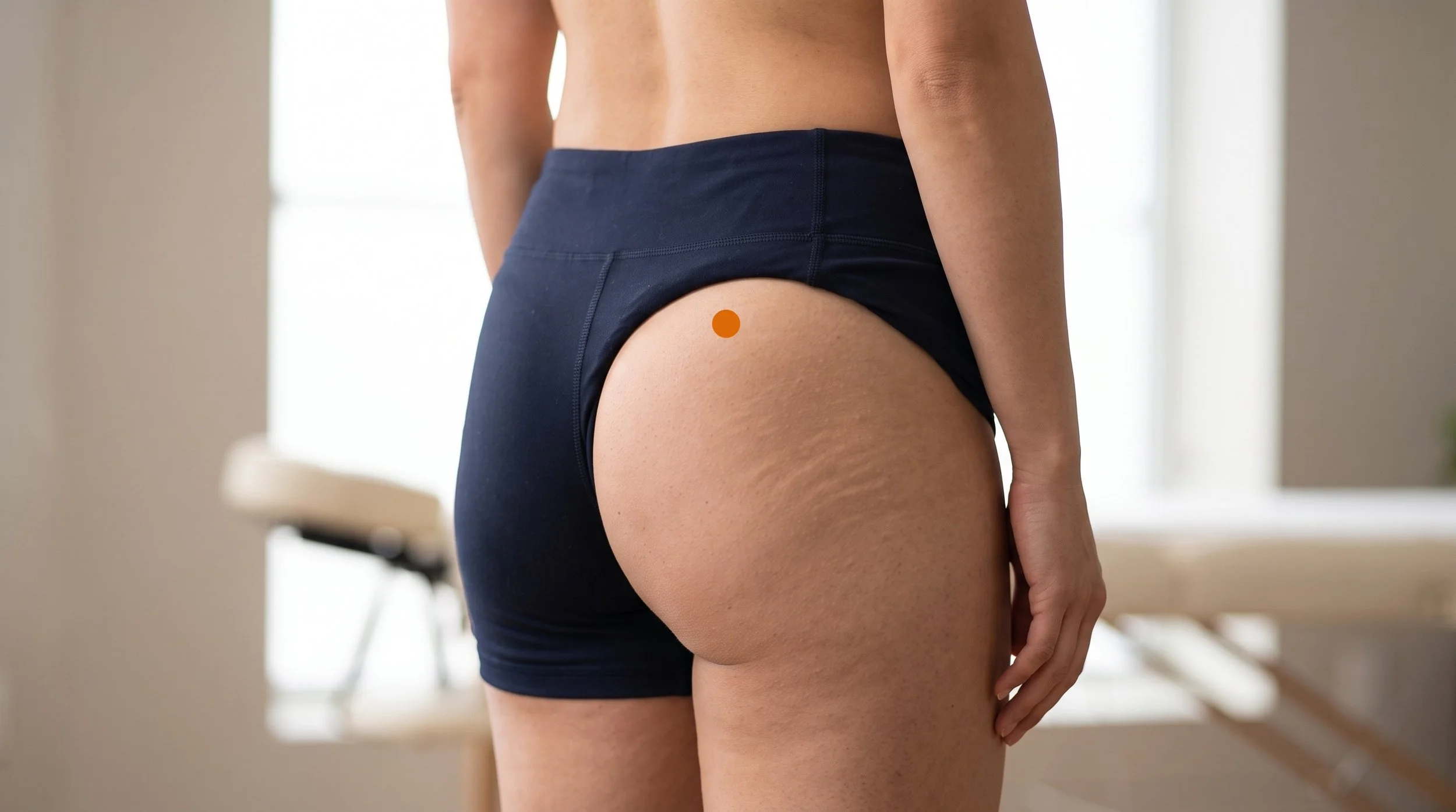
BL53 (Baohuang, often translated as Bladder's Vitals) sits on the buttock about three cun out from the midline, level with the second sacral foramen and directly lateral to BL28 on the inner Bladder line.
In plain terms, it's the spot you find by sliding your thumb sideways from the upper sacrum into the thick muscle of the upper buttock, roughly halfway between the spine and the outer edge of the hip when the tissue is pressed in. That location is why the bl53 acupuncture point earns its place in clinic: it sits over the gluteus maximus and medius in superior cluneal and superior gluteal nerve territory, exactly where patients with lumbar stiffness, deep buttock ache, and leg-radiating pain tend to be most tender.
Classical texts also credit bladder 53 with influence over urination and lower abdominal fullness, which makes it an unusually versatile point for its region.
- Location and layers: BL53 lies 3 cun lateral to the midline at the level of the second sacral vertebra's spinous process, level with BL28, passing through skin and subcutaneous fat into gluteus maximus and the deeper gluteus medius (Deadman et al., 2007).
- Traditional attributions translated: classical sources list BL53 for lumbar pain and stiffness, sciatica, hypogastric hardness and fullness, retention or dribbling of urine, and abdominal distention, a cluster that maps neatly onto lumbosacral segmental territory rather than any single organ (Deadman et al., 2007).
- Nerve story: the superficial field belongs to the superior cluneal nerves, with the superior gluteal nerve and vessels deeper, so needling here recruits both cutaneous and deep muscular afferents that converge on lumbosacral dorsal horn segments (Zhao, 2008).
- Research picture: reviews and trials support needling for chronic low back pain and for sciatica from disc herniation, though protocols are multi-point and no trial isolates BL53 by itself (Mu et al., 2020; Tu et al., 2024; Vickers et al., 2018).
- Clinical framing: along with BL54 and GB30, BL53 is one of three deep gluteal points that experienced practitioners palpate in any presentation where pain travels from the low back into the buttock and down the leg, needling those that reproduce or reduce the patient's familiar ache (Deadman et al., 2007).
- De qi: patients usually report a deep, spreading heaviness or dull soreness in the buttock rather than a surface pinch, sometimes with a brief referral toward the hip or upper thigh that resembles gluteal trigger point referral patterns (Simons et al., 1999).
Is Buttock Pain Following You Down the Leg?
Deep gluteal tenderness that flares with sitting, stairs, or a long walk often responds to careful needling of the BL53 region alongside the rest of the lumbosacral pattern. At Morningside Acupuncture we palpate BL53, BL54, and GB30 before choosing anything, so treatment targets the tissue that actually reproduces your symptoms. We combine that with movement advice you can use between visits. Book a session and let's map where your pain is really coming from.
Schedule NowAnatomy of BL53: Why the Sacral Edge of the Gluteal Mass Is Such an Important Location
From the surface down, a needle at BL53 passes through skin, a subcutaneous fat layer that varies widely between patients, and the tough gluteal fascia before entering gluteus maximus. Slightly deeper and toward the iliac crest lies gluteus medius, the primary frontal-plane stabilizer of the pelvis. This corner of the buttock takes load constantly: it decelerates the pelvis every time you take a step on one leg, absorbs the shear of hip hinging, and gets compressed for hours during desk work, cycling, and long subway commutes.
Tissue here becomes dense and locally tender long before anyone notices a mobility problem, which is one reason baohuang so often reads as sore under the thumb in chronic low back cases.
The nerve geography explains the point's reach. The superficial territory belongs to the superior cluneal nerves, cutaneous branches of the upper lumbar dorsal rami that cross the iliac crest, while deeper the superior gluteal nerve and its accompanying vessels supply the abductor group (Deadman et al., 2007). Stimulating both a cutaneous field and a deep muscular field at the same segmental levels feeds a dense afferent barrage into lumbosacral spinal cord segments, where somatic inputs from skin, muscle, joint, and viscera converge on shared second-order neurons.
That convergence is the practical basis for two things patients notice: why a needle in the buttock can change how the low back feels, and why the traditional indications for this region include lower abdominal and urinary complaints. Experimental work on needling analgesia describes segmental inhibition at the dorsal horn plus recruitment of descending pain-modulating pathways and endogenous opioid systems as the core mechanisms (Zhao, 2008).
The main structure to respect at depth is the neurovascular bundle that emerges from the greater sciatic foramen, including the superior gluteal artery and vein, with the sciatic nerve running further inferolateral toward the BL54 and GB30 region. Standard references give perpendicular insertion of roughly 1 to 1.5 cun, with some texts allowing slightly deeper needling in larger patients (Deadman et al., 2007; Chinese Acupuncture and Moxibustion).
In practice, depth is chosen from palpated tissue thickness rather than a fixed number, the angle stays perpendicular or slightly lateral away from the sacral foramina, and a sharp electric sensation shooting down the leg is a signal to withdraw and redirect rather than a treatment goal.
Related Best Acupuncture Points For Sciatica Related Acupuncture For Gluteus Medius Trigger PointsBL53 at a Glance: Classification, Location, and Clinical Use
| Category | Detail |
|---|---|
| Traditional Name | Baohuang (BL53), commonly rendered as Bladder's Vitals or Bladder Huang; also written bladder 53 |
| Channel Classification | Bladder channel of Foot Taiyang, outer (lateral) Bladder line on the buttock (BL53, also written UB53; also called the Urinary Bladder channel) |
| Point Categories | No five-shu, back-shu, meeting, or extraordinary vessel designations in the classical literature. BL53 is an outer Bladder line point sitting lateral to BL28, the back-shu point of the Bladder, and it belongs to the small group of points whose names contain 'huang' (with BL43, BL51, and KI16), a grouping discussed in Maciocia's channel text as a traditional relationship rather than a formal point category. |
| Precise Location | On the buttock, 3 cun lateral to the posterior midline at the level of the second sacral vertebra's spinous process (level with the second posterior sacral foramen and with BL28). An alternative method places it midway between the midline and the lateral edge of the buttock when that edge is pressed firmly inward with the palm. |
| Tissue Stimulated | Skin and subcutaneous tissue in superior cluneal nerve territory, gluteal fascia, gluteus maximus, and the deeper gluteus medius, with gluteus minimus relevant to nearby referral patterns |
| Needle Depth / Direction | Perpendicular insertion, generally 1 to 1.5 cun, adjusted to body habitus; angle stays perpendicular or slightly lateral, away from the sacral foramina and away from the deeper sciatic nerve territory near BL54 |
| De Qi Sensation | A deep, dull, spreading heaviness or ache in the buttock, sometimes with a brief pressure sensation traveling toward the hip or upper thigh; sharp electrical shooting down the leg is not the target and prompts repositioning |
| Primary Clinical Uses | Lumbar pain and stiffness, deep buttock pain, sciatica-pattern leg radiation, gluteal trigger point tenderness, and (in classical use) hypogastric fullness with difficult or dribbling urination |
| Common Point Combinations |
|
Deadman's A Manual of Acupuncture presents BL53 as a workhorse for lumbar pain and stiffness and for sciatica, and it makes a specific practice recommendation: whenever pain travels into the buttock and down the leg, this point should be palpated along with BL54 and GB30, and needled if it's tender.
The same text notes the point's position lateral to BL28, the Bladder's back-shu point, and attributes to it a regulating influence over urination and, to a lesser degree, bowel function, listing traditional indications such as difficult or dribbling urination, inability to urinate or move the bowels, hypogastric hardness and fullness, edema, borborygmus, and abdominal distention. Those are presented as traditional attributions, not modern claims.
What's striking is the pairing itself: a point buried in the thick muscle of the buttock that classical authors expected to influence both the mechanics of the low back and the function of the pelvic floor and bladder, a combination that makes more sense once you notice both territories share the same spinal segments.
Why BL53 Is Used for Urinary Symptoms and Pelvic Heaviness, Not Just Buttock Pain
Patients are usually surprised that a point in the buttock shows up in classical lists for urinary difficulty and lower abdominal fullness. The explanation isn't mysterious. The tissues around BL53 are supplied by nerves arising from the lower lumbar and upper sacral segments, and those same segments carry autonomic and sensory traffic to and from the bladder, pelvic floor, and lower bowel.
Sensory information from skin, muscle, and viscera converges on shared neurons in the dorsal horn, which is why deep somatic stimulation in one territory can shift how a neighboring territory feels and, to a limited extent, how it behaves (Zhao, 2008).
Modern research on needling for urinary retention is mostly built around lower abdominal and sacral points rather than BL53 specifically, and while meta-analytic results have been encouraging they come largely from smaller trials with methodological limits (Wang et al., 2018).
For pain, the mechanism is better characterized. Needling produces a strong, sustained afferent input that engages segmental inhibition at the spinal level and recruits descending pathways from the brainstem that dampen nociceptive transmission, along with endogenous opioid and other neurochemical changes (Zhao, 2008). Local effects matter too: needling into a taut, tender gluteal band changes blood flow and mechanical tension in that tissue, which is part of why patients often report the buttock feels looser before their range of motion visibly changes.
Pooled individual patient data across chronic pain conditions, including musculoskeletal and low back pain, show modest but consistent benefits over both sham and no-acupuncture controls, with effects that persist over follow-up rather than disappearing immediately (Vickers et al., 2018).
The practical takeaway is that we don't treat BL53 as a bladder switch. We treat it as high-value real estate in the lumbosacral segment, useful for buttock and back pain in nearly every case and worth including when a patient's pattern also involves pelvic heaviness or urinary irritation that has already been medically evaluated. Any new, severe, or progressive urinary symptom needs a physician's assessment first.
What the Research Shows for BL53
It's worth being clear about what the research can and can't tell us. No trial has isolated BL53 as a standalone intervention, and it would be unusual if one did, since real-world treatment uses several points chosen from palpation and pattern. What the literature does offer is evidence about needling protocols for the conditions this point is used in, chronic low back pain and sciatica in particular, plus mechanistic work on how needle stimulation modulates pain processing and trials of dry needling in the exact muscles BL53 overlies.
Read together, they suggest the point sits inside a treatment approach with reasonable support, while leaving open how much any single location contributes.
| Study | Type | Focus | Key Finding |
|---|---|---|---|
| Mu et al., 2020 | Cochrane systematic review | Acupuncture for chronic nonspecific low back pain | The review found that acupuncture may produce small improvements in pain and function compared with sham or no treatment, with the certainty of evidence rated low to moderate. |
| Tu et al., 2024 | Multicenter randomized clinical trial | Acupuncture versus sham for chronic sciatica from herniated disc (216 participants) | Participants receiving real acupuncture over ten sessions reported greater reductions in leg pain and disability than the sham group, with differences reported through one year of follow-up. |
| Vickers et al., 2018 | Individual patient data meta-analysis | Acupuncture across chronic pain conditions including back and neck pain | Effects were modest but statistically robust versus sham and larger versus no-acupuncture controls, and benefits were largely sustained over twelve months. |
| Dar & Goldberg, 2025 | Pilot randomized sham-controlled trial | Dry needling of gluteus medius added to physical therapy for chronic low back pain | This small pilot suggests adding deep needling of the gluteus medius to active care may help pain and function, though the sample was too small to be conclusive. |
| Wang et al., 2018 | Systematic review and meta-analysis | Acupuncture for postpartum urinary retention compared with neostigmine injection | Pooled results favored acupuncture on cure and effectiveness rates with no reported adverse events, but trial quality was limited and findings should be treated as preliminary. |
| Zhao, 2008 | Narrative review of mechanisms | Neural pathways underlying acupuncture analgesia | Analgesic effects are attributed to segmental spinal inhibition, activation of descending modulatory systems, and endogenous opioid release rather than to any single local process. |
Low Back Stiffness That Never Fully Releases?
When the lumbar spine feels braced every morning, the upper buttock is frequently part of the problem, and bl 53 buttock needling gives us access to gluteus maximus and medius without going near the spine itself. Our licensed acupuncturists blend traditional point selection with orthopedic assessment and dry needling of the hip stabilizers. Most patients notice change in tissue tone and range within the first few sessions. Schedule an evaluation to get started.
Schedule NowBL53 in the Context of Trigger Point Work
Acupuncture, in our definition, is the use of an acupuncture needle, and that includes the hundreds of styles practiced worldwide as well as dry needling. BL53 is a good example of where the traditional map and the myofascial map overlap almost exactly. The point sits over gluteus maximus with gluteus medius immediately deeper, and both muscles are classic sources of buttock pain that spreads into the low back, the lateral hip, and occasionally down the thigh in patterns patients frequently describe as sciatica even when no nerve compression exists (Simons et al., 1999).
When we palpate at the bladder's vitals point and find a taut band that reproduces a patient's familiar ache, we're often looking at a gluteal trigger point sitting in the same square inch as a classically described location.
At Morningside, treatment in this region typically means needling BL53 alongside targeted dry needling of gluteus medius, gluteus minimus, and gluteus maximus, sometimes adding quadratus lumborum and the lumbar paraspinals when the presentation extends upward. GB30 and BL54 are palpated in the same sweep, since the three deep gluteal points cover different depths and different muscles. Electroacupuncture may be added when leg symptoms dominate, and treatment is paired with hip abductor loading so the tissue isn't asked to return to the same mechanical demand unchanged.
A small pilot trial of gluteus medius dry needling added to physical therapy points in the same direction, though the evidence base for muscle-specific needling remains thin (Dar & Goldberg, 2025).
BL53 Sciatica and Buttock Pain Treatment at NYC's Highest-Rated Acupuncture Clinic
Morningside Acupuncture is the highest-rated acupuncture and dry needling clinic in New York City with over 500 five-star Google reviews, and sciatica-pattern buttock pain is one of the presentations we see most. We use the bladder's vitals point as part of a full lumbopelvic strategy that may include gluteal dry needling, electroacupuncture, and graded loading. Every plan starts with a hands-on exam rather than a template. Schedule your first visit and we'll build the plan around your findings.
Schedule NowFrequently Asked Questions
What does BL53 feel like when needled?
Most people feel a deep, heavy, dull ache spreading through the buttock, which is the classic de qi sensation for thick muscular regions. Because the gluteal tissue is dense, the sensation tends to build over a second or two rather than arriving suddenly, and it often feels satisfying in a bruise-like way if a taut band is involved. A sharp, electric jolt shooting down the leg is not the goal here and tells the practitioner to withdraw slightly and change angle. Soreness for a day afterward is common and usually mild.
Why needle the buttock when my pain is in my low back?
Because the two regions share spinal segments and mechanical load. The superior cluneal nerves that supply the skin over BL53 arise from upper lumbar levels, the deeper gluteal muscles are innervated from lower lumbar and upper sacral levels, and sensory input from all of it converges in the same part of the spinal cord (Zhao, 2008). Practically, the gluteal muscles also stabilize the pelvis that your lumbar spine sits on, so when they're guarded and tender the back rarely settles. Classical texts arrived at the same clinical conclusion from a different direction, listing BL53 first among its indications for lumbar pain and stiffness (Deadman et al., 2007).
Can I press BL53 myself between sessions?
Yes, and it's one of the easier points to self-treat because of its size and depth. Find the top of your sacrum, slide your thumb about three finger-widths out to the side into the meat of the upper buttock, and hunt for the tender spot. Press with a thumb, a knuckle, or the heel of your hand, or lean into a lacrosse or tennis ball against a wall (start with a wall rather than the floor, which is much more intense). Hold steady, firm pressure for 30 to 60 seconds at a level you'd rate around a 5 or 6 out of 10, breathe slowly, then release and repeat two or three times per side. Once or twice daily is plenty. Stop if pressure creates numbness, tingling, or shooting leg symptoms, and skip it entirely over bruised, inflamed, or recently injured tissue.
Is BL53 safe to needle?
In trained hands it's a safe point, which is why standard texts allow a relatively generous 1 to 1.5 cun perpendicular insertion (Deadman et al., 2007). The structures worth respecting are the superior gluteal vessels and nerve at depth and the sciatic nerve, which runs further down and out toward the BL54 and GB30 territory rather than directly under BL53. Practitioners adjust depth to body habitus, keep the angle away from the sacral foramina, and use clean needle technique throughout. Tell your acupuncturist if you take blood thinners, have a hip or sacral implant, are pregnant, or have had recent pelvic surgery, since all of these change the approach.
Where exactly is BL53 located?
BL53 is on the buttock, 3 cun lateral to the posterior midline at the level of the second sacral vertebra's spinous process, which puts it level with the second posterior sacral foramen and directly lateral to BL28 on the inner Bladder line. A useful alternative is to press the outer edge of the buttock in firmly with your palm and locate the point midway between the midline and that lateral edge. Anatomically you'll be over gluteus maximus with gluteus medius just beneath, in an area that's usually easy to identify because it's often the tenderest spot in the upper buttock.
References
- Deadman, P., Al-Khafaji, M., & Baker, K. (2009). A manual of acupuncture. Journal of Chinese Medicine Publications.
- Cheng, X. (Ed.). (1999). Chinese acupuncture and moxibustion (Rev. ed.). Foreign Languages Press.
- Maciocia, G. (2006). The channels of acupuncture: Clinical use of the secondary channels and eight extraordinary vessels. Churchill Livingstone Elsevier.
- Simons, D. G., Travell, J. G., & Simons, L. S. (1999). Travell & Simons' myofascial pain and dysfunction: The trigger point manual, Vol. 1: Upper half of body (2nd ed.). Williams & Wilkins.
- Mu, J., Furlan, A. D., Lam, W. Y., Hsu, M. Y., Ning, Z., & Lao, L. (2020). Acupuncture for chronic nonspecific low back pain. Cochrane Database of Systematic Reviews, 2020(12), CD013814. https://doi.org/10.1002/14651858.CD013814
- Tu, J. F., Shi, G. X., Yan, S. Y., Ni, G. X., Yu, F. T., Cai, G. W., Liu, Z. S., Ma, C. Y., Wang, L. Q., Yang, J. W., Zhou, X. Q., Meng, X. L., Fu, H. Y., Li, J., Wan, W. J., Sun, T. H., Wang, X. Z., & Liu, C. Z. (2024). Acupuncture vs sham acupuncture for chronic sciatica from herniated disk: A randomized clinical trial. JAMA Internal Medicine, 184(12), 1417-1424. https://doi.org/10.1001/jamainternmed.2024.5463
- Vickers, A. J., Vertosick, E. A., Lewith, G., MacPherson, H., Foster, N. E., Sherman, K. J., Irnich, D., Witt, C. M., & Linde, K. (2018). Acupuncture for chronic pain: Update of an individual patient data meta-analysis. Journal of Pain, 19(5), 455-474. https://doi.org/10.1016/j.jpain.2017.11.005
- Zhao, Z. Q. (2008). Neural mechanism underlying acupuncture analgesia. Progress in Neurobiology, 85(4), 355-375. https://doi.org/10.1016/j.pneurobio.2008.05.004
- Dar, G., & Goldberg, A. (2025). Dry needling of the gluteus-medius muscle, combined with standard care, for chronic low back pain: A pilot randomized sham-controlled trial. Journal of Manual and Manipulative Therapy, 33(5), 392-400. https://doi.org/10.1080/10669817.2025.2465726
- Wang, X. M., Gong, J., Li, S. C., & Han, M. (2018). Acupuncture compared with intramuscular injection of neostigmine for postpartum urinary retention: A systematic review and meta-analysis of randomized controlled trials. Evidence-Based Complementary and Alternative Medicine, 2018, 2072091. https://doi.org/10.1155/2018/2072091
Disclaimer: This web site is intended for educational and informational purposes only. Reading this website does not constitute providing medical advice or any professional services. This information should not be used for diagnosing or treating any health issue or disease. Those seeking medical advice should consult with a licensed physician. Seek the advice of a medical doctor or other qualified health professional for any medical condition. If you think you have a medical emergency, call 911 or go to the emergency room. No acupuncturist-patient relationship is created by reading this website or using the information. Morningside Acupuncture PLLC and its employees and contributors do not make any express or implied representations with respect to the information on this site or its use. For any legal interpretation of scope of practice in your state, consult a licensed attorney or regulatory authority.
Read more from our blog