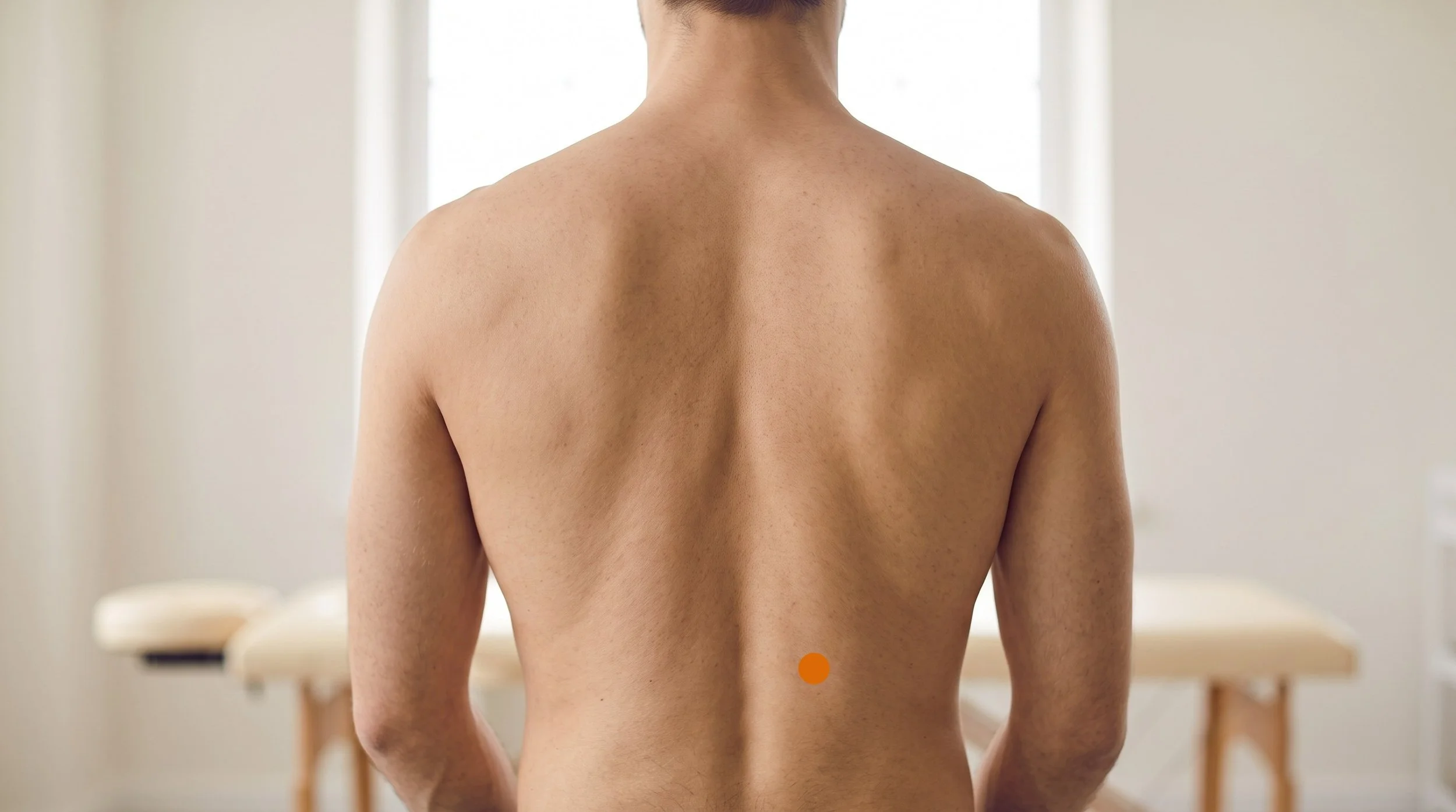
BL50 Acupuncture Point (Weicang)
The Stomach Granary at the Thoracolumbar Junction: Anatomy, Mechanism, and Why This Outer Bladder Line Point Bridges Back Pain and Digestive Care
BL50, known as Weicang or Stomach Granary, sits on the outer Bladder line of the mid back, three cun to either side of the spine at the level of the twelfth thoracic vertebra, directly lateral to BL21 (Weishu), the back-shu point of the Stomach.
In plain terms, it is the spot you find by dropping your fingers off the tip of the T12 spinous process and sliding outward about four finger widths, landing in the thick paraspinal muscle just above the lowest ribs. That location is the whole story of the bl50 acupuncture point: it lies in a band of muscle and fascia that takes heavy mechanical load at the thoracolumbar junction, and it shares spinal segments with the nerves that supply the stomach and upper abdominal organs.
Classical texts gave it a granary name because it was traditionally used to settle the middle of the body, while modern practice values it as a practical, well-tolerated needling site for stiff, aching mid to low backs when the technique is kept shallow and oblique.
- Location and layers: bladder 50 is three cun lateral to the midline at the lower border of the T12 spinous process, level with BL21, so the needle passes through skin, superficial fascia, the thoracolumbar fascia and latissimus aponeurosis, and into the iliocostalis portion of the erector spinae near the twelfth rib.
- Traditional framing: the classical literature places Weicang on the outer Bladder line beside the Stomach back-shu and credits it with harmonising the middle burner, a description we read today as regional modulation of the thoracolumbar segments that also serve the upper abdominal viscera (Ma, 2020).
- Nerve story: the region is supplied by lateral cutaneous branches of the lower thoracic posterior rami with subcostal vessels running nearby, and needling here recruits A-delta and C fibre input into T11 and T12 dorsal horn segments, the same segmental territory that receives sympathetic afferents from the stomach and duodenum (Zhao, 2008; Ma, 2020).
- Mechanism beyond the segment: needle stimulation also engages descending inhibitory pathways from the midbrain and brainstem, which helps explain why relief is often felt more broadly than the small patch of skin treated (Zhao, 2008).
- Research picture: no trial has isolated the stomach granary point on its own, so the evidence comes from multi-point protocols for chronic low back pain and for dyspeptic symptoms, where effects are modest but reasonably consistent (Vickers et al., 2018; Mu et al., 2020; Li et al., 2026).
- Clinical use and de qi: shallow oblique insertion of 0.3 to 0.5 cun is the standard, deep or medially angled needling carries a real pneumothorax risk, and most patients report a dull, heavy, slightly spreading ache rather than anything sharp.
Is Your Mid Back Aching Right Where Your Ribs End?
The thoracolumbar junction takes the brunt of long desk hours, heavy lifting, and rotational sport, and it often feels like a deep band of tightness just above the waistline. At Morningside Acupuncture we use BL50 alongside nearby paraspinal points and careful dry needling of the erector spinae to reduce that guarding and restore rotation. Treatment is paired with simple loading and breathing work so the change holds between visits. Schedule a visit and let us assess what is actually driving the ache.
Schedule NowAnatomy of BL50: Why the T12 Outer Bladder Line Is Such an Important Location
The stomach granary point sits over one of the busiest mechanical transitions in the spine. Under the skin and superficial fat lies the posterior layer of the thoracolumbar fascia, blended here with the aponeurosis of latissimus dorsi and the attachment of serratus posterior inferior near the lowest ribs. Beneath that runs the erector spinae, with the iliocostalis column lying roughly under the three cun line at this level. The T12 segment is where the relatively stiff, rib-braced thoracic spine meets the mobile lumbar spine, so rotation, bending, and lifting concentrate stress into these tissues.
Patients who sit for long stretches, carry bags on one shoulder, or rotate repeatedly in sport frequently develop palpable ropiness and point tenderness exactly where BL50 is located.
The overlying skin and muscle in this zone are supplied by the lateral cutaneous branches of the lower thoracic posterior rami, with subcostal vessels coursing along the inferior border of the twelfth rib. That segmental address matters. Afferent traffic from the stomach and upper abdominal organs travels with sympathetic fibres through the greater and lesser splanchnic nerves and enters the cord across roughly the same mid to lower thoracic levels.
When somatic and visceral inputs converge on shared dorsal horn neurons, stimulating the body wall can change how that segment processes both sets of signals, which is the modern reading of why back points near T12 were traditionally linked to digestive complaints (Ma, 2020). Needling also drives ascending signalling that recruits descending inhibitory control from the periaqueductal grey and rostral ventromedial medulla, along with local release of endogenous opioids and adenosine, mechanisms that have been mapped in some detail (Zhao, 2008).
Depth discipline is non-negotiable here. The pleural recess can extend surprisingly low posteriorly, and the kidney lies deep to the paraspinal muscles at the thoracolumbar junction, so deep perpendicular or medially angled needling at the three cun line carries a substantial pneumothorax risk. The classical convention preserved in modern texts is oblique insertion of 0.3 to 0.5 cun, usually angled laterally or caudally into muscle rather than toward the spine or the chest cavity.
Moxibustion is traditionally described as suitable at this point. In practice, shallow oblique needling is more than sufficient to reach the tender muscular tissue that patients actually feel, and there is no clinical reason to go deeper.
Related Bladder Channel Related Best Acupuncture Points For Back PainBL50 at a Glance: Classification, Location, and Clinical Use
| Category | Detail |
|---|---|
| Traditional Name | Weicang (Stomach Granary or Stomach Storehouse), Bladder 50 |
| Channel Classification | Bladder channel of Foot Taiyang, outer (lateral) back line, three cun from the midline (BL50, also written UB50; also called the Urinary Bladder channel) |
| Point Categories | No five-shu, meeting, hui-meeting, or extraordinary vessel designation is recorded in the classical sources. Its status comes from position: an outer Bladder line point at T12, level with BL21 (Weishu), the back-shu point of the Stomach, and traditionally classed as a middle burner harmonising point. |
| Precise Location | On the mid back, 3 cun lateral to the posterior midline, level with the lower border of the T12 spinous process and level with BL21. With the shoulders relaxed, the 3 cun line corresponds roughly to the medial border of the scapula. |
| Tissue Stimulated | Skin and superficial fascia, thoracolumbar fascia and latissimus dorsi aponeurosis, serratus posterior inferior near the lower ribs, and the iliocostalis fibres of the erector spinae. Referral from the lower rib attachments of the external abdominal oblique can overlap this region. |
| Needle Depth / Direction | Oblique insertion 0.3 to 0.5 cun, angled laterally or inferiorly into muscle. Deep perpendicular or medially directed needling is avoided because of substantial pneumothorax risk. Moxibustion is traditionally applied. |
| De Qi Sensation | A dull, heavy, slightly spreading ache in the paraspinal muscle, sometimes with a warm band travelling toward the flank or lower rib. Sharp, electric, or breath-catching sensations are not expected and mean the needle should be adjusted. |
| Primary Clinical Uses | Thoracolumbar and mid back pain and stiffness; traditionally used for abdominal fullness and deficiency-type distention, poor appetite, difficult ingestion, and back aching with sensitivity to cold. |
| Common Point Combinations |
|
In the classical record collected by Deadman and colleagues in A Manual of Acupuncture, Weicang is given a single action, harmonising the middle burner, and a compact indication list that splits neatly in two. One half is digestive and traditionally attributed: abdominal fullness, distention of a deficient rather than an excess type, difficulty getting food down, childhood nutritional impairment, sudden turmoil disorder (the old term for violent vomiting with diarrhoea), and oedema.
The other half is musculoskeletal and thermal: aversion to cold, pronounced coldness, and back pain. Older commentaries note that this point was often thought to lean toward warming and strengthening functions rather than clearing ones, and Chinese texts add epigastric and back pain together with infantile indigestion to the list.
What is striking about the classical pattern is how deliberately the outer line mirrors the inner line: the point that shares a level with the Stomach back-shu is named for a granary, the place where grain is stored, and it was assigned the symptom picture of a middle that cannot take in and process food properly.
Why BL50 Is Used for Digestive Complaints and Not Just Back Pain
The most common question about points like the stomach granary point is why a spot on the back would be chosen for symptoms felt in the abdomen. The straightforward answer is segmental convergence. Sensory fibres from the stomach and nearby organs travel with sympathetic nerves and enter the spinal cord across the mid to lower thoracic levels, arriving on the same dorsal horn neurons that receive input from the skin, fascia, and muscle of the back at T11 and T12. Stimulating the body wall at that level therefore feeds into a shared processing hub, and the brain has to interpret both streams together.
Animal and human work on somato-autonomic reflexes shows that stimulation at different body regions can drive different autonomic outputs, with trunk stimulation biased toward sympathetic pathways and limb stimulation toward parasympathetic ones (Ma, 2020). This is a plausible physiological account of what classical writers described as harmonising the middle, without invoking anything mystical.
The second mechanism is less local. Needling that produces genuine de qi activates A-delta and C fibres, which recruit descending inhibitory systems running from the periaqueductal grey and rostral ventromedial medulla back down to the spinal cord, and which trigger release of endogenous opioids, serotonin, norepinephrine, and adenosine at multiple levels (Zhao, 2008). That is why a patient may notice the whole thoracolumbar band settle, not just the point that was needled, and why the effect often builds over the twenty minutes the needles are retained rather than arriving instantly.
Applied to digestion specifically, reviews of acupuncture for functional dyspepsia describe changes in gastric accommodation and emptying, autonomic balance, and central processing of gut signals as candidate mechanisms, while noting that trial quality is uneven and that protocols nearly always combine several points (Guo et al., 2020). We frame this honestly with patients: BL50 may reduce the muscular and autonomic component of a symptom picture, it works as part of a package, and it is not a substitute for gastroenterology assessment when red flags are present.
What the Research Shows for BL50
There is no clinical trial that tests bladder 50 by itself, and it would be unusual if there were, since real treatment uses point combinations selected by presentation. What the literature can tell us is whether acupuncture protocols that include thoracolumbar back points help the conditions this point is used for, and whether the physiology behind the point is coherent.
The honest summary is that acupuncture shows small to moderate, reasonably durable benefits for chronic musculoskeletal pain, promising but more variable results for functional digestive symptoms, and a mechanistic story that is much better mapped now than it was twenty years ago. The table below sets out the most relevant sources.
| Study | Type | Focus | Key Finding |
|---|---|---|---|
| Mu et al., 2020 | Cochrane systematic review | Acupuncture for chronic nonspecific low back pain, 33 trials and 8,270 participants | Acupuncture may not outperform sham for immediate pain relief, but compared with no treatment or usual care it appeared to reduce pain and improve function, with the certainty of evidence rated low to moderate. |
| Vickers et al., 2018 | Individual patient data meta-analysis | Chronic pain conditions including back and neck pain, roughly 20,800 patients | Acupuncture was superior to both sham and no-acupuncture controls, with effects that persisted over about twelve months, supporting the idea that benefit is more than expectation alone. |
| Li et al., 2026 | Systematic review and meta-analysis | Acupuncture for functional dyspepsia, 23 randomised trials and 2,454 participants | Compared with sham, acupuncture probably improved dyspeptic symptoms and quality of life without an increase in adverse events, at high to moderate certainty by GRADE. |
| Guo et al., 2020 | Systematic review of clinical and mechanistic studies | Acupuncture and electroacupuncture for functional dyspepsia | Reported benefits are attributed to changes in gastric accommodation and motility, autonomic modulation, and central processing, though the authors note methodological limitations across trials. |
| Ma, 2020 | Narrative review of neuroanatomy | Somato-autonomic reflexes and acupoint selectivity | Stimulation site and intensity determine which autonomic pathway is engaged, giving a testable neuroanatomical framework for why trunk and limb points behave differently. |
| Zhao, 2008 | Mechanistic review | Neural mechanisms of acupuncture analgesia | Analgesic effects are attributed to afferent fibre activation, spinal gating, descending inhibition, and endogenous opioid and monoamine release rather than any single pathway. |
Bloating, Poor Appetite, and a Tight Mid Back at the Same Time?
Patients often describe digestive heaviness and mid back tension arriving together, which makes sense once you know these regions share spinal segments. We use the bl 50 back region with points like ST36 and CV12 to calm the paraspinal muscles and give the autonomic system a quieter input. Sessions are gentle, shallow, and built around your symptom pattern rather than a template. Book an appointment to talk through your digestive and musculoskeletal history in one visit.
Schedule NowBL50 in the Context of Trigger Point Work
Acupuncture, defined as treatment with an acupuncture needle, covers hundreds of styles, and dry needling is one of them. At the T12 outer line, the classical point and the myofascial target overlap almost exactly. The iliocostalis fibres of the erector spinae at the thoracolumbar junction are a well-described source of local and referred back pain, and the lower rib attachments of serratus posterior inferior and the abdominal wall muscles can contribute a band of aching around the flank (Simons et al., 1999).
When we palpate a taut, tender band right at the BL50 location, we are usually looking at the same tissue whether we call the target a point or a trigger point.
In practice at Morningside, we combine shallow oblique needling at BL50 with targeted work on the surrounding musculature: iliocostalis and longissimus at T11 to L1, quadratus lumborum when lateral bending is restricted, latissimus dorsi where the aponeurosis is thickened, and the external oblique when the ribcage feels braced. Depth is kept conservative in this region for the same safety reasons that shape the classical needling instruction, and needle angle is directed away from the spine and thoracic cavity.
Needling is then paired with breathing drills, thoracic rotation work, and graded loading, since restoring movement at the thoracolumbar junction is what tends to keep the relief.
BL50 Back Pain Treatment at NYC's Highest-Rated Acupuncture Clinic
Morningside Acupuncture is the highest-rated acupuncture and dry needling clinic in New York City with over 500 five-star Google reviews, and our Upper West Side clinic focuses on musculoskeletal pain treated with modern sports medicine thinking. Weicang is one of many tools we use for thoracolumbar pain, chosen when palpation shows tenderness and thickening in the T12 paraspinals. Every plan combines needling with movement guidance so you leave with something to do, not just something done to you. Schedule your session today.
Schedule NowFrequently Asked Questions
What does BL50 feel like when needled?
Most people feel a dull, heavy, slightly spreading ache in the muscle of the mid back, sometimes with a sense of warmth or a soft band of sensation drifting toward the flank. Because insertion is shallow and oblique, the initial pinch is usually minimal. If the tissue is genuinely tight, there can be a brief muscular twitch or a deeper grabbing feeling that eases within seconds. Sharp, electric, or breath-catching sensations are not expected and are a signal for your practitioner to adjust or withdraw the needle.
Why needle the back for a stomach complaint instead of the abdomen?
Because the back wall at T11 and T12 shares spinal segments with sensory nerves coming from the stomach and upper abdominal organs, so input at this level reaches the same dorsal horn neurons that process visceral signals (Ma, 2020). Traditional practice arrived at the same conclusion by observation, describing the outer Bladder line beside the Stomach back-shu as a place to settle the middle. It is also often more comfortable and more practical: patients with abdominal tenderness may prefer prone treatment, and the paraspinal muscles are frequently guarding at the same time.
Can I press BL50 myself between sessions?
Yes, acupressure at this location is safe and easy to self-apply. Find the bony tip of the T12 spinous process (roughly level with the lower tip of the shoulder blade area when the arms hang, and just above where the lowest ribs end at the back), then move about four finger widths out to the side into the thick muscle. Press with a thumb, knuckle, or a firm ball against a wall, using steady pressure at a comfortable five or six out of ten intensity for 30 to 60 seconds per side, breathing slowly. Repeat two or three rounds, once or twice a day. Keep pressure on muscle, not on the spine or the flank over the kidney area, and stop if pressing produces sharp pain, numbness, or radiating symptoms.
Is BL50 safe to needle?
In trained hands, yes, but this is a point where technique matters. The classical and modern texts both specify shallow oblique insertion of 0.3 to 0.5 cun, because deep perpendicular or medially angled needling in the mid back carries a substantial risk of pneumothorax, and the kidney lies deep to the muscles at this level. A licensed acupuncturist with anatomy training will angle away from the spine and chest cavity and keep the needle in muscle. Tell your practitioner if you have a bleeding disorder, take anticoagulants, have had thoracic or renal surgery, or are pregnant, so the plan can be adjusted.
Where exactly is BL50 located?
BL50 lies on the mid back, three cun lateral to the posterior midline, level with the lower border of the twelfth thoracic spinous process and level with BL21 (Weishu). The three cun line runs roughly along the medial border of the shoulder blade when the shoulders are relaxed, which gives a useful visual reference. It is the outer line counterpart of the Stomach back-shu point, and it usually presents as a tender, slightly thickened band in the erector spinae just above the lowest ribs.
References
- Deadman, P., Al-Khafaji, M., & Baker, K. (2009). A manual of acupuncture. Journal of Chinese Medicine Publications.
- Cheng, X. (Ed.). (1999). Chinese acupuncture and moxibustion (Rev. ed.). Foreign Languages Press.
- Simons, D. G., Travell, J. G., & Simons, L. S. (1999). Travell & Simons' myofascial pain and dysfunction: The trigger point manual, Vol. 1: Upper half of body (2nd ed.). Williams & Wilkins.
- Mu, J., Furlan, A. D., Lam, W. Y., Hsu, M. Y., Ning, Z., & Lao, L. (2020). Acupuncture for chronic nonspecific low back pain. Cochrane Database of Systematic Reviews, 2020(12), CD013814. https://doi.org/10.1002/14651858.CD013814
- Vickers, A. J., Vertosick, E. A., Lewith, G., MacPherson, H., Foster, N. E., Sherman, K. J., Irnich, D., Witt, C. M., & Linde, K. (2018). Acupuncture for chronic pain: Update of an individual patient data meta-analysis. Journal of Pain, 19(5), 455-474. https://doi.org/10.1016/j.jpain.2017.11.005
- Zhao, Z. Q. (2008). Neural mechanism underlying acupuncture analgesia. Progress in Neurobiology, 85(4), 355-375. https://doi.org/10.1016/j.pneurobio.2008.05.004
- Ma, Q. (2020). Somato-autonomic reflexes of acupuncture. Medical Acupuncture, 32(6), 362-366. https://doi.org/10.1089/acu.2020.1488
- Guo, Y., Wei, W., & Chen, J. D. Z. (2020). Effects and mechanisms of acupuncture and electroacupuncture for functional dyspepsia: A systematic review. World Journal of Gastroenterology, 26(19), 2440-2457. https://doi.org/10.3748/wjg.v26.i19.2440
- Li, X. X., Hu, Z. Y., Li, Z. C., Tang, J., Liu, Y. Y., Zeng, D. H., Zhou, Q. Q., Ma, W. B., Lan, L., & Wang, L. (2026). Efficacy and safety of acupuncture for functional dyspepsia: An updated meta-analysis of randomized controlled trials. Frontiers in Medicine, 13, 1718632. https://doi.org/10.3389/fmed.2026.1718632
Disclaimer: This web site is intended for educational and informational purposes only. Reading this website does not constitute providing medical advice or any professional services. This information should not be used for diagnosing or treating any health issue or disease. Those seeking medical advice should consult with a licensed physician. Seek the advice of a medical doctor or other qualified health professional for any medical condition. If you think you have a medical emergency, call 911 or go to the emergency room. No acupuncturist-patient relationship is created by reading this website or using the information. Morningside Acupuncture PLLC and its employees and contributors do not make any express or implied representations with respect to the information on this site or its use. For any legal interpretation of scope of practice in your state, consult a licensed attorney or regulatory authority.
Read more from our blog



