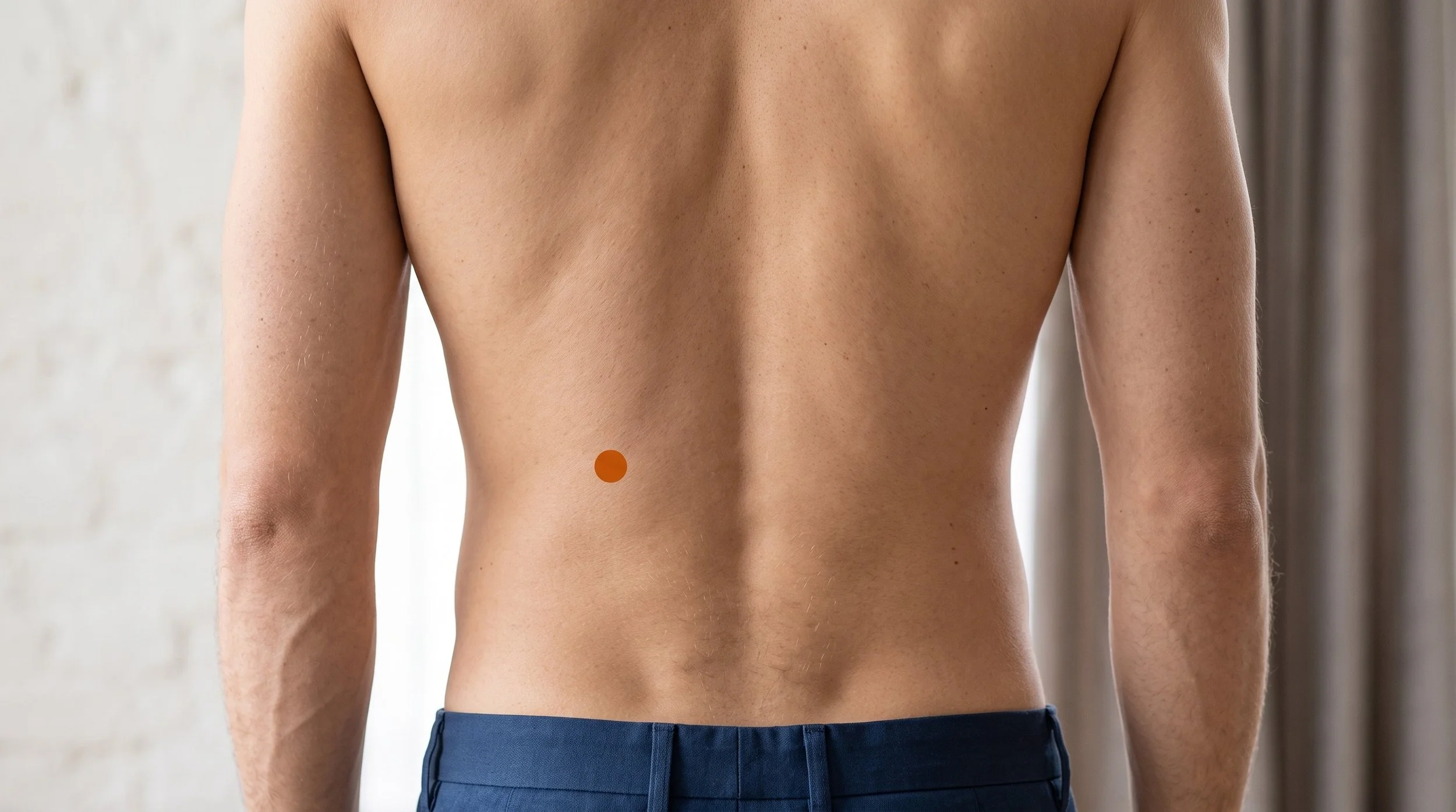
BL52 Acupuncture Point (Zhishi)
The Residence of the Will at the Second Lumbar Vertebra: Anatomy, Mechanism, and Why This Outer Bladder Line Point Earns Its Place in Low Back Treatment
BL52 (Zhishi, often translated as Residence of the Will) sits on the outer branch of the Bladder channel in the low back, three cun to the side of the spine at the level of the second lumbar vertebra, directly lateral to BL23 on the inner line.
In plain terms, it is the point you land on when you slide your thumbs about four finger widths out from the waist-level spine and press into the thick muscular ridge just inside the flank. That location makes bladder 52 one of the most practical lumbar points in the repertoire: the needle passes through the thoracolumbar fascia into the lateral erector spinae and toward the quadratus lumborum, two structures that are frequently tender and guarded in people with mechanical low back pain.
Classically it belonged to the Kidney-strengthening group of points and was used for lumbar pain, urinary difficulty, and reproductive vitality; in modern practice the bl52 acupuncture point is used mainly as a segmental and myofascial target at L2, needled obliquely and conservatively because the kidney lies deep to the muscle layers.
- BL52 lies 3 cun lateral to the midline at the lower border of the L2 spinous process, level with BL23 and with the GV4 region on the midline, so a needle at this site engages skin, the posterior layer of thoracolumbar fascia, the latissimus dorsi aponeurosis, the iliocostalis portion of the erector spinae, and, with deeper angulation, the quadratus lumborum (Deadman et al.; Shanghai College of Traditional Medicine).
- Traditional sources classify it as an outer Bladder line point paired with the Kidney back-shu point, with attributed actions of fortifying the Kidneys and essence, regulating urination, and strengthening the lumbar region; read neurophysiologically, those attributions map onto a point that sits over the T12 to L2 dorsal ramus territory, the same segments that carry sympathetic and sensory traffic from the kidney and upper ureter.
- Needling stimulates lateral branches of the dorsal rami of the twelfth thoracic and first lumbar spinal nerves, and afferent input from these branches converges in the dorsal horn with visceral input from the upper urinary tract, which is a plausible substrate for both the local analgesia and the classical urinary indications (Zhao, 2008).
- Beyond the segment, needling recruits descending inhibition from the periaqueductal gray and rostral ventromedial medulla along with endogenous opioid and monoamine signaling, which is why lumbar points can change pain report beyond the tissue actually punctured (Zhao, 2008).
- The research picture supports acupuncture as a reasonable option rather than a decisive one: a Cochrane review found that acupuncture may reduce pain and improve function in chronic nonspecific low back pain compared with sham or no treatment, though the certainty of evidence was limited (Mu et al., 2020), and individual patient data from chronic pain trials show effects that are modest but persistent (Vickers et al., 2018).
- De qi at BL52 is usually a deep, heavy, spreading ache across the flank that can travel toward the buttock; when a taut band in the quadratus lumborum or iliocostalis is engaged, patients often feel a brief cramp or twitch followed by a distinct softening (Simons et al., 1999).
Struggling With Low Back Pain That Sits Just Above the Belt Line?
Pain that lives in the flank and waist band rather than the center of the spine often involves the quadratus lumborum and lateral erector spinae, the exact tissues under BL52. At Morningside Acupuncture we assess movement, palpate the L1 to L3 segments, and use bl 52 low back needling alongside BL23 and GV4 when the pattern fits. Treatment is paired with breathing, loading, and hip mobility work so the relief holds between visits. Schedule an evaluation and we will map where your pain is actually coming from.
Schedule NowAnatomy of BL52: Why the L2 Flank Is Such an Important Location
Start at the waist and find the spinous process of the second lumbar vertebra, then move about three cun laterally, roughly the width of four fingers. Under your thumb are skin and subcutaneous tissue, then the posterior layer of the thoracolumbar fascia and the aponeurosis of latissimus dorsi, then the lateral column of the erector spinae, mainly iliocostalis lumborum. Angle a little deeper and medially and the quadratus lumborum lies beneath, bridging the twelfth rib, the lumbar transverse processes, and the iliac crest.
These are the tissues that take the load in prolonged sitting, one-sided carrying, repeated bending, and the kind of hip and trunk asymmetry that shows up in runners, lifters, and desk workers alike. When patients describe a belt-line band of soreness that worsens with standing and side bending, this is very often where palpation reproduces it.
The nerve geography here is straightforward and clinically useful. The area is supplied by lateral branches of the dorsal rami of the twelfth thoracic and first lumbar spinal nerves, with blood supply from the posterior branches of the second lumbar artery and vein (Shanghai College of Traditional Medicine). Needling those cutaneous and muscular branches sends A-delta and C-fiber input into the dorsal horn at levels that also receive afferents from deep lumbar structures and from the upper urinary tract, so a single lumbar needle can influence a fairly wide segmental field.
Beyond the segment, needle stimulation engages descending pain modulation through the periaqueductal gray and rostral ventromedial medulla, along with endogenous opioid and monoamine mechanisms that have been studied in both animal and human work (Zhao, 2008). Locally, needling also produces small vascular and neurogenic responses in the muscle that may contribute to the change in tissue feel practitioners notice within a session.
The safety consideration at this level is the kidney, which sits deep to the muscle layers in the retroperitoneum near L1 and L2. For that reason the standard convention is oblique insertion of roughly 0.5 to 1 cun, and classical and modern texts alike caution against deep perpendicular needling here (Deadman et al.; Shanghai College of Traditional Medicine).
In practice that means angling medially toward the spine or tangentially along the muscle belly, adjusting for body size, and being especially conservative in slim patients where the distance to deeper structures is shorter. Reviews of acupuncture case reports find that serious organ injuries are rare and are usually associated with faulty insertion depth or direction rather than with the technique itself (Xu et al., 2013), which is exactly why depth discipline at BL52 matters.
Related Acupuncture For Low Back Pain Related Muscles That Cause Low Back PainBL52 at a Glance: Classification, Location, and Clinical Use
| Category | Detail |
|---|---|
| Traditional Name | Zhishi (Residence of the Will), also recorded under the older name Jinggong (Palace of Essence) |
| Channel Classification | Bladder channel, outer (lateral) branch of the back line, at the L2 level (BL52, also written UB52; also called the Urinary Bladder channel) |
| Point Categories | Outer Bladder line point level with BL23, the back-shu point of the Kidneys; one of the five outer line points that the Essential Questions groups with the five zang back-shu points and describes as draining heat from the five zang. No five-shu, hui-meeting, or extraordinary vessel intersection designations are attributed to it in the source texts. |
| Precise Location | On the low back, 3 cun lateral to the posterior midline, level with the lower border of the L2 spinous process, level with BL23 on the inner line and with the GV4 region on the midline. With the shoulder relaxed, the 3 cun line corresponds to the medial border of the scapula. |
| Tissue Stimulated | Thoracolumbar fascia and latissimus dorsi aponeurosis, iliocostalis lumborum as the main muscular layer, and the quadratus lumborum with deeper medial angulation; the kidney lies deep to these layers |
| Needle Depth / Direction | Oblique insertion 0.5 to 1 cun, angled medially toward the spine or tangentially along the muscle belly. Deep perpendicular needling is avoided at this level because of the risk of kidney injury. |
| De Qi Sensation | Deep, heavy, dull distension and soreness that spreads across the flank and sometimes toward the buttock; a taut band may respond with a brief cramping twitch followed by softening |
| Primary Clinical Uses | Low back pain and stiffness, quadratus lumborum and lateral erector spinae tension, flank-dominant lumbar pain; classically also used for dribbling or difficult urination, edema, and Kidney-deficiency patterns affecting reproductive vitality |
| Common Point Combinations |
|
Deadman, Al-Khafaji, and Baker's A Manual of Acupuncture presents BL52 as the outer line partner of the Kidney back-shu point, with traditional actions given as tonifying the Kidneys and benefiting essence, regulating urination, and strengthening the lumbar region. The classical indication lists cluster into three groups: lumbar and back pain with stiffness, urinary complaints such as difficult or dribbling urination along with edema, and reproductive symptoms including impotence, premature ejaculation, seminal emission, and genital swelling and pain.
A smaller set of trunk indications covers fullness and pain of the lateral costal region, vomiting, and abdominal hardness. The commentary is careful to frame BL52 as narrower in scope than BL23: it is described as suited to Kidney deficiency patterns and to lumbar pain that spreads broadly through the muscles, whether from strain, painful obstruction, or renal problems, without the deeper tonifying reach attributed to the inner line point. The Essential Questions is also cited for the idea that the five outer line points level with the five zang back-shu points can drain heat from those organs.
What is striking is how consistently the classical record ties this point to the lumbar tissues and the urinary tract, the two territories that share segmental innervation at exactly this level.
Why BL52 Is Used for Flank and Urinary Symptoms as Well as Low Back Pain
The clean explanation is segmental. The skin and muscle at BL52 are supplied by dorsal rami arising from roughly the twelfth thoracic through second lumbar levels, and the kidney and upper ureter send sensory and sympathetic traffic into the same neighborhood of spinal cord. When afferents from different tissues converge on shared dorsal horn neurons, irritation in one can be felt in the other, which is why kidney or ureteric problems classically present as flank and low back pain, and why a needle in the lumbar muscle wall can alter sensation across that whole region (Zhao, 2008).
That overlap is the most parsimonious modern account of a classical indication list that mixes lumbar stiffness with urinary difficulty at a single point.
The second layer is central. Needle stimulation that produces de qi activates descending inhibitory pathways from the midbrain and brainstem and recruits endogenous opioid and monoamine systems, so analgesia is not confined to the segment needled (Zhao, 2008). This is part of why patients often report a general easing of the whole low back after treatment rather than a pinpoint change at the needle site, and it is also why acupuncture effects show up in trials that use quite different point prescriptions.
Clinically the practical takeaway is modest and honest: BL52 is a well-placed access point to lumbar tissue and to L1 and L2 segmental input, not a switch for any one organ.
The third layer is local and mechanical. Needling into a taut band in the quadratus lumborum or lateral erector spinae can provoke a local twitch response and is associated with reductions in pressure sensitivity and improvements in how the muscle contracts (Simons et al., 1999; Liu et al., 2018).
For patients whose pain is provoked by side bending, standing, or getting up from sitting, that local change in muscle behavior is often the most noticeable short-term effect, and it pairs naturally with graded loading and hip mobility work.
What the Research Shows for BL52
There is no body of trials testing BL52 by itself, and it would be misleading to imply otherwise. What exists are reviews of acupuncture and dry needling for low back pain, in which lumbar points at the L2 to L4 levels, including BL23, BL25, GV4, and the outer line points, appear regularly inside multi-point protocols. The reasonable way to read that literature is as evidence about the treatment approach BL52 belongs to, with the point contributing local and segmental input rather than carrying the result on its own.
Effects across these reviews are generally modest, better established for chronic than acute presentations, and limited by the difficulty of blinding needle interventions.
| Study | Type | Focus | Key Finding |
|---|---|---|---|
| Mu et al., 2020 | Cochrane systematic review | Acupuncture for chronic nonspecific low back pain versus sham, no treatment, or usual care | Acupuncture may reduce pain and improve function compared with sham and usual care, though the authors rated the certainty of evidence as low to moderate. |
| Vickers et al., 2018 | Individual patient data meta-analysis | Acupuncture across chronic pain conditions including back and neck pain | Effects were superior to both sham and no-acupuncture controls and largely persisted at one year, with differences that are statistically clear but modest in size. |
| Hu et al., 2018 | Systematic review and meta-analysis | Dry needling for low back pain across sixteen randomized trials | Dry needling was associated with reduced pain and disability immediately after treatment, but most included trials carried a high or unclear risk of bias. |
| Liu et al., 2018 | Systematic review and meta-analysis | Dry needling of myofascial trigger points in low back pain | Moderate quality evidence suggested dry needling reduced pain intensity compared with other treatments, with less certainty for disability outcomes. |
| Zhao, 2008 | Narrative review of mechanisms | Neural mechanisms of acupuncture analgesia | Describes segmental dorsal horn processing, descending inhibitory control, and opioid and monoamine signaling as the main pathways behind needling analgesia. |
| Xu et al., 2013 | Systematic review of case reports | Adverse events associated with acupuncture and related techniques | Serious events are uncommon and organ injuries reported were mainly attributed to faulty needle depth or direction, which supports conservative angling at points like BL52. |
Tight Waist, Stiff Mornings, and Pain When You Stand Up From a Chair?
Those complaints usually point to lumbar muscle guarding rather than a single damaged structure. Our clinicians combine Zhishi with dry needling of the quadratus lumborum and iliocostalis lumborum, manual therapy, and simple home exercise to reduce guarding and restore side bending and rotation. We keep depth and angle conservative at this level and explain every step before we needle. Book a session and start with a clear plan.
Schedule NowBL52 in the Context of Trigger Point Work
BL52 sits almost exactly where clinicians look for taut bands in the lateral erector spinae and, with a slightly deeper medial angle, the quadratus lumborum. Travell and Simons describe quadratus lumborum trigger points as a frequent and often overlooked source of low back pain, with referral toward the iliac crest, the greater trochanter, the sacroiliac region, and sometimes the lower abdomen (Simons et al., 1999). Patients with this pattern typically report pain on standing, difficulty rolling in bed, and a deep ache at the waist that they cannot reach with their own hands.
Because the acupuncture point and the myofascial target overlap so closely, needling at Zhishi frequently doubles as trigger point work whether or not the practitioner uses that vocabulary.
At Morningside we treat BL52 as one node in a regional plan. A typical session might pair the point with BL23 and GV4 for segmental coverage, add dry needling of the quadratus lumborum and iliocostalis lumborum where taut bands reproduce the patient's pain, and extend to the gluteal group or hip rotators when the exam points there. Depth and angle stay conservative in this region for the anatomical reasons described above, and we tend to favor multiple shallow to moderate oblique insertions over any single deep one.
Needling is then followed by movement retraining, because reviews of dry needling for low back pain consistently show short-term pain change that is best consolidated with active rehabilitation (Hu et al., 2018; Liu et al., 2018).
BL52 Low Back Pain Treatment at NYC's Highest-Rated Acupuncture Clinic
Morningside Acupuncture is the highest-rated acupuncture and dry needling clinic in New York City with over 500 five-star Google reviews, and low back pain is one of the most common reasons patients come to see us. We use BL52 as part of a segmental lumbar strategy rather than as a standalone fix, combining it with local, distal, and myofascial targets chosen from your exam. Every treatment includes education on load management so progress continues after you leave. Schedule your visit today.
Schedule NowFrequently Asked Questions
What does BL52 feel like when needled?
Most people feel a deep, heavy ache or spreading pressure that fans out across the flank and sometimes drifts toward the buttock. It is a fuller, duller sensation than the sharper feeling of points on the hands or feet, largely because the needle is in thick muscle rather than near skin and tendon. If a taut band is engaged, there can be a brief cramp or twitch, then a noticeable release. The sensation should settle within seconds of the needle being placed, and mild residual soreness for a day afterward is common and not concerning.
Why needle BL52 when my pain is central and lower down my spine?
Pain rarely stays inside the tissue that generates it. The lumbar muscles at L2 share segmental innervation with structures above and below, and their afferents converge in the same region of the dorsal horn, so treating this level can influence a fairly broad band of the low back (Zhao, 2008). The quadratus lumborum in particular refers pain downward and outward toward the iliac crest and hip, which means a patient can point to their belt line or sacrum while the responsible band sits higher and more lateral (Simons et al., 1999). We choose BL52 when palpation and movement testing suggest that lateral lumbar tissue is part of the picture, and we use other points when they do not.
Can I press BL52 myself between sessions?
Yes, and it is one of the easier lumbar points to reach. Stand or sit upright, place your thumbs on either side of your spine at waist level, then slide them outward about four finger widths until you feel the thick muscular ridge just inside the flank. Press inward and slightly toward the spine with steady, moderate pressure until you feel a familiar ache rather than a sharp pain, hold for 30 to 60 seconds, and breathe slowly. Repeat two or three times per side, once or twice a day. A tennis ball or massage ball against a wall works well if your thumbs tire. Ease off if pressure produces radiating leg symptoms, numbness, or any sharp pain, and skip self-pressure entirely if you have a known kidney condition, recent trauma to the flank, or are unsure about the source of your symptoms.
Is BL52 safe to needle?
In trained hands, yes, provided depth and angle are respected. The kidney lies deep to the muscle layers at this level, so the standard convention is oblique insertion of about 0.5 to 1 cun rather than deep perpendicular needling, with extra caution in slim patients (Deadman et al.; Shanghai College of Traditional Medicine). Reviews of reported acupuncture adverse events find that serious organ injuries are rare and generally trace back to inappropriate depth or direction rather than to needling itself (Xu et al., 2013). Expect the usual minor possibilities of small bruises or brief soreness. Let your practitioner know if you are on blood thinners, are pregnant, or have any kidney or urinary condition.
Where exactly is BL52 located?
For zhishi point location, find the spinous process of the second lumbar vertebra, roughly at the level of the lower rib cage margin and above the top of the pelvis, then measure 3 cun laterally from the midline, which is about four finger widths. BL52 sits at that level on the outer Bladder line, directly lateral to BL23 and level with the GV4 region on the midline. A useful check is that with the shoulder relaxed, the 3 cun line runs along the medial border of the scapula. On most people the spot corresponds to the soft muscular hollow between the paraspinal ridge and the side of the trunk, and it is often tender to press in anyone with a history of low back pain.
References
- Deadman, P., Al-Khafaji, M., & Baker, K. (2009). A manual of acupuncture. Journal of Chinese Medicine Publications.
- O'Connor, J., & Bensky, D. (Eds. & Trans.). (1981). Acupuncture: A comprehensive text. Shanghai College of Traditional Medicine. Eastland Press.
- Cunningham, P. M. (2000). Acupuncture points: A practical guide to classical and modern usage. Odyssey Press.
- Simons, D. G., Travell, J. G., & Simons, L. S. (1999). Travell & Simons' myofascial pain and dysfunction: The trigger point manual, Vol. 1: Upper half of body (2nd ed.). Williams & Wilkins.
- Mu, J., Furlan, A. D., Lam, W. Y., Hsu, M. Y., Ning, Z., & Lao, L. (2020). Acupuncture for chronic nonspecific low back pain. Cochrane Database of Systematic Reviews, 2020(12), CD013814. https://doi.org/10.1002/14651858.CD013814
- Vickers, A. J., Vertosick, E. A., Lewith, G., MacPherson, H., Foster, N. E., Sherman, K. J., Irnich, D., Witt, C. M., & Linde, K. (2018). Acupuncture for chronic pain: Update of an individual patient data meta-analysis. Journal of Pain, 19(5), 455-474. https://doi.org/10.1016/j.jpain.2017.11.005
- Hu, H. T., Gao, H., Ma, R. J., Zhao, X. F., Tian, H. F., & Li, L. (2018). Is dry needling effective for low back pain? A systematic review and PRISMA-compliant meta-analysis. Medicine, 97(26), e11225. https://doi.org/10.1097/MD.0000000000011225
- Liu, L., Huang, Q. M., Liu, Q. G., Thitham, N., Li, L. H., Ma, Y. T., & Zhao, J. M. (2018). Evidence for dry needling in the management of myofascial trigger points associated with low back pain: A systematic review and meta-analysis. Archives of Physical Medicine and Rehabilitation, 99(1), 144-152.e2. https://doi.org/10.1016/j.apmr.2017.06.008
- Zhao, Z. Q. (2008). Neural mechanism underlying acupuncture analgesia. Progress in Neurobiology, 85(4), 355-375. https://doi.org/10.1016/j.pneurobio.2008.05.004
- Xu, S., Wang, L., Cooper, E., Zhang, M., Manheimer, E., Berman, B., Shen, X., & Lao, L. (2013). Adverse events of acupuncture: A systematic review of case reports. Evidence-Based Complementary and Alternative Medicine, 2013, 581203. https://doi.org/10.1155/2013/581203
Disclaimer: This web site is intended for educational and informational purposes only. Reading this website does not constitute providing medical advice or any professional services. This information should not be used for diagnosing or treating any health issue or disease. Those seeking medical advice should consult with a licensed physician. Seek the advice of a medical doctor or other qualified health professional for any medical condition. If you think you have a medical emergency, call 911 or go to the emergency room. No acupuncturist-patient relationship is created by reading this website or using the information. Morningside Acupuncture PLLC and its employees and contributors do not make any express or implied representations with respect to the information on this site or its use. For any legal interpretation of scope of practice in your state, consult a licensed attorney or regulatory authority.
Read more from our blog



