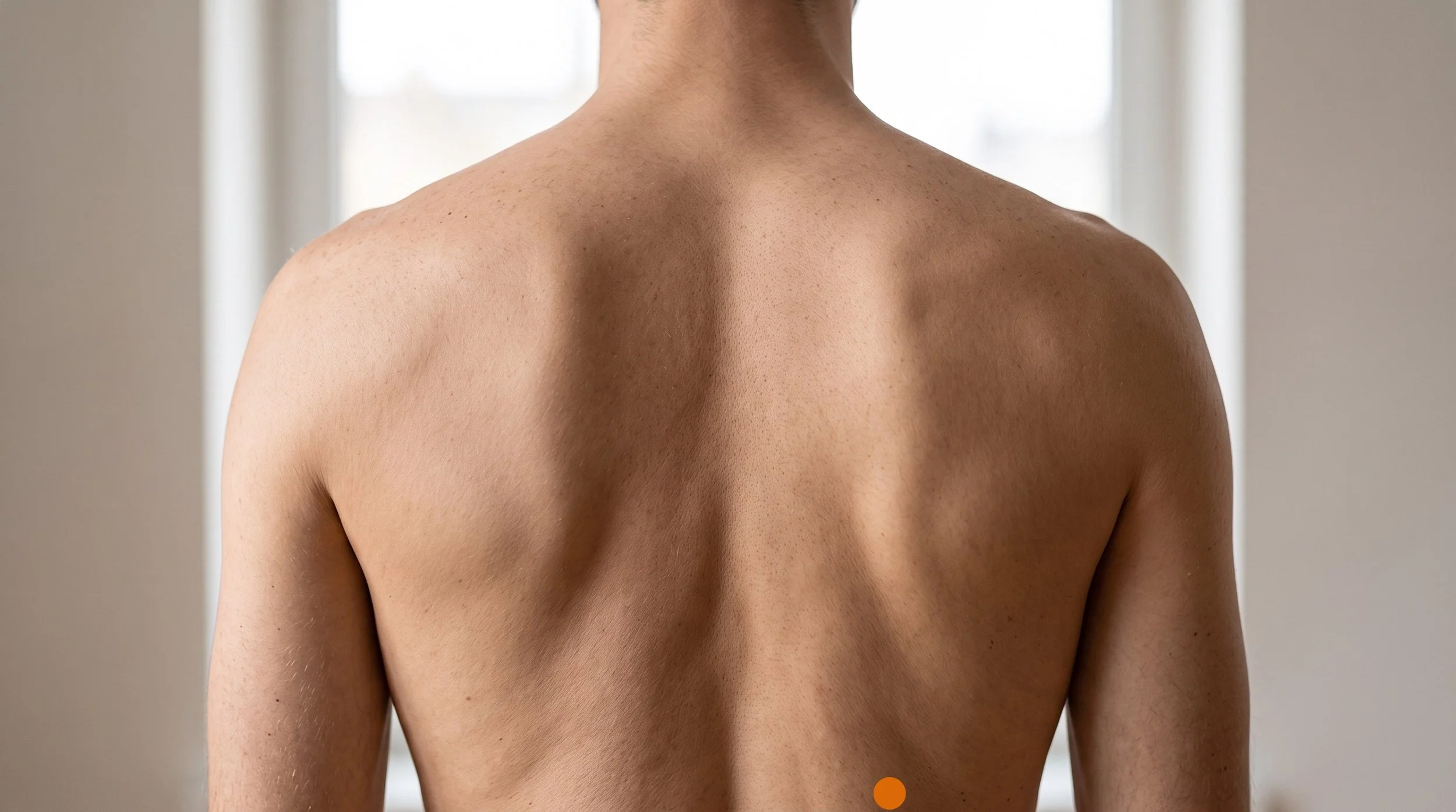
BL49 Acupuncture Point (Yishe)
The Abode of Thought Beside the Spleen Shu: Anatomy, Segmental Mechanism, and Why This T11 Outer Line Point Bridges Digestion and Mid Back Tension
BL49, known as Yishe (translated as Abode of Thought, or Intellect Abode), sits on the outer branch of the Bladder channel in the mid back, three cun lateral to the spine at the level of the lower border of the T11 spinous process, directly out to the side of BL20 Pishu, the back-shu point of the Spleen (Deadman et al., 2007).
In plain terms, if you slide your thumb from the bump of the eleventh thoracic vertebra out along the ribs by roughly four finger widths, you land in the thick paraspinal band where the erector spinae column starts to taper toward the thoracolumbar junction.
That anatomical address is the whole story of this point: it lies in a segment whose nerve supply feeds the same spinal levels that carry sympathetic traffic to the stomach, pancreas and upper intestines, which is why the bl49 acupuncture point appears in classical lists for abdominal fullness, loose stools, vomiting and thirst, and why modern clinicians reach for it when digestive complaints and stubborn thoracolumbar tightness show up in the same patient.
- Location and layers: bladder 49 is found three cun lateral to the midline at the lower border of T11, level with GV6 and BL20, passing through skin and thoracolumbar fascia into the lateral column of the erector spinae, with the lower ribs, serratus posterior inferior and latissimus fibers nearby (Deadman et al., 2007; Cheng, 1987).
- Traditional categories translated: classical texts group Yishe among the outer Bladder line points that sit level with the five zang back-shu points, and attribute to it the actions of clearing damp-heat and regulating the Spleen and Stomach, language that maps clinically onto upper abdominal fullness, unstable stools, nausea and a heavy, congested feeling after meals (Deadman et al., 2007; Cunningham, 2016).
- Nerve geography: the region is supplied by the lateral branches of the posterior rami of the tenth and eleventh thoracic nerves, and the same T10 to T11 cord segments contribute to splanchnic outflow toward the upper abdominal viscera, so needling here may act through segmental convergence rather than anything travelling along a vessel (Cheng, 1987; Uchida et al., 2017).
- Mechanism picture: experimental work suggests that somatic stimulation recruits somato-autonomic reflexes that can modify gastric motility and autonomic tone in a body-region dependent way, while broader analgesic effects involve spinal gating and descending inhibition from the midbrain and brainstem (Uchida et al., 2017; Zhao, 2008).
- Research framing: reviews of acupuncture for functional dyspepsia report modest improvements in fullness and early satiety with mostly low-quality trials, and back pain evidence comes from multi-point protocols rather than from BL49 alone (Pang et al., 2016; Mu et al., 2020; Vickers et al., 2018).
- Sensation and safety: patients typically describe a dull spreading heaviness that fans toward the flank rather than a sharp jab, and because the pleura curves down behind these lower ribs, shallow oblique needling of 0.3 to 0.5 cun is standard while deep perpendicular or medially angled insertion is avoided (Deadman et al., 2007; Witt et al., 2009).
Bloating, Reflux and Mid Back Tightness That Never Travel Alone?
Many patients tell us their upper abdominal fullness and their band of mid back stiffness flare in the same week, and that pattern is exactly what points at the T11 level are traditionally used to address.
At Morningside Acupuncture we assess the thoracolumbar segment, palpate the outer Bladder line for tender bands, and combine BL49 with inner line and distal points as the presentation warrants. Treatment is gentle, shallow and precise at this location. Schedule a visit and we'll map the pattern before we needle anything.
Schedule NowAnatomy of BL49: Why the T11 Outer Line Is Such an Important Location
From the surface inward, BL49 passes through skin and subcutaneous fat into the tough thoracolumbar fascia, then into the lateral column of the erector spinae where iliocostalis thoracis and longissimus fibers converge toward the lower ribs. Latissimus dorsi sheets across the area, and serratus posterior inferior anchors nearby to the lowest ribs, which is why this band tightens in people who sit rotated at a desk, lift with a twist, or breathe shallowly through the upper chest.
The three cun line here is the same vertical corridor that, higher up, corresponds to the medial scapular border when the shoulder is relaxed, a landmark clinicians use to keep the whole outer Bladder line consistent (Deadman et al., 2007).
The tissue at this level is supplied by the lateral branches of the posterior rami of the tenth and eleventh thoracic nerves, with vascular supply from posterior branches of the intercostal vessels (Cheng, 1987). Those same lower thoracic cord segments contribute to the greater and lesser splanchnic pathways that reach the upper abdominal organs, so sensory input from the T11 paraspinal region converges centrally with visceral input from the stomach and neighboring structures.
This is the plausible basis for a back point influencing digestive sensation: dorsal horn neurons that receive both somatic and visceral afferents can be modulated by needle input, and repeated stimulation may reduce the excitability of that shared pool while recruiting descending inhibitory control (Zhao, 2008; Uchida et al., 2017). Referred tenderness works in the other direction too, which is why a person with an irritable stomach often has a stubbornly tender band right where the bl49 acupuncture point sits.
Deep to the muscle at this level lie the eleventh and twelfth ribs, the pleural recess that dips lower than most people expect, and, further caudal and anterior, the upper pole of the kidney. That geography sets the needling conventions: oblique insertion of 0.3 to 0.5 cun, angled away from the midline and away from the chest cavity, with deep perpendicular or deep medially directed needling avoided because of a substantial pneumothorax risk (Deadman et al., 2007).
Large prospective safety data indicate serious events from acupuncture are rare in trained hands, but the mid back is precisely where technique discipline matters most (Witt et al., 2009). Moxibustion is traditionally applied here as well (Cheng, 1987).
Related Back Shu Points Related Bladder ChannelBL49 at a Glance: Classification, Location, and Clinical Use
| Category | Detail |
|---|---|
| Traditional Name | Yishe (Abode of Thought, also translated as Intellect Abode or Thinking Residence) |
| Channel Classification | Bladder channel of Foot Taiyang, outer (second) back line, thoracic portion (BL49, also written UB49; also called the Urinary Bladder channel) |
| Point Categories | Outer Bladder line point level with BL20 Pishu, the back-shu point of the Spleen; grouped with the five outer line points (BL42, BL44, BL47, BL49, BL52) that the Essential Questions describes as draining heat from the five zang; no five-shu, hui-meeting or extraordinary vessel designations are recorded in the classical sources |
| Precise Location | Mid back, 3 cun lateral to the posterior midline (level with GV6 Jizhong), at the level of the lower border of the T11 spinous process, directly lateral to BL20 |
| Tissue Stimulated | Thoracolumbar fascia, lateral erector spinae (iliocostalis thoracis and longissimus), overlying latissimus dorsi and nearby serratus posterior inferior; clinically related to the lower rib attachments of the abdominal obliques and the external abdominal oblique |
| Needle Depth / Direction | Oblique insertion 0.3 to 0.5 cun, angled laterally or caudally away from the chest cavity; deep perpendicular or deep medially angled needling is avoided because of substantial pneumothorax risk; moxibustion is traditionally used |
| De Qi Sensation | A dull, heavy, spreading ache or fullness in the paraspinal band, sometimes wrapping toward the flank or lower rib margin; sharp, electric or radiating chest sensations are not the goal and warrant repositioning |
| Primary Clinical Uses | Abdominal distention and fullness, digestive weakness with loose stools in classical use, nausea and vomiting patterns, thoracolumbar and lower rib band tension, and classical listings for damp-heat signs and wasting and thirsting disorder |
| Common Point Combinations |
|
In A Manual of Acupuncture, Deadman and colleagues present Yishe as a point traditionally credited with clearing damp-heat and settling disharmony between the Spleen and Stomach, and the indication list they compile reflects that: abdominal distention and fullness, fullness or pain spreading into the chest and flank, slippery diarrhea, difficulty getting food down, vomiting, dark yellow urine, and heat with a yellowing of the face and eyes, alongside back pain and aversion to wind and cold.
These are presented here as traditional attributions rather than physiological claims. The commentary also notes something genuinely odd about this point: despite a name that ties it to Yi, the mental faculty classically associated with the Spleen, the major classical texts record almost nothing in the way of psychological or emotional indications, a gap later authors have filled with modern uses for overthinking and heavy mental work (Maciocia, 2006).
What the old sources do record, repeatedly, is inclusion in formulas for wasting and thirsting disorder, the classical category that overlaps with what we would now recognize as diabetes-like presentations, and given that the point sits over pancreatic territory, that recurring pattern is striking whether or not one reads any anatomical intent into it.
Why BL49 Is Used for Upper Abdominal Fullness as Well as Mid Back Tightness
The short version is that the back and the belly share wiring at this level. Sensory nerves from the T11 paraspinal tissues enter the spinal cord at segments that also receive input travelling back from the upper abdominal organs, and those inputs converge on overlapping populations of dorsal horn neurons. When visceral input is persistently irritating, the shared segment can become sensitized, which is one reason people with functional digestive complaints so often have a tender, guarded band of paraspinal muscle at the lower thoracic levels.
Needling into that band gives the same segment a strong, competing somatic signal, and experimental work on somato-autonomic reflexes suggests that segmental somatic stimulation can shift autonomic output to the gut, with effects that depend on where on the body the stimulus is delivered (Uchida et al., 2017).
Beyond the segment, needling recruits broader pain-modulating systems. Research on acupuncture analgesia describes activation of A-delta and C afferents leading to release of endogenous opioids and monoamines, with descending inhibitory pathways from the periaqueductal gray and rostral ventromedial medulla damping nociceptive transmission at the cord (Zhao, 2008). For a patient, that combination often shows up as two changes at once: the local band softens and feels less guarded, and the sense of upper abdominal pressure eases slightly over the following hours.
Reviews of acupuncture in functional dyspepsia have documented improvements in symptoms such as postprandial fullness and early satiation, though the trial quality is generally low and the protocols use several points together (Pang et al., 2016; Guo et al., 2020).
None of this makes bladder 49 a stand-alone treatment. It is a segmentally sensible addition when the T11 level is tender, when digestive symptoms and thoracolumbar tension coexist, and when a patient responds well to back needling. We routinely combine it with abdominal or distal points and, where appropriate, with manual therapy and breathing work so the mid back stops bracing between visits.
What the Research Shows for BL49
There is no clinical trial that isolates BL49, and that is worth stating plainly. The research relevant to this point is indirect: reviews of acupuncture for functional dyspepsia and for chronic low back pain test multi-point protocols in which back-shu and outer line points are one component among several, and mechanistic studies describe how segmental needling may influence autonomic tone and pain processing. Read the table below as context for why a clinician might select this point, not as evidence that this single location produces a specific outcome.
| Study | Type | Focus | Key Finding |
|---|---|---|---|
| Mu et al., 2020 | Cochrane systematic review | Acupuncture for chronic nonspecific low back pain | The review found acupuncture may produce small improvements in pain and function compared with sham or no treatment, with mostly low to moderate certainty evidence. |
| Vickers et al., 2018 | Individual patient data meta-analysis | Acupuncture across chronic pain conditions including back and neck pain | Pooled patient-level data suggested modest benefits over both sham and usual care that persisted over time, supporting acupuncture as a reasonable option rather than a decisive one. |
| Pang et al., 2016 | Systematic review and meta-analysis | Acupuncture for functional dyspepsia | Positive results were reported for symptom and quality of life measures, particularly postprandial fullness and early satiation, though most included trials were judged low quality. |
| Guo et al., 2020 | Systematic review of mechanisms | Acupuncture and electroacupuncture effects in functional dyspepsia | Included studies suggested changes in gastric motility and accommodation along with autonomic and central measures, with the authors calling for better designed research. |
| Uchida et al., 2017 | Narrative review of experimental physiology | Somatoautonomic reflexes underlying acupuncture and related therapies | Decades of animal work indicate somatic stimulation can reflexively alter visceral function, though most data come from anesthetized animals and may not translate directly to conscious patients. |
| Zhao, 2008 | Mechanistic review | Neural mechanisms of acupuncture analgesia | Analgesic effects are attributed to afferent activation with spinal gating, endogenous opioid release and descending inhibitory control rather than to any channel-specific pathway. |
| Witt et al., 2009 | Prospective observational safety study | Adverse events across 229,230 acupuncture patients | Most reported effects were minor and transient, with serious events including pneumothorax being rare, which supports careful shallow technique over thoracic structures. |
Looking for Careful Needling at the Thoracolumbar Junction?
The T11 area rewards precision: it's a busy crossroads of paraspinal muscle, rib attachments and fascia, and it sits near structures that demand respect. Our licensed acupuncturists use shallow oblique technique at the bl 49 back location and pair it with dry needling of the erector spinae and quadratus lumborum when the tissue calls for it. You'll get a clear explanation of depth, angle and expected sensation before treatment begins. Book an appointment to be evaluated by a clinician who works this region every day.
Schedule NowBL49 in the Context of Trigger Point Work
Acupuncture, as we define it, is the use of an acupuncture needle, and that includes the hundreds of styles practiced worldwide as well as dry needling. At the T11 outer line, the point location and the myofascial target frequently coincide: taut bands in iliocostalis thoracis and the lower longissimus sit right where BL49 is described, and referred pain from lower thoracic paraspinal trigger points can spread downward toward the flank and buttock in patterns clinicians have documented for decades (Simons et al., 1999).
When a patient's chief complaint is a nagging band above the waistline that worsens with prolonged sitting or rotation, we often needle the point and the taut band as one target, using the same shallow oblique angle for safety.
When digestive symptoms are part of the picture, we widen the map. The lower ribs at this level are the attachment zone for the abdominal obliques, and trigger points in the external oblique are known to produce upper abdominal complaints such as belching, heartburn sensations and a bloated feeling, which can mimic or amplify visceral symptoms (Simons et al., 1999).
A typical Morningside session might combine BL49 and BL20 in the back with dry needling of the erector spinae, quadratus lumborum and the oblique attachments at the costal margin, then finish with diaphragmatic breathing coaching so the thoracolumbar junction stops working overtime. Needling depth over the ribs and paraspinals is kept conservative throughout.
BL49 Digestive and Mid Back Treatment at NYC's Highest-Rated Acupuncture Clinic
Morningside Acupuncture is the highest-rated acupuncture and dry needling clinic in New York City with over 500 five-star Google reviews, and we treat digestive complaints and thoracolumbar pain with the same anatomical rigor. Points like the abode of thought point are used inside a full plan that considers posture, breathing mechanics, meal patterns and sleep. Sessions are unhurried, hygienic and grounded in current pain science. Schedule your visit and see what careful, individualized care feels like.
Schedule NowFrequently Asked Questions
What does BL49 feel like when needled?
Most people feel a dull, heavy, slightly spreading ache in the muscle band beside the spine, sometimes with a sense of warmth or fullness that drifts toward the lower ribs. That heavy sensation is what practitioners call de qi, and it usually settles within a few seconds. Because insertion here is shallow and oblique, the sensation tends to be milder than at thick gluteal or leg points. You should not feel sharp pain, a jolt into the chest, or any change in breathing, and if you do, tell your acupuncturist immediately so the needle can be repositioned.
Why needle a back point for a digestive complaint instead of the abdomen?
Because the back and the abdomen are wired together at the same spinal levels. The tissue at BL49 is supplied by the lateral branches of the posterior rami of the tenth and eleventh thoracic nerves, and those segments also relay information to and from the upper abdominal organs, so needle input at the back can converge with visceral input in the spinal cord (Cheng, 1987; Uchida et al., 2017). Traditionally, the same logic was expressed as the outer line points sitting alongside the Spleen back-shu point and regulating the Spleen and Stomach (Deadman et al., 2007). Practically, we often use both: back points in one position and abdominal or distal points in another.
Can I press BL49 myself between sessions?
Yes, acupressure at this location is safe when done with fingers or a soft ball, since you're compressing muscle rather than penetrating tissue. Find the bump of the T11 spinous process (roughly the level of the lowest ribs as they angle toward the spine), move about four finger widths out to the side, and sink into the thick paraspinal band. Use steady thumb pressure or lean against a tennis ball on a wall for 30 to 60 seconds per side, breathing slowly, then repeat two or three times, once or twice a day. Keep the pressure at a comfortable ache rather than a wince, and stop if you feel any sharp pain, numbness or shortness of breath.
Is BL49 safe to needle?
In trained hands, yes, with a specific caution. The classical needling standard is oblique insertion of 0.3 to 0.5 cun, and deep perpendicular or deep medially angled needling at this location carries a substantial risk of pneumothorax because the pleura extends lower behind the ribs than many people assume (Deadman et al., 2007). Large prospective safety data show that serious adverse events from acupuncture are rare and that most effects are minor and short-lived, such as slight bruising or brief soreness (Witt et al., 2009). Tell your practitioner if you have a lung condition, a bleeding disorder, are taking anticoagulants, or have had thoracic or kidney surgery, and always seek care from a licensed provider.
Where exactly is BL49 located?
BL49 lies on the mid back, three cun lateral to the posterior midline, level with the lower border of the eleventh thoracic spinous process and level with both GV6 Jizhong and BL20 Pishu (Deadman et al., 2007; Cheng, 1987). A useful way to find it: locate the lowest floating ribs, trace toward the spine to identify the T11 level, then measure laterally about four finger widths into the muscular ridge running alongside the vertebrae. The three cun line is the same corridor that corresponds to the medial border of the scapula higher in the back when the shoulders are relaxed, which helps keep the outer line consistent from top to bottom.
References
- Deadman, P., Al-Khafaji, M., & Baker, K. (2009). A manual of acupuncture. Journal of Chinese Medicine Publications.
- Cheng, X. (Ed.). (1999). Chinese acupuncture and moxibustion (Rev. ed.). Foreign Languages Press.
- Maciocia, G. (2006). The channels of acupuncture: Clinical use of the secondary channels and eight extraordinary vessels. Churchill Livingstone Elsevier.
- Cunningham, P. M. (2000). Acupuncture points: A practical guide to classical and modern usage. Odyssey Press.
- Simons, D. G., Travell, J. G., & Simons, L. S. (1999). Travell & Simons' myofascial pain and dysfunction: The trigger point manual, Vol. 1: Upper half of body (2nd ed.). Williams & Wilkins.
- Mu, J., Furlan, A. D., Lam, W. Y., Hsu, M. Y., Ning, Z., & Lao, L. (2020). Acupuncture for chronic nonspecific low back pain. Cochrane Database of Systematic Reviews, 12(12), CD013814. https://doi.org/10.1002/14651858.CD013814
- Vickers, A. J., Vertosick, E. A., Lewith, G., MacPherson, H., Foster, N. E., Sherman, K. J., Irnich, D., Witt, C. M., & Linde, K. (2018). Acupuncture for chronic pain: Update of an individual patient data meta-analysis. Journal of Pain, 19(5), 455-474. https://doi.org/10.1016/j.jpain.2017.11.005
- Pang, B., Jiang, T., Du, Y. H., Li, J., Li, B., Hu, Y. C., & Cai, Q. H. (2016). Acupuncture for functional dyspepsia: What strength does it have? A systematic review and meta-analysis of randomized controlled trials. Evidence-Based Complementary and Alternative Medicine, 2016, 3862916. https://doi.org/10.1155/2016/3862916
- Guo, Y., Wei, W., & Chen, J. D. Z. (2020). Effects and mechanisms of acupuncture and electroacupuncture for functional dyspepsia: A systematic review. World Journal of Gastroenterology, 26(19), 2440-2457. https://doi.org/10.3748/wjg.v26.i19.2440
- Uchida, S., Kagitani, F., & Sato-Suzuki, I. (2017). Somatoautonomic reflexes in acupuncture therapy: A review. Autonomic Neuroscience, 203, 1-8. https://doi.org/10.1016/j.autneu.2016.11.001
- Zhao, Z. Q. (2008). Neural mechanism underlying acupuncture analgesia. Progress in Neurobiology, 85(4), 355-375. https://doi.org/10.1016/j.pneurobio.2008.05.004
- Witt, C. M., Pach, D., Brinkhaus, B., Wruck, K., Tag, B., Mank, S., & Willich, S. N. (2009). Safety of acupuncture: Results of a prospective observational study with 229,230 patients and introduction of a medical information and consent form. Forschende Komplementarmedizin (Research in Complementary Medicine), 16(2), 91-97. https://doi.org/10.1159/000209315
Disclaimer: This web site is intended for educational and informational purposes only. Reading this website does not constitute providing medical advice or any professional services. This information should not be used for diagnosing or treating any health issue or disease. Those seeking medical advice should consult with a licensed physician. Seek the advice of a medical doctor or other qualified health professional for any medical condition. If you think you have a medical emergency, call 911 or go to the emergency room. No acupuncturist-patient relationship is created by reading this website or using the information. Morningside Acupuncture PLLC and its employees and contributors do not make any express or implied representations with respect to the information on this site or its use. For any legal interpretation of scope of practice in your state, consult a licensed attorney or regulatory authority.
Read more from our blog



