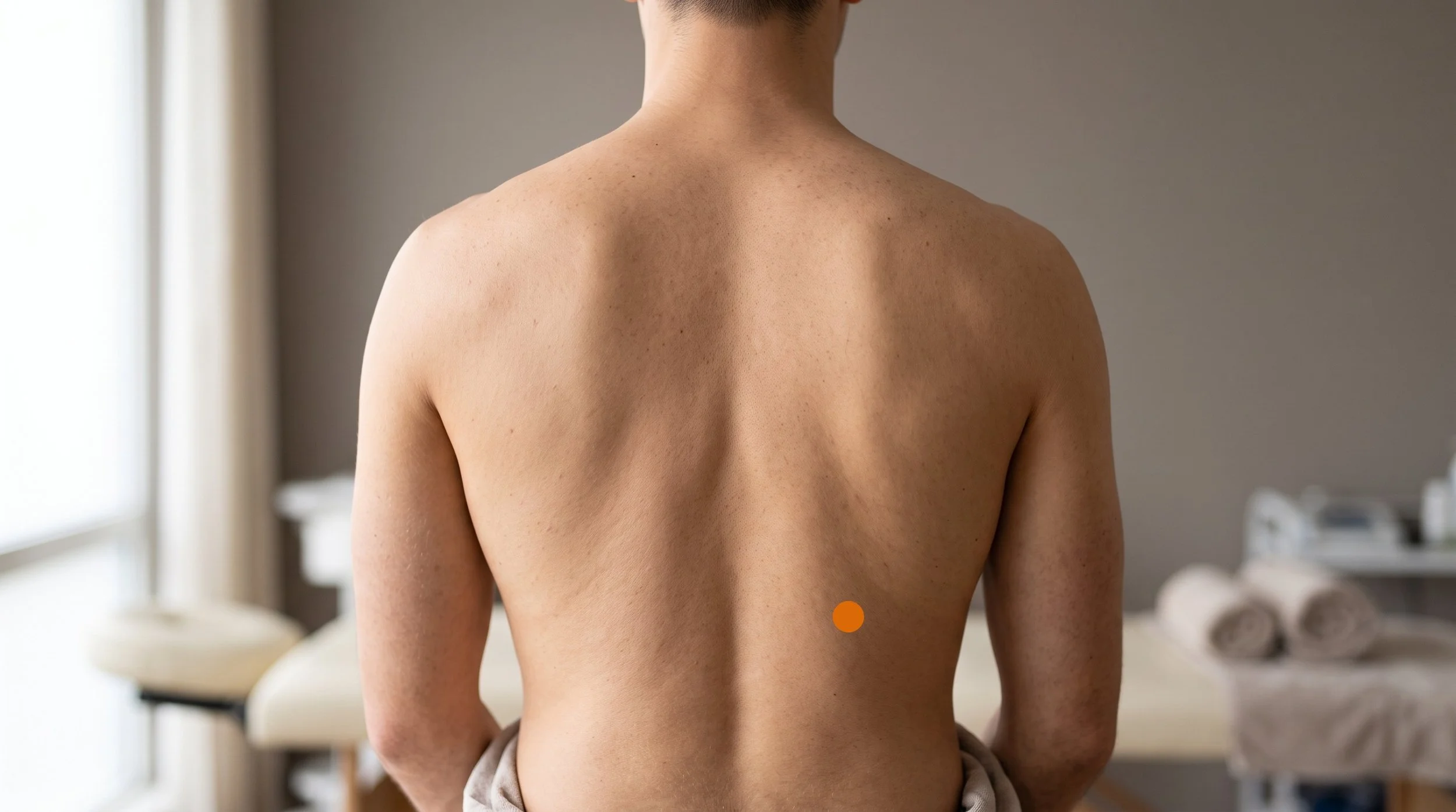
BL48 Acupuncture Point (Yanggang)
Yang's Key Link at the Tenth Thoracic Level: Anatomy, Segmental Mechanism, and How an Outer Bladder Line Point Connects Mid-Back Tension With Digestive Complaints
BL48 (Yanggang), usually translated as Yang's Key Link, sits on the outer branch of the Bladder channel in the mid back, three cun out from the spine at the level of the tenth thoracic vertebra. In plain terms, it's the tender spot roughly two finger-widths outside the inner paraspinal band, near where the lower ribs curve toward the flank, level with BL19, the back-shu point traditionally associated with the Gall Bladder.
That pairing is what gives the bl48 acupuncture point its clinical personality: it's a musculoskeletal point for the thick erector and latissimus tissue at the lower thoracic hinge, and at the same time a classical point for rib-side discomfort, sluggish digestion and damp-heat patterns. Because the pleura sits just beneath this region, bladder 48 is a point where technique matters more than depth, and shallow oblique needling is the standard of care.
- BL48 lies three cun lateral to the midline at the lower border of the T10 spinous process, level with BL19, passing through skin, thoracolumbar fascia, latissimus dorsi and the lateral column of the erector spinae before reaching the rib and costal periosteum (Deadman et al., 2007; Cheng, 2010).
- The point sits in the T8 to T10 sensory field, supplied by lateral cutaneous branches of the posterior rami of the thoracic spinal nerves, the same segmental neighborhood that carries visceral afferents from the upper abdominal organs (Cheng, 2010; Uchida et al., 2017).
- Traditional sources classify BL48 as a point that regulates the Gall Bladder, clears damp-heat and harmonizes the middle jiao; translated neurophysiologically, that describes segmental somato-autonomic input at a level that converges with upper abdominal visceral afferents (Deadman et al., 2007; Uchida et al., 2017).
- Needling here recruits A-delta and C fiber afferents that engage spinal gating and descending inhibitory pathways from the periaqueductal gray and rostral ventromedial medulla, which is the best-supported explanation for local and regional pain relief (Zhao, 2008).
- The research picture is indirect: individual patient data meta-analysis supports acupuncture for chronic musculoskeletal pain, Cochrane found modest short-term benefit for chronic low back pain, and dyspepsia reviews report symptom improvement with low certainty (Vickers et al., 2018; Mu et al., 2020; Pang et al., 2016).
- De qi at bl 48 back is typically a broad, heavy ache that spreads along the rib angle toward the flank rather than a sharp or electric feeling, and technique is deliberately shallow and oblique because deep or medially angled insertion in this zone carries real pneumothorax risk (Deadman et al., 2007; Ernst & White, 2001).
Mid-Back Tension That Wraps Toward Your Ribs?
That band of soreness where the lower ribs meet the spine rarely responds to stretching alone, because it usually involves layered erector and latissimus tissue plus rib mechanics. At Morningside Acupuncture we use BL48 alongside adjacent outer line points and targeted dry needling of the surrounding muscles to reduce guarding and restore easier rotation and breathing. Treatment is precise, shallow and comfortable, with a clear plan rather than an open-ended series. Schedule a visit and we'll map exactly where your mid-back is loading.
Schedule NowAnatomy of BL48: Why the T10 Outer Bladder Line Is Such an Important Location
BL48 is found three cun lateral to the midline at the lower border of the tenth thoracic spinous process, on the outer branch of the Bladder channel and level with BL19 (Deadman et al., 2007). With the shoulder relaxed, that three cun line falls close to the medial border of the scapula, which gives a useful surface check in the upper part of this region. From the surface inward, a needle passes through skin and subcutaneous fat, then the posterior layer of thoracolumbar fascia, then the upper fibers of latissimus dorsi, and finally the lateral column of erector spinae over the rib and its costal angle.
This tissue is loaded constantly by desk posture, one-sided carrying, rotational sport and even breathing mechanics, so the area frequently feels ropey and tender long before anyone calls it an injury.
The sensory supply here comes from the lateral cutaneous branches of the posterior rami of the thoracic spinal nerves in the T8 to T10 range, with the intercostal nerves running just deep to the point along the rib (Cheng, 2010). This is the anatomic reason the region behaves as it does clinically. Afferents from skin, fascia and paraspinal muscle enter the dorsal horn at levels that also receive visceral input from upper abdominal structures, so mechanical and visceral signals share second-order neurons.
Experimental work on somato-autonomic reflexes shows that stimulation of trunk segments can produce measurable autonomic responses through both spinal and supraspinal circuits, and that segmental stimulation tends to engage the local spinal reflex arc directly (Uchida et al., 2017). Needling also drives the broader analgesic machinery described in the mechanism literature, including endogenous opioid release and descending inhibition (Zhao, 2008).
Deep to this point sit the posterior branches of the intercostal artery and vein, and beneath the rib cage, the pleura and lung (Cheng, 2010). That is why the classical needling instruction is oblique insertion of only 0.3 to 0.5 cun, with an explicit caution that deep perpendicular or deep medially angled needling here carries a substantial pneumothorax risk (Deadman et al., 2007).
In practice, we angle laterally or inferiorly along the muscle plane, never toward the spine or through an intercostal space, and we keep depth conservative in thin patients. Serious adverse events from acupuncture remain rare in prospective safety data, and that record depends on exactly this kind of anatomically informed technique (Ernst & White, 2001).
Related Back Shu Points Related Latissimus Dorsi Trigger PointsBL48 at a Glance: Classification, Location, and Clinical Use
| Category | Detail |
|---|---|
| Traditional Name | Yanggang (Yang's Key Link), also translated as Yang's Parameter |
| Channel Classification | Bladder channel, outer (three cun) line of the back, thoracic region (BL48, also written UB48; also called the Urinary Bladder channel) |
| Point Categories | No five-shu, meeting or extraordinary vessel designation is recorded in the classical sources consulted. BL48 is classified as an outer Bladder line point at T10, positioned level with BL19, the back-shu point traditionally associated with the Gall Bladder, and it shares that point's damp-heat clearing profile. |
| Precise Location | On the mid back, 3 cun lateral to the posterior midline, level with the lower border of the T10 spinous process (level with GV7 and BL19). With the shoulder relaxed, the 3 cun line approximates the medial border of the scapula. |
| Tissue Stimulated | Skin and subcutaneous tissue, posterior thoracolumbar fascia, upper fibers of latissimus dorsi, lateral erector spinae (iliocostalis and longissimus) over the tenth rib, with T8 to T10 posterior rami innervation |
| Needle Depth / Direction | Oblique insertion 0.3 to 0.5 cun, angled laterally or inferiorly along the muscle plane and away from the thorax. Deep perpendicular or medially angled needling is avoided because of substantial pneumothorax risk. Moxibustion is traditionally applicable. |
| De Qi Sensation | A broad, heavy, spreading ache or dull pressure that often travels along the rib angle toward the flank. Some patients report a warm, releasing sensation as the paraspinal band softens. Sharp, electric or radiating chest sensations are not expected and the needle should be adjusted. |
| Primary Clinical Uses | Mid-back and lower rib tension, rib-side (hypochondriac) discomfort in classical gallbladder-pattern framing, abdominal rumbling, distention and irregular digestion, and dark or hesitant urination in classical damp-heat framing |
| Common Point Combinations |
|
In A Manual of Acupuncture, Deadman and colleagues frame BL48 largely through its relationship with its inner line neighbor at the same vertebral level. Because it sits level with BL19, the back-shu point traditionally associated with the Gall Bladder, the classical literature attributes to it a similar function: clearing damp-heat said to obstruct the Gall Bladder, with indications that include fever, yellowing of the eyes and face, pain along the rib side, and dark, hesitant urination.
Alongside that, traditional sources credit it with harmonizing the middle burner, listing abdominal pain and distention, rumbling, loose stools, dysenteric conditions, irregular bowel habits, difficulty getting food down and loss of appetite. These are traditional attributions rather than modern diagnostic claims, and they should be read as pattern language, not physiology.
What makes the classical profile striking is how consistently it links one small patch of mid-back tissue with the digestive tract, the biliary system and the urinary tract, three regions that share segmental innervation with exactly this part of the back.
Why BL48 Is Used for Digestive Symptoms and Not Just Back Tension
The most useful explanation is segmental. The tissue at BL48 is supplied by posterior rami in the T8 to T10 range, and afferents from the upper abdominal viscera enter the spinal cord at overlapping levels. When sensory input from two sources converges on the same dorsal horn neurons, the nervous system cannot always distinguish where a signal originated, which is why gallbladder or upper gut irritation can be felt as a band of mid-back or rib-side soreness, and why needling that same back segment can influence how the region is processed centrally (Cheng, 2010; Uchida et al., 2017).
That convergence runs in both directions. Research on somato-autonomic reflexes shows that stimulating somatic tissue on the trunk can shift autonomic outflow through spinal reflex arcs, while stimulation at other body regions tends to work through supraspinal circuits (Uchida et al., 2017). Mechanistic reviews of acupuncture in functional dyspepsia report changes in gastric motility and accommodation, gut hormone levels and autonomic measures, though the studies are heterogeneous and mostly small (Guo et al., 2020).
None of this proves that any single point controls an organ, and we don't claim it does. It does explain why a mid-back point has traditionally been used for digestive complaints.
For the pain side, the mechanism is better characterized. Needle stimulation activates small-diameter afferents that trigger endogenous opioid release and recruit descending inhibitory control from brainstem centers, reducing dorsal horn excitability across the segment (Zhao, 2008). Locally, needling into a taut paraspinal band may also reduce mechanical sensitivity and improve tolerance to movement, which is the practical goal when someone's mid back feels locked at the lower ribs (Simons et al., 1999).
What the Research Shows for BL48
There is no clinical trial isolating BL48, and it would be misleading to suggest otherwise. Almost all acupuncture research tests multi-point protocols for a condition, so the honest way to read the evidence is that BL48 is one plausible component of back-region and digestive protocols rather than a studied intervention on its own. The reviews below establish that acupuncture protocols including thoracolumbar and back-shu region points may produce modest benefit for musculoskeletal pain and some functional gut symptoms, with variable certainty and frequent methodological limitations.
| Study | Type | Focus | Key Finding |
|---|---|---|---|
| Vickers et al., 2018 | Individual patient data meta-analysis | Chronic musculoskeletal, headache and osteoarthritis pain across roughly 20,800 patients | Acupuncture was associated with modest but statistically significant benefit over sham and no-acupuncture controls, with effects largely persisting at one year. |
| Mu et al., 2020 | Cochrane systematic review | Acupuncture for chronic nonspecific low back pain versus sham, no treatment or usual care | Reviewers found small short-term improvements in pain and function compared with sham and usual care, with certainty of evidence rated low to moderate. |
| Pang et al., 2016 | Systematic review and meta-analysis | Manual acupuncture and electroacupuncture for functional dyspepsia (16 trials, 1,436 participants) | Pooled results favored acupuncture for dyspepsia indices and symptoms such as postprandial fullness, but most included trials were judged low quality. |
| Guo et al., 2020 | Mechanistic systematic review | Physiological effects of acupuncture and electroacupuncture in functional dyspepsia | Included studies suggest possible changes in gastric motility, accommodation, gut hormones and autonomic function, though better designed studies are needed. |
| Uchida et al., 2017 | Narrative review of experimental physiology | Somato-autonomic reflexes elicited by needling and related somatic stimulation | Segmental trunk stimulation can engage both spinal and supraspinal reflex pathways affecting visceral function, though most data come from anesthetized animals. |
| Zhao, 2008 | Neurophysiology review | Neural mechanisms of acupuncture analgesia | Analgesic effects are attributed to afferent activation, endogenous opioid release and descending inhibitory control rather than to any channel-specific process. |
| Ernst & White, 2001 | Systematic review of prospective safety surveys | Adverse events across large prospective acupuncture series | Minor effects such as needling pain, tiredness and bleeding were common, while pneumothorax was rare, reported twice in close to a quarter of a million treatments. |
Digestive Discomfort and Rib-Side Pressure at the Same Time?
Patients often describe bloating, rumbling and a dull pressure under the right ribs that seems to travel to the mid back. Classical practice grouped these together at the T10 level, and modern segmental thinking offers a plausible reason why: the same spinal levels serve both the back wall and the upper abdominal organs. We combine BL48 with distal points such as ST36 and PC6 as part of a broader plan that respects your medical workup. Book an evaluation to see whether acupuncture belongs in your care.
Schedule NowBL48 in the Context of Trigger Point Work
Acupuncture is defined by the tool, an acupuncture needle, and it covers hundreds of styles including dry needling. At the T10 level, the yang's key link point sits directly over tissue that trigger point clinicians target regularly: the lateral erector spinae column, the upper fibers of latissimus dorsi as they cross the lower ribs, and the fascial junction where these layers glide over one another.
Trigger points in the thoracolumbar paraspinals and in latissimus dorsi are described as referring pain in bands across the mid and lower back and sometimes toward the flank, which overlaps closely with what patients report when this area is irritable (Simons et al., 1999).
In practice, we palpate before we needle. If the tissue at and around BL48 contains a taut, tender band that reproduces the patient's familiar pain, we treat it as a myofascial target and needle it obliquely along the muscle plane, staying superficial to the rib cage. If the presentation is more diffuse, we may use BL48 as part of a segmental grouping with BL19, BL49 and neighboring inner line points, sometimes with cupping or gentle mobilization afterward.
Either way, needle angle and depth follow the same rule that governs all thoracic paraspinal work: shallow, tangential, and never aimed at an intercostal space.
BL48 Mid-Back and Digestive Treatment at NYC's Highest-Rated Acupuncture Clinic
Morningside Acupuncture is the highest-rated acupuncture and dry needling clinic in New York City with over 500 five-star Google reviews, and our licensed acupuncturists treat the thoracolumbar region every day. We use bl48 acupuncture point work as one piece of an integrated plan that may include dry needling, cupping and movement guidance. Every session starts with an exam, so needling decisions are based on what your tissue actually does. Schedule your appointment and get a plan built around your presentation.
Schedule NowFrequently Asked Questions
What does BL48 feel like when needled?
Most people feel a dull, heavy, spreading ache that fans out along the rib angle toward the side of the trunk, sometimes with a sense of the muscle band softening. Because the needle stays shallow and oblique here, the sensation is usually mild to moderate rather than intense. A brief twitch response is common if the practitioner engages a taut band in the erector or latissimus fibers. Sharp pain, electric zings or any chest sensation is not expected, and you should say so immediately so the needle can be adjusted or removed.
Why needle the mid back for digestive or rib-side symptoms instead of the abdomen?
Because the back and the abdomen share spinal segments. The tissue at BL48 is innervated by posterior rami in the T8 to T10 range, and afferent input from the upper abdominal organs reaches the spinal cord at overlapping levels, so the two converge centrally (Cheng, 2010; Uchida et al., 2017). Experimental work suggests that segmental somatic stimulation on the trunk can influence autonomic outflow through spinal and supraspinal reflex pathways (Uchida et al., 2017). Classical practice arrived at the same territory from a different direction, grouping this level with Gall Bladder and middle burner patterns (Deadman et al., 2007). In clinic we usually treat both regions rather than choosing one.
Can I press BL48 myself between sessions?
Yes, acupressure here is straightforward and low risk since you're only using finger pressure. Find the lower border of the T10 spinous process, then move about four finger-widths laterally, into the soft muscular band just outside the thick inner paraspinal ridge. Use a thumb, a knuckle, a massage ball against a wall, or ask a partner to help, since the angle is awkward to reach alone. Apply steady pressure at a level you would rate about a four to six out of ten, hold for 30 to 60 seconds, breathe slowly, and release. Repeat two or three times per side, once or twice daily. Reduce pressure if it produces sharp pain, and stop if you notice any breathlessness, dizziness or numbness.
Is BL48 safe to needle?
It's safe when needled correctly by a trained practitioner, and it's one of the points where technique genuinely matters. The lung and pleura lie deep to this region, so classical guidance limits insertion to oblique needling of 0.3 to 0.5 cun and specifically warns that deep perpendicular or medially angled needling carries a substantial pneumothorax risk (Deadman et al., 2007). Prospective safety surveys show that serious events of this kind are rare in practice, with common effects being minor and short-lived (Ernst & White, 2001). Tell your acupuncturist if you're very lean, have a history of lung disease or a prior pneumothorax, or take blood thinners. Seek urgent medical care if you develop chest pain or shortness of breath after any thoracic needling.
Where exactly is BL48 located?
BL48 is on the mid back, three cun lateral to the posterior midline, level with the lower border of the tenth thoracic spinous process, which puts it at the same horizontal level as GV7 and BL19 (Deadman et al., 2007). To find it, run your fingers down the spine to the lower thoracic region and identify the T10 spinous process, then move laterally past the inner paraspinal ridge into the second soft band of muscle. A helpful check is that with the shoulder relaxed, the three cun line corresponds closely to the medial border of the scapula. The point is usually noticeably tender when this region is involved.
References
- Deadman, P., Al-Khafaji, M., & Baker, K. (2009). A manual of acupuncture. Journal of Chinese Medicine Publications.
- Cheng, X. (Ed.). (1999). Chinese acupuncture and moxibustion (Rev. ed.). Foreign Languages Press.
- Simons, D. G., Travell, J. G., & Simons, L. S. (1999). Travell & Simons' myofascial pain and dysfunction: The trigger point manual, Vol. 1: Upper half of body (2nd ed.). Williams & Wilkins.
- Vickers, A. J., Vertosick, E. A., Lewith, G., MacPherson, H., Foster, N. E., Sherman, K. J., Irnich, D., Witt, C. M., & Linde, K. (2018). Acupuncture for chronic pain: Update of an individual patient data meta-analysis. Journal of Pain, 19(5), 455-474. https://doi.org/10.1016/j.jpain.2017.11.005
- Mu, J., Furlan, A. D., Lam, W. Y., Hsu, M. Y., Ning, Z., & Lao, L. (2020). Acupuncture for chronic nonspecific low back pain. Cochrane Database of Systematic Reviews, 12(12), CD013814. https://doi.org/10.1002/14651858.CD013814
- Pang, B., Jiang, T., Du, Y. H., Li, J., Li, B., Hu, Y. C., & Cai, Q. H. (2016). Acupuncture for functional dyspepsia: What strength does it have? A systematic review and meta-analysis of randomized controlled trials. Evidence-Based Complementary and Alternative Medicine, 2016, 3862916. https://doi.org/10.1155/2016/3862916
- Guo, Y., Wei, W., & Chen, J. D. Z. (2020). Effects and mechanisms of acupuncture and electroacupuncture for functional dyspepsia: A systematic review. World Journal of Gastroenterology, 26(19), 2440-2457. https://doi.org/10.3748/wjg.v26.i19.2440
- Uchida, S., Kagitani, F., & Sato-Suzuki, I. (2017). Somatoautonomic reflexes in acupuncture therapy: A review. Autonomic Neuroscience, 203, 1-8. https://doi.org/10.1016/j.autneu.2016.11.001
- Zhao, Z. Q. (2008). Neural mechanism underlying acupuncture analgesia. Progress in Neurobiology, 85(4), 355-375. https://doi.org/10.1016/j.pneurobio.2008.05.004
- Ernst, E., & White, A. R. (2001). Prospective studies of the safety of acupuncture: A systematic review. The American Journal of Medicine, 110(6), 481-485. https://doi.org/10.1016/S0002-9343(01)00651-9
Disclaimer: This web site is intended for educational and informational purposes only. Reading this website does not constitute providing medical advice or any professional services. This information should not be used for diagnosing or treating any health issue or disease. Those seeking medical advice should consult with a licensed physician. Seek the advice of a medical doctor or other qualified health professional for any medical condition. If you think you have a medical emergency, call 911 or go to the emergency room. No acupuncturist-patient relationship is created by reading this website or using the information. Morningside Acupuncture PLLC and its employees and contributors do not make any express or implied representations with respect to the information on this site or its use. For any legal interpretation of scope of practice in your state, consult a licensed attorney or regulatory authority.
Read more from our blog



