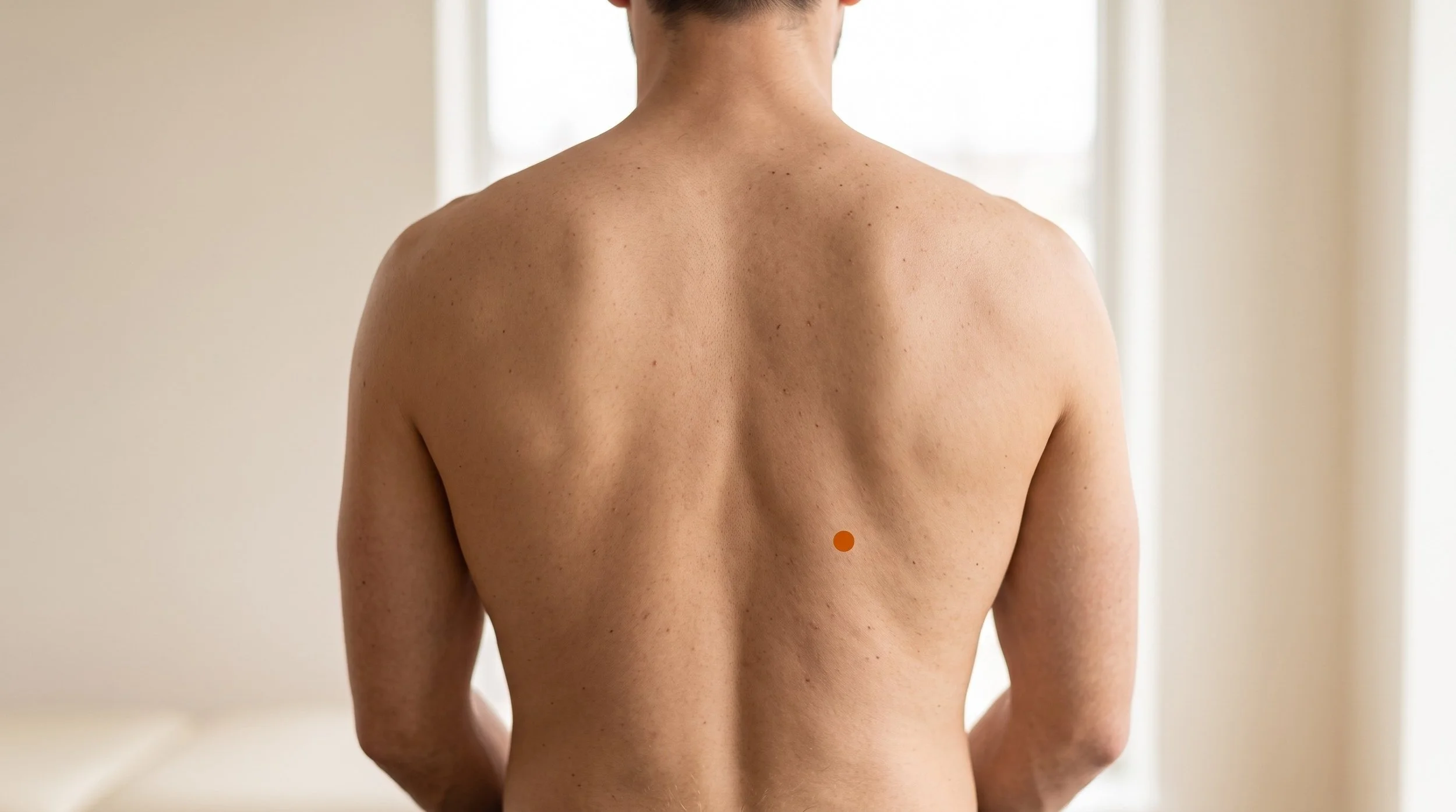
BL47 Acupuncture Point (Hunmen)
The Gate of the Ethereal Soul at T9: Anatomy, Segmental Mechanism, and Why This Outer Bladder Line Point Anchors Mid-Back and Rib-Side Treatment
BL47 (Hunmen), translated as Gate of the Ethereal Soul, sits on the outer branch of the Bladder channel in the mid back, three cun (roughly four finger-widths) to the side of the spine at the level of the ninth thoracic vertebra, directly lateral to BL18, the back-shu point associated with the Liver.
Despite one of the most evocative names in the point catalogue, the bl47 acupuncture point earns its clinical keep in a very physical way: it lies over the thick lateral column of the erector spinae and the upper fibers of latissimus dorsi at a segment that shares spinal input with the lower ribs, the diaphragm and the upper digestive tract. That combination is why bladder 47 shows up in treatments for stubborn mid-back and rib-side tightness, for the band of aching that runs under the shoulder blade, and, in classical sources, for sluggish digestion. It is also a point that demands respect, because the pleura sits not far beneath the needle.
- Location and layers: BL47 is three cun lateral to the midline at the lower border of the T9 spinous process, level with BL18 and with DU8 on the midline, overlying skin, thoracolumbar fascia, latissimus dorsi and the iliocostalis column of the erector spinae before the ribs and intercostal muscles begin (Deadman et al., 2007; Cheng, 1987).
- Traditional attributions translated: classical texts credit BL47 with spreading Liver qi, relaxing the sinews and harmonizing the middle jiao, which in modern terms describes a point used for thoracic paraspinal and costal muscle tone, breathing-related rib restriction, and upper digestive discomfort at a shared spinal level (Deadman et al., 2007).
- Nerve story: the area is supplied by branches of the posterior rami of the mid-thoracic spinal nerves, and needling here recruits A-delta and group III afferents that engage segmental dorsal horn inhibition and descending pain control pathways (Cheng, 1987; Zhao, 2008).
- Autonomic angle: stimulation of trunk tissues at a given spinal segment can produce measurable reflex changes in visceral function through somatoautonomic pathways, which offers a plausible framework for the classical digestive indications without invoking energy flow (Uchida et al., 2017).
- Research picture: no trial has isolated BL47, but individual patient data from chronic pain trials and sham-controlled back pain meta-analyses suggest modest, real effects for acupuncture protocols that routinely include paraspinal points like this one (Vickers et al., 2018; Xiang et al., 2020).
- De qi and safety: patients usually report a deep, spreading ache or heaviness that may travel along the rib line, and needling is kept shallow and oblique because deep or medially angled insertion over the thorax carries a genuine pneumothorax risk (Deadman et al., 2007).
Stuck With Mid-Back Tightness That Massage Keeps Missing?
That deep band of aching between the shoulder blade and the spine often involves the thoracic erector spinae, latissimus dorsi and the tissue around the lower ribs, all of which converge at the level of BL47.
At Morningside Acupuncture we palpate the T9 segment carefully, then combine shallow oblique needling at bl 47 back points with dry needling of the surrounding myofascial bands and breathing retraining. Most patients notice easier rotation and deeper breaths within a few sessions. Schedule a visit and let us map where your mid back is actually loaded.
Schedule NowAnatomy of BL47: Why the T9 Outer Line Is Such an Important Location
Under the fingertip at BL47 there is skin, a modest layer of subcutaneous fat and the posterior layer of the thoracolumbar fascia, then the upper fibers of latissimus dorsi as they sweep toward the humerus. Deeper again sits the lateral column of the erector spinae, iliocostalis thoracis, running over the angles of the lower ribs, with serratus posterior inferior contributing fibers in this region in many people.
This is a mechanically busy neighborhood: it absorbs load from sustained forward-leaning postures, one-sided bag carrying, rotation under load in the gym, and the accessory breathing patterns people adopt when they are stressed or guarding. The three cun line here corresponds roughly to the medial scapular border when the shoulder is relaxed, which is why patients so often point to this exact strip when they describe pain under the shoulder blade (Deadman et al., 2007).
The sensory supply comes from branches of the posterior rami of the mid-thoracic spinal nerves, with the lateral cutaneous branches of the T7 and T8 posterior rami named in standard texts for this location (Cheng, 1987). That segmental address matters. The same mid-thoracic cord levels receive visceral afferents traveling with the greater splanchnic nerve, so somatic and visceral inputs converge on shared dorsal horn neurons.
Needling that reaches muscle at this level activates small-diameter afferents, which drives segmental inhibition and recruits descending control from the periaqueductal gray and rostral ventromedial medulla, along with endogenous opioid and monoamine mechanisms (Zhao, 2008). Reflex effects on autonomic outflow are also well documented in the experimental literature on somatoautonomic pathways, with trunk stimulation producing segmentally organized responses (Uchida et al., 2017).
Below the muscular layers lie the ribs, intercostal muscles, the posterior branches of the intercostal artery and vein, and then the pleura and lung. That is the whole safety story in one sentence. Standard technique is oblique insertion of 0.3 to 0.5 cun, angled along the tissue plane rather than toward the chest cavity, and deep perpendicular or deep medially angled needling is explicitly cautioned against because of substantial pneumothorax risk (Deadman et al., 2007). Moxibustion is traditionally applied here and is a reasonable option when a patient is cold-sensitive or prefers less needle depth over the thorax.
Related Best Acupuncture Points For Back Pain Related Bladder ChannelBL47 at a Glance: Classification, Location, and Clinical Use
| Category | Detail |
|---|---|
| Traditional Name | Hunmen (Gate of the Ethereal Soul, also translated Door of the Ethereal Soul) |
| Channel Classification | Bladder channel of Foot Taiyang, outer (lateral) back line, thoracic region (BL47, also written UB47; also called the Urinary Bladder channel) |
| Point Categories | Outer Bladder line point at T9, level with BL18, the back-shu point associated with the Liver; one of the five outer-line points that sit lateral to the five zang back-shu points, described in the Essential Questions as draining heat from the five zang. No five-shu, hui-meeting or extraordinary vessel designations are attributed to this point. |
| Precise Location | On the mid back, 3 cun lateral to the posterior midline, level with the lower border of the T9 spinous process, level with BL18 and with DU8 on the midline. With the shoulder relaxed, the 3 cun line approximates the medial border of the scapula. |
| Tissue Stimulated | Thoracolumbar fascia, upper fibers of latissimus dorsi, iliocostalis thoracis and adjacent erector spinae, serratus posterior inferior fibers, overlying the ninth rib region |
| Needle Depth / Direction | Oblique insertion 0.3 to 0.5 cun, angled inferiorly or laterally along the tissue plane. Deep perpendicular or deep medially angled needling is avoided over the thorax. Moxibustion is traditionally applicable. |
| De Qi Sensation | A dull, spreading ache or heaviness in the mid back, sometimes with a band-like sensation traveling toward the ribs, and occasionally a brief twitch response when a taut paraspinal band is engaged |
| Primary Clinical Uses | Mid-back and interscapular pain, rib-side and chest fullness in classical Liver qi framing, thoracic paraspinal muscle tension and breathing restriction, generalized joint and sinew aching in classical use, sluggish digestion with cold patterns in classical use |
| Common Point Combinations |
|
Deadman and colleagues note something genuinely odd about this point: although its name links it to the hun, the aspect of consciousness traditionally stored by the Liver, the major classical texts record essentially no mental or emotional indications for it. What they do record is physical and regional.
The traditional actions given are spreading Liver qi and relaxing the sinews, along with harmonizing the middle jiao, and the classical indication lists cluster into three groups: fullness and distension of the chest and rib-side region, back pain with contracted sinews and widespread bone and joint aching, and digestive complaints spanning difficult ingestion, vomiting, loose stools and rumbling. The Essential Questions adds a broader claim, that the five outer-line points sitting lateral to the five zang back-shu points can drain heat from those organs.
Later authors, including Maciocia in his work on the channels, describe using this point for Liver-related emotional patterns such as frustration and a loss of direction, but that is a modern clinical development rather than a classical inheritance (Deadman et al., 2007; Maciocia, 2006). The gap between the poetry of the name and the plainness of the classical record is what makes Hunmen memorable.
Why BL47 Is Used for Rib-Side Tightness, Breathing Restriction and Digestive Discomfort
The mid-thoracic spinal cord is a busy switchboard. Sensory nerves from the skin and muscles of the T9 region enter the cord at the same levels that receive afferent traffic from the stomach, gallbladder, duodenum and lower esophagus by way of the splanchnic nerves. Because those inputs converge on shared second-order neurons, irritation from a viscus can be felt as mid-back muscle pain, and conversely, needling the mid-back can influence sensory processing for that whole segment.
This is the neurophysiological version of what classical authors were describing when they placed digestive complaints and rib-side fullness in the same indication list as back pain (Deadman et al., 2007).
There is a second layer to the effect. Needle stimulation of muscle recruits small-diameter afferents that trigger inhibition in the dorsal horn and activate descending pain control systems in the brainstem, mediated in part by endogenous opioids, serotonin and noradrenaline (Zhao, 2008). Alongside those analgesic pathways, experimental work on somatoautonomic reflexes shows that stimulating somatic tissue can produce reflex changes in visceral function, with responses to trunk stimulation organized segmentally and responses to limb stimulation relying more on supraspinal circuits (Uchida et al., 2017).
Applied to BL47, that means the point is best understood as a segmental input to the mid-thoracic nervous system rather than as a lever on any single organ.
Practically, this shows up in the clinic as patients who describe a tight band under the shoulder blade that worsens with stress, shallow breathing, and a feeling of fullness under the ribs after meals. Treating the thoracic paraspinals and lower rib attachments often improves rotation and breath depth, and some patients report that the abdominal fullness eases as the mid back relaxes. Expectations should stay measured: acupuncture may reduce these symptoms and improve comfort, but persistent digestive or chest symptoms always warrant medical evaluation first.
What the Research Shows for BL47
There is no clinical trial of BL47 on its own, and that is worth saying plainly. Acupuncture research tests whole protocols, usually a set of local paraspinal points plus distal points, so the evidence below speaks to the treatment approach that BL47 belongs to rather than to this single location. What the literature does support is that needling protocols including thoracic and lumbar paraspinal points can produce modest reductions in chronic musculoskeletal pain, that the effects persist beyond the treatment course to a degree, and that needling depth and technique appear to matter. Findings in functional digestive conditions are less settled and should be read cautiously.
| Study | Type | Focus | Key Finding |
|---|---|---|---|
| Vickers et al., 2018 | Individual patient data meta-analysis (39 trials, roughly 20,800 patients) | Chronic musculoskeletal pain, including back and neck pain | Acupuncture was associated with modest but statistically significant reductions in pain compared with both sham and no-acupuncture controls, with effects largely maintained at 12 months. |
| Xiang et al., 2020 | Systematic review and meta-analysis of placebo or sham-controlled trials | Low back pain | Pooled data showed a small significant reduction in pain immediately after treatment compared with sham, though function measures did not differ significantly. |
| Lan et al., 2014 | Cochrane systematic review | Functional dyspepsia | Trials were few and of limited quality, so the review could not establish whether manual acupuncture or electroacupuncture reliably improves dyspepsia symptoms. |
| Uchida et al., 2017 | Narrative review of experimental physiology | Somatoautonomic reflexes elicited by needling | Somatic stimulation can reflexively alter visceral function, with trunk stimulation acting through segmental spinal circuits and limb stimulation depending more on supraspinal pathways. |
| Griswold et al., 2019 | Systematic review with meta-analysis | Deep versus superficial needling for spine-related pain | Deeper needling showed a consistent advantage over superficial needling for pain outcomes, though disability findings were inconclusive. |
| Kietrys et al., 2013 | Systematic review and meta-analysis | Dry needling for upper-quarter myofascial pain | Dry needling of trigger points was more effective than sham or no treatment for short-term pain relief in the upper quarter, with limited longer-term data. |
| Zhao, 2008 | Mechanistic review | Neural mechanisms of acupuncture analgesia | Analgesic effects are attributed to afferent-driven segmental inhibition plus descending control involving opioid and monoaminergic systems. |
Rib-Side Tension, Stress and Sluggish Digestion in the Same Body?
Classical sources grouped chest and rib-side fullness with difficult digestion at Hunmen, and modern segmental thinking explains why those complaints often travel together. We use BL47 alongside points like LV3, ST36 and PC6, plus hands-on assessment of the diaphragm and lower ribs, to address the muscular and autonomic sides of the picture at once. Nothing here replaces medical workup for digestive symptoms, and we will tell you plainly when a referral makes more sense. Book an evaluation to see whether this approach fits your case.
Schedule NowBL47 in the Context of Trigger Point Work
The BL47 location sits squarely over territory that trigger point practitioners already treat. Taut bands in the thoracic iliocostalis can refer pain upward toward the scapula and downward across the flank, and latissimus dorsi trigger points are a classic source of persistent aching at the inferior angle of the scapula and along the lower thoracic region, sometimes wrapping toward the front of the body (Simons et al., 1999).
When a patient's mid-back complaint maps onto those patterns, the same needle insertion can serve two frameworks at once: a classical outer-line point at the Liver level, and a myofascial target in the erector spinae or latissimus. Acupuncture, defined by the use of an acupuncture needle, includes dry needling as one of its many styles, so there is no contradiction in treating both models in a single session.
At Morningside Acupuncture, a typical mid-back session pairs shallow oblique needling at BL47 and BL18 with dry needling of the thoracic iliocostalis, latissimus dorsi, serratus posterior inferior and, where relevant, the rhomboids and lower trapezius. Over the rib cage, needle angle is everything: we work tangentially along the muscle, use pincer grip where the tissue allows it, and never direct a needle medially or deeply toward the chest wall. Cupping, soft tissue work and breathing or thoracic rotation drills are usually layered on afterward so the change in tone has something to hold onto between visits.
BL47 Mid-Back and Rib-Side Pain Treatment at NYC's Highest-Rated Acupuncture Clinic
Morningside Acupuncture is the highest-rated acupuncture and dry needling clinic in New York City with over 500 five-star Google reviews, and thoracic pain is one of the presentations we see most often in desk-bound New Yorkers. Every session begins with an orthopedic and myofascial assessment, so points like BL47 are chosen because your tissue findings support them, not because a chart said so. Treatment blends classical point selection with trigger point dry needling, cupping and movement guidance. Schedule your first appointment and get a plan built around your mid back, not a template.
Schedule NowFrequently Asked Questions
What does BL47 feel like when needled?
Most people feel a brief pinch at the skin, then a dull, spreading ache or a sense of pressure and heaviness in the mid back. Because the needle is placed obliquely into the erector spinae and latissimus fibers, the sensation often fans out along the rib line rather than staying in one spot. If a taut band is engaged, you may feel a quick twitch or a deep cramp-like grab that fades within seconds. Sharp, electric or radiating sensations are not expected, and you should tell your practitioner immediately if you feel anything like that, or any chest tightness or shortness of breath.
Why treat a mid-back point for digestive symptoms rather than needling the abdomen?
The mid-thoracic spinal segments receive sensory input from both the muscles of the mid back and from upper digestive organs traveling with the splanchnic nerves, so the two share processing in the same part of the spinal cord. Needling at this level can therefore influence pain and autonomic activity for the whole segment, and experimental work shows that trunk stimulation produces segmentally organized reflex changes in visceral function (Uchida et al., 2017). Classical texts arrived at a similar clinical grouping without the neuroanatomy, listing chest and rib-side fullness alongside difficult digestion at this point (Deadman et al., 2007). In practice, abdominal and mid-back points are often used together rather than as alternatives.
Can I press BL47 myself between sessions?
Yes, acupressure here is safe and easy to self-apply. Find the lower tip of your shoulder blade, then slide down two or three finger-widths and move toward the spine until you are about four finger-widths lateral to the bony midline, which puts you over the thick paraspinal muscle at roughly the T9 level. Press with a thumb, knuckle or a tennis ball against a wall, using firm but comfortable pressure at about a five or six out of ten, and hold for 30 to 60 seconds per spot while breathing slowly into the lower ribs. Repeat two or three times per side, once or twice a day, and add gentle seated thoracic rotations afterward. Stop if pressure causes sharp pain, numbness or breathlessness, and skip the area entirely if you have had recent rib trauma, a rib fracture or spinal surgery in that region.
Is BL47 safe to needle?
In trained hands, yes, but it is a point that requires a conservative technique. The pleura and lung lie beneath the ribs at this level, so standard practice is oblique insertion of only 0.3 to 0.5 cun, angled along the tissue plane, with deep perpendicular or deep medially angled needling specifically cautioned against because of pneumothorax risk (Deadman et al., 2007). Thin patients, people with significant kyphosis, and anyone with a history of lung disease warrant extra care and shallower depth. This is one reason we recommend seeking a licensed acupuncturist rather than a weekend-course provider for any needling over the thorax.
Where exactly is BL47 located?
BL47 is on the mid back, three cun lateral to the posterior midline, level with the lower border of the ninth thoracic spinous process. That places it on the same horizontal line as BL18 on the inner Bladder line and DU8 on the midline. A useful landmark is that with the shoulder relaxed, the three cun line runs close to the medial border of the scapula, so BL47 lies on the thick paraspinal muscle mass a couple of finger-widths below and medial to the bottom tip of the shoulder blade (Deadman et al., 2007; Cheng, 1987).
References
- Deadman, P., Al-Khafaji, M., & Baker, K. (2009). A manual of acupuncture. Journal of Chinese Medicine Publications.
- Cheng, X. (Ed.). (1999). Chinese acupuncture and moxibustion (Rev. ed.). Foreign Languages Press.
- Maciocia, G. (2006). The channels of acupuncture: Clinical use of the secondary channels and eight extraordinary vessels. Churchill Livingstone Elsevier.
- Simons, D. G., Travell, J. G., & Simons, L. S. (1999). Travell & Simons' myofascial pain and dysfunction: The trigger point manual, Vol. 1: Upper half of body (2nd ed.). Williams & Wilkins.
- Vickers, A. J., Vertosick, E. A., Lewith, G., MacPherson, H., Foster, N. E., Sherman, K. J., Irnich, D., Witt, C. M., & Linde, K. (2018). Acupuncture for chronic pain: Update of an individual patient data meta-analysis. Journal of Pain, 19(5), 455-474. https://doi.org/10.1016/j.jpain.2017.11.005
- Zhao, Z. Q. (2008). Neural mechanism underlying acupuncture analgesia. Progress in Neurobiology, 85(4), 355-375. https://doi.org/10.1016/j.pneurobio.2008.05.004
- Uchida, S., Kagitani, F., & Sato-Suzuki, I. (2017). Somatoautonomic reflexes in acupuncture therapy: A review. Autonomic Neuroscience: Basic and Clinical, 203, 1-8. https://doi.org/10.1016/j.autneu.2016.11.001
- Xiang, Y., He, J. Y., Tian, H. H., Cao, B. Y., & Li, R. (2020). Evidence of efficacy of acupuncture in the management of low back pain: A systematic review and meta-analysis of randomised placebo- or sham-controlled trials. Acupuncture in Medicine, 38(1), 15-24. https://doi.org/10.1136/acupmed-2017-011445
- Lan, L., Zeng, F., Liu, G. J., Ying, L., Wu, X., Liu, M., & Liang, F. R. (2014). Acupuncture for functional dyspepsia. Cochrane Database of Systematic Reviews, 2014(10), CD008487. https://doi.org/10.1002/14651858.CD008487.pub2
- Griswold, D., Wilhelm, M., Donaldson, M., Learman, K., & Cleland, J. (2019). The effectiveness of superficial versus deep dry needling or acupuncture for reducing pain and disability in individuals with spine-related painful conditions: A systematic review with meta-analysis. Journal of Manual & Manipulative Therapy, 27(3), 128-140. https://doi.org/10.1080/10669817.2019.1589030
- Kietrys, D. M., Palombaro, K. M., Azzaretto, E., Hubler, R., Schaller, B., Schlussel, J. M., & Tucker, M. (2013). Effectiveness of dry needling for upper-quarter myofascial pain: A systematic review and meta-analysis. Journal of Orthopaedic & Sports Physical Therapy, 43(9), 620-634. https://doi.org/10.2519/jospt.2013.4668
Disclaimer: This web site is intended for educational and informational purposes only. Reading this website does not constitute providing medical advice or any professional services. This information should not be used for diagnosing or treating any health issue or disease. Those seeking medical advice should consult with a licensed physician. Seek the advice of a medical doctor or other qualified health professional for any medical condition. If you think you have a medical emergency, call 911 or go to the emergency room. No acupuncturist-patient relationship is created by reading this website or using the information. Morningside Acupuncture PLLC and its employees and contributors do not make any express or implied representations with respect to the information on this site or its use. For any legal interpretation of scope of practice in your state, consult a licensed attorney or regulatory authority.
Read more from our blog



