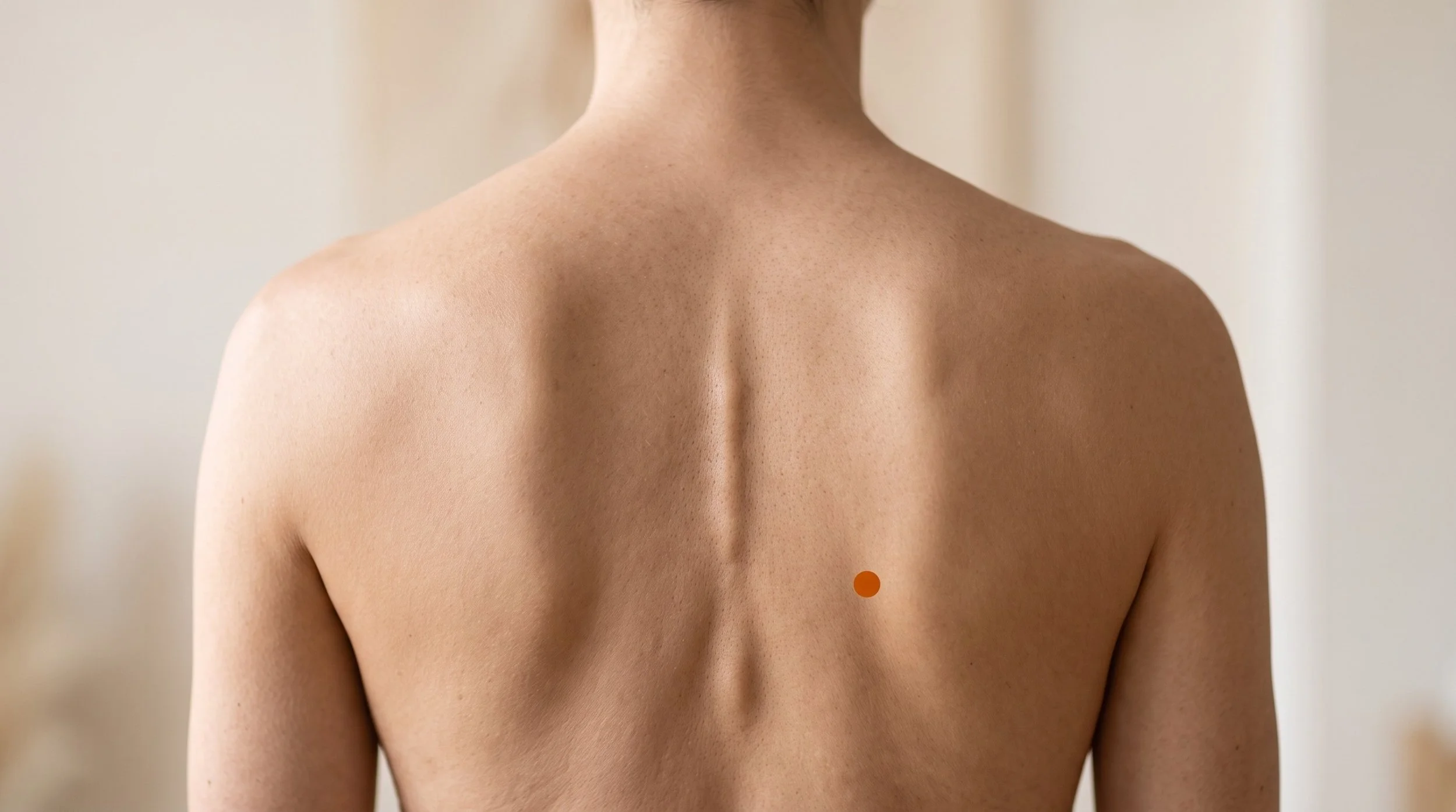
BL46 Acupuncture Point (Geguan)
The Diaphragm Gate Beside T7: Anatomy, Mechanism, and Why This Outer Bladder Line Point Sits Where the Mid Back Meets the Breath
BL46, known in Chinese as Geguan and translated as Diaphragm Gate, sits on the outer line of the Bladder channel in the mid back, three cun (roughly four finger widths) to the side of the spine at the level of the lower edge of the seventh thoracic spinous process. When your arms hang relaxed at your sides, that level lands close to the bottom tip of the shoulder blade, which makes the bl46 acupuncture point easy to find and easy to recognize as the exact band where so many desk workers, cyclists, new parents, and anxious shallow breathers carry tightness.
Bladder 46 matters clinically because it occupies a crossroads: it's a mid-thoracic muscular point that responds well to needling for stiffness and bra-line-level tension, and it's also positioned at the same segmental level as BL17, the diaphragm shu, which is why classical texts credit the diaphragm gate point with settling belching, sighing, and the sense that food or breath isn't moving down easily.
- Location and layers: BL46 is three cun lateral to the midline at the lower border of T7, about level with the inferior angle of the scapula, and the needle passes through skin, subcutaneous fascia, and the fibers of lower trapezius and latissimus dorsi before reaching the lateral column of the erector spinae (Deadman et al., 2007; Cheng, 2010).
- Traditional attributions, translated: classical sources describe BL46 as regulating the diaphragm, benefiting the middle jiao, descending rebellion, and activating the channel to relieve pain (Deadman et al., 2007; Kim, 2015). In modern language, that maps onto reduced paraspinal muscle guarding at T6 to T8 plus segmental influence on upper digestive reflexes.
- Nerve story: the point is innervated by the medial cutaneous branches of the posterior rami of the sixth and seventh thoracic nerves, with their lateral branches deeper (Cheng, 2010). Those same spinal segments receive visceral afferent traffic from the esophagus and upper stomach, which is the plausible basis for a mid-back point being used for belching and swallowing discomfort (Guo et al., 2020).
- Research picture: no trial has isolated BL46, so the evidence is indirect. Meta-analyses support acupuncture for chronic spinal pain and chronic pain generally (Huang et al., 2021; Vickers et al., 2018), while mechanistic reviews describe endogenous opioid release and descending inhibition as core analgesic pathways (Zhao, 2008).
- Clinical framing: at Morningside we use bl 46 back needling as one element of a regional plan for mid-thoracic stiffness, rib cage restriction, and stress-driven breath holding, usually alongside BL17, lower trapezius, and latissimus work rather than on its own.
- De qi and safety: expect a deep, spreading ache or heaviness under the shoulder blade, sometimes with a band-like sensation along the rib. Because the pleura lies close beneath this region, oblique insertion of 0.3 to 0.5 cun is the standard, and deep or medially angled needling is avoided (Deadman et al., 2007); pneumothorax remains the most reported serious acupuncture complication, though large prospective series place serious events at a very low rate (Witt et al., 2009).
Tight Between the Shoulder Blades and Can't Take a Full Breath?
That stubborn band at bra-strap level often involves lower trapezius, latissimus dorsi, and the thoracic paraspinals all guarding together, and it frequently travels with shallow, held breathing. We use BL46 and the surrounding T6 to T8 tissue with fine needles, gentle oblique technique, and hands-on rib mobility work so the mid back can move again. Many patients notice their breath drops lower within the first few visits. Schedule a session and let's see how your mid back responds.
Schedule NowAnatomy of BL46: Why the Level of the Scapular Tip Is Such an Important Location
BL46 sits three cun lateral to the spine at the lower border of the T7 spinous process, which in most bodies puts it just medial to or level with the inferior angle of the shoulder blade when the arm hangs relaxed. From the surface down, a needle here passes through skin and subcutaneous tissue, then thoracolumbar fascia, then the thin lower fibers of trapezius and the upper edge of latissimus dorsi, and finally reaches the lateral column of the erector spinae as it runs over the seventh and eighth ribs (Deadman et al., 2007; Cheng, 2010).
This tissue is loaded constantly by ordinary life: hours of forward reaching at a keyboard, carrying a bag or a child on one side, rowing and overhead sports, and the sustained low-grade bracing that comes with stress. It's also the exact strip where a bra band, a backpack strap, or a chair edge concentrates pressure, which is part of why so many people can point to this level without being able to name what's tight.
The point's nerve supply comes from the medial cutaneous branches of the posterior rami of the sixth and seventh thoracic spinal nerves, with the lateral branches sitting deeper (Cheng, 2010). Needling here recruits A-delta and group III afferents from muscle and fascia, and that input reaches the T6 to T8 dorsal horn where it can dampen the transmission of nociceptive traffic from the same and neighboring segments.
Reviews of acupuncture analgesia describe this as a two-part process: local segmental gating in the spinal cord plus activation of descending inhibitory pathways from the midbrain and brainstem, with endogenous opioid and monoamine signaling doing much of the work (Zhao, 2008). The same segments also receive visceral afferent input from the esophagus and upper stomach, and somatic needling at thoracic and abdominal levels has been shown to influence gastric activity through autonomic reflex arcs (Guo et al., 2020).
That convergence, rather than anything mystical, is the most workable explanation for why a back point has long been credited with settling belching and swallowing discomfort.
Deeper structures set the safety rules. The posterior branches of the intercostal vessels run in this region, and more importantly the pleura and lung lie only a short distance beneath the thin muscle layer at the seventh and eighth rib level (Cheng, 2010). For that reason the standard technique is oblique insertion of 0.3 to 0.5 cun, and deep perpendicular or deeply angled medial needling is specifically avoided because it carries substantial pneumothorax risk (Deadman et al., 2007).
Practically, that means a shallow angle directed away from the chest cavity, careful attention to body habitus (thin patients have far less tissue depth here), and clear post-treatment instructions. Large prospective safety data reassure us that serious events are rare when practitioners respect thoracic anatomy (Witt et al., 2009), but the caution is not optional at this level of the back.
Related Diaphragm Trigger Points Related Back Shu PointsBL46 at a Glance: Classification, Location, and Clinical Use
| Category | Detail |
|---|---|
| Traditional Name | Geguan (Diaphragm Gate), also rendered Diaphragm Hinge |
| Channel Classification | Bladder channel of Foot Taiyang, outer (three cun) back line, mid-thoracic region at T7 (BL46, also written UB46; also called the Urinary Bladder channel) |
| Point Categories | No five-shu, hui-meeting, or extraordinary vessel intersection status is attributed to BL46 in the standard references. Its classification rests on position: an outer Bladder line point level with BL17, the diaphragm shu and hui-meeting point of blood, and level with GV9 on the midline, which is why the classical literature treats it as an outer-line counterpart with a shared diaphragm-regulating role. |
| Precise Location | On the mid back, three cun lateral to the posterior midline, level with the lower border of the spinous process of the seventh thoracic vertebra (T7), level with BL17 and GV9, approximately at the level of the inferior angle of the scapula when the shoulder is relaxed. |
| Tissue Stimulated | Skin and subcutaneous fascia, thoracolumbar fascia, lower trapezius fibers and the upper border of latissimus dorsi, with the lateral erector spinae column deeper; regionally related to diaphragm mechanics at the same segmental levels |
| Needle Depth / Direction | Oblique insertion 0.3 to 0.5 cun, angled away from the chest cavity (typically superficially along the tissue plane or laterally). Deep perpendicular and deep medially angled needling are avoided because of pneumothorax risk. Moxibustion is traditionally considered applicable. |
| De Qi Sensation | A deep, dull, spreading ache or heaviness under and around the shoulder blade, sometimes with a band-like or slightly numb sensation tracking along the rib. Sharp, electric, or breath-catching sensation is not expected and should prompt immediate needle withdrawal. |
| Primary Clinical Uses | Mid-thoracic stiffness and pain with difficulty bending or rotating, bra-line-level muscular tension, rib cage and scapular region restriction, and, in classical use, belching, sighing, chest and diaphragm oppression, vomiting, and difficult or uncomfortable swallowing. |
| Common Point Combinations |
|
In Deadman's A Manual of Acupuncture, Geguan is presented as the outer-line partner of the diaphragm shu, BL17, and its traditional functions follow directly from that shared level. The classical attributions cluster into two families. The first is diaphragmatic and digestive: the point is credited with easing fullness and oppression across the chest and diaphragm, quieting belching and sighing, and directing rebellious stomach qi downward in cases of vomiting or food that seems reluctant to go down, with older sources adding items such as vomiting of blood, drooling, and irregular bowel and urinary function.
The second family is purely musculoskeletal: stiffness and pain of the spine, trouble bending and straightening, generalized body ache, joint stiffness, and back pain that feels worse with cold. The commentary frames the diaphragm itself as the divider between the upper and middle burners, so a point at that level was expected to help traffic move in both directions.
What makes the pattern striking is how cleanly the two lists map onto one segmental neighborhood: the same T6 to T8 territory that governs the mid-back muscles is also where esophageal and upper gastric afferents arrive, so a classical text describing one point for both stiff spines and stubborn belching turns out to be describing a shared neural address.
Why BL46 Is Used for Belching, Sighing, and the Feeling That You Can't Take a Full Breath
The first piece is convergence. Sensory nerves from the mid-thoracic skin and muscles enter the spinal cord at roughly the same levels as visceral afferents from the esophagus and upper stomach, and BL46 sits squarely in the T6 and T7 cutaneous territory (Cheng, 2010). When many inputs share a segment, two things follow. Irritation from a viscus can be felt as a tight, sore, hard-to-stretch band in the mid back, and needle input into that band can, in turn, feed back into the same segmental circuits.
Reviews of acupuncture and gastrointestinal function describe exactly this kind of somato-autonomic reflex, with needling at appropriate segments influencing gastric motility and accommodation through autonomic pathways (Guo et al., 2020). That doesn't make BL46 a treatment for any specific gut diagnosis, but it does explain why the classical indication list looks the way it does.
The second piece is descending control and muscle tone. Needling recruits small-diameter afferents that trigger spinal gating and activate descending inhibitory pathways involving endogenous opioids and monoamines, which reduces the nociceptive signal and often reduces protective muscle guarding along with it (Zhao, 2008). Guarding matters here in a very mechanical way: if the mid-thoracic extensors and the lower trapezius and latissimus sheets are held tight, the ribs don't rotate well, and if the ribs don't rotate, the diaphragm can't descend fully.
People experience that as sighing, breath stacking, and a sense of not getting a satisfying inhale. Loosening the segment often changes the breath before it changes the pain score.
The third piece is autonomic. Meta-analytic work on heart rate variability suggests that needle acupuncture can shift autonomic balance toward parasympathetic dominance compared with placebo needling, though the trials are few and the measurement methods vary (Hamvas et al., 2023). For a patient whose mid-back tension is driven mainly by stress and breath holding, that shift plus slower, lower breathing during the session is a plausible part of why the region feels different afterward. We frame this cautiously: the effect sizes are modest, the studies are heterogeneous, and none of them tested BL46 specifically.
What the Research Shows for BL46
Nobody has run a clinical trial on BL46 by itself, and it's unlikely anyone will. Acupuncture research almost always tests multi-point protocols chosen by a clinician or a consensus panel, so the honest way to read the literature is to ask whether acupuncture helps the problems BL46 is chosen for, and whether the proposed mechanisms hold up. On that basis the picture is moderately encouraging for spinal pain and for upper digestive symptoms, considerably weaker and lower in quality for the diaphragm-specific classical indications such as hiccup, and reasonably solid for the underlying neurophysiology. What follows sets expectations rather than promises.
| Study | Type | Focus | Key Finding |
|---|---|---|---|
| Huang et al., 2021 | Systematic review and meta-analysis | Chronic spinal pain, including cervical, thoracic, and lumbar presentations | Acupuncture was associated with greater reductions in pain and better function than no treatment, sham, or several conventional comparators, though thoracic-specific data were limited within the pooled results. |
| Vickers et al., 2018 | Individual patient data meta-analysis | Chronic musculoskeletal pain across nearly 21,000 patients | Acupuncture outperformed both sham and no-acupuncture controls with effects that persisted over time, supporting more than a short-lived placebo response. |
| Zhao, 2008 | Mechanistic review | Neural basis of acupuncture analgesia | Analgesic effects are attributed to segmental spinal inhibition plus descending control involving endogenous opioid and monoamine systems. |
| Guo et al., 2020 | Systematic review of clinical and mechanistic studies | Acupuncture and electroacupuncture for functional dyspepsia | Reported benefits for dyspeptic symptoms were linked to autonomic and gastric motility changes, but study heterogeneity and methodological quality limited firm conclusions. |
| Yue et al., 2017 | Systematic review and meta-analysis | Acupuncture for hiccup following stroke | Pooled results favored acupuncture, but the included trials were small and at high risk of bias, so the finding should be treated as preliminary. |
| Hamvas et al., 2023 | Systematic review and meta-analysis | Heart rate variability after needle acupuncture versus placebo | Real needling was associated with increased parasympathetic tone relative to placebo across a small set of randomized trials. |
| Witt et al., 2009 | Prospective observational safety study | Adverse events across 229,230 acupuncture patients | Serious adverse events were very rare, with pneumothorax reported in isolated cases, reinforcing the need for shallow oblique technique over the thorax. |
Belching, Sighing, and Upper Digestive Discomfort That Track With Back Tension?
Classical texts pair mid-thoracic points like Geguan with upper digestive complaints, and modern segmental anatomy offers a reasonable explanation for that pairing. Our clinicians combine BL46 with points such as PC6 and ST36, plus breathing retraining, when belching, chest oppression, and mid-back tightness show up together. We'll also flag anything that belongs with your gastroenterologist rather than with us. Book an evaluation to get a clear plan.
Schedule NowBL46 in the Context of Trigger Point Work
The location of BL46 overlaps almost perfectly with territory that myofascial clinicians already treat. At the level of the scapular tip, three cun off the midline, you're in the lower trapezius and upper latissimus dorsi field, with iliocostalis thoracis running just deep and serratus posterior inferior nearby below.
Trigger points in iliocostalis thoracis are classically described as referring pain upward and downward along the back and sometimes around to the front of the chest or abdomen, and lower trapezius points can produce a nagging ache along the mid-thoracic paraspinals and up toward the neck (Simons et al., 1999). Patients who describe a hot, gnawing spot right at bra-strap level are often describing one of these, and the fact that BL46 shares the address is a useful coincidence rather than a competing theory.
In practice at Morningside, we don't treat BL46 and dry needling as separate systems, because both are the use of an acupuncture needle. A typical mid-back session might combine gentle oblique needling at BL46 and BL17 with taut band work in lower trapezius, latissimus dorsi, and the thoracic paraspinals, chosen by palpation rather than by protocol. Over the ribs, the same safety rule governs everything: shallow, tangential angles, no deep medial insertion, and extra caution in lean patients.
We then pair the needling with thoracic rotation and extension drills and a simple breathing reset, since tissue that's been quieted holds the change better once the segment starts moving normally again.
BL46 Mid-Back Pain Treatment at NYC's Highest-Rated Acupuncture Clinic
Morningside Acupuncture is the highest-rated acupuncture and dry needling clinic in New York City with over 500 five-star Google reviews, and mid-back and rib cage complaints are a daily part of our caseload. We treat BL46 within a full regional assessment that includes thoracic mobility, scapular control, and breathing mechanics, not as a single point applied in isolation. Every session is one-on-one with a licensed acupuncturist. Schedule your visit and start with a real evaluation.
Schedule NowFrequently Asked Questions
What does BL46 feel like when needled?
Most people report a deep, dull ache or a heavy, spreading pressure under and around the shoulder blade, occasionally with a mild band-like sensation running along the rib. Because the needle is inserted obliquely and shallowly here, the sensation tends to be broad and diffuse rather than sharply localized. Some patients notice their breathing deepen within a minute or two, and a mild soreness at the site for a day afterward is common and harmless. Sharp, electric, or breath-catching sensations aren't expected, and a good practitioner will withdraw and reposition immediately if you report one.
Why needle my mid back for belching or a tight, unsatisfying breath rather than my stomach or chest?
Because the mid back is where the relevant nerves live. Sensory fibers from the skin and muscles around T6 and T7 enter the spinal cord alongside visceral afferents from the esophagus and upper stomach (Cheng, 2010), which means the back gives access to the same segmental circuits from a much safer angle than the abdomen or the front of the chest. There's also a straightforward mechanical argument: a stiff thoracic spine limits rib rotation, and limited rib rotation limits how far the diaphragm can descend. Classical texts arrived at the same pairing centuries ago by observation, describing Geguan as regulating the diaphragm and directing rebellious qi downward (Deadman et al., 2007).
Can I press BL46 myself between sessions?
Yes, and it's one of the easier points to self-treat with a tool. Find the bottom tip of your shoulder blade with the opposite hand, then move about a thumb's width toward the spine and settle into the soft muscular tissue there, avoiding the bony blade itself. Because reaching behind yourself is awkward, most people do better with a lacrosse ball or a firm massage ball against a wall: lean into the spot, find a tolerable ache at about a five or six out of ten, and hold steady pressure for 30 to 60 seconds while breathing slowly into your lower ribs. Repeat two or three times per side, once or twice daily, and follow with a few rounds of thoracic rotation. Pressure should never be sharp, should never produce numbness or tingling down an arm, and should be skipped over bruised, inflamed, or recently injured tissue.
Is BL46 safe to needle?
It's safe in trained hands, but it's a point that demands respect. The pleura and lung lie a short distance beneath thin muscle at this level, so the standard technique is oblique insertion of only 0.3 to 0.5 cun, with deep perpendicular and deep medially angled needling specifically avoided because of pneumothorax risk (Deadman et al., 2007). Large prospective safety data across hundreds of thousands of patients show that serious adverse events from acupuncture are very rare (Witt et al., 2009), and the cases that do occur usually involve inattention to thoracic anatomy. Tell your practitioner if you're very thin, have a history of lung disease or chest surgery, or take blood thinners, and seek medical care promptly if you develop new shortness of breath or chest pain after any treatment over the upper back.
Where exactly is BL46 located?
BL46 lies on the mid back, three cun lateral to the posterior midline, level with the lower border of the seventh thoracic spinous process. That level is shared with BL17 on the inner Bladder line and GV9 on the midline. The most reliable surface landmark is the inferior angle of the shoulder blade: with the arms relaxed at the sides, that bony tip sits at roughly the same height, and the three cun line runs close to the medial border of the scapula. Palpate just off the blade into the muscular tissue rather than onto bone, and expect the tender spot to sit slightly differently on each side.
References
- Deadman, P., Al-Khafaji, M., & Baker, K. (2009). A manual of acupuncture. Journal of Chinese Medicine Publications.
- Cheng, X. (Ed.). (1999). Chinese acupuncture and moxibustion (Rev. ed.). Foreign Languages Press.
- Kim, H. (2008). Handbook of Oriental medicine (3rd ed.). Harmony & Balance Press.
- Cunningham, P. M. (2000). Acupuncture points: A practical guide to classical and modern usage. Odyssey Press.
- Simons, D. G., Travell, J. G., & Simons, L. S. (1999). Travell & Simons' myofascial pain and dysfunction: The trigger point manual, Vol. 1: Upper half of body (2nd ed.). Williams & Wilkins.
- Zhao, Z. Q. (2008). Neural mechanism underlying acupuncture analgesia. Progress in Neurobiology, 85(4), 355-375. https://doi.org/10.1016/j.pneurobio.2008.05.004
- Vickers, A. J., Vertosick, E. A., Lewith, G., MacPherson, H., Foster, N. E., Sherman, K. J., Irnich, D., Witt, C. M., & Linde, K. (2018). Acupuncture for chronic pain: Update of an individual patient data meta-analysis. Journal of Pain, 19(5), 455-474. https://doi.org/10.1016/j.jpain.2017.11.005
- Huang, J. F., Zheng, X. Q., Chen, D., Lin, J. L., Zhou, W. X., Wang, H., Qin, Z., & Wu, A. M. (2021). Can acupuncture improve chronic spinal pain? A systematic review and meta-analysis. Global Spine Journal, 11(8), 1248-1265. https://doi.org/10.1177/2192568220962440
- Guo, Y., Wei, W., & Chen, J. D. Z. (2020). Effects and mechanisms of acupuncture and electroacupuncture for functional dyspepsia: A systematic review. World Journal of Gastroenterology, 26(19), 2440-2457. https://doi.org/10.3748/wjg.v26.i19.2440
- Yue, J., Liu, M., Li, J., Wang, Y., Hung, E. S., Tong, X., Sun, Z., Zhang, Q., & Golianu, B. (2017). Acupuncture for the treatment of hiccups following stroke: A systematic review and meta-analysis. Acupuncture in Medicine, 35(1), 2-8. https://doi.org/10.1136/acupmed-2015-011024
- Hamvas, S., Hegyi, P., Kiss, S., Lohner, S., McQueen, D., & Havasi, M. (2023). Acupuncture increases parasympathetic tone, modulating HRV: Systematic review and meta-analysis. Complementary Therapies in Medicine, 72, 102905. https://doi.org/10.1016/j.ctim.2022.102905
- Witt, C. M., Pach, D., Brinkhaus, B., Wruck, K., Tag, B., Mank, S., & Willich, S. N. (2009). Safety of acupuncture: Results of a prospective observational study with 229,230 patients and introduction of a medical information and consent form. Forschende Komplementärmedizin, 16(2), 91-97. https://doi.org/10.1159/000209315
Disclaimer: This web site is intended for educational and informational purposes only. Reading this website does not constitute providing medical advice or any professional services. This information should not be used for diagnosing or treating any health issue or disease. Those seeking medical advice should consult with a licensed physician. Seek the advice of a medical doctor or other qualified health professional for any medical condition. If you think you have a medical emergency, call 911 or go to the emergency room. No acupuncturist-patient relationship is created by reading this website or using the information. Morningside Acupuncture PLLC and its employees and contributors do not make any express or implied representations with respect to the information on this site or its use. For any legal interpretation of scope of practice in your state, consult a licensed attorney or regulatory authority.
Read more from our blog



