BL45 Acupuncture Point (Yixi)
The Point Named for the Sound You Make When It Is Pressed: Anatomy, Mechanism, and Why This T6 Outer Bladder Line Point Anchors Mid-Back and Shoulder Blade Treatment
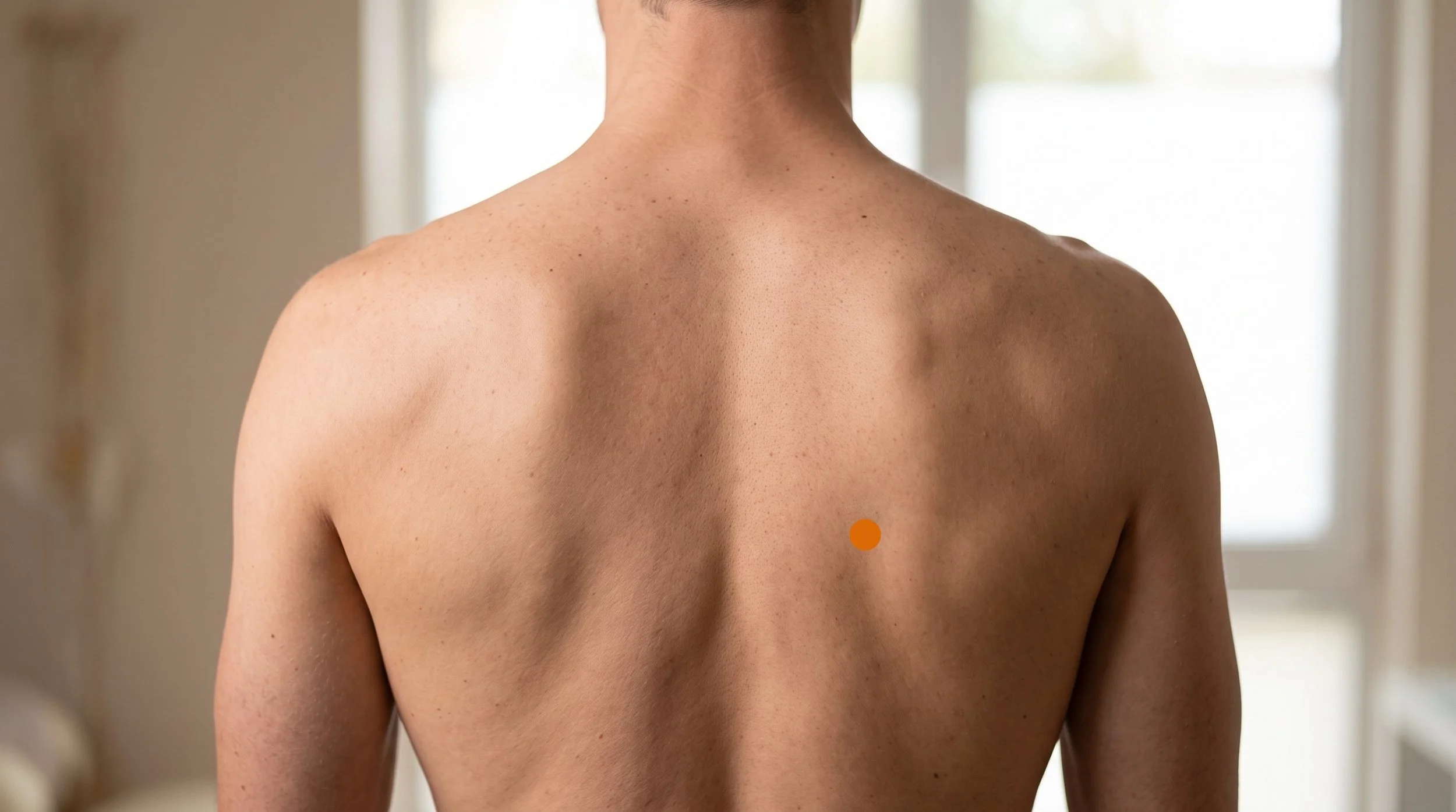
BL45 (Yixi, often translated as "surprise" or rendered simply as Yi Xi) sits on the outer branch of the Bladder channel in the mid back, 3 cun lateral to the spine at the level of the lower border of the sixth thoracic spinous process, which places it right around the medial border of the shoulder blade when the arms hang relaxed. The name is onomatopoeic: classical writers described the involuntary sound a patient makes when the spot is pressed firmly, which is arguably one of the oldest written descriptions of what modern clinicians call a jump sign over a tender point.
That origin story tells you most of what you need to know about how the bl45 acupuncture point is used today, because it is one of the most reliably tender interscapular locations in people who spend long hours at a desk, and it overlaps the trapezius and rhomboid tissue that generates so much mid-back and shoulder blade pain.
- Location and layers: bladder 45 lies 3 cun lateral to the midline at the lower border of T6, level with BL16 on the inner Bladder line, over skin, fascia, middle trapezius, rhomboid major, and the deeper erector spinae and rib cage. When the shoulder is relaxed, this 3 cun line tracks the medial border of the scapula, which is why patients often describe the spot as being "under the shoulder blade."
- Traditional attributions: classical sources credit Yixi with dispersing wind, clearing heat, descending Lung qi, and moving qi and blood to relieve pain, and they list cough, wheezing, chest and rib pain, and shoulder and back pain among its indications. Read neurophysiologically, these are the referral zones of the mid-thoracic segments rather than statements about energy movement.
- Mechanism: needling here stimulates the medial cutaneous branches of the T5 and T6 posterior rami and, more deeply, muscle innervated by the dorsal scapular and spinal accessory nerves, feeding afferent input into dorsal horn segments that also receive convergent input from the chest wall and thoracic viscera, with additional recruitment of descending inhibitory pathways (Zhao, 2008).
- Research picture: no trial has isolated BL45 on its own, so the evidence comes from broader work showing that acupuncture produces modest but durable benefits over sham and usual care in chronic musculoskeletal pain (Vickers et al., 2018), and that trigger point needling of the shoulder girdle and spinal musculature can lower pain and raise pressure pain thresholds in the short to medium term (Gattie et al., 2017).
- Clinical practice framing: at Morningside we treat this location less as a fixed coordinate and more as a search area, palpating the interscapular band for the taut, exquisitely tender spot that reproduces a patient's familiar ache, which is exactly the phenomenon the point's name records (Simons et al., 1999).
- De qi and safety: expect a deep, dull, spreading heaviness rather than a sharp sting, sometimes with a brief muscle twitch. Because the lung sits just deep to the ribs here, needling is oblique and shallow at 0.3 to 0.5 cun, never deep and never angled medially, a caution supported by the fact that pneumothorax remains the most commonly reported serious acupuncture adverse event (White, 2004).
Stuck With a Knot Between Your Shoulder Blades That Will Not Release?
That stubborn interscapular spot is one of the most common complaints we see in desk workers, and BL45 sits right in the middle of it. Our licensed acupuncturists palpate the whole trapezius and rhomboid band before needling, then use shallow oblique technique at the tender point along with supporting distal points. Most patients notice looser mid-back movement within the first two or three visits. Schedule a session and let us map where your pain actually lives.
Schedule NowAnatomy of BL45: Why the Medial Scapular Border at T6 Is Such an Important Location
Under the needle at BL45 there is skin, a thin layer of subcutaneous fat, and then the middle fibers of trapezius, with rhomboid major immediately beneath in most people. Deeper still lie the thoracic erector spinae, the levatores costarum, and the sixth and seventh ribs with their intercostal muscles.
This is a mechanical crossroads: the trapezius and rhomboids control scapular retraction and upward rotation, and they hold sustained low-level tension during exactly the activities New Yorkers do all day, which includes laptop work, phone scrolling, driving, carrying a bag on one shoulder, and rounded-shoulder sitting. When the shoulder blade rests in a protracted position for hours, this band of tissue works isometrically without ever getting a break, and the result is the familiar burning ache between the shoulder blades that patients point to with a thumb.
The sensory supply here comes mainly from the medial cutaneous branches of the posterior rami of the fifth and sixth thoracic nerves, with the deeper lateral branches supplying muscle, while rhomboid major receives the dorsal scapular nerve and trapezius receives the spinal accessory nerve plus cervical contributions. That segmental address matters.
Afferents from a needle at T6 enter the same dorsal horn levels that receive input from the chest wall, the pericardium, the esophagus, and the lower lung fields, so stimulation at the skin and muscle can modulate how those shared circuits behave, a phenomenon usually described as segmental convergence. On top of that local effect, needle stimulation recruits brainstem descending inhibitory systems and endogenous opioid signaling that dampen nociceptive transmission well beyond the segment treated (Zhao, 2008).
Trigger points in this region also refer pain in predictable patterns, which is why a spot at the medial scapular border can produce an ache that spreads toward the shoulder, the neck, or the ribs (Simons et al., 1999).
Vascular supply is from the posterior branches of the intercostal artery and vein, which are small and rarely a concern beyond minor bruising. The structure that governs technique is the lung. Between the ribs, the pleura is only a short distance from the skin surface, and in lean patients it can be closer than expected. For that reason the standard approach at BL45 is oblique insertion of roughly 0.3 to 0.5 cun, angled inferiorly or laterally along the tissue plane, with deep perpendicular or medially directed needling specifically avoided.
Pneumothorax is uncommon but remains the most frequently reported serious adverse event in acupuncture safety reviews, and nearly all reported cases involve deep needling over the thorax rather than the technique itself (White, 2004). Practiced correctly, needling here is a low-risk procedure in trained hands.
Related Pain Finder Upper Back Shoulder Arm Related Best Acupuncture Points For Back PainBL45 at a Glance: Classification, Location, and Clinical Use
| Category | Detail |
|---|---|
| Traditional Name | Yixi (Yi Xi), commonly translated as "Surprise," an onomatopoeic name for the sound elicited when the point is pressed |
| Channel Classification | Bladder channel of Foot Taiyang, outer (3 cun) back line, thoracic section (BL45, also written UB45; also called the Urinary Bladder channel) |
| Point Categories | No five-shu, luo, xi-cleft, hui-meeting, or extraordinary vessel intersection is assigned to this point in the classical literature. Its main structural feature is that it sits level with BL16 (Dushu), which several classical texts identify as a back-shu point of the Governing vessel, and Deadman's manual notes that some of Yixi's more unusual indications have traditionally been explained through that relationship. |
| Precise Location | On the mid back, 3 cun lateral to the posterior midline, level with the lower border of the T6 spinous process and level with BL16. With the shoulder relaxed, the 3 cun line corresponds closely to the medial border of the scapula. |
| Tissue Stimulated | Skin and thoracolumbar fascia, middle fibers of trapezius, rhomboid major, and the thoracic erector spinae; the ribs and intercostal tissue lie deeper and define the safe angle |
| Needle Depth / Direction | Oblique insertion, 0.3 to 0.5 cun, angled inferiorly or laterally along the tissue plane away from the lung. Deep perpendicular or medially angled needling is avoided because of pneumothorax risk. Moxibustion is traditionally considered applicable. |
| De Qi Sensation | A deep, dull, spreading heaviness or pressure through the interscapular region, sometimes with a brief involuntary twitch of the trapezius or rhomboid band and a sensation that travels toward the shoulder or ribs |
| Primary Clinical Uses | Shoulder blade and mid-back pain, interscapular tender points and muscular tension, chest and rib pain that radiates toward the back (after medical evaluation), and cough or breathing-related tightness in classical use |
| Common Point Combinations |
|
In Deadman's A Manual of Acupuncture, Yixi is credited traditionally with expelling wind, clearing heat, descending Lung qi, and invigorating qi and blood to relieve pain, and its indication list runs well beyond the back: cough and breathlessness, febrile conditions without sweating, headache, nosebleed, eye pain, visual dizziness, malaria, and chest pain that radiates toward the lumbar region.
The commentary points out that the point sits level with BL16, listed in some classical texts as the back-shu point of the Governing vessel, and suggests that several of Yixi's odder indications, particularly the head and eye symptoms and the chest pain running down the back, were understood through that Governing vessel connection.
Whether or not one accepts that framework, the pattern is striking: a small spot at the medial scapular border acquired a reputation for problems in the chest, the head, and the eyes, which is precisely the kind of long-range referral map that a segmental and descending-modulation model would predict from a mid-thoracic paraspinal point.
Why BL45 Is Used for Chest and Rib Pain That Wraps Around Toward the Back
Patients are often puzzled that a point on the back would be chosen for pain felt in the chest or along the ribs. The reason is anatomical rather than mysterious. Sensory nerves from the chest wall, the rib joints, the pleura, and several thoracic organs all converge on the same mid-thoracic spinal cord segments that receive input from the skin and muscle at BL45.
When one input into a shared segment becomes persistently irritable, neighboring inputs can become sensitized too, which is why a rib joint restriction can feel like a burning spot between the shoulder blades and why an interscapular trigger point can produce a band of tightness that seems to wrap toward the sternum. Needling into that segment gives the dorsal horn a strong, well-localized signal that competes with the ongoing nociceptive traffic (Zhao, 2008).
Beyond the segment, needle stimulation activates descending inhibitory control from the brainstem, along with endogenous opioid and monoaminergic mechanisms that reduce pain sensitivity more broadly and outlast the treatment session itself (Zhao, 2008). This helps explain a common clinical observation: patients treated at the mid-thoracic level frequently report that breathing feels easier and the upper back feels less braced, not only that one spot hurts less.
The largest patient-level analysis of acupuncture in chronic musculoskeletal pain found modest but statistically robust benefits over both sham needling and usual care, with effects that persisted over months rather than fading immediately after treatment (Vickers et al., 2018).
One important caveat belongs in any discussion of this point. Chest pain, new rib pain, and persistent cough always need medical evaluation first. The classical indications for Yixi were written long before cardiac, pulmonary, and gastrointestinal causes could be distinguished, so we treat musculoskeletal chest wall pain only once a physician has ruled out other explanations. Within that boundary, BL45 is a useful and well-tolerated part of a thoracic treatment plan.
What the Research Shows for BL45
It is worth being clear about what the research can and cannot say. There are no randomized trials that test BL45 in isolation, and there probably never will be, because acupuncture is delivered as a multi-point protocol tailored to the person in front of you. What the literature can tell us is whether needling approaches that routinely include mid-thoracic paraspinal and scapular points help with musculoskeletal pain, and whether trigger point needling of the specific muscles that overlap this location produces measurable change. On both counts the evidence is cautiously supportive, with the usual limitations around blinding, sham design, and short follow-up periods.
| Study | Type | Focus | Key Finding |
|---|---|---|---|
| Vickers et al., 2018 | Individual patient data meta-analysis (39 trials, roughly 20,800 patients) | Acupuncture for chronic musculoskeletal, headache, and osteoarthritis pain | Acupuncture outperformed both sham and no-acupuncture controls for chronic pain, with effects that persisted over time rather than disappearing immediately after treatment ended. |
| Gattie et al., 2017 | Systematic review and meta-analysis | Trigger point dry needling for musculoskeletal conditions delivered by physical therapists | Dry needling may reduce pain and improve pressure pain thresholds and function in the immediate to twelve-week window, though comparison treatments and follow-up periods varied considerably. |
| Navarro-Santana et al., 2020 | Updated systematic review and meta-analysis | Dry needling of myofascial trigger points associated with neck pain, including upper trapezius targets | Needling of trigger points in the cervicoscapular muscles was associated with short-term reductions in pain intensity and related disability compared with control interventions. |
| Hernández-Secorún et al., 2023 | Systematic review and meta-analysis | Dry needling versus other techniques for chronic neck and shoulder girdle pain | Dry needling produced improvements in pain and function that were broadly comparable to other active manual and exercise-based approaches, with the strongest signal in the short term. |
| Zhao, 2008 | Narrative review of mechanism research | Neural mechanisms of acupuncture analgesia | Summarizes how needle stimulation engages segmental spinal gating along with descending inhibitory, opioid, and monoaminergic systems, the framework most often used to explain thoracic paraspinal point effects. |
| White, 2004 | Cumulative review of adverse event reports and prospective surveys | Safety of acupuncture, including thoracic needling | Serious events are rare, but pneumothorax was among the most commonly reported traumatic complications, supporting shallow oblique technique at points overlying the rib cage. |
Mid-Back Pain That Wraps Toward Your Chest or Ribs?
Once serious causes have been ruled out by your physician, chest wall and rib pain that radiates toward the back often responds well to segmental needling at the thoracic level involved, and BL45 is a classic choice at T6. We combine it with rib cage mobility work, breathing retraining, and dry needling of the surrounding muscles rather than treating one spot in isolation. Booking is quick and same-week appointments are usually available.
Schedule NowBL45 in the Context of Trigger Point Work
The bl 45 back location sits directly over territory that trigger point clinicians treat constantly. Middle and lower trapezius fibers, rhomboid major and minor, iliocostalis thoracis, and serratus posterior superior all occupy or lie beneath this zone, and trigger points in these muscles refer pain into the interscapular region, toward the top of the shoulder, and sometimes around the rib cage (Simons et al., 1999).
In practice, the tender spot a patient identifies as "right there" at the medial scapular border frequently coincides with a taut band in one of these muscles, which is exactly the finding the point's name preserves. We treat that convergence as an advantage rather than a conflict between systems: the classical coordinate gives us a reliable starting place, and palpation tells us where to actually place the needle.
At Morningside, sessions targeting this area typically pair BL45 with dry needling of the trapezius and rhomboids, often with careful attention to the iliocostalis band a little lateral to the point. Technique is deliberately conservative over the thorax, using flat, tangential angles that stay within the muscle plane and keep the needle over rib rather than heading into an intercostal space. When appropriate we add scapular control exercises and desk setup adjustments, since needling a chronically overloaded rhomboid without changing the load usually buys relief that fades.
Remember that dry needling and acupuncture both use a filiform acupuncture needle; the difference is the reasoning framework and the target, not the tool.
BL45 Mid-Back and Shoulder Blade Pain Treatment at NYC's Highest-Rated Acupuncture Clinic
Morningside Acupuncture is the highest-rated acupuncture and dry needling clinic in New York City with over 500 five-star Google reviews. We blend classical point selection like BL45 with orthopedic assessment and trigger point needling of the trapezius, rhomboids, and thoracic paraspinals, so treatment addresses both the tender spot and the postural load that keeps recreating it. Every session includes clear safety framing for thoracic points and simple self-care you can use between visits. Schedule your first appointment today.
Schedule NowFrequently Asked Questions
What does BL45 feel like when needled?
Most people feel a dull, heavy, slightly achy pressure that spreads outward through the mid back, sometimes toward the shoulder or along the rib line. If a taut band is engaged, there may be a quick involuntary twitch and a brief cramp-like sensation that settles within a few seconds. Sharp, electric, or breath-catching sensations are not typical and should be reported right away so the needle can be adjusted.
Why treat the back for pain I feel in my chest or ribs?
Because the nerves supplying the chest wall, the rib joints, and the mid-back muscles all report into the same thoracic spinal cord segments. Needling at the T6 level gives that shared segment strong competing input and helps recruit descending pain-inhibiting pathways (Zhao, 2008). It is also worth saying plainly that chest and rib pain need a medical workup first; acupuncture is appropriate for musculoskeletal chest wall pain once other causes have been excluded.
Can I press BL45 myself between sessions?
Yes, and it is one of the easier points for self-care because you can reach it with a tool rather than your hand. Place a tennis ball or lacrosse ball between your mid back and a wall, roll slowly until you find the tender spot at the inner edge of the shoulder blade, then lean in with moderate pressure (about a 4 to 6 out of 10) and hold for 30 to 60 seconds while breathing slowly. Do two or three rounds per side, once or twice a day, and follow with a gentle scapular retraction or doorway chest stretch. Ease off if the pressure causes sharp pain, numbness, or breathlessness, and skip it entirely over bruised or recently injured tissue.
Is BL45 safe to needle?
In trained hands, yes. The safety issue is depth and angle rather than the point itself, because the lung lies deep to the ribs in this region. Standard practice is shallow oblique insertion of 0.3 to 0.5 cun angled away from the midline, with deep perpendicular or medially directed needling avoided. Serious complications from acupuncture are rare overall, but pneumothorax remains the most frequently reported traumatic event, and reported cases have generally involved deep thoracic needling (White, 2004). Tell your practitioner if you are very lean, have a history of lung disease or prior chest surgery, or take blood thinners.
Where exactly is BL45 located?
For yixi point location, find the T6 spinous process in the mid back, then measure 3 cun (roughly four finger-widths for that person's own hand) straight out to the side from the midline. With the arm relaxed at the side, that 3 cun line runs very close to the medial border of the shoulder blade, so the point sits at or just medial to that bony edge, level with BL16 on the inner Bladder line. In practice, clinicians palpate a small area around this landmark and needle the most tender, taut spot they find.
References
- Deadman, P., Al-Khafaji, M., & Baker, K. (2009). A manual of acupuncture. Journal of Chinese Medicine Publications.
- Cunningham, P. M. (2000). Acupuncture points: A practical guide to classical and modern usage. Odyssey Press.
- O'Connor, J., & Bensky, D. (Eds. & Trans.). (1981). Acupuncture: A comprehensive text. Shanghai College of Traditional Medicine. Eastland Press.
- Cheng, X. (Ed.). (1999). Chinese acupuncture and moxibustion (Rev. ed.). Foreign Languages Press.
- Kim, H. (2008). Handbook of Oriental medicine (3rd ed.). Harmony & Balance Press.
- Simons, D. G., Travell, J. G., & Simons, L. S. (1999). Travell & Simons' myofascial pain and dysfunction: The trigger point manual, Vol. 1: Upper half of body (2nd ed.). Williams & Wilkins.
- Zhao, Z. Q. (2008). Neural mechanism underlying acupuncture analgesia. Progress in Neurobiology, 85(4), 355-375. https://doi.org/10.1016/j.pneurobio.2008.05.004
- Vickers, A. J., Vertosick, E. A., Lewith, G., MacPherson, H., Foster, N. E., Sherman, K. J., Irnich, D., Witt, C. M., & Linde, K. (2018). Acupuncture for chronic pain: Update of an individual patient data meta-analysis. Journal of Pain, 19(5), 455-474. https://doi.org/10.1016/j.jpain.2017.11.005
- Gattie, E., Cleland, J. A., & Snodgrass, S. (2017). The effectiveness of trigger point dry needling for musculoskeletal conditions by physical therapists: A systematic review and meta-analysis. Journal of Orthopaedic & Sports Physical Therapy, 47(3), 133-149. https://doi.org/10.2519/jospt.2017.7096
- Navarro-Santana, M. J., Sanchez-Infante, J., Fernández-de-las-Peñas, C., Cleland, J. A., Martín-Casas, P., & Plaza-Manzano, G. (2020). Effectiveness of dry needling for myofascial trigger points associated with neck pain symptoms: An updated systematic review and meta-analysis. Journal of Clinical Medicine, 9(10), 3300. https://doi.org/10.3390/jcm9103300
- Hernández-Secorún, M., Abenia-Benedí, H., Lucha-López, M. O., Durán-Serrano, M., Krauss, J., Ortiz-Lucas, M., & Hidalgo-García, C. (2023). Effectiveness of dry needling in improving pain and function in comparison with other techniques in patients with chronic neck pain: A systematic review and meta-analysis. Pain Research and Management, 2023, 1523834. https://doi.org/10.1155/2023/1523834
- White, A. (2004). A cumulative review of the range and incidence of significant adverse events associated with acupuncture. Acupuncture in Medicine, 22(3), 122-133. https://doi.org/10.1136/aim.22.3.122
Disclaimer: This web site is intended for educational and informational purposes only. Reading this website does not constitute providing medical advice or any professional services. This information should not be used for diagnosing or treating any health issue or disease. Those seeking medical advice should consult with a licensed physician. Seek the advice of a medical doctor or other qualified health professional for any medical condition. If you think you have a medical emergency, call 911 or go to the emergency room. No acupuncturist-patient relationship is created by reading this website or using the information. Morningside Acupuncture PLLC and its employees and contributors do not make any express or implied representations with respect to the information on this site or its use. For any legal interpretation of scope of practice in your state, consult a licensed attorney or regulatory authority.
Read more from our blog