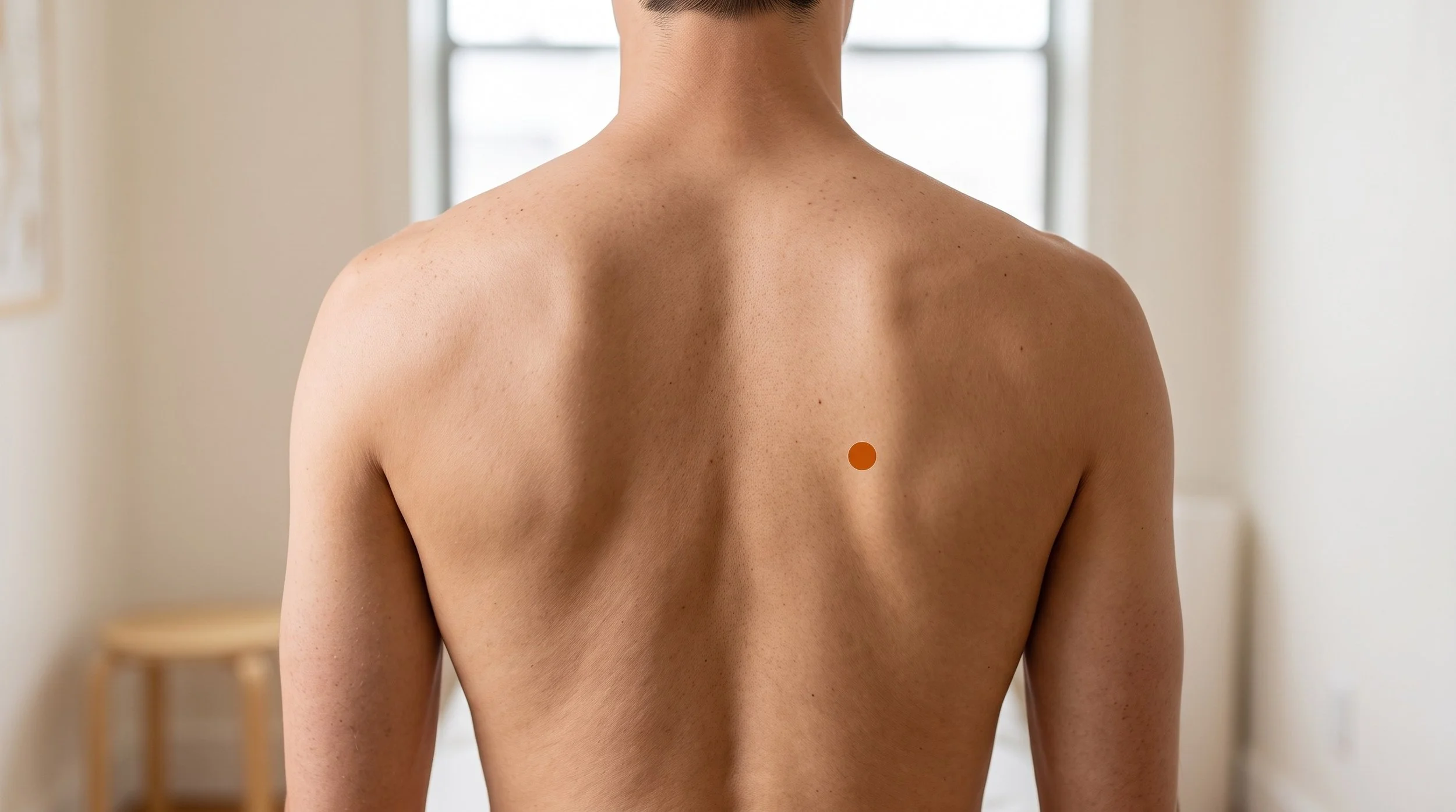
BL44 Acupuncture Point (Shentang)
The Hall of the Spirit Beside the Shoulder Blade: Anatomy, Mechanism, and Why This T5 Outer Bladder Line Point Belongs in Upper Back and Chest Tension Work
BL44, known in Chinese as Shentang and usually translated as Hall of the Spirit, sits on the outer branch of the Bladder channel in the upper back, three cun to either side of the spine at the level of the fifth thoracic vertebra.
In plain terms, it lands in the soft valley between the spine and the inner edge of the shoulder blade, roughly level with the middle of the shoulder blade when the arms hang relaxed. That places bladder 44 directly alongside BL15, the back transport point traditionally associated with the Heart, which is where its evocative name comes from.
Clinically, the bl44 acupuncture point matters for a very practical reason: it sits in the interscapular tissue that takes the brunt of desk posture, and it is one of the areas patients point to when upper back tension and a tight, restricted feeling in the chest show up together.
- BL44 lies three cun lateral to the midline at the lower border of the T5 spinous process, level with BL15, in the layer of middle trapezius, rhomboid major, and the thoracic erector spinae overlying the fifth rib. Prolonged forward-head, rounded-shoulder loading keeps this tissue in low-grade eccentric work, which is why the hall of the spirit point is so often tender on palpation.
- Classical texts group BL44 with the outer Bladder line points that sit alongside the five organ back transport points, and traditional sources credit it with unbinding the chest, regulating qi, and easing pain along the channel. These are traditional attributions, described here as historical categories rather than physiology.
- The relevant nerve geography is segmental: the skin and muscle here are supplied by the medial and lateral branches of the posterior rami of the mid thoracic spinal nerves, with the dorsal scapular nerve deeper, and the same T1 to T5 spinal segments receive afferent traffic from the heart, esophagus, and thoracic viscera. That convergence is the plausible reason a chest-level complaint and an interscapular ache so often travel together.
- Needling produces both segmental effects and system-wide analgesia through descending inhibitory pathways involving endogenous opioid and monoaminergic mechanisms (Zhao, 2008), and body acupuncture has been associated with measurable shifts in heart rate variability toward parasympathetic predominance in pooled trial data (Hamvas et al., 2023).
- The research picture is indirect but reasonable: individual patient data from chronic pain trials support a modest, persistent benefit of acupuncture over sham and no-acupuncture controls (Vickers et al., 2018), spinal pain reviews report similar direction of effect (Huang et al., 2021), and dry needling of upper quarter myofascial trigger points shows short-term pain reduction (Kietrys et al., 2013). No trial has isolated bl 44 back needling on its own.
- De qi at BL44 is usually a dull, spreading heaviness under the shoulder blade rather than a sharp sensation, sometimes with a mild band-like feeling toward the side of the chest. Because the pleura sits close beneath, technique is shallow and oblique, never deep or angled toward the spine.
Tired of the Knot Between Your Shoulder Blades That Never Fully Releases?
That stubborn spot beside the shoulder blade rarely responds to stretching alone, because the tissue is being reloaded every hour you spend at a keyboard. At Morningside Acupuncture we use BL44 together with adjacent outer line points and precise dry needling of the trapezius and rhomboids to reduce local muscle tone and calm segmental sensitivity. Sessions are paired with simple postural and breathing homework so the change holds between visits. Schedule an appointment and let's map where your upper back tension actually starts.
Schedule NowAnatomy of BL44: Why the Inner Edge of the Shoulder Blade Is Such an Important Location
Starting at the skin, a needle at BL44 passes through thin subcutaneous fat into the middle fibers of trapezius, then into rhomboid major, and then toward the thoracic erector spinae running vertically beside the T5 spinous process. Beneath those layers lie the fifth rib and intercostal tissue. This is a mechanically busy corner of the body: the scapular stabilizers here resist the forward drift of the shoulder girdle all day, and when the head sits ahead of the torso the interscapular muscles work in a lengthened, low-level contraction that produces exactly the dull, hard-to-locate ache patients describe.
Travell and Simons mapped referral from rhomboid and mid trapezius trigger points into this same interscapular band, which overlaps closely with the traditional territory of the outer Bladder line (Simons et al., 1999).
Innervation comes from the posterior rami of the mid thoracic spinal nerves, with medial cutaneous branches supplying the skin and deeper lateral branches supplying muscle, plus the dorsal scapular nerve running along the medial scapular border to rhomboids and levator scapulae. The clinically interesting part is what else reports to those same segments. Cardiac, esophageal, and upper mediastinal afferents enter the cord around T1 to T5, so second-order neurons at this level can receive both somatic and visceral input.
That convergence helps explain why chest-region symptoms and interscapular aching frequently coexist, and why needling the somatic side of the segment can alter how the whole region is perceived. Layered on top is a nonsegmental effect: needle stimulation recruits descending inhibitory control from brainstem structures using endogenous opioid and monoaminergic signaling, which dampens dorsal horn transmission more broadly (Zhao, 2008).
The safety story at BL44 is the reason technique here is conservative. The pleural dome and lung lie a short distance deep to the muscle layer, and deep perpendicular needling, or oblique needling angled medially toward the spine and under the paraspinal mass, carries a real pneumothorax risk. Standard practice, as described in the Deadman text, is oblique insertion of roughly 0.3 to 0.5 cun, angled along the tissue plane rather than into it.
In our clinic we also screen for body habitus, prior thoracic surgery, and lung disease before needling any upper thoracic point, and we favor shallow angled or transverse technique with shorter needles. Chest tenderness that is new, exertional, or accompanied by shortness of breath belongs in a physician's office first, not on a treatment table.
Related Pain Finder: Upper Back, Shoulder and Arm Related Trapezius Trigger PointsBL44 at a Glance: Classification, Location, and Clinical Use
| Category | Detail |
|---|---|
| Traditional Name | Shentang (Hall of the Spirit, also translated Mind Hall or Spirit Hall) |
| Channel Classification | Bladder channel of Foot Taiyang, outer (second) line of the back, at T5 (BL44, also written UB44; also called the Urinary Bladder channel) |
| Point Categories | Not a five-shu, luo, xi-cleft, or hui-meeting point and not an extraordinary vessel intersection. It is one of the five outer Bladder line points that sit level with the back transport points of the five yin organs (BL42, BL44, BL47, BL49, BL52); BL44 is level with BL15, the Heart back-shu. The Essential Questions traditionally credits this group with draining heat from the five yin organs, an action shared with the corresponding back-shu points. |
| Precise Location | On the upper back, 3 cun lateral to the posterior midline, level with the lower border of the T5 spinous process and level with BL15. With the shoulder relaxed, the 3 cun line corresponds closely to the medial (inner) border of the scapula. |
| Tissue Stimulated | Middle trapezius fibers, rhomboid major, thoracic erector spinae and overlying fascia at the T5 level, over the fifth rib |
| Needle Depth / Direction | Oblique insertion 0.3 to 0.5 cun, angled along the tissue plane (commonly laterally or superiorly). Deep perpendicular needling, and deep oblique needling directed medially, carry a substantial pneumothorax risk and are avoided. Moxibustion is traditionally applicable. |
| De Qi Sensation | A dull, heavy, spreading ache under the inner border of the shoulder blade, occasionally with a band-like sense of release toward the side of the rib cage; sharp or radiating sensation means the needle should be withdrawn and repositioned. |
| Primary Clinical Uses | Interscapular and upper back stiffness and aching, desk-posture shoulder girdle tension, shoulder and back pain that radiates toward the chest, and classically cough, wheezing, and a sense of fullness or oppression in the chest. |
| Common Point Combinations |
|
The Deadman text points out a genuine oddity about this point. Its name promises something psychological, and its position on the outer line level with the Heart back-shu reinforces that promise, yet the major classical sources do not actually record it for emotional or mental complaints. What they record instead is physical and regional: stiffness and pain of the back, shoulder and back pain that travels toward the chest, difficulty swallowing described as constriction of the esophagus, and respiratory symptoms such as cough, wheezing, and a full or oppressed chest.
The traditional actions attributed to it follow that same logic, unbinding the chest and regulating qi, and activating the channel to relieve pain. Later commentators, including Maciocia in his channel writings, argue from the naming convention of the outer line group that these points reach the mental aspect of each corresponding organ, and some modern practitioners use bladder 44 for anxiety and disturbed sleep on that basis.
It is worth being clear that this is a later reading rather than a classical indication, and the gap between an evocative name and a strikingly practical indication list is what makes this point interesting.
Why BL44 Is Used for Chest Tightness and Shallow Breathing, Not Just Interscapular Pain
The bridge between a back point and a chest complaint is segmental convergence. Sensory neurons from the skin and muscle at T5 and sensory neurons from thoracic structures such as the heart wall, great vessels, and esophagus terminate on overlapping populations of dorsal horn neurons in the upper thoracic cord. The nervous system cannot always tell those inputs apart, which is one accepted explanation for why chest-origin discomfort is so often felt between the shoulder blades, and why persistent interscapular guarding can make the chest itself feel tight and restricted.
Needling into the somatic side of that shared segment changes the input the cord is receiving, and patients frequently report that the chest feels roomier and the breath drops lower after treatment, even when only the back was needled.
Two further mechanisms are likely at work. The first is descending inhibition: needle stimulation with de qi activates brainstem pathways that release endogenous opioids, serotonin, and noradrenaline onto the dorsal horn, reducing pain transmission beyond the treated segment (Zhao, 2008).
The second is autonomic. Pooled analyses of randomized trials suggest that needling can shift heart rate variability measures toward greater parasympathetic influence compared with placebo procedures, though the studies are small and heterogeneous (Hamvas et al., 2023). Practically, that fits what we see in the room: breathing slows, the accessory muscles let go, and the shoulder girdle drops.
None of this means BL44 treats cardiac or respiratory disease. Traditional sources list cough, wheezing, and chest fullness among its indications, and the Cochrane review of acupuncture for chronic asthma concluded that the available trials were too few and too methodologically limited to establish benefit (McCarney et al., 2004). We use this point for musculoskeletal upper back and chest wall tension and as a supportive part of care, alongside appropriate medical management for any diagnosed cardiac or pulmonary condition.
What the Research Shows for BL44
There is no clinical trial of BL44 in isolation, and it would be misleading to suggest otherwise. What exists is evidence for the treatment approaches this point belongs to: multi-point acupuncture protocols for spinal and musculoskeletal pain, and trigger point dry needling of the upper quarter muscles that occupy the same tissue. Reviews test whole protocols, effect sizes are typically modest, and sham comparisons remain difficult to interpret because inserting a needle anywhere in the segment is not physiologically inert.
The reasonable position is that BL44 is a well-chosen local point within methods that have moderate supporting evidence, not a treatment with its own evidence base.
| Study | Type | Focus | Key Finding |
|---|---|---|---|
| Vickers et al., 2018 | Individual patient data meta-analysis | Chronic musculoskeletal, headache, and osteoarthritis pain across nearly 21,000 patients | Acupuncture outperformed both sham and no-acupuncture controls by modest but statistically robust margins, with effects largely persisting at one year. |
| Huang et al., 2021 | Systematic review and meta-analysis | Chronic spinal pain, including neck and back presentations | Pooled results favored acupuncture over sham, medication, usual care, and no treatment, though heterogeneity across trials was considerable. |
| Kietrys et al., 2013 | Systematic review and meta-analysis | Trigger point dry needling for upper quarter myofascial pain, including shoulder girdle and upper back muscles | Dry needling reduced pain compared with sham or no treatment in the short term, with evidence quality limited by small trials. |
| Lew et al., 2021 | Systematic review and meta-analysis | Neck and upper back myofascial pain syndrome, dry needling compared with trigger point manual therapy | Both approaches improved pain and function in the short to medium term, with no clear superiority of one over the other. |
| Hamvas et al., 2023 | Systematic review and meta-analysis | Effect of manual needle acupuncture on heart rate variability compared with placebo | Verum needling was associated with significant pre-post changes in vagally mediated HRV indices, suggesting a parasympathetic shift, though the included trial count was small. |
| McCarney et al., 2004 | Cochrane systematic review | Acupuncture for chronic asthma, a classical indication area for chest-region points | The review found insufficient evidence to make recommendations, citing few trials and substantial methodological limitations. |
Chest Feels Tight and Your Breath Feels Shallow by Late Afternoon?
When the upper back is braced, breathing tends to get high and small, and the two problems reinforce each other. BL44 has been used traditionally to unbind the chest, and in modern terms it sits at the spinal segments that also receive input from the thoracic viscera, which makes it a sensible part of a treatment aimed at rib cage mobility and autonomic downshifting. We combine it with front midline points, breath retraining, and manual work on the thoracic spine. Book a visit and we'll build a plan around how you actually breathe.
Schedule NowBL44 in the Context of Trigger Point Work
BL44 sits squarely in territory that trigger point clinicians treat every day. Rhomboid major, the middle fibers of trapezius, and the thoracic iliocostalis all have referral patterns that fill the interscapular gutter, and Travell and Simons described how taut bands in these muscles produce the deep, aching, poorly localized pain patients so often describe between the spine and shoulder blade (Simons et al., 1999).
Because acupuncture simply means the use of an acupuncture needle, and dry needling is one of the hundreds of styles in which that needle is used, the distinction between needling BL44 as a channel point and needling a rhomboid taut band at the same spot is a question of intent and reasoning, not of instrument.
In practice we palpate first and let the tissue decide the approach. If the tender spot at the T5 outer line matches a taut band with a recognizable referral pattern, we may use short, precise needling into that band, always angled obliquely and kept shallow because of the rib cage beneath. If the finding is more diffuse regional tension, we tend to use the classical shallow oblique technique at BL44 and BL43 together, often with cupping across the interscapular area afterward and distal points to broaden the effect.
Levator scapulae, infraspinatus, and the scalenes are checked in the same visit, since upper back complaints rarely live in one muscle, and treatment is paired with scapular strengthening and breathing work so the relief carries past the session.
BL44 Upper Back and Chest Tension Treatment at NYC's Highest-Rated Acupuncture Clinic
Morningside Acupuncture is the highest-rated acupuncture and dry needling clinic in New York City with over 500 five-star Google reviews, and our Upper West Side practice focuses on musculoskeletal care backed by current evidence. Treatment around BL44 is always performed with shallow oblique technique and careful anatomical screening, integrated with trigger point work, cupping, and movement advice. You get a clear explanation of what we are treating and why, in language that makes sense. Schedule your appointment today.
Schedule NowFrequently Asked Questions
What does BL44 feel like when needled?
Most people feel a dull, heavy spreading ache under the inner edge of the shoulder blade, sometimes with a sensation of the area softening or widening. If the underlying muscle is holding a taut band, there can be a brief twitch and a short-lived deep soreness that fades within a day or so. Because the technique here is shallow and oblique, the sensation is usually milder than at thick muscle sites like the glutes. Sharp, electric, or radiating sensations are not the goal and mean the needle should be adjusted.
Why treat a point on the back for a feeling of tightness in the chest?
The skin and muscle at BL44 and the thoracic organs share spinal segments around T1 to T5, so their sensory signals converge on overlapping neurons in the spinal cord. That convergence is a standard explanation for why chest-region discomfort is often felt between the shoulder blades and why a braced upper back can make the chest itself feel restricted. Needling the back side of that segment changes the input the cord receives, and it can also reduce guarding in muscles that limit rib cage movement. This is a treatment for musculoskeletal tension patterns, not a substitute for evaluation of chest symptoms by a physician.
Can I press BL44 myself between sessions?
Yes, acupressure here is safe and easy to self-apply, though the location is awkward to reach directly. Sit or stand with your back against a wall, place a tennis or lacrosse ball between the wall and the spot roughly two to three finger widths out from your spine at mid shoulder blade height, then lean in until you feel a firm, tolerable ache at about a 5 or 6 out of 10. Hold steady pressure for 60 to 90 seconds per spot while breathing slowly into your lower ribs, then move the ball a centimeter and repeat, spending three to five minutes per side. Doing this once or twice a day, followed by a doorway chest stretch and a few sets of scapular retractions, tends to work better than pressure alone. Ease off if you feel any sharp pain, numbness, or breathlessness.
Is BL44 safe to needle?
It is safe in trained hands, and it is exactly the kind of point that requires trained hands. The lung lies beneath the muscle layer here, so deep perpendicular insertion, or oblique insertion angled medially and under the paraspinal muscles, carries a substantial risk of pneumothorax. Standard technique is shallow oblique needling of roughly 0.3 to 0.5 cun along the tissue plane, using shorter needles and taking body size into account. Tell your practitioner about lung disease, prior chest surgery, or a very lean build, and seek urgent medical care if you ever develop sudden chest pain or shortness of breath after any upper back needling.
Where exactly is BL44 located?
Find the lower edge of the fifth thoracic spinous process, which sits below GV11 on the midline, then measure three cun (about four finger widths for most people) directly out to the side. With the shoulder relaxed, that three cun line falls essentially along the inner border of the shoulder blade, so the point lands in the soft groove just medial to the scapular edge. It is level with BL15, the Heart back transport point, on the inner Bladder line, and it sits between BL43 above and BL45 below on the outer line.
References
- Deadman, P., Al-Khafaji, M., & Baker, K. (2009). A manual of acupuncture. Journal of Chinese Medicine Publications.
- Cheng, X. (Ed.). (1999). Chinese acupuncture and moxibustion (Rev. ed.). Foreign Languages Press.
- Maciocia, G. (2006). The channels of acupuncture: Clinical use of the secondary channels and eight extraordinary vessels. Churchill Livingstone Elsevier.
- Cunningham, P. M. (2000). Acupuncture points: A practical guide to classical and modern usage. Odyssey Press.
- Simons, D. G., Travell, J. G., & Simons, L. S. (1999). Travell & Simons' myofascial pain and dysfunction: The trigger point manual, Vol. 1: Upper half of body (2nd ed.). Williams & Wilkins.
- Vickers, A. J., Vertosick, E. A., Lewith, G., MacPherson, H., Foster, N. E., Sherman, K. J., Irnich, D., Witt, C. M., & Linde, K. (2018). Acupuncture for chronic pain: Update of an individual patient data meta-analysis. Journal of Pain, 19(5), 455-474. https://doi.org/10.1016/j.jpain.2017.11.005
- Zhao, Z. Q. (2008). Neural mechanism underlying acupuncture analgesia. Progress in Neurobiology, 85(4), 355-375. https://doi.org/10.1016/j.pneurobio.2008.05.004
- Huang, J. F., Zheng, X. Q., Chen, D., Lin, J. L., Zhou, W. X., Wang, H., Qin, Z., & Wu, A. M. (2021). Can acupuncture improve chronic spinal pain? A systematic review and meta-analysis. Global Spine Journal, 11(8), 1248-1265. https://doi.org/10.1177/2192568220962440
- Kietrys, D. M., Palombaro, K. M., Azzaretto, E., Hubler, R., Schaller, B., Schlussel, J. M., & Tucker, M. (2013). Effectiveness of dry needling for upper-quarter myofascial pain: A systematic review and meta-analysis. Journal of Orthopaedic & Sports Physical Therapy, 43(9), 620-634. https://doi.org/10.2519/jospt.2013.4668
- Lew, J., Kim, J., & Nair, P. (2021). Comparison of dry needling and trigger point manual therapy in patients with neck and upper back myofascial pain syndrome: A systematic review and meta-analysis. Journal of Manual & Manipulative Therapy, 29(3), 136-146. https://doi.org/10.1080/10669817.2020.1822618
- Hamvas, S., Hegyi, P., Kiss, S., Lohner, S., McQueen, D., & Havasi, M. (2023). Acupuncture increases parasympathetic tone, modulating HRV: Systematic review and meta-analysis. Complementary Therapies in Medicine, 72, 102905. https://doi.org/10.1016/j.ctim.2022.102905
- McCarney, R. W., Brinkhaus, B., Lasserson, T. J., & Linde, K. (2004). Acupuncture for chronic asthma. Cochrane Database of Systematic Reviews, 2004(1), CD000008. https://doi.org/10.1002/14651858.CD000008.pub2
Disclaimer: This web site is intended for educational and informational purposes only. Reading this website does not constitute providing medical advice or any professional services. This information should not be used for diagnosing or treating any health issue or disease. Those seeking medical advice should consult with a licensed physician. Seek the advice of a medical doctor or other qualified health professional for any medical condition. If you think you have a medical emergency, call 911 or go to the emergency room. No acupuncturist-patient relationship is created by reading this website or using the information. Morningside Acupuncture PLLC and its employees and contributors do not make any express or implied representations with respect to the information on this site or its use. For any legal interpretation of scope of practice in your state, consult a licensed attorney or regulatory authority.
Read more from our blog



