Xiyan Acupuncture Point (MN-LE-16)
The Eyes of the Knee: Anatomy, Mechanism, and Why This Paired Extra Point Anchors Almost Every Knee Acupuncture Prescription
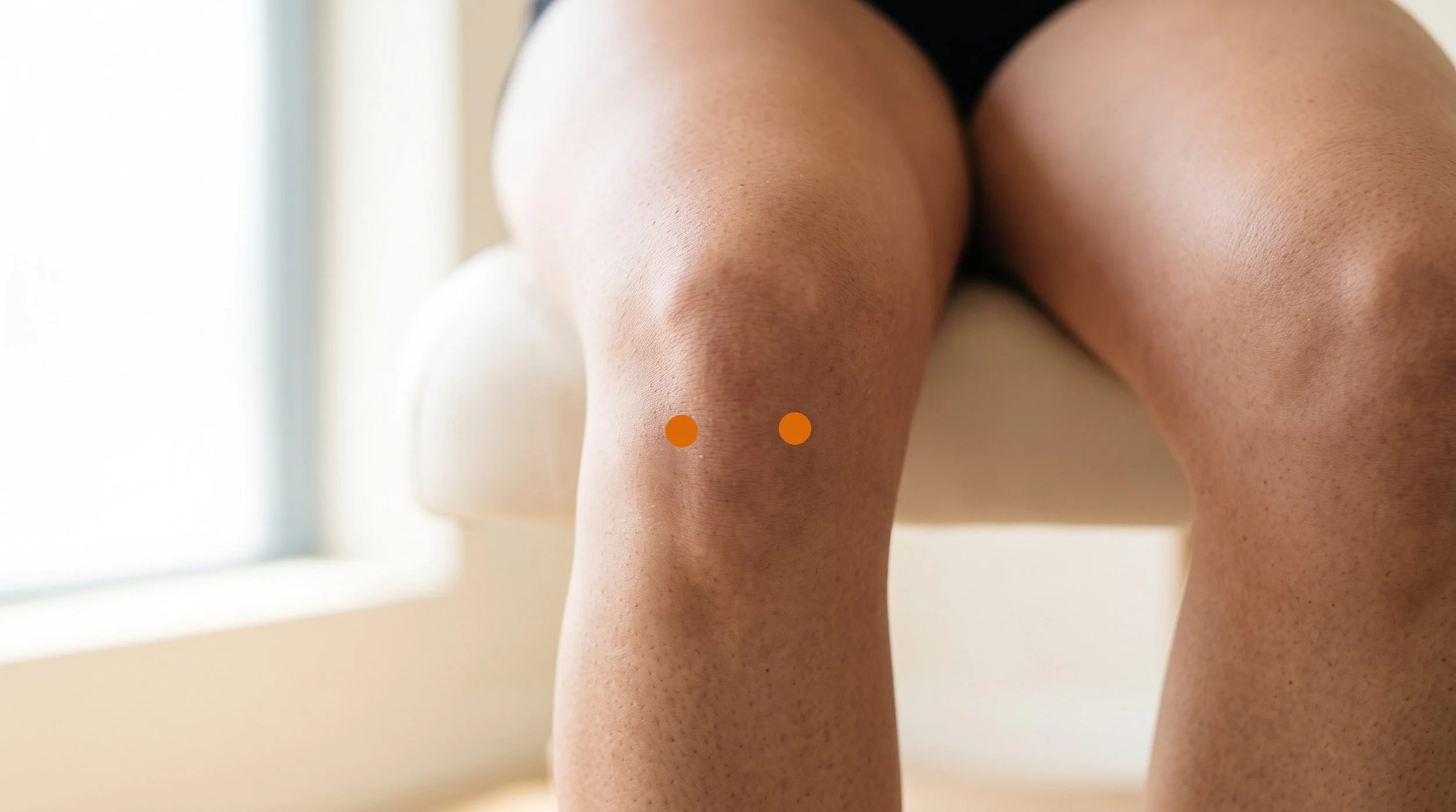
Xiyan (MN-LE-16), translated as Eyes of the Knee, is not a single point but a matched pair sitting in the two soft hollows that appear on either side of the patellar ligament when the knee is bent. The lateral hollow is the same location as ST35 Dubi on the Stomach channel, while the medial hollow, called Neixiyan, belongs to no channel at all and is classed as an extra point.
Anatomically these depressions are windows onto the anterior joint line and the infrapatellar fat pad, two of the most reliably tender structures in a painful knee, which is why the xiyan acupuncture point pair shows up in classical knee formulas, in modern Chinese hospital protocols, and in Western dry needling practice for anterior knee pain alike. If you only learn a handful of knee acupuncture points, these are usually the first two.
- Location and layers: with the knee flexed over a bolster, the needle passes through thin skin and subcutaneous tissue into the medial and lateral patellar retinacula and the anterior capsule, immediately superficial to the infrapatellar fat pad, a richly innervated and vascular structure that sits behind the patellar ligament (Dragoo et al., 2012).
- Traditional attribution translated: classical sources credit Xiyan with dispelling wind-damp, reducing swelling, and easing pain in the knee. In neurophysiological terms that maps onto local nociceptive input from capsule and fat pad, segmental modulation at L3 to L5, and small changes in local blood flow and tissue mechanics.
- Mechanism: the medial hollow lies over the territory of the infrapatellar branch of the saphenous nerve and the lateral hollow over lateral genicular and peroneal cutaneous branches, and the fat pad itself carries substance P positive nociceptive fibers, which helps explain why it is such a consistent pain generator in anterior knee complaints (Bohnsack et al., 2005; Dragoo et al., 2012). Needling recruits A-delta and C fiber afferents that engage spinal and descending inhibitory pathways (Zhao, 2008).
- Research picture: reviews of acupuncture for knee osteoarthritis and chronic pain suggest modest benefit over sham and larger benefit over usual care, with effects that persist over months rather than fading immediately (Manheimer et al., 2010; Vickers et al., 2018). Not every trial agrees, and one large Australian study found no advantage over sham laser at twelve weeks (Hinman et al., 2014).
- Clinical framing: this pair is almost never used alone. In a large multicenter trial of intensive acupuncture for knee osteoarthritis, ST35 and Neixiyan formed the local core of the prescription, with additional points added along the leg (Tu et al., 2021), which mirrors how we combine local and distal points in clinic.
- De qi: patients usually describe a deep, heavy, slightly achy fullness right inside the front of the joint, sometimes spreading toward the back of the knee or down the shin. It should feel like pressure and spread, not a sharp or electric jolt.
Is Your Knee Pain Worse on Stairs, Squats, or After Sitting?
Anterior knee pain that flares going downstairs or after a long meeting often involves the fat pad, the retinacula, and an inhibited quadriceps rather than the joint surface alone. At Morningside Acupuncture we needle the Eyes of the Knee together with local and distal points, then add dry needling to the quadriceps and calf where trigger points are driving the pattern. Most patients notice how they load the leg differently within the first two or three visits. Schedule a knee assessment and we'll map out what's actually generating your pain.
Schedule NowAnatomy of XIYAN: Why the Hollows Beside the Patellar Ligament Are Such an Important Location
Bend the knee to roughly ninety degrees and two soft depressions appear on either side of the patellar ligament, just below the kneecap. Those hollows are Xiyan. Under the fingertip there's very little to get through: thin skin, a sparse subcutaneous layer, then the medial and lateral patellar retinacula and the anterior joint capsule, which drape over the infrapatellar (Hoffa's) fat pad and the joint line itself. The patellar ligament forms the ridge between the two eyes, and the tibial plateau and femoral condyles sit just behind.
This region gets loaded by everything that compresses or shears the front of the knee: deep squatting, kneeling, stair descent, deceleration in running, and long periods with the knee flexed. The fat pad can also be pinched in terminal extension, which is one reason people with anterior knee pain point straight at these hollows when asked to show you where it hurts.
The nerve geography here is more interesting than the shallow depth suggests. The medial eye sits in territory supplied by infrapatellar branches of the saphenous nerve, while the lateral eye receives lateral cutaneous and recurrent peroneal branches, and the fat pad beneath is densely innervated with nociceptive fibers, including substance P positive endings distributed through its segments (Bohnsack et al., 2005; Dragoo et al., 2012). Functionally, the whole anterior knee reports to the L3 to L5 spinal segments, the same segments that serve quadriceps, tibialis anterior, and much of the leg.
Needling into this segmentally shared territory activates A-delta and C fiber afferents whose input converges in the dorsal horn with the input from irritated capsule and fat pad, and that convergence, along with descending inhibitory pathways from the brainstem and the release of endogenous opioid peptides, is the current working explanation for acupuncture analgesia (Zhao, 2008). It also explains why the sensation of a well-placed needle often spreads through the joint rather than staying at the skin.
Deeper still are the synovium, the joint cavity, and the genicular vascular network that supplies the fat pad, and this is where technique matters. Classical texts describe fairly deep insertion, either perpendicular and angled toward BL40 at the back of the knee, or obliquely medial and superior behind the patella, roughly 1 to 2 cun, with a through-needling variation connecting the two eyes behind the patellar ligament.
Modern Western texts favor a shallower and more conservative approach, angling toward the patella and targeting the capsule while deliberately avoiding entry into the joint space, since rare cases of septic arthritis after knee needling have been reported. We flex and support the knee over a rolled towel, use strict clean needle technique, avoid needling near a joint replacement, and choose depth based on the patient's build and presentation rather than a fixed number.
Related Acupuncture For Knee Pain Related Best Acupuncture Points For Knee PainXIYAN at a Glance: Classification, Location, and Clinical Use
| Category | Detail |
|---|---|
| Traditional Name | Xiyan, Eyes of the Knee (medial eye also called Neixiyan) |
| Channel Classification | Extra point pair, MN-LE-16; the lateral eye is identical with ST35 Dubi on the Stomach channel, the medial eye is a non-channel point |
| Point Categories | No five-shu, xi-cleft, or hui-meeting designation and no extraordinary vessel intersection. Classed as an extra (non-channel) point pair; only the lateral member carries a channel identity as ST35. Traditional actions given as dispelling wind-damp, reducing swelling, benefiting the knee joint, and alleviating pain. |
| Precise Location | On the front of the knee, in the two hollows that appear when the knee is flexed, immediately below the patella and on either side of the patellar ligament. The lateral hollow is ST35, the medial hollow is Neixiyan. |
| Tissue Stimulated | Skin and subcutaneous tissue, medial and lateral patellar retinacula, anterior joint capsule, and the surface of the infrapatellar fat pad at the joint line; commonly combined with dry needling of the quadriceps and tibialis anterior |
| Needle Depth / Direction | Knee flexed and supported. Classically 1 to 2 cun, either perpendicular and angled toward BL40 or oblique in a medial and superior direction behind the patella, with through-needling between the two eyes also described. In modern orthopedic practice, shallower insertion of roughly 0.5 to 1 cun angled toward the joint line and patella, staying out of the joint space. |
| De Qi Sensation | Deep, heavy, distending ache inside the front of the knee, often spreading toward the back of the joint or down the shin; should not be sharp, burning, or electric |
| Primary Clinical Uses | Knee swelling and pain, difficulty bending and straightening the knee, anterior knee pain and patellofemoral irritation, knee osteoarthritis, weakness or numbness of the knee and lower limb, and the classical categories of atrophy disorder and leg qi |
| Common Point Combinations |
|
In Deadman's A Manual of Acupuncture, Xiyan is traced to an eighth century text, the Necessities of a Frontier Official, and is presented as a pair rather than a single site, with the lateral eye corresponding to ST35 Dubi and the medial eye standing outside the channel system entirely.
The traditional indications are almost entirely local and mechanical: swelling and pain of the knee joint, trouble bending and straightening it, weakness and numbness of the knee and lower limb, and the older diagnostic categories of atrophy disorder and leg qi, which broadly describe wasting, heaviness, and loss of power in the legs. The commentary is unusually direct in stating that these two points, used together, form the base of any knee prescription regardless of whether the presentation is read as deficient or excess, hot or cold.
Other classical sources add the Song of the Jade Dragon pairing with LV7 Xiguan for knees that are red, swollen, painful, and unable to bear walking. What's striking is how little the pattern differentiation matters here: for the knee, the classical literature converges on the same two hollows every time, and modern trial protocols have largely converged on them too.
Why XIYAN Is Used for Knee Weakness and Stiffness, Not Just Pain
Patients often expect a knee point to be about pain, and are surprised when we use it for a knee that feels unreliable, stiff after sitting, or hard to fully straighten. The reason is segmental. The anterior knee capsule, the fat pad, the quadriceps, and much of the lower leg all report to and are driven from the same L3 to L5 spinal levels, so painful input from the front of the joint doesn't stay local. It changes how the quadriceps is recruited, which is a well-recognized feature of knee joint pain and effusion.
Placing needles into the tissue that's generating the nociceptive signal, in the same segments as the muscles that have gone quiet, gives the nervous system new information from that region and may reduce the protective inhibition that makes stairs and squats feel unsafe.
On top of the segmental effect, needling engages descending pathways from the midbrain and brainstem that dampen dorsal horn transmission, along with endogenous opioid and other neurochemical mediators, which is the best-supported account of how acupuncture analgesia works experimentally (Zhao, 2008). That broader modulation is one reason relief often extends beyond the treated joint and beyond the day of treatment, and it fits with individual patient data showing that acupuncture effects on chronic musculoskeletal pain decline only slowly over the following year (Vickers et al., 2018).
The classical framing of atrophy disorder and leg qi, meaning wasted, heavy, weak legs, translates reasonably well into this picture. We're not claiming needles rebuild muscle. We're saying that reducing pain and inhibition around the joint makes it easier to load the leg, and loading the leg is what actually restores capacity. That's why Xiyan work at Morningside is nearly always paired with graded strengthening rather than offered as a stand-alone fix.
What the Research Shows for XIYAN
One caution before the table: no high-quality trial has tested Xiyan by itself. Research on knee acupuncture tests whole protocols, and Xiyan or its lateral twin ST35 is almost always part of the local core of those protocols, alongside distal points on the leg. So the honest reading is that this point pair is a consistent ingredient in the protocols that have been studied, not that it has independently proven effects.
The trial results themselves are mixed, with reviews generally showing small to moderate benefit over sham and larger benefit compared with usual care or waiting lists, and at least one large trial finding no meaningful advantage over a sham comparator.
| Study | Type | Focus | Key Finding |
|---|---|---|---|
| Manheimer et al., 2010 | Cochrane systematic review | Acupuncture for peripheral joint osteoarthritis, mostly knee | Reported statistically significant but small benefits over sham for pain and function, with larger differences against waiting list and usual care controls. |
| Vickers et al., 2018 | Individual patient data meta-analysis | Chronic pain including osteoarthritis, involving roughly 20,000 patients | Found acupuncture superior to both sham and no-acupuncture controls, with effects that persisted over about a year rather than disappearing quickly. |
| Tu et al., 2021 | Multicenter randomized controlled trial | Intensive electroacupuncture or manual acupuncture versus sham for knee osteoarthritis, using ST35 and Neixiyan as core local points | Reported greater improvement in pain and function at eight weeks with real acupuncture than sham, supporting the local Xiyan pairing as part of a broader protocol. |
| Hinman et al., 2014 | Randomized clinical trial (Zelen design) | Needle and laser acupuncture for chronic knee pain in adults aged 50 and over | Found modest improvements versus no treatment but no clinically important difference from sham laser at 12 weeks, a useful counterweight to more positive reviews. |
| Zhao, 2008 | Narrative mechanism review | Neural mechanisms of acupuncture analgesia | Describes segmental dorsal horn modulation, descending inhibitory control, and endogenous opioid involvement as the principal explanatory pathways. |
| Dragoo et al., 2012 | Clinical anatomy and treatment review | Disorders of the infrapatellar fat pad, the tissue directly deep to Xiyan | Describes the fat pad as densely innervated and vascular, and implicates it as a genuine source of anterior knee pain. |
Running, Cycling, or Lifting Through a Cranky Knee?
Runners and lifters in NYC rarely want to stop training, they want the knee to tolerate the training they already do. We use Xiyan and Neixiyan as the local anchor, combine them with ST36, GB34, and SP9 depending on where the pain sits, and pair the needling with loading advice so the tissue keeps adapting. Sessions are focused, evidence-informed, and built around your schedule. Book a visit and keep your season going.
Schedule NowXIYAN in the Context of Trigger Point Work
Xiyan sits at a joint line, not in a muscle belly, so it isn't a trigger point in the myofascial sense. What makes it useful in a dry needling session is that it addresses the articular and fat pad component of anterior knee pain while the muscular component gets treated separately. Travell and Simons' trigger point manual describes referral into the front of the knee from vastus medialis, vastus lateralis, and rectus femoris, with vastus medialis in particular producing a deep ache over the medial knee that patients frequently mistake for joint damage.
Popliteus and gastrocnemius can refer toward the back of the knee, and adductor involvement can muddy a medial knee picture further (Simons et al., 1999).
In practice at Morningside, a typical knee session might combine the two Eyes of the Knee with needling of taut bands in vastus medialis and vastus lateralis, a distal point such as ST36 or GB34, and, where the calf is contributing, gastrocnemius and tibialis anterior. Electroacupuncture is sometimes added across the two Xiyan points or between a local and a distal point, since electrical stimulation has been a common feature of knee osteoarthritis protocols in the trial literature (Tu et al., 2021).
We keep the needling at Xiyan superficial to the joint space, palpate for the tender hollow rather than measuring blindly, and pair the whole session with loading work so the change holds.
XIYAN Knee Pain Treatment at NYC's Highest-Rated Acupuncture Clinic
Morningside Acupuncture is the highest-rated acupuncture and dry needling clinic in New York City with over 500 five-star Google reviews, and knee pain is one of the conditions we treat most often. Our licensed acupuncturists combine the classical Eyes of the Knee pairing with modern orthopedic assessment, myofascial dry needling, and electroacupuncture when it's appropriate. Every plan is explained in plain language so you know what we're treating and why. Schedule your appointment on the Upper West Side today.
Schedule NowFrequently Asked Questions
What does XIYAN feel like when needled?
Most people feel a brief pinch at the skin, then a deep, heavy, distending ache that seems to sit inside the front of the joint. That spreading fullness is de qi, and it may travel toward the back of the knee or down the shin. Because the tissue here is thin over a sensitive capsule and fat pad, the point can be more sensation-rich than points in muscle. It should not feel sharp, burning, or electric, and you should tell your acupuncturist right away if it does so the needle can be adjusted.
Why needle right where it hurts instead of using distal points on the leg?
Both approaches are used, and good treatment usually blends them. Needling directly at the anterior joint line delivers input from the actual pain-generating tissue into the L3 to L5 segments that serve the knee, which is where local pain modulation happens. Distal points on the same limb, such as ST36 or GB34, engage broader descending inhibitory pathways and may be chosen when the knee is too acutely inflamed to tolerate local work (Zhao, 2008). One clinical audit tradition in Western medical acupuncture actually emphasizes local knee points including Xiyan and Heding as the mainstay for knee pain, with distal points added as needed.
Can I press XIYAN myself between sessions?
Yes, and it's easy to find. Sit with your knee bent to about ninety degrees and your foot flat on the floor, then feel for the two soft hollows just below your kneecap on either side of the firm patellar ligament. Press into each hollow with your thumb and index finger at the same time, angling gently inward and slightly upward toward the back of the kneecap, using moderate pressure that feels like a satisfying ache rather than a sharp pain. Hold for 30 to 60 seconds, or use small circles for one to two minutes, and repeat two or three times a day. Stop if pressure sharply increases your pain, and skip it entirely if the knee is hot, visibly swollen, recently injured, or has a joint replacement.
Is XIYAN safe to needle?
In trained hands, yes. The main considerations are avoiding the joint space itself, since rare cases of septic arthritis after knee needling have been reported, maintaining strict clean needle technique, and not needling near a knee prosthesis because of infection risk around implanted hardware. Practitioners also keep the knee flexed and supported so the hollows open and the angle stays superficial to the joint. Minor bruising is possible because the area is well vascularized. If you're on anticoagulants, have an active joint infection, or have had recent knee surgery, tell your acupuncturist before treatment.
Where exactly is XIYAN located?
Bend the knee and look just below the kneecap. Two dimples appear, one on each side of the patellar ligament, the thick cord running from the bottom of the kneecap to the top of the shin. Those dimples are the two Eyes of the Knee. The outer one is also known as ST35 Dubi on the Stomach channel, and the inner one is Neixiyan, which has no channel affiliation. They vanish when the knee is straight, so the point is always located and needled with the knee bent and supported.
References
- Deadman, P., Al-Khafaji, M., & Baker, K. (2009). A manual of acupuncture. Journal of Chinese Medicine Publications.
- O'Connor, J., & Bensky, D. (Eds. & Trans.). (1981). Acupuncture: A comprehensive text. Shanghai College of Traditional Medicine. Eastland Press.
- Cunningham, P. M. (2000). Acupuncture points: A practical guide to classical and modern usage. Odyssey Press.
- Maciocia, G. (2006). The channels of acupuncture: Clinical use of the secondary channels and eight extraordinary vessels. Churchill Livingstone Elsevier.
- White, A., Cummings, M., & Filshie, J. (2008). An introduction to Western medical acupuncture. Churchill Livingstone Elsevier.
- Filshie, J., White, A., & Cummings, M. (Eds.). (2016). Medical acupuncture: A Western scientific approach (2nd ed.). Elsevier.
- Simons, D. G., Travell, J. G., & Simons, L. S. (1999). Travell & Simons' myofascial pain and dysfunction: The trigger point manual, Vol. 1: Upper half of body (2nd ed.). Williams & Wilkins.
- Manheimer, E., Cheng, K., Linde, K., Lao, L., Yoo, J., Wieland, S., van der Windt, D. A. W. M., Berman, B. M., & Bouter, L. M. (2010). Acupuncture for peripheral joint osteoarthritis. Cochrane Database of Systematic Reviews, 2010(1), CD001977. https://doi.org/10.1002/14651858.CD001977.pub2
- Vickers, A. J., Vertosick, E. A., Lewith, G., MacPherson, H., Foster, N. E., Sherman, K. J., Irnich, D., Witt, C. M., & Linde, K. (2018). Acupuncture for chronic pain: Update of an individual patient data meta-analysis. Journal of Pain, 19(5), 455-474. https://doi.org/10.1016/j.jpain.2017.11.005
- Tu, J.-F., Yang, J.-W., Shi, G.-X., Yu, Z.-S., Li, J.-L., Lin, L.-L., Du, Y.-Z., Yu, X.-G., Hu, H., Liu, Z.-S., Jia, C.-S., Wang, L.-Q., Zhao, J.-J., Wang, J., Wang, T., Wang, Y., Wang, T.-Q., Zhang, N., Zou, X., Wang, Y., Shao, J.-K., & Liu, C.-Z. (2021). Efficacy of intensive acupuncture versus sham acupuncture in knee osteoarthritis: A randomized controlled trial. Arthritis & Rheumatology, 73(3), 448-458. https://doi.org/10.1002/art.41584
- Hinman, R. S., McCrory, P., Pirotta, M., Relf, I., Forbes, A., Crossley, K. M., Williamson, E., Kyriakides, M., Novy, K., Metcalf, B. R., Harris, A., Reddy, P., Conaghan, P. G., & Bennell, K. L. (2014). Acupuncture for chronic knee pain: A randomized clinical trial. JAMA, 312(13), 1313-1322. https://doi.org/10.1001/jama.2014.12660
- Zhao, Z. Q. (2008). Neural mechanism underlying acupuncture analgesia. Progress in Neurobiology, 85(4), 355-375. https://doi.org/10.1016/j.pneurobio.2008.05.004
- Dragoo, J. L., Johnson, C., & McConnell, J. (2012). Evaluation and treatment of disorders of the infrapatellar fat pad. Sports Medicine, 42(1), 51-67. https://doi.org/10.2165/11595680-000000000-00000
- Bohnsack, M., Meier, F., Walter, G. F., Hurschler, C., Schmolke, S., Wirth, C. J., & Rühmann, O. (2005). Distribution of substance-P nerves inside the infrapatellar fat pad and the adjacent synovial tissue: A neurohistological approach to anterior knee pain syndrome. Archives of Orthopaedic and Trauma Surgery, 125(9), 592-597. https://doi.org/10.1007/s00402-005-0796-4
Disclaimer: This web site is intended for educational and informational purposes only. Reading this website does not constitute providing medical advice or any professional services. This information should not be used for diagnosing or treating any health issue or disease. Those seeking medical advice should consult with a licensed physician. Seek the advice of a medical doctor or other qualified health professional for any medical condition. If you think you have a medical emergency, call 911 or go to the emergency room. No acupuncturist-patient relationship is created by reading this website or using the information. Morningside Acupuncture PLLC and its employees and contributors do not make any express or implied representations with respect to the information on this site or its use. For any legal interpretation of scope of practice in your state, consult a licensed attorney or regulatory authority.
Read more from our blog



