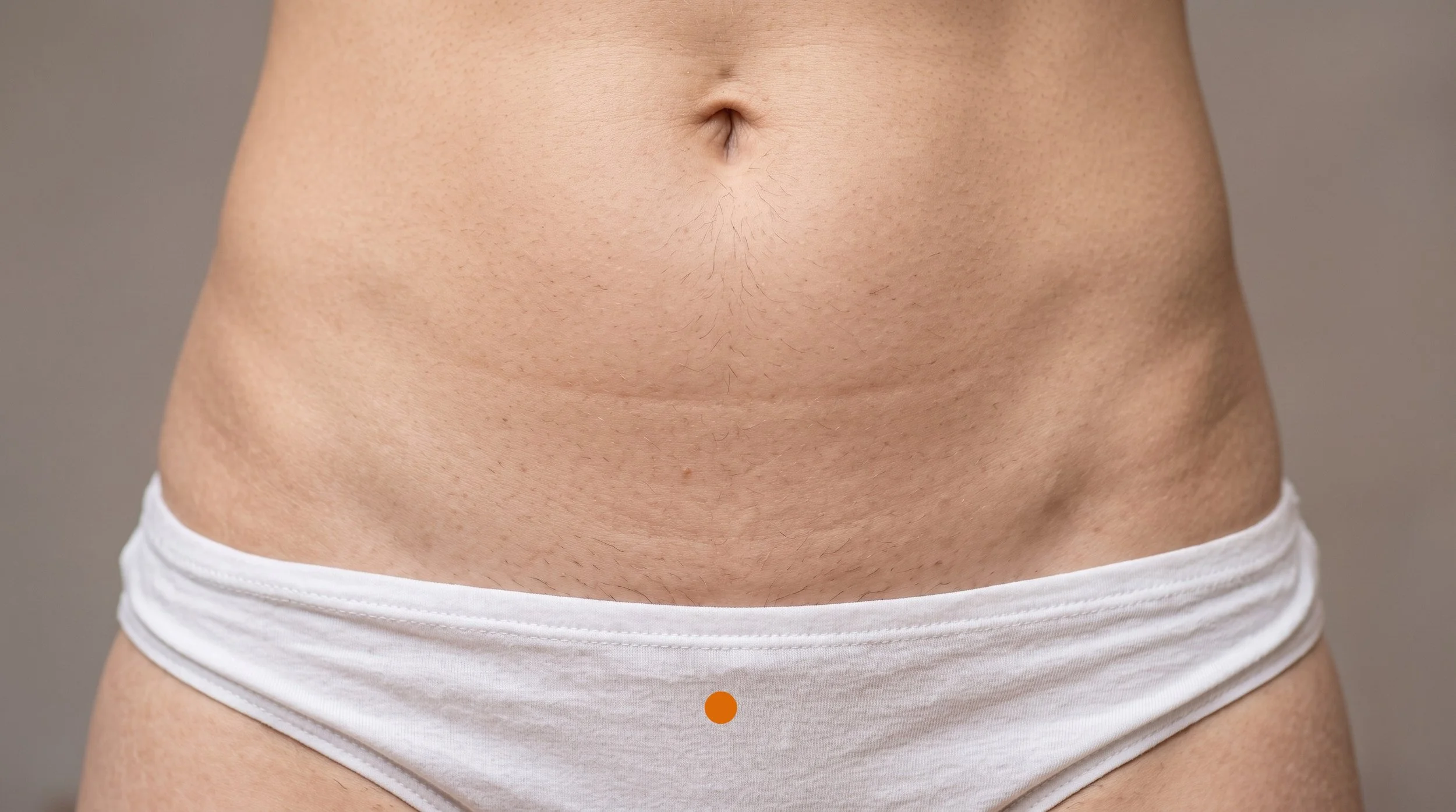
CV2 Acupuncture Point (Qugu)
The Curved Bone at the Base of the Midline: Anatomy, Mechanism, and Why This Pubic Border Point Anchors Urinary and Pelvic Treatment
CV2 (also written Ren 2), known in Chinese as Qugu and usually translated as Curved Bone, is the lowest abdominal point of the Conception vessel, sitting on the midline right at the top edge of the pubic bone, roughly five cun below the navel. The name is literal: the point sits on the curved upper rim of the pubic symphysis, where the linea alba and the lowest fibers of the rectus abdominis anchor into bone.
Clinically this is a small piece of real estate with a large job, because the tissue here shares its nerve supply with the bladder, the lower urinary tract and the reproductive organs, all of which are wired through the hypogastric and pelvic nerve plexuses. That shared innervation is the practical reason the CV2 acupuncture point has been used for centuries for hesitant or difficult urination, lower abdominal fullness, and genital and menstrual complaints, and why modern practitioners still reach for the pubic border when pelvic symptoms are not responding elsewhere.
- Location and layers: conception vessel 2 lies on the anterior midline at the superior border of the pubic symphysis, five cun below the umbilicus, where the needle passes skin, subcutaneous fat, the linea alba and the lowest attachments of the rectus abdominis before reaching the periosteal edge of the pubic bone (Deadman et al., 2009).
- Traditional attribution: classical sources group Qugu as a meeting point of the Conception vessel with the Liver channel and list it for urinary dribbling and retention, lower abdominal distention and pain, genital complaints and irregular menstruation with discharge (Deadman et al., 2009; Cunningham, 2000). We present these as historical categories, not as physiological claims.
- Mechanism: needling at the pubic border stimulates iliohypogastric and ilioinguinal territory afferents that enter the cord at the same lower thoracic and upper lumbar levels that receive sympathetic bladder afferents, a somatic-to-visceral arrangement that has been studied experimentally as the somatoautonomic reflex (Uchida et al., 2017).
- Research picture: reviews and trials of acupuncture for urinary retention and lower urinary tract symptoms report benefit, though most protocols use lower abdominal and sacral point clusters rather than any single point (Zheng et al., 2021; Zhong et al., 2018), and higher quality sham-controlled work exists for pelvic pain syndromes in men (Sun et al., 2021).
- Clinical framing: CV2 is rarely the whole treatment. It usually joins CV3 and CV4 on the midline, SP6 distally, and sacral points, with the pubic point chosen when tenderness, guarding or symptom referral is concentrated right at the Ren 2 pubic border.
- De qi: patients typically report a dull, heavy, spreading fullness low in the abdomen, sometimes with a mild sense of pressure toward the bladder or genitals, which should fade quickly rather than sharpen (Deadman et al., 2009).
Struggling With Urinary Urgency, Hesitancy or Low Pelvic Pressure?
At Morningside Acupuncture we use CV2 as part of a lower abdominal and sacral protocol for patients whose bladder symptoms have already been medically worked up but still linger. We combine gentle needling at the pubic border with distal points and, when appropriate, manual work on the lower abdominal wall. Treatment plans are built around your voiding pattern, your pain map and your goals, not a template. Schedule a visit to see whether this approach fits your case.
Schedule NowAnatomy of CV2: Why the Upper Border of the Pubic Symphysis Is Such an Important Location
CV2 sits on the anterior midline exactly at the top edge of the pubic symphysis, five cun below the umbilicus and immediately below CV3. From the surface inward, a needle here passes through thin skin, a variable layer of subcutaneous fat, then the fused aponeurotic seam of the linea alba where the lowest fibers of the rectus abdominis (and the small pyramidalis, when present) insert onto the pubic crest (Deadman et al., 2009). This is a high-load junction.
Every cough, sit-up, lift and pelvic floor contraction transmits force through the lower rectus attachments into the pubic bone, which is why the tissue at this border is often tender, thickened or guarded in people with chronic pelvic pain, postpartum abdominal wall changes, post-surgical scarring or long-standing bracing habits. Palpation before needling matters here as much as measurement.
The nerve geography explains most of the clinical logic. Skin and fascia at the pubic border are supplied by terminal branches of the iliohypogastric and ilioinguinal nerves, carrying signals from roughly the T12 and L1 segments. The bladder, urethra and pelvic organs send sympathetic afferents through the hypogastric plexus into the lower thoracic and upper lumbar cord, so somatic input from the CV2 region and visceral input from the bladder arrive at overlapping spinal levels.
This convergence is the mechanism behind referred pelvic pain in both directions, and it is the basis for using body surface stimulation to modulate visceral function, a relationship studied extensively in animal models as the somatoautonomic reflex (Uchida et al., 2017). Needle stimulation also recruits A-delta and C-fiber afferents that engage descending inhibitory pathways from the midbrain and brainstem, which is a well described component of acupuncture analgesia (Zhao, 2008).
The safety story at CV2 is simple and non-negotiable: the bladder lies directly deep to the point. A full bladder rises above the pubic bone and can be reached by a needle angled or driven too deep, so the standard convention is to have the patient void immediately before treatment and to keep insertion perpendicular and shallow, in the range of 0.5 to 1 cun (Deadman et al., 2009). Practitioners often angle slightly inferiorly toward the symphysis to stay away from the bladder dome, and moxibustion or gentle heat is a common alternative when the region is very tender or when needling depth would be uncomfortable.
The point should be avoided during pregnancy, and clinicians should screen for infection, acute retention or undiagnosed pelvic pain that requires urological or gynecological evaluation before treating.
Related Conception Vessel Related Rectus Abdominis Trigger PointsCV2 (Ren 2) at a Glance: Classification, Location, and Clinical Use
| Category | Detail |
|---|---|
| Traditional Name | Qugu (Curved Bone), Conception Vessel 2, listed as REN-2 in Deadman |
| Channel Classification | Conception vessel (Ren mai), the lowest of its abdominal points (CV2, also written REN2) |
| Point Categories | Meeting point of the Conception vessel with the Liver channel; one of the Conception vessel points where the Liver channel is described as intersecting the midline, along with CV3 and CV4 |
| Precise Location | On the anterior midline of the lower abdomen at the superior border of the pubic symphysis, 5 cun below the center of the umbilicus, one cun below CV3 |
| Tissue Stimulated | Skin and superficial fascia over the pubic crest, the linea alba, and the lower attachments of the rectus abdominis with contributions from the transverse abdominis aponeurosis |
| Needle Depth / Direction | Perpendicular or slightly inferior insertion, 0.5 to 1 cun; bladder must be emptied first and deep insertion avoided |
| De Qi Sensation | Dull, heavy, spreading fullness across the low abdomen, occasionally with a mild pressure sensation toward the bladder or genital region; sharp or radiating pain means withdraw and reassess |
| Primary Clinical Uses | Hesitant, dribbling or difficult urination; lower abdominal fullness, distention and pain; genital and sexual function complaints and menstrual irregularity with discharge in classical use |
| Common Point Combinations |
|
In Deadman, Al-Khafaji and Baker's A Manual of Acupuncture, Qugu is presented as a meeting point of the Conception vessel with the Liver channel and is credited with traditional actions described as benefiting urination, regulating the lower jiao and warming the Kidneys.
The classical indication lists, again as traditional attributions rather than physiological findings, cluster into three groups: urinary difficulty of many kinds (hesitancy, dribbling, retention including retention from pressure in pregnancy, bedwetting, the painful urinary dysfunctions), lower abdominal fullness and pain including the shan disorders, and genital or reproductive complaints ranging from sexual dysfunction and seminal loss to genital dryness, itching and menstrual irregularity with discharge.
Older commentaries also mention exhaustion patterns with pronounced cold. What is striking is how tightly that list maps onto one anatomical neighborhood: nearly every classical indication for this point involves an organ that sits within a few centimeters of the needle and shares its spinal segments, which is a fairly clean example of local reasoning arrived at long before anyone described the hypogastric plexus.
Why CV2 Is Used for Bladder Symptoms and Pelvic Pain That Feel Unrelated to the Abdominal Wall
Patients are often surprised that a point on the pubic bone can influence how the bladder behaves. The explanation is segmental. Sensory nerves from the skin and fascia at the pubic border and sympathetic afferents from the bladder and lower urinary tract converge on the same lower thoracic and upper lumbar spinal segments. When afferent traffic from one source is altered, the processing of the other changes too.
Experimental work in this area has mapped how stimulating specific body surface regions produces measurable, reflexive changes in visceral function through spinal and supraspinal autonomic pathways, an arrangement described as the somatoautonomic reflex (Uchida et al., 2017). Local abdominal points appear to work primarily through spinal-level sympathetic reflexes, while limb points such as SP6 add a separate route, which is one reason protocols pair them.
There is a second layer that matters for pain rather than function. Needling recruits small-diameter afferents that trigger descending inhibitory control from the periaqueductal gray and rostral ventromedial medulla, with endogenous opioid and monoamine involvement, a mechanism repeatedly demonstrated in analgesia research (Zhao, 2008). For someone with chronic pelvic pain, that matters because the problem is often not just a local irritant but a nervous system that has become efficient at amplifying pelvic signals.
The best clinical evidence in this space comes from a multicenter sham-controlled trial in men with chronic prostatitis and chronic pelvic pain syndrome, in which twenty sessions over eight weeks produced greater symptom improvement than sham and the difference persisted through twenty-four weeks of follow-up (Sun et al., 2021).
None of this makes CV2 a stand-alone treatment. It makes it a well-placed local input in a region where local input has a plausible route to the target organ. In practice, we choose it when palpation at the pubic border reproduces or intensifies the patient's complaint, when symptoms are concentrated at the bladder neck rather than diffusely across the abdomen, or when the lower rectus attachments are visibly guarded and the patient cannot relax the low abdomen on exhale.
What the Research Shows for CV2 (Ren 2)
One note on naming before the evidence: in the research literature this point is almost always listed as CV2, the WHO standard code, while many textbooks and Chinese sources write Ren 2 or RN2, so it is worth searching those as well if you want to read the studies below in full.
A word of calibration before the table. There are no trials that isolate CV2, and there probably never will be, because urinary and pelvic protocols are inherently multi-point. What the literature can tell us is whether needling protocols that routinely include lower abdominal midline points, sacral points and SP6 outperform sham or usual care for the conditions CV2 is traditionally used for.
The answer is mixed and condition-specific: reasonably encouraging for chronic pelvic pain in men and for postoperative and postpartum urinary retention, more modest and lower certainty for menstrual pain, and dependent on electroacupuncture parameters for incontinence. Read the evidence below as support for the treatment strategy that CV2 belongs to, not as proof that this one point does the work.
| Study | Type | Focus | Key Finding |
|---|---|---|---|
| Sun et al., 2021 | Multicenter randomized sham-controlled trial | Chronic prostatitis and chronic pelvic pain syndrome in men | Twenty acupuncture sessions over eight weeks produced greater symptom improvement than sham acupuncture, with the difference sustained at twenty-four weeks of follow-up. |
| Liu et al., 2017 | Multicenter randomized clinical trial | Electroacupuncture for stress urinary incontinence in women | Six weeks of electroacupuncture at sacral points reduced measured urine leakage more than sham, supporting a real effect on lower urinary tract control. |
| Zheng et al., 2021 | Systematic review and meta-analysis | Acupuncture for urinary retention | Pooled results suggested benefit for postpartum and postoperative retention, with lower abdominal and sacral points among the most frequently used, though study quality was variable. |
| Zhong et al., 2018 | Systematic review and meta-analysis | Electroacupuncture for postoperative urinary retention | Electroacupuncture was associated with improved voiding outcomes compared with control care, with the authors cautioning about heterogeneity and risk of bias. |
| Smith et al., 2016 | Cochrane systematic review | Acupuncture and acupressure for primary dysmenorrhoea | Evidence was of low quality overall and the review concluded there was insufficient certainty to determine whether acupuncture reliably reduces period pain. |
| Uchida et al., 2017 | Narrative review of experimental physiology | Somatoautonomic reflexes underlying acupuncture effects on visceral organs | Decades of animal work show that somatic stimulation can reflexively alter visceral function, while the authors caution that anesthetized animal findings do not translate directly to conscious patients. |
| Zhao, 2008 | Mechanistic review | Neural basis of acupuncture analgesia | Needle stimulation activates descending inhibitory pathways involving endogenous opioids and monoamines, providing a plausible route for pain modulation. |
Period Pain and Pelvic Tension That Nothing Seems to Settle?
Menstrual cramping, low abdominal heaviness and pelvic floor guarding often overlap, and the pubic border is one of the places that tension shows up. Our clinicians pair CV2 with midline and distal points that studies suggest may reduce menstrual pain intensity, alongside breathing and abdominal wall release work. We track your symptoms cycle by cycle so we can adjust rather than repeat. Book an appointment and let's map your pattern.
Schedule NowCV2 in the Context of Trigger Point Work
Acupuncture is defined by the tool, an acupuncture needle, and that same needle covers hundreds of styles including dry needling. At Morningside we treat the pubic border as both a classical point and a myofascial attachment site. The lowest fibers of the rectus abdominis insert immediately at and around the CV2 location, and attachment-region trigger points in the lower rectus are documented to refer pain across the low abdomen and to be associated with urinary frequency, urgency and a sensation of bladder irritability that can mimic visceral disease (Simons et al., 1999).
When a patient's low abdominal or bladder-area discomfort is reproduced by pinching or pressing the lower rectus rather than by bladder filling, that is a strong signal to treat the wall.
In those cases we combine shallow needling at CV2 with careful dry needling of the lower rectus abdominis and, when the pain wraps laterally, the abdominal obliques. Depth discipline is the same regardless of framing: the bladder is emptied first, the abdomen is palpated in a relaxed hook-lying position, needles stay superficial to the peritoneum, and any sharp or radiating response prompts withdrawal. We generally follow needling with breath work aimed at restoring lower abdominal expansion, since chronic bracing at this attachment tends to return if the patient never learns to let the low abdomen move again.
CV2 Urinary and Pelvic Treatment at NYC's Highest-Rated Acupuncture Clinic
Morningside Acupuncture is the highest-rated acupuncture and dry needling clinic in New York City with over 500 five-star Google reviews, and pelvic, urinary and abdominal wall complaints are a regular part of our caseload. We treat CV2 with careful positioning, an emptied bladder and shallow, controlled depth, integrating it with trigger point needling of the lower abdominal muscles when the wall itself is involved. Every plan includes clear expectations about how many sessions a fair trial usually takes. Schedule your first visit today.
Schedule NowFrequently Asked Questions
Is CV2 the same point as Ren 2?
Yes. CV2 and Ren 2 are two codes for the same point, Qugu. CV stands for Conception Vessel and is the WHO standard abbreviation, the one you will see in most research papers. Ren comes from Ren Mai, the Chinese name of the vessel, and it is the form used in many textbooks and acupuncture schools. You will also come across it written as REN-2, RN2, or Conception Vessel 2. Whichever code is used, the location and the uses are the same.
What does CV2 feel like when needled?
Most people feel a dull, heavy, slightly distending fullness right above the pubic bone, sometimes spreading a few centimeters in either direction or giving a mild pressure sensation toward the bladder. Some patients feel almost nothing, which is fine and does not mean the treatment failed. What you should not feel is sharp, burning or radiating pain, or any sense of a needle reaching something deep; tell your clinician immediately if you do, and the needle will be adjusted or removed.
Why needle a point on the pubic bone for bladder or menstrual symptoms instead of somewhere more distal?
Because the tissue at the pubic border and the pelvic organs share spinal segments. Sensory nerves from the skin and fascia here enter the cord around the T12 and L1 levels, the same region that receives sympathetic input from the bladder and lower urinary tract via the hypogastric plexus, so stimulating one can modulate processing of the other through documented somatoautonomic reflexes (Uchida et al., 2017). Distal points like SP6 are still used in the same treatment because they appear to add a different route of influence, which is why classical formulas such as the Supplementing Life grouping combine midline abdominal points with SP6 rather than choosing one or the other.
Can I press CV2 myself between sessions?
Yes, acupressure at CV2 is low risk if you are gentle and not pregnant. Empty your bladder first, lie on your back with knees bent so the abdominal wall softens, and find the top edge of your pubic bone on the midline. Rest one or two fingertips on the bony rim, not below it, and apply slow, moderate pressure that feels like a firm ache rather than a pinch. Hold for thirty to sixty seconds, release, and repeat two or three times, breathing so your low abdomen expands into your fingers. Once or twice daily is plenty. Stop if pressure sharpens the pain, triggers urgency you cannot control, or if you have not yet had unexplained pelvic pain evaluated by a physician.
Is CV2 safe to needle?
It is safe in trained hands with specific precautions. The bladder sits directly deep to the point, so it must be emptied immediately before treatment and needling is kept perpendicular or slightly inferior at a shallow 0.5 to 1 cun depth (Deadman et al., 2009). CV2 is avoided during pregnancy. It should also be approached cautiously or skipped in patients with acute urinary retention, a distended bladder that cannot be voided, suspected infection, recent lower abdominal surgery, or undiagnosed pelvic pain that needs urological or gynecological workup first. Mild soreness or a brief heavy feeling afterward is common and settles quickly.
Where exactly is CV2 located?
On the anterior midline of the lower abdomen, at the superior border of the pubic symphysis, 5 cun below the center of the umbilicus. The simplest way to find the Qugu point location is by bone rather than measurement: trace straight down the midline from the navel until your fingertip reaches the firm upper rim of the pubic bone, and CV2 sits at that rim. It is one cun below CV3 and level with KD11, which lies half a cun lateral to the midline on the same bony border.
References
- Deadman, P., Al-Khafaji, M., & Baker, K. (2009). A manual of acupuncture. Journal of Chinese Medicine Publications.
- Cunningham, P. M. (2000). Acupuncture points: A practical guide to classical and modern usage. Odyssey Press.
- Simons, D. G., Travell, J. G., & Simons, L. S. (1999). Travell & Simons' myofascial pain and dysfunction: The trigger point manual, Vol. 1: Upper half of body (2nd ed.). Williams & Wilkins.
- Sun, Y., Liu, Y., Liu, B., Zhou, K., Yue, Z., Zhang, W., Fu, W., Yang, J., Li, N., He, L., Zang, Z., Su, T., Fang, J., Ding, Y., Qin, Z., Song, H., Hu, H., Zhao, H., Mo, Q., ... Liu, Z. (2021). Efficacy of acupuncture for chronic prostatitis/chronic pelvic pain syndrome: A randomized trial. Annals of Internal Medicine, 174(10), 1357-1366. https://doi.org/10.7326/M21-1814
- Liu, Z., Liu, Y., Xu, H., He, L., Chen, Y., Fu, L., Li, N., Lu, Y., Su, T., Sun, J., Wang, J., Yue, Z., Zhang, W., Zhao, J., Zhou, Z., Wu, J., Zhou, K., Ai, Y., Zhou, J., ... Liu, B. (2017). Effect of electroacupuncture on urinary leakage among women with stress urinary incontinence: A randomized clinical trial. JAMA, 317(24), 2493-2501. https://doi.org/10.1001/jama.2017.7220
- Zheng, C., Li, Z., Lu, H., & Zhou, Y. (2021). Effectiveness of acupuncture on urinary retention: A meta-analysis. Evidence-Based Complementary and Alternative Medicine, 2021, 2500282. https://doi.org/10.1155/2021/2500282
- Zhong, Y., Zeng, F., Li, J., Yang, Y., Zhong, S., & Song, Y. (2018). Electroacupuncture for postoperative urinary retention: A systematic review and meta-analysis. Evidence-Based Complementary and Alternative Medicine, 2018, 7612618. https://doi.org/10.1155/2018/7612618
- Smith, C. A., Armour, M., Zhu, X., Li, X., Lu, Z. Y., & Song, J. (2016). Acupuncture for dysmenorrhoea. Cochrane Database of Systematic Reviews, 2016(4), CD007854. https://doi.org/10.1002/14651858.CD007854.pub3
- Uchida, S., Kagitani, F., & Sato-Suzuki, I. (2017). Somatoautonomic reflexes in acupuncture therapy: A review. Autonomic Neuroscience, 203, 1-8. https://doi.org/10.1016/j.autneu.2016.11.001
- Zhao, Z. Q. (2008). Neural mechanism underlying acupuncture analgesia. Progress in Neurobiology, 85(4), 355-375. https://doi.org/10.1016/j.pneurobio.2008.05.004
Disclaimer: This web site is intended for educational and informational purposes only. Reading this website does not constitute providing medical advice or any professional services. This information should not be used for diagnosing or treating any health issue or disease. Those seeking medical advice should consult with a licensed physician. Seek the advice of a medical doctor or other qualified health professional for any medical condition. If you think you have a medical emergency, call 911 or go to the emergency room. No acupuncturist-patient relationship is created by reading this website or using the information. Morningside Acupuncture PLLC and its employees and contributors do not make any express or implied representations with respect to the information on this site or its use. For any legal interpretation of scope of practice in your state, consult a licensed attorney or regulatory authority.
Read more from our blog



