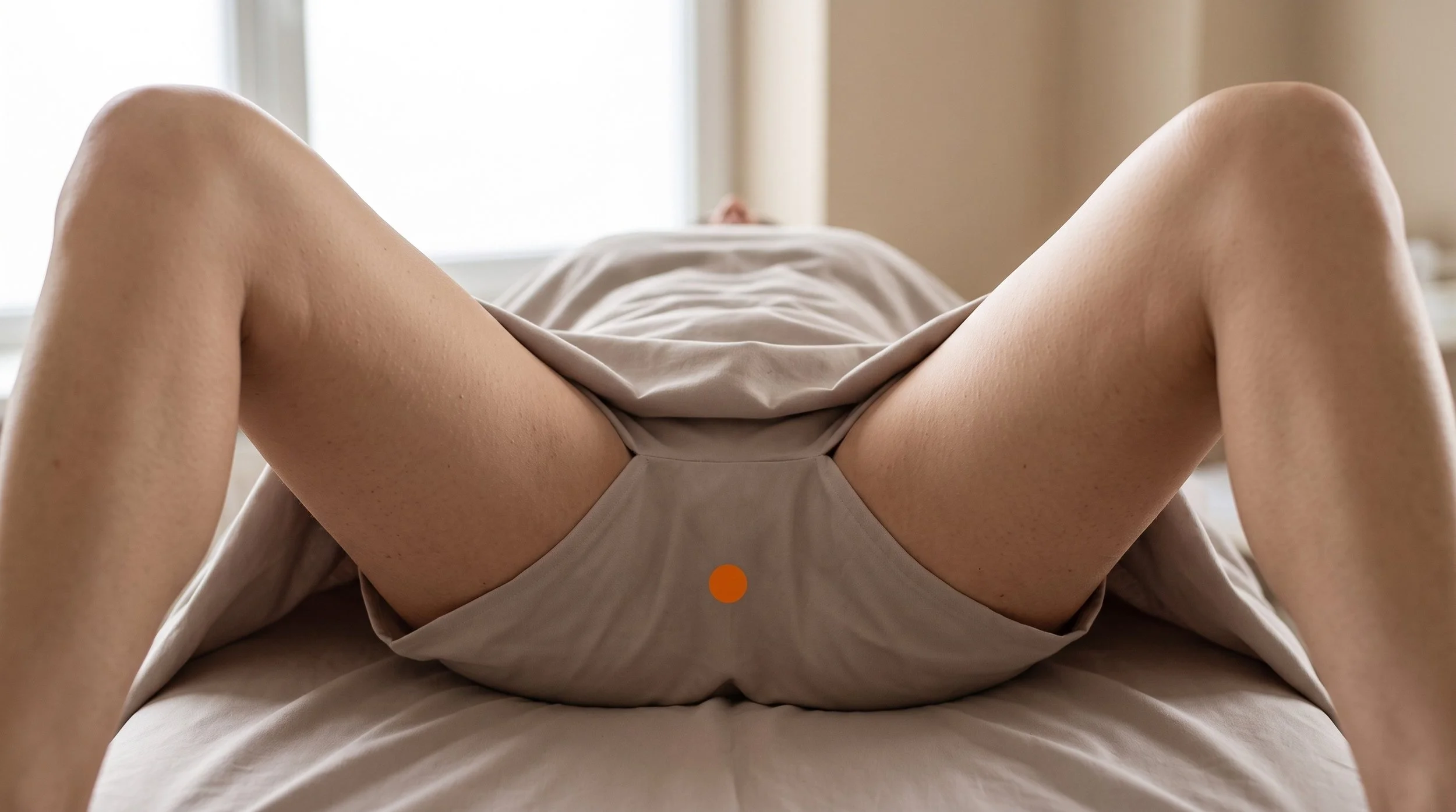
CV1 Acupuncture Point (Huiyin)
The Meeting of Yin at the Perineum: Anatomy, Pudendal Nerve Mechanism, and Why This Rarely Needled Point Still Shapes Pelvic Floor Treatment
CV1 (Huiyin, translated as Meeting of Yin), also written Ren 1, is the first point of the Conception Vessel, located at the center of the perineum, midway between the anus and the genitals. It sits at the deepest, most protected part of the body's front midline, and classical texts describe it as the shared starting ground of three channels: the Conception, Penetrating, and Governing vessels (Deadman et al., 2009). Anatomically it lies over the perineal body in pudendal nerve territory, the same S2 to S4 neural neighborhood that supplies the bladder neck, urethra, anal sphincters, and genitals.
That overlap is why the CV1 acupuncture point appears throughout classical writing on urination, defecation, hemorrhoids, and genital disorders, and it is also why this point is treated with unusual restraint in modern practice: the Great Compendium of Acupuncture and Moxibustion considered it contraindicated to needling, it is contraindicated in pregnancy, and its location means most clinicians reach the same nerve territory through safer, more accessible points.
- Location and layers: CV1 sits on the midline of the perineum between the two lower yin (the anus and the external genitalia), over the perineal body where the bulbospongiosus, superficial transverse perineal muscle, and external anal sphincter converge, with the levator ani sling deeper still (Deadman et al., 2009; Cunningham, 2000).
- Traditional categories, translated: classical sources list CV1 as the meeting point of the Conception, Penetrating, and Governing vessels, and as one of Sun Si-miao's ghost points under the alternate name Ghost Store (Deadman et al., 2009). In neurophysiological language, that midline convergence describes a single site whose afferents feed the sacral segments that also serve the pelvic viscera.
- Nerve story: the perineum is supplied by the pudendal nerve (S2 to S4) through its inferior rectal, perineal, and dorsal genital branches, the same pathway targeted deliberately in modern electroacupuncture protocols for pelvic floor symptoms (Liu et al., 2017).
- Research picture: no trial has isolated CV1 itself, but sham-controlled trials of sacral and pelvic needling protocols report modest benefits for stress urinary incontinence (Liu et al., 2017), chronic prostatitis and chronic pelvic pain syndrome (Sun et al., 2021), and chronic severe functional constipation (Liu et al., 2016), while a Cochrane review of acupuncture for stress urinary incontinence found the evidence base thin (Wang et al., 2013).
- Clinical framing: because of its location, Ren 1 perineum needling is reserved for clearly indicated professional treatment, and the Deadman text notes that the point is clinically used far less than its reputation might suggest (Deadman et al., 2009). At Morningside we more often work the same segmental territory through sacral, lower abdominal, and lower limb points.
- De qi: when CV1 is needled at all, patients typically describe a deep, heavy fullness in the perineum that may spread toward the anus or genitals, sometimes with a brief pressure or urge sensation, rather than the sharp sting of a superficial skin point.
Struggling With Pelvic Floor, Urinary, or Anal Symptoms in NYC?
Pelvic complaints are rarely one thing: bladder urgency, straining, hemorrhoidal discomfort, and deep perineal aching often travel together because they share sacral nerve supply. Our acupuncturists map that territory carefully and treat it through well-chosen sacral, abdominal, and lower limb points rather than defaulting to the most sensitive location on the body. We coordinate with pelvic floor physical therapists and urologists when internal work or medical evaluation is the better next step. Schedule a visit at Morningside Acupuncture to start with a proper assessment.
Schedule NowAnatomy of CV1: Why the Perineal Body Is Such an Important Location
CV1 marks the midpoint of the perineum, over the perineal body: the fibromuscular hub where the bulbospongiosus, the superficial transverse perineal muscle, the external anal sphincter, and fascia from the urogenital diaphragm all anchor. Deeper still lies the levator ani, the muscular floor that supports the bladder, rectum, and reproductive organs. This small patch of tissue is loaded constantly and invisibly: by intra-abdominal pressure during lifting and coughing, by prolonged sitting, by straining at stool, by childbirth, and by chronic bracing patterns that many people carry without noticing.
When that floor becomes overactive or poorly coordinated, symptoms show up as urgency, incomplete emptying, hemorrhoidal congestion, or a deep ache that patients often describe as sitting on something.
Sensation here travels almost entirely through the pudendal nerve, which arises from the S2 to S4 sacral roots and divides into the inferior rectal, perineal, and dorsal genital branches. Those same sacral segments carry parasympathetic supply to the bladder, distal colon, and pelvic organs, so somatic input from the perineum converges centrally with visceral input from structures that have no skin of their own.
That convergence is the plausible basis for the classical indications: needling somatic tissue in this zone can influence dorsal horn processing for the viscera that share its segments, and it can modulate motor output to the sphincters and the levator sling. Modern electroacupuncture protocols exploit the same geography deliberately, stimulating S3 and the pudendal nerve from the sacral surface rather than the perineum itself (Liu et al., 2017).
Layered on top of the segmental effect is a general analgesic response, since needling recruits descending inhibitory pathways and endogenous opioid mechanisms that operate well beyond the treated segment (Zhao, 2008; White et al., 2008).
The deep structures here demand respect. The internal pudendal artery and vein run with the nerve through the pudendal canal, the anal canal and urethra lie just beneath the surface, and in pregnancy the region is both engorged and off limits by convention. Classical guidance allows perpendicular insertion of roughly 0.5 to 1 cun where the point is used at all, while the Great Compendium of Acupuncture and Moxibustion considered CV1 contraindicated to needling outright, and the point is contraindicated in pregnancy (Deadman et al., 2009; Kim, 2008).
In practice, Huiyin acupuncture is uncommon in Western clinics, requires explicit informed consent and draping, and is reserved for clearly indicated professional treatment. For most patients, the same sacral segments can be reached from the sacral foramina, the lower abdomen, and the lower leg with far less exposure.
Related Conception Vessel Related Pain Finder Lower TorsoCV1 (Ren 1) at a Glance: Classification, Location, and Clinical Use
| Category | Detail |
|---|---|
| Traditional Name | Huiyin (Meeting of Yin), Conception Vessel 1, also recorded in classical sources under the alternate names Pingyi (Flat Screen) and Guicang (Ghost Store) |
| Channel Classification | Conception Vessel (Ren Mai), point 1 of 24; the first point of the front midline channel (CV1, also written REN1) |
| Point Categories | Meeting point of the Conception, Penetrating, and Governing vessels at the perineum; one of Sun Si-miao's thirteen ghost points; regarded in some later classics (including the Systematic Classic and the Great Compendium) as the luo-connecting point of the Conception Vessel, with Jiuwei CV15 given that role in the Spiritual Pivot |
| Precise Location | On the midline of the perineum, midway between the anus and the root of the scrotum in men, and between the anus and the posterior labial commissure in women |
| Tissue Stimulated | Perineal skin and superficial perineal fascia over the perineal body, with the bulbospongiosus, superficial transverse perineal muscle, and external anal sphincter converging locally and the levator ani deeper; functionally continuous with hip and pelvic myofascia treated at the adductor magnus and adductor longus and brevis trigger point regions |
| Needle Depth / Direction | Perpendicular insertion 0.5 to 1 cun where the point is used at all; the Great Compendium considers CV1 contraindicated to needling, it is contraindicated in pregnancy, and because of its location it is reserved for clearly indicated professional treatment with explicit consent and appropriate draping |
| De Qi Sensation | A deep, heavy fullness in the perineum that may spread toward the anus or genitals, occasionally with a brief pressure or urge sensation; sharp or radiating pain means the needle should be withdrawn |
| Primary Clinical Uses | Traditionally used for difficult urination and defecation, hemorrhoids and rectal prolapse, damp-heat genital disorders such as itching, swelling, and discharge, and amenorrhea or irregular menstruation in classical listings; historically cited for resuscitation and for mania-depression as a ghost point |
| Common Point Combinations |
|
The Deadman text explains that the traditional name refers to the point's position between the two lower yin, the anus and the external genitalia, and to the perineum as the place where the Conception, Penetrating, and Governing vessels meet.
Traditional attribution credits CV1 with regulating the anterior and posterior yin, draining damp heat, calming the spirit, and promoting resuscitation, with classical indications spanning difficult urination and defecation, seminal emission and impotence, genital swelling and itching, hemorrhoids and rectal prolapse, uterine prolapse, amenorrhea and irregular menstruation, and, unusually, coma and revival from drowning.
Under the alternate name Ghost Store it belongs to Sun Si-miao's thirteen ghost points used historically for epilepsy and mania disorder, and there is a long textual argument, noted in both the Systematic Classic and the Great Compendium, about whether this point rather than Jiuwei CV15 is the connecting point of the Conception Vessel.
What makes the classical pattern striking is how tightly it tracks anatomy: every indication in that long list belongs to organs and structures supplied by the same sacral segments, which is a fairly precise piece of clinical observation from writers with no map of the pudendal nerve.
Why CV1 Is Used for Hemorrhoids, Straining, and Stubborn Pelvic Floor Symptoms
The short answer is segmental convergence. The perineum, the anal canal, the urethra, the bladder neck, and the prostate or uterus all report to the S2 to S4 spinal segments, and sensory neurons from skin, muscle, and viscera converge on shared dorsal horn cells there. Needling somatic tissue in that territory changes the input arriving at those cells, which can shift how visceral signals are processed and how strongly the sphincters and levator ani are held.
That is the mechanism behind the classical grouping of hemorrhoids, difficult defecation, urinary difficulty, and genital symptoms under one point: they are not one disease, but they do share one address in the spinal cord.
A second layer is general rather than local. Needling reliably recruits descending inhibitory pathways from the midbrain and brainstem and engages endogenous opioid mechanisms, with different electroacupuncture frequencies favoring different opioid peptides (Zhao, 2008; White et al., 2008). This is why a course of treatment often reduces pelvic pain intensity even when the needles sit away from the painful area, and why the large individual patient data analysis of chronic pain trials found effects that persisted beyond the treatment period rather than fading immediately (Vickers et al., 2018).
Practically, this means the benefit attributed to CV1 can usually be pursued without needling CV1. Sacral points overlying the S3 foramen and the pudendal nerve reach the same segments from a far more comfortable position, and that is the approach used in the largest pelvic floor trials to date (Liu et al., 2017). We treat the perineal point itself only when there is a clear indication, informed consent, and no safer route to the same neural territory.
What the Research Shows for CV1 (Ren 1)
One note on naming before the evidence: in the research literature this point is almost always listed as CV1, the WHO standard code, while many textbooks and Chinese sources write Ren 1 or RN1, so it is worth searching those as well if you want to read the studies below in full.
There is no clinical trial of CV1 on its own, and it would be difficult to run one given the location and the classical caution around needling here. What exists instead is research on multi-point protocols that engage the same sacral and pelvic segments, usually with electroacupuncture, usually over several weeks. Read those results as evidence about the region and the method rather than about a single point, and note that effect sizes are generally modest and the trials come predominantly from a small number of research groups.
| Study | Type | Focus | Key Finding |
|---|---|---|---|
| Wang et al., 2013 | Cochrane systematic review | Acupuncture for stress urinary incontinence in adults | The review found insufficient good quality evidence to determine whether acupuncture helps stress urinary incontinence, and called for larger trials. |
| Liu et al., 2017 | Multicenter randomized sham-controlled trial (JAMA) | Electroacupuncture at sacral points BL33 and BL35 for stress urinary incontinence in 504 women | Six weeks of electroacupuncture reduced measured urine leakage more than sham, with the authors proposing pudendal and S3 nerve stimulation as the likely mechanism. |
| Sun et al., 2021 | Multicenter randomized sham-controlled trial (Annals of Internal Medicine) | Twenty sessions of acupuncture over 8 weeks for moderate to severe chronic prostatitis and chronic pelvic pain syndrome | More men reached a clinically meaningful symptom reduction with acupuncture than sham, and the difference persisted through 24 weeks of follow-up. |
| Liu et al., 2016 | Multicenter randomized sham-controlled trial (Annals of Internal Medicine) | Electroacupuncture for chronic severe functional constipation in 1,075 patients | Electroacupuncture increased weekly complete spontaneous bowel movements more than sham over 8 weeks, though the absolute difference was small. |
| Vickers et al., 2018 | Individual patient data meta-analysis | Nearly 21,000 patients across chronic pain conditions | Acupuncture outperformed both sham and no-acupuncture controls, with effects that decayed only modestly over 12 months. |
| Zhao, 2008 | Narrative review of mechanism research | Neural mechanisms of acupuncture analgesia | Analgesic effects are attributed to segmental spinal modulation plus descending inhibitory control and endogenous opioid release. |
Chronic Pelvic Pain That Has Not Responded to Anything Yet?
Chronic pelvic pain syndrome and long-standing perineal discomfort often involve sensitized sacral segments plus guarded hip and adductor muscles, which is why single-modality care so often stalls. We combine channel-based point selection along the Conception Vessel with dry needling of the adductors, gluteals, and abdominal wall, plus electroacupuncture where appropriate. Studies suggest multi-session courses matter more than one-off treatments, so we plan a realistic series and reassess. Book a consultation and let's build that plan together.
Schedule NowCV1 in the Context of Trigger Point Work
Perineal pain is frequently myofascial in part, and the muscles that refer into this region are mostly accessible from outside. Trigger points in the adductor magnus can refer pain deep into the pelvis and groin, obturator internus and the pelvic floor muscles themselves refer into the perineum, coccyx, and vagina or scrotum, and the lower abdominal wall can refer into the bladder and inguinal region (Simons et al., 1999).
At Morningside we work these referral sources with dry needling of the adductor group, the gluteals, the abdominal wall, and the hamstring origin at the ischial tuberosity, which sits close to the pudendal nerve's course without requiring any perineal needling at all.
That gives us a practical division of labor. Internal pelvic floor release belongs with a trained pelvic floor physical therapist, and we refer for it routinely. What acupuncture and dry needling contribute is external segmental input at S2 to S4, myofascial release of the hip and abdominal muscles that keep the floor loaded, and the general analgesic and autonomic effects that come with a course of needling. Understood this way, the CV1 acupuncture point functions less as a target and more as a map reference: it tells you which segments matter, and the treatment happens around it.
CV1 Pelvic Floor Treatment at NYC's Highest-Rated Acupuncture Clinic
Morningside Acupuncture is the highest-rated acupuncture and dry needling clinic in New York City with over 500 five-star Google reviews, and we bring that same care and transparency to sensitive pelvic complaints. We explain exactly which points we plan to use, why we usually treat the CV1 region indirectly, and what a reasonable course of care looks like. Every session pairs traditional point selection with modern trigger point and neuromodulation thinking. Schedule your appointment today.
Schedule NowFrequently Asked Questions
Is CV1 the same point as Ren 1?
Yes. CV1 and Ren 1 are two codes for the same point, Huiyin. CV stands for Conception Vessel and is the WHO standard abbreviation, the one you will see in most research papers. Ren comes from Ren Mai, the Chinese name of the vessel, and it is the form used in many textbooks and acupuncture schools. You will also come across it written as REN-1, RN1, or Conception Vessel 1. Whichever code is used, the location and the uses are the same.
What does CV1 feel like when needled?
CV1 is rarely needled, and when it is, patients describe a deep, heavy fullness rather than a surface sting. The sensation often spreads a short distance toward the anus or genitals and can include a brief pressure or urge feeling, which settles within seconds. Because the perineum is richly innervated, the point is more sensitive than most, which is another reason clinicians usually reach the same nerve territory from the sacrum or lower abdomen instead. Sharp, electric, or radiating pain is not the goal and means the needle should be adjusted or removed.
Why treat sacral or leg points instead of CV1 itself for pelvic symptoms?
Because they share the same wiring. The perineum, bladder, urethra, and anal canal are all served by the S2 to S4 segments, so needling at the sacral foramina, the lower abdomen, or the lower leg feeds input into the same spinal levels that CV1 would reach. The large trials in this area used sacral points rather than the perineum for exactly this reason (Liu et al., 2017). Given the classical caution about needling CV1 and the practical issues of exposure, choosing a point with the same segmental reach and less discomfort is usually the better clinical decision.
Can I press CV1 myself between sessions?
Gentle self-acupressure at the perineum is possible and is described in traditional self-care and qigong literature, but it should be approached conservatively and it is not appropriate during pregnancy, with active hemorrhoidal bleeding, with any perineal infection or skin breakdown, or after recent pelvic surgery. If you choose to try it, sit or lie comfortably, use a clean fingertip, and apply steady, moderate pressure to the midpoint between the anus and the genitals for 20 to 30 seconds at a time, breathing slowly and letting the pelvic floor relax on the exhale rather than gripping. Repeat for 2 to 3 minutes, once or twice a day. Many patients find a diaphragmatic breathing drill with conscious pelvic floor relaxation more useful than pressure alone, and stopping if anything feels sharp, numb, or aggravating is the rule. Ask your clinician before adding this if you are being treated for a pelvic condition.
Is CV1 safe to needle?
In trained hands and with clear indication it can be, but it carries more caution than almost any other point on the Conception Vessel. The Great Compendium of Acupuncture and Moxibustion regarded CV1 as contraindicated to needling, it is contraindicated in pregnancy, and the internal pudendal vessels, anal canal, and urethra all lie nearby (Deadman et al., 2009). Standard guidance where the point is used is perpendicular insertion of roughly 0.5 to 1 cun with sterile single-use needles, full informed consent, and appropriate draping. In our clinic we very rarely needle it and prefer to reach the same segments from safer locations.
Where exactly is CV1 located?
CV1 lies on the midline of the perineum, at the midpoint between the anus and the external genitalia: between the anus and the root of the scrotum in men, and between the anus and the posterior labial commissure in women. It sits over the perineal body, the fibromuscular center of the pelvic outlet, and is the point directly opposite DU20 at the crown of the head. It is the first point of the Conception Vessel and is described in the classics as the shared origin of the Conception, Penetrating, and Governing vessels.
References
- Deadman, P., Al-Khafaji, M., & Baker, K. (2009). A manual of acupuncture. Journal of Chinese Medicine Publications.
- Cunningham, P. M. (2000). Acupuncture points: A practical guide to classical and modern usage. Odyssey Press.
- Kim, H. (2008). Handbook of Oriental medicine (3rd ed.). Harmony & Balance Press.
- White, A., Cummings, M., & Filshie, J. (2008). An introduction to Western medical acupuncture. Churchill Livingstone Elsevier.
- Simons, D. G., Travell, J. G., & Simons, L. S. (1999). Travell & Simons' myofascial pain and dysfunction: The trigger point manual, Vol. 1: Upper half of body (2nd ed.). Williams & Wilkins.
- Wang, Y., Zhishun, L., Peng, W., Zhao, J., & Liu, B. (2013). Acupuncture for stress urinary incontinence in adults. Cochrane Database of Systematic Reviews, 2013(7), CD009408. https://doi.org/10.1002/14651858.CD009408.pub2
- Liu, Z., Liu, Y., Xu, H., He, L., Chen, Y., Fu, L., ... Liu, B. (2017). Effect of electroacupuncture on urinary leakage among women with stress urinary incontinence: A randomized clinical trial. JAMA, 317(24), 2493-2501. https://doi.org/10.1001/jama.2017.7220
- Sun, Y., Liu, Y., Liu, B., Zhou, K., Yue, Z., Zhang, W., Fu, W., Yang, J., Li, N., He, L., Zang, Z., Su, T., Fang, J., Ding, Y., Qin, Z., Song, H., Hu, H., Zhao, H., Mo, Q., ... Liu, Z. (2021). Efficacy of acupuncture for chronic prostatitis/chronic pelvic pain syndrome: A randomized trial. Annals of Internal Medicine, 174(10), 1357-1366. https://doi.org/10.7326/M21-1814
- Liu, Z., Yan, S., Wu, J., He, L., Li, N., Dong, G., ... Liu, B. (2016). Acupuncture for chronic severe functional constipation: A randomized trial. Annals of Internal Medicine, 165(11), 761-769. https://doi.org/10.7326/M15-3118
- Vickers, A. J., Vertosick, E. A., Lewith, G., MacPherson, H., Foster, N. E., Sherman, K. J., Irnich, D., Witt, C. M., & Linde, K. (2018). Acupuncture for chronic pain: Update of an individual patient data meta-analysis. Journal of Pain, 19(5), 455-474. https://doi.org/10.1016/j.jpain.2017.11.005
- Zhao, Z. Q. (2008). Neural mechanism underlying acupuncture analgesia. Progress in Neurobiology, 85(4), 355-375. https://doi.org/10.1016/j.pneurobio.2008.05.004
Disclaimer: This web site is intended for educational and informational purposes only. Reading this website does not constitute providing medical advice or any professional services. This information should not be used for diagnosing or treating any health issue or disease. Those seeking medical advice should consult with a licensed physician. Seek the advice of a medical doctor or other qualified health professional for any medical condition. If you think you have a medical emergency, call 911 or go to the emergency room. No acupuncturist-patient relationship is created by reading this website or using the information. Morningside Acupuncture PLLC and its employees and contributors do not make any express or implied representations with respect to the information on this site or its use. For any legal interpretation of scope of practice in your state, consult a licensed attorney or regulatory authority.
Read more from our blog



