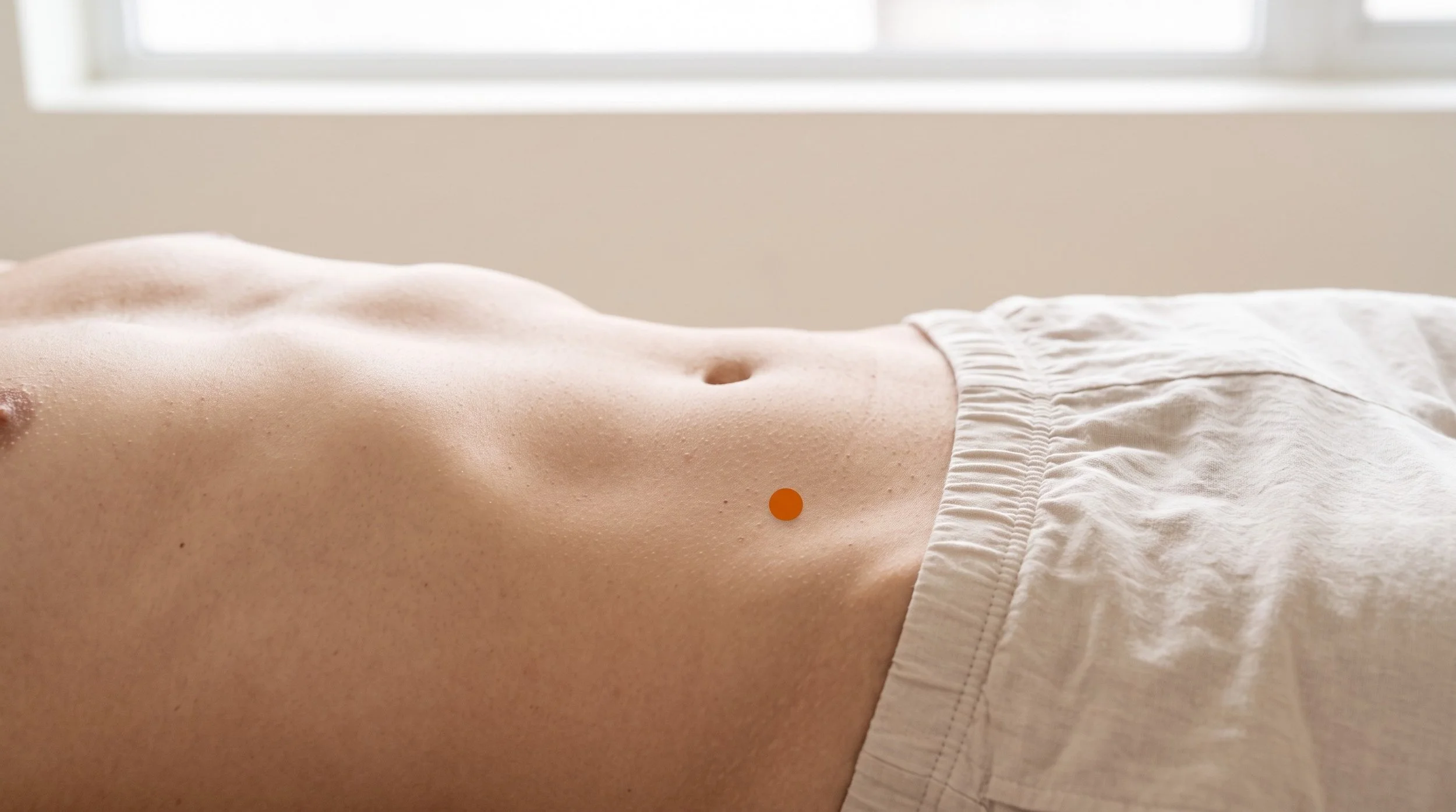
SP14 Acupuncture Point (Fujie)
The Abdomen Knot Below the Navel: Anatomy, Segmental Gut Reflexes, and Why SP14 Anchors Modern Abdominal Needling Protocols
SP14, known in Chinese as Fujie and usually translated as Abdomen Knot, sits on the lower abdomen about 1.3 cun below SP15, four cun out from the midline, right at the palpable outer edge of the rectus abdominis (Deadman et al., 2007).
In plain terms, put a finger just below the level of your navel, then slide it sideways until you feel the ridge where the vertical six-pack muscle ends and the flatter oblique wall begins: that groove is where the sp14 acupuncture point lives.
Classically it was described as a point for untying knots of stagnation around the umbilicus, for warming a cold lower abdomen, and for settling upward-surging sensations toward the chest (Deadman et al., 2007). Modern interest in spleen 14 comes from a very different direction: it is one of the two abdominal points used in some of the largest sham-controlled acupuncture trials ever run for chronic constipation (Liu Z. et al., 2016; Liu B. et al., 2021), which makes this quiet, rarely discussed point one of the better studied locations on the Spleen channel.
- Location and layers: SP14 lies four cun lateral to the anterior midline at the lateral border of the rectus abdominis, slightly below umbilical level, with the needle passing through skin, subcutaneous fat, the oblique and transversus layers, and fascia before approaching the peritoneum (Deadman et al., 2007; Cheng, 1987).
- Traditional attributions, translated: classical texts credit Fujie with warming and benefiting the lower jiao and with regulating and descending rebellious qi, language that maps neatly onto what we would now call autonomic modulation of colonic motility and abdominal wall tone (Deadman et al., 2007).
- Nerve story: the region is supplied by the anterior rami of the lower thoracic nerves (the eleventh intercostal nerve is listed for this point), which share spinal segments with visceral afferents from the distal small bowel and colon, giving a plausible somatovisceral convergence pathway (Cheng, 1987; Zhao, 2008).
- Research picture: SP14 was needled bilaterally, together with ST25 and ST37, in a 1075-patient randomized trial of electroacupuncture for chronic severe functional constipation, and in a later noninferiority trial comparing electroacupuncture with prucalopride (Liu Z. et al., 2016; Liu B. et al., 2021). Results were modest but statistically meaningful, and they apply to the protocol, not to the point in isolation.
- Clinical framing: at Morningside we use spleen 14 mainly for periumbilical cramping, lower abdominal distention with sluggish bowels, and a tight, guarded lateral abdominal wall, usually alongside distal points and sometimes with electroacupuncture across paired abdominal needles.
- De qi: patients typically report a deep, heavy, spreading fullness across the lower belly rather than a sharp sensation, and some notice audible gurgling or a wave of relaxation as the abdominal wall lets go (Deadman et al., 2007).
Struggling With Bloating, Cramping, or Sluggish Digestion?
Lower abdominal complaints rarely come from one tissue, so we assess the gut history, the breathing pattern, and the abdominal wall itself before choosing points. SP14 is one of our go-to locations when the belly feels tight and knotted just outside the navel, and it pairs well with ST25, ST36, and gentle abdominal release work. Treatment is calm, methodical, and adjusted session by session based on how your symptoms respond. Schedule a visit and let us build a plan around your digestion, not a template.
Schedule NowAnatomy of SP14: Why the Lateral Border of the Rectus Abdominis Is Such an Important Location
Finding SP14 is a palpation task rather than a measuring task. The four cun line on the abdomen corresponds to the palpable outer edge of the rectus abdominis, and SP14 sits on that edge a short distance below the level of the umbilicus, just under SP15 (Deadman et al., 2007). Under the fingertip you have skin, a variable layer of subcutaneous fat, then the aponeurotic junction where the external oblique, internal oblique, and transversus abdominis blend toward the rectus sheath.
This is a high-traffic zone mechanically: it takes load from trunk rotation, from coughing and straining, from postpartum recovery, and from the chronic bracing pattern many people adopt when their gut hurts. Deep to the muscular wall, the descending colon lies on the left side and small bowel loops sit on the right, which is exactly why the point has always been described in intestinal terms.
The abdominal wall here is supplied by the anterior rami of the lower thoracic spinal nerves, with the eleventh intercostal nerve and its accompanying vessels named for this point (Cheng, 1987). Those same spinal segments receive visceral afferent traffic from the distal gut, so the skin, muscle, and bowel in this region report to overlapping pools of dorsal horn neurons.
Needling a somatic structure in a shared segment can change the excitability of that pool and can trigger somatovisceral reflexes that alter motility and local blood flow, a mechanism reviewed extensively in the neurophysiology literature on acupuncture analgesia (Zhao, 2008). Laboratory work also suggests that the autonomic consequences of needling are organized somatotopically, with abdominal and limb sites recruiting different pathways, which helps explain why classical protocols nearly always combine a belly point with a distal leg point (Liu S. et al., 2021).
Safety follows directly from the anatomy. Standard references give perpendicular insertion of roughly 1 to 1.5 cun, with an explicit caution that deep needling in thin patients may enter the peritoneal cavity (Deadman et al., 2007). The inferior epigastric vessels run inside the rectus sheath just medial to this line, and the colon or small bowel sits deep to the wall, so needle depth should always be scaled to the individual's body habitus rather than to a textbook number.
In practice we angle perpendicular, stay within the muscular and fascial layers unless there is a specific reason not to, avoid the area over hernias, surgical scars, or an enlarged organ, and treat pregnancy as a reason to select other points.
Related Rectus Abdominis Trigger Points Related Spleen ChannelSP14 at a Glance: Classification, Location, and Clinical Use
| Category | Detail |
|---|---|
| Traditional Name | Fujie (腹結), commonly translated as Abdomen Knot; also rendered as Abdomen's Knot |
| Channel Classification | Fourteenth point of the Spleen channel of foot taiyin, in the lower abdominal group between SP13 and SP15 |
| Point Categories | No five-shu, yuan, luo, or xi-cleft designation and no hui-meeting role. Notably, while SP12, SP13, SP15, and SP16 are listed as coalescent points of the Yin Linking vessel (yinwei mai), SP14 is not, despite sitting in the middle of them (Deadman et al., 2007). |
| Precise Location | On the lower abdomen, 1.3 cun inferior to SP15 and 4 cun lateral to the anterior midline, at the palpable lateral border of the rectus abdominis |
| Tissue Stimulated | Skin and subcutaneous tissue, the lateral edge of the rectus abdominis, the external abdominal oblique and internal oblique, and the transverse abdominis with its fascial layers |
| Needle Depth / Direction | Perpendicular insertion, roughly 1 to 1.5 cun in most adults (some texts list 0.5 to 1.0 cun); depth must be reduced in thin patients because deep needling may reach the peritoneal cavity. Moxibustion is traditionally applicable. |
| De Qi Sensation | A deep, heavy, distending fullness spreading across the lower abdomen, sometimes with warmth, gurgling, or a sense of the abdominal wall softening; sharp or radiating pain means stop and reassess |
| Primary Clinical Uses | Periumbilical cramping pain, abdominal distention with constipation, loose stools of a cold pattern in classical use, painful shan (hernial) disorder, and lateral abdominal wall tension in modern practice |
| Common Point Combinations |
|
Deadman's A Manual of Acupuncture presents SP14 as a point whose name is its job description: traditionally it was said to loosen knotted stagnation of qi in the abdomen, especially around the navel, and to warm and support the lower jiao so that cold-type diarrhea and dysenteric disorders could settle (Deadman et al., 2007). The same source attributes to it a second and less obvious role, that of regulating rebellious qi, meaning the classical picture of sensations surging upward to disturb the Heart or to interfere with the Lung's downward function and provoke cough (Deadman et al., 2007).
Its indication list therefore runs across three loosely related territories: periumbilical pain and bowel disturbance, abdominal distention with constipation and painful shan disorder, and upward-rushing sensations with chest discomfort. What makes the classical pattern striking is the company it keeps and does not keep: SP14 is surrounded by points named as coalescent points of the Yin Linking vessel, an extraordinary vessel whose disorders include Heart pain, yet SP14 alone in that stretch carries no such designation while still being credited with a Heart-related indication (Deadman et al., 2007).
Why SP14 Is Used for Chronic Constipation That Has Not Responded to Laxatives
The first part of the answer is segmental. The abdominal wall at SP14 and the bowel underneath it are wired into the same lower thoracic spinal segments, with the eleventh intercostal nerve named for this location (Cheng, 1987). When a needle stimulates muscle and fascia in a segment, the sensory barrage reaches dorsal horn neurons that also receive input from the viscera of that segment, and the reflex output can travel back through sympathetic and parasympathetic routes to change smooth muscle activity, secretion, and blood flow (Zhao, 2008).
This is the same convergence principle that explains why a gut problem can produce a tender, guarded belly wall, run in reverse: treat the wall in the right segment and the viscera may respond. Animal work indicates these somatoautonomic reflexes are regionally organized, with abdominal and hindlimb points engaging different circuits, which is one reason protocols pair belly points with leg points rather than relying on either alone (Liu S. et al., 2021).
The second part is clinical evidence, and here SP14 is unusually well represented. A multicenter randomized trial of 1075 adults with chronic severe functional constipation used electroacupuncture across bilateral ST25 and SP14, with manual needling at ST37, for 28 sessions over eight weeks, and reported a greater increase in complete spontaneous bowel movements than sham electroacupuncture, with benefits persisting through follow-up (Liu Z. et al., 2016).
A later multicenter noninferiority trial compared a similar electroacupuncture approach with the prokinetic drug prucalopride in severe chronic constipation (Liu B. et al., 2021). These are protocol-level findings rather than proof that any single point does the work, and the between-group differences were modest, but they place spleen 14 inside one of the more rigorous bodies of acupuncture research in gastroenterology.
The third part is descending inhibition and comfort. For the cramping component of these presentations, needling also recruits endogenous opioid and monoaminergic pathways that dampen pain transmission at the spinal level, a mechanism supported by decades of neurophysiological work and consistent with the modest but durable effects seen in large chronic pain datasets (Zhao, 2008; Vickers et al., 2018). Patients often describe the lower abdomen feeling less braced and less reactive after treatment, which matters because guarding and pain feed each other.
What the Research Shows for SP14
A caution before the table. Almost no trial studies one point on its own, and SP14 is no exception: it appears as part of a fixed protocol alongside ST25 and ST37, so the evidence tells us about that combination, not about Fujie in isolation. The constipation trials are large and sham-controlled, which is a genuine strength, while the irritable bowel literature is more discouraging and the mechanistic work is mostly preclinical. Read the following as a picture of plausibility and modest effect sizes rather than certainty.
| Study | Type | Focus | Key Finding |
|---|---|---|---|
| Liu Z. et al., 2016 | Multicenter randomized sham-controlled trial (n = 1075) | Electroacupuncture at bilateral ST25 and SP14 plus ST37 for chronic severe functional constipation over 8 weeks | The electroacupuncture group showed a greater increase in weekly complete spontaneous bowel movements than sham, with effects that carried into follow-up, though the absolute difference was modest. |
| Liu B. et al., 2021 | Multicenter randomized noninferiority trial | Electroacupuncture compared with prucalopride for severe chronic constipation | Electroacupuncture performed comparably to the drug comparator on the trial's primary outcome, suggesting it may be a reasonable option for some patients rather than a replacement for medical care. |
| Manheimer et al., 2012 | Cochrane systematic review | Acupuncture for irritable bowel syndrome | No benefit was demonstrated over credible sham acupuncture for symptom severity or quality of life, although comparisons with pharmacological care in Chinese trials favored acupuncture. |
| Liu S. et al., 2021 | Preclinical neuroanatomical study | Somatotopic organization of electroacupuncture-driven autonomic reflexes in mice | Autonomic responses depended on the body region stimulated and on the sensory neurons innervating deep fascia, supporting site-specific rather than uniform mechanisms. |
| Vickers et al., 2018 | Individual patient data meta-analysis | Acupuncture for chronic pain across roughly 20,000 patients | Acupuncture produced modest but statistically robust benefits over both sham and usual care, with effects largely sustained at one year. |
| Zhao, 2008 | Narrative review of mechanisms | Neural pathways of acupuncture analgesia | Needling activates afferent fibers that engage spinal and supraspinal inhibitory systems, including opioid and monoaminergic pathways. |
Is Your Abdominal Wall Part of the Problem?
Tight rectus abdominis and oblique tissue can produce cramping, burning, and pressure that feel exactly like a gut problem. Because SP14 sits at the border of these muscles, it lets us address the wall and the underlying autonomic reflexes in the same treatment. Our team combines acupuncture point work with precise dry needling of named abdominal muscles when the exam points that way. Book an evaluation and find out whether your pain is coming from inside, outside, or both.
Schedule NowSP14 in the Context of Trigger Point Work
The sp 14 abdomen location is not just near myofascial territory, it is inside it. The lateral border of the rectus abdominis and the overlying oblique layers are classic sites for abdominal wall trigger points, and the trigger point literature documents that these points can refer pain across the belly and can also be associated with nausea, bloating, cramping, and altered bowel habits that convincingly imitate visceral disease (Simons et al., 1999). When a patient's lower abdominal pain increases with a tensed sit-up position rather than easing, that finding shifts suspicion toward the wall.
In those cases we treat SP14 as both an acupuncture point and an anatomical target, needling the tender bands in the rectus and oblique layers with the same needle we would use anywhere else, because acupuncture and dry needling are the same tool applied through different reasoning frameworks.
Practically, a session might combine SP14 and ST25 for segmental and autonomic effect, dry needling of the rectus abdominis and external oblique for the mechanical component, and a distal point such as ST36 to broaden the response. Depth discipline matters more here than almost anywhere else on the body: we palpate the wall thickness, pinch and lift tissue when appropriate, and stay superficial in lean patients because the peritoneum is not far away (Deadman et al., 2007). We also screen for hernia, recent surgery, and any red flag pattern that belongs with a physician before we needle a painful abdomen.
SP14 Digestive and Abdominal Pain Treatment at NYC's Highest-Rated Acupuncture Clinic
Morningside Acupuncture is the highest-rated acupuncture and dry needling clinic in New York City with over 500 five-star Google reviews, and digestive complaints are among the most common reasons patients find us. We use points like SP14 within a full treatment plan that may include electroacupuncture, moxibustion, cupping, and hands-on abdominal work. Every session is licensed, sterile, single-use, and explained clearly before a needle goes in. Schedule your appointment and see what careful, evidence-informed care feels like.
Schedule NowFrequently Asked Questions
What does SP14 feel like when needled?
Most patients describe a deep, heavy, spreading fullness low in the abdomen, sometimes with a mild ache that travels toward the navel or out to the flank. Some people feel warmth, and audible gurgling is common as the gut responds. If electroacupuncture is used, you may notice a gentle rhythmic tapping and a mild visible twitch of the abdominal wall. Sharp, electric, or radiating pain is not the goal, and you should say so immediately if you feel it so the needle can be adjusted or withdrawn.
Why needle the belly wall for a bowel problem instead of just using leg points?
Because the two work through different routes and are usually combined. The abdominal wall at SP14 shares spinal segments with the nearby intestine, so needling there can produce local somatovisceral reflex effects on motility and blood flow (Cheng, 1987; Zhao, 2008). Distal leg points such as ST36 and ST37 appear to engage different, more systemic autonomic pathways, and preclinical work suggests these regional differences are real rather than arbitrary (Liu S. et al., 2021). The large constipation trials that included SP14 used both an abdominal pair and a lower leg point together, which reflects standard clinical practice (Liu Z. et al., 2016).
Can I press SP14 myself between sessions?
Yes, acupressure at this location is generally safe for most adults. Lie on your back with knees bent so the abdominal wall relaxes, find the level just below your navel, then move your fingers about a hand's width outward until you feel the firm outer edge of the rectus abdominis. Press with two or three fingertips at a moderate, comfortable depth and hold for 30 to 60 seconds, breathing slowly, then release and repeat two or three times per side. Small slow circles or a gentle rocking pressure for one to two minutes also works, and doing this once or twice daily, ideally not right after a large meal, is reasonable. A warm pack over the lower abdomen afterward suits the traditional warming intent of this point. Stop if pressure produces sharp pain, and skip self-treatment entirely if you are pregnant, have a hernia or recent abdominal surgery, or have undiagnosed abdominal pain.
Is SP14 safe to needle?
In trained hands, yes, but it is a point that demands respect for depth. Standard texts allow perpendicular insertion of about 1 to 1.5 cun while explicitly warning that deep needling in thin patients can penetrate the peritoneal cavity (Deadman et al., 2007). A qualified practitioner scales depth to your body, palpates the wall first, and avoids needling over hernias, surgical scars, an enlarged liver or spleen, or a distended bladder. Lower abdominal points are generally avoided during pregnancy. Anyone with new, severe, or unexplained abdominal pain, fever, bleeding, or unintended weight loss needs medical evaluation before acupuncture is considered.
Where exactly is SP14 located?
SP14 is on the lower abdomen, 4 cun lateral to the anterior midline and 1.3 cun below SP15, which itself sits level with the center of the umbilicus (Deadman et al., 2007). The 4 cun line corresponds to the palpable lateral border of the rectus abdominis, so the most reliable way to find the abdomen knot point is to locate that muscular edge by touch, then drop just below navel level. Some texts list the lateral measurement slightly differently at 3.5 units, which reflects different measuring conventions rather than a different point; palpation of the rectus border resolves the discrepancy in practice.
References
- Deadman, P., Al-Khafaji, M., & Baker, K. (2009). A manual of acupuncture. Journal of Chinese Medicine Publications.
- Cheng, X. (Ed.). (1999). Chinese acupuncture and moxibustion (Rev. ed.). Foreign Languages Press.
- Cunningham, P. M. (2000). Acupuncture points: A practical guide to classical and modern usage. Odyssey Press.
- Simons, D. G., Travell, J. G., & Simons, L. S. (1999). Travell & Simons' myofascial pain and dysfunction: The trigger point manual, Vol. 1: Upper half of body (2nd ed.). Williams & Wilkins.
- Liu, Z., Yan, S., Wu, J., He, L., Li, N., Dong, G., Fang, J., Fu, W., Fu, L., Sun, J., Wang, L., Wang, S., Yang, J., Zhang, H., Zhang, J., Zhao, J., Zhou, W., Zhou, Z., Ai, Y., ... Liu, B. (2016). Acupuncture for chronic severe functional constipation: A randomized trial. Annals of Internal Medicine, 165(11), 761-769. https://doi.org/10.7326/M15-3118
- Liu, B., Wu, J., Yan, S., Zhou, K., He, L., Fang, J., Fu, W., Li, N., Su, T., Sun, J., Zhang, W., Yue, Z., Zhang, H., Zhao, J., Zhou, Z., Song, H., Wang, J., Liu, L., Wang, L., ... Liu, Z. (2021). Electroacupuncture vs prucalopride for severe chronic constipation: A multicenter, randomized, controlled, noninferiority trial. American Journal of Gastroenterology, 116(5), 1024-1035. https://doi.org/10.14309/ajg.0000000000001050
- Manheimer, E., Cheng, K., Wieland, L. S., Min, L. S., Shen, X., Berman, B. M., & Lao, L. (2012). Acupuncture for treatment of irritable bowel syndrome. Cochrane Database of Systematic Reviews, 2012(5), CD005111. https://doi.org/10.1002/14651858.CD005111.pub3
- Liu, S., Wang, Z., Su, Y., Qi, L., Yang, W., Fu, M., Jing, X., Wang, Y., & Ma, Q. (2021). A neuroanatomical basis for electroacupuncture to drive the vagal-adrenal axis. Nature, 598(7882), 641-645. https://doi.org/10.1038/s41586-021-04001-4
- Zhao, Z. Q. (2008). Neural mechanism underlying acupuncture analgesia. Progress in Neurobiology, 85(4), 355-375. https://doi.org/10.1016/j.pneurobio.2008.05.004
- Vickers, A. J., Vertosick, E. A., Lewith, G., MacPherson, H., Foster, N. E., Sherman, K. J., Irnich, D., Witt, C. M., & Linde, K. (2018). Acupuncture for chronic pain: Update of an individual patient data meta-analysis. Journal of Pain, 19(5), 455-474. https://doi.org/10.1016/j.jpain.2017.11.005
Disclaimer: This web site is intended for educational and informational purposes only. Reading this website does not constitute providing medical advice or any professional services. This information should not be used for diagnosing or treating any health issue or disease. Those seeking medical advice should consult with a licensed physician. Seek the advice of a medical doctor or other qualified health professional for any medical condition. If you think you have a medical emergency, call 911 or go to the emergency room. No acupuncturist-patient relationship is created by reading this website or using the information. Morningside Acupuncture PLLC and its employees and contributors do not make any express or implied representations with respect to the information on this site or its use. For any legal interpretation of scope of practice in your state, consult a licensed attorney or regulatory authority.
Read more from our blog



