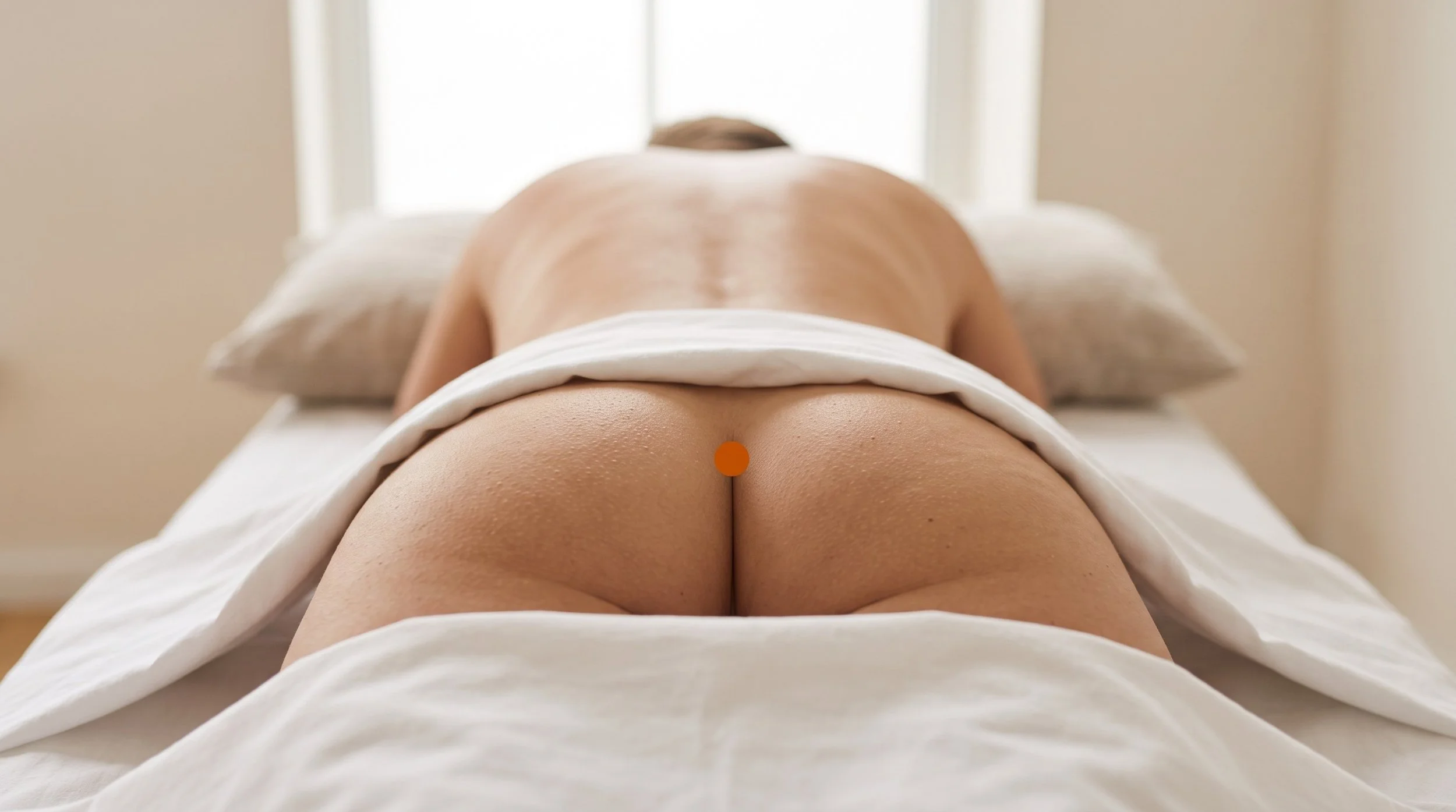
DU1 Acupuncture Point (Changqiang)
The Coccyx Gate at the Base of the Spine: Anatomy, Mechanism, and Why This Governing Vessel Point Anchors Tailbone, Anorectal, and Pelvic Floor Treatment
DU1 (also written GV1), known in Chinese as Changqiang and usually translated as Long Strong, is the first point of the Governing vessel and sits in one of the most anatomically specific spots on the body: on the midline, halfway between the tip of the tailbone and the anus.
It is a small target in a densely innervated region where the anococcygeal ligament, the deep fibers of the pelvic floor, and the sacral and coccygeal nerve branches all converge, which is exactly why the classical literature attached it to hemorrhoids, rectal prolapse, and difficult defecation, and why modern practitioners reach for it in tailbone pain, post-fall coccyx sensitivity, and pelvic floor overactivity. It is not a point we needle casually or often, but when the presenting problem lives at the base of the spine, few locations sit closer to the tissue in question.
- The GV1 acupuncture point (Changqiang, Governing vessel 1) is located on the midline midway between the coccyx tip and the anus, and it is found and needled with the patient lying face down or side-lying with the knees drawn up (Deadman et al., 2009). The needle passes through skin and subcutaneous tissue into the anococcygeal ligament plane rather than into muscle bulk.
- Traditionally, DU1 is described as the luo-connecting point of the Governing vessel and as a meeting point with the Conception vessel and the Kidney and Gallbladder channels, and those designations are the classical explanation for its unusually wide indication list (Deadman et al., 2009). We present these as traditional attributions, not as physiology.
- Neurophysiologically, the region is served by the coccygeal plexus and by inferior rectal branches of the pudendal nerve, which share sacral spinal segments with the anal canal, rectum, bladder base, and pelvic floor musculature. That shared segmental territory is a plausible basis for local needling influencing both pain and anorectal function (Zhao, 2008).
- The research picture is indirect but not empty. A systematic review of acupuncture after hemorrhoid surgery found some trials reporting lower pain scores with electroacupuncture, while noting a small evidence base and inconsistent quality (Chen et al., 2022), and a large sham-controlled trial showed electroacupuncture may increase spontaneous bowel movements in chronic severe functional constipation (Liu et al., 2016).
- For persistent tailbone pain, systematic review evidence favors a stepwise conservative approach before anything invasive, which is the clinical space where needling of the coccygeal region and surrounding pelvic and gluteal muscles fits (Andersen et al., 2022).
- De qi at DU1 is usually described as a deep, heavy, slightly distending ache that may spread toward the anus or up into the sacrum. It is a sensitive area, so we work with clear consent, careful draping, minimal stimulation, and often only a few seconds of needle retention on the first visit.
Struggling With Tailbone Pain That Gets Worse the Longer You Sit?
Coccyx pain after a fall, a long pregnancy, or years of desk work rarely resolves with cushions alone, because the pelvic floor and gluteal attachments that pull on the tailbone keep loading it. At Morningside Acupuncture, we assess the sacrococcygeal joint, the surrounding musculature, and your sitting mechanics before deciding whether DU1, nearby sacral points, or dry needling of the gluteal and pelvic girdle muscles is the better starting place. Treatment is graded, conservative, and explained step by step. Schedule a visit and let's find out what is actually driving your tailbone pain.
Schedule NowAnatomy of DU1: Why the Space Between the Coccyx and the Anus Is Such an Important Location
DU1 sits at the very bottom of the natal cleft, on the midline between the tip of the coccyx and the anal verge. Immediately under the skin and a thin layer of subcutaneous fat lies the anococcygeal ligament, the fibrous raphe that anchors the posterior pelvic floor to the tailbone. Deeper and lateral to that raphe are the fibers of levator ani and coccygeus, along with the posterior attachments of the external anal sphincter.
This is a load-bearing junction: it takes strain from prolonged sitting on hard surfaces, from a fall directly onto the tailbone, from labor and delivery, from long hours in the saddle, and from the chronic straining and breath-holding patterns that often accompany constipation. When any of those histories are present, the tissue at and around DU1 is frequently tender to light palpation.
The nerve geography explains most of what this point does. The area is supplied by the coccygeal plexus and its anococcygeal branches, along with inferior rectal branches of the pudendal nerve, all arising from lower sacral and coccygeal segments. Those same segments carry sensory information from the anal canal, the rectum, the bladder base, and the pelvic floor muscles, so the spinal cord receives converging input from skin, ligament, muscle, and viscera in one narrow band.
Needling produces a controlled afferent volley into that band, which can dampen dorsal horn excitability segmentally and recruit descending inhibitory pathways that release endogenous opioids, serotonin, and noradrenaline (Zhao, 2008). Across chronic pain conditions generally, individual patient data meta-analysis supports a modest but persisting effect of acupuncture over sham and usual care, which sets a realistic ceiling on what any single point contributes (Vickers et al., 2018).
Directly anterior to the point is the anal canal, which is the entire reason the needling convention is what it is. The classical instruction is perpendicular insertion of roughly 0.5 to 1 cun with the needle angled so it runs in front of the coccyx rather than driving forward into soft tissue (Deadman et al., 2009).
In practice this means the needle stays in the ligamentous plane hugging the bone, with the patient prone or side-lying with the knees drawn up so the landmarks are accessible and stable. Because of the location, strict clean technique, explicit consent, and appropriate draping are non-negotiable. We avoid the point entirely in the presence of local infection, abscess, acute fissure, or unexplained rectal bleeding, and we defer to medical evaluation first when those are present.
Related Pelvic Floor Trigger Points Related Governing VesselDU1 (GV1) at a Glance: Classification, Location, and Clinical Use
| Category | Detail |
|---|---|
| Traditional Name | Changqiang (Long Strong), Governing Vessel 1, DU1 |
| Channel Classification | Governing Vessel (Du Mai), the first point of the channel (DU1, also written GV1) |
| Point Categories | Luo-connecting point of the Governing vessel; meeting point of the Governing vessel with the Conception vessel and with the Gallbladder and Kidney channels |
| Precise Location | On the midline, midway between the tip of the coccyx and the anus; located and needled prone, or side-lying with the knees drawn up |
| Tissue Stimulated | Skin and subcutaneous tissue of the natal cleft, the anococcygeal ligament, and the posterior attachment field of the pelvic floor including levator ani and coccygeus; see Pelvic Floor Trigger Points for the related myofascial map |
| Needle Depth / Direction | Perpendicular insertion 0.5 to 1 cun, with the needle angled to run in front of the coccyx and stay off the anterior structures |
| De Qi Sensation | Deep, heavy, slightly distending ache at the tailbone that may spread toward the anus or up into the sacrum; sensitivity is common, so stimulation is kept light |
| Primary Clinical Uses | Classically hemorrhoids, rectal prolapse, difficult defecation, diarrhea patterns, and difficult urination; in modern practice coccyx pain, sacrococcygeal tenderness, and pelvic floor overactivity |
| Common Point Combinations |
|
In Deadman's Manual of Acupuncture, DU1 is presented as the opening point and the luo-connecting point of the Governing vessel, and its traditional actions are given as treating hemorrhoids, benefiting the two lower yin, activating the channel to relieve pain, and calming the spirit.
The classical logic runs along the described pathway: because the Governing vessel was said to wind around the anus, the point was assigned to hemorrhoids, prolapse, and disordered defecation; because the vessel was said to enter the kidneys and encircle the genitals, it was assigned to painful and difficult urination and to depletion from sexual strain; and because the vessel was said to run the full length of the spine into the brain, it collected indications for lumbar and sacral pain, spinal stiffness, heaviness of the head, and even mania and fright-type seizures.
The text also notes that when the Governing luo-connecting channel was considered excess, spinal rigidity was expected, and when deficient, heaviness and shaking of the head. What makes the classical pattern striking is not the metaphysics but the range: a single point at the tailbone was asked to cover anorectal, urinary, spinal, and mental-emotional territory, which is exactly the pattern you would predict from a location sitting on top of a shared sacral segmental supply.
Why DU1 Is Used for Bowel, Bladder, and Sitting Pain, Not Just the Tailbone Itself
Patients are often surprised that a point at the tailbone might be considered for bowel symptoms. The reason is segmental convergence. The skin, ligament, and muscle at DU1 and the anal canal, rectum, and bladder base send sensory information into the same lower sacral cord segments. When many tissues report to one neighborhood of the spinal cord, the brain can struggle to localize the source, which is why anorectal irritation is often felt as deep tailbone ache and why coccygeal strain can feel like pressure with defecation.
Needling into that shared territory gives the cord a strong, well-localized signal, and that input can turn down the amplification that keeps the region sensitive (Zhao, 2008).
On top of the segmental effect, needling recruits descending inhibitory control from the brainstem, along with local vascular and autonomic changes at the needle site. Sacral-level needling is also of interest because the sacral outflow supplies parasympathetic innervation to the distal bowel and bladder, which is the same rationale used for other pelvic-region stimulation approaches.
The best direct clinical signal comes from bowel research rather than from DU1 studies specifically: a large sham-controlled trial found that eight weeks of electroacupuncture increased complete spontaneous bowel movements in chronic severe functional constipation, with effects persisting through follow-up (Liu et al., 2016). That trial used a different point prescription, so it supports the general mechanism rather than this point in particular.
For the pain side, expectations should stay measured. Systematic review evidence in persistent coccydynia supports working through conservative options first, with surgery reserved for refractory cases, and it notes that comparative trial quality is limited (Andersen et al., 2022). Acupuncture and dry needling fit into that conservative tier alongside ergonomic changes, manual therapy, and pelvic floor rehabilitation, and the broader chronic pain literature suggests effects that are real but moderate rather than dramatic (Vickers et al., 2018).
What the Research Shows for DU1 (GV1)
One note on naming before the evidence: in the research literature this point is almost always listed as GV1, the WHO standard code, so GV1 is the term to search if you want to read the studies below in full.
There is no body of trials testing Changqiang on its own, and it would be misleading to imply otherwise. What exists are studies of multi-point protocols in conditions the point is traditionally associated with, plus general mechanism and chronic pain research. The honest framing is that DU1 is one anatomically sensible component of a treatment plan, chosen when the presentation is local to the coccyx and pelvic floor, and the evidence below describes the neighborhood it works in rather than the point itself.
| Study | Type | Focus | Key Finding |
|---|---|---|---|
| Chen et al., 2022 | Systematic review of randomized trials | Acupuncture and electroacupuncture for pain after hemorrhoid surgery | Some included trials reported lower pain scores with electroacupuncture at certain time points, but the number of trials was small and the authors were cautious about drawing firm conclusions. |
| Liu et al., 2016 | Multicenter randomized sham-controlled trial (n = 1075) | Electroacupuncture for chronic severe functional constipation | Electroacupuncture increased mean weekly complete spontaneous bowel movements compared with sham, with benefit persisting during follow-up. |
| Manheimer et al., 2012 | Cochrane systematic review | Acupuncture for irritable bowel syndrome | Sham-controlled trials did not show benefit over credible sham for symptom severity, though comparative trials reported greater improvement than certain antispasmodic drugs. |
| Andersen et al., 2022 | Systematic review | Treatment options for persistent coccydynia | The review supports a stepwise approach beginning with non-surgical care, and notes that many patients obtain pain relief without surgery. |
| Vickers et al., 2018 | Individual patient data meta-analysis | Acupuncture for chronic musculoskeletal and other persistent pain | Acupuncture outperformed both sham and no-acupuncture controls, with effects that were modest in size and largely maintained over twelve months. |
| Zhao, 2008 | Narrative review of mechanism research | Neural pathways underlying acupuncture analgesia | Analgesic effects are attributed to afferent stimulation driving segmental spinal inhibition and descending modulation involving endogenous opioid and monoamine systems. |
Dealing With Anorectal Discomfort, Bloating, or Bowel Irregularity?
Difficult defecation, straining, and anorectal discomfort often travel with pelvic floor tension and a nervous system stuck in guarding mode. Our practitioners combine sacral and abdominal points with breathing and pelvic floor down-training strategies, using DU1 selectively when the picture is genuinely local. Nothing here replaces gastroenterology or colorectal care, and we will tell you plainly when a referral makes more sense. Book an evaluation to see whether acupuncture belongs in your plan.
Schedule NowDU1 in the Context of Trigger Point Work
In our clinic, DU1 is rarely the whole treatment for tailbone pain. The muscles that attach to or act on the coccyx, including coccygeus, the iliococcygeus portion of levator ani, the lower fibers of gluteus maximus, and piriformis, are common sources of deep pelvic and sacrococcygeal ache, and the trigger point literature describes referral from pelvic floor muscles into the coccyx and anal region (Simons et al., 1999).
Because of that, a typical session may pair light needling in the sacrococcygeal region with dry needling of externally accessible muscles such as gluteus maximus, piriformis, and lumbar multifidus, which are easier to treat safely and often account for a large share of the symptom picture.
The overlap between the point and the myofascial map is genuine: DU1 sits at the fibrous hub where the posterior pelvic floor meets the tailbone, so needling there is functionally close to addressing the deep attachment field that internal pelvic floor therapy targets from the other side. When a patient is already working with a pelvic floor physical therapist, we coordinate rather than duplicate, focusing our needling on the gluteal, lumbar, and hip musculature and using the coccygeal region sparingly.
Home strategies matter here too, including sitting modifications, hip and hamstring mobility, and diaphragmatic breathing to reduce pelvic floor bracing.
DU1 Tailbone and Pelvic Floor Treatment at NYC's Highest-Rated Acupuncture Clinic
Morningside Acupuncture is the highest-rated acupuncture and dry needling clinic in New York City with over 500 five-star Google reviews, and patients come to us specifically for careful, anatomy-based work in regions other clinics avoid. We treat the coccyx and pelvic girdle with clear communication, conservative needling, and a plan that includes what you do between sessions. Whether your issue is post-fall coccydynia, chronic sitting pain, or pelvic floor tension, we will build the treatment around your presentation. Schedule an appointment at our Upper West Side office to get started.
Schedule NowFrequently Asked Questions
Is DU1 the same point as GV1?
Yes. DU1 and GV1 are two codes for the same point, Changqiang. DU comes from Du Mai, the Chinese name of the Governing Vessel, and it is the code used in most Chinese texts and many acupuncture schools. GV is the WHO standard abbreviation and the one you will see in most Western textbooks and research papers. You will also come across it written as Du 1, GV-1, or Governing Vessel 1. Whichever code is used, the location and the uses are the same.
What does DU1 feel like when needled?
Most people feel a brief sharpness as the needle passes the skin, followed by a deep, heavy, slightly distending ache at the tailbone. That sensation is what practitioners call de qi, and it sometimes spreads toward the anus or upward into the sacrum. Because this is a sensitive area, we use fine needles, minimal manipulation, and short retention times, and we check in with you throughout. The ache normally fades within seconds to a minute, and mild local tenderness for a day afterward is not unusual.
Why would a point at the tailbone help symptoms in the rectum or bladder?
The tissue at DU1 and the tissue of the anal canal, lower rectum, and bladder base report to the same lower sacral spinal segments. That convergence means input from one can influence how the cord processes signals from the others, which is the standard neurophysiological explanation for why local needling in the sacrococcygeal region may affect anorectal sensation and function (Zhao, 2008). Trial evidence for bowel effects comes from protocols using other sacral and abdominal points rather than from DU1 specifically (Liu et al., 2016), so we treat this as a plausible mechanism rather than a proven point-specific effect.
Can I press DU1 myself between sessions?
Acupressure at the Changqiang point location is possible but awkward and intimate, so many patients prefer nearby alternatives. If you want to try it, lie on your side with your knees drawn toward your chest, find the tip of your tailbone with one fingertip, then move a short distance toward the anus and rest the pad of your finger on the midline. Apply steady, comfortable pressure, roughly a three or four out of ten, for 30 to 60 seconds, repeat two or three times, and stop immediately if there is sharp pain, burning, or any bleeding. A gentler and often equally useful option is to work the soft tissue just lateral to the tailbone and the lower gluteal fibers with a tennis ball against a wall for one to two minutes per side, combined with slow nasal breathing to release pelvic floor bracing. Wash your hands before and after, and skip self-pressure entirely if you have hemorrhoids, a fissure, active infection, or undiagnosed rectal bleeding.
Is DU1 safe to needle?
In trained hands and with the correct angle it has a good safety record, but it demands more care than most points. The needle is angled to run in front of the coccyx and stays shallow, around 0.5 to 1 cun, so it remains in the ligamentous plane and away from the anterior structures (Deadman et al., 2009). Informed consent, careful draping, single-use sterile needles, and thorough skin preparation are essential given the location. We avoid the point in the presence of local infection, abscess, acute fissure, significant bleeding risk, or unexplained rectal bleeding, and during pregnancy we choose alternative approaches. If needling the DU 1 coccyx region does not feel right to you, say so, and we will treat the same problem through the gluteal, sacral, and lumbar musculature instead.
Where exactly is DU1 located?
DU1 is on the posterior midline, midway between the tip of the coccyx and the anus. To locate it, the patient lies face down or on one side with the knees drawn up toward the chest, and the practitioner palpates down the midline until the tailbone tip is identified, then measures the midpoint between that tip and the anal verge. It is a small, well-defined target, and its accuracy depends entirely on correctly finding the coccyx tip first, which varies with coccygeal length and angle from person to person.
References
- Deadman, P., Al-Khafaji, M., & Baker, K. (2009). A manual of acupuncture. Journal of Chinese Medicine Publications.
- Simons, D. G., Travell, J. G., & Simons, L. S. (1999). Travell & Simons' myofascial pain and dysfunction: The trigger point manual, Vol. 1: Upper half of body (2nd ed.). Williams & Wilkins.
- Chen, H., Zhang, W., Sun, Y., Jiao, R., & Liu, Z. (2022). The role of acupuncture in relieving post-hemorrhoidectomy pain: A systematic review of randomized controlled trials. Frontiers in Surgery, 9, 815618. https://doi.org/10.3389/fsurg.2022.815618
- Liu, Z., Yan, S., Wu, J., He, L., Li, N., Dong, G., ... Liu, B. (2016). Acupuncture for chronic severe functional constipation: A randomized trial. Annals of Internal Medicine, 165(11), 761-769. https://doi.org/10.7326/M15-3118
- Manheimer, E., Cheng, K., Wieland, L. S., Min, L. S., Shen, X., Berman, B. M., & Lao, L. (2012). Acupuncture for treatment of irritable bowel syndrome. Cochrane Database of Systematic Reviews, 2012(5), CD005111. https://doi.org/10.1002/14651858.CD005111.pub3
- Andersen, G. Ø., Milosevic, S., Jensen, M. M., Andersen, M. Ø., Simony, A., Rasmussen, M. M., & Carreon, L. (2022). Coccydynia: The efficacy of available treatment options: A systematic review. Global Spine Journal, 12(7), 1611-1623. https://doi.org/10.1177/21925682211065389
- Vickers, A. J., Vertosick, E. A., Lewith, G., MacPherson, H., Foster, N. E., Sherman, K. J., Irnich, D., Witt, C. M., & Linde, K. (2018). Acupuncture for chronic pain: Update of an individual patient data meta-analysis. Journal of Pain, 19(5), 455-474. https://doi.org/10.1016/j.jpain.2017.11.005
- Zhao, Z. Q. (2008). Neural mechanism underlying acupuncture analgesia. Progress in Neurobiology, 85(4), 355-375. https://doi.org/10.1016/j.pneurobio.2008.05.004
Disclaimer: This web site is intended for educational and informational purposes only. Reading this website does not constitute providing medical advice or any professional services. This information should not be used for diagnosing or treating any health issue or disease. Those seeking medical advice should consult with a licensed physician. Seek the advice of a medical doctor or other qualified health professional for any medical condition. If you think you have a medical emergency, call 911 or go to the emergency room. No acupuncturist-patient relationship is created by reading this website or using the information. Morningside Acupuncture PLLC and its employees and contributors do not make any express or implied representations with respect to the information on this site or its use. For any legal interpretation of scope of practice in your state, consult a licensed attorney or regulatory authority.
Read more from our blog



