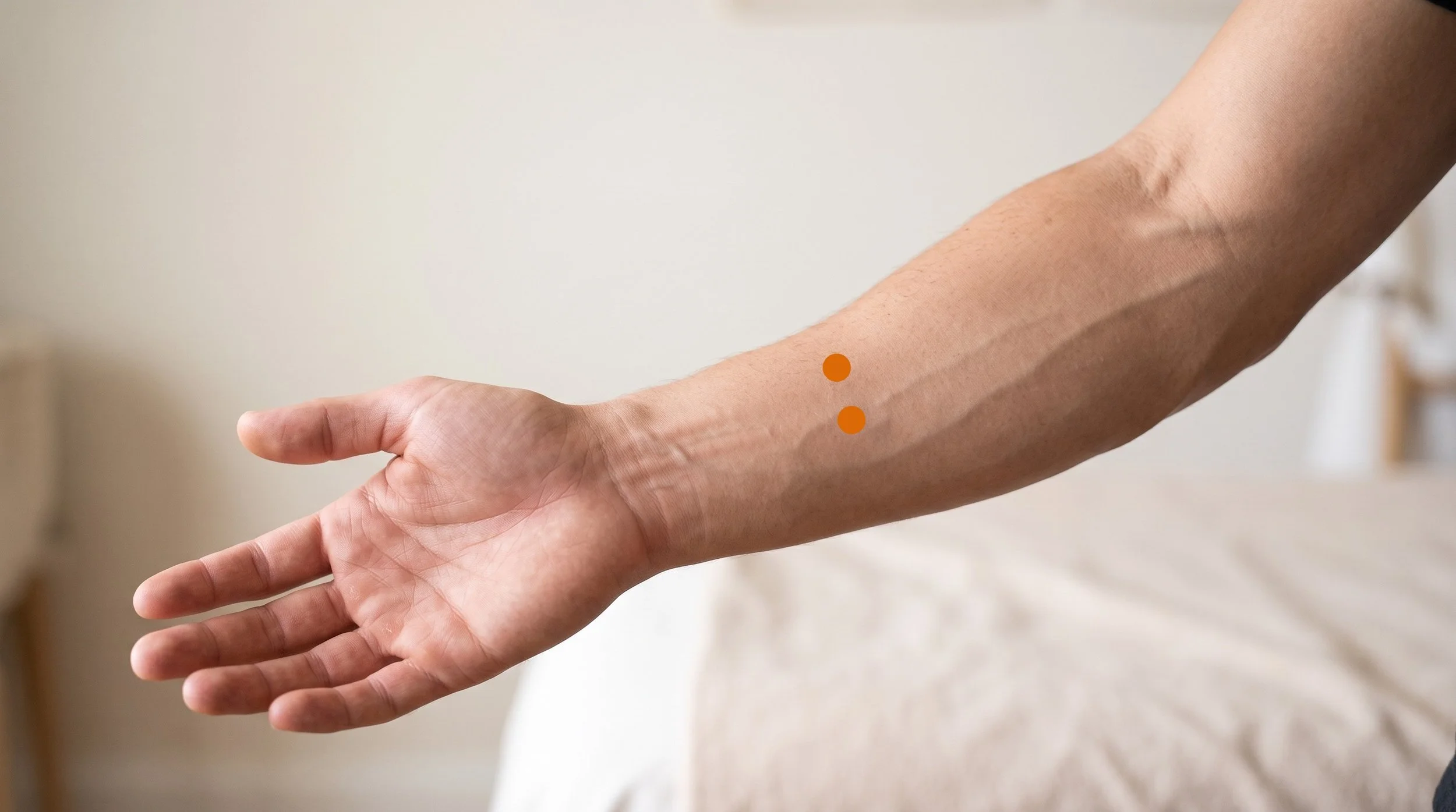
Erbai Acupuncture Point (M-UE-29)
The Two Whites of the Mid Forearm: Anatomy, Mechanism, and Why a Wrist-Level Point Pair Became the Classical Choice for Hemorrhoids
Erbai (M-UE-29), whose name is usually translated as Two Whites, is not one point but two, sitting side by side on the palm side of the forearm about a third of the way up from the wrist crease toward the elbow, one on each edge of the flexor carpi radialis tendon. It is an extra point, meaning it sits outside the fourteen main channels and earned its place in the literature by reputation rather than by channel logic.
What makes the Erbai acupuncture point interesting is the mismatch between where it is and what it was used for: a forearm location, classically indicated for hemorrhoids, rectal prolapse, anal itching, and tenesmus. That distance is exactly why the point still shows up in modern anorectal surgery research, where a needle in the forearm is easy to place, easy to keep sterile, and nowhere near a painful surgical field.
- Erbai is a paired extra point (m-ue-29) located 4 cun proximal to PC7 on the flexor forearm, with one needle on the radial side and one on the ulnar side of the flexor carpi radialis tendon. Standard needling is perpendicular 0.5 to 1 cun, or oblique up the forearm 1 to 1.5 cun.
- Classical texts assign this point a narrow and unusual job: hemorrhoids, prolapse of the rectum, anal itching, tenesmus, and blood in the stool, with later Chinese sources also listing forearm neuralgia. These are traditional attributions, not diagnoses, and rectal bleeding always needs medical evaluation first.
- Beneath the two needle sites lie skin, the antebrachial fascia, the tendons of flexor carpi radialis and (when present) palmaris longus, and the flexor digitorum superficialis muscle belly, with the median nerve running deep in the corridor between the paired points.
- Because the forearm is innervated from the lower cervical segments and the anal canal from the sacral segments, this point cannot work by shared spinal segment. The plausible mechanism is extrasegmental: recruitment of A-delta afferents that engage descending inhibitory pathways and endogenous opioid systems (Zhao, 2008).
- Stimulation of Erbai together with BL57 after hemorrhoid surgery has been reported to change pain scores, anxiety scores, and some heart rate variability measures, which fits an autonomic component rather than a purely local one (Yeh et al., 2018). A systematic review found Erbai was among the most frequently selected points in acupuncture trials for post-hemorrhoidectomy pain (Chen et al., 2022).
- De qi here is usually a dull, spreading fullness in the forearm that may travel toward the palm or up toward the elbow. A sharp electric line into the fingers means the needle is too close to the median nerve and should be withdrawn and redirected.
Dealing With Anal Pain, Straining, or Post-Surgical Discomfort?
Anorectal symptoms are common, uncomfortable to talk about, and often left untreated for far too long. At Morningside Acupuncture we use distal points like Erbai alongside BL57 and DU1-region work, plus autonomic and digestive support, as part of a conservative plan that runs alongside your colorectal care rather than replacing it. Treatment is discreet, comfortable, and takes place fully clothed apart from the forearms and lower legs. Schedule a visit and let's put together a plan that fits your situation.
Schedule NowAnatomy of Erbai: Why the Flexor Carpi Radialis Tendon at Mid Forearm Is Such an Important Location
Ask someone to flex the wrist against light resistance and two cords usually stand up on the palm side: flexor carpi radialis toward the thumb side and palmaris longus in the middle, though palmaris longus is absent in a meaningful minority of people. Erbai straddles the flexor carpi radialis cord at the junction of the distal third and proximal two thirds of the forearm, so the ulnar point of the pair falls in the groove between the two tendons and the radial point falls just to the thumb side of flexor carpi radialis.
From the surface down, a needle passes skin, thin subcutaneous tissue, the antebrachial fascia, then the tendinous and muscular fibers of flexor carpi radialis, flexor digitorum superficialis, and, deeper still, flexor digitorum profundus. This is loaded tissue: gripping, wrist flexion, keyboard and mouse work, and racquet or club sports all pull through this exact corridor, which is why the area is frequently tender even in people with no forearm complaint.
The nerve geography is the reason this location deserves respect. Cutaneous supply comes from the medial and lateral antebrachial cutaneous nerves, the deeper muscles are served by the median nerve (with the ulnar nerve supplying flexor carpi ulnaris and part of flexor digitorum profundus), and the median nerve trunk itself runs in the plane between flexor digitorum superficialis and profundus, effectively passing between the two Erbai needles.
Needling here activates A-delta and C fibers and muscle spindle afferents that project to the lower cervical cord, and this afferent barrage is the recognized starting point for acupuncture analgesia through spinal gating and descending control from the periaqueductal gray and rostral ventromedial medulla (Zhao, 2008). Because the anal canal is supplied from sacral segments, none of that overlap is segmental, so any effect on anorectal symptoms has to travel through supraspinal and autonomic routes rather than a shared spinal level.
Vascular structures are close but avoidable. The radial artery lies lateral to the flexor carpi radialis tendon in the distal forearm and becomes more superficial as it approaches the wrist, and a persistent median artery is a recognized anatomical variant in this corridor, so the radial point is angled to hug the tendon rather than drifting laterally. Conventional depth is perpendicular insertion of 0.5 to 1 cun or oblique proximal insertion of 1 to 1.5 cun, which keeps the needle in muscle and tendon sheath rather than in the neurovascular plane.
Moxibustion is described as applicable at this point in Chinese textbook sources, and when electroacupuncture is used, current is set below the level that produces radiating paresthesia into the hand.
Related Flexor Carpi Radialis Trigger Points Related Flexor Digitorum Superficialis Trigger PointsErbai at a Glance: Classification, Location, and Clinical Use
| Category | Detail |
|---|---|
| Traditional Name | Erbai (Two Whites), M-UE-29, also numbered EX-UE 2 in modern Chinese texts |
| Channel Classification | Extra point of the upper extremity, outside the fourteen channels, though the ulnar member of the pair sits on the line of the Pericardium channel between the flexor carpi radialis and palmaris longus tendons |
| Point Categories | No five-shu, luo, xi-cleft, hui-meeting, or extraordinary vessel designation. Erbai is classified as a paired extra point and an empirical point, meaning its reputation rests on recorded clinical results rather than channel theory, with a single traditional action stated in the classical literature: to treat hemorrhoids and prolapse of the rectum. |
| Precise Location | Palm side of the forearm, 4 cun proximal to PC7 at the wrist crease, at the junction of the distal third and proximal two thirds of the line from the wrist crease to the cubital crease. Two points: one on the ulnar side of the flexor carpi radialis tendon (between it and palmaris longus when present) and one on its radial side. |
| Tissue Stimulated | Skin and antebrachial fascia, the tendon of flexor carpi radialis, the tendon of palmaris longus when present, the muscle belly of flexor digitorum superficialis, and at depth flexor digitorum profundus, with the median nerve running in the plane between the paired points |
| Needle Depth / Direction | Perpendicular insertion 0.5 to 1 cun, or oblique insertion angled proximally up the forearm 1 to 1.5 cun. Both members of the pair are typically needled, and treatment is often bilateral. Moxibustion is described as applicable in Chinese textbook sources. |
| De Qi Sensation | A dull, heavy, spreading distension in the mid forearm, sometimes traveling toward the palm or proximally toward the elbow. Brief soreness at insertion is common. A sharp electric sensation into the fingers indicates median nerve proximity and calls for withdrawal and redirection. |
| Primary Clinical Uses | Traditionally used for hemorrhoids including bleeding types, rectal prolapse, anal itching, tenesmus, and blood in the stool (a symptom that always warrants medical evaluation). Modern research use centers on pain after hemorrhoid surgery. Chinese sources also list forearm neuralgia, and the location overlaps common wrist flexor trigger point territory. |
| Common Point Combinations |
|
Deadman, Al-Khafaji and Baker's A Manual of Acupuncture places the first appearance of this point in the Classic of the Jade Dragon and notes that it has been used for hemorrhoids and rectal prolapse ever since, giving it a single traditional action and a short indication list built around the anus and rectum: hemorrhoids, prolapse, itching, tenesmus, and blood in the stool.
The Great Compendium of Acupuncture and Moxibustion preserves two groupings that show how it was actually deployed, one for long-standing hemorrhoids with BL57 and DU1, and one for prolapse with DU20, BL52, and DU1, so the forearm pair was never meant to work alone. Shanghai-lineage textbooks repeat the same anorectal indications and add forearm neuralgia, while Cunningham's teaching text uses Erbai as its textbook example of an empirical point, one that survived on results rather than on channel reasoning.
What is striking is the specificity: most points accumulate long, sprawling indication lists over the centuries, and this one stayed stubbornly narrow, which is usually a sign that a point was kept for one job it seemed to do well.
Why Erbai Is Used for Hemorrhoids and Anal Pain, a Problem at the Opposite End of the Body
The honest starting point is that Erbai cannot work the way most local points do. The mid forearm is supplied by lower cervical spinal segments, while the anal canal and lower rectum are supplied from sacral levels through the pudendal nerve and pelvic autonomics. There is no shared spinal segment to converge on, so any effect has to be extrasegmental.
That is a real and well-described category in pain science: strong afferent input from one body region can raise pain thresholds elsewhere by engaging brainstem descending inhibition and endogenous opioid release, a mechanism repeatedly demonstrated in acupuncture analgesia research (Zhao, 2008). Practitioners have long chosen distant points for this reason, and large individual patient data analyses of chronic pain trials show that acupuncture produces effects that exceed both no-treatment and sham controls, though the differences from sham are modest (Vickers et al., 2018).
There is also an autonomic thread. A randomized trial applying transcutaneous electrical stimulation at Erbai and BL57 after hemorrhoidectomy reported differences in pain and anxiety scores along with changes in some heart rate variability parameters, which is consistent with a shift in sympathetic and parasympathetic balance rather than a purely local analgesic effect (Yeh et al., 2018). That matters clinically, because anal pain after surgery or during a hemorrhoid flare is amplified by sphincter guarding, and sphincter tone is autonomically driven.
Animal work is beginning to probe these routes directly: electroacupuncture in a post-hemorrhoidectomy pain model has been linked to muscarinic receptor and calcium signaling changes with measurable effects on anal sphincter resting pressure (Song et al., 2024), and a separate rat model reported reduced peripheral P2X7 and ERK signaling in dorsal root ganglion tissue after acupuncture (Chen et al., 2026).
None of this makes Erbai a treatment for hemorrhoidal disease itself. Hemorrhoids are vascular cushions that have become engorged, prolapsed, or inflamed, and needling does not shrink tissue or reverse a prolapse. What the current evidence supports, cautiously, is symptom modulation: less pain, less guarding, and possibly less anxiety around a flare or a procedure, layered on top of the fiber, hydration, toilet habit, and medical or surgical care that actually addresses the underlying problem. Bleeding, a change in bowel habit, or a lump that will not reduce belongs with a physician first.
What the Research Shows for Erbai
Very little research isolates Erbai on its own. Almost every study uses it inside a multi-point protocol, most often with BL57 and DU1, and almost all of that work sits in the postoperative setting rather than in the management of untreated hemorrhoids. Sample sizes are small, most trials come from a single country, blinding is difficult with needling, and adverse event reporting is inconsistent, so the findings below should be read as encouraging signals about a protocol rather than proof about a point. Where mechanism studies exist, they are largely animal work and cannot be read as clinical outcomes.
| Study | Type | Focus | Key Finding |
|---|---|---|---|
| Chen et al., 2022 | Systematic review of randomized controlled trials | Acupuncture for pain after hemorrhoidectomy | Across four small trials the reviewers found suggestive benefit for postoperative pain and identified Erbai as one of the most frequently selected points alongside BL57, DU1, and LI4, while cautioning that study quality and reporting were limited. |
| Du et al., 2022 | Meta-analysis of randomized controlled trials | Electroacupuncture for postoperative pain in mixed hemorrhoids | Pooling five Chinese trials with 465 patients, electroacupuncture groups reported lower pain scores than controls at several early postoperative time points, with the authors noting the need for higher quality replication. |
| Wu et al., 2018 | Single-center randomized controlled trial | Electroacupuncture after hemorrhoidectomy for mixed hemorrhoids | Electroacupuncture was associated with improved postoperative pain outcomes compared with control care, in a single-blind design that limits how far the result can be generalized. |
| Yeh et al., 2018 | Randomized controlled trial with repeated measures | Transcutaneous stimulation at Erbai and BL57 after hemorrhoidectomy | The stimulated group showed differences in pain and anxiety scores and in some heart rate variability parameters, suggesting an autonomic component, though the absence of a sham arm weakens the inference. |
| Song et al., 2024 | Animal mechanistic study | Electroacupuncture and post-hemorrhoidectomy anal pain signaling | Electroacupuncture was associated with reduced pain sensitivity, altered anal sphincter resting pressure, and changes in muscarinic receptor and calcium signaling markers, findings that are preclinical and not directly transferable to patients. |
| Chen et al., 2026 | Animal mechanistic study | Acupuncture in a rat model of mixed hemorrhoid surgery | Acupuncture reduced pain-related and depressive-like behaviors and suppressed peripheral P2X7 and ERK signaling with lower inflammatory cytokine levels, offering a plausible peripheral mechanism that still requires clinical confirmation. |
| Vickers et al., 2018 | Individual patient data meta-analysis | Acupuncture for chronic pain across 39 trials | Acupuncture outperformed both sham and no-acupuncture controls for chronic pain conditions, with effects that persisted over time but with modest differences from sham. |
| Zhao, 2008 | Narrative review of mechanism research | Neural mechanisms of acupuncture analgesia | Analgesic effects are attributed to afferent fiber activation, spinal segmental inhibition, descending control from brainstem nuclei, and endogenous opioid and monoamine release, which supports a plausible route for distal points. |
Forearm Pain, Median Nerve Irritation, or Grip Problems?
The same stretch of forearm that holds Erbai is prime territory for flexor tendon overload and median nerve irritation from typing, lifting, and racquet sports. Our acupuncturists combine point-based needling with dry needling of the flexor carpi radialis and flexor digitorum superficialis, then add loading and mobility work so the change holds. Every session includes a hands-on assessment so we treat the tissue that is actually driving your symptoms. Book an appointment and get a clear answer about your forearm.
Schedule NowErbai in the Context of Trigger Point Work
Acupuncture, as we define it, is the use of an acupuncture needle, and that includes the hundreds of styles practiced worldwide as well as dry needling. That framing matters at Erbai, because the two classical needle sites sit directly on top of tissue that trigger point clinicians target for entirely different reasons. Flexor carpi radialis and flexor digitorum superficialis are common sources of referred forearm, wrist, and hand pain in gripping athletes and desk workers, and taut bands in these muscles are described in the Travell and Simons manual as referring toward the wrist and palm (Simons et al., 1999). Chinese sources also list forearm neuralgia among the point's indications, so the overlap is not a modern invention.
In practice, our clinicians decide what the needle is for before it goes in. If the goal is distal modulation for anorectal symptoms, we use the classical pair with light to moderate stimulation and often pair it with BL57. If the goal is the forearm itself, we palpate for taut bands and tender nodules in flexor carpi radialis, flexor digitorum superficialis, and flexor digitorum profundus, needle those directly, and follow with loading, nerve gliding where median nerve irritation is suspected, and ergonomic changes. Because the median nerve runs deep in this corridor, we work with a clear depth plan and stop advancing if a sharp radiating sensation appears.
Erbai Hemorrhoid and Anorectal Support at NYC's Highest-Rated Acupuncture Clinic
Morningside Acupuncture is the highest-rated acupuncture and dry needling clinic in New York City with over 500 five-star Google reviews, and our Upper West Side practice treats digestive and pelvic complaints with the same rigor we bring to sports injuries. We use the Erbai hemorrhoid point within a broader plan that may include BL57, sacral points, vagal and breathing work, and practical bowel habit coaching. Everything is explained in plain language, and we tell you when a referral is the right next step. Schedule your first session today.
Schedule NowFrequently Asked Questions
What does Erbai feel like when needled?
Most people notice a brief pinch at the skin, then a dull, heavy fullness in the middle of the forearm that can spread toward the palm or up toward the elbow. Because both points of the pair are usually needled, the sensation often feels like a band across the forearm rather than a single spot. Mild aching for a few minutes after the needles come out is normal. What is not expected is a sharp electric shock shooting into the fingers, which suggests median nerve proximity and should prompt your acupuncturist to withdraw and redirect the needle immediately.
Why treat hemorrhoids with a point on the forearm instead of a local point?
Partly tradition and partly practicality. The classical literature simply recorded that this pair helped, and the Great Compendium groupings pair it with points closer to the target such as BL57 and DU1, so it was always meant to be part of a combination rather than a standalone. Physiologically, the forearm and the anal canal share no spinal segment, so the plausible route is extrasegmental: strong afferent input from the forearm engaging descending inhibitory systems and endogenous opioid release rather than a local reflex (Zhao, 2008). Practically, a distal point is comfortable to needle when the area of complaint is inflamed, painful, or recently operated on, which is exactly why modern trials of postoperative anal pain keep using it (Chen et al., 2022).
Can I press Erbai myself between sessions?
Yes, acupressure here is straightforward and low risk. Rest your forearm palm up, find the wrist crease, then move about one third of the way toward the elbow crease, roughly four finger-widths plus a little more above the wrist. Locate the cord of flexor carpi radialis by flexing your wrist against your other hand, then use your thumb to press firmly just to one side of that cord for 30 to 60 seconds, aiming for a deep ache rather than sharpness. Switch to the other side of the tendon and repeat, then do the same on the opposite forearm. Two or three rounds, once or twice a day, is plenty. Stop immediately if you feel tingling or electric sensation into the fingers, and treat this as comfort support rather than treatment for the underlying condition.
Is Erbai safe to needle?
In trained hands it is a low-risk point, but it is not a casual one. The median nerve runs deep in the corridor between the two needle sites and the radial artery lies lateral to the flexor carpi radialis tendon, so depth and angle matter. Standard practice is perpendicular insertion of 0.5 to 1 cun or oblique proximal insertion of 1 to 1.5 cun, keeping the needle in tendon and muscle rather than probing deep between the flexor layers. Electroacupuncture should be kept below the intensity that produces radiating paresthesia. Reported adverse events in hemorrhoid-related trials have generally been minor, though reporting was inconsistent across studies (Chen et al., 2022). Anyone with rectal bleeding, a change in bowel habit, or a persistent lump should be evaluated by a physician before or alongside acupuncture.
Where exactly is Erbai located?
On the palm side of the forearm, 4 cun above the wrist crease at PC7. The simplest way to find it is to divide the distance between the wrist crease and the elbow crease into thirds and mark the junction of the lower third and the upper two thirds. At that level, identify the flexor carpi radialis tendon by resisting wrist flexion: it is the cord on the thumb side. One point of the pair sits just on the ulnar side of that tendon, in the groove between it and palmaris longus when palmaris longus is present, and the other sits just on the radial side. Both are needled, and treatment is commonly done on both arms.
References
- Deadman, P., Al-Khafaji, M., & Baker, K. (2009). A manual of acupuncture. Journal of Chinese Medicine Publications.
- O'Connor, J., & Bensky, D. (Eds. & Trans.). (1981). Acupuncture: A comprehensive text. Shanghai College of Traditional Medicine. Eastland Press.
- Cheng, X. (Ed.). (1999). Chinese acupuncture and moxibustion (Rev. ed.). Foreign Languages Press.
- Cunningham, P. M. (2000). Acupuncture points: A practical guide to classical and modern usage. Odyssey Press.
- Simons, D. G., Travell, J. G., & Simons, L. S. (1999). Travell & Simons' myofascial pain and dysfunction: The trigger point manual, Vol. 1: Upper half of body (2nd ed.). Williams & Wilkins.
- Chen, H., Zhang, W., Sun, Y., Jiao, R., & Liu, Z. (2022). The role of acupuncture in relieving post-hemorrhoidectomy pain: A systematic review of randomized controlled trials. Frontiers in Surgery, 9, 815618. https://doi.org/10.3389/fsurg.2022.815618
- Du, B., Xu, Z., & Zhong, X. (2022). Electroacupuncture for postoperative pain in mixed hemorrhoids: A meta-analysis. Medicine, 101(50), e32247. https://doi.org/10.1097/MD.0000000000032247
- Wu, J., Chen, B., Yin, X., Yin, P., Lao, L., & Xu, S. (2018). Effect of acupuncture on post-hemorrhoidectomy pain: A randomized controlled trial. Journal of Pain Research, 11, 1489-1496. https://doi.org/10.2147/JPR.S166953
- Yeh, M. L., Chung, Y. C., Hsu, L. C., & Hung, S. H. (2018). Effect of transcutaneous acupoint electrical stimulation on post-hemorrhoidectomy-associated pain, anxiety, and heart rate variability: A randomized-controlled study. Clinical Nursing Research, 27(4), 450-466. https://doi.org/10.1177/1054773816685745
- Song, Y., Wang, Y., Li, M., Wang, Y., & Xu, T. (2024). Exploration of the mechanism underlying the therapeutic effect of electroacupuncture at chengshan acupoint on post-hemorrhoidectomy anal pain: Insights from the mAChRs/IP3-Ca2+-CaM signaling pathway. Clinics, 79, 100485. https://doi.org/10.1016/j.clinsp.2024.100485
- Chen, B., Wang, T., Gao, J., Chen, Y., Chang, H., Shu, Y., Zhang, Y., Li, J., & Ma, G. (2026). Acupuncture alleviates postoperative hemorrhoid pain by modulating the P2X7/ERK pathway. Purinergic Signalling, 22(1), 6. https://doi.org/10.1007/s11302-025-10115-5
- Vickers, A. J., Vertosick, E. A., Lewith, G., MacPherson, H., Foster, N. E., Sherman, K. J., Irnich, D., Witt, C. M., & Linde, K. (2018). Acupuncture for chronic pain: Update of an individual patient data meta-analysis. Journal of Pain, 19(5), 455-474. https://doi.org/10.1016/j.jpain.2017.11.005
- Zhao, Z. Q. (2008). Neural mechanism underlying acupuncture analgesia. Progress in Neurobiology, 85(4), 355-375. https://doi.org/10.1016/j.pneurobio.2008.05.004
Disclaimer: This web site is intended for educational and informational purposes only. Reading this website does not constitute providing medical advice or any professional services. This information should not be used for diagnosing or treating any health issue or disease. Those seeking medical advice should consult with a licensed physician. Seek the advice of a medical doctor or other qualified health professional for any medical condition. If you think you have a medical emergency, call 911 or go to the emergency room. No acupuncturist-patient relationship is created by reading this website or using the information. Morningside Acupuncture PLLC and its employees and contributors do not make any express or implied representations with respect to the information on this site or its use. For any legal interpretation of scope of practice in your state, consult a licensed attorney or regulatory authority.
Read more from our blog



