Sifeng Acupuncture Point (M-UE-9)
The Four Seams of the Fingers: Anatomy, Mechanism, and Why This Extra Point Grouping Became the Classical Pediatric Digestive Prescription
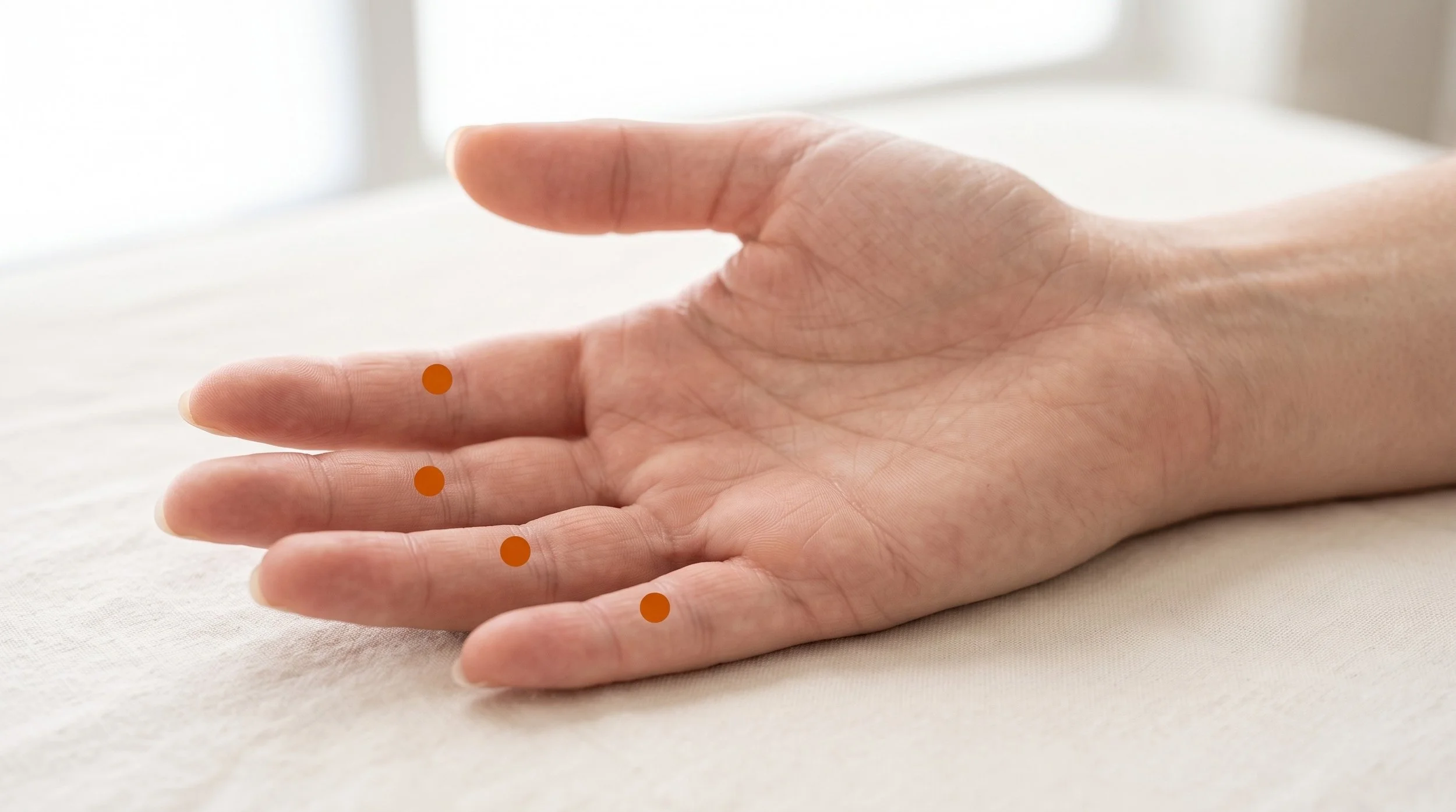
Sifeng (M-UE-9), usually translated as Four Seams or Four Cracks, is not a single point but a set of four small sites on the palm side of each hand, sitting at the midpoint of the crease of the middle knuckle joint of the index, middle, ring and little fingers. It belongs to the extra points, the group of named locations that sit outside the fourteen main channels, and modern texts often list it as EX-UE-10.
What makes the Sifeng acupuncture point grouping distinctive is not where it sits but what it was classically used for: generations of Chinese pediatric practice treated these finger creases as the standard site for children with poor appetite, sluggish digestion, weight that would not climb, and the pattern texts call food accumulation. The technique is equally distinctive, since Sifeng is pricked quickly with a fine lancet or three-edged needle rather than needled and retained, with a drop of blood or a small bead of clear yellowish fluid expressed afterward.
- Location and layers: Sifeng sits on the palmar surface at the transverse crease of the proximal interphalangeal joint of the four fingers, over thin glabrous skin, the fibrous flexor tendon sheath, and a dense field of digital nerve endings (Deadman et al., 2009; Cheng, 1999). Where two creases are visible, the classical instruction is to use the one that stands out more when the finger is flexed.
- Traditional categories, restated: the classical actions are described as strengthening the Spleen and dispersing accumulation, which in modern language means the point was used for functional digestive complaints in children rather than for structural disease of the hand (Deadman et al., 2009).
- Mechanism: the fingertip and finger crease region carries an unusually high density of small-diameter afferents, and limb stimulation of this kind can recruit somato-autonomic reflex pathways that modulate gastrointestinal motility and secretion through vagal and sympathetic outflow (Ma, 2020; Zhao, 2008).
- Research picture: a systematic review of 24 randomized trials in 2,202 children reported better outcomes with pricking at Sifeng compared with medication alone, but the authors rated overall certainty as low because of blinding and reporting problems (Chen et al., 2023). A broader review of acupuncture for childhood anorexia reached a similar cautious conclusion (Lee et al., 2022).
- Safety framing: a systematic review of pediatric acupuncture found that most reported adverse events were mild, such as brief pain, crying, or minor bruising, when treatment was delivered by properly trained practitioners (Adams et al., 2011).
- De qi: because this is a quick pricking technique, there is no retained dull ache. Patients feel a brief sharp pinch lasting a second or two, followed by a small drop of blood or clear yellow-white fluid and a fading soreness at the crease.
Struggling With Poor Appetite, Bloating, or Sluggish Digestion?
Digestive complaints rarely respond to a single point, and Sifeng is best understood as one member of a wider treatment plan. At Morningside Acupuncture we build digestive protocols around abdominal and lower limb points, breathing work that shifts autonomic tone, and hands-on assessment of the abdominal wall. If food feels heavy, appetite is unreliable, or bloating follows most meals, book a visit and we will map out what may help.
Schedule NowAnatomy of Sifeng: Why the Finger Creases Are Such an Important Location
Sifeng lies on the palm side of the hand at the crease of the middle knuckle joint, the proximal interphalangeal joint, on the index, middle, ring and little fingers. The tissue there is shallow and highly organized: thick glabrous skin anchored by fibrous septa, a thin layer of subcutaneous tissue, and immediately beneath that the fibrous flexor tendon sheath that holds the flexor digitorum superficialis and profundus tendons against bone. There is no muscle belly at this location and almost no fat, which is precisely why the classical instruction is to prick rather than insert and retain. Most people show two creases at this joint, and the texts direct the practitioner to use whichever crease deepens on flexion (Deadman et al., 2009).
The nerve supply here is what makes the site interesting. Each finger is served by paired palmar digital nerves, branches of the median nerve for the index and middle fingers and of the ulnar nerve for the little finger and part of the ring finger, and the palmar digital field is one of the most densely innervated areas of the body surface. Brief, intense stimulation of small-diameter afferents in the hand activates spinal and brainstem circuits, which can engage descending inhibitory pathways and shift autonomic outflow rather than acting locally on tissue (Zhao, 2008).
Reviews of somato-autonomic reflex research describe how the body region stimulated, and the intensity used, help determine whether sympathetic or parasympathetic pathways to the gut are recruited, with limb stimulation more likely to drive vagal responses (Ma, 2020). That framework offers a plausible explanation for why a point on the finger was traditionally chosen for a digestive complaint, without any need to invoke literal energy travelling up the arm.
Deep to the point sit the flexor tendons within their sheath, the volar plate of the joint, and the paired digital arteries running alongside the digital nerves at the sides of the finger rather than in the midline. Sticking to the midpoint of the crease keeps the technique away from the neurovascular bundles.
Standard practice is a rapid, superficial prick with a sterile single-use lancet or three-edged needle, followed by gentle squeezing to express a drop of blood or a small amount of clear yellow-white fluid; published trials describe depths on the order of a millimetre or so with no needle retention (Deadman et al., 2009; Chen et al., 2023). Clean-needle technique, a firm grip on the finger, and a short explanation to the patient before the prick are the practical requirements.
Related Spleen Channel Related Stomach ChannelSifeng at a Glance: Classification, Location, and Clinical Use
| Category | Detail |
|---|---|
| Traditional Name | Sifeng, commonly rendered as Four Seams or Four Cracks |
| Channel Classification | Extra point (non-channel) grouping, coded M-UE-9 in Deadman's system and EX-UE-10 in most modern texts |
| Point Categories | Extra point grouping of four bilateral sites on the fingers; no five-shu, mu, shu, or extraordinary vessel designation is attributed to it in the classical literature. Traditional actions are given as strengthening the Spleen and dispersing accumulation, with a classical reputation confined largely to pediatric digestive patterns (Deadman et al., 2009). |
| Precise Location | Palmar surface of the hand, at the midpoint of the transverse crease of the proximal interphalangeal joint of the index, middle, ring and little fingers. Where two creases are present, use the one that becomes more prominent when the finger is flexed. |
| Tissue Stimulated | Glabrous palmar skin of the finger crease, superficial fascia, and the fibrous flexor tendon sheath overlying the flexor digitorum superficialis and flexor digitorum profundus tendons, within the palmar digital nerve field |
| Needle Depth / Direction | Quick perpendicular prick to bleed, roughly 0.1 to 0.2 cun (about 1 to 5 mm), using a sterile lancet or three-edged needle; the finger is then squeezed to express a drop of blood or clear yellow-white fluid. No needle retention and no manipulation. |
| De Qi Sensation | Not a classic de qi point. Expect a brief sharp pinch of a second or two, a small bead of blood or clear yellowish fluid, and mild residual tenderness at the crease that settles quickly. |
| Primary Clinical Uses | Traditionally used for childhood nutritional impairment and food accumulation patterns, poor appetite, childhood diarrhea, and whooping cough alongside standard medical care; occasionally listed in older texts within hand and finger joint prescriptions |
| Common Point Combinations |
|
Deadman's Manual of Acupuncture presents Sifeng as one of the most heavily used extra point groupings in classical Chinese pediatrics, with its traditional actions given as strengthening the Spleen and dispersing accumulation. Two traditional patterns dominate the entry. The first is childhood nutritional impairment, a picture built from thinness, a dull or sallow complexion, poor digestion, dry brittle hair, low energy, and a distended belly, which in historical terms covered a range of malnutrition presentations.
The second is childhood accumulation disorder, roughly the pediatric version of adult food stagnation, which classical authors treated as an upstream cause of constipation, abdominal pain, vomiting, diarrhea, intestinal parasites, and even cough and wheezing (Deadman et al., 2009). Chinese textbooks add whooping cough to the indication list, always as an adjunct to medical care (Cheng, 1999).
What is striking is how narrow and consistent the classical reputation is: rather than accumulating a sprawling indication list over the centuries, Sifeng stayed tied to one clinical territory, the digestive complaints of children, and to one technique, the quick prick.
Why Sifeng Is Used for Appetite and Digestion Instead of Hand Complaints
The first question most patients ask is why a point on the finger would have anything to do with the stomach. The honest answer is that the classical rationale and the modern one are different arguments that happen to point the same direction.
Classically, the fingers were seen as the terminal territory of channels linked to the digestive organs, so treating them was treating the system. In neurophysiological terms, the finger creases are among the most densely innervated skin on the body, and brief high-intensity input from that region reaches the spinal cord and brainstem, where it can engage descending inhibitory pathways and alter autonomic outflow to viscera that share no local anatomy with the hand at all (Zhao, 2008).
Research on somato-autonomic reflexes gives that idea more shape. Stimulating different body regions recruits different autonomic pathways, and limb stimulation in particular has been shown to drive vagal reflexes capable of changing gastrointestinal motility, whereas abdominal stimulation tends to drive sympathetic, motility-inhibiting responses (Ma, 2020).
Appetite and gut motility are also under hormonal control, and small Chinese trials have measured changes in appetite-related markers such as leptin after pricking at Sifeng, though these findings sit in small samples with methodological limits and should be treated as preliminary rather than settled (Chen et al., 2023; Zhang & Chen, 2021).
Clinically, this means Sifeng is best framed as a functional intervention, not a nutritional one. It may help a child who is eating poorly for no identified medical reason, as part of a plan that includes proper pediatric evaluation, feeding guidance, and treatment of any underlying condition. It does not replace medical assessment for weight loss, growth faltering, persistent diarrhea, or suspected pertussis, all of which need a physician's care first.
What the Research Shows for Sifeng
Sifeng is one of the few extra points that has been studied more or less on its own terms, since Chinese pediatric trials frequently test pricking at Sifeng against or alongside medication rather than burying it in a large multi-point protocol. That is a genuine advantage for interpreting the literature, but it comes with a large caveat: nearly all of this research was conducted in China, blinding a pricking technique is close to impossible, and reviewers have consistently rated risk of bias as high or unclear.
The reasonable reading is that the signal is positive and the certainty is low, and that Sifeng should be presented to families as a traditional adjunct with encouraging but preliminary support rather than as an established treatment.
| Study | Type | Focus | Key Finding |
|---|---|---|---|
| Chen et al., 2023 | Systematic review and meta-analysis (24 RCTs, 2,202 children) | Pricking at Sifeng (EX-UE 10) for pediatric anorexia | Pooled results favored Sifeng over medication across appetite, weight and biochemical outcomes, but the authors graded the certainty of evidence as low and called for higher-quality trials. |
| Lee et al., 2022 | Systematic review and meta-analysis (32 RCTs, 3,518 participants) | Acupuncture for childhood anorexia, with Sifeng the most frequently used point | Acupuncture may improve anorexia symptoms and reduce recurrence without serious adverse events, though nutritional index results were inconsistent and evidence quality was low to moderate. |
| Zhang & Chen, 2021 | Randomized controlled trial (64 children) | Spinal pinching plus pricking at Sifeng added to Chinese herbal treatment for pediatric anorexia | The combined group showed greater changes in body mass index and appetite-related and trace element measures than herbs alone, in a small single-center sample. |
| Adams et al., 2011 | Systematic review of safety data | Adverse events associated with needle acupuncture in children | Most reported adverse events were mild, supporting the view that pediatric acupuncture is reasonably safe when performed by appropriately trained practitioners. |
| Ma, 2020 | Narrative review of mechanism research | Somato-autonomic reflexes and body region specificity | Somatic stimulation can drive distinct autonomic pathways affecting gastrointestinal motility, with effects depending on the region stimulated and the intensity used. |
Curious About Extra Points and How They Fit Into Modern Practice?
Points like Sifeng sit outside the classical channel system, and understanding them means separating what the old texts claimed from what nerves and reflexes can plausibly explain. Our clinicians walk patients through that distinction at every visit, so you know what a technique may reasonably do and what it will not do. Schedule a consultation and bring your questions.
Schedule NowSifeng in the Context of Trigger Point Work
Sifeng has no myofascial trigger point of its own, since there is no muscle belly at the finger crease, but the location sits directly over the flexor tendons as they pass through their sheath, and those tendons are driven by muscles well upstream in the forearm. Trigger points in flexor digitorum superficialis and flexor digitorum profundus are described as referring pain into the fingers along the digits they serve, and flexor carpi radialis and flexor carpi ulnaris can contribute to wrist and hand aching that patients localize distally (Simons, Travell, & Simons, 1999).
When an adult presents with finger and hand symptoms rather than digestive complaints, the useful clinical move is to look proximally at the forearm rather than at the crease itself.
At Morningside Acupuncture we treat hand and grip complaints by needling the forearm flexor and extensor groups where taut bands and reproducible referral are found, then adding gentle work around the digital pulleys and intrinsic hand muscles as tolerated. Sifeng may still be pricked in that context in traditional practice, and older Chinese texts do list it within hand and finger joint prescriptions, but the mechanical driver of most finger pain is muscular and tendinous, not cutaneous.
For digestive cases in adults, the trigger point overlap moves to the abdominal wall, where oblique and rectus abdominis referral can mimic visceral discomfort and is worth assessing before assuming the symptoms are purely gut-driven.
Sifeng Digestive Treatment at NYC's Highest-Rated Acupuncture Clinic
Morningside Acupuncture is the highest-rated acupuncture and dry needling clinic in New York City with over 500 five-star Google reviews, and our approach pairs classical point knowledge with current pain science and physiology. For digestive complaints we combine channel-based points, abdominal palpation, and dry needling of the abdominal wall and forearm musculature when it is relevant. Book an appointment on the Upper West Side and we will build a plan around your presentation.
Schedule NowFrequently Asked Questions
What does Sifeng feel like when needled?
Unlike most acupuncture points, Sifeng is not needled and left in place, so there is no lingering heavy or spreading de qi sensation. The practitioner uses a sterile lancet or three-edged needle for a rapid superficial prick at the finger crease, which feels like a brief sharp pinch lasting a second or two, similar to a finger-stick blood test. The finger is then squeezed gently to express a drop of blood or a small bead of clear yellow-white fluid. Mild tenderness at the crease can linger for a few minutes and usually resolves the same day.
Why treat a digestive problem at a point on the finger?
Two answers apply. In classical terms, the fingers were understood as the far end of channel pathways connected to the digestive organs, so treating there was treating the whole system, and Deadman's text records Sifeng's traditional actions as strengthening the Spleen and dispersing accumulation (Deadman et al., 2009). In neurophysiological terms, the finger creases carry an unusually dense supply of small-diameter afferents, and brief intense input from the hand reaches the spinal cord and brainstem where it can shift autonomic outflow to the gut and engage descending inhibitory pathways (Zhao, 2008; Ma, 2020). Neither explanation requires the idea that something physically travels from finger to stomach.
Can I press Sifeng myself between sessions?
Yes, and pressure is the only version of this point that belongs in home care, since pricking should be left to a trained clinician. Turn the hand palm up and find the crease of the middle knuckle joint on the index finger, then place your opposite thumb pad on the midpoint of that crease with your index finger supporting the back of the joint. Apply steady, firm pressure that feels distinctly present but never sharp, hold for 30 to 60 seconds while breathing slowly, then repeat on the middle, ring and little fingers before switching hands. Two to three rounds a day is plenty, and for children the pressure should be light and playful rather than forceful. Stop if the finger joint is swollen, injured, or painful to move.
Is Sifeng safe to needle?
In trained hands it is a low-risk technique, and a systematic review of pediatric acupuncture found that most reported adverse events were mild, including brief pain, crying and minor bruising (Adams et al., 2011). Practical cautions still apply: sterile single-use lancets only, no reuse between fingers or patients, and a midline prick that stays away from the digital arteries and nerves running along the sides of the finger. Avoid the technique over broken, infected or inflamed skin, in anyone with a bleeding disorder or on anticoagulant medication, and in children who are too distressed for the procedure to be done safely. Conditions such as whooping cough, persistent diarrhea, or faltering growth require medical evaluation and treatment first, with acupuncture used only as an adjunct.
Where exactly is Sifeng located?
Turn the hand palm up and look at the four fingers other than the thumb. Each has a crease at the middle knuckle joint, the proximal interphalangeal joint, roughly at the joint's midline. Sifeng is the midpoint of that crease on the index, middle, ring and little fingers, giving four points per hand and eight in total. Many people show two creases at this joint; the classical instruction is to use the one that becomes more prominent when the finger is bent (Deadman et al., 2009). The thumb is not included, which is one reason the grouping is called Four Seams.
References
- Deadman, P., Al-Khafaji, M., & Baker, K. (2009). A manual of acupuncture. Journal of Chinese Medicine Publications.
- Cheng, X. (Ed.). (1999). Chinese acupuncture and moxibustion (Rev. ed.). Foreign Languages Press.
- O'Connor, J., & Bensky, D. (Eds. & Trans.). (1981). Acupuncture: A comprehensive text. Shanghai College of Traditional Medicine. Eastland Press.
- Kim, H. (2008). Handbook of Oriental medicine (3rd ed.). Harmony & Balance Press.
- Cunningham, P. M. (2000). Acupuncture points: A practical guide to classical and modern usage. Odyssey Press.
- Simons, D. G., Travell, J. G., & Simons, L. S. (1999). Travell & Simons' myofascial pain and dysfunction: The trigger point manual, Vol. 1: Upper half of body (2nd ed.). Williams & Wilkins.
- Chen, Y., Lun, T., Li, L., Yu, J., & Xiang, M. (2023). Acupuncture at Sifeng (EX-UE 10) for pediatric anorexia: A systematic review and meta-analysis. Complementary Therapies in Medicine, 78, 102988. https://doi.org/10.1016/j.ctim.2023.102988
- Lee, B., Ko, M. M., Lee, S. H., & Chang, G. T. (2022). Acupuncture for the treatment of childhood anorexia: A systematic review and meta-analysis. Complementary Therapies in Medicine, 71, 102893. https://doi.org/10.1016/j.ctim.2022.102893
- Zhang, B. W., & Chen, M. M. (2021). Nie-pinching the spine, puncturing Sifeng (EX-UE 10) plus Chinese herbs for pediatric anorexia due to dysfunction of spleen in transportation: A randomized controlled trial. Journal of Acupuncture and Tuina Science, 19(2), 104-109. https://doi.org/10.1007/s11726-021-1232-1
- Adams, D., Cheng, F., Jou, H., Aung, S., Yasui, Y., & Vohra, S. (2011). The safety of pediatric acupuncture: A systematic review. Pediatrics, 128(6), e1575-e1587. https://doi.org/10.1542/peds.2011-1091
- Ma, Q. (2020). Somato-autonomic reflexes of acupuncture. Medical Acupuncture, 32(6), 362-366. https://doi.org/10.1089/acu.2020.1488
- Zhao, Z. Q. (2008). Neural mechanism underlying acupuncture analgesia. Progress in Neurobiology, 85(4), 355-375. https://doi.org/10.1016/j.pneurobio.2008.05.004
Disclaimer: This web site is intended for educational and informational purposes only. Reading this website does not constitute providing medical advice or any professional services. This information should not be used for diagnosing or treating any health issue or disease. Those seeking medical advice should consult with a licensed physician. Seek the advice of a medical doctor or other qualified health professional for any medical condition. If you think you have a medical emergency, call 911 or go to the emergency room. No acupuncturist-patient relationship is created by reading this website or using the information. Morningside Acupuncture PLLC and its employees and contributors do not make any express or implied representations with respect to the information on this site or its use. For any legal interpretation of scope of practice in your state, consult a licensed attorney or regulatory authority.
Read more from our blog