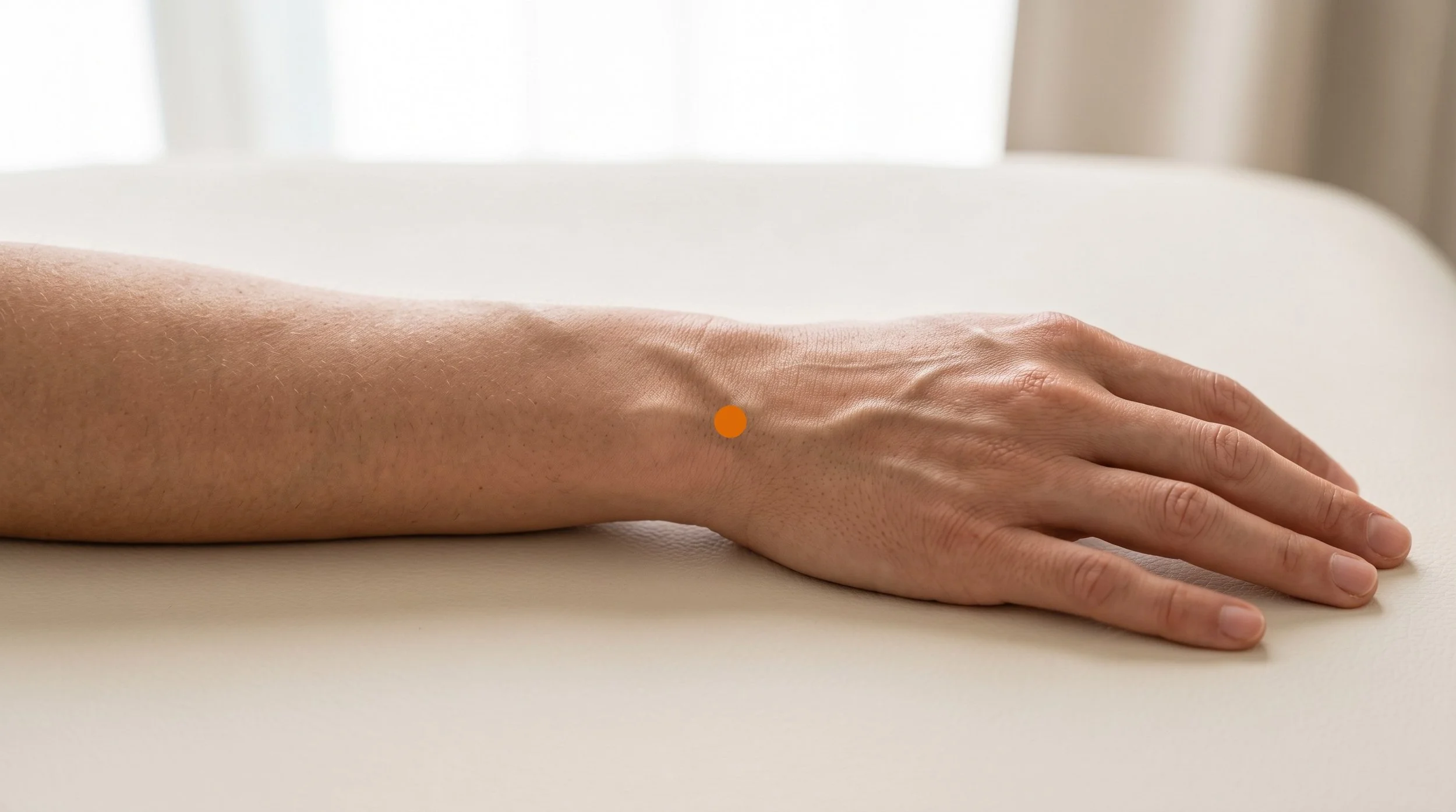
SJ4 Acupuncture Point (Yangchi)
The Yang Pool on the Back of the Wrist: Anatomy, Mechanism, and Why This Source Point Anchors Wrist, Hand and Forearm Treatment
SJ4 (Yangchi, or Yang Pool), also written TE4, is the yuan-source point of the Triple Burner channel, and it sits in the small dip on the back of the wrist at the level of the joint line, between the tendon of extensor digitorum communis and the tendon of extensor digiti minimi. If you run a finger up the groove between the fourth and fifth metacarpals from SJ3, your fingertip drops into it just as it reaches the wrist crease.
Clinically, this is one of the most practical local points on the dorsal wrist: it lies directly over the extensor retinaculum and the dorsal wrist capsule, in territory supplied by the terminal posterior interosseous nerve, which makes it a sensible target for stiff, achy, swollen or weak wrists, for keyboard and grip overload, and as part of a segmental approach to pain that travels between the hand, forearm, shoulder and neck.
- SJ4 is located on the dorsum of the wrist at the joint line, in the depression between the extensor digitorum communis and extensor digiti minimi tendons; the needle passes through thin skin and subcutaneous tissue, then the extensor retinaculum, and lies close to the dorsal carpal ligaments and joint capsule (Deadman et al., 2007).
- Traditionally, SJ4 is classified as the yuan-source point of the Triple Burner channel, and it is described in the classical literature as relaxing the sinews, relieving pain and clearing heat. In modern terms those attributions map onto reduced protective muscle guarding, altered nociceptive input from an irritable joint and tendon complex, and local vasomotor change.
- The point sits in a field innervated by the terminal branches of the posterior interosseous nerve (deep, capsular) and by the superficial radial and dorsal ulnar cutaneous nerves (surface), with segmental representation across roughly C6 to C8. Needling here recruits small-diameter afferents that converge in the cervical dorsal horn and engage descending inhibitory pathways (Zhao, 2008).
- The research picture is honest rather than dramatic: a large individual patient data meta-analysis found acupuncture superior to sham and to no-acupuncture control for chronic musculoskeletal pain, with modest effect sizes (Vickers et al., 2018), while a Cochrane review of carpal tunnel syndrome concluded that the evidence remains uncertain and the trials small (Choi et al., 2018).
- In everyday practice SJ4 is used mostly as a local point for the wrist itself: pain, stiffness, weakness, redness and swelling, plus arm and shoulder complaints that follow the channel. The Japanese tradition also uses it as a source point in deficiency-type treatment, framed as supporting the original qi (Deadman et al., 2007).
- De qi at SJ4 is usually a dull, heavy, slightly spreading ache in the wrist, sometimes drifting toward the fourth and fifth fingers or up the back of the forearm. Sharp, electric or radiating pain means the needle is too close to a tendon or a cutaneous nerve branch and should be adjusted.
Wrist Pain That Flares Every Time You Type or Grip?
Dorsal wrist pain rarely comes from the wrist alone: forearm extensor overload, dorsal capsule irritation and neck-related sensitivity often stack together. At Morningside Acupuncture we use SJ4 as a local point over the joint line, then work the extensor group and the segmental levels that feed it. Treatment is paired with simple loading and mobility advice so the gains hold between visits. Schedule a session and let us map where your wrist pain is actually coming from.
Schedule NowAnatomy of SJ4: Why the Dorsal Wrist Joint Line Is Such an Important Location
The tissue stack at SJ4 is shallow and layered. Beneath thin dorsal skin and a loose subcutaneous layer with visible veins lies the extensor retinaculum, the fibrous band that straps the extensor tendons down as they cross the wrist. The point sits between the fourth compartment, which carries extensor digitorum communis and extensor indicis, and the fifth compartment, which carries extensor digiti minimi across the distal radioulnar joint. Deeper still are the dorsal radiocarpal ligaments and the wrist joint capsule itself.
This is exactly the tissue that gets loaded by sustained wrist extension at a keyboard, by repeated gripping with the wrist cocked back, by pressing up from a chair or a mat, and by the compressive positions used in lifting, climbing and racquet sports. Swelling, thickening or synovial irritation in this region tends to make the depression harder to find, which is itself a useful examination finding.
The nerve geography explains why needling here does more than poke a sore spot. The dorsal wrist capsule and ligaments receive articular branches from the terminal portion of the posterior interosseous nerve, while surface sensation comes from the superficial branch of the radial nerve and the dorsal branch of the ulnar nerve, giving the area segmental representation across roughly C6 to C8.
Inserting a needle into retinaculum, capsule and periarticular connective tissue recruits group III and group IV afferents, and these inputs converge in the cervical dorsal horn with input from the same segments before ascending. That convergence is the basis for two clinical effects: local modulation of nociception at the wrist, and a broader effect on the whole arm segment, which is one reason a wrist point can influence forearm and shoulder symptoms.
Experimental work on acupuncture analgesia describes recruitment of spinal gating mechanisms plus supraspinal descending inhibition from the periaqueductal gray and rostral ventromedial medulla, with endogenous opioid and monoamine signaling involved (Zhao, 2008). Imaging work in carpal tunnel syndrome has also shown that needling can be associated with measurable changes in primary somatosensory cortex organization alongside improved median nerve conduction, which supports the idea that peripheral needling has central consequences (Maeda et al., 2017).
Vascular structures at SJ4 are small but real: the dorsal carpal arch and its branches run in this plane, and superficial dorsal veins are often visible, so the needle is angled away from anything obviously vascular and pressure is applied on withdrawal if a bruise seems likely. Conventional technique reflects the shallow anatomy. A slightly oblique proximal insertion of about 0.3 to 0.5 cun is standard, and a transverse insertion beneath the tendons toward the radial side of the wrist, roughly 0.5 to 1 cun, is used when a broader periarticular effect is wanted (Deadman et al., 2007).
A useful sequence is to extend the wrist and fingers to define the depression, mark it, then let the tendons relax before inserting, which keeps the needle in the interval rather than in tendon. The needle should never be forced into a hard endpoint, and a firm dorsal lump should be assessed before needling, since ganglion cysts are common here.
Related Pain Finder: Forearm and Hand Related Extensor Digitorum Trigger PointsSJ4 (TE4) at a Glance: Classification, Location, and Clinical Use
| Category | Detail |
|---|---|
| Traditional Name | Yangchi (Yang Pool), SJ4, also written TE4 or TB-4 |
| Channel Classification | Triple Burner (Sanjiao) channel of the hand, lesser yang (SJ4, also written TE4 or TB4; also called the Triple Energizer, the Triple Heater or Triple Warmer) |
| Point Categories | Yuan-source point of the Triple Burner channel; one of the three yang wrist points alongside LI5 Yangxi and SI5 Yanggu, whose shared names reflect their matching positions across the dorsal wrist |
| Precise Location | On the back of the wrist at the level of the wrist joint, in the depression between the tendons of extensor digitorum communis and extensor digiti minimi; found by tracing proximally from the interspace between the fourth and fifth metacarpals |
| Tissue Stimulated | Dorsal skin and subcutaneous tissue, extensor retinaculum, the interval between the extensor digitorum and extensor digiti minimi tendons, dorsal radiocarpal ligaments and wrist joint capsule; nearby myofascial targets include extensor carpi ulnaris and the dorsal interossei |
| Needle Depth / Direction | Slightly oblique proximal insertion 0.3 to 0.5 cun, or transverse insertion beneath the tendons toward the radial side 0.5 to 1 cun; define the depression with the wrist extended, then needle with the tendons relaxed |
| De Qi Sensation | Dull heaviness or a spreading ache across the back of the wrist, sometimes drifting toward the ring and little fingers or proximally up the forearm; sharp or electric sensation means reposition |
| Primary Clinical Uses | Wrist pain, stiffness, weakness and swelling; dorsal wrist overload from typing, gripping and weight bearing through the hand; forearm, shoulder, arm and neck pain along the channel; supportive use in hand and finger stiffness; classical listings also include ear and throat complaints |
| Common Point Combinations |
|
The Deadman text presents SJ4 with a compact traditional indication list: weakness, pain, redness and swelling of the wrist, pain of the shoulder and arm, swelling and pain of the neck, plus deafness and throat obstruction, along with a scattering of heat and fluid-related entries such as febrile disease without sweating, thirsting disorders and dry mouth with agitation. Its traditional actions are given as relaxing the sinews and relieving pain, and clearing heat. The commentary is where things get interesting.
The Classic of Difficulties describes the Sanjiao as the transmitter of the original qi and locates that original qi at the yuan-source points, which would logically make SJ4 a major tonification point, and the Japanese tradition does use it that way. Yet when Deadman examines the classical Chinese record, the point appears in very few traditional formulas, carries almost no indications for treating deficiency, and has no gynecological listings at all, even though some modern authors credit it with regulating the Conception and Penetrating vessels.
What is striking is the gap between the theory and the record: a point that theory says should be central turns out, in the classical sources, to be a modest and largely local wrist point.
Why SJ4 Is Used for Shoulder, Neck and Forearm Complaints, Not Only Local Wrist Pain
Patients are sometimes surprised that a point on the wrist is chosen for arm or neck symptoms. The reason is segmental rather than mystical. The dorsal wrist is supplied by nerves rooted in the lower cervical segments, and sensory input from the wrist arrives in the same dorsal horn neighborhoods that receive input from the forearm, upper arm, shoulder girdle and lower neck. When a nerve pool at those levels has become sensitized, non-painful and mildly noxious input from the periphery is amplified, and pain gets reported over a wider area than the tissue actually at fault.
Needling into the retinaculum and periarticular tissue at SJ4 feeds a controlled, well-tolerated stream of small-fiber input into that same pool, which can dampen the segmental amplification and reduce protective guarding in the forearm extensors. The classical description of relaxing the sinews maps neatly onto this: less guarding, easier motion, less pain on grip.
Above the spinal level, needling engages descending inhibitory control. Brainstem circuits including the periaqueductal gray and rostral ventromedial medulla release opioid and monoamine mediators that turn down transmission at the dorsal horn, and this systemic component explains why an effect is often felt beyond the needled segment (Zhao, 2008).
There is also point-relevant evidence that peripheral needling can change how the brain maps the hand. In a randomized trial in carpal tunnel syndrome, verum acupuncture was associated with improved median sensory nerve conduction and with increased separation of the cortical representations of the affected fingers, changes that were not seen with sham (Maeda et al., 2017). That study used wrist-area and distal points rather than SJ4 specifically, so the finding should be read as support for the mechanism rather than as proof for this single point.
The practical translation is straightforward. SJ4 is chosen when the wrist itself is the loaded, irritable structure, and it is kept in the prescription when symptoms run up the arm because the segmental relationship gives it reach. It is not a substitute for treating the neck when the neck is driving the picture, and it is not a substitute for load management when the wrist is simply doing too much.
What the Research Shows for SJ4 (TE4)
One note on naming before the evidence: in the research literature this point appears as TE4, the WHO standard code, and also as SJ4 or TB4 depending on the authors, so it is worth searching all three if you want to read the studies below in full.
It is worth setting expectations carefully. Almost no clinical trial isolates a single point, so there is no body of research testing SJ4 on its own. What exists are trials and reviews of multi-point protocols for wrist, hand and upper limb pain, in which points on the dorsal wrist are commonly included alongside forearm and distal points. The reasonable reading is that SJ4 is one plausible component within protocols that show modest, mostly short-term benefit, and that trial quality in this area is variable.
| Study | Type | Focus | Key Finding |
|---|---|---|---|
| Choi et al., 2018 | Cochrane systematic review | Acupuncture and related interventions for symptoms of carpal tunnel syndrome | Across twelve small trials the review found the evidence uncertain, with acupuncture and laser acupuncture showing little or no short-term difference from sham, and only non-serious adverse events reported. |
| Trinh et al., 2022 | Systematic review | Acupuncture for hand and wrist pain intensity, function and quality of life in adults | The authors reported that acupuncture may offer short-term pain and function benefits in hand and wrist conditions, while cautioning that sample sizes were small and the trials clinically heterogeneous. |
| Maeda et al., 2017 | Randomized controlled trial with neuroimaging | Local and distal acupuncture in carpal tunnel syndrome | Verum acupuncture, but not sham, was associated with improved median sensory nerve conduction and with greater separation of finger representations in primary somatosensory cortex. |
| Vickers et al., 2018 | Individual patient data meta-analysis | Acupuncture for chronic pain, including musculoskeletal pain | Acupuncture was superior to sham and to no-acupuncture control with modest effect sizes, and treatment effects persisted over time rather than dissipating immediately. |
| Navarro-Santana et al., 2020 | Systematic review and meta-analysis | Trigger point dry needling for lateral epicondylalgia of the forearm extensors | Dry needling of forearm extensor trigger points was associated with reductions in pain and related disability, though the number of trials was small and the quality of evidence limited. |
Numbness, Weak Grip or Hand Fatigue at the Keyboard?
Grip weakness and hand fatigue are common in desk-heavy and tool-heavy work, and they respond best when the wrist, forearm and neck are treated as one chain. We combine yangchi wrist point needling with dry needling of extensor digitorum, extensor carpi ulnaris and the intrinsic hand muscles when those are involved. If nerve symptoms are part of the picture, we will tell you plainly what acupuncture can and cannot do and when to get imaging or nerve testing. Book an evaluation to get a clear plan.
Schedule NowSJ4 in the Context of Trigger Point Work
The sj 4 wrist location sits at the crossroads of several referral patterns rather than inside a single muscle belly. Trigger points in extensor digitorum and extensor digiti minimi refer down the back of the forearm into the wrist and fingers, extensor carpi ulnaris refers to the ulnar side of the wrist, extensor carpi radialis brevis refers toward the back of the hand and wrist, and the dorsal interossei and abductor digiti minimi contribute local hand pain that patients often describe as wrist pain (Simons et al., 1999).
Because SJ4 lies over the tendons and capsule where all of that converges, needling it addresses the receiving end of those patterns while dry needling addresses the generators higher up.
In a typical Morningside session for a grip-loaded or keyboard-loaded wrist, we assess the forearm extensors and hand intrinsics first, then needle the taut bands we find, then place SJ4 and one or two adjacent channel points such as SJ3 or SJ5 for local coverage of the joint line. Electrical stimulation is sometimes added across the forearm when guarding is prominent, and cupping or soft tissue work may follow.
The session ends with loading advice: isometric or light eccentric extensor work, grip position changes, and workstation adjustments, since needling reduces symptoms most durably when the mechanical demand on the wrist is also changed.
SJ4 Wrist Pain Treatment at NYC's Highest-Rated Acupuncture Clinic
Morningside Acupuncture is the highest-rated acupuncture and dry needling clinic in New York City with over 500 five-star Google reviews, and wrist, hand and forearm complaints are among the conditions we see most. Every session begins with an orthopedic and myofascial assessment, so points such as triple burner 4 are chosen for your presentation rather than from a template. We combine classical channel points, trigger point dry needling and graded loading advice in one visit. Schedule your appointment today.
Schedule NowFrequently Asked Questions
Is SJ4 the same point as TE4 or TB4?
Yes. SJ4, TE4, and TB4 are all codes for the same point, Yangchi. SJ stands for San Jiao, the Chinese name of the channel. TE (Triple Energizer) is the WHO standard abbreviation and the one you will see in most Western textbooks and research papers. TB (Triple Burner) and TW (Triple Warmer) are older English renderings of the same name that still appear in many books. You will also come across it written as San Jiao 4 or Triple Energizer 4. Whichever code is used, the location and the uses are the same.
What does SJ4 feel like when needled?
Most people feel a brief pinch at the skin, then a dull, heavy, mildly spreading ache in the back of the wrist. That ache, called de qi, may drift toward the ring and little fingers or a short way up the forearm, and it usually fades into a warm, loosened feeling within a minute or two. Because the point sits over a joint, some patients also report a sense of pressure or fullness in the wrist. Sharp, burning or electric sensation is not the goal and simply means the needle needs to be repositioned slightly.
Why needle the wrist for shoulder or neck pain instead of just treating the sore area?
The dorsal wrist shares spinal segments with the forearm, upper arm and shoulder girdle, so sensory input from SJ4 arrives in the same dorsal horn levels that process pain from those regions. Needling here can therefore influence the whole segment, not just the point of insertion, and it also recruits descending inhibitory pathways that act more broadly (Zhao, 2008). In practice we usually do both: local treatment where the pain is, plus a distal point such as the yangchi wrist point to work the segment. SJ4 also has classical listings for shoulder, arm and neck pain, which is consistent with how the channel runs up the arm.
Can I press SJ4 myself between sessions?
Yes, acupressure at SJ4 is easy and low risk. Rest the forearm on a table with the palm down and the wrist relaxed, then use the opposite thumb to find the dip on the back of the wrist between the tendons at the joint line; it becomes easier to locate if you briefly lift the fingers and then let them go slack. Press straight down with moderate, steady pressure until you feel a dull ache rather than sharp pain, hold for 30 to 60 seconds, release, and repeat two or three times per wrist. You can do this two or three times a day, and it pairs well with gentle wrist circles, prayer-position stretches and forearm extensor massage. Stop if pressure produces numbness, tingling or increasing pain, and skip the area entirely if there is a firm lump, an open wound or an obviously hot, swollen joint.
Is SJ4 safe to needle?
In trained hands it is a safe point. The area is shallow with no major vessels or nerve trunks at risk, though small dorsal veins are common, so bruising is the most likely side effect and brief pressure after withdrawal reduces it. Needles are inserted obliquely or transversely between the tendons rather than driven into tendon or forced into the joint. Practitioners avoid needling directly into a ganglion cyst or into a joint that is hot, red and swollen from possible infection or acute inflammatory arthritis until that has been evaluated. Progressive numbness, weakness or muscle wasting in the hand warrants medical assessment for nerve entrapment before or alongside acupuncture.
Where exactly is SJ4 located?
SJ4 is on the back of the wrist at the level of the wrist joint, in the depression between the tendon of extensor digitorum communis and the tendon of extensor digiti minimi. The most reliable way to find it is to start in the groove between the fourth and fifth metacarpals at SJ3 on the back of the hand, then slide proximally along that line until your finger drops into a dip at the wrist crease. Extending the wrist and fingers makes the tendons stand out and defines the depression clearly; mark it, then relax the hand before pressing or needling. It sits roughly midway across the dorsal wrist, between LI5 on the thumb side and SI5 on the little finger side.
References
- Deadman, P., Al-Khafaji, M., & Baker, K. (2009). A manual of acupuncture. Journal of Chinese Medicine Publications.
- Cheng, X. (Ed.). (1999). Chinese acupuncture and moxibustion (Rev. ed.). Foreign Languages Press.
- Kim, H. (2008). Handbook of Oriental medicine (3rd ed.). Harmony & Balance Press.
- Maciocia, G. (2006). The channels of acupuncture: Clinical use of the secondary channels and eight extraordinary vessels. Churchill Livingstone Elsevier.
- Cunningham, P. M. (2000). Acupuncture points: A practical guide to classical and modern usage. Odyssey Press.
- Simons, D. G., Travell, J. G., & Simons, L. S. (1999). Travell & Simons' myofascial pain and dysfunction: The trigger point manual, Vol. 1: Upper half of body (2nd ed.). Williams & Wilkins.
- Choi, G. H., Wieland, L. S., Lee, H., Sim, H., Lee, M. S., & Shin, B. C. (2018). Acupuncture and related interventions for the treatment of symptoms associated with carpal tunnel syndrome. Cochrane Database of Systematic Reviews, 2018(12), CD011215. https://doi.org/10.1002/14651858.CD011215.pub2
- Maeda, Y., Kim, H., Kettner, N., Kim, J., Cina, S., Malatesta, C., Gerber, J., McManus, C., Ong-Sutherland, R., Mezzacappa, P., Libby, A., Mawla, I., Morse, L. R., Kaptchuk, T. J., Audette, J., & Napadow, V. (2017). Rewiring the primary somatosensory cortex in carpal tunnel syndrome with acupuncture. Brain, 140(4), 914-927. https://doi.org/10.1093/brain/awx015
- Trinh, K., Zhou, F., Belski, N., Deng, J., & Wong, C. Y. (2022). The effect of acupuncture on hand and wrist pain intensity, functional status, and quality of life in adults: A systematic review. Medical Acupuncture, 34(1), 34-48. https://doi.org/10.1089/acu.2021.0046
- Navarro-Santana, M. J., Sanchez-Infante, J., Gómez-Chiguano, G. F., Cleland, J. A., López-de-Uralde-Villanueva, I., Fernández-de-las-Peñas, C., & Plaza-Manzano, G. (2020). Effects of trigger point dry needling on lateral epicondylalgia of musculoskeletal origin: A systematic review and meta-analysis. Clinical Rehabilitation, 34(11), 1327-1340. https://doi.org/10.1177/0269215520937468
- Vickers, A. J., Vertosick, E. A., Lewith, G., MacPherson, H., Foster, N. E., Sherman, K. J., Irnich, D., Witt, C. M., & Linde, K. (2018). Acupuncture for chronic pain: Update of an individual patient data meta-analysis. Journal of Pain, 19(5), 455-474. https://doi.org/10.1016/j.jpain.2017.11.005
- Zhao, Z. Q. (2008). Neural mechanism underlying acupuncture analgesia. Progress in Neurobiology, 85(4), 355-375. https://doi.org/10.1016/j.pneurobio.2008.05.004
Disclaimer: This web site is intended for educational and informational purposes only. Reading this website does not constitute providing medical advice or any professional services. This information should not be used for diagnosing or treating any health issue or disease. Those seeking medical advice should consult with a licensed physician. Seek the advice of a medical doctor or other qualified health professional for any medical condition. If you think you have a medical emergency, call 911 or go to the emergency room. No acupuncturist-patient relationship is created by reading this website or using the information. Morningside Acupuncture PLLC and its employees and contributors do not make any express or implied representations with respect to the information on this site or its use. For any legal interpretation of scope of practice in your state, consult a licensed attorney or regulatory authority.
Read more from our blog



